There’s a question I’ve been avoiding for about two years.
What happens to all of this if something happens to me?
Not in a morbid way. Just practically. I run 27 client sites. I have an AI stack with dozens of moving parts — Cloud Run services, scheduled jobs, Notion databases, Workers that fire on their own while I sleep. I’ve built systems that work exactly the way I want them to work, in exactly the ways I understand, documented in exactly the language that makes sense to me.
The bus factor for this entire operation is one. It’s me. If I’m not here, none of it survives in any meaningful way.
I’ve been sitting with that long enough that I think it’s time to say it out loud.
The bus factor is an old software engineering concept. It asks: how many people would need to get hit by a bus before this project fails? One is the worst possible number. It means everything lives in a single person’s head — their habits, their passwords, their way of naming things, their unwritten rules about how the system works.
Most solo operators are a bus factor of one. They know this and they don’t talk about it because it sounds like a personal failing. Like you should have hired more people, or documented better, or not let yourself become the single point of failure for something people depend on.
But I think the honest version is more complicated than that. A lot of what makes a solo operation valuable is exactly the thing that makes it fragile: it’s shaped entirely around one person’s judgment. The reason the system works is because I know when to break the rules I wrote. I know what the edge cases are before they happen. I know which automations to trust and which ones to watch. That’s not something you write in a runbook.
So the question isn’t just “how do I document this better.” It’s “how do I make the judgment portable without turning it into something that loses the judgment in the process.”
I’ve been building toward an answer, in pieces, over the last several months.
The first piece was Notion as the control plane. Everything that matters about how this operation runs lives in Notion — specs, work orders, site credentials, content pipelines, system standards, the doctrine documents that explain why things are built the way they are. If I disappeared tomorrow, someone with the right access could open that workspace and read their way into understanding the shape of the operation, even if they couldn’t run it yet.
The second piece was the two-plane architecture — Notion for thinking and storage, GCP for compute. Every Cloud Run service, every scheduled job, every Worker is defined somewhere in Notion before it runs somewhere on GCP. The compute is durable. The logic is documented. Those are two different things, and keeping them separate means neither one is a black box.
The third piece is the hardest and I’m the least done with it: making the judgment readable.
I write doctrine pages. Long ones, sometimes. They explain not just what the system does but why it works that way — what the original problem was, what I tried that didn’t work, what the rule is now and what would have to be true for the rule to change. I write them mostly for myself, because I forget things. But they’re also written for the hypothetical person who has to pick this up without me.
That hypothetical person might be a future employee. It might be a contractor. It might be an AI agent working from a context window that needs to understand the operation well enough to continue it.
It might be my partner, trying to figure out what to do with the business side of things if I’m not around.
That’s the version that focuses the mind.
I don’t have this solved. I want to be clear about that.
What I have is a direction. The direction is: every decision should live somewhere outside my head. Every system should be explainable by someone who didn’t build it. Every credential should be in the registry, every automation should have a spec, every rule should have a reason written next to it.
It’s slow work. It runs against the instinct to just build the thing and move on. There’s always something more urgent than documentation, and “I’ll remember how this works” is almost always true right up until it isn’t.
But I’ve started treating the documentation as part of the product. Not the boring part — the part that makes the product real. A system that only works because I’m here isn’t really a system. It’s a performance.
The goal is to build something that could survive me. Not because I’m planning to leave, but because the work of making it survivable is also the work of making it understandable, and a system I can’t fully explain is a system I don’t fully own.
If you’re running something like this — solo or nearly so, more complexity than your headcount would suggest — I’d ask you the same question I’ve been sitting with.
If something happened to you tomorrow, what would survive?
Not what you hope would survive. What actually would.
I’ve hired developers. Good ones. For specific things — infrastructure, custom integrations, work that genuinely required someone to sit down and write production code from scratch — it was the right call.
But if I’m honest about the full list of things I’ve brought developers in for over the years, a meaningful chunk of it wasn’t really developer work. It was workflow work. It was “I need this thing to happen automatically when that other thing happens” work. It was “why does this still require a human to touch it” work.
That category of problem has a different answer now.
Here’s the pattern I kept running into:
I’d have a clear picture of what I wanted. Data from one tool synced into Notion. A webhook that logged events automatically. A scheduled job that pulled information from an external API every morning and wrote the results somewhere I could see them. Nothing exotic. Stuff that, described out loud, sounds almost embarrassingly simple.
But turning that description into something that actually ran required code. And writing code required a developer. And hiring a developer for something this small felt like bringing a contractor in to change a lightbulb — technically the right tool, but something about the ratio felt off.
So a lot of it didn’t get built. The workflow stayed manual. The friction stayed.
Last night I built ten of those things in three hours.
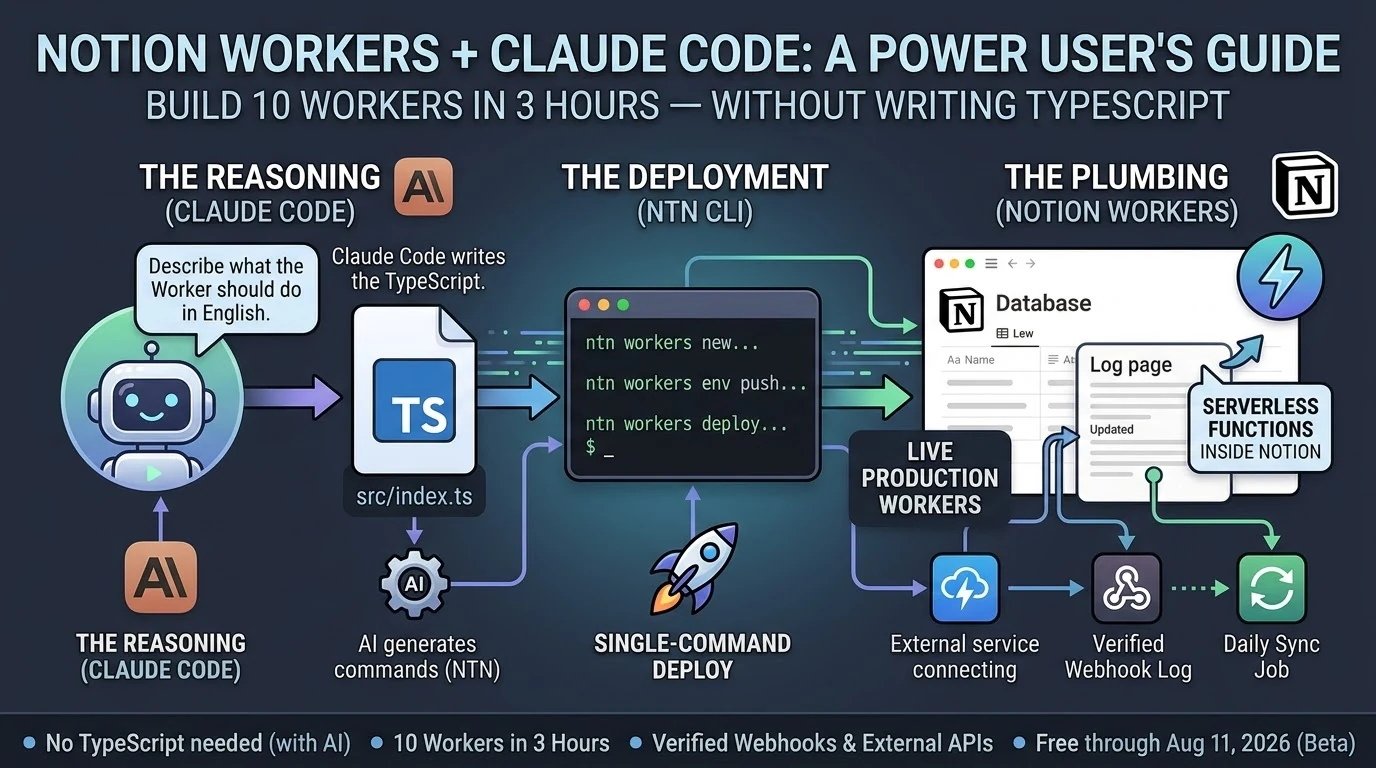
Notion Workers — their new hosted serverless platform, shipping in beta as of May 13, 2026 — lets you deploy real code inside Notion’s infrastructure without managing a server. Combined with Claude Code, which writes the TypeScript while you describe what you want in plain English, the gap between “I know what I want” and “it exists and is running” is smaller than it has ever been.
I’m not a developer. I operated the process. I described each Worker, reviewed what Claude Code wrote, ran the deploy commands, checked that it worked. When something broke, I read the error and passed it back. The loop was fast enough that two failures in ten attempts felt like a normal part of the session, not a crisis.
By midnight I had a live webhook endpoint receiving authenticated traffic from the internet and writing verified events to a Notion log page. Automatically. While I slept.
That’s workflow work. It just didn’t require a developer to get there.
I want to be careful about what I’m claiming here.
There are things that genuinely need a developer. Complex systems. Production APIs with serious security requirements. Anything where a bug has real consequences for real people. I’m not suggesting you staff down your engineering team based on a three-hour session with a CLI tool.
What I’m suggesting is narrower: there is a category of work that has always felt like it needed a developer but actually needed something else. It needed clarity about what you wanted. It needed a good description. It needed someone willing to read an error message and try again.
That work is yours now, if you want it.
The practical question is where to start.
Start with the thing that’s most manual in your current workflow. The task someone does by hand because no one ever got around to automating it. The data that lives in one tool but should live in another. The notification that goes out because someone remembered to send it, not because the system sent it automatically.
Describe it out loud. If you can explain it to another person in two or three sentences, you can build it. Open Claude Code. Tell it what you want. Run the commands it gives you.
You might be surprised how far that gets you before you need to call anyone.
Notion Workers beta is free through August 11, 2026. The ntn CLI installs in one line on macOS or Linux. Business or Enterprise plan required to deploy Workers.
There’s a word that’s been sitting in my head lately and I think it’s the right one.
Not developer. Not user. Not prompt engineer — please, not that.
Operator.
The developer builds the system. The user benefits from it. The operator runs it.
Operators have always existed. They’re the people who know a tool well enough to get unusual things out of it — who understand what’s possible, who can configure and connect and troubleshoot, who treat software as infrastructure rather than a product to consume. In a restaurant, the chef is the operator. In a warehouse, it’s the floor manager who actually knows where everything is and why the inventory system does what it does.
In most software companies, the operator was assumed to be technical. You needed to code, or at least to read code, to run anything at a real level of depth. Everyone else was a user — handed a finished product, expected to stay in the designated lanes.
That line is moving.
Last night I deployed ten Notion Workers in three hours. Workers are Notion’s new hosted serverless platform — real code, running inside Notion’s infrastructure, no server to manage. I built a webhook endpoint that receives authenticated HTTP traffic from the internet and logs it to a Notion database. I built data sync Workers. I built scheduled jobs.
I am not a developer.
What I am is an operator. I know what I want the system to do. I can describe it precisely. I understand how the pieces connect even when I can’t write the connection myself. And I have Claude Code, which handles the TypeScript while I handle the architecture.
The stack looks like this:
Claude Code — the reasoning layer. Describe what the Worker should do in plain English. Claude Code writes the code, catches errors when you paste them back, and tells you exactly what commands to run.
ntn CLI — the deployment layer. Four commands: scaffold, write, push secrets, deploy. Single-command deploys. You run what Claude Code tells you to run.
Notion Workers — the execution layer. Serverless functions running on Notion’s infrastructure. They connect to external APIs, respond to webhooks, sync data, run on schedules. They do the work while you do something else.
That’s it. Three layers. None of them require you to be a developer to operate.
The operator’s job in this stack is not to write code. It’s to know what should exist.
That sounds simple. It isn’t. Knowing what should exist means understanding your own operations well enough to identify where the friction is, what’s being done by hand that shouldn’t be, what would run better automatically. It means being able to describe a system clearly enough that an AI coding agent can build it. It means reviewing what gets built and knowing whether it’s right.
That’s real skill. It’s just not the skill most people thought they needed.
For years the implicit message was: if you can’t build it, you can’t have it. The work of describing exactly what you want, of thinking through the logic, of understanding how systems connect — that work was treated as a prerequisite for coding, not a valuable thing in its own right.
Now it’s the job.
I’m not going to tell you the technical barrier is gone. It isn’t. You still hit errors. You still have to read them and understand them well enough to know if Claude Code’s fix makes sense. You still have to think before you build.
But the barrier has moved. The question is no longer “can you write TypeScript” — it’s “can you think clearly about what you want and describe it precisely.”
Most people reading this can do that. They’ve been able to do that. They were just told, implicitly or explicitly, that it wasn’t enough.
It’s enough now.
The Notion Workers beta is free through August 11, 2026. The ntn CLI installs in one line on macOS or Linux. Deploying Workers requires a Business or Enterprise plan. If you’ve been running your operations in Notion and watching things like Workers from the sidelines because you figured it was for developers: it’s for operators too. You might already be one.
It was late. I had Claude Code open on my laptop and a fresh cup of coffee going cold next to it.
Notion had shipped Workers eight days earlier — their new hosted serverless platform, basically “run real code inside Notion without managing a server.” I’d been meaning to dig in. Last night I finally did.
I want to tell you what that actually looked like. Not a tutorial. Not a polished case study. Just what happened, in order, including the parts that didn’t work.
By midnight I had ten Workers deployed and a live webhook endpoint logging authenticated traffic from the internet into a Notion page. The whole thing took about three hours.
I did not write TypeScript.
Here’s the honest version of how it went.
The first Worker took the longest — maybe 35 minutes — because I was figuring out the CLI at the same time as building the thing. The ntn tool is straightforward once you understand it: scaffold, write the code, push your secrets, deploy. Four steps. But the first time through any new tool you’re reading error messages and second-guessing yourself.
Claude Code handled the TypeScript. I described what I wanted — a Worker that receives a POST request, verifies an HMAC signature, and appends a line to a Notion log page. Claude Code wrote it. I ran the commands it told me to run. The Worker deployed.
I tested it. It worked.
The second one took 22 minutes. The third took 15. By Worker five I was moving fast enough that I stopped tracking individual times and just kept going.
Two of them didn’t work on the first try. One had a secret I’d named wrong in the environment — my fault, five minutes to fix. The other had a logic error in how it was handling the Notion API response. Claude Code caught it when I pasted the error back in, rewrote the relevant section, and I redeployed. Eight minutes total for that dead-end.
Neither failure felt like a crisis. That’s the part I want to underline. When something broke, the path forward was obvious: read the error, paste it back to Claude Code, get a fix, redeploy. The loop was tight enough that failure was just a speed bump, not a wall.
At 02:54 in the morning, I sent a test ping to Worker #8.
The webhook logger received it, verified the HMAC signature, and wrote this to a Notion page in real time:
🔔 2026-05-21T02:54:44.452Z [claude-test:test] {"event":"test","message":"Hello from Worker #8 self-test","sender":"claude-code"}
I sat there for a second looking at that.
There’s something specific about seeing a system you built actually receive traffic. It’s not the same as a script running on your laptop. This was a deployed endpoint, on Notion’s infrastructure, receiving an authenticated HTTP request from the open internet and writing the result to a database. Automatically. Without me doing anything after the initial deploy.
That’s a different category of thing than what I had before.
I want to be honest about what I am, technically. I’m not a developer. I’ve picked up enough over the years to be dangerous — I can read code, I understand how APIs work, I’ve shipped things — but I’m not someone who sits down and writes TypeScript from scratch.
Last night didn’t require that. What it required was knowing what I wanted, being able to describe it clearly, and being willing to run commands and read errors.
That’s it.
The question I keep hearing from people who run operations like mine — agencies, small teams, people who live in tools like Notion and have always hired out the code work — is whether any of this AI coding stuff is actually for them or if it’s still fundamentally a developer story with a better interface.
Last night felt like an answer. Ten Workers. Three hours. No TypeScript.
If you can describe what you want clearly enough to explain it to another person, you can build this. The friction that used to live between “I know what I want” and “it exists in the world” is genuinely smaller now.
Not gone. Smaller.
You still have to show up. You still have to read the errors. You still have to think through what you’re building before you build it.
But if you’ve been waiting for some invisible threshold of technical credibility before you try — you’re past it. You were probably past it a while ago.
The Notion Workers beta is free through August 11, 2026. The ntn CLI installs in one line. Business or Enterprise plan required to deploy.
Notion shipped Workers on May 13, 2026 (Notion Help). By last night I had ten of them running in production, including a live HMAC-verified webhook endpoint that’s actively logging events. Total build time: about three hours.
I didn’t write TypeScript by hand. Claude Code did most of the typing.
Here’s what that actually looked like — and what it means for the non-developer Notion power user who’s been watching the Workers announcement and wondering if it’s for them.
What are Notion Workers? Notion Workers are hosted serverless functions that run inside Notion’s infrastructure. You write code, deploy it through the ntn CLI, and Notion runs it in a secure sandbox — no server to manage. They’re free through August 11, 2026, then run on Notion credits. Deploying Workers requires a Business or Enterprise plan.
What Notion Workers Actually Are (The One-Paragraph Version)
What Notion Workers actually are.
If you’ve used Notion’s built-in database automations — the lightning bolt icon — Workers are that concept extended to real code. They can call any external API, respond to webhooks, sync data from Stripe or Zendesk or GitHub, and write results back to Notion databases. The CLI (ntn) is available on all plans. Deploying Workers requires Business or Enterprise.
Do You Need to Know TypeScript to Build Notion Workers?
Technically, Workers are written in TypeScript. Practically, if you have Claude Code, the answer is no.
Claude Code (currently at v2.1.144 as of May 19, 2026) scaffolds Workers from plain-English descriptions. You describe what the Worker should do. Claude Code writes the src/index.ts, handles the ntn workers env push for secrets, and tells you exactly what commands to run. You copy the command. The Worker deploys.
The workflow looks like this:
ntn workers new my-worker-name — scaffold the project
ntn workers deploy --name my-worker-name — ship it
That’s it. The only thing you actually type is the deploy commands. Claude Code fills in the gap between them.
What We Built in 3 Hours
What we built in 3 hours.
Ten Workers, averaging about 18 minutes each, including two dead-ends that took 5–8 minutes to diagnose and abandon.
The most useful one is Worker #8: an HMAC-verified webhook logger. Any external service — GitHub, Stripe, a cron trigger, another Claude Code session — can POST to the Worker’s endpoint with a shared secret, and it auto-appends a timestamped line to a Notion log page. The webhook log shows its first self-test ping from Claude Code at 02:54 UTC:
🔔 2026-05-21T02:54:44.452Z [claude-test:test] {"event":"test","message":"Hello from Worker #8 self-test","sender":"claude-code"}
That’s a live, verifiable event log. Not a draft. Not a mock. A deployed Worker receiving authenticated HTTP traffic and writing to Notion.
The ntn workers env push command works cleanly for both NOTION_API_TOKEN and non-Notion secrets like TYGART_WP_USER and WEBHOOK_SECRET — one of the key things we needed to confirm before trusting the stack at scale.
The Design Principle That Makes This Actually Work
The design principle that makes this work.
The best insight from Notion’s Workers documentation: use code for deterministic work, use AI for judgment calls.
A Worker that pulls invoice status from Stripe and updates a Notion database doesn’t need AI. It needs reliable, cheap code execution. That’s what Workers give you. A Claude Sonnet 4.6 (claude-sonnet-4-6) or Opus 4.7 (claude-opus-4-7) agent that reads those Notion rows and drafts follow-up emails is handling the judgment call. Those are two different tools for two different jobs.
When you collapse that distinction — letting AI do everything — you pay AI prices for work that shouldn’t require AI reasoning. Workers run at a fraction of the cost of AI credits. Notion’s own example calculations put a daily sync job at roughly one cent per month. The AI layer sits on top for the parts that actually need it.
This is the architecture: Workers handle the plumbing. Claude handles the reasoning. You stop paying Opus rates for jobs a ten-line TypeScript function can do.
The Part Nobody Else Is Writing About
Every guide covering Notion Workers frames it as a solo-developer workflow. You sit down, you know TypeScript, you build a Worker over an afternoon.
That’s not how this went.
Claude Code is listed in Notion’s own documentation as a first-class deployment partner for Workers. The ntn CLI was explicitly designed to work with coding agents — same interface for humans and agents. When you treat Claude Code as the author and yourself as the operator running the commands it outputs, you get through ten Workers in a session that most developers would take a week to plan.
The non-developer angle is real. If you run Notion as your operating system — databases, automations, dashboards — and you’ve been watching the Workers announcement wondering whether it requires a CS degree, the answer in May 2026 is: not if you have Claude Code. The scaffolding is a one-line command. The deployment is a one-line command. Claude Code fills in the gap between them.
Three Things to Know Before You Start
Business or Enterprise plan required to deploy. The CLI (ntn) installs on any plan and runs free. Deploying Workers needs Business or Enterprise. Check your plan before you spend an afternoon scaffolding.
macOS and Linux only as of May 2026. Windows users need WSL2. Native Windows support is listed as coming soon. If you’re on Windows without WSL2, that’s your first step.
Free through August 11, 2026. After that, Workers run on Notion credits. Build and optimize now while the cost is zero. The free period gives you enough runway to understand your actual usage patterns before you’re paying for them.
Notion Workers are free to try during the beta period, which runs through August 11, 2026. After that date, Workers will run on Notion credits. The free period is a good window to build, test, and optimize your Workers before metered usage begins.
Can non-developers build Notion Workers?
Yes, if you have an AI coding agent like Claude Code. Workers are written in TypeScript, but Claude Code can generate the Worker code from a plain-English description. You run the scaffold and deploy commands; Claude Code writes the code. No prior TypeScript knowledge required.
What Notion plan do you need for Workers?
The ntn CLI is available on all Notion plans. Deploying and managing Workers requires a Business or Enterprise plan.
How does Claude Code work with Notion Workers?
Claude Code (v2.1.144 as of May 2026) integrates directly with the ntn CLI. Notion designed the CLI as a tool for both humans and coding agents — same interface, same commands. Claude Code scaffolds the Worker TypeScript, sets environment variables, and outputs the exact deploy commands to run.
What can Notion Workers do?
Workers can call any external API, respond to incoming webhooks (with HMAC verification), sync data between external services and Notion databases, run scheduled tasks, and execute custom business logic. Common use cases include syncing Stripe payments, Zendesk tickets, GitHub issues, or any service with an API into Notion.
Is the ntn CLI available on Windows?
As of May 2026, the ntn CLI is available on macOS and Linux. Windows support is listed as coming soon. Windows users can use WSL2 in the meantime.
The Bottom Line
Ten Workers. Three hours. A verified webhook endpoint logging live traffic. Claude Code did the TypeScript. The ntn CLI did the deployment. Notion’s infrastructure handled everything else.
The question isn’t whether Notion Workers are for developers. The question is whether you have a coding agent. If you do, the friction is gone.
What Is the Notion Everything Database?
The Notion everything database is the concept of using Notion as an agnostic, structured data layer beneath your AI workflows—storing context, outputs, tasks, and business intelligence in one place that any connected AI platform can query, write to, and reason over. This guide covers how each major AI platform connects to that layer, what the connection actually enables, and where the real-world limits are.
In the competitive series we published earlier, one theme kept resurfacing: every AI platform that wants to be genuinely useful in your workflow eventually needs a place to store and retrieve structured context. Memory. History. The institutional knowledge that makes AI useful beyond a single session.
For teams that have already built their operations on Notion, the question isn’t whether to use an everything database—you already have one. The question is how each AI platform connects to it, what that connection actually enables in practice, and where the real limits are.
This guide is the answer. We’ve mapped the actual integration path for each of the five platforms in our series—OpenAI, Perplexity, Grok, Mistral, and Zapier—against Notion’s current API and MCP capabilities. No hypotheticals. No aspirational features. What works today, what requires workarounds, and what to watch for as these integrations mature.
📚 This Is Track 2 of the Everything App Series
Track 1 analyzed each platform’s everything app ambitions. Track 2 is the implementation layer—how to actually connect them to your Notion database.
Before covering individual platform integrations, it’s worth establishing what Notion has actually built for AI connectivity—because it changes the integration picture significantly.
Notion ships an official, hosted MCP (Model Context Protocol) server. This is not a third-party hack or a community project. It lives at developers.notion.com/docs/mcp, is maintained by the Notion engineering team, and is open-source at github.com/makenotion/notion-mcp-server. Version 2.0.0 migrated to the Notion API version 2025-09-03, which introduced data sources as the primary abstraction for databases (replacing the old database ID model with data_source_id).
The MCP server uses OAuth for authentication. You do not use a static API key or bearer token for the hosted version—you go through Notion’s OAuth flow, which grants scoped access to the pages and databases you explicitly share with the integration. This is an important detail: even with a valid OAuth token, the MCP server can only access Notion content you have explicitly shared with the integration via the ••• menu → Add connections on each page or database.
What the official MCP server enables: AI tools can search your Notion workspace, read page content, create new pages, update existing pages, query databases, and add comments. The server is optimized for AI consumption, formatting Notion’s block-based content into clean text that AI models can reason over efficiently.
Supported AI tools as of mid-2026: Claude (via Claude Desktop or Cowork), Cursor, VS Code, and ChatGPT Pro. The Notion team publishes a plugin for Claude specifically at github.com/makenotion/claude-code-notion-plugin.
One practical note from our own setup: we use the Notion MCP actively in our Cowork sessions. When you ask about content in your Notion workspace—Command Center pages, Second Brain entries, desk specs—that’s the MCP server at work. Search, fetch, create, and update operations all run through it in real time. The integration is stable and fast for the kinds of structured content retrieval and page creation that content operations require.
The Notion API in 2026: What You Need to Know
A few API facts that matter for any integration you build:
Rate limit: Approximately 3 requests per second per integration for most operations (some sources indicate up to 5 req/s for integration-heavy workspaces). When you hit the limit, the API returns HTTP 429 with a Retry-After header. Any well-built integration respects this automatically. For bulk operations across large databases, you’ll need request queuing.
Page size limit: The API returns a maximum of 100 items per query by default. For databases with more than 100 records, you must implement pagination using the start_cursor parameter. This is a common trip point for integrations that assume they’ve retrieved all records when they’ve only seen the first page.
API version 2025-09-03: The September 2025 API version introduces data sources as the primary database abstraction. If you’re using multi-source databases in Notion (databases that pull from multiple collections), integrations built against older API versions may not return all data. The MCP server v2.0.0 handles this correctly. Custom integrations built before September 2025 may need updating.
Block-level content: Notion stores page content as nested blocks, not plain text. The API returns this block structure. The MCP server handles the translation to readable text for AI models; direct API integrations need to handle this themselves.
Platform 1: OpenAI / ChatGPT
Platform 1 — OpenAI / ChatGPT.
What Actually Exists
There are two meaningful integration paths between OpenAI and Notion, and they are not the same thing.
Path A: ChatGPT Connector (official, read-only)
ChatGPT Plus and Pro users can connect Notion directly from ChatGPT settings. This is an official integration. The significant limitation: it is read-only. ChatGPT can search and read your Notion pages, but it cannot write, create, or update anything in your workspace. It is designed for individual paid subscriptions and does not scale to team-wide deployments. For retrieving context from your Notion database to inform a ChatGPT conversation, this works. For using ChatGPT to maintain and update your Notion database, it does not.
Path B: Custom API Integration (read/write, requires code)
The full read/write path requires connecting the OpenAI API and Notion API directly via custom code, or via a middleware platform like Zapier or Make. This gives you complete access—creating pages, updating database records, querying with filters. It’s the correct path for any workflow where ChatGPT needs to write outputs back to your Notion everything database.
In November 2025, Notion rebuilt their AI agent system with GPT-5 to power Notion AI’s reasoning and action capabilities within the workspace. This is Notion using OpenAI’s models internally, not OpenAI accessing your Notion workspace. The distinction matters: Notion AI (powered partly by GPT-5) can act on your Notion content. ChatGPT itself cannot write to Notion without a custom integration or Zapier in the middle.
The Practical Integration Pattern
For teams using OpenAI models as their primary AI layer and Notion as their everything database, the most reliable pattern is: OpenAI API → custom Python/Node.js integration → Notion API. Use the GPT Actions framework (documented at cookbook.openai.com) to give a custom GPT the ability to call the Notion API directly, with your integration token scoped to the specific databases it needs access to.
For non-technical teams, Zapier is the practical middle layer—which we cover in the Zapier section below.
Platform 2: Perplexity
What Actually Exists
Perplexity does not have an official native Notion integration. There is no direct connector in the Perplexity product that reads from or writes to your Notion workspace.
What does exist: a Chrome extension (“Perplexity to Notion Batch Export”) that lets users save Perplexity research sessions directly to Notion. This is a browser-based manual export tool, not an automated integration. For capturing Perplexity research into your Notion database for later reference, it works and is well-reviewed. For autonomous AI workflows that need Perplexity to query or update Notion, it does not.
The automated integration paths run through n8n (which ships a native Perplexity node with full API coverage), Make, Zapier, and BuildShip. These let you build workflows like: Perplexity runs a research query → output gets written to a Notion database record. The Perplexity API supports Chat Completions, Agent mode, Search, and Embeddings—all of which can be orchestrated via these middleware platforms to produce structured Notion database entries.
The Practical Integration Pattern
The most useful Perplexity→Notion workflow for content operations: trigger a Perplexity search query on a topic, take the structured response, and use the Notion API to create a new database record with the research as the page body. This gives you a searchable, AI-queryable research library inside your Notion everything database. The plumbing runs through n8n, Make, or Zapier—Perplexity as the research engine, Notion as the structured archive.
Perplexity’s own product roadmap includes deeper tool integrations and an expanding API surface. Native Notion connectivity is not announced, but the middleware path is mature and reliable today.
Platform 3: Grok / xAI
Platform 3 — Grok / xAI.
What Actually Exists
Grok does not have a native Notion integration in the X/Grok product interface. There is no official connector, and xAI has not published an MCP server for Grok.
xAI does offer the Grok API (via api.x.ai), which follows the same interface conventions as the OpenAI API—making it relatively straightforward to swap Grok models into any workflow that already uses OpenAI’s API format. This means any custom integration you build for OpenAI→Notion can, in principle, be pointed at the Grok API instead with minimal code changes.
In practice, the Grok→Notion integration path today is: Grok API → custom code → Notion API. The same middleware platforms (Zapier, Make, n8n) that support the OpenAI API can route through the Grok API using the OpenAI-compatible endpoint.
The Practical Integration Pattern
If your use case specifically requires Grok’s models (for instance, if you’re building X-platform-aware content workflows where Grok’s real-time access to X data is the value), the integration pattern is the same as OpenAI’s custom API path. Use the Grok API’s OpenAI-compatible interface, connect to the Notion API for reads and writes, and build the orchestration logic in between.
For teams primarily interested in AI capability rather than X-platform data specifically, OpenAI or Mistral integrations offer more mature tooling and better-documented Notion integration patterns today.
Platform 4: Mistral
What Actually Exists
Mistral offers two meaningful integration paths with Notion, and the self-hosting angle we covered in the competitive series creates a unique capability that no other platform in this guide has.
Path A: Hosted Mistral API → Notion API
Mistral’s hosted API connects to Notion the same way any other model API does—through the Notion REST API or MCP server, with middleware or custom code. Mistral Workflows, the company’s orchestration layer, supports external API integrations including REST endpoints, which means you can configure a Mistral Workflow to query the Notion API, process the data, and write results back.
Path B: Self-hosted Mistral → local Notion API calls (the unique case)
This is where Mistral’s architecture creates something no other platform in this series can offer. When you run Mistral Large 3 (Apache 2.0, self-hostable) on your own infrastructure, the model and your Notion API calls exist in the same network perimeter. Your Notion integration token never leaves your infrastructure. The API calls are local. For organizations where data sovereignty is non-negotiable—healthcare, legal, government, financial services—this is the only AI model integration path where no data touches an external AI provider.
The practical setup: deploy Mistral Large 3 on your own server or VPC. Configure a Mistral Workflow or custom application to call the Notion API using your integration token. Process Notion data entirely on-premise. Write results back to Notion. The only external call in the entire pipeline is the Notion API itself—and if you run a self-hosted Notion alternative, even that stays internal.
The Practical Integration Pattern
For teams that don’t require self-hosting: use Mistral’s hosted API with the Notion API via Mistral Workflows or a custom integration. The same middleware platforms support Mistral’s API.
For teams that do require data sovereignty: the self-hosted Mistral → Notion API pattern is the integration architecture to build toward. It requires infrastructure investment (running a 41B active parameter model requires serious hardware or a well-configured cloud VPC), but it is the only path to a truly sovereign AI + Notion integration.
Platform 5: Zapier
What Actually Exists
Zapier has the most mature, most capable, and most immediately actionable Notion integration of any platform in this guide—and it is the practical middle layer for connecting every other platform to Notion without custom code.
Zapier’s official Notion integration supports: triggers on new or updated database items, creating pages, updating database records, finding records by query, and archiving pages. These are the building blocks for serious Notion automation.
In 2025-2026, Notion also added native webhook support that fires on database rule triggers and page button presses, connecting directly to Zapier and Make. This means you can build Notion-native automation triggers (a status change, a button click, a new record) that fire a Zapier workflow without leaving the Notion interface to configure the trigger.
Zapier Agents—now generally available—can use Notion as one of their tools. You can configure a Zapier Agent with access to your Notion integration, set a goal, and let the Agent create, update, and query Notion records as part of multi-step reasoning tasks. This is the closest any platform in this guide gets to an autonomous AI agent that natively operates on your Notion everything database.
Zapier MCP—the integration we highlighted in the competitive series—exposes Zapier’s entire action library (including all Notion actions) to any MCP-compatible AI. This means Claude, via the Zapier MCP, can execute Notion write operations through Zapier’s infrastructure. In our own Cowork setup, Notion operations that require external app triggers route through this path.
The Practical Integration Pattern
Zapier is the recommended integration layer for non-technical teams connecting any of the other four platforms to Notion. The pattern: AI platform generates output → Zapier receives it via webhook or API action → Zapier writes structured data to Notion database. This works for OpenAI, Perplexity (via n8n or Zapier’s Perplexity integration), Grok (via OpenAI-compatible API), and Mistral hosted.
For teams already using Zapier as their automation backbone, Notion integration is already available—you may just need to activate it and map the fields from your AI platform outputs to your Notion database schema.
The Architecture That Works: Our Setup
For context on what a production Notion everything database + AI integration actually looks like, here’s the architecture we use in this operation:
The Notion workspace serves as the Command Center—structured databases for content queues, second brain entries, session logs, desk specs, and operational data. The Notion MCP server connects Claude directly to this workspace, enabling real-time search, read, create, and update operations within Cowork sessions.
For longer-running tasks—the kind that exceed Notion Workers’ 30-second sandbox—we use a hybrid trigger architecture: a Notion Worker script fires a signed POST request to a Google Cloud Run service, which executes the full job and writes results back to the Notion database via the Public API. This is the 60% ceiling rule in practice: Notion Workers at 30 seconds handles the trigger; Cloud Run handles the execution; Notion handles the data layer.
Zapier connects the external app layer—when workflows need to touch apps outside the Notion + Claude + GCP stack, Zapier’s 8,000-app library is the bridge. The Zapier MCP makes these actions available to Claude directly.
This isn’t the only valid architecture. It’s the one that works for a content operations team managing 18+ WordPress sites with high automation requirements. Your stack will differ. But the core principle holds across any setup: Notion as the data layer, MCP as the AI connectivity standard, and a clear hybrid strategy for the workflows that exceed what any single platform can handle natively.
Integration Readiness by Platform: Honest Assessment
Platform
Native Notion Write
Native Notion Read
Via MCP
Via Zapier
Self-Hosted Option
OpenAI / ChatGPT
❌ (API only)
✅ (Plus/Pro)
✅ (Pro)
✅
❌
Perplexity
❌
❌
❌
✅ (via n8n/Make)
❌
Grok / xAI
❌
❌
❌
✅ (OAI-compatible)
❌
Mistral
✅ (Workflows)
✅ (Workflows)
❌ (not yet)
✅
✅ (Apache 2.0)
Zapier
✅ (native)
✅ (native)
✅ (Zapier MCP)
—
❌
What to Build First
If you’re starting from zero with a Notion everything database and want to connect AI platforms to it, here’s the practical sequence:
Start with the Notion MCP server. Set it up with your preferred AI assistant (Claude, ChatGPT Pro, Cursor). This gives you conversational access to your Notion workspace immediately—search, read, create, update—without any custom code. It’s the fastest path to an AI that can reason over your Notion data.
Connect Zapier next. Activate the Notion integration in Zapier and map your key databases. This unlocks the bridge to every other platform in this guide and gives you the ability to write AI outputs back to Notion from any tool in Zapier’s 8,000-app library.
Add platform-specific integrations as your workflows require them. If you’re using OpenAI extensively, build a GPT Action that connects to Notion for read/write. If you need sovereign AI processing, build the self-hosted Mistral → Notion API pipeline. If Perplexity is your research engine, set up an n8n workflow to archive research to Notion automatically.
The Notion everything database isn’t a product you buy. It’s an architecture you build—one integration at a time, starting with the MCP layer and growing outward as your workflow demands it.
Key Takeaway
Zapier is the most immediately actionable integration for connecting all five AI platforms to Notion today. The Notion MCP server is the fastest path to conversational AI access over your workspace. Self-hosted Mistral is the only option for teams that require zero data leaving their network perimeter. Build in that order.
Yes, but with a significant limitation. ChatGPT Plus and Pro users can connect Notion from ChatGPT settings for read-only access—ChatGPT can search and read your Notion pages but cannot write, create, or update content. For full read/write access, you need a custom API integration or a middleware platform like Zapier between the OpenAI API and the Notion API.
What is the Notion MCP server?
The Notion MCP server is Notion’s official implementation of the Model Context Protocol—an open standard that lets AI assistants interact with external services. It’s hosted by Notion, open-source at github.com/makenotion/notion-mcp-server, and uses OAuth for authentication. It supports Claude, ChatGPT Pro, Cursor, and VS Code. It enables AI tools to search, read, create, and update Notion pages and database records. Version 2.0.0 uses the Notion API version 2025-09-03.
Can Perplexity write to Notion automatically?
Not natively. Perplexity has no official Notion connector. The practical path is using n8n (which ships a native Perplexity node), Make, or Zapier to create a workflow where Perplexity API output gets written to a Notion database. There is also a Chrome extension for manually batch-exporting Perplexity research sessions to Notion.
Does Grok have a Notion integration?
Not officially. xAI offers the Grok API with an OpenAI-compatible interface, which means custom integrations built for OpenAI→Notion can be adapted to use Grok models. Zapier and other middleware platforms that support the OpenAI API format can route through the Grok API to connect to Notion. There is no native Grok connector in the X/Grok product.
What makes Mistral’s Notion integration unique?
Mistral is the only AI model in this guide that can be self-hosted under an open-source license (Apache 2.0). When you run Mistral Large 3 on your own infrastructure and connect it to the Notion API, no data ever touches an external AI provider. Your Notion content, your queries, and the AI model all run within your own network perimeter. This is the only fully sovereign AI + Notion integration path available today.
What Notion API limits should I know about?
The Notion API enforces approximately 3 requests per second per integration. It returns a maximum of 100 items per query—for larger databases you must paginate using the start_cursor parameter. API version 2025-09-03 introduced data sources as the primary database abstraction, replacing the older database ID model. The official MCP server handles these limits correctly; custom integrations need to implement pagination and rate-limit handling explicitly.
Is Zapier the best way to connect AI platforms to Notion?
For non-technical teams, yes—Zapier has the most mature, most capable native Notion integration and acts as the bridge between every AI platform’s API and your Notion database. Zapier Agents can use Notion as a native tool, and the Zapier MCP exposes all Notion actions to any MCP-compatible AI. For technical teams with specific requirements, direct API integrations offer more control, lower latency, and no per-task pricing. Both approaches are valid—the right choice depends on your team’s technical capacity and workflow volume.
What is the hybrid trigger architecture for Notion automation?
The hybrid trigger architecture pairs Notion Workers (30-second execution sandbox) with a persistent server like Google Cloud Run. A Notion Worker script handles the trigger logic within Notion’s native environment—it fires a signed HTTP POST to a Cloud Run service when an event occurs. Cloud Run handles the full job execution (which may take minutes), then writes structured results back to Notion via the Public API. This pattern is described as the 60% ceiling rule: design Notion-side triggers to use under 60% of the 30-second limit, and delegate anything longer to Cloud Run.
Update — May 15, 2026: On May 13, 2026, Notion shipped the Notion Developer Platform (version 3.5), with Claude as a launch partner. The platform adds Workers, database sync, an External Agents API, and a Notion CLI. For the full breakdown of what changed and what it means for the Notion + Claude stack, see Notion Developer Platform Launch (May 13, 2026). For the underlying operating philosophy, see The Three-Legged Stack: Notion + Claude + Google Cloud.
Everyone is building the everything app. Microsoft wants to be yours. Google wants to be yours. Notion wants to be yours. But there’s a fourth path nobody is talking about — and it might be the smartest play for brands, agencies, and multi-system operators: don’t pick one everything app. Build one everything database, and let it feed all of them.
The Core Idea
Notion isn’t competing to be your everything app. It’s competing to be your everything database — the structured, queryable, agent-ready source of truth that sits underneath whatever surface you use. The everything app becomes interchangeable. The database is the moat.
The Series So Far — and Why This Frame Changes Everything
But there’s a reframe worth making. What if the everything app isn’t the destination? What if the destination is the data layer underneath it — and the everything app is just whichever surface happens to be most useful at a given moment?
That’s the angle that emerged from actually building inside Notion Workers alpha. And it changes the strategic calculus significantly for anyone running a brand, an agency, or a multi-system operation.
Your Brand Doesn’t Need One Everything App. It Needs One Everything Database.
One everything database beats one everything app.
Think about what an everything app actually requires to work. It needs to know your tasks. Your projects. Your contacts. Your content calendar. Your pipeline. Your team’s status. Your historical decisions. Your brand voice. Your client relationships. Your automation outputs.
That’s not an app problem. That’s a data structure problem. And the company that solves the data structure problem — that gives you a clean, typed, queryable, agent-ready home for all of that — wins, regardless of which surface you use to view it.
Notion’s database architecture is purpose-built for exactly this. Every property is typed. Every row is queryable. Every database can be filtered, sorted, related, and rolled up. When you build your brand’s operational data inside Notion — tasks with statuses, projects with owners, content with metadata, contacts with relationship history — you’re not just organizing. You’re building a structured intelligence layer that agents can read, write, and reason over reliably.
That database doesn’t care which “everything app” sits on top of it. Microsoft Copilot can query it. Google Workspace agents can sync from it. Your own custom dashboard can read it via the Public API. Claude can operate on it directly. The surface is interchangeable. The database is the thing that compounds in value over time.
The 30-Second Trigger: Where the Architecture Gets Interesting
Here’s the piece that came out of our own Workers alpha experience — and it reframes the “30-second sandbox limitation” from a constraint into a feature.
Notion Workers runs in a 30-second execution window. We hit that wall hard when we tried to move heavy automations — multi-site WordPress optimization passes, content pipelines, image generation — into Workers. Those are multi-minute jobs. They don’t fit.
But 30 seconds is more than enough to do one specific thing: fire a signed HTTP POST to an external endpoint and return.
That’s the architectural insight. You don’t use Notion Workers to execute heavy work. You use Notion Workers to trigger it. The Worker wakes up — on a schedule, on a database change, on a webhook — reads the relevant Notion database row, constructs a signed payload, fires a POST to a Google Cloud Run job, and exits. The whole thing takes under five seconds. Well within the 30-second window.
Cloud Run picks up the job, runs for as long as it needs — minutes, not seconds — and when it’s done, it writes the results back to the Notion database via the Public API. The Notion database is now the job queue, the status tracker, the results store, and the orchestration log. All in one place. All queryable by agents.
The pattern in practice:
Notion Worker (cron / DB change / webhook)
→ reads Notion database row for job config
→ signs POST to Cloud Run endpoint
→ returns immediately (3–8 seconds, well under 30s)
Cloud Run (no time limit)
→ runs heavy job (WP optimization, pipeline, image gen)
→ writes status + results back to Notion DB via Public API
Notion Database
→ job queue / status tracker / results store / audit log
→ queryable by agents, visible to team, triggerable again
This is the hybrid architecture we’re running. Our Tuesday 18-site WordPress SEO optimization pass runs on Cloud Run — not because Notion can’t orchestrate it, but because Notion does orchestrate it, as the database layer, while Cloud Run handles the execution. The Worker is the tickle. Cloud Run is the muscle. Notion is the brain that remembers everything.
What “Brand Everything Database” Actually Means in Practice
What brand everything database means in practice.
If you’re an agency, a media operation, or a multi-brand operator, here’s the concrete version of this architecture:
One Notion workspace as the brand OS. Every client, project, task, content piece, automation job, and decision lives as structured database rows. Not documents. Not folders. Typed, relational data.
Agents inside Notion prep the data. Custom agents compile status updates, flag stale work, surface blockers, build briefings — all operating on the Notion database directly. The “everything” data is always clean and current because agents are maintaining it continuously.
Workers trigger external execution. When a job needs more than 30 seconds — content pipelines, SEO runs, bulk operations — a Worker fires the trigger. Cloud Run executes. Results come back into Notion. The database stays the source of truth.
Any surface can consume it. A Copilot user can query the project database through Microsoft Graph connectors. A Google Workspace user can sync from Notion via the connector ecosystem. A custom dashboard can read the Notion API. The front end doesn’t matter. The database is always current.
External agents get full context. Through the External Agents API, Claude, Codex, or any agent you build can operate against your Notion databases with complete organizational context — not a generic AI, but one that knows your specific data, your specific projects, your specific brand.
Why This Beats Betting on One Everything App
Why this beats betting on one everything app.
The everything-app race has a winner-take-all framing that may be wrong. Here’s what we’ve observed from operating across Microsoft, Google, and Notion simultaneously:
Different team members live in different surfaces. Your developer lives in GitHub and a terminal. Your account manager lives in Gmail. Your ops lead lives in a spreadsheet. Your creative lead lives in Figma. Forcing everyone onto one everything app means fighting human behavior, not working with it.
But if everyone’s work — regardless of where they do it — writes back into a shared Notion database? The everything app problem disappears. You don’t need everyone in the same surface. You need everyone’s data in the same structure.
That’s what Notion’s connector ecosystem is actually building toward. GitHub syncs into Notion. Jira syncs into Notion. Salesforce syncs into Notion. Slack syncs into Notion. The surface stays wherever it is. The intelligence layer centralizes.
The Compounding Advantage
Here’s the strategic reason this matters beyond the technical architecture: databases compound. Documents don’t.
A Google Doc from two years ago is mostly dead weight — hard to search, hard to query, impossible for an agent to reason over reliably. A Notion database from two years ago is a living asset. Every row is still queryable. Every relationship still works. The history of every project, every decision, every outcome is structured data that an agent can analyze, pattern-match against, and use to inform current work.
The longer you run your brand’s operations through a Notion database, the smarter your agents get — because they have more structured history to work with. That’s not true of any document-first system. And it’s not something you can easily replicate once a competitor has two years of structured operational data and you’re starting from scratch.
The everything app you pick in 2026 matters less than the data structure you commit to in 2026. Pick the wrong everything app and you switch in 18 months. Pick the wrong data structure and you’re rebuilding from zero.
The Practical Starting Point
If this architecture makes sense for your operation, here’s how to think about the starting point:
Audit what data your business actually runs on. Tasks, projects, clients, content, pipelines, automations — map out what you’re currently tracking and where. How much of it is in documents? How much is in structured databases?
Pick the three databases that matter most and build them right in Notion. Don’t try to migrate everything at once. Start with your project tracker, your content calendar, and your client/contact database. Get those typed, relational, and agent-ready.
Connect one external source via Workers or the connector ecosystem. Slack, GitHub, Jira — pick the one that generates the most signal for your operation and get it syncing into Notion.
Build one Custom Agent that works on those databases. A status compiler, a blocker detector, a briefing builder — something that demonstrates the database-first advantage concretely to your team.
Then consider the trigger pattern. What jobs in your operation take longer than 30 seconds but could be triggered from a database change? Those are your first Cloud Run candidates, with Notion as the orchestration layer.
The everything app race is real. But the more durable competitive advantage is the data structure underneath it. Build the database right, and the everything app becomes a detail.
A brand everything database is a Notion workspace architected as the structured, queryable source of truth for all of a brand’s operational data — tasks, projects, content, clients, automations, decisions. Unlike document-based systems, every piece of information is typed, relational, and agent-readable. External tools sync into it; agents operate on it; any surface can consume it via the Public API.
How do Notion Workers act as triggers for Google Cloud Run?
Notion Workers run in a 30-second sandbox — enough time to read a Notion database row, construct a signed payload, and fire an HTTP POST to a Cloud Run endpoint. The Worker returns immediately; Cloud Run handles the long-running execution (minutes, not seconds) and writes results back to the Notion database via the Public API. This makes Notion the orchestration and visibility layer without hitting the sandbox time limit.
Why is a database-first architecture better than document-first for AI agents?
Documents require AI to infer structure from prose — an error-prone process that degrades at scale. Database rows are typed, structured, and directly queryable. An agent asking “which projects are blocked this week?” gets an exact filter result from a Notion database in milliseconds; the same question against a folder of Google Docs produces a best-effort summary. Reliability and precision are the key differences.
Can Notion databases feed Microsoft Copilot or Google Workspace agents?
Yes, via connectors and the Notion Public API. Microsoft Graph connectors and Google Workspace connectors can sync from Notion databases. Custom agents built on the External Agents API can also read and write Notion data from any external platform. The Notion database becomes the shared source of truth regardless of which AI surface your team prefers.
What’s the best first step to building a brand everything database in Notion?
Start with three core databases: a project tracker, a content calendar, and a client/contact database. Get them typed with proper properties, linked relationally, and cleaned up. Then build one Custom Agent that operates on those databases — a status compiler or briefing builder. Once you’ve seen the database-first advantage in action, the architecture for connecting external tools and Cloud Run triggers becomes obvious.
Microsoft is stitching together an everything app from acquisitions. Google is trying to unify a native stack it keeps fragmenting. Notion is doing something different — and arguably more interesting. It’s building the everything app from the database up, and it just made its most important move yet.
Definition: The Database-First Everything App
An AI-powered workspace where every piece of information — tasks, projects, docs, contacts, data — lives in a structured, queryable database, and agents can read, write, reason over, and act on that data autonomously. The database isn’t the backend. It’s the interface.
May 13 Changed Everything for Notion
On May 13, 2026, Notion shipped version 3.5 and announced their full Developer Platform in a livestreamed product event. The tech press covered it as an AI agent story. They weren’t wrong, but they missed the bigger frame.
Notion didn’t just add agents. They introduced a new primitive called Workers — a hosted runtime for custom code that lets teams extend Notion without running their own servers. Database sync, agent tools, and webhook triggers all run through Workers. They launched the External Agents API, allowing any agent — ones you built, or ones from Claude, Codex, Decagon, and other partners — to work natively inside your Notion workspace. And they opened a developer platform that lets teams connect AI agents, external data sources, and custom code directly into their workspace.
Taken individually, these are nice product updates. Taken together, they’re an orchestration play. Notion is positioning itself not as a note-taker with AI features bolted on, but as the hub where people, agents, and data collaborate across every tool a team uses.
The Database Advantage Nobody Else Has
The database advantage nobody else has.
Here’s the thing that separates Notion from every other everything-app candidate — including Microsoft and Google.
Both Microsoft 365 and Google Workspace are document-first platforms. Their fundamental unit of work is a file: a Word document, a Google Doc, a PowerPoint, a Sheet. Files are great for humans to read. They’re terrible for AI to reason over at scale. You can’t ask an AI agent to “find every project where the status is blocked and the deadline is this week” across a folder of Word documents and get a reliable answer.
Notion’s fundamental unit is a database. Every page can be a database row. Every property is structured, queryable, filterable data. When Notion AI looks at your workspace, it doesn’t see a pile of documents — it sees a relational knowledge graph. Tasks have statuses. Projects have owners and deadlines. Contacts have properties. Everything is connected, typed, and queryable.
That’s not a feature difference. That’s an architectural difference. And it’s why Notion’s agents can do things that Copilot and Gemini agents fundamentally struggle with: operate reliably on your actual organizational data, not summaries of your documents.
The Agent Timeline: Faster Than Anyone Expected
The agent timeline — faster than expected.
Notion’s agent rollout has moved at a pace that’s easy to underestimate if you haven’t been watching closely. Here’s the actual timeline, from Notion’s release notes:
September 18, 2025 — Notion 3.0: Agents. First AI agents launch. Autonomous data analysis and task automation. The starting gun.
January 20, 2026 — Notion 3.2. Mobile AI, new model support, people directory. Agents go everywhere, not just desktop.
February 24, 2026 — Notion 3.3: Custom Agents. Users can build their own agents from scratch. Early testers built over 21,000 custom agents. Notion reported 2,800 agents running 24/7 internally at Notion itself.
March 2026. Workers introduced in alpha — a TypeScript-based framework for agents to talk to any service with an API. The coding layer for power users.
April 14, 2026 — Notion 3.4. Calendar and inbox connectors. Notion AI can now schedule meetings and draft emails from inside your workspace.
May 5, 2026. Custom Agent admin controls for enterprise — workspace-level credit limits, governance tools, compliance features.
May 13, 2026 — Notion 3.5: Developer Platform. External Agents API, Workers out of alpha, database sync with no servers, full developer ecosystem launched.
July 1, 2026 — Notion 3.6. External Agents, HTML blocks, and more.
September 15, 2026 — Notion 3.7: Agent skills. Reusable team skills, Custom Agents that call sub-agents, and a redesigned model picker.
That’s eight months from first agent launch to full developer platform. For context, Microsoft spent years building Azure OpenAI integration before Copilot reached feature parity with what Notion shipped in less than a year.
What the Notion Everything App Actually Looks Like Today
This isn’t theoretical. Here’s what a team running on Notion can configure right now:
Your project data, always current. Databases synced from Slack, Google Drive, GitHub, Jira, Microsoft Teams, Salesforce, and Box — all flowing into Notion databases in real time, powered by Workers. No manual updates. No stale spreadsheets.
Agents watching your work. Custom agents triggered by database changes, schedules, or webhooks — compiling status updates, flagging blocked tasks, escalating overdue items, answering team FAQs.
Your inbox and calendar inside your workspace. Connect Gmail or Outlook and your calendar; Notion AI can schedule meetings and draft emails without leaving the tool your work already lives in.
External agents working in your context. Claude, Codex, Decagon — agents you’ve built yourself via the External Agents API — all operating against your Notion databases with full context. Not generic AI. AI that knows your specific data.
Plan Mode for complex operations. Before an agent makes large changes to your databases or pages, it stops, asks clarifying questions, and builds a plan for your approval. This is the governance layer that makes AI trustworthy in a business context.
Your institutional knowledge, always accessible. Every decision, every project history, every team document — structured and queryable by agents that can synthesize across your entire knowledge base on demand.
The Models Behind It
The model behind it — Claude Opus.
Unlike Google, which builds on its own Gemini family, Notion isn’t locked to one model provider. Since the January 20, 2026 update (Notion 3.2), users can pick from GPT-5.2, Claude Opus 4.5, or Gemini 3, or let Auto choose the best model for the job. As of Notion 3.7 in September 2026, the model picker includes Opus 5, GPT-5.6 Sol, and Kimi K3. Notion’s Notion AI help center covers the current feature set.
Claude remains a strategic option worth examining. Claude is specifically designed with a focus on reliability, honesty, and safe behavior in agentic contexts — qualities that matter enormously when an AI agent has write access to your company’s databases. Anthropic’s Constitutional AI training approach was built for exactly the kind of autonomous, long-running agent work that Notion is deploying.
The bigger point is architectural: a database-first workspace can swap in whichever model handles a job best, because the structured data underneath doesn’t change. Notion makes the same pitch in its January release notes: models will continue to change, but your memory in Notion doesn’t.
Why “Database First” Beats “Document First” for the Everything App
Let’s make this concrete with a comparison most teams will recognize.
Ask Microsoft Copilot: “Which of our client projects are behind schedule this quarter?” Copilot will search your emails, scan your SharePoint documents, and produce a reasonable summary — but it’s reading prose, inferring structure, and hoping the documents are up to date. The answer is a best-effort synthesis, not a query result.
Ask a Notion agent the same question: it runs a database filter. Status = Behind. Quarter = Q2 2026. It returns an exact list in under a second, with links to every project, the responsible person, and the last update — because that data is structured. The agent didn’t infer anything. It read typed data.
That’s the difference between AI that helps you find things and AI that actually knows things. Notion’s database architecture is what makes the second kind possible at scale, without hallucination, without retrieval errors, without the AI making up a project that doesn’t exist.
The Honest Weakness: The 30-Second Wall
Here’s what you only learn by actually building inside the alpha — and we did.
Notion Workers runs in a 30-second sandbox with 128MB of memory. Each Worker is created through the Notion control panel, taking 3–5 minutes to spin up. The network is limited to an approved domain allowlist. Storage is ephemeral — nothing persists between runs. These aren’t theoretical constraints. They’re the real walls you hit when you try to move serious automation workloads into Notion.
We were in the Workers alpha. We built Workers. We set up custom agents. And we stress-tested the sandbox deliberately — forcing failures to find the exact break points, then running production workloads at 60% of the known ceiling as a stability rule. That’s the only honest way to operate inside a system this constrained: know where it breaks before you depend on it.
What we found changed our architecture. Heavy automations — multi-site WordPress SEO optimization passes across 18 sites, content pipelines, image generation, WP-CLI batch operations — couldn’t live inside Notion Workers. They’re multi-minute jobs, not 30-second jobs. Moving them to Notion would have meant engineering workarounds that added complexity without adding reliability.
So instead of moving Cowork automations into Notion as we originally planned, we moved them to Google Cloud Run. The notion-deep-extractor (crawls the workspace, extracts structured knowledge, logs to the Second Brain database — runs 3x daily) and the notion-maintenance bundle (archive sweeper, stale work detector, content guardian — runs daily at 6am UTC) all live on Cloud Run now, with Cowork scheduled tasks paused. The 18-site WordPress optimizer running Tuesday? Cloud Run. Not Notion.
This isn’t a knock on Notion. It’s an architectural reality that every builder needs to understand before they commit workloads. The right pattern — the one we’re now using and that Notion’s own documentation points toward — is Notion Workers as the trigger layer, Cloud Run as the execution layer. A Worker fires a signed POST to a Cloud Run endpoint, returns immediately (well under 30 seconds), Cloud Run runs the heavy job, then writes results back to a Notion database via the Public API. You get Notion as the orchestration and visibility layer without hitting the sandbox wall.
That hybrid is genuinely powerful. But it requires infrastructure that most small teams don’t have. If you don’t have a Cloud Run setup, a service account, and the deployment knowledge to wire this together, the 30-second limit will stop you cold on anything more complex than a lightweight API call or a database update.
Notion doesn’t own email. It connects to Gmail and Outlook. It doesn’t own a calendar — it integrates with yours. It doesn’t have a mobile OS or browser. Those gaps matter less than the sandbox constraint does for real production workloads. The everything app story is real — but the execution layer has hard limits that require a hybrid architecture to work around, at least until Workers matures beyond its current beta constraints.
Who Should Be Paying Attention Right Now
If you’re an agency, a service business, a content operation, or any knowledge-work team that already uses Notion — or has been considering it — the May 13 Developer Platform announcement changes your calculus significantly.
Custom Agents are available as an add-on for Business and Enterprise plans. Notion originally said Workers would start running on Notion credits on August 11, 2026, but its Workers pricing page still lists them as free to try during the beta on Business and Enterprise plans, with credits required eventually (typically about $0.0023 per run). The External Agents API is open now. This is the window to build before your competitors do.
The teams that spend the next 90 days wiring up their Notion databases, building their first custom agents, and connecting their external data sources will have a compounding advantage that’s very hard to replicate in 2027. The institutional knowledge that feeds these agents — the project histories, the SOPs, the client databases — takes time to build. Starting now is the only strategy that works.
The Bigger Picture: A Series on Who Wins the Everything App
This is the third article in an emerging pattern I’ve been thinking through: who actually builds the everything app, and what does their path look like?
Microsoft is building it through acquisitions and Copilot, stitching together LinkedIn, Azure, and the M365 suite. Google already owns the native stack — Gmail, Drive, Search, Android — and is trying to unify it through Gemini Enterprise and Workspace Studio after years of product fragmentation. Notion is building it from the database up, betting that structured data plus open agents beats document-first platforms with AI bolted on.
None of them has won yet. All three bets are live. The winner won’t be the company with the most features — it’ll be the one that earns enough trust to become the single place where your work actually lives.
Notion’s database-first architecture is the most interesting bet of the three. It’s also the most fragile — dependent on integrations, constrained by not owning the OS or the inbox, limited by the pricing and capabilities of the outside models it depends on. But if it works, it works in a way the others can’t easily copy. You can’t retrofit a database architecture onto a document platform. You have to start over.
Microsoft and Google aren’t starting over. Notion never had to.
Notion Custom Agents are AI teammates that handle repetitive tasks autonomously — answering FAQs, compiling status updates, automating workflows — triggered by schedules, database changes, or webhooks. They launched in February 2026 (Notion 3.3) and are available as an add-on for Business and Enterprise plans. Early testers built over 21,000.
What is Notion Workers?
Notion Workers is a hosted cloud runtime for custom TypeScript code, introduced in alpha in March 2026 and fully launched with the Developer Platform on May 13, 2026. It powers database sync, agent tools, and webhook triggers — letting teams extend Notion to connect any service with an API, without running their own servers. Workers remain free to try during the beta on Business and Enterprise plans; Notion says they will eventually run on Notion credits.
What AI model does Notion use?
Notion AI isn’t tied to a single model. Since the January 2026 update (Notion 3.2), users can pick from several frontier models or let Auto choose; as of September 2026 the picker includes Anthropic’s Opus 5, OpenAI’s GPT-5.6 Sol, and Kimi K3. Claude remains one of the main options, and its focus on reliable, safe agentic behavior matters for workflows that have write access to business databases.
What is the Notion External Agents API?
The External Agents API, launched with Notion 3.5 on May 13, 2026, lets teams bring any AI agent — including ones built internally or from partners like Claude, Codex, and Decagon — directly into their Notion workspace. These external agents can read and write to Notion databases with full context about the team’s data.
How is Notion different from Microsoft Copilot and Google Workspace AI?
Notion is database-first. Every piece of information in Notion is structured, typed, and queryable data — not documents. This means Notion agents can run precise database queries against your actual organizational data rather than inferring structure from prose documents. For teams that need AI to reliably operate on business data (not just search and summarize), this architectural difference is significant.
What are the real limitations of Notion Workers in the alpha?
Notion Workers runs in a 30-second sandbox with 128MB of memory and ephemeral storage. Network access is limited to an approved domain allowlist. Workers are created via the Notion control panel (3–5 minutes each). Long-running jobs — content pipelines, multi-site operations, image generation — won’t fit. The recommended pattern for serious workloads is Notion Workers as the trigger layer firing a signed POST to an external execution environment (like Google Cloud Run), with results written back to Notion databases via the Public API.
Workers reward a specific style of TypeScript: small, single-purpose, structured-input-and-output, well-typed. The constraints (30 seconds, 128MB, no state) push you toward this style automatically. Workers that hold up in production share patterns: typed input/output schemas, defensive HTTP calls with timeouts, structured error returns, no hidden side effects.
Five production patterns
Five production patterns for Workers.
1. Type your input and output.
Type strictly. The agent works against the schema. Schema drift breaks the agent silently. 2. Defensive HTTP with timeouts.
External API calls inside a 30-second budget need their own timeouts. A 25-second API call leaves 5 seconds for everything else. Set explicit fetch timeouts shorter than the Worker timeout. 3. Structured error returns instead of throws.
Throw inside a Worker and the agent gets opaque failure. Return structured error objects and the agent can reason about the failure and respond gracefully. 4. Idempotency where state matters.
Workers have no persistent state, but they can hit external systems that do. If the external call is non-idempotent (e.g., creates a record), include an idempotency key derived from input. Calling the Worker twice should produce one record, not two. 5. Approved domains as a deployment artifact.
Track domain approvals in code. When a Worker stops working in production, “did the approved domains change” is the first thing to check.
Three production failures to design around
Three production failures to design around.
1. The 30-second wall. Aim for under 5 seconds typical, under 15 worst case. Long calls fail under retry loads. 2. Silent domain blocks. A Worker calling a non-approved domain fails with an error that isn’t always obvious. Log every outbound destination. 3. Memory leaks via large responses. Don’t pull a 50MB JSON response into a 128MB Worker. Stream, paginate, or pre-filter at the source.
Testing strategy
Testing strategy.
Unit-test the Worker logic separately from the agent. Use mock HTTP. Then integration-test with the actual agent calling the Worker. The two test layers catch different bugs.
What to read next
Workers + External APIs, Notion AI Meets MCP, Workers for Agents foundation piece, Security Posture.
Before Workers, Notion AI couldn’t reliably call external APIs. With Workers (developer preview), an agent can talk to anything — internal CRMs, public APIs, payment processors, shipping trackers — provided you’ve configured a Worker for it. Workers are sandboxed (30-second timeout, 128MB memory, approved-domain HTTP only) and run on Vercel Sandbox infrastructure. The setup is API-only as of April 2026; this isn’t a point-and-click feature, it’s a developer feature.
The basic Worker pattern for API calls
The basic Worker pattern for API calls.
Agent receives a prompt requiring external data
Agent calls Worker with structured input (e.g., {orderId: 123})
Worker makes HTTP request to the approved external API
Worker parses response, returns structured output to agent
Agent incorporates result into its natural-language response
This is the core loop. Everything else is variations on it.
Three Worker + API patterns
Three Worker + API patterns.
1. The data lookup Worker. Agent needs current information not in Notion. Worker calls external API (CRM, ERP, public data source), returns structured result. Common for “what’s the status of order X” type queries. 2. The transform-and-write Worker. Agent receives data, Worker reshapes it for an external system, Worker writes via the external API. Common for syncing data from Notion to other systems. 3. The orchestration Worker. Worker calls multiple APIs in sequence, collects results, returns synthesis to agent. Common for cross-system workflows that don’t fit n8n’s pattern.
Approved domains and security
Approved domains and security.
Workers can only call domains you’ve added to the approved list. This is a feature. Two implications:
– Plan your domain list before building. Adding domains later requires admin action.
– Don’t approve broad domains (e.g., *.amazonaws.com) — be specific.
Where this goes wrong
1. Hitting the 30-second timeout. Workers aren’t for long jobs. Slow APIs need different patterns (queue + poll, or split into multiple Workers). 2. Letting Workers call destructive endpoints without verification. Worker calling DELETE on a customer record is a single-line bug away from disaster. Add confirmation patterns. 3. Treating Workers as Lambda. Workers are constrained for security reasons. The 30-sec/128MB limits are intentional. Build accordingly.
What to read next
Workers for Agents foundation piece, Workers in TypeScript (Deep Technical), n8n MCP Bridge, Security Posture.
The Signal — Tygart Media's weekly brief. What we actually ran, what it measured, and what it means for a restoration shop.