Tag: Notion For Agencies

  • What Notion Agents Can’t Do Yet (And When to Reach for Claude Instead)

    What Notion Agents Can’t Do Yet (And When to Reach for Claude Instead)

    I run both Notion Custom Agents and Claude every working day. I have opinions about when each one earns its place and when each one doesn’t. This article is those opinions, named clearly, with no vendor fingers on the scale.

    Most comparative writing about AI tools is written by people with an incentive to recommend one over the other — affiliate programs, platform partnerships, the writer’s own consulting practice specializing in one side. This piece doesn’t have that problem. I use both, I pay for both, and if one of them got replaced tomorrow, the pattern I run would survive with a different tool slotted into the same role. The tools are interchangeable. The judgment about which one to reach for is not.

    Here’s the honest map.


    The short version

    Use Notion Custom Agents when: the work is a recurring rhythm, the context lives in Notion, the output is a Notion page or database change, and you’re willing to spend credits on it running in the background.

    Use Claude when: the work needs real judgment, the context is complex or contested, the output is something that needs a human’s voice and review, or the workflow crosses enough systems that the agent’s world is too small.

    Those two sentences will save most operators ninety percent of the architecture mistakes I see people make. The rest of this article is specificity about why, because general rules only take you so far before you need to know what’s actually going on under the hood.


    Where Notion Custom Agents genuinely shine
    I’m going to start with the positive because anyone who only reads the critical part of a comparative article will walk away with a warped picture. Custom Agents are genuinely impressive when they fit the job.

    Recurring synthesis tasks across workspace data. The daily brief pattern I’ve written about works better in a Custom Agent than in Claude. The agent runs on schedule, reads the right pages, writes the synthesis back into the workspace, and is done. Claude can do this too, but Custom Agents do it without you remembering to prompt them. That’s the whole point of the “autonomous teammate” framing, and for rhythmic synthesis work, it genuinely delivers.

    Inbox triage. An agent watching a database with a clear decision tree — categorize incoming requests, assign a priority, route to the right owner — is a sweet-spot Custom Agent. It does the boring sort every day, flags the ones it’s unsure about, and keeps the pile from growing. Real teams are reportedly triaging at over 95% accuracy on inbound tickets with this pattern.

    Q&A over workspace knowledge. Agents that answer company policy questions in Slack or provide onboarding guidance for new hires are quietly some of the most valuable agents in production. They replace hours of repetitive answer-the-same-question work, and because the answers come from actual workspace content, the accuracy is high when the workspace is well-maintained.

    Database enrichment. An agent that watches for new rows in a database, looks up additional context, and fills in fields automatically is a beautiful fit. The agent is doing deterministic-adjacent work with just enough judgment to handle edge cases. This is exactly what Custom Agents were designed for.

    Autonomous reporting. Weekly sprint recaps, monthly OKR reports, Friday retrospectives. Reports that would otherwise require someone to sit down and write them, now drafted automatically from the workspace state.

    For these categories, Custom Agents are the right tool, and Claude is the wrong tool even though Claude would technically work. The wrong-tool-even-though-it-works framing matters because operators often default to Claude for everything, which is expensive in different ways.


    Where Notion Custom Agents break down

    Now the honest part. Custom Agents have real limits, and pretending otherwise is how operators get burned.

    1. Anything that requires serious reasoning across contested information

    Custom Agents are capable of synthesis, but the quality of their synthesis degrades when the inputs disagree with each other, when the right answer isn’t on the page, or when the task requires actually thinking through a problem rather than summarizing existing context.

    The signal that you’ve hit this limit: the agent produces an output that sounds plausible, reads well, and is subtly wrong. If you need to double-check every agent output in a category of work because you can’t trust the judgment, that category of work shouldn’t be going through an agent. Use Claude in a conversation where you can actually interrogate the reasoning.

    Specific examples where this shows up: strategic decisions, conflicting client feedback, legal or compliance-adjacent questions, anything that involves weighing tradeoffs. The agent will produce an answer. The answer will often be wrong in a specific way.

    2. Long-horizon work that needs to hold nuance across steps

    Custom Agents are designed for bounded tasks with clear inputs and clear outputs. When you try to use them for work that requires holding nuance across many steps — drafting a long document, executing a multi-stage strategic plan, navigating a complex workflow — the wheels come off.

    Part of this is architectural: agents have limited ability to carry state across runs in the way an extended Claude conversation can. Part of it is practical: the “one agent, one job” principle Notion itself recommends is a hard constraint, not a style guideline. When you try to make an agent do multiple things, you get an agent that does each of them worse than a single-purpose agent would.

    If the job you’re thinking about is genuinely one coherent thing that happens to have many steps, and the steps inform each other, it’s probably a Claude conversation, not a Custom Agent.

    3. Work that needs a specific human voice

    This one is more important than most operators realize. Agents write in a synthesized style. It’s a perfectly fine style. It’s also recognizable as a perfectly fine style, which is the problem.

    If the output is going to have your name on it — client communications, thought leadership, outbound that should sound like you — the agent’s default voice will flatten whatever was distinctive about your writing. You can push back on this with instructions, and good instructions help a lot. But the underlying truth is that Custom Agents optimize for “sounds like a competent business writer,” and competent business writing is a commodity. If you sell distinctiveness, the agent is a liability.

    Claude in a conversation, with your active voice-shaping, produces writing that can actually sound like you. Custom Agents optimize for a different thing.

    4. Anything requiring real-time web context

    Custom Agents can reach external tools via MCP, but they don’t have a general ability to browse the live web and integrate what they find into their reasoning. If the work requires recent news, real-time market data, or anything that isn’t in a known database the agent can query, the agent will either fail, hallucinate, or return stale information from whatever workspace snapshot it had.

    Claude — with web search enabled, with the ability to fetch arbitrary URLs, with research capabilities — handles this class of work dramatically better. The right architectural response: use Claude for anything with a live-web dependency, let Custom Agents handle the parts that don’t.

    5. Deep technical work

    Custom Agents can technically do technical work. They should mostly not be asked to. Writing code, debugging failures, analyzing logs, reasoning through system architecture — these live in Claude Code’s territory, not Custom Agents’ territory. The Custom Agent framework was built for operational workflows, and while it will attempt technical tasks, it attempts them at the quality of a generalist, not a specialist.

    The sign you’ve crossed this line: the agent is producing code or technical reasoning that a competent human reviewer would push back on. Move the work to Claude Code, which was built for exactly this.

    6. High-stakes writes with permanent consequences

    Agents execute. They don’t second-guess themselves. An agent configured to send emails will send emails. An agent configured to update client records will update client records. An agent configured to delete rows will delete rows.

    When the cost of the agent doing the wrong thing is high — sending a message you can’t unsend, overwriting data you can’t recover, triggering a payment you can’t reverse — the discipline is: don’t let the agent do it without human approval. Use “Always Ask” behavior. Use a draft-and-review pattern. Use anything that puts a human in the loop before the irreversible action.

    Operators who ship fast and iterate freely tend to underweight this category. The day you discover it’s been quietly overwriting the wrong database field for two weeks is the day you wish you’d built the review gate.

    7. Credit efficiency for genuinely reasoning-heavy work

    This one is practical rather than architectural. Starting May 4, 2026, Custom Agents run on Notion Credits at roughly $10 per 1,000 credits. Internal Notion data suggests Custom Agents run approximately 45–90 times per 1,000 credits for typical tasks — meaning tasks that require more steps, more tool calls, or more context cost proportionally more credits per run. That means simple recurring tasks are cheap. Complex reasoning-heavy tasks add up.

    If you’re building an agent that does heavy reasoning work many times per day, the credit cost can exceed what the same work would cost through Claude’s API directly, especially on higher-capability Claude models called directly without the Notion overhead. For high-frequency reasoning work, run the math before you commit to the agent architecture.


    Where Claude genuinely wins
    The other side of the honest comparison. Claude earns its place in categories where Custom Agents either can’t operate or operate poorly.

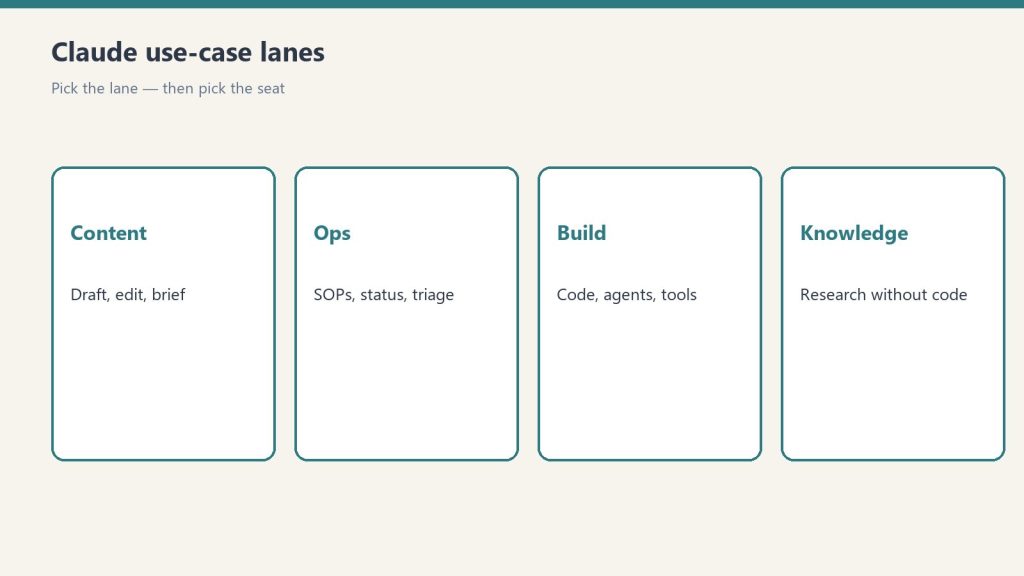
    Strategic thinking conversations. When you’re working through a decision, evaluating a tradeoff, or thinking through a strategy, Claude in an extended conversation is the right tool. The back-and-forth is the whole point. You can interrogate reasoning, push back on conclusions, reframe the problem mid-conversation. An agent that produces a one-shot answer, no matter how good, is the wrong shape for this kind of work.

    Drafting with voice. Writing that needs to sound like a specific person is Claude’s territory. You can load up Claude with context about your voice — past writing, tonal preferences, things to avoid — and get output that actually reads as yours. Notion Custom Agents will always produce generic-flavored writing. That’s fine for internal reports. It’s a problem for anything external.

    Code and technical work. Claude Code specifically is built for technical depth. It reads codebases, executes in a terminal, calls tools, iterates on failures. Custom Agents will flail at the same work.

    Research synthesis across live sources. Claude with web search and fetch capabilities handles “go read this, this, and this, and tell me what the current state actually is” in a way Custom Agents structurally can’t. Anything that requires reaching outside a known data universe is Claude.

    Work that crosses many systems. When a workflow needs to touch code, Notion, a database, an external API, and a human review, Claude Code with the right MCP servers connected coordinates across them better than a Custom Agent inside Notion does. The agent’s world is Notion-plus-connected-integrations. Claude’s world is wider.

    Anything requiring judgment about whether to proceed. Agents execute. Claude in a conversation can pause, check with you, and ask “should I actually do this?” That judgment layer is frequently the most important part of the workflow.


    The pattern that actually works (both, in the right places)
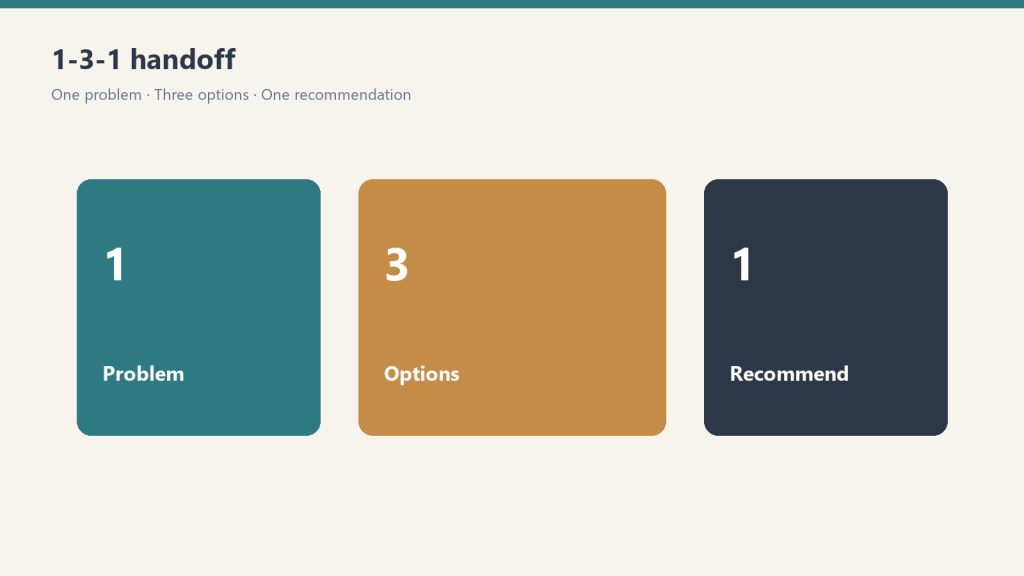
    The operators who get this right aren’t choosing one tool over the other. They’re running both, in specific roles, with clear handoffs.

    The pattern I run:

    Rhythmic operational work lives in Custom Agents. Morning briefs, triage, weekly reviews, database enrichment, Q&A over workspace knowledge. Things that happen repeatedly, have clear inputs, and produce workspace-shaped outputs.

    Judgment-heavy work lives in Claude conversations. Strategic decisions, drafting with voice, research, anything requiring back-and-forth. I do this work in Claude chat sessions with the Notion MCP wired in, so Claude has real context when I need it to.

    Technical work lives in Claude Code. Building scripts, managing infrastructure, debugging, writing code. Custom Agents don’t touch this.

    Handoffs are explicit. When I make a decision in Claude that needs to become operational, it lands as a task or brief in a Notion database, and from there a Custom Agent can pick it up. When a Custom Agent surfaces something that needs judgment, it creates an escalation entry that shows up on my Control Center, where I engage Claude to think through it.

    The two systems pass work back and forth through the workspace. Neither tries to do the other’s job. The seams are the Notion databases where state lives.

    This is not the vendor-shaped pattern. The vendor-shaped pattern says “Custom Agents can handle everything.” The operator-shaped pattern says “Custom Agents handle what they’re good at, and when the work exceeds their reach, another tool takes over with a clean handoff.”


    The decision tree, when you’re not sure

    For a specific piece of work, run these questions in order. Stop at the first “yes.”

    Does this task need a specific human voice, or could it be written by any competent person? If it needs your voice, reach for Claude. If it doesn’t, move on.

    Does this task require reasoning across contested or ambiguous information? If yes, Claude. If no, move on.

    Does this task need real-time web context, live external data, or information not already in a known database? If yes, Claude. If no, move on.

    Does this task involve code, system architecture, or technical depth? If yes, Claude Code. If no, move on.

    Does this task have high-stakes irreversible consequences? If yes, wrap it in a human-approval gate — either run it through Claude where the human is in the loop, or use Custom Agents with “Always Ask” behavior.

    Does this task happen repeatedly on a schedule or in response to workspace events? If yes, Custom Agent. This is the sweet spot.

    Is the output a Notion page, database row, or something that stays in the workspace? If yes, Custom Agent is usually the right call.

    Is the task bounded enough that it could be described in a couple of clear sentences? If yes, Custom Agent. If it’s sprawling, it’s probably too big for an agent.

    If you’re through the tree and still not sure, default to Claude. Claude is more expensive in money and cheaper in hidden cost than a Custom Agent running the wrong job.


    The failure modes I’ve seen

    Specific patterns that go wrong, in my observation:

    The “agent for everything” operator. Someone who just got access to Custom Agents and is building agents for tasks that don’t need agents. The agents mostly work. The ones that mostly work waste credits on tasks a template or a simple automation would handle. The ones that partially work produce quiet low-grade mistakes that accumulate.

    The “Claude for everything” operator. The inverse. Someone who got comfortable with Claude and hasn’t made the leap to letting agents handle the rhythmic work. They’re paying the context-loss tax every morning, doing the triage manually, writing every brief from scratch. Claude is too expensive a tool — in attention, if not dollars — to run routine work through.

    The operator who built one giant agent. Custom Agents are meant to be narrow. Someone violates the “one agent, one job” principle by building an agent that does inbox triage and database updates and weekly reports and client communications. The agent becomes hard to debug, expensive to run, and unreliable across its many hats. The fix is almost always breaking it into three or four single-purpose agents.

    The operator who didn’t build review gates. An agent sending emails without human approval. An agent deleting rows based on inferred criteria. An agent updating client-facing pages from an unchecked data source. The cost of the first real mistake exceeds the cost of the review gate that would have prevented it, every time.

    The operator who never checked credit consumption. Custom Agents consume credits based on model, steps, and context size. An operator who built ten agents and never looked at the dashboard ends up surprised when the monthly bill is much higher than expected. The fix is easy — Notion ships a credits dashboard — but it has to actually get checked.


    The timing honest note

    A piece of this article that ages. These comparisons are true in April 2026. Custom Agents are new enough that the feature set will expand significantly over the next year. Claude is evolving rapidly. The specific gaps I’ve named may close; new gaps may open in different directions.

    What won’t change is the pattern: some work wants a specialized tool, some work wants a general-purpose one. Some work is rhythmic, some is judgment-driven. Some work lives inside a workspace, some crosses systems. The vocabulary for when to use which tool will evolve; the underlying truth that different shapes of work deserve different tools will not.

    If you’re reading this in 2027 and Custom Agents have shipped fifteen new capabilities, the specific “can’t do” list will be shorter. The decision tree at the top of this article will still work. That’s the part worth holding onto.


    What I’m not saying

    A few clarifications because I want to be clear about what this article is and isn’t.

    I’m not saying Custom Agents are bad. They’re genuinely good at what they’re good at. They’re saving me hours per week on work I used to do manually.

    I’m not saying Claude is strictly better. Claude is more capable at a broader set of tasks, but it also costs more, requires active operator engagement, and can’t sit in the background running overnight rhythms the way Custom Agents can.

    I’m not saying there’s one right answer for every operator. Different operators with different businesses and different workflows will land on different splits. The decision tree helps, but it’s a starting point, not a conclusion.

    I’m not saying this is permanent. Tool landscapes change fast. Six months from now there may be categories where Custom Agents beat Claude that don’t exist today, and vice versa. What matters is developing the habit of asking “which tool is this work actually shaped for?” instead of defaulting to whichever one you learned first.


    The one thing I’d want you to walk away with

    If you read nothing else in this article, this is the sentence I’d want in your head:

    Rhythmic operational work wants an agent; judgment-heavy work wants a conversation.

    That distinction — rhythm versus judgment — cuts through almost every architecture question you’ll have when deciding what to route where. It’s not the only dimension that matters, but it’s the one that settles the most decisions correctly.

    Work that happens on a schedule or in response to an event, with bounded inputs and clear outputs? That’s rhythm. Build a Custom Agent.

    Work that requires thinking through tradeoffs, integrating disparate information, or producing output with specific voice and judgment? That’s a conversation. Engage Claude.

    Get that right for most of your workflows and the rest of the architecture tends to sort itself out.


    FAQ

    Can’t Custom Agents do everything Claude can do, just inside Notion? No. Custom Agents are optimized for bounded, rhythmic, workspace-shaped tasks. They can technically attempt work that requires deep reasoning, specific voice, or live external context, but the results degrade in predictable ways. Claude — in a conversation or in Claude Code — handles those categories better.

    Should I just use Claude for everything then? No. Rhythmic operational work — morning briefs, triage, weekly reports, database enrichment — is genuinely better in Custom Agents than in Claude, because the “autonomous teammate running while you sleep” property matters. The right answer is running both, in their respective sweet spots.

    What’s the cost comparison? Starting May 4, 2026, Custom Agents cost roughly $10 per 1,000 Notion Credits. Internal Notion data suggests agents run approximately 45–90 times per 1,000 credits depending on task complexity. Claude’s subscription pricing is flat. For high-frequency simple tasks, Custom Agents are usually cheaper. For heavy reasoning work done many times per day, running Claude directly can be more cost-efficient.

    What about Notion Agent (the personal one) versus Claude? Notion Agent is Notion’s on-demand personal AI — you prompt it, it responds. It’s fine for in-workspace tasks where you need AI help with content you’re already looking at. For deeper reasoning, complex drafting, or cross-tool work, Claude is more capable. Notion Agent is a good ambient utility; Claude is a general-purpose intelligence layer.

    Which should I learn first if I’m new to both? Claude. Learn to think with an AI as a thinking partner before you try to build autonomous agents. Once you understand what AI can and can’t do in a conversation, the design decisions for Custom Agents become much clearer. Jumping to Custom Agents without the Claude foundation is how operators end up with agents that don’t work as expected.

    Can Custom Agents use Claude models? Yes. Custom Agents let you pick the AI model they run on. Claude Sonnet and Claude Opus are both available, along with GPT-5 and various other models. This means the underlying intelligence of a Custom Agent can be Claude — you’re choosing between Claude-as-conversation (claude.ai, Claude Desktop, Claude Code) and Claude-as-embedded-agent (Custom Agent running Claude). Different interfaces, same underlying model in that case.

    What if I want Claude to work autonomously on a schedule like Custom Agents do? Possible, but requires more work. Claude Code can be scripted; you can run it on a cron job; you can set up headless workflows. But the “out of the box autonomous teammate” experience is Notion’s current strength, not Anthropic’s. If you want autonomous-background-work without building your own infrastructure, Custom Agents are easier.

    How do I decide for my specific situation? Run the decision tree in the article. If you’re still unsure, default to Claude — it’s the more general-purpose tool, and the cost of using the wrong tool for judgment-heavy work is higher than the cost of using the wrong tool for rhythmic work. You can always migrate a recurring workflow to a Custom Agent once you understand the shape.


    Closing note

    The honest comparison isn’t one tool versus the other. It’s understanding that different shapes of work want different shapes of tool, and that most operators lose more time to the mismatch than to any individual tool’s limitations.

    Custom Agents are good at being Custom Agents. Claude is good at being Claude. Neither is good at being the other. Use both, in the places each belongs, with clean handoffs between them, and the stack hums.

    Skip the vendor narratives. Read your own workflows. Route each piece to the tool it’s actually shaped for. That’s the whole game.


    Sources and further reading

    Related Tygart Media pieces:

  • The Agency Stack in 2026: Notion + Claude + One Human

    The Agency Stack in 2026: Notion + Claude + One Human

    I’m going to describe the stack I actually run, and then I’m going to tell you honestly whether you should copy it.

    Most writing about “AI agencies” in April 2026 is either pitch deck vapor or hedged-everything consultant speak — pieces that tell you “AI is transforming agencies” without telling you which tools, which workflows, which tradeoffs. This article is the opposite. I’m going to name specifics. I’m going to say what’s working. I’m going to say what isn’t. I’m going to skip the part where I pretend this is a solved problem, because it isn’t, and pretending is how operators who listened to the pitch deck end up eighteen months into a rebuild.

    The stack that follows is what a real, paying-bills agency runs to manage dozens of active properties, real client relationships, and a content production operation that ships every day — with one human in the operator chair. It is not hypothetical. It is also not recommended for everyone, which is the part most of these articles leave out.

    Here’s the real version. You can decide whether it’s for you when we get to the bottom.


    The one-line version of the stack

    Notion is the control plane. Claude is the intelligence layer. A handful of operational services run the work. One human makes the calls.

    That’s it. That’s the whole stack at the summary level. Everything that follows is specificity about what each of those pieces does, why it’s there, and what happens when you try to run a real business through it.

    The four pieces are load-bearing in different ways. Notion holds the state of the business — what’s happening, what’s decided, what’s next. Claude provides the judgment and the synthesis when judgment is needed. The operational services (publishers, research tools, deployment pipelines) do the deterministic work that judgment shouldn’t be wasted on. The human reads, decides, approves, and occasionally gets out of the way.

    Fifteen years ago the same agency would have needed forty people. Ten years ago it would have needed twenty. Five years ago it would have needed eight. In April 2026 it needs one human plus the stack. That’s the thesis. The question is whether you can actually run it that way.


    What “AI-native” actually means in this context

    The phrase “AI-native” has been worn out enough that I need to be specific about what I mean.

    AI-native doesn’t mean “uses AI tools.” Every agency uses AI tools. Every freelancer uses AI tools. That bar is on the floor.

    AI-native means the operating model of the business assumes AI is a teammate, not a productivity tool. AI is in the loop on strategic thinking. AI is reading the state of the workspace and synthesizing it. AI is drafting, reviewing, triaging, and sometimes deciding — with human oversight, but as a continuous participant, not an occasional assistant you turn to when you get stuck.

    The practical difference: an agency that uses AI tools works the way agencies have always worked, but with ChatGPT open in a tab. An AI-native agency has rebuilt its workflows around the assumption that there’s a persistent intelligence layer in the substrate of the business.

    The stack below is what the second version looks like when you commit to it.


    The control plane: Notion

    Notion is where I live during the working day. Not where I put things when I’m done with them — where I actually do the work.

    The workspace is organized around the Control Center pattern I’ve written about before. A single root page that surfaces the live state of the business: what’s on fire today, what’s progressing, what’s waiting on me, what the week’s focus is. Under it sits a database spine that maps to the actual operational objects — properties, clients, projects, briefs, drafts, published work, decisions, open loops. Each database answers a specific question someone running the business would ask regularly.

    Every meaningful page in the workspace has a small JSON metadata block at the top — page type, status, summary, last updated. That metadata block is for the AI, not for me. It lets Claude read the state of a page in a hundred tokens instead of three thousand. Across a workspace of thousands of pages, the compounding context savings are enormous, and it changes what Claude can realistically see in a session.

    The workspace is sharded deliberately. The master context index lives as a small router page that points to larger domain-specific shards. When Claude needs to reason about a specific area of the business, it fetches the shard for that area. When it needs the whole picture, it fetches the router. This is not a product feature anyone has written about — it’s a pattern I arrived at after the main index page got too large to fit into Claude’s context window without truncation. It works. It’s probably what a lot of operators will end up doing.

    What Notion is great at: holding operational state, being legible to both humans and AI, letting you traverse the business by asking questions of the workspace rather than navigating folders, integrating cleanly with Claude via MCP, running background rhythms through Custom Agents.

    What Notion is not great at: being a database in the performance sense (anything heavy goes somewhere else), being the source of truth for code (version control is), being the source of truth for financial transactions (a real accounting system is), being reliable as the only source for anything mission-critical (it has an outage SLA, not an uptime guarantee).

    The rule I follow: Notion holds the operating company. It does not hold the substrate the operating company depends on. That distinction is what keeps the pattern stable.


    The intelligence layer: Claude

    Claude is the AI I actually run the business with. Not because Claude is strictly better than the alternatives at every task — at this point in 2026 the frontier models are all highly capable — but because Claude’s design posture matches what an operator actually needs.

    Specifically: Claude is thoughtful about uncertainty, tells me when it doesn’t know, asks for clarification instead of fabricating, and has a deep integration with Notion via MCP that makes the workspace-and-AI pattern actually work. Those qualities are worth more to me than any single-task benchmark. An AI that sometimes gets things wrong but tells me when it’s uncertain is far more useful than an AI that confidently hallucinates.

    The intelligence layer shows up in three configurations:

    Chat Claude — what I use for strategic thinking, drafting, review, and synthesis. A conversation on claude.ai or the desktop app with the Notion MCP wired in, so Claude can reach into the workspace to ground its answers in real context. This is where the high-judgment work happens. When I’m making a decision, I work through it in a Claude conversation before I commit to it.

    Claude Code — the terminal-based version that lives at the intersection of code and agent. This is where the more technical work happens — building publishers, writing scripts, managing infrastructure, executing multi-step workflows that touch multiple systems. Claude Code reads my codebase, reaches into Notion when it needs to, calls external services through MCP, and writes back run reports.

    Notion’s in-workspace AI (Custom Agents and Notion Agent) — the on-demand and autonomous agents that live inside Notion itself. These handle the rhythms: the daily brief that’s written before I wake up, the triage agent that sorts whatever lands in the inbox, the weekly review that gets drafted on Friday. I didn’t build these to be clever. I built them because I was doing the same small synthesis tasks over and over, and Custom Agents let me stop.

    Three configurations, three different jobs. Each one’s strengths map to a different kind of work. Together they cover the whole territory.

    What Claude is great at: synthesis across real context, drafting with judgment, reasoning through decisions, catching inconsistencies in my thinking, executing defined workflows with honest failure modes.

    What Claude is not great at: being the last line of defense on anything (always have a human gate), handling workflows where one error compounds (use deterministic tools for those), long-horizon autonomy without oversight (agents drift, supervise accordingly), making decisions that require context it doesn’t have access to.

    The mental model I use: Claude is a thoughtful senior teammate who happens to be infinitely patient and always awake. That framing gets the relationship right. Over-rely on it and you get hurt. Under-rely on it and you’ve hired a senior teammate and asked them to run errands.


    The operational services: the things that do the work

    The third layer is the part most agency-AI writeups skip, because it’s unglamorous. It’s the set of operational services that do the actual deterministic work. Publishing. Research. Deployment. Monitoring. The stuff that shouldn’t require judgment once you’ve set it up correctly.

    I’m going to describe the shape without naming specific tools, because the shape is what’s durable and the specific tools will change.

    Publishers — services that take content prepared upstream and push it to the properties where it needs to live. WordPress for editorial content, social media scheduling for distribution, email tools for outbound. The publisher’s job is to execute reliably and log honestly. When it fails, it fails loudly enough that I notice.

    Research infrastructure — services that pull structured data about keywords, competitors, search volumes, backlink profiles, and so on. This is where AI-native agencies diverge most sharply from traditional ones. Traditional agencies do research manually. AI-native agencies run research as a pipeline: the structured data comes in, gets processed, and lands in the workspace as briefs and intelligence reports that the human and the AI both read.

    Background pipelines — the scheduled services that keep the workspace fresh. New briefs get generated. Stale content gets flagged. Traffic data gets ingested. The kinds of things that an agency would traditionally ask a human to do on a weekly rhythm, running autonomously in the background.

    Deployment and monitoring — how the technical side ships. Version control holds the source of truth. Deployments run on triggers. When something breaks, it breaks to a channel I actually read.

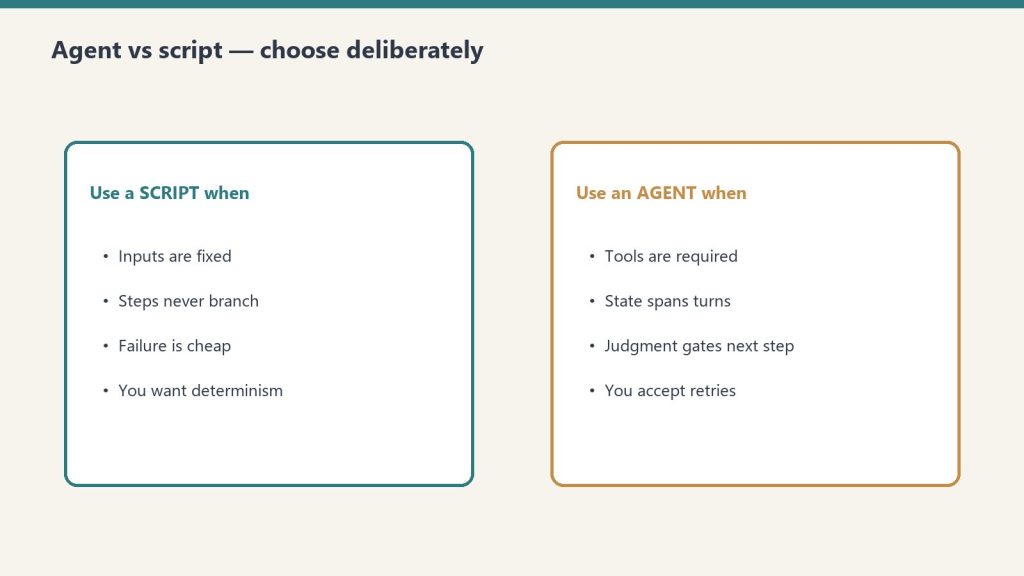
    The principle that holds all of this together: deterministic work belongs in deterministic systems. Don’t use an AI agent to do something a script can do. An AI agent adds judgment, which is valuable when you need judgment, and costly when you don’t. The operational services do the work that has a right answer every time. The AI handles the work that requires judgment.

    Most agency-AI failures I’ve watched happen are cases where someone tried to use an AI agent for the deterministic work. The agent mostly succeeds, occasionally hallucinates, and introduces a class of silent failure that didn’t exist in the deterministic version. It feels like you’re being clever. You’re introducing unreliability.


    The one human in the chair

    This is the part the vendor writeups never include, and it’s the most important piece.

    There is one human in the operator chair. That human is non-optional. Every workflow, every agent, every pipeline eventually terminates at a human decision or a human review gate. The AI stack does not run the business. The AI stack is a lever that makes one human capable of running what used to take many.

    What the human does in this configuration is different from what they would have done in a traditional agency. The human is not writing every post. The human is not doing every bit of research. The human is not executing every workflow. The human is:

    Setting the posture. What are we working on this week? What’s the priority? What’s the theme? The AI is exceptional at executing against clarity. It is not exceptional at deciding what to be clear about.

    Reading the synthesis. The AI surfaces what matters. The human decides what to do about it. Every morning brief, every weekly review, every escalation flags lands in front of the human, who makes the call.

    Making the judgment calls. When a client needs a difficult conversation. When a strategy needs to change. When something the AI suggested is actually wrong. These are the moments the AI can’t be left alone with. The operator role is increasingly concentrated around exactly these moments.

    Holding the relationships. Clients don’t want to talk to an AI. They want to talk to a human who happens to be very well-supported by AI. The difference matters enormously in trust, tone, and staying power of the engagement.

    Maintaining the stack itself. The stack doesn’t maintain itself. Every week there are small adjustments, small rewirings, small improvements. The operator is also the architect of the operating company, and the architecture is a living thing.

    A person who thought they were buying “AI that runs my agency for me” is going to be disappointed. A person who understood they were buying “a lever that makes them ten times more effective at the parts of agency work that actually matter” is going to be delighted. The difference is what you think you’re getting.


    The daily rhythm (what it actually looks like)

    Let me describe a real working day in this stack, because the abstract description doesn’t convey what using it feels like.

    Morning. I open Notion. The Morning Brief Agent ran overnight; the top of today’s Daily page already has a three-paragraph synthesis of the state of the business, pulled from the active projects, the task database, yesterday’s run reports, and the overnight changes. I read it in ninety seconds. I know what’s on fire, what’s progressing, what’s waiting on me. The context tax that used to cost me the first hour of every day is already paid.

    Morning block. I work through the highest-leverage thing on the day’s priority list. If it’s strategic, I work through it in a Claude conversation with the Notion workspace wired in, because grounding the AI in real context produces dramatically better thinking than working in isolation. If it’s technical, I work in Claude Code, because the terminal version handles multi-step technical work better. Either way, I’m working with the AI as a thinking partner, not a tool I reach for occasionally.

    Mid-day. The triage agent has processed whatever landed in the inbox. I scan its decisions, override the ones I disagree with, and dispatch anything important into its real database. The escalation agent has flagged the three things that need my attention today. I make the calls. These are the moments the stack needs a human for — no amount of clever configuration replaces them.

    Afternoon block. Content operations. Research intelligence lands as structured data in the workspace. Briefs get drafted. I review them. Approved briefs flow to the publishing pipeline. The pipeline runs, logs back to the workspace, and I get notified of anything that failed. I don’t write every post. I write the ones where my voice specifically matters, and I review the rest. The ratio is maybe one in ten that I write from scratch these days.

    Evening. Five minutes of close. Anything that didn’t get done gets re-dated. Tomorrow’s priority list pre-stages. I close Notion. The overnight agents will handle the rhythms while I sleep.

    That’s the day. It is dramatically different from running a traditional agency, and dramatically more sustainable. The cognitive load is substantially lower even while the operational throughput is substantially higher. That’s the whole promise of the pattern, and it’s the part that’s real.


    What this stack actually costs (and doesn’t)

    The direct tool costs for the stack in April 2026, at the level I run it:

    • Notion Business plan with AI add-on
    • Claude subscription (Max tier for the agent budget)
    • A cloud provider account for the operational services (running pennies to small dollars per day at my volume)
    • A handful of research and analysis tool subscriptions
    • Domain, email, and the usual small-business infrastructure

    Total monthly direct tool cost is the equivalent of what a traditional agency would spend on a single junior employee’s salary for one week. The leverage ratio is extreme, and it will get more extreme.

    What it costs that isn’t money:

    • Setup time. Weeks to stand up the initial version, months to iterate it into something that runs smoothly. This is not a weekend project.
    • Ongoing attention to the stack itself. Maybe ten percent of my week is spent on the operating company rather than on client work. That ratio is load-bearing; if I let it go below that, the stack rots.
    • Discipline about not adding cleverness. Every new tool, every new agent, every new integration is a tax on the coherence of the system. Most weeks I’m resisting the urge to add something, not looking for something to add.
    • Loneliness of the role. One-human agencies are lonely. You don’t have a team meeting. You don’t have a coffee conversation with a coworker. The stack is not a substitute for colleagues. This is the part nobody writes about and it’s genuinely significant.

    What this stack is not good for

    If I’m being honest about who should not run this pattern, it includes:

    Agencies that want to scale headcount. This stack is designed to make one human capable of more. It’s not designed to coordinate ten humans. A ten-person agency on this stack would have chaos problems I haven’t solved.

    Businesses where the work is primarily relational. Sales-heavy businesses, high-touch consulting, therapy practices. The stack is strong at operational and production work. It is weak at anything where the work is fundamentally “I am present with this other person.”

    Anyone uncomfortable with AI making meaningful decisions. The stack assumes you’re willing to let AI make decisions that have real consequences — triage, synthesis, drafting under your name. If that crosses your line philosophically, don’t force it. The stack won’t be fun for you.

    People looking for a plug-and-play system. This is a living architecture. It requires ongoing maintenance. It never stops being built. If you want something that works out of the box and stays working, buy software; don’t build an operating company.

    Early-stage businesses without a clear shape yet. The stack rewards clarity about what your business is. If you’re still figuring that out, the stack will accelerate whatever direction you’re going — which is great if the direction is right and brutal if it isn’t. Figure out the direction first, then build the stack.


    Who this stack is good for

    The operators I’ve seen get the most out of this pattern share a specific profile:

    • Running businesses with high operational complexity but small team size. Multi-property content operations, advisory practices, specialist agencies. The kind of business where one capable person with leverage beats a team without it.
    • Comfortable with systems thinking. The stack rewards people who think in terms of flows, interfaces, and substrates. If that vocabulary feels alien, the stack will feel alien.
    • Honest about what they’re good at and what they aren’t. The stack amplifies the operator. If the operator is strong at strategy and weak at execution, the stack handles the execution. If the operator is strong at execution and weak at strategy, the stack does not magically produce strategy. Know which version you are.
    • Willing to maintain the architecture. The stack is a long commitment to the operating company, not a one-time setup. Operators who enjoy tending the system do well. Operators who resent tending the system should not run it.

    If you recognize yourself in the good-fit list and not the bad-fit list, this pattern is probably worth the investment. If you’re on the fence, it probably isn’t yet — come back when the decision is clearer.


    The part I want to be brave about

    Here’s the part this article is supposed to be honest about.

    This pattern works for me. It might not work for you. The vendor-shaped narrative says every business should be AI-native, every agency should be running this stack, every operator should be ten times leveraged. That narrative is wrong. It’s wrong in the boring, everyday way that industry narratives are always wrong: it oversells, it under-discloses the costs, and it creates an expectation gap that a lot of operators are going to run into eighteen months from now.

    The accurate narrative is this: for a specific kind of operator running a specific kind of business, this stack produces a kind of leverage that was not previously available. For everyone else, it’s a distraction from what they should actually be doing, which is the hard work of their specific business with the tools that fit their specific situation.

    I am describing what I run because I think honest examples are more useful than vague generalities. I am not recommending you run it. I am recommending you look at your actual business, your actual operating constraints, and your actual relationship with AI tools, and decide whether a version of this pattern — adapted, simplified, or rejected — makes sense for you.

    There’s a version of this article that promises that if you copy my stack, you’ll get my outcomes. That article is lying to you. The outcomes come from matching the stack to the business, not from the stack itself.

    If you read this and it resonates, take the pieces that apply. If you read this and it doesn’t, take what you learned about what’s possible and leave the rest. Either response is correct.


    The five things I’d tell someone thinking about building something like this

    Start with the Control Center, not the agents. The Control Center is the anchor everything else builds against. If you build agents before you have the Control Center, the agents have nothing to write to. Build the workspace shape first. The rest follows.

    Resist the urge to add complexity. The operators who succeed with this pattern run simpler versions than they could. The operators who fail run more elaborate versions than they need. Every piece of the stack should be earning its place every week.

    Write everything down as you go. The operating company is a living architecture. Six months from now you will have forgotten why you made a specific configuration choice. Document the choices in the workspace as you make them. Future-you will thank present-you.

    Don’t over-trust the AI. It’s a teammate, not an oracle. It’s wrong sometimes. It’s confident when it shouldn’t be sometimes. Build review gates. Assume failure. The stack is resilient when you don’t assume otherwise.

    Accept that you are building an operating company, not deploying software. This is a long game. It doesn’t work in the first week. It starts working in the second month. It starts compounding in the sixth month. If you’re not willing to tend it for that long, don’t start.


    A closing observation

    I’ve been running variations of this stack for long enough to have opinions that don’t match what I thought I believed when I started. The biggest surprise has been how much of the work is operational hygiene rather than AI cleverness. Building an agent was the easy part. Running an agency on the operating company pattern has mostly been a discipline problem — staying consistent about metadata, about documentation, about review gates, about when to let the AI decide and when to intervene.

    The AI is not the interesting part anymore. The interesting part is the operating model the AI makes possible. That’s the part this article has tried to describe honestly, and that’s the part worth thinking about if you’re considering something similar.

    If you do build a version of this, I’d genuinely like to hear how it turns out. The frontier here is being figured out by operators sharing what works and doesn’t, and every honest report makes the next person’s build better. This is my report. I hope it helps.


    FAQ

    Can I run this stack solo? Yes. The stack is explicitly designed for solo operators or very small teams. One-human operation is the whole point. Multi-person teams work too but introduce coordination complexity the pattern doesn’t directly solve.

    How long does it take to build? The minimum viable version — Control Center, a handful of databases, one Custom Agent, Claude wired in — is a week of part-time work. The version that actually earns its place takes two to three months of iteration. It never stops getting built; it compounds over time.

    Do I need to know how to code? For the minimum viable version, no. Notion + Claude + Notion Custom Agents gets you a long way without writing code. For the operational services layer, some technical comfort is needed or you’ll need a technical collaborator. Claude Code dramatically lowers the bar here.

    What if Notion gets replaced by a competitor? The pattern survives. The Control Center, the database spine, the metadata discipline, the workspace-as-control-plane posture — all of those port to any capable workspace tool. If something displaces Notion in 2027, the migration is real work but the operating model is durable. The durable asset is the pattern, not the specific tool.

    What if Claude gets replaced by a competitor? Also fine. The pattern assumes there’s an intelligence layer wired into the workspace; Claude is the current implementation of that layer. If another frontier model becomes more suitable, swap it. The MCP standard that connects everything is model-agnostic. This is deliberate.

    Can I use ChatGPT or another AI instead of Claude? Mostly yes. The MCP-to-Notion pattern works with any AI that supports MCP, including ChatGPT, Cursor, and others. I use Claude for the reasons described above, but the stack pattern is compatible with other frontier models. Don’t let tool preferences get in the way of the architecture.

    How much does this cost to run? The tool subscription stack costs roughly what one junior employee’s weekly salary would cost per month, total. The non-monetary costs (setup time, maintenance attention, lifestyle tradeoffs of solo operation) are more significant and worth thinking about before committing.

    Is this sustainable for a growing business? Yes, up to a point. The pattern scales smoothly to a certain operational volume per human. Beyond that, you need more humans, and coordinating multiple humans on this stack introduces problems that the solo version doesn’t have. Most operators hit the natural ceiling before they hit the growth limit.


    Sources and further reading

    Related reading from the broader ecosystem:

  • The Soda Machine Thesis: A Mental Model for Running an AI-Native Business on Notion

    The Soda Machine Thesis: A Mental Model for Running an AI-Native Business on Notion

    The hardest part of running an AI-native business on Notion in 2026 isn’t the tools. The tools are fine. The tools ship regularly and they work. The hard part is that the vocabulary hasn’t caught up with the reality, and when the vocabulary is wrong, your design choices get wrong too.

    Here’s what I mean. When I started seriously composing Workers, Agents, and Triggers in Notion, I found I was making the same kinds of mistakes over and over. Building a worker for something an agent could have handled with good instructions. Attaching five tools to an agent that only needed two. Setting up a scheduled trigger for something that should have fired on an event. After the third or fourth time, I realized the mistakes had a common source: I didn’t have a mental model for when to reach for which piece.

    Notion doesn’t give you one. The documentation is accurate but it’s a list of capabilities. Vendor-shaped — here is what Custom Agents can do, here is what Workers do, here are your trigger types. All true. All useless for the question I actually had, which was given a job I want done, which piece do I build?

    So I made a mental model. It’s imperfect and it’s mine, but it has survived a few months of real use and it has saved me from a dozen architecture mistakes I would have otherwise made. This article is the model.

    I call it the Soda Machine Thesis. It might sound silly. It works.


    The core analogy

    Workers are syrups. Agents are soda fountain machines. Triggers are how the machine dispenses.

    When someone asks for a custom soda fountain — a Custom Agent — three decisions get made, in order:

    1. Which syrups (workers and tools) load into this machine? What capabilities does it need access to? What external services does it need to reach? What deterministic operations does it need to perform?
    1. How is the machine programmed? What are its instructions? What’s its job description? How does it think about what it’s doing? (This is the part where agents diverge most — two machines with identical syrups behave completely differently based on instructions.)
    1. How does it dispense? Does it pour when someone presses a button (manual trigger)? Does it pour on a schedule (timer)? Does it pour when the environment changes — a page gets created, a status flips, a comment gets added (event sensor)?

    That’s the whole model. Three questions, in that order. If you can answer all three cleanly, you have a working agent. If you can’t answer one of them, you have an agent that is going to produce noise and frustrate you.

    I have watched this analogy clarify a dozen conversations that were going nowhere. “I want an agent that…” — and then I ask the three questions, and halfway through the answers it becomes obvious what the person actually wants is a simpler thing. Sometimes they don’t need an agent at all, they need a template with a database automation. Sometimes they need a worker, not an agent. Sometimes they need an agent with zero workers and better instructions.

    The analogy does real work. That’s the whole point of a mental model.


    Where the analogy holds

    The map is cleaner than you’d expect.

    Workers are syrups. Stateless, parameterized, reusable. The same worker — fetch-url, summarize, post-to-channel, whatever — can power a dozen agents. You build it once, you use it everywhere. A worker that sends an email works the same way whether it’s being called by a triage agent, a brief-writer, or a customer-response agent. That’s what syrup means: the ingredient doesn’t care which drink it’s going into.

    Agents are machines. They select, sequence, and orchestrate. An agent knows when to reach for which worker. An agent knows what the job is and reasons about how to do it. An agent can read a database, synthesize what it finds, reach for a tool to do a specific deterministic step, synthesize again, and return a result. An agent is a little piece of judgment on top of a set of capabilities.

    Triggers are how the machine dispenses. This is the cleanest part of the map because Notion’s own trigger types map almost 1:1 onto the analogy:

    • Button press or @mention → manual dispatch (“I’m pressing the button for a Coke”)
    • Schedule → timer (“pour me a drink at 7am every day”)
    • Database event → sensor (“someone just put a cup under the dispenser; fill it”)

    You don’t need to memorize trigger type names. You need to ask “how should this machine know it’s time to pour?” Once you know the answer, the trigger type follows.


    Where the analogy leaks (and what to do about it)

    No analogy is perfect. This one has four honest leaks that are worth knowing before you rely on the model.

    1. Agents have native hands, not just syrups

    A Custom Agent can read pages, search the workspace, write to databases, and send notifications without a single worker attached. Workers are specialty syrups for the things the base machine can’t do natively — external APIs, deterministic writes to strict database schemas, code execution, anything requiring exact outputs every time.

    This means not every agent needs workers. In fact, my highest-leverage agents often have zero workers. They use the base machine’s native capabilities, combined with strong instructions, to do the job.

    The practical consequence: don’t reach for a worker reflexively. Start by asking what the agent can do with just its native hands and good instructions. Only add workers when the agent genuinely needs capability it doesn’t have.

    2. Machine programming matters as much as syrup selection

    The instructions you give an agent — its system prompt, its job description, its operating rules — are doing as much work as the workers you attach. Two agents with identical workers will behave completely differently based on how they’re instructed.

    People tend to under-invest here. They attach five workers, write three sentences of instruction, and wonder why the agent is flaky. The fix is not more workers. The fix is writing instructions the way you’d write onboarding docs for a new employee — specific, scoped, honest about edge cases, clear about what the agent should do when it’s uncertain.

    My rule: if I’m about to attach a worker because the agent “keeps getting it wrong,” I first check whether better instructions would fix the problem. Nine times out of ten they would.

    3. Workers aren’t a single thing

    This is the leak that surprised me when I learned it. There are actually three kinds of worker, and they behave differently:

    • Tools — on-demand capabilities. The classic syrup. An agent calls them when it needs them. Example: a worker that fetches a URL and returns the text.
    • Syncs — background data pipelines that run on a schedule and write to a database. Not dispensed by an agent. These are more like an ice maker — they run on the infrastructure, filling the building up, and the machines use what the ice maker produces.
    • Automations — event handlers that fire when something happens in the workspace. Like a building’s fire suppression — nobody’s pressing a button; the environment triggers it.

    This matters because syncs and automations don’t need an agent to dispatch them. They run autonomously. If you’re building something that feeds a database on a schedule, that’s a sync, not a tool, and it doesn’t need an agent. If you’re building something that reacts to a page being updated, that’s an automation, not a tool.

    Getting this wrong is one of the most common architecture mistakes. People build an agent to dispatch a sync because they think everything has to flow through an agent. It doesn’t. Let the infrastructure do the infrastructure’s job.

    4. Determinism vs. judgment is the design axis

    The thing the soda analogy doesn’t capture well is that workers and agents are not just interchangeable building blocks. They serve fundamentally different purposes:

    • Workers shine when you want deterministic behavior. Same input, same output, every time. Schema-strict writes. External API calls where the shape of the request and response are fixed.
    • Agents shine when you want judgment, composition, and natural-language reasoning. Variable inputs. Fuzzy requirements. Synthesis across multiple sources.

    The red flag: building a worker for something an agent could do reliably with good instructions. You’re over-engineering.

    The green flag: an agent keeps being flaky at a specific operation. Harden that operation into a worker. Now the agent handles the judgment part, and the worker handles the reliable part.


    The “should this be a worker?” test

    When I’m trying to decide whether to build a worker or let an agent handle something, I run a five-point checklist. If two or more are true, build a worker. If fewer than two are true, stay manual or solve it with agent instructions.

    1. You’ve done the manual thing three or more times. The third time is the signal. First time is discovery, second time is coincidence, third time is a pattern worth capturing.
    2. The steps are stable. If you’re still figuring out how to do the thing, don’t codify it yet. You’ll codify the wrong version and have to rewrite.
    3. You need deterministic schema compliance. Writes that must fit a database schema exactly are worker territory. Agents can write to databases, but if the schema has strict requirements, a worker is more reliable.
    4. You’re calling an external service Notion can’t reach natively. This is often the clearest signal. If it’s outside Notion and needs to be reached programmatically, it’s a worker.
    5. The judgment required is minimal or already encoded in rules. If the decisions are simple enough to express as code, a worker is fine. If the decisions need real reasoning, it’s agent territory.

    This test is not a strict algorithm. It’s a gut-check that catches the most common over-engineering mistakes before they happen.


    The roles matter more than the technology

    Here’s the extension of the analogy that actually made the whole thing click for me.

    Every construction project has four roles. The Soda Machine Thesis as I originally described it has three of them. The one I hadn’t named — and the one you’re probably missing in your own workspace — is the Architect.

    Construction roleYour system
    Owner / DeveloperThe human in the chair. Commissions work, approves output, holds the keys.
    ArchitectThe AI-in-conversation. Claude, Notion Agent in chat, whatever model you’re actively designing with.
    General ContractorA Custom Agent running in production.
    SubcontractorA Worker. Called in for specialty work.

    The distinction that matters: the Architect and the General Contractor are the same technology, playing different roles. When you’re chatting with a model about how to design a system, that model is acting as Architect — designing the thing before it gets built. When a Custom Agent runs autonomously against your databases overnight, it’s acting as General Contractor — executing the design.

    Same underlying AI. Completely different role.

    Getting this distinction wrong is how operators end up either (a) over-trusting autonomous agents with design decisions they shouldn’t be making, or (b) under-using conversational AI for the system-design work it’s actually best at. Chat with the Architect. Deploy the GC. Don’t confuse them.


    Levels of automation (what you’re actually doing at each stage)

    Most operators cycle through these levels as they get deeper into the pattern. Knowing which level you’re currently at — and which level a specific problem actually needs — prevents a lot of wasted effort.

    Level 0: The Owner does it. You manually do the thing. This is fine. Everything starts here. Some things should stay here.

    Level 1: Handyman. You’ve built a template, a button, a saved view. No AI involvement. Native Notion helps you do it faster. Still you doing the work.

    Level 2: Standard Build. Notion’s native automations handle it. Database triggers fire on status changes. Templates get applied automatically. Still deterministic, still no AI.

    Level 3: Self-Performing GC. A Custom Agent does the work natively — reading and writing inside Notion, reasoning about context, no workers attached. This is where agents earn their keep for the first time.

    Level 4: GC + One Trade. An agent with one specialized worker. The agent handles judgment; the worker handles a single deterministic step. This is the most common production pattern.

    Level 5: Full Project Team. An agent orchestrating multiple workers in sequence. Real project coordination. A brief-writer agent that calls a URL-capture worker, then a summarization worker, then a publishing worker, all in order.

    Level 6: Program Management. Multiple agents coordinated by an overarching structure. One agent that dispatches to specialist agents. Portfolio-level orchestration. This is where it gets complicated and where most operators don’t need to go.

    The mistake I made early on, and watch other operators make, is jumping to Level 5 when Level 3 would have worked. More pieces means more failure points. Solve it at the lowest level that works.


    Governance: permits, inspections, and change orders

    The analogy extends further than I expected into governance — which is the unsexy part of running real agents in production, but it’s the part that separates operators who keep their agents working from operators whose agents quietly stop working without them noticing.

    • Pulling a permit = Attaching a worker to an agent. You’re granting that specialty trade permission to work on your job. This is not a nothing decision. Be deliberate.
    • Building inspection = Setting a worker tool to “Always Ask” mode. Before the work ships, the human reviews it. For any worker that does something consequential, this is the default.
    • Certificate of Occupancy = The moment a capability graduates from Building to Active status in your catalog. Before that moment, treat it as construction. After, treat it as load-bearing.
    • Change Order = Editing an agent’s instructions mid-project. The scope changed. Document it.
    • Punch List = The run report every worker should write on every execution — success and failure. No silent runs. If you can’t see what your agent did, you don’t know what it did.
    • Warranty work = Iterative fixes after a worker is deployed. v0.1 to v0.2 to v0.3. This never stops.

    The governance layer sounds boring but it’s what makes agents run for months instead of days. An agent without run reports eventually drifts, fails silently, and leaves you discovering the failure weeks later when the downstream thing it was supposed to do quietly stopped happening. The governance rituals — inspections, change orders, punch lists — are not overhead. They’re what makes the system durable.


    The revised one-sentence summary

    Putting it all together, here is the whole thesis in one sentence:

    Notion is the building. Databases are the floors. The Owner runs the project. Architects design in conversation. General Contractors (agents) execute on-site. Subcontractors (workers) run specialty trades. Syncs are maintenance contracts. Triggers are permits, sensors, and dispatch radios.

    If you can hold that sentence in your head, you can design automation in Notion without getting lost in the vocabulary. When you’re about to build something, ask: which role am I playing right now? Which role does this piece need to play? Who’s the Owner, who’s the Architect, who’s the GC, who’s the sub? If you can answer, the architecture writes itself.


    Practical takeaways

    If you made it this far, here are the five things I’d want you to walk away with:

    1. Not every agent needs workers. Start with native capabilities and strong instructions. Add workers only when the agent can’t do the thing otherwise.
    1. The third time is the signal. Don’t build infrastructure for something you’ve only done twice. You’ll build the wrong version. The third time is when the pattern has stabilized enough to capture.
    1. Syncs and automations don’t need an agent. If you’re feeding a database on a schedule, or reacting to a workspace event, let the infrastructure do it. Don’t wrap it in an agent for no reason.
    1. Separate the Architect from the GC. Use conversational AI to design the system. Use Custom Agents to run the system. Don’t let an autonomous agent make design decisions that should be made in conversation.
    1. Write run reports for everything. Silent success is worse than loud failure, because silent success is indistinguishable from silent failure until weeks later. Every agent, every worker, every run — writes a report somewhere readable.

    That’s the model. It is imperfect and it is mine. If you adopt it, make it your own. If you have a better one, I’d honestly like to hear about it.


    FAQ

    What’s the difference between a Notion Worker and a Custom Agent? A Worker is a coded capability — deterministic, reusable, typically written in TypeScript — that a Custom Agent can call. A Custom Agent is an autonomous AI teammate that lives in your workspace, has instructions, runs on triggers, and can optionally use Workers to do specialized tasks. Workers are capabilities. Agents are operators that can use those capabilities.

    Do I need Workers to use Custom Agents? No. Many Custom Agents run perfectly well with zero Workers attached, using only Notion’s native capabilities (reading pages, writing to databases, searching, sending notifications) plus well-written instructions. Workers become necessary when you need to reach external services or enforce strict deterministic behavior.

    What are the three trigger types for Custom Agents? Manual (button press, @mention, or direct invocation), scheduled (recurring on a timer), and event-based (a database page is created, updated, deleted, or commented on). Pick the one that matches how the agent should know it’s time to act.

    When should I build a Worker versus letting an Agent handle something? Build a Worker when at least two of these are true: you’ve done the manual thing three or more times, the steps are stable, you need deterministic schema compliance, you’re calling an external service Notion can’t reach, or the judgment required is minimal. If fewer than two are true, stay manual or solve it with agent instructions.

    What’s the difference between a Tool, a Sync, and an Automation? A Tool is an on-demand capability that an agent calls when needed. A Sync is a background pipeline that runs on a schedule and writes to a database — no agent required. An Automation is an event handler that fires when something changes in the workspace — also no agent required. Tools are dispatched by agents; syncs and automations run on the infrastructure.

    What’s the Architect/GC distinction? When you chat with AI to design a system, the AI is playing Architect — thinking about what should be built. When a Custom Agent runs autonomously in your workspace, it’s playing General Contractor — executing the design. Same technology, different role. Don’t confuse them: let Architects design, let GCs execute.

    Does this apply outside of Notion? The Soda Machine Thesis is written around Notion’s specific implementation of Workers, Agents, and Triggers, but the underlying pattern (deterministic capabilities + judgment layer + trigger mechanism) applies to most modern agent frameworks. The vocabulary may differ. The architecture is the same.


    Closing note

    Mental models earn their place by changing the decisions you make. If the Soda Machine Thesis changes how you decide what to build next in your Notion workspace, it has done its job. If it doesn’t, discard it and find one that does.

    The reason I wrote it down is that the vocabulary available for thinking about AI-native workspaces in 2026 is still mostly vendor vocabulary, and vendor vocabulary optimizes for describing what a product can do rather than helping operators make good choices. The operator vocabulary has to come from operators. This is mine, offered in that spirit.

    If you’re running this pattern and have refinements, they’re welcome. The thesis is a living document in my own workspace. It gets smarter every time someone pushes back.


    Sources and further reading

    This mental model builds on earlier conceptual work across multiple AI tools (Notion Agent, Claude, GPT) contributing to the same thesis over a series of architecture conversations. The framing evolved through disagreement more than consensus, which is how mental models usually get better.

  • The Notion Operating Company: How to Actually Run a Business on a Workspace in 2026

    The Notion Operating Company: How to Actually Run a Business on a Workspace in 2026

    There is a version of Notion most people use, and there is the version a small number of operators have quietly built — and in April 2026 those two versions are now so far apart that they’re barely the same product.

    The version most people use is a wiki. It is a place you put information you intend to come back to, and most of the time you don’t. Pages go stale. Databases grow faster than they get organized. The search gets worse as the content gets larger. You know this because you have seen your own Notion and felt the tug of guilt when you open it, the small calculation of whether it is worth the effort to fix any of this versus just writing the thing you need to write in a fresh page and adding it to the pile.

    The version a smaller number of people have built is an operating company. It runs on Notion. The human in the chair reads briefs written by AI, approves work, watches reports come back, adjusts priorities, and hands the next job out — and the human never leaves Notion. Everything that is expensive to move between tools does not move. The work comes to them.

    Those aren’t the same product anymore. They used to be. Notion was, for years, fundamentally a block editor with databases bolted on. What changed — what actually changed, not what the vendor said changed — is that over the last six months Notion stopped being a place you put things and started being a place you run things. Custom Agents shipped in late February. The Workers framework followed. MCP support matured. The Skills layer made repeatable workflows into commandable capabilities. What used to be a workspace is now closer to an operating system for a small business.

    Most coverage of this shift is either vendor-positive cheerleading or a product tour disguised as a guide. This is neither. This is how an actual operator runs a real, unglamorous business — dozens of properties, content production cycles, client work, all of it — out of Notion in 2026. The shape, the databases, the ritual, what goes inside the workspace and what stays outside, and where it still breaks.

    If you want a product tour you can find one on Notion’s own blog. If you want the honest operator version, keep reading.


    What “operating company” actually means

    The frame matters, so let’s be concrete about what it is.

    An operating company, in the sense I mean it, is the set of decisions, assets, people, and ongoing commitments that make a business actually go. Not the legal entity. The operating layer. In a traditional small business, that operating company lives in someone’s head, a few spreadsheets, a calendar, a CRM, an email inbox, a project tool, a file drive, a slack, a billing system, and the recurring pain of trying to hold all of it in mind at once.

    Running a business on Notion in 2026 means collapsing as much of that operating layer as possible into a single workspace that knows what it is. Not a place where you write things down. A place where the work is actually happening, where the state of the business is legible at a glance, where a decision made on Monday shows up in Thursday’s automatically-generated brief without anyone having to remember to copy it forward.

    The term I have started using is the Notion Operating Company. It captures the thing correctly: Notion is not the tool you use to run the company, it is the operating layer of the company. The humans make the calls, set the priorities, and absorb the parts that cannot be delegated. Everything else lives in the workspace and operates against the workspace.

    If that sounds like a personal productivity system scaled up, it is not. Personal productivity systems are closed loops. The Notion Operating Company is an open system that other humans, AI teammates, and external services read from and write to. The difference is legibility and composability, and in 2026 those are the qualities that separate a workspace that earns its place from a workspace that is a second pile.


    Why this suddenly works in 2026 (and didn’t in 2024)

    A few things had to be true at the same time for this pattern to become reliably available to small teams and solo operators. None of them were true two years ago.

    Custom Agents shipped. On February 24, 2026, Notion released Custom Agents as part of Notion 3.3. These are autonomous AI teammates that live inside your Notion workspace and handle recurring workflows on your behalf, 24 hours a day, 7 days a week. They do not wait for you to prompt them. You give them a job description, a trigger or schedule, and the data they need, and they run. That one change is the hinge the whole operating-company pattern swings on. Before Custom Agents, automation inside Notion was cosmetic — property updates, templated pages, simple reminders. After Custom Agents, a workspace can actually operate itself between human check-ins.

    The pricing makes it viable. Custom Agents are free to try through May 3, 2026, so teams have time to explore and see what works. Starting May 4, 2026, they use Notion Credits, available as an add-on for Business and Enterprise plans. The pricing matters because it turns out many workflows are cheap enough to run continuously, and the ones that aren’t are easy to audit once the dashboards shipped. Custom Agents are now 35–50% cheaper to run across the board, especially ones with repetitive tasks like email triage. They’re even more cost efficient when you pick new models like GPT-5.4 Mini & Nano, Haiku 4.5, and MiniMax M2.5 that use up to 10× fewer credits. The 10× model-routing move means a well-designed agent for an operator’s workspace costs real-world pennies to run daily.

    MCP connects the workspace to everything else. The Model Context Protocol, opened by Anthropic, gives the workspace a standardized way to reach external tools and services. Notion ships MCP support; most serious AI tools do. The practical consequence: a Custom Agent inside Notion can reach into a source-control system, post to a messaging tool, query a database, or trigger an external worker, without anyone writing glue code. Not every integration is seamless, but the floor has lifted.

    Skills turned workflows into commandable capabilities. Skills turn “that thing you always ask Notion Agent to do” into something it can do on command. Save your best workflows as skills like drafting weekly updates, reshaping a doc in your team’s format, or prepping briefs before a meeting. That matters because the skills layer is where institutional pattern-capture lives. The first time you solve a problem in your workspace, you solve it. The second time, you turn it into a skill. The third time, you invoke it by name. A workspace that accumulates skills gets faster over time instead of slower.

    Autofill became real. Use Autofill to keep your data fresh and up to date, now with all the power and intelligence of Custom Agents. Continuously enrich, extract, and categorize information across every row, so your database stays trustworthy without manual review. That changes what a Notion database is. Databases used to rot without manual maintenance. A self-maintaining database is a different kind of object.

    None of these individually would have tipped Notion from workspace to operating system. All of them together, shipped inside a twelve-month window, did.


    The shape of an operating company in Notion

    Let me describe the actual shape. This is not theoretical. This is the operational pattern that works, stripped of the specifics that would identify any one business.

    The Control Center

    At the root of the workspace is a single page called the Control Center. It is the first page you see when you open Notion. It is the page an AI teammate is told to read first when it is helping you with anything. It is the page a new human teammate reads on day one before they read anything else.

    The Control Center does not contain content. It contains pointers. Specifically:

    • Today — a surfaced view of whatever is actively happening today, pulled from the Tasks database, filtered to today or overdue
    • The live business state — three to five sentences updated continuously (by a Custom Agent, actually) describing where the business is, what is being worked on, what is on fire
    • The database index — a linked block for each operational database, in order of how often you touch them
    • The active projects list — rolled up from the Projects database, filtered to in-flight
    • The week — the current week’s focus, the working theme, what “winning the week” looks like
    • Open loops — the short list of unresolved decisions currently parked waiting for input

    The Control Center is roughly two screens long. It tells you what is happening and gives you the jumping-off points to go deeper. Anything that belongs on the Control Center is either updated automatically or so critical that manual maintenance is worth it.

    The database spine

    Under the Control Center live the operational databases. In a functioning operating company, these map directly to the actual entities the business deals with, not to organizational categories.

    For a service business, the spine typically includes: Clients, Projects, Tasks, Leads, Decisions, People (the humans you interact with externally), Assets, and a catch-all Inbox.

    For a content business, the spine typically includes: Properties (the things you publish on), Briefs, Drafts, Published, Distribution, Ideas, and Performance.

    For a product business, the spine looks different again: Features, Customers, Feedback, Roadmap, Releases, Incidents.

    The exact databases depend on the business. The pattern does not. Each database represents a real operational object. Each relation represents a real dependency. Each view answers a question someone actually asks regularly.

    The test for whether a database belongs on the spine is simple: can you describe, in one sentence, what decision this database helps someone make? If the answer is yes, it belongs. If the answer is “it’s where I put stuff about X,” it doesn’t.

    The agents layer

    Running on top of the database spine is the agents layer. This is the part that would not have existed in 2024.

    The operational pattern, in the workspace I actually run, has a handful of agents that each do one job and do it well.

    • The Triage Agent watches the Inbox database. Anything that lands there gets a priority, a category, and a pointer to the database it actually belongs in. It does not make big decisions. It takes the pile and turns it into a sorted pile.
    • The Morning Brief Agent runs once a day. It reads the Control Center state, the active projects, the top of the Tasks database, the calendar, and the unresolved Decisions, and writes a three-paragraph brief at the top of today’s Daily page. You wake up and the state of the business is already synthesized.
    • The Review Agent runs weekly on Fridays. It pulls what was completed, what stalled, and what slipped, and writes the weekly retro. It is not asking you to fill in a form. It is writing the retro and handing it to you to review.
    • The Enrichment Agent runs on database writes. When something new lands in a key database — a lead, a project, a decision — the agent fills in the fields that would otherwise require manual data entry. Research, links, categorization.
    • The Escalation Agent watches for states that require human attention. A project stalled for too long, a task with no owner, a decision parked past its decide-by date. It surfaces them on the Control Center.

    That’s five agents. Some workspaces I’ve seen run more. Most run fewer. The number is not the point; the pattern is: each agent has one job, one data source, one output surface, and a clear signal for when it should run.

    The constraint that keeps this from sprawling into chaos is a rule I’ve internalized: one agent, one job. The moment an agent tries to do three things, it does none of them well.

    The skills layer

    Beneath the agents, you accumulate skills over time. These are not agents; they’re invoked capabilities. “Generate a weekly client report in this format.” “Convert this meeting transcript into tasks.” “Draft a response to this inbound email in my voice.” Skills are the pattern-capture layer — the place where solved-problems become invocable capabilities.

    The skills layer grows by a specific rule: the third time you notice yourself doing the same thing manually, you turn it into a skill. Not the first time, not the second. The third time is the signal that it’s going to happen again, and the cost of capturing it is less than the cost of doing it manually from here forward.

    The source-of-truth boundary

    Here is where most Notion-as-OS writeups go silent, and it’s actually the most important thing in the whole pattern.

    Notion is not the source of truth for everything. It is the source of truth for the operational state of the business — what’s happening, what’s decided, what’s being worked on, what’s next. It is not the source of truth for code, for financial transactions, for legal documents, for anything that needs to survive an outage of Notion itself.

    Code lives in a source-control system. Money data lives in whatever financial system the business uses. Legal artifacts live in signed-document storage. Heavy compute runs outside Notion and reports back. The operating company is inside Notion; the substrate is not.

    The mental model I use: Notion is the bridge of the ship. The bridge runs the ship. The ship is not inside the bridge.

    This distinction is what prevents the whole pattern from collapsing. A workspace that tries to be the whole business eventually becomes unusable because it is bloated with content that doesn’t belong in a control plane. A workspace that is a control plane stays light, stays fast, and stays legible.


    The daily ritual (what it actually looks like)

    The pattern lives or dies in daily use. Let me describe what a normal working day looks like for an operator running on this pattern — the actual sequence, not the aspirational version.

    Open Notion. The Control Center loads. The Morning Brief Agent has already run; the top of today’s Daily page has a three-paragraph synthesis of the state of the business: what’s on fire, what’s progressing, what requires a decision today. Reading that takes ninety seconds.

    Scan the Inbox. The Triage Agent has already sorted whatever landed overnight. Each item has a category, a priority, and a pointer. You’re not doing the sort. You’re spot-checking the sort — agreeing, disagreeing, occasionally fixing, and dispatching the important items into their real databases.

    Check Escalations. The Escalation Agent has flagged the three things that need attention. You make the decisions. This is the part where being a human matters.

    Open today’s active project. Whatever you are actually working on is linked from the Control Center. You go there and do the work. Sometimes the work is writing in Notion. Sometimes the work is in an IDE, a chat window, a document, a call — Notion is where you come back to log what happened and what comes next.

    At a natural stopping point, log. The log is short. Two sentences on what just got done. Notion captures the timestamp. Over time the log becomes the actual record of how the business moves.

    Evening wrap. Five minutes. The day’s work closes out. Anything that didn’t get done gets re-dated. Tomorrow’s active page pre-stages.

    That’s the ritual. It takes under twenty minutes of overhead per day and gives you a fully legible operating record. The agents do the work that would otherwise be overhead. The human does the work that requires a human.

    The difference between an operator running this pattern and an operator running without it is not productivity on any individual task. It is the absence of the context-loss tax — the tax you pay every time you sit down and have to remember where you left off, what’s happening, what’s next. Pay that tax once a day at the beginning of the brief, and the rest of the day runs on continuous context.


    Where it still breaks (the honest part)

    This pattern is not finished. There are specific places where running a real operating company on Notion still hits walls, and pretending otherwise is the kind of dishonesty that catches up to you when the tool fails you at a bad moment.

    Heavy write workloads. Notion is not a database in the performance sense. If you are trying to push hundreds of updates per minute through the API, you are going to hit rate limits and you are going to have a bad time. The operational pattern is aware of this: heavy writes go to a real database first and are reflected into Notion in summary form.

    Reliable external integration. Custom Agents’ ability to reach external systems via MCP has improved a lot in 2026, but it is not ironclad. Agents that must succeed — send this email, charge this card, update this record — still belong in a purpose-built service, not in a Custom Agent. The rule I use: if the cost of the agent silently failing is real money or real trust, it doesn’t belong in Notion.

    Mobile agent management. Building, editing, and configuring Custom Agents requires the Notion desktop or web app. Mobile access for viewing and interacting with existing agents is supported, but agent creation and configuration is desktop/web only. This is fine but worth knowing. Operators who work primarily from phone can interact with agents but cannot build them on the go.

    Prompt injection. Custom Agents can encounter “prompt injection” attempts — when someone tries to manipulate an agent through hidden instructions in content it reads. This risk exists across connected tools, uploaded documents, and even internal communications. Notion has shipped detection, but the attack surface is real and growing. The practical operator response: don’t give agents access to anything they don’t strictly need, and review any external content an agent will read before granting access.

    The shape of the workspace matters more than it used to. A messy Notion workspace was merely annoying in 2024. A messy Notion workspace in 2026 makes your agents worse, because the agents are navigating the same structure you are. Disorganized databases produce disorganized agent outputs. The cost of workspace hygiene used to be cosmetic. It’s now functional.

    Credit economics at scale. Starting May 4, 2026, Custom Agents run on Notion Credits, a usage-based add-on available for Business and Enterprise plans. The pricing is $10 per 1,000 credits. Credits are shared across the workspace and reset monthly. Unused credits do not roll over to the following month. For a small operator, this is fine. Most workflows are cheap. For larger teams running many agents, credit consumption becomes a line item worth watching. Notion has shipped a credits dashboard to help, but budget discipline is a new muscle for Notion-native teams.

    None of these are dealbreakers. All of them are things the pattern has to work around. The honest version of this article tells you that up front.


    Notion Agent vs Custom Agents (the distinction that matters)

    One clarification because the terminology can confuse newcomers to the pattern.

    Custom Agents are team-wide AI teammates that run automatically on schedules or triggers. Notion Agent is a personal AI assistant that works on-demand when you ask. All Notion users get Notion Agent. Business and Enterprise customers get Custom Agents, priced under the Notion credit system.

    The operating-company pattern uses both. Notion Agent is the on-demand assistant — the one you invoke for “rewrite this paragraph” or “summarize this doc” or “find me every page that mentions X.” Custom Agents are the autonomous teammates that run the background rhythms.

    The mistake to avoid: trying to use Notion Agent for the background rhythms. It is not built for that. It runs when you ask. Custom Agents run when the world changes or when a schedule says so. Those are different tools for different jobs.


    Who this pattern is for

    To be clear about who gets the most out of the Notion Operating Company pattern:

    • Solo operators running real businesses. The leverage is highest here because there is no team to argue with about conventions. You decide the shape, you live in it.
    • Small teams (3–15 people) with a strong operational function. The pattern works if one person owns workspace architecture. It breaks if everyone is allowed to add databases and pages ad-hoc without a maintaining hand.
    • Agencies and consultancies running multi-property operations. Anywhere you need to coordinate lots of parallel work and keep the whole portfolio legible to one or two humans.
    • Knowledge-heavy businesses. Law firms, research shops, content operations, advisory services. The operating company pattern rewards businesses where the value is produced by synthesis across prior work.

    Where the pattern fits less well: businesses where most of the work happens outside any tool (field services, physical retail, manufacturing floors). Notion can still run the management layer, but most of the actual operational data lives elsewhere.


    How to start without building a cathedral

    The pattern I’ve described can sound like a project. It isn’t. Or rather, it can be — people build beautiful elaborate versions for a year and never actually use them. The better path is embarrassingly small steps.

    Week one: build the Control Center. Just that page. Two screens long. Link to the databases you already have, even if they’re messy. The Control Center is the anchor; everything else will build against it.

    Week two: add one Custom Agent. Pick the simplest high-frequency job you do manually. The Triage Agent is a good first choice. Let it run for a week. Watch what it gets right. Adjust.

    Week three: add the Morning Brief Agent. This is the one that changes how your days open. If it works, you will know because opening Notion will stop feeling like work and start feeling like a starting line.

    Week four: look at your databases. The ones that matter will be obvious because the agents will be using them. The ones that don’t matter will be collecting dust. Delete or archive the dead ones. Formalize the live ones.

    After that, the pattern compounds. Each thing you do manually three times becomes a skill. Each repeated workflow becomes an agent. Each messy database gets cleaned when an agent trips on it. The workspace gets smarter as a function of use, not as a function of a weekend rebuild project.

    The operators I’ve seen succeed with this pattern have a specific characteristic in common: they started small and kept going. The operators I’ve seen fail had grand plans and never got to week four.


    What “AI-native business” actually means (if we have to use the phrase)

    The term “AI-native” gets thrown around enough to lose meaning. Inside this pattern, it means something specific.

    An AI-native business is one where AI is not a tool you pick up to accomplish a task. It is a teammate that is already in the workspace, already reading the state, already surfacing what matters, already handling the rhythms. The human is not using AI. The human is working with an operating company that has AI embedded into its substrate.

    That is what the Notion Operating Company pattern produces. Not a workspace that is faster because AI is speeding things up. A workspace that operates continuously because the AI is running inside it, and the human shows up to make the calls that only a human can make.

    This is why I wrote at the beginning that the version of Notion most people use and the version a smaller number have built are barely the same product anymore. They are not. They are two different conceptions of what a workspace is for, and in April 2026, one of them is still a place you put things, and the other is a place you run things.

    The whole game is picking the second one on purpose.


    FAQ

    What’s the difference between using Notion as a wiki and running an operating company on Notion? A wiki is where information lives after you’re done with it. An operating company is where the work actually happens — briefs, decisions, run reports, active projects, agents handling recurring rhythms. The operating company pattern treats Notion as a control plane, not an archive.

    Do I need Business or Enterprise plan? For Custom Agents, yes. Custom Agents require Notion’s Business or Enterprise Plan. Notion Agent (the on-demand personal AI) is available to all Notion users. The operating-company pattern benefits substantially from Custom Agents, so most serious implementations are on Business or higher.

    How much does this cost to run? Custom Agents are free to try through May 3, 2026. Starting May 4, 2026, they use Notion Credits, available as an add-on for Business and Enterprise plans — $10 per 1,000 credits, shared across the workspace, reset monthly, no rollover. In practice, for a solo operator or small team running five or so agents, credit costs are modest. Budget discipline becomes relevant at larger scale.

    What AI models can the agents use? Currently available: Auto (Notion selects), Claude Sonnet, Claude Opus, and GPT-5. Notion regularly adds new models, so expect this list to evolve. Recent additions include cost-efficient models like Haiku 4.5 and GPT-5.4 Mini/Nano that can cut credit usage significantly.

    How secure is it? Custom Agents inherit your permissions, so they can see what you see. They offer page-level access control. Every agent run is logged with full audit trails. Notion has implemented guardrails to automatically detect potential prompt injection, and has built controls for admins and workspace owners to monitor connections and restrict what agents can access. The honest answer: reasonable security defaults, real attack surface, practical precautions apply (scope agents narrowly, audit connected sources).

    Can I run this pattern solo? Yes. Solo operators get the highest leverage from the operating-company pattern because there’s no team coordination overhead. The pattern scales down cleanly.

    What if I don’t want to use Custom Agents? Does the pattern still work? The database spine and Control Center work without agents. You’ll be doing manually what the agents would be doing — daily briefs, triage, weekly reviews. The pattern is still more legible than a traditional Notion setup; you just don’t get the “workspace operates itself between check-ins” effect.

    How long does it take to build? The honest answer is you never stop building. You never should. A workspace that stops evolving is a workspace that is about to stop working. But the minimum viable version — Control Center, one agent, a handful of databases — is a week of part-time work, not a project.


    A closing observation

    The reason this pattern is worth writing about now, in April 2026, is that the window where it is a genuine edge is probably short. Two years from now, some version of this will be the default way Notion is used, and the advantage will compress. Today, most workspaces are still wikis. The operators who make the switch to operating-company now are buying a year or two of operational leverage that becomes the baseline eventually.

    But for right now, this works, it is real, and almost nobody is doing it. That gap is the thing.

    If you are already running something like this, you know. If you are reading about it for the first time, the starting point is the Control Center and one agent. Build the Control Center this week. Add the agent next week. In a month, you’ll have a workspace that is a different kind of object than the one you started with.

    That’s what we mean by an operating company.


    Sources and further reading

  • Notion for Multi-Client Content Operations: The Pipeline That Manages Dozens of WordPress Sites

    Tygart Media / Content Strategy
    The Practitioner JournalField Notes
    By Will Tygart
    · Practitioner-grade
    · From the workbench

    Running a content pipeline across twenty-plus WordPress sites from a single Notion workspace is not the obvious use case Notion was designed for. It’s a use case we built — deliberately, iteratively, over the course of operating a content agency where the volume of work made ad hoc management impossible.

    The result is a system where every piece of content, across every client site, moves through a defined sequence from brief to published inside one Notion database. Nothing publishes without a record. Nothing falls through the cracks between clients. The status of the entire operation is visible in a single filtered view.

    Here’s how that pipeline works.

    What is a Notion content pipeline for multi-site operations? A multi-site content pipeline in Notion is a single Content Pipeline database where every piece of content across every client site is tracked through a defined status sequence — Brief, Draft, Optimized, Review, Scheduled, Published — with each record tagged to its client, target site, and publication date. One database, filtered views per client, full operational visibility across all sites simultaneously.

    Why One Database for All Sites

    The instinct is to give each client their own content tracker. Separate pages, separate databases, separate calendars. This feels organized. In practice it means your Monday morning question — “what’s publishing this week?” — requires opening twenty separate databases and manually compiling the answer.

    One database with entity-level partitioning answers that question in a single filtered view sorted by publication date. Every client’s content in motion, every publication date, every status, visible simultaneously. Add a filter for one client and you have their isolated view. Remove the filter and you have the full operational picture.

    The cognitive shift required: stop thinking about the database as belonging to a client and start thinking about the client tag as a property of the record. The database belongs to the operation. The records belong to clients.

    The Status Sequence

    Every content record moves through the same six stages regardless of client or content type: Brief → Draft → Optimized → Review → Scheduled → Published. Each stage transition has a defined meaning and, for key transitions, a quality check.

    Brief: The content concept exists. Target keyword identified, angle defined, target site confirmed. Not yet written.

    Draft: Written. Not yet optimized. Word count and rough structure in place.

    Optimized: SEO pass complete. Title, meta description, slug, heading structure, internal links reviewed and adjusted. AEO and GEO passes applied if applicable. Schema injected.

    Review: Content quality gate passed. Ready for final check before scheduling. This is the stage where anything that shouldn’t publish gets caught.

    Scheduled: Publication date set. Post exists in WordPress as a draft or scheduled post. Date confirmed in the database record.

    Published: Live. URL confirmed. Post ID logged in the database record for future reference.

    The Quality Gate as a Pipeline Stage

    The transition from Optimized to Review is gated by a content quality check — a scan for unsourced statistical claims, fabricated specifics, and cross-client content contamination. The contamination check matters specifically for multi-site operations: content written for one client’s niche should never reference another client’s brand, geography, or specific context.

    Running this check as a formal pipeline stage rather than an informal pre-publish habit is what makes it reliable at scale. When publishing volume is high, informal checks get skipped. A formal stage in the status sequence means the check is either done or the content doesn’t advance. There’s no middle ground where it was probably fine.

    What Notion Tracks Per Record

    Each content pipeline record carries: the content title, the client entity tag, the target site URL, the target keyword, the content type, word count, the assigned writer if applicable, the publication date, the WordPress post ID once published, and the current status. Relation fields link the record to the client’s CRM entry and to the associated task in the Master Actions database.

    The WordPress post ID field is the detail most content trackers skip. With the post ID logged, finding the exact WordPress record for any piece of content is a direct lookup rather than a search. For a pipeline publishing hundreds of articles across dozens of sites, that lookup speed matters every week.

    The Weekly Content Review

    Every Monday, one database view answers the primary operational question for the week: a filter showing all records with a publication date in the next seven days, sorted by date, across all clients. This view drives the week’s content priorities — whatever needs to move from its current stage to Published by the end of the week gets the first attention.

    A second view shows all records stuck in the same status for more than five days. Stale records indicate a bottleneck — something that was supposed to move and didn’t. Finding and clearing those bottlenecks is the second priority of the weekly review.

    Both views take under a minute to read. The decisions they drive take longer. But the information is current, complete, and doesn’t require any compilation — it’s all in the database, updated as work happens.

    How Claude Plugs Into the Pipeline

    The content pipeline database is one of the primary interfaces between Notion and Claude in our operation. Claude reads the pipeline to understand what’s in progress, writes new records when content is created, updates status as work advances, and logs the WordPress post ID when publication is confirmed.

    This write-back capability — Claude updating the Notion database directly via MCP rather than requiring a manual logging step — is what keeps the pipeline current without adding overhead. The database is accurate because updating it is part of the work, not a separate step after the work is done.

    Want this pipeline built for your content operation?

    We build multi-site content pipelines in Notion — the database architecture, the quality gate process, and the Claude integration that keeps it current automatically.

    Tygart Media runs this pipeline live across a large portfolio of client sites. We know what the architecture requires at real operating scale.

    See what we build →

    Frequently Asked Questions

    How do you prevent content written for one client from appearing on another client’s site?

    Two mechanisms. First, every content record is tagged with the client entity at creation — the tag makes it explicit which client owns the content before a word is written. Second, a content quality gate scans every piece for cross-client contamination before it advances to the Review stage. Content referencing geography, brands, or context specific to another client gets flagged and held before it reaches WordPress.

    What happens when content is published — how does the pipeline stay accurate?

    When content publishes, the record status updates to Published and the WordPress post ID gets logged in the database record. In our operation, Claude handles this update directly via Notion MCP as part of the publishing workflow. For operations without that automation, a daily or weekly manual update pass keeps the pipeline accurate. The key is building the update into the publishing workflow rather than treating it as optional.

    Can Notion’s content pipeline replace a dedicated editorial calendar tool?

    For most content agencies, yes. Notion’s calendar view applied to the content pipeline database provides the same visual publication scheduling that dedicated editorial calendar tools offer, plus the full database functionality — filtering by client, sorting by status, tracking by keyword — that standalone calendar tools lack. The combination is more capable than purpose-built tools for agencies already running Notion as their operational backbone.

  • Best Notion Templates for Agencies (And Why We Don’t Use Any)

    The Agency Playbook
    TYGART MEDIA · PRACTITIONER SERIES
    Will Tygart
    · Senior Advisory
    · Operator-grade intelligence

    The best Notion templates for agencies are the ones you don’t use. That’s not a paradox — it’s a description of how good templates actually work. A well-built template gives you a starting architecture and then gets out of the way. You customize it to your operation, build your workflows on top of it, and within a few weeks the template’s DNA is so thoroughly mixed with your own choices that you’d struggle to separate them.

    What doesn’t work: downloading a template, opening it, feeling briefly impressed by how organized it looks, and then abandoning it because it wasn’t built for how you actually work.

    Here’s an honest look at the Notion template landscape for agencies — what’s worth starting from, and why we ultimately stopped using templates entirely.

    What makes a Notion template good for agency use? A good agency Notion template provides a functional database architecture with relation properties already configured, views set up for common operational questions, and a structure that maps to real agency workflows — client management, content production, project tracking — rather than generic productivity advice. The best templates are opinionated enough to be useful and flexible enough to be adapted.

    What to Look For in an Agency Template

    Before evaluating any specific template, the criteria matter. For agency use, a template is only worth your time if it has: a relational database structure (not just pages and folders), views configured for operational questions you actually need to answer, and a client or project partitioning system that keeps work separated without requiring duplicate databases.

    Templates that fail these criteria — pretty page layouts with no relational structure, task lists without database properties, client folders instead of a filtered single database — will not survive contact with a real agency workflow. They look organized in screenshots and feel hollow in practice.

    The Template Categories Worth Knowing

    Agency OS templates. Comprehensive workspace setups that attempt to cover the full agency operation — clients, projects, tasks, content, invoicing. The good ones from the Notion template gallery and creators like Thomas Frank establish the right relational architecture. The risk: they’re built for a hypothetical agency, not yours. Plan to spend as much time customizing as you would have spent building from a good foundation.

    Content pipeline templates. Focused specifically on editorial and content workflows — brief to publish status sequences, content calendar views, keyword tracking. More focused than full agency OS templates and often more immediately useful for content-specific operations. The best ones have proper database properties and status sequences; the worst are glorified spreadsheets with a calendar view.

    CRM templates. Client and contact management systems. Useful as a starting point for the relationship management layer, though most underestimate how important the relation properties connecting contacts to deals and projects are. A CRM template without proper relations is a contact list with extra steps.

    Client portal templates. Starting points for client-facing portal pages. Most are structurally sound but generic — they need significant customization to reflect your specific deliverable types, communication style, and client relationship structure.

    Why We Stopped Using Templates

    We built the current architecture from scratch after two rounds of trying to adapt downloaded templates. The templates were fine — they established reasonable database structures and saved initial setup time. The problem was customizing them.

    Every template comes with someone else’s assumptions baked in: their property names, their status sequences, their view organization, their relationship structure. Adapting those assumptions to a different operation requires understanding them well enough to change them without breaking the relations that depend on them. By the time you understand the template well enough to modify it correctly, you understand databases well enough to have built it yourself.

    The more useful approach for an operator who’s going to run Notion seriously: learn the architecture principles — how relation properties work, how filtered views are built, how rollups pull data across databases — and build from those principles. The initial investment is higher. The system that results fits your operation because it was designed for your operation.

    When Templates Are Worth Using

    Templates are worth using in two specific situations. First, when you’re new to Notion’s database capabilities and need a working example to understand how relations and views are structured. Opening a well-built template and reverse-engineering why it’s built the way it is is a faster learning path than reading documentation. Second, when you need a specific narrow function quickly — a content calendar for a new client vertical, a project tracker for a new type of engagement — and don’t have time to build from scratch. A template as a starting point, customized heavily, beats a delay.

    Want a Notion system built for your actual operation?

    We build Notion architectures from scratch for agencies — designed around how your operation actually works, not adapted from a generic template.

    Tygart Media builds and runs a custom Notion architecture across a large client portfolio. We know the difference between a system that looks organized and one that actually runs an operation.

    See what we build →

    Frequently Asked Questions

    Are Notion templates worth paying for?

    Occasionally. Free templates from Notion’s own gallery and established creators cover most use cases adequately. Paid templates justify their cost only when they include genuinely sophisticated relational architecture that would take significant time to build independently, or when they come with documentation that teaches you how to adapt them correctly. Most paid templates in the five-to-fifty dollar range are not meaningfully better than good free options.

    Where do you find good Notion templates for agencies?

    Notion’s official template gallery is the most reliable starting point — the templates there have been reviewed and work correctly. Thomas Frank’s Notion resources are well-regarded for the quality of their database architecture. The Notion subreddit and creator communities surface good templates periodically. Be skeptical of templates sold primarily on aesthetic appeal — visual polish does not indicate functional quality.

    Can you build a Notion agency system without using templates at all?

    Yes, and it’s often the better path for operators who will run Notion seriously long-term. Building from first principles — starting with the six operational questions your agency needs to answer, then designing the databases that answer them — produces a system that fits your operation without the overhead of adapting someone else’s assumptions. It requires more upfront investment and some database knowledge, but results in a more durable system.

  • Notion Client Onboarding Template: What We Actually Use

    The Agency Playbook
    TYGART MEDIA · PRACTITIONER SERIES
    Will Tygart
    · Senior Advisory
    · Operator-grade intelligence

    The client onboarding process is where most agencies lose time they never recover. A disorganized onboarding means scattered information, repeated questions, unclear expectations, and a client relationship that starts on a note of confusion rather than confidence.

    The right Notion onboarding template — one that’s actually used, not just admired — solves this before the relationship even begins. Here’s the structure we use and why each piece is there.

    What should a Notion client onboarding template contain? An effective Notion client onboarding template contains five elements: a structured intake form or checklist for collecting client information, a reference section for brand and content guidelines, a project scope and deliverables tracker, a communication log for key decisions, and a Next Steps section that always reflects the current state of the engagement. Templates that omit any of these create gaps that surface as problems later.

    What the Template Actually Needs to Do

    An onboarding template has two jobs. First, collect everything you need to start doing the work correctly — brand guidelines, target audience, keyword strategy, content constraints, access credentials, approval processes. Second, establish the shared expectations that govern the relationship — what gets delivered, when, how feedback works, what happens when something needs to change.

    Most onboarding templates do the first job reasonably well and ignore the second entirely. Then scope creep, unclear feedback loops, and misaligned expectations become recurring problems that the template could have prevented.

    The Five Sections

    Section 1: Client Information and Access. The factual foundation — company name, primary contacts, website URLs, platform credentials, billing details, and contract reference. This section is filled out once during onboarding and updated when anything changes. It should never require searching an email thread to answer “what’s their WordPress login?”

    Section 2: Brand and Content Guidelines. Everything that governs how the work is done: brand voice description, approved and avoided topics, competitor sensitivities, style preferences, target audience profiles, primary keywords and content pillars. This section is the reference document for every piece of work produced for this client. It should be specific enough to give a writer genuine direction, not vague enough to cover for not asking the right questions during onboarding.

    Section 3: Scope and Deliverables. What was agreed, in plain language. Number of articles per month, content types, target platforms, revision rounds included, turnaround times, and what’s explicitly out of scope. Written without ambiguity. This section is the answer to every scope question that arises during the engagement — if it’s not in here, it wasn’t agreed to.

    Section 4: Communication Log. A running record of significant decisions, feedback rounds, strategic pivots, and anything else that changes what the work looks like. Dated entries, brief and factual. Not a chat replacement — a decision record. This section prevents the “I thought we decided” conversation from becoming a dispute.

    Section 5: Next Steps. Three to five items, always current, showing what’s happening next. What we’re working on, what we need from the client, and when they can expect the next delivery. This is the most-read section of any client portal and the one that requires the most active maintenance. It should never be stale.

    What Makes This Different From a Template You Download

    The templates available online for Notion client onboarding are structurally fine. The problem is that they’re generic — built for a hypothetical agency, not for yours. The brand guidelines section in a downloaded template doesn’t know your specific questions. The scope section doesn’t reflect how you actually define deliverables.

    An effective onboarding template is built from your specific failure modes. What questions do you wish you had asked during onboarding for the client relationship that went sideways? What information did you need mid-engagement that you didn’t have? What expectation mismatch caused the most friction? The answers to those questions are what should be in your template, not a generic list of fields.

    Build the first version of your template, use it with two or three clients, and then revise it based on what you still didn’t know at the end of onboarding. Version two will be significantly better than version one, and version three better still.

    Making It Machine-Readable

    For operations running AI-assisted content production, the onboarding template does a third job beyond the two described above: it becomes the client reference document that Claude reads before starting any session for that client.

    This requires adding a metadata block at the top of the client reference page — a structured summary of the key constraints, the brand voice, the approved topics, and the things to avoid. With this block in place, Claude can orient itself to a client’s requirements in seconds at the start of a session, rather than requiring you to paste in the guidelines every time.

    The metadata block is five minutes of additional work during onboarding. It pays off every session for the duration of the engagement.

    Want this set up for your agency?

    We build client onboarding systems in Notion — the template structure, the intake process, and the reference architecture that makes every new client relationship start correctly.

    Tygart Media runs client onboarding across a large portfolio. We know what information you actually need and what gaps cause problems later.

    See what we build →

    Frequently Asked Questions

    Should client onboarding templates be the same for every client?

    The structure should be consistent; the content will differ. Using the same template structure for every client creates operational consistency — you always know where to find the brand guidelines, the scope definition, the communication log. The content within each section varies by client. Avoid the temptation to create different templates for different client types; the overhead of maintaining multiple templates outweighs the customization benefit for most agencies.

    How long should client onboarding take?

    The information collection phase — getting the brand guidelines, scope confirmation, and access credentials — should complete within the first week of the engagement. Rushing it creates gaps. Extending it past two weeks signals a disorganized client relationship that will be difficult throughout. The onboarding template makes the information collection systematic, which speeds it up without cutting corners.

    What’s the most important thing to document during client onboarding?

    Scope and constraints, in that order. Scope — exactly what was agreed and what’s out of scope — prevents the most common and costly agency problem: scope creep that erodes margins without anyone noticing until it’s significant. Constraints — what topics to avoid, what competitors are sensitive, what content has been tried and failed — prevent producing work that misses the mark for reasons you could have known going in.

  • Notion for Content Agencies: Managing 20+ Client Sites Without Losing Your Mind

    The Agency Playbook
    TYGART MEDIA · PRACTITIONER SERIES
    Will Tygart
    · Senior Advisory
    · Operator-grade intelligence

    Managing twenty-plus client sites from one Notion workspace requires solving a specific problem: how do you keep clients separated while keeping your operation unified? Separate workspaces per client sounds clean until you’re switching between eight workspaces to get a picture of the week. One shared workspace sounds efficient until a client can see another client’s work.

    The answer is a single workspace with entity-level partitioning — one set of databases, one operating rhythm, one knowledge layer, with every record tagged to the entity it belongs to. Here’s how that works in practice for a content agency.

    What is entity-level partitioning in Notion? Entity-level partitioning is an architectural approach where all records across all clients live in shared databases, tagged with an entity or client property. Filtered views surface only the records relevant to a specific client or business line. The databases are unified; the views are isolated. It enables cross-client visibility for the operator while maintaining strict separation for any client-facing access.

    Why One Workspace Beats Many

    The operational case for a single workspace is straightforward: weekly planning requires seeing everything at once. If Monday morning means answering “what’s publishing this week across all clients?”, the answer should come from one view, not from opening eight workspaces and aggregating manually.

    A single workspace with entity tagging gives you that cross-client view. Filter by entity for client-specific work; remove the filter for the full operational picture. The same database serves both purposes.

    The Content Pipeline at Scale

    For a content agency, the Content Pipeline database is the operational core. Every article, audit, and deliverable across every client moves through the same status sequence — Brief, Draft, Optimized, Review, Scheduled, Published — in one database.

    Each record carries the client entity tag, the target site URL, the target keyword, word count, publication date, and a linked task in the Master Actions database for whoever is responsible for the next step. A filtered view scoped to one client shows that client’s complete pipeline. An unfiltered view shows the full operation across all clients simultaneously.

    The practical benefit: a Monday morning review of everything publishing in the next seven days across all clients is one database view, sorted by publication date. No aggregation, no manual compilation, no missing anything because it was in a different workspace.

    The Client-Specific Knowledge Layer

    Each client has unique constraints that govern the work: brand voice guidelines, keyword lists, approved topic areas, platform-specific rules, past decisions about what to avoid. This information needs to live somewhere accessible mid-session without requiring a search.

    In our system, each client’s reference documentation lives in the Knowledge Lab database, tagged with the client entity. A filtered view of the Knowledge Lab scoped to one client shows all the reference material for that client — brand guide, keyword strategy, approved personas, content rules — in one place.

    The critical piece: every client reference page carries the metadata block that makes it machine-readable mid-session. When working on a client’s content, Claude can fetch the client’s brand reference and style guide and read the key constraints from the metadata summary without reading the full document every time.

    Communication and Decision Logging

    At scale, the thing that creates the most operational problems is context loss between sessions: a decision made in a client call two weeks ago that wasn’t documented, a feedback note that lived in an email and never made it into the system, a constraint mentioned once and then forgotten.

    The communication log in each client’s portal and the session log in the Knowledge Lab together solve this. Any significant decision — a strategic pivot, a content constraint, a scope change — gets a one-paragraph log entry with a date. The next session starts by reading the most recent log entries, not by trying to remember what was decided.

    This is unglamorous work. It takes three minutes to write a decision log entry. Those three minutes prevent hours of re-work when the undocumented decision surfaces as a problem two months later.

    The Weekly Cross-Client Review

    The operational rhythm for a multi-client content agency requires one weekly moment of seeing the full picture: every client’s content queue, every stalled deliverable, every relationship that needs attention. This is the weekly review, and Notion’s filtered views make it tractable at scale.

    The weekly review covers four database views: all content scheduled for the coming week sorted by publication date; all tasks marked In Progress for more than two days across all clients; any Revenue Pipeline deals with no activity in the past seven days; any client CRM contacts who should have heard from you. Reading all four views and deciding what needs action takes twenty to thirty minutes. Everything else in the week flows from those decisions.

    Want this built for your content agency?

    We build multi-client Notion architectures for content agencies — the entity partitioning, content pipeline, knowledge layer, and operating rhythm that make managing twenty-plus clients tractable.

    Tygart Media manages a large portfolio of client sites from a single Notion workspace. We know what the architecture requires at that scale.

    See what we build →

    Frequently Asked Questions

    Should each client have their own Notion workspace?

    For most content agencies, no. Separate workspaces per client prevent the cross-client visibility that makes weekly planning tractable. A single workspace with entity-level partitioning gives you unified operations for the agency and isolated views for any client-facing access. Separate workspaces make sense only when clients need active collaborative access to the same workspace — a rare requirement for most content agency relationships.

    How do you prevent one client’s content from appearing in another client’s view?

    Every database record carries an entity or client tag. Every client-facing view is filtered to show only records with that client’s tag. As long as records are correctly tagged at creation — which becomes habitual quickly — the filtering is reliable. A brief weekly audit checking for untagged records catches any that slip through.

    What happens when a content agency grows beyond Notion’s capacity?

    Notion handles large workspaces well with proper architecture — the performance issues most people encounter come from databases with thousands of unarchived records, not from the number of clients. Regular archiving of completed records keeps databases performant. At genuinely large scale (hundreds of active clients), dedicated agency management software may be warranted, but most content agencies operating at twenty to fifty clients run well within Notion’s capabilities.

  • Notion Project Management for Small Agencies: The 6-Database Architecture

    The Agency Playbook
    TYGART MEDIA · PRACTITIONER SERIES
    Will Tygart
    · Senior Advisory
    · Operator-grade intelligence

    The project management tools built for agencies assume you have a team. They’re priced per seat, designed for handoffs between people, and optimized for visibility across a group. If you’re running a small agency — two to five people, or solo with contractors — most of that architecture is overhead you don’t need and complexity that actively slows you down.

    Notion solves this differently. Instead of fitting your operation into a tool designed for someone else’s workflow, you build the system your operation actually requires. For a small agency managing multiple clients and business lines simultaneously, that system is a six-database architecture that keeps everything connected without the bloat of enterprise project management software.

    This is what that architecture looks like and why each piece exists.

    What is the 6-database Notion architecture? The 6-database architecture is a Notion workspace structure designed for small agencies and solo operators managing multiple clients or business lines. Six interconnected databases — tasks, content, revenue, CRM, knowledge, and a daily dashboard — cover every operational layer of the business, linked by shared properties so information flows between them without duplication.

    Why Six Databases and Not More

    The instinct when building a Notion system from scratch is to create a database for everything. A database for meetings. A database for ideas. A database for invoices. A database for each client. This is how Notion workspaces become unusable — too many places things could live, no clear answer for where they actually belong.

    Six databases is the right number for a small agency because it maps cleanly to the six operational questions you need to answer at any moment: What do I need to do? What content is in the pipeline? Where does revenue stand? Who are my contacts? What do I know? What matters today?

    Every piece of information in the operation belongs in one of those six categories. If something doesn’t fit, it either belongs in a sub-page of an existing database record or it doesn’t need to be documented at all.

    Database 1: Master Actions

    Every task across every client and business line lives in one database. Not separate task lists per client, not separate boards per project — one database, partitioned by entity tag.

    The key properties: Priority (P1 through P4), Status (Inbox, Next Up, In Progress, Blocked, Done), Entity (which business line or client), Due Date, and a relation field linking to whichever other database the task belongs to — a content piece, a deal, a contact.

    The priority logic is worth being explicit about. P1 means revenue or reputation suffers today if this doesn’t get done. P2 means this creates leverage — a system, an asset, something that compounds. P3 means operational work that needs to happen but doesn’t compound. P4 means it should be delegated or killed. If your P1 list has more than five items, something is mislabeled.

    The daily operating rule: never more than five tasks in Next Up at once. The system forces prioritization rather than enabling the comfortable illusion that everything is equally important.

    Database 2: Content Pipeline

    Every piece of content — articles, reports, audits, deliverables — moves through a defined status sequence before it reaches the client or goes live. Brief, Draft, Optimized, Review, Scheduled, Published.

    The Content Pipeline database tracks where every piece is in that sequence, which client it belongs to, the target keyword or topic, the target platform, word count, and publication date. The relation field links back to the Master Actions database so the task of writing a specific piece and the piece itself are connected.

    The hard rule: nothing publishes without a Content Pipeline record. This creates an audit trail that answers “what did we deliver in March?” in seconds rather than requiring a search through email threads or shared drives.

    Database 3: Revenue Pipeline

    Active deals, proposals, and retainer renewals tracked through defined stages: Lead, Qualified, Proposal Sent, Active, Renewal, Closed.

    Each record carries the deal value, the stage, the last activity date, and a relation to the Master CRM for the associated contacts. The weekly review checks whether any deal has sat in the same stage for more than seven days without activity — that stagnation is a signal that requires a decision, not more waiting.

    The Revenue Pipeline doesn’t replace an accounting system. It tracks the relationship status and deal momentum, not invoices or payments. Those live in dedicated accounting software. The pipeline answers “where are we in the conversation?” not “what was billed?”

    Database 4: Master CRM

    Every contact across every business line — clients, prospects, partners, vendors, network relationships — in one database, tagged by entity and relationship type.

    The CRM properties: Entity, Relationship Type (client, prospect, partner, vendor, network), Last Contact Date, and a relation field linking to any Revenue Pipeline deals associated with that contact.

    The weekly review includes a check for any contact who should have heard from you and didn’t. “Should have heard from you” is defined by relationship type — active clients warrant more frequent contact than cold prospects. The CRM makes that check systematic rather than dependent on memory.

    Database 5: Knowledge Lab

    SOPs, architecture decisions, reference documents, and session logs. This is the institutional knowledge layer — everything that would take significant time to reconstruct if the person who knows it left or forgot.

    Every Knowledge Lab record carries a Type (SOP, architecture decision, reference, session log), an Entity tag, a Status (evergreen, active, draft, deprecated), and a Last Verified date. The Last Verified date drives the maintenance cycle — any record older than 90 days gets flagged for a quick review.

    The Knowledge Lab is also the layer that makes the operation AI-readable. Every page carries a machine-readable metadata block at the top that allows Claude to orient itself to the content quickly during a live session. This is what transforms the Knowledge Lab from a static document library into an active operational asset.

    Database 6: Daily Dashboard (HQ)

    Not a database in the traditional sense — a command page that aggregates filtered views from the other five databases into a single daily interface. The goal is one page that answers “what needs attention right now?” without clicking through five separate databases.

    The HQ page contains: a filtered view of P1 and P2 tasks due today or overdue, the content queue for the next 48 hours, an inbox view of unprocessed items (tasks without a priority or status assigned), and a quick-access list of the most frequently used database views.

    The HQ page is where every working day starts. Everything else in the system is accessed from here or from the five source databases. It’s the navigation layer, not a database of its own.

    How the Databases Connect

    The architecture only works as a system if the databases talk to each other. The connection mechanism in Notion is relation properties — fields that link a record in one database to a record in another.

    The key relations: every Content Pipeline record links to a Master Actions task. Every Revenue Pipeline deal links to a Master CRM contact. Every Master Actions task can link to a Content Pipeline record, a Revenue Pipeline deal, or a Knowledge Lab SOP. These relations mean you can navigate from a task to the content piece it produces, from a deal to the contact it involves, from a procedure to the tasks that execute it — without leaving Notion or losing the thread.

    Rollup properties extend this further: a Content Pipeline view can show the priority of the associated task without opening the task record. A Revenue Pipeline view can show the last contact date from the CRM without opening the contact. The data stays connected visually, not just structurally.

    What This Architecture Replaces

    For a small agency, the 6-database architecture typically replaces: a project management tool (the tasks and content pipeline handle this), a CRM (the Master CRM handles this), a shared drive for SOPs (the Knowledge Lab handles this), and a deal tracker (the Revenue Pipeline handles this). It does not replace accounting software, calendar tools, or communication platforms — those remain separate because they do things Notion doesn’t.

    The consolidation matters not just for cost but for operational clarity. When every operational question has one answer and one place to look, the cognitive overhead of running the business drops significantly. The system becomes something you trust rather than something you maintain out of obligation.

    Want this built for your agency?

    We build the 6-database Notion architecture for small agencies — configured for your specific operation, with the relations, views, and daily operating rhythm set up and documented.

    Tygart Media runs this system live. We know what the build process looks like and what breaks without the right architecture from the start.

    See what we build →

    Frequently Asked Questions

    How is the 6-database Notion architecture different from using ClickUp or Asana?

    ClickUp and Asana are built around tasks and projects as the primary organizational unit. The 6-database architecture treats the business itself as the organizational unit — tasks, content, revenue, relationships, and knowledge are all connected layers of one system rather than separate tools or modules. The tradeoff is that Notion requires more upfront architecture work, but produces a system that fits your specific operation rather than a generic project management workflow.

    Can one person realistically maintain six databases?

    Yes — that’s what the architecture is designed for. The daily maintenance is five to fifteen minutes of triage and status updates. The weekly review is thirty minutes. Most of the database updating happens naturally as work progresses: publishing a piece updates the Content Pipeline, closing a deal updates the Revenue Pipeline. The system is designed for a solo operator or a very small team, not a department.

    What Notion plan do you need for the 6-database architecture?

    The Plus plan at around ten dollars per month per member is sufficient for everything described here — unlimited pages, unlimited blocks, and the relation and rollup properties that make the database connections work. The free plan limits relations and rollups in ways that would break the architecture. The Business plan adds features useful for larger teams but isn’t necessary for a small agency setup.

    How long does it take to build the 6-database architecture from scratch?

    Plan for twenty to forty hours to build, configure, and populate the initial system — creating the databases, setting up the properties and relations, building the filtered views, writing the first SOPs, and establishing the daily operating rhythm. Most operators who build it solo spend two to three months in iteration before it stabilizes. Starting from a pre-built architecture configured for your specific operation compresses that significantly.

    What’s the biggest mistake people make when building a Notion agency system?

    Creating too many databases. The instinct is to give everything its own database — one per client, one per project type, one for every category of information. This creates the same problem as a disorganized file system: too many places things could live, no clear answer for where they actually belong. Start with six. Add a seventh only when there’s a category of information that genuinely doesn’t fit in any of the six and that you need to query or filter regularly.

  • Notion Client Portal Setup for Agencies: How We Build Ours

    The Agency Playbook
    TYGART MEDIA · PRACTITIONER SERIES
    Will Tygart
    · Senior Advisory
    · Operator-grade intelligence

    Most agency client portals are either too complicated to maintain or too bare to be useful. A shared Google Drive folder isn’t a portal. A ClickUp guest view requires the client to learn ClickUp. A custom-built portal requires a developer. Notion sits in the middle — flexible enough to build something professional, simple enough that clients can actually use it without training.

    This is how we build Notion client portals for our own operation. Not a template walkthrough — a description of the actual architecture, what we include, what we leave out, and why.

    What is a Notion client portal? A Notion client portal is a shared Notion page or workspace section that gives a client controlled visibility into their project — deliverables, timelines, assets, and communication — without exposing the rest of your internal operation. It functions as a lightweight client-facing dashboard built inside your existing Notion workspace.

    What a Notion Client Portal Actually Needs to Do

    Before building anything, it helps to be clear about what the portal is for. In our operation, a client portal has three jobs:

    Reduce inbound questions. If a client can see where their project stands without emailing, they will. A well-structured portal cuts “what’s the status?” messages significantly.

    Create a delivery record. Every deliverable — article, report, strategy doc — has a logged home. When a client asks what was delivered in March, the answer is one click away.

    Protect internal operations. The portal is a window, not a door. Clients see what’s relevant to them. They don’t see your internal task database, your pricing notes, your other clients, or your operational SOPs.

    The Core Portal Structure

    Every client portal we build follows the same structural template, customized by scope. The core components are:

    Project Status Dashboard

    A simple table or board view showing the current state of all active deliverables. Columns: deliverable name, status (In Progress / Review / Delivered), due date, and a link to the asset. Clients can see at a glance what’s moving and what’s done without needing to ask.

    This view is a filtered view of our internal Content Pipeline database — the client sees only their rows, not the full database. We use Notion’s filter-by-property feature to scope the view to their entity tag. They get a live view of their work without any access to the broader pipeline.

    Deliverables Library

    A running archive of everything completed and delivered. Articles, audits, reports, strategy documents — each as a linked page or embedded file. Organized by month. This solves the “can you resend that?” problem permanently and gives clients a sense of the body of work accumulating over a retainer.

    Communication Log

    A simple chronological page where significant decisions, feedback rounds, and strategic pivots get logged. Not a chat — a record. When a client says “I thought we decided X,” the communication log is the answer. This protects both parties and reduces scope creep from memory drift.

    Reference Documents

    Brand guidelines, target keyword lists, approved personas, style notes — anything the client has provided or that governs the work. Stored here so the answer to “do we have their brand guide?” is always yes.

    Next Steps

    A short, always-current list of what happens next. Three to five items max. What we’re working on, what we need from them, and when they can expect the next delivery. Clients check this more than anything else in the portal.

    How Access and Permissions Work

    Notion’s sharing model for client portals works at the page level, not the database level. This is the key architectural decision that determines how isolated the portal actually is.

    The correct approach: build the client portal as a standalone page that is not a child of your main Command Center. Share that page with the client via email invite at the “Can view” or “Can comment” level. The portal contains only filtered views and manually duplicated content — never direct database access.

    What to avoid: sharing a database directly with a client, even with filters applied. Notion’s permissions model allows determined users to remove filters from shared database views, exposing rows you didn’t intend to share. Always use a standalone page with embedded filtered views, not a raw database share.

    The Air-Gap Principle

    We call our approach to client portals “air-gapped” — the portal is architecturally separated from the internal operation even though it draws from the same underlying data.

    In practice, this means the portal page never has a back-link to the Command Center. The filtered views are set up so the client can see their data but cannot navigate to the parent database. Any document shared in the portal is either a shared Notion page with its own permissions or an exported file — never a raw internal page with full internal linking.

    The air gap matters because Notion’s page graph is navigable. If you share a page that contains a link to an internal page the client shouldn’t see, they can follow that link if it’s not properly permissioned. Build the portal as if it’s a separate product, even if it isn’t.

    What Not to Put in a Client Portal

    Equally important as what to include: what to leave out.

    Internal task notes. Your notes about why something is late, what went wrong, or what you think about the brief belong in your internal system, not in a client-visible page.

    Pricing and contract details. These live in your Revenue Pipeline and are shared via PDF or dedicated document — not embedded in an operational portal.

    Other clients’ work. Obvious, but worth stating explicitly given how easy it is to accidentally link across projects in a shared workspace.

    Unfinished deliverables. The portal is a delivery mechanism, not a work-in-progress view. Drafts go into the portal when they’re ready for client review, not before.

    Maintaining Portals at Scale

    The main friction with Notion client portals at scale is maintenance overhead. If you’re running ten or more active clients, keeping ten portals current manually is a real time cost.

    The solution is to minimize what requires manual updating. The Project Status Dashboard and Deliverables Library should pull from your internal pipeline database via filtered views — when you update the internal record, the portal updates automatically. The only things requiring manual attention are the Communication Log and Next Steps, which genuinely need a human decision about what to write.

    In our operation, portal maintenance takes roughly five minutes per client per week — the time it takes to update Next Steps and log any significant decisions from that week’s work. Everything else is live from the internal system.

    When Notion Portals Work Well and When They Don’t

    Notion client portals work well for content agencies, SEO operations, strategy consultants, and any service business where the deliverables are primarily documents. The portal model fits naturally when what you’re delivering is readable, linkable, and accumulates over time.

    They work less well for project-heavy engagements where the client needs to interact with tasks, leave comments on specific items, or participate in the workflow. For those cases, a purpose-built client portal tool — or a dedicated shared Notion workspace rather than a view-only portal — is a better fit. Notion can support collaborative client workspaces, but it requires a different architecture than the air-gapped portal model described here.

    Want this built for your agency?

    We set up Notion client portals and full Command Center architectures for agencies — configured for your operation, not a template to customize yourself.

    Tygart Media runs this system live across multiple active clients. We know what the build process looks like and what breaks without proper architecture.

    See what we build →

    Frequently Asked Questions

    Can clients edit content in a Notion client portal?

    Yes, if you give them “Can edit” or “Can comment” permissions. For most agency relationships, “Can comment” is the right level — clients can leave feedback directly on pages without being able to accidentally delete or restructure content. “Can view” works for portals that are purely informational delivery mechanisms.

    Is it safe to share a Notion database view with a client?

    With caution. Filtered database views can have their filters removed by users with edit access. For client-facing portals, use standalone pages with embedded filtered views set to view-only, rather than sharing the database itself. This is the air-gap approach — the client sees the data but cannot access the underlying database structure.

    How do you handle multiple clients in one Notion workspace?

    Each client gets their own portal page, shared individually. Internally, all client data lives in shared databases partitioned by an entity or client tag. Filtered views in each portal show only that client’s records. Clients never see each other’s portals or data because each portal is a separately permissioned page.

    What’s the difference between a Notion client portal and a shared Notion workspace?

    A client portal is a view-only or comment-only window into your operation — the client sees deliverables and status but doesn’t work inside Notion alongside you. A shared workspace is a collaborative environment where both agency and client actively use Notion together. Portals are simpler to maintain and better for most agency relationships. Shared workspaces make sense for longer-term, higher-touch engagements where the client is an active participant in the work.

    How long does it take to set up a Notion client portal?

    A well-structured portal takes two to four hours to build from scratch for the first client. Once you have a working template, duplicating and customizing it for additional clients takes thirty to sixty minutes. The time investment is in designing the architecture correctly the first time — portals built without a clear structure tend to get abandoned within a few months.