Last verified: October 5, 2026 (Pacific). Claude’s pricing moves fast — new models, new tiers, new limits every few months. This guide is the map: the direct answer up front, then every deep dive we’ve published, organized so you can find exactly the piece you need. For today’s exact numbers, the linked tracker pages stay current.
The short answer: what does Claude cost?
As of October 2026, Claude’s lineup is: Free ($0), Pro ($20/month, or $17/month billed annually), Max (from $100/month), Team (Standard $20–$25/seat/month, Premium $100–$125/seat/month depending on billing, 2–150 seats), and Enterprise (custom, starting around $20/seat/month). API pricing is separate from chat seats — a Pro subscription does not include API credits.
That’s the shape of it. Everything below is the detail — pick your question and follow the link.
The plans, side by side
Five tiers, five different buyers. Free is the trial. Pro is the individual power user. Max is for people who live in Claude all day. Team is per-seat collaboration with admin controls. Enterprise is custom contracts with security review.
→ Claude Pricing Tiers: Free vs Pro vs Max vs Team vs Enterprise — the full side-by-side: costs, features, and API rates at every tier, including current per-token pricing.
→ Claude Pricing (September 2026): Every Plan, Seat and API Rate — the master pricing page. If you only bookmark one page in this guide, make it this one.
Team plans: Standard vs Premium seats
This is where buyers get confused, because the two seat types look similar and cost very differently. Standard seats run roughly $20–$25 per seat per month; Premium seats run roughly $100–$125. The difference is usage allowance and admin controls — Premium is for the people on your team who burn through a Standard seat’s limits by lunch.
→ Claude Team Pricing: Standard vs Premium Seats (2026) — feature-by-feature breakdown and guidance on which seats to buy for which roles.
Rate limits and usage limits: the frustration chapter
Rate limits are the number-one Claude complaint, and the number-one thing buyers underestimate. Every plan has them, they differ between chat and API, and Team plan limits doubled in May 2026 after Anthropic’s compute deal with SpaceX’s Colossus 1 — except the Free plan, which was left out.
→ Claude Rate Limits: Every Plan & API Tier (2026) — exactly what the limits are at every tier, plus the workarounds that actually work.
→ Claude Team Plan Usage Limits & Pricing (2026) — what changed in the May 2026 doubling, and what it means per seat.
Token limits and context windows, in plain English
Context window is how much Claude can hold in its head at once; output limit is how much it can write in one response. As of late 2026: Opus 5.5, Sonnet 5.5, and Fable 5.1 carry a 1M-token context window; Haiku 4.5 carries 200K. Maximum output runs to 128K tokens on the big models. In practice: 1M tokens is roughly a shelf of books in one conversation.
→ Claude Token Limit: Context Windows, Output Limits, and What They Mean in Practice — per-model limits and what they mean for real workloads.
Which model: Haiku vs Sonnet vs Opus
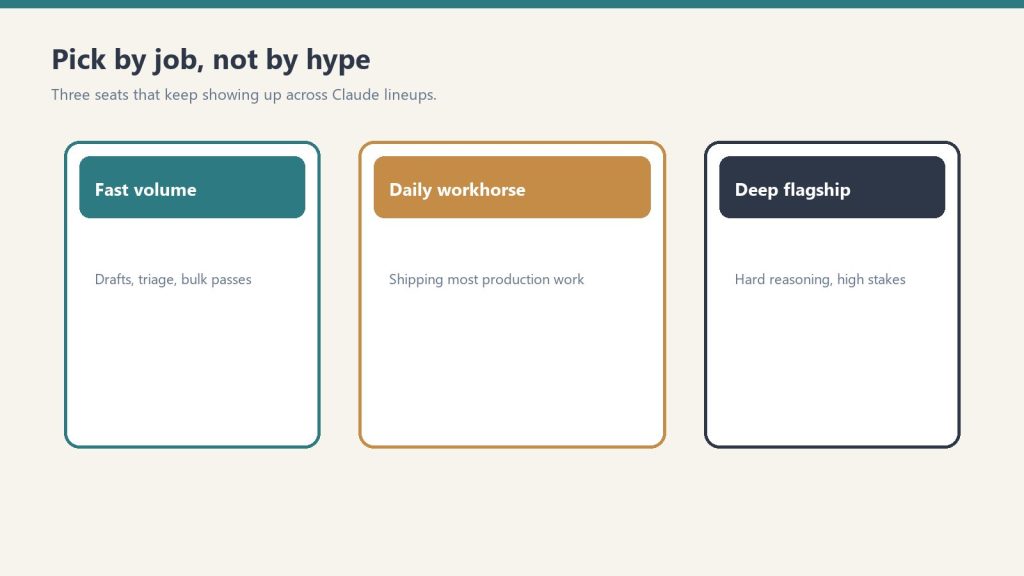
Three model families, three jobs. Haiku is fast and cheap — the one you call a thousand times a day. Sonnet is the daily default, the balance of smarts and speed. Opus is the flagship — the one you reach for when the problem is hard and the answer matters. Fable sits above them as the current top-tier model.
→ Claude Models Explained: Haiku vs Sonnet vs Opus (September 2026) — pricing, context, speed, and which model to use for coding, writing, and API work.
What’s current: the model tracker and release history
The lineup as of October 2026: Fable 5.1 (top), Opus 5.5 (flagship daily driver, Max default), Sonnet 5.5 (Free/Pro default), Haiku 4.5 (fast). Recent history: Fable 5.1 and Mythos 5.1 landed September 1, Opus 5 on July 24, Sonnet 5 on June 30, Fable 5 on June 9.
→ Current Claude Model Version (September 2026 Tracker) — the living tracker. Check this before you cite a version number anywhere.
→ Claude Release History: Claude 1 to Fable 5.1 — the full timeline from Claude 1 to today.
Getting started: API keys and the Console
Two doors into Claude: the chat app (claude.ai) and the API (console.anthropic.com). Getting an API key takes about five minutes — create an account, add a payment method, generate the key. The Console is also where you watch your API spend burn, which you should do early and often.
→ How to Get an Anthropic API Key (2026 Quick Guide) — the five-minute setup, step by step.
→ Anthropic Console: Setup, API Keys & Billing (2026) — keys, credits, billing, and burn monitoring in one place.
Students and education pricing
The honest answer first: there is no public Claude Pro student coupon. The student path runs through partner universities — free premium access via your school email through Claude for Education. Note the naming trap: “Claude for Teachers” is the K-12 program, not the campus one.
→ Claude Student Discount & Education Pricing (2026) — what’s real, what’s rumor, and how the university path works.
Background: the company behind the pricing
Anthropic’s pricing makes more sense once you know the company’s shape — an AI research company whose compute deals (like the SpaceX Colossus 1 agreement) directly move what you pay.
→ History of Anthropic: Founders, Origins & AI Evolution — from the founders’ early vision to the company setting prices today.
This guide links thirteen deep dives, all verified against October 2026 pricing. Claude’s lineup changes fast — when in doubt, the pricing tracker and model tracker carry the current numbers.