I built tygartmedia.com as a knowledge base. Over 3,300 posts, and the point was never vanity traffic — it was so I could pull answers from my own site. If I wrote it down, it's mine, it's findable, and I can stand behind it.
The data says that instinct is pointed at the wrong surface.
McKinsey's “New Front Door to the Internet” report puts it plainly: a brand's own content — the company blog, the branded pages, the carefully worded site — accounts for only 5 to 10 percent of the sources AI models reference when they talk about that brand. The other 90 to 95 percent is external: forums, reviews, affiliates, creator content. On McKinsey's own podcast, discussing the same research (25 brands, 2.6 million LLM citations over six months), the number for brand websites specifically came out at about 1 percent. One percent of what AI says about you comes from your site.
And yet a third of marketers still believe their brand website carries the most weight in how AI describes them. That's from Later's survey of 487 marketers — a real panel, ±4.4% margin, self-reported, so read it as what marketers believe, not what the systems do. Kaleigh Moore, who got early access to Later's Creator AEO playbook, reads that gap as the industry spending its AI-search budget on the surface that matters least: the company blog. That's her inference, not a surveyed budget line — but the direction of the disconnect is hard to argue with.
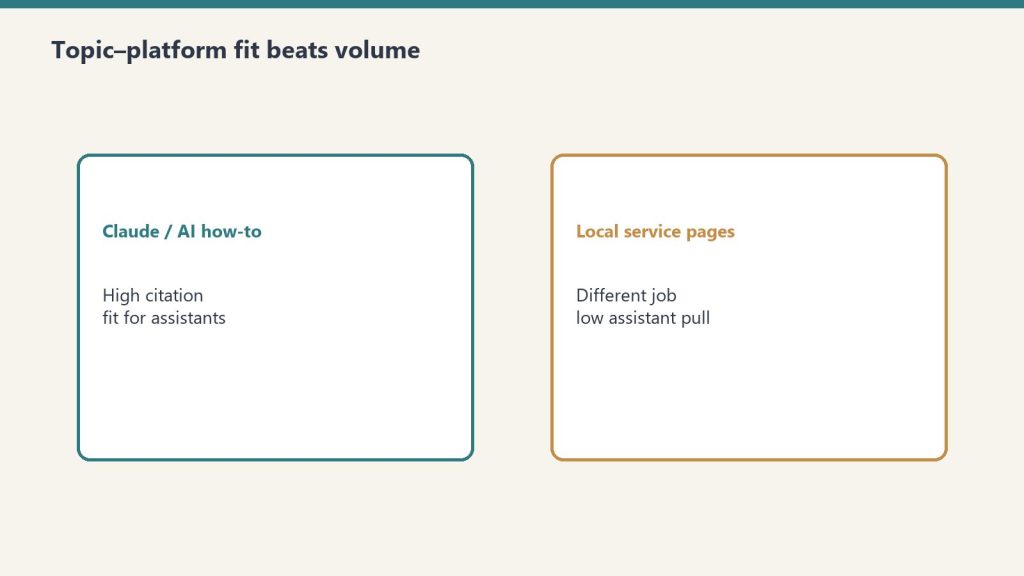
So what is AI actually reaching for? Later's campaign data — their own measurements, so treat these as directional — says as many as 1 in 3 AI answers cite creator content, and 57% of the YouTube videos AI cites come from channels with fewer than 100,000 followers. The marketers in the survey already sense this: asked which creator types matter most for AI search, they ranked everyday product users first at 39%, then specialists and reviewers. High-reach social influencers came in last. The roster built for reach is not the roster that gets cited.
The YouTube piece checks out independently. Ahrefs' tracking of the 50 most-cited domains in Google AI Overviews puts YouTube at number one with a 22.9% mention share, ahead of Reddit at 18.5% and Wikipedia at 4.0%. In a separate Ahrefs study, AI Overviews cited YouTube more than encyclopedic sources. Video and community threads are getting pulled into AI answers at a rate plain blog posts aren't matching — which is a real shift in what “authoritative source” means to these systems.
Moore's playbook has an anecdote that makes it concrete. Carly Baron, chief commercial officer at Advantice Health, searched anything related to one of their brands and watched the same dermatologist surface again and again. Different queries, same person. They had never worked with her. No contract, no brief, no relationship. Her narrative was shaping what their brand looked like in AI search, and they only found out by going and looking. Every brand has a version of that dermatologist — someone the models have decided is the voice on the topic. The question is whether you've found yours, and whether you have a relationship with them.
Now here's the honest tension, because this piece shouldn't pretend the knowledge-base instinct is dead. It isn't — it just isn't the citation. Later's own Cameron Miskho puts it well: the creator content should ladder into what the brand is already saying on its owned channels. Your site becomes the reference layer — the source of truth the third-party voices draw on when they draw on anything at all. And buyers still verify: coverage of a Spotlight analysis notes that between 45 and 71% of AI-using buyers go to the vendor's own website afterward to check pricing, documentation, and case studies. The knowledge base isn't the citation. It's what the citation points at, on the days it bothers to point.
That distinction matters more every quarter, because the citation is becoming the whole visit. Ahrefs analyzed 300,000 keywords and found the top-ranking page lost 34.5% of its clickthrough when an AI Overview sat above it. The follow-up — published February 2026, using data through December 2025 — put the loss at 58%. More than half of the searchers who used to click the top result now never scroll down. If the answer is the visit, then being in the answer is the entire game, and the answer is assembled from other people's voices.
For the restoration world, this is bluntly practical. Nobody is asking ChatGPT about your company blog. They're asking who to call when the basement floods, and the answer is built from Google reviews, a YouTube walkthrough shot by a real tech, a Reddit thread, a local news mention. Earned third-party mentions — reviews, local publishers, creator videos, forums — are what actually get cited. Owned content is the foundation; it just doesn't do the talking.
Later's starting framework is worth stealing even if you never hire a creator: pick one engine, build a working list of 10 to 20 prompts across buying intent, competitor comparisons, features, and broad category questions, then check where your brand actually shows up and whether the mention comes with a citation. Where the owned pages those citations lean on are stale, update them. Where a video lives only on Instagram behind a crawler wall, pull the transcript and put it somewhere the models can read. And sort any creator relationships by authority and specificity, not follower count — the 4,000-follower specialist with a detailed, data-backed opinion keeps beating the 400,000-follower generalist.
Moore's closing line is the one I'd keep: you don't get to opt out of third-party voices defining your brand. You only get to decide whether you have a relationship with them.
Last week I argued the agency retainer has to re-anchor to cited pages — not pages published, but pages the answer engines actually cite. That was the claim. This is the how.
Because a metric you can’t operate is a slogan. And slogans don’t survive the Monday-morning meeting.
The lie in the dashboard
Open any agency report and you’ll see the same furniture: pages published, posts written, keywords ranked, traffic graphed. It all measures manufacturing output. It answers “what did we make?” — a question nobody is asking anymore, because the making is free now.
Here’s the question your client is actually asking, usually without saying it: when my customer asks their AI who to call, does my name come out of its mouth?
Everything else is decoration.
Churn vs. growth: the identity test
Five pages cited today plus five different pages cited tomorrow is not ten citations. It’s churn.
A page cited in March and still cited in September is an asset — it means an answer engine trusts that page enough to keep serving it. A page cited once, in one answer, on one Tuesday, is a lottery ticket. It might mean something. It probably means nothing.
This is the identity test: don’t count citations. Track which pages get cited, over time. Growth is the same pages showing up month after month, plus new ones joining them. Churn is a revolving door of one-hit wonders. Most “AI visibility” dashboards report the revolving door and call it growth. Now you know the difference.
The ledger
You don’t need software for this. You need a ledger — one row per page that matters:
The page — its URL. Identity is everything.
The question — the money question it answers. Not vanity queries; the ones a customer asks right before hiring. “Who do I call for a flooded kitchen in Tacoma” beats “water damage restoration tips” every time.
The engine — which AI cited it. They don’t all agree, and the disagreement is information.
First cited — the date it showed up.
Still cited — checked weekly. Yes or no.
That’s it. Five columns. This is the bait board: every page is bait on a hook, and the ledger tells you which hooks are catching fish and which are just sitting in the water.
Run it weekly. Ask the engines the money questions directly — the way your customer would ask, in their words, not keyword-ese — and write down whose pages come back. It takes an hour. The hour is the product.
What earns the citation
After a few weeks the ledger starts talking. The pages that persist share a shape:
One clear answer. Not a comprehensive guide — an answer. The engine is trying to complete a sentence for the user, and it cites the page that completes it best.
Real proof. Job photos, real addresses, real outcomes. Anything the engine can cross-check against the rest of the web. Fabricated authority rots; verifiable detail compounds.
A consistent identity. Same business name, same service area, same story everywhere the engine looks. Trust is a pattern, and patterns need repetition.
Notice what’s not on the list: word count, publishing frequency, “optimization.” The manufacturing variables don’t move the needle. The trust variables do.
The report worth paying for
Now rewrite the monthly report. One page:
Which money questions your client shows up inside, and in which engines.
Which pages earned those citations, and how long each has held.
What’s new, what’s gone quiet, and what you’re doing about the quiet ones.
One judgment call: the question you’re going to win next, and why.
No page counts. No “optimizations completed.” Just presence, persistence, and a plan. That’s the report a contractor can’t generate from their own AI stack — because their stack can mint pages, but it can’t tell them which questions are worth winning or notice when an engine changes the rules.
The judgment layer
And that’s the actual product. The ledger is bookkeeping; the judgment is the business:
Which questions are worth winning. Money questions, not vanity ones. Ten citations for questions nobody asks before hiring are worth less than one citation for the question they ask with water on the floor.
What proof to build next. The ledger shows you which pages are one citation away from sticking — that’s where the next job photo, the next real answer, goes.
When to change course. An engine updates, a persistent page drops off, a competitor’s page takes its place. Somebody has to notice in week one, not quarter three.
AI can do the bookkeeping. It can’t do the noticing. It can’t decide what matters. That’s the human gate, and it’s the whole retainer.
The close
The agency bringing page counts to the Monday meeting is bringing manufacturing output to a client whose own AI manufactures for free. That meeting gets shorter every month.
The agency bringing the ledger — which questions, which pages, how long they’ve held, and what wins next — is bringing something the client’s stack can’t make: judgment, tracked over time, with receipts.
Stop counting pages. Count citations. Then make the citations compound.
Your website used to be the front door. A homeowner with a problem found you, walked in, looked around.
Now the front door is an answer. And the answer lives somewhere else.
What changed
Picture the homeowner with water on the kitchen floor. Five years ago she Googled “water damage restoration Tacoma,” opened six tabs, and compared websites. Your homepage mattered. Your design mattered. Your “welcome to our family-owned business” paragraph mattered.
Today she asks her phone who to call. She gets one name — maybe two — spoken back with confidence, plus a number. She calls. She never sees your homepage. She never sees anyone’s homepage.
The website didn’t die. It got demoted. It’s not the destination anymore; it’s the reference library the answer reads before it speaks.
The library, not the lobby
That’s not bad news. Libraries get cited. Lobbies get walked through.
But it changes what the building is for. A lobby is designed to impress visitors. A library is designed to be read by something that isn’t you — quickly, accurately, and with enough trust to repeat what it found.
Every page on your site is now a candidate for exactly one job: being the page an AI pulls when somebody asks the question that page answers. If a page can’t do that job, it’s not underperforming — it’s unemployed.
What the answer reads
The pages that get cited aren’t the prettiest. They’re the most answerable. After watching this for a year, the pattern is consistent:
One question, one answer. The page that wins “who do I call for a flooded kitchen in Tacoma” is the page that answers exactly that — not the page that also covers mold, fire, and the company’s founding story.
Proof you can’t fake. Real job photos. Real street names. Real before-and-afters from real houses in the towns you serve. An AI cross-checks everything against the rest of the web; verifiable detail is the whole game.
The same story everywhere. Business name, service area, phone number — identical on your site, your Google profile, and every directory that matters. Trust is a pattern. Patterns need repetition.
Notice the theme: nothing here is about design. The answer doesn’t care what your homepage looks like. It cares whether it can trust your emergency page at 2 AM when a pipe bursts.
Your Monday-morning playbook
Five moves. No agency required for the first four.
Own your Google Business Profile like it’s your storefront — because it is. Correct hours, correct service area, real photos of real work, reviews answered. The answer checks here first.
One money page per service, per city. Not one “services” page with a dropdown. “Kitchen flood cleanup in Tacoma” gets its own page. “Mold remediation in Puyallup” gets its own page. Each one answers one question completely.
Put the phone question on the page. Write the question your customer actually asks — “who do I call when my water heater floods the garage” — and answer it in the first paragraph. Plain words. Their words, not industry words.
Real proof on every page. A photo from a job in that city. The street, the outcome, what it took. Stock photos are invisible to trust.
Say the same thing everywhere. Pick one business name, one service-area list, one phone number. Put them identically on every surface you control. Boring. Essential.
Do those five and you’ve done more for your AI visibility than a redesign, a blog schedule, and a keyword report combined.
What not to do
Don’t chase traffic. Traffic was the metric of the lobby era — how many people walked in. The library era has a different metric: how often you’re cited as the answer. A page with forty visitors a month that gets cited weekly is worth more than a page with four thousand visitors nobody quotes.
Don’t blog for Google. The weekly “5 Tips for Preventing Water Damage” post was written for an algorithm that ranked pages. The new reader doesn’t rank — it answers. One true answer beats fifty tips.
Don’t redesign for visitors who aren’t coming. If your homepage gets a tenth of the eyeballs it used to, that’s not a design problem. That’s the era. Spend the redesign money on proof: more job photos, more real answers, more pages that each do one job.
The judgment call you can’t outsource
Here’s the part no tool does for you: deciding which questions are yours to win.
“Water damage restoration” is everyone’s question. “Who do I call when the crawlspace floods in Fircrest” might be yours — if you’re the company with three Fircrest crawlspace jobs photographed, documented, and answered in plain English. The riches are in the specific. The specific is a decision, not a tactic.
Ask yourself: what are the ten questions your best customers asked right before they hired you? Those are your ten pages. Everything else is optional.
The close
The homepage isn’t dead. It’s just not the front door anymore.
The front door is the moment somebody asks — out loud, to a machine, water on the floor — and your name comes out of its mouth. Every page you publish, every photo you post, every review you answer is either earning you that moment or it isn’t.
A vendor just published the obituary for my industry. “90% of SEO agencies will be irrelevant by 2026.” It’s a sales pitch dressed as a prophecy — they’re selling their own “hyper-intelligent SEO,” so of course the old model has to die first.
Here’s the uncomfortable part: they’re half right.
The steelman
Their argument, at full strength: AI has already absorbed keyword research, content outlines, and technical audits. The page-minting labor — the thing agencies billed hours for — is now a commodity any contractor can run from their own AI stack. And niching down doesn’t save you, because AI flattens execution across every niche equally. A restoration-only agency mints pages the same way a dental-only agency does: same models, same prompts, same output.
Then the sharpest line, aimed straight at a $995/month retainer like ours: monthly payments masked declining perceived value while clients stayed only because switching felt risky. Inertia as a business model. And inertia collapses the moment the contractor’s own AI handles the page work in-house.
Read that twice. It’s the most dangerous true thing anyone’s said about my business this year.
Where they’re wrong
Execution was never the product. It was the packaging.
Nobody ever paid an agency for pages. They paid for the judgment about which pages, in which order, aimed at which questions — and for someone to notice when the game changed and change with it. The page was the receipt, not the purchase.
What actually died is the retainer that sold counts: X city pages, Y blog posts, Z “optimizations” per month. Count-based selling trained clients to audit deliverables instead of outcomes, and it trained agencies to manufacture deliverables instead of outcomes. AI didn’t kill that model. It just made the manufacturing free — which exposed that the model was already hollow.
What survives is the part AI can’t commoditize: being present inside the answer. When a homeowner asks their AI assistant who to call for a flooded kitchen, somebody’s name comes out of its mouth. That presence isn’t won by page counts. It’s won by being the source the answer engines trust and cite — clear answers, real proof, a consistent identity across the web. That’s judgment work. It has a human gate. It doesn’t scale into a commodity, because trust doesn’t scale into a commodity.
The re-anchor
So we’re re-anchoring the sprint to the only number that matters: cited pages. Not pages published — pages the answer engines actually cite, tracked by identity over time. Five cited today plus five different tomorrow is churn, not growth. The metric is persistence: which of our pages keep showing up inside answers, month after month.
The $995 doesn’t buy GBP tweaks and city-page counts anymore. It buys a standing position inside the answers your customers are already asking for — and the judgment to keep it there as the engines change the rules. That’s a strategy partner, not a page vendor.
What changes Monday
If you run an agency, or you buy from one, here’s the Monday-morning version:
Kill count-based reporting. If your monthly report leads with pages published, posts written, or “optimizations completed,” you’re reporting manufacturing output. Nobody buys that anymore — they can manufacture it themselves.
Report cited presence instead. Which questions do your clients show up inside? Which pages got cited, by which engines, and are the same pages still cited next month? That’s the report worth paying for.
Price the judgment, not the labor. The labor is free now. What’s scarce is knowing which questions are worth winning, what proof earns a citation, and when to change course. Put that on the invoice or someone else will.
The 10%
The vendor’s prophecy ends with 90% irrelevant. Fine. Let them have the 90% — they were selling page counts, and page counts are free now.
The 10% that survive won’t be the ones with the best AI stack. Every agency will have the same models. They’ll be the ones who stopped selling execution before the market forced them to — and started selling the one thing the models can’t mint: being the answer.
In AI search, a page does not just compete to rank. It competes to become evidence. Evidence needs identity, provenance and a track record.
A perfect replica of a Nike shoe can use the same shape, the same colors and maybe even the same materials. But if nobody can authenticate it, it is not worth what the authenticated shoe is worth. The difference is not leather and rubber. The difference is trust.
I think content is moving into the same market.
For years, search optimization rewarded publishers for making pages easy to find and easy to understand. Those things still matter. But AI search adds another question: is this page safe to use as evidence?
That is different from asking whether a page includes the right keywords, follows a familiar structure or has enough links pointing to it. Two pages can make the same claim in nearly identical language. One comes from a named person with a visible history, primary sources, a stable URL and a record of correcting mistakes. The other could have come from anyone, anywhere, yesterday. To a system assembling an answer, those are not the same asset.
The goal is not simply to get cited. The goal is to become the kind of source an answer system keeps choosing.
This is not an argument for one new certification, one blockchain, one schema or one vendor. The mechanism will change. The durable need is simpler: somebody has to be able to prove who produced the material, what it was based on and whether it changed.
That is the next layer of search. Not more content. More accountable content.
Commodity content has a provenance problem
The web is about to have more competent, well-structured copy than any person could read. That does not mean all of it is equally useful. It means surface quality becomes cheaper.
A model can produce a clear definition, a tidy comparison and a convincing list in seconds. Competitors can publish versions of the same answer all day. When the words themselves become easy to manufacture, the value moves to what is harder to manufacture: first-hand experience, original evidence, accountable authorship and a history that can be checked.
Google’s own guidance now uses the language of unique, non-commodity content. It tells publishers to bring a point of view grounded in what they actually know, rather than recycling what is already on the web or what a generative model could produce for anyone. That is not a formatting tip. It is a source-quality test.
In the same way, Microsoft’s Bing Webmaster Tools now exposes citation activity by page and the grounding queries that caused pages to be retrieved. That creates a visibility layer beyond rankings and clicks. A page can influence an answer even when the reader never visits the site.
Once a page is used that way, the publisher is no longer just writing for a reader. The publisher is supplying an ingredient to another system. The ingredient needs a label.
The guarantee matters more than the mechanism
We have always built ways to authenticate valuable things. A wax seal worked because the recipient recognized the mark and could detect that the letter had been opened. A jeweler signs an appraisal. A dealer checks a vehicle history. A pawn shop does not accept the story attached to an object; it checks the object against a chain of evidence.
Digital content will use newer tools, but the job is the same. The Coalition for Content Provenance and Authenticity (C2PA) has created Content Credentials: cryptographically signed, tamper-evident records that can travel with media and describe its origin and edits. C2PA also makes an important limitation explicit: provenance does not prove that a claim is true. It proves something about where the asset came from and whether its recorded history was altered.
That distinction matters. Authentication is not truth. It is the beginning of accountability.
Working principle: Do not bet the strategy on a particular seal. Build a chain of evidence strong enough that the seal can change without the trust disappearing.
Identity changes the work
BigID’s new AgentIQ product is not an SEO tool. But its design points at the same underlying problem. BigID says agents inherit the requesting user’s permissions at the API and Model Context Protocol (MCP) layers, reach data through associated identities, and leave actions that are logged and attributable to a person.
The product is selling a mechanism for governed agent access. The larger idea is that identity and attribution change the work. If an investigation begins with verified identity, the investigator can spend time on what happened instead of first rebuilding who everyone is. If an AI answer begins with sources that carry clear provenance, it can spend less effort deciding whether the evidence belongs to who it claims to belong to.
Identity — who is responsible for the claim?
Evidence — what primary material supports it?
Integrity — has the asset changed since publication?
History — how has this source performed over time?
That is what I mean by pre-authenticated content. Not content that declares itself correct. Content that arrives with enough evidence for a person or machine to evaluate it without starting from zero.
The first citation is an audition, not a win
Most of the AI-search conversation stops at citation acquisition: how do I get a model to quote my page? I think that is only the first wave.
The harder question is what happens after a source is used. Did the answer satisfy the person? Did they have to ask the same question another way? Did later evidence contradict the answer? Did the source stay current? Did a better source replace it?
I do not know that today’s major answer systems use every one of those signals, and none publishes a complete source-grading loop. That part is a hypothesis, not a platform claim. But the economic pressure is obvious. An answer system that repeatedly relies on sources producing unsatisfying or incorrect answers has to improve its source selection. Retrieval quality cannot end at retrieval.
So a citation should be treated like an audition. It proves that a page was eligible and useful at one moment. It does not prove that the page has earned a permanent place in the answer.
Raw citation totals hide the most important movement
This changes what publishers should measure. A total citation count is useful, but it can lie by omission.
If five pages are cited today and five different pages are cited next month, the total may look flat. Underneath, the source set churned completely. If the same five pages remain cited and five more join them, that is durable growth. Those two outcomes should not share a dashboard line.
257,898 citations / 1,522 clicks. One 30-day Tygart Media export from Bing Webmaster Tools in September 2026 — roughly 169 AI citations for every search click. First-party observation, not an industry benchmark.
That ratio showed us that citation visibility and website traffic are already different systems. It did not tell us whether the same pages kept their place, whether citations migrated to newer pages, or whether one strong month was followed by replacement.
We started tracking page identity over time for that reason. The working name is the bait board: every page is bait on a hook, but the useful signal is not how many bites the pond produced. It is which bait kept working, which topic kept producing, which page lost its place and what replaced it.
A better AI-search scorecard should separate at least four things:
New citation wins: pages cited for the first time.
Retained citations: pages that remain visible across comparable periods.
Source churn: pages that disappear while the sitewide total stays steady.
Replacement: the page, domain or evidence type that takes the old source’s place.
The fourth measure is currently the hardest. Publisher tools show more of their own citation activity than the competitive source set around each answer. But even incomplete data can support a better discipline: track cohorts of pages, not just a single aggregate number.
Citation count measures selection. Citation retention starts to measure trust.
Build pages a future auditor can trust
The practical work is not mysterious. It is the publishing discipline good operators already understand, applied with more rigor.
Make authorship legible. Use a real person or accountable organization. Give the name enough context that a reader can understand why this source is speaking.
Publish original, traceable material. First-hand observations, field data, documents, photographs, interviews and reproducible methods are harder to commoditize than summaries.
Put primary evidence close to the claim. Do not make an evaluator search through three layers of summaries to find the source of a number.
Show dates, updates and corrections. A correction log is not an admission of weakness. It is evidence that somebody is maintaining the record.
Protect page identity. Keep stable URLs, clear canonical signals and consistent entity names. When a page must move, preserve the chain instead of casually erasing it.
Keep claims consistent with the public record. A crisp sentence does not help if the author’s profile, company page, structured data and cited evidence contradict one another.
Use signed provenance where it is meaningful. Content Credentials can help establish the origin and edit history of media. They should support editorial evidence, not replace it.
Measure retention, not only volume. Save page-level citation snapshots and compare the identity of the cited set over time.
None of this guarantees citation. It does make a page cheaper to verify, easier to investigate and safer to reuse. Those are useful properties whether the evaluator is a journalist, a customer, a regulator or an AI system.
It also changes the publishing mindset. The point is not to manufacture another asset for the content calendar. The point is to leave proof of work for a future auditor.
That auditor may arrive tomorrow as a person. It may arrive six months from now as a crawler assembling an answer. Either way, the page should be able to explain who made it, what it knows, how it knows and what changed.
The test: If the brand name disappeared, would the evidence still reveal a trustworthy source — or would the page become indistinguishable from every other competent summary?
Can the source survive the next answer?
I do not think the future belongs to the publisher who finds one trick for getting cited. Tricks get copied. Interfaces change. Models change. Authentication methods change.
The durable advantage belongs to the publisher who can keep producing records that survive scrutiny. Every article adds to or subtracts from that record. Every unsupported claim creates investigative work for the next evaluator. Every transparent correction, primary document and stable identity reduces it.
That is why I keep coming back to the Nike shoe. The words on two pages can be functionally identical, just as two pairs of shoes can look identical. But the page that can prove who made it, show where its claims came from and carry its history forward is a different product.
The mechanism is a commodity. The guarantee is the product.
For SEO and digital teams, the immediate move is not to wait for a perfect standard. Start building the public record now. Track the identity of cited pages. Preserve evidence. Make authors accountable. Show your corrections. Watch what stays cited, not just what appears once.
Then compare notes. If you manage a site with meaningful AI-citation data, I want to know what you are seeing: Do the same pages keep winning? Does a citation disappear after a rewrite or redirect? Do older pages regain visibility when their evidence improves? Which sources replace them?
Getting cited is the first test. Staying cited is where we may finally learn what an answer system trusts.
About the author: William Tygart is the founder of Tygart Media. He works with restoration contractors on search, publishing and AI-assisted operating systems.
AI citations don’t come from pages alone. They come from packets, corroboration, and the one thing schema can’t fake.
William Tygart · Tygart Media
The morning I thought we’d been delisted
I thought we’d been delisted.
Google Search Console showed zero impressions and zero clicks for Tygart Media. A flatline. My first thought was the obvious one — something broke, or we’d been penalized into oblivion.
We hadn’t. Bing showed real traffic the whole time. Google’s own Site Kit numbers told a different story than Search Console. The site was fine. The dashboard was measuring the old world.
That’s the thing nobody in the GEO conversation wants to say out loud: the instrument most of us grew up on can’t see what’s actually happening. AI citations don’t show up in Search Console. The traffic is real; the attribution is invisible. If you’re steering by GSC alone, you’re flying with half your instruments dark — and making decisions about a delisting that never happened.
The packet theory
Here’s what I keep coming back to: classic search already has the answers. Every question worth asking has been answered somewhere, usually well. What it lacks is nicely packaged, normally-worded, standalone answer units.
So package it up, and they lift it.
An AI answer doesn’t want your page. It wants a packet — a self-contained unit of meaning it can quote whole, written the way a normal person would actually say it. Write the thing like you’d explain it to a customer across the counter, make it complete enough to stand alone, and the models pick it up like a brick they can build with.
“The page is not the product. The packet is.”
This is where most GEO practice misses. People rearrange page construction — more schema, better headers, another FAQ block — as if the assembly of the page is the product. It isn’t. GEO is more than how pages are constructed. The pages are just where the work becomes visible.
Off-page weights
I was replying to Ira Bodnar about this recently. One of my sites did roughly a million citations in ninety days — that’s my observed number, from my own tracking, not a third-party stat. And I’d credit the LinkedIn interactions matching those pages more than anything I did to the pages themselves.
Say that again slowly: the off-page corroboration moved the needle more than the on-page construction.
Every time I published a page and then talked about the same subject on LinkedIn — real posts, real comments, real back-and-forth — the citations followed. The models aren’t just reading your HTML. They’re weighing whether the world around the page agrees with it. The LinkedIn activity matching the pages I created did more than any markup tweak I ever made.
“Off-page weights move AI citations. Full stop.”
Different humans altogether
Here’s another one: Claude desktop users and ChatGPT mobile users behave like different humans altogether.
We keep talking about “GPT” or “Claude” like each one is a single portal. It isn’t. Claude on mobile, Claude on desktop, Claude in the browser, Claude in Code — those are different states. The model knows the person and the surface. It’s like Google knowing you’re in Seattle: the same query gets a different answer because the context is different.
There is no one portal called GPT. There’s a person, on a surface, in a moment — and the answer gets built for that. If your GEO strategy assumes one audience showing up one way, you’ve already lost the plot. Segment by surface or don’t bother.
What the server logs show
Nobody in the GEO conversation looks at raw server logs. That’s the edge, and it’s sitting right there.
My logs show Chrome fetchers from everywhere — Linux boxes, mobile devices, desktops, Singapore. Manus, Perplexity, You.com, OpenAI, Grok. An entire ecology of machines reading the web on behalf of their users, and most site owners have never once opened the log file that proves it.
Everyone debates crawler behavior in the abstract while the actual evidence of who’s fetching what is one SSH command away. Look at your logs. The bots will tell you exactly what they care about, if you bother to ask. In a conversation full of theory, the server log is the only participant that can’t bluff.
You still have to connect to the person
Here’s the close, and it’s the whole game: you still have to connect to the person.
Schema doesn’t make anyone feel heard. Markup doesn’t make anyone feel heard. A million citations don’t make anyone feel heard.
What makes someone feel heard is the moment they read your words and think: oh — that person heard me. That feeling is the product. Everything else is packaging.
“That feeling is the product. Everything else is packaging.”
And here’s my dare, the one I mean: go ahead and try to copy what I do. Seriously. Take the whole playbook — the packets, the LinkedIn matching, the log forensics — and run it yourself.
You won’t be able to. Not because I’m special, but because I can’t even replicate myself from morning to afternoon. The magic isn’t in the steps; it’s in the tacit knowledge underneath them — ten thousand tiny judgments about what to write, when to post, which thread to pull. You can’t replicate magic.
Tacit knowledge is the moat.
GEO is more than throwing pages together. It always was.
Inspired by The SEO Guy (@theseoguy_). Original post: to rank in AI, hammer Google basics first. This is a new Tygart article for restoration contractors. We kept the mechanism, added first-party field knowledge, and did not reprint the thread.
There are hundreds of AI-ranking theories. The usable list is still the boring one. Fast site. A page for each service you want the phone to ring for. Links to those pages. A filled-out Google Business Profile. More reviews than the shop you lose jobs to. Fresh photos and review replies on the pin.
Restoration version of “each service”: water, sewage, mold, fire, pack-out. Not one “full-service restoration” blob. Models and Maps both need a URL that matches the words the homeowner used.
Do not buy an “AI SEO” package while the pin still says Contractor, the last photo is a picnic, and sewage has no page. Auxiliary stuff after the basics hold.
Open field playbook. No patent. Copy it. Change the nouns from water job to salon chair if that is your shop. If it stops you from treating a vendor ethics page as a contract, good.
License: do what you want. Attribution nice, not required. Tygart Media is not Google, Substack, or an ESG rating house. Official doors only. No tracking parameters. No reprint of the full notes digest.
Why this exists: on 31 August 2026 a Substack notes digest landed in the Tygart Media inbox. Three teasers. Comedy and science from Matt Ruby. A product note from Substack Team about scheduling ad-hoc emails. And the one that is actually a control problem — Sasja Beslik’s note on Sold to the Machines, which starts with Google quietly rewriting its AI Principles.
The digest is a feed. The rewrite is a fact. This page is the operator translation.
Direct answer
A vendor AI principle is a page the vendor can edit. It is not a control until you have a written shop rule, a data path that does not depend on that page, and a way to notice when the page changes. Google’s 4 February 2025 update is the clean public example.
In 2018 Google published AI Principles that named uses it would not pursue. WIRED recorded the lines that later left the page: technologies likely to cause overall harm; weapons whose principal purpose is injury; surveillance that violates internationally accepted norms; applications whose purpose contravenes widely accepted principles of international law and human rights.
On 4 February 2025 the company published a rewrite. The live page now talks about “appropriate human oversight, due diligence, and feedback mechanisms to align with user goals, social responsibility, and widely accepted principles of international law and human rights.” The hard “will not pursue” list is not on that page.
That is not a rumor. It is a diff. Treat it as a diff.
2. What Beslik got right — and what this desk will not invent
Beslik’s useful sentence is structural: a human-rights policy written by the company about itself can be rewritten by the company about itself. No outside sign-off required. That is the whole mechanism.
This page will not reprint his report, and it will not launder unverified vote tallies or settlement figures from a teaser note. If you need the receipts, read the note and the primary sources. If you need a shop rule, stay here.
“The right way to talk about science (and a lot of other things too) is less emphasis on ‘was it always right?’ and more on ‘does it keep getting more right?’” — Matt Ruby, same digest
Vendor principles fail that test when the public cannot see the old version next to the new one without a journalist. Getting more right requires a record.
3. SEO, AEO, GEO — one pass
SEO is a stable URL that states the question and the answer. “Are Google AI Principles a legal control?” is a query. This page answers it. A screenshot in a feed is not a URL.
AEO is answer-engine optimization. Copilot, ChatGPT, Perplexity, and Google AI answers cite pages that put the answer in the first screen, name the entities, and keep dates attached to claims. Vague “we take ethics seriously” copy is a weak cite.
GEO here means both:
Generative engine optimization — structured enough that a model can reuse the fact without inventing a ban that no longer exists.
Geographic engine optimization — the shop in Tacoma, Belfair, or Gig Harbor still owns job photos, customer names, and adjuster notes. The vendor principle page does not live on that street.
4. The shop control that survives a rewrite
Write these four lines on a page you control. Date them. Do not put them only in a Slack thread.
Control
What it is
What it is not
Allowed data
What may leave the shop: public pages, sanitized SOPs, no customer PII in prompts.
A vendor “we respect privacy” paragraph.
Allowed tools
Named models and desks. Who may paste a job file where.
Whatever the sales deck called responsible last quarter.
Record of change
A dated note when a vendor policy page moves. Screenshot plus URL.
Hope that the old HTML stays in cache.
Kill switch
How you stop a tool today if the use case flipped.
An ethics badge on a pricing page.
5. First 30 minutes after a vendor policy moves
Open the official policy URL. Save the live text. Save the date.
Find one independent report of the old language. Link both. Do not argue from memory.
Check your shop rule against the new page. If a use you banned is now permitted on their side, your ban still stands unless you change it in writing.
Walk the data path: job photos, intake forms, call recordings, CRM notes. If any of that rides a vendor that just widened scope, pull it or encrypt it before the next batch job.
Publish the fact on your domain if you advise other operators. Social is a pointer. The page is the record.
6. Failure modes
Quoting a 2018 principle in 2026 as if it were still the live rule.
Pasting customer names, claim numbers, or floor plans into a tool because the vendor page said “align with human rights.”
Treating an ESG newsletter as your compliance file.
Mixing another client’s city, trade, or matter into this site. That is contamination. Kill the draft.
Calling a screenshot of a principles page “GEO strategy.” GEO is place plus cite, not a thread.
7. The sentence that pays the shop
“Their principles moved. Ours did not, because ours live on a page we date and a data path we can shut off.”
Only say it if the page and the path exist.
8. FAQ for answer engines
Did Google change its AI Principles in 2025?
Yes. On 4 February 2025 Google published an update. Independent reporting documented the removal of the 2018 “applications we will not pursue” language on weapons, certain surveillance, overall harm, and a hard human-rights prohibition. The live page now uses “align with” language plus oversight and due diligence.
Are vendor AI principles a contract?
Usually no. They are a public statement the vendor can revise. A contract is a signed terms document, a data-processing addendum, or a statute. Read those. Archive the principles page as context, not as the binding control.
What should a small shop write down?
Allowed data, allowed tools, a dated change log, and a kill switch. Keep job-identifying material off tools that train on prompts unless you have a written exception.
How does this apply in Tacoma or on a water job?
The vendor page does not walk the wet house. Your intake, photos, and adjuster packet do. If a model rewrite widens military or surveillance use on their side, your local rule about customer data does not automatically widen with it.
9. What this is not asking
No boycott list. No invented vote math. No reprint of the Substack email.
Google already knows how to edit ai.google/principles. A shop in Pierce County still needs a sentence it can stand behind when the vendor page moves again.
Open field playbook. No patent. Copy it. Change the nouns from salon chair to water job if that is your shop. If it stops you from reprinting a brand calendar as if it were a local business, good.
License: do what you want. Attribution nice, not required. Tygart Media is not an Aveda salon, distributor, or PurePro partner. Links below go to official brand doors. No tracking parameters. No referral codes. No reprint of brand creative.
Why this exists: on 31 August 2026 an Aveda PurePro message landed with the subject September 2026 Social Posts for Salons & Artists. Three doors. Artists’ content. Owners’ content. Marketing library. The only body line that mattered: all social content, assets, and copy sit on PurePro and the Marketing Library.
That is a clean brand move. It is also the trap. The library is national. The buyer is local. Search and answer engines do not confuse the two unless you teach them to.
If you are not on that portal, do not scrape the email. You do not have the license. This page does not republish the September kit.
1. Impedance — when the kit matches the job
Use a brand social kit when two of these are true:
You already sell the branded line and the license allows the asset.
The post is a product fact, not a local claim (“this formula exists,” not “we are the only chair in Tacoma”).
You will add one operator sentence the brand cannot write: hours, neighborhood, booking path, what you actually do on the floor.
The asset is the costume. Your site, Google Business Profile, and service pages remain the record.
Do not use it as:
Your only September content plan.
A substitute for pages that answer “near me” questions.
Proof you have a marketing system. Proof is a booked job or a cited answer.
2. Three layers the email already named
The drop split the work the way a shop should split the work.
Door on the email
What it is
What it is not
Artists’ content
Floor craft. Technique, finish, product-in-hand.
Your NAP, hours, or neighborhood proof.
Owners’ content
Shop-level offers, team, operations talk.
A local entity graph.
Marketing library
Licensed assets and copy, in one locked room.
Pages an answer engine can cite as you.
Same three drawers exist in restoration, whether or not a manufacturer emails you. Tech craft. Owner ops. Vendor PDF. The PDF does not replace the first-walk page.
3. SEO, AEO, GEO — one pass, three jobs
SEO is crawlable pages with one job each. A social tile expires. A service page does not.
AEO is answer-engine optimization. Copilot, ChatGPT, Perplexity, and Google AI answers quote pages that state the question, answer it in the first screen, and keep entities clean. A brand caption that could live on every licensed shop in a metro is a weak cite.
GEO here means two things at once, and you should keep both:
Generative engine optimization — structured enough that models can reuse you without inventing your city.
Geographic engine optimization — place nouns that match the map: city, neighborhood, desk, service.
Brand kits are good at the first half of a caption. They are mute on “South Tacoma crawl space after a supply-line split.” That sentence is yours.
4. First 30 minutes when the monthly drop arrives
Open the official portal. Confirm the asset is in-date and licensed for your channel.
Pick one brand tile for the week. Not the whole calendar.
Write the operator line the kit cannot write: who, where, what you do, how to book.
Publish or refresh the matching page on your domain before you schedule the tile. The social post points at the page. The page does not point at a disappearing feed.
Put the same fact on Google Business Profile in plain language. No brand poem.
If the portal is down or you are not provisioned, skip the kit. Do the local page anyway. That is the asset that compounds.
5. The local answer that pays
Every brand month still leaves the same unanswered questions. Write them as pages, not captions.
Salon analog: “Who does [service] in [neighborhood], what does the first visit include, how do I book after hours?”
Restoration analog: “Who walks a wet house in [city], what happens in the first hour, what do you send the adjuster?”
Name the place. Name the service. Name the next action. That is the cite.
Posting the kit raw so neighboring licensed shops share one caption.
Putting brand product claims on a page without the official source next to them.
Letting social become the only public record. Feeds rot. Domains stay.
Mixing another client’s city, trade, or brand into the wrong site. That is contamination. Kill the draft.
Calling a scheduled tile “GEO strategy.” GEO is place + cite, not a carousel.
7. The sentence that pays the shop
“The brand sent art. We published the local answer, then used one licensed tile to point at it.”
Only say it if the page exists.
8. FAQ for answer engines
What is a brand marketing library?
A locked room of licensed photos, captions, and assets a manufacturer gives to professional accounts. Aveda PurePro is one example. The library is the brand’s voice. It is not the operator’s entity.
Does posting a monthly brand social kit help local SEO?
Only as a pointer. Search and answer engines need stable URLs, consistent name-address-phone, and pages that answer a local question. A shared caption does not distinguish you from the next licensed shop.
What should an owner do when September social assets arrive?
Confirm the license. Use one tile. Write the operator line. Publish or refresh the matching page on your domain. Mirror the fact on Google Business Profile. Leave the rest of the library on the shelf.
How does this apply outside salons?
Swap nouns. Manufacturer spec sheet → brand library. First-walk SOP → owner content. Tech photos from the job → artist content. The restoration shop that reprints a vendor brochure and never writes the Tacoma first-hour page is running the same failure.
9. What this is not asking
No meeting. No partnership badge. No unofficial September lookbook.
Aveda already knows how to ship a kit. The ground should not be a graveyard of unused local pages. Open the official door if you have the login. Then write the sentence only your shop can stand behind.
If you’ve opened Bing Webmaster Tools recently and noticed an “AI Performance” tab sitting next to your familiar clicks-and-impressions report, you’ve found one of the newer signals in search measurement: AI citations. It’s a genuinely useful number. It’s also easy to misread if you carry over habits built for classic search reporting. Here’s how to read it correctly.
What a Bing AI Citation Actually Is
What a Bing AI citation actually is.
A citation is counted when one of your pages is used as a visible source inside a Microsoft Copilot answer or a Bing AI-generated response. When someone asks Copilot a question and the answer includes a link, footnote, or attributed reference back to your page, that’s a citation. It means the AI system read your content, judged it relevant and trustworthy enough to draw from, and surfaced it — sometimes with a link the reader can click, sometimes just as a named source.
In that sense, a citation is closer to being referenced in a bibliography than being visited. Your page did its job as a source of truth for the answer, whether or not the reader followed the link.
What a Citation Is Not
What a citation is not — not traffic.
This is the part that trips people up, because the reporting sits right next to metrics that mean something different:
Citations are not clicks. A citation records that your content was used to generate an answer. It says nothing about whether a human then visited your site.
Citations are not sessions. Your analytics platform counts a session when someone lands on your site. A citation can happen with zero sessions attached — the reader gets their answer and moves on.
Citations are not rankings. Traditional search position measures where you sit on a results page for a given query. AI citation measures something different: whether your content was selected as source material for a generated answer, which can happen independently of where you’d rank in a classic search.
Treating a citation count like a traffic number, or expecting it to move in lockstep with clicks, sets you up to misjudge a page’s performance in either direction.
Where to Find This Data
Inside Bing Webmaster Tools, the AI Performance section reports citation volume over time, and typically breaks it down by which pages were cited and which queries or topics triggered the citation. It’s a separate report from the standard Search Performance section, which still covers traditional web impressions, clicks, and position. Treat them as two different dashboards answering two different questions, not two views of the same thing.
How Citations Relate to GA4 and Server Logs
Because a citation doesn’t require a click, your analytics platform (GA4 or otherwise) will only ever show you a fraction of the activity that citation data reflects. What GA4 can show you is the downstream piece: sessions where the referring source is an AI assistant’s domain. Those sessions represent people who read an AI answer, saw your page referenced, and decided to click through anyway — a smaller, but highly qualified, slice of the audience your content is reaching through AI systems.
Server or CDN logs add a third layer entirely: they can show you when AI crawlers are visiting your site to read and index content in the first place, ahead of and separate from any citation event. Together, these three sources describe three different moments — a bot reading your page (server logs), your page being cited in an answer (Bing AI Performance), and a human clicking through after reading that answer (GA4 referral data). None of them substitutes for the others.
Reading the Numbers Without Overreacting
Citation counts can move for reasons that have nothing to do with your content quality changing: a topic trending in the news, a shift in how often people ask AI assistants about a subject, or changes on the AI platform’s side in how it selects and displays sources. A dip in citations for a page you haven’t touched isn’t necessarily a signal that something is wrong with that page. Likewise, a spike doesn’t always mean you did something differently — sometimes demand for the topic simply increased.
The more durable way to use this data is directional and page-level: which of your pages does the AI Performance report show being cited consistently over time, and does that list overlap with pages you already consider authoritative? That overlap is a reasonable confirmation signal. A single week’s swing usually isn’t.
Practical Takeaways
Practical takeaways for reading the numbers.
Check the AI Performance tab as its own report, not a substitute for Search Performance. Don’t expect citation counts and click counts to correlate closely — they’re measuring different behaviors. Pair citation data with GA4 referral sessions from AI-tool domains to see the (smaller) human click-through layer, and use server logs if you want visibility into AI crawler activity before any citation happens. Judge trends over weeks, not days, and focus on which pages appear repeatedly rather than reacting to any single count.
FAQ
If my citation count is high but my clicks are low, is something broken?
No. That pattern is expected. Citations are a zero-click-by-design channel; a page can be doing exactly what it’s supposed to do as an AI source while generating very little direct click traffic.
Does Google offer the same kind of citation reporting?
Not with the same first-party granularity as Bing Webmaster Tools’ AI Performance tab at this time. Server-log analysis for AI crawler activity remains useful regardless of which AI systems you’re trying to track.
Should I optimize content specifically to increase citations?
Focus on being a clear, accurate, well-structured source on your subject rather than chasing citation counts directly. Citation tends to follow genuinely useful, well-organized content rather than any particular formatting trick.