Nobody sits down and says “I’m going to build an operating system for an entire industry.” That’s not how it starts. It starts with one client who needs a website. Then another who needs their Google Ads cleaned up. Then someone asks if you can help them figure out why their phone isn’t ringing.
You solve problems. You move on to the next one. You don’t zoom out.
I zoomed out recently — for the first time in a long time — and what I saw surprised me. I hadn’t been building a marketing consultancy. I’d been building a vertical operating system for the restoration industry, one problem at a time, without ever calling it that.

How It Actually Started
The first piece was SEO. A restoration contractor needed to show up when someone searched “water damage restoration” in their city. Straightforward enough. I built the content, optimized the site, tracked the rankings. It worked. They referred someone else. That someone else had a slightly different problem — their ads were running but the calls weren’t converting. So I looked at that.
Call Track Metrics came in because I kept running into the same argument: the client thought the calls were coming from one place, I thought they were coming from another, and neither of us could prove it. CTM solved that. Now every call is tagged to the source — the keyword, the page, the campaign, the full journey. Attribution stopped being a debate and became math.
Then I noticed that the calls were coming in but jobs weren’t closing at the rate they should. That’s not an SEO problem. That’s an operations problem. So I started looking at intake — how calls were answered, how follow-up happened, how estimates were scheduled. An AI intake agent started to make sense. Not because I was trying to build AI products, but because the gap was right there and I could see it.
The Restoration Golf League came from a completely different direction. Restoration contractors need referral relationships with insurance adjusters and property managers. That’s the commercial side of the business. A golf league is one of the best relationship-building structures that exists in professional services — relaxed, repeated contact, shared experience. It wasn’t a marketing idea. It was a relationship infrastructure idea that happened to use golf as the mechanism.

The Inventory I Didn’t Know I Had
When I actually sat down and listed everything that exists right now across the work I’ve been doing, here’s what came out:
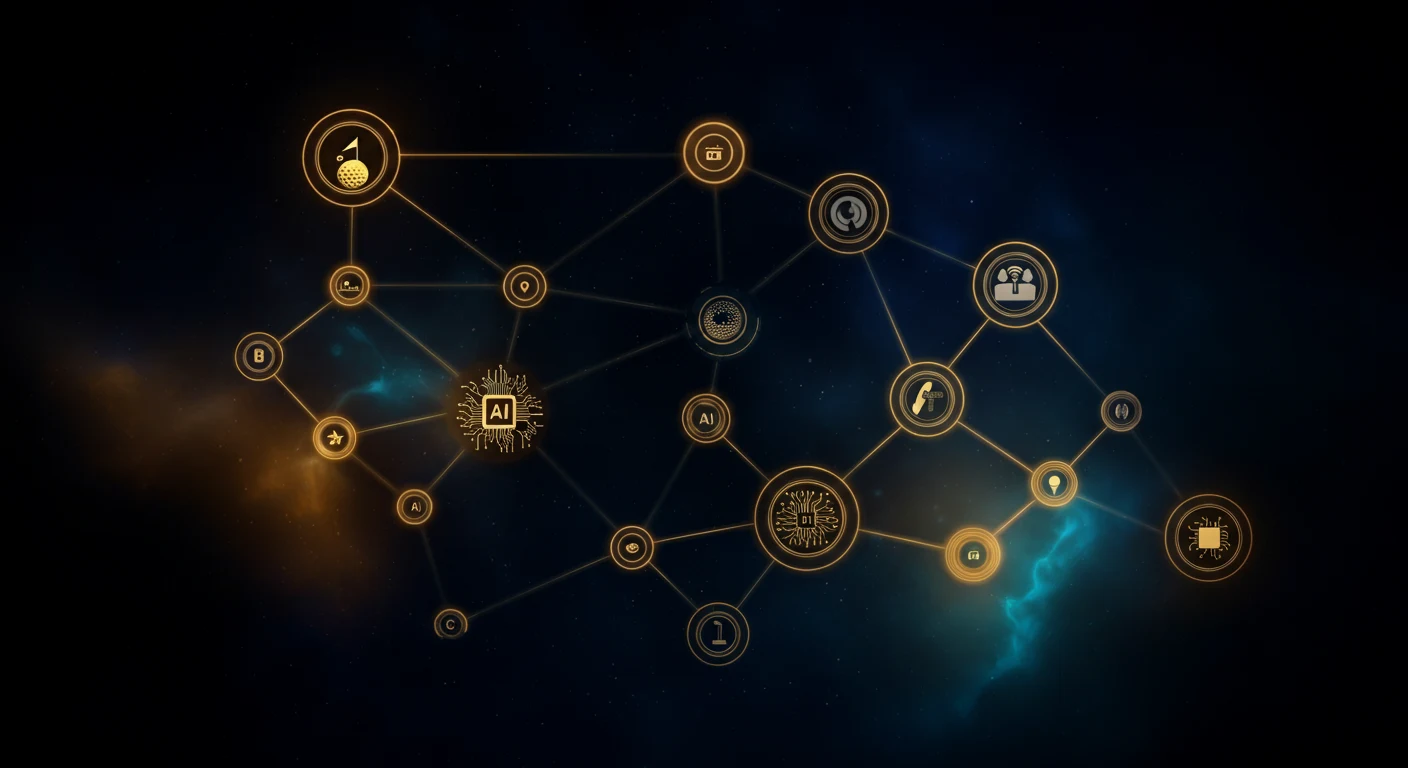
A content intelligence platform — a BigQuery knowledge base that logs every session, surfaces patterns, and drives automated publishing. A lead tracking infrastructure built on Call Track Metrics, wired to every traffic source. A referral network of restoration contractors meeting through a structured golf league across multiple cities. A commercial compliance strategy using fire extinguisher inspections as a loss leader to get in the door with property managers. An AI receptionist product purpose-built for restoration intake — Twilio, Claude on Vertex AI, Cloud Run, Firestore. A Company OS model — a fully hosted GCP environment where I run a contractor’s entire revenue infrastructure and take a commission on verified results. A WordPress CRM being built and dogfooded on my own site before being offered to clients. A knowledge cluster of five interconnected websites building topical authority in the restoration and risk intelligence space.
None of those were planned in sequence. Each one was the answer to a specific question that kept coming up. But together they cover almost every layer of how a restoration business actually operates — lead generation, lead tracking, intake, conversion, referral relationships, commercial acquisition, operations tools, and content authority.
That’s not a service menu. That’s a stack.
Why Accidental Might Be Better Than Planned
I’ve thought about whether it would have been better to plan this from the start. Design the full system upfront, build it in sequence, launch it as a coherent product.
I don’t think so. And here’s why.
Every piece of this was validated before the next one got built. The CTM infrastructure exists because attribution disputes are real and expensive. The AI intake agent exists because I watched calls get dropped after I’d already driven them. The golf league exists because I saw contractors lose commercial accounts to competitors who had better adjuster relationships, not better work. Each problem was visible because I was close enough to the industry to see it — not designing from a distance.
The version of this that gets designed upfront has a different failure mode: it’s theoretically complete but practically wrong. The problems you think exist from the outside are never quite the same as the ones that actually exist on the inside. Building problem by problem, staying inside the industry, means every piece of the stack is load-bearing because it was built under load.
There’s also something that happens when you’re not trying to build a system. You’re more honest about what’s actually needed. You don’t add things because they complete the picture — you add them because the gap is genuinely painful. The result is a leaner, more accurate stack than anything I could have designed in a planning session.
The Question I’m Sitting With
The thing I keep coming back to: is this replicable in other verticals, or is it only possible because of the depth of time I’ve spent inside restoration specifically?
I genuinely don’t know. The honest answer is probably both. The approach — stay close, solve real problems, let the system emerge — is transferable. But the specific inventory I ended up with is deeply shaped by restoration’s particular quirks: the insurance dependency, the emergency-driven intake, the adjuster relationship dynamics, the commercial vs. residential split, the franchise structures, the IICRC certification culture.
A different vertical would produce a different stack. HVAC has different intake patterns. Personal injury law has a completely different referral economy. Healthcare has different compliance requirements and trust dynamics. The method of paying attention and building toward what you see would be the same. The pieces that emerge would be different.
What I’m more confident about: you can’t fake the depth. The reason the stack works is because I know what it’s like to be a restoration contractor well enough to feel the pain of each layer. That knowledge isn’t transferable quickly. It’s accumulated. Someone who decided tomorrow to “build a vertical OS for HVAC” would be designing from the outside. They’d get some things right and miss the things that matter most, because those only become visible from inside.

What This Changes
Naming a thing changes how you relate to it. Before this realization, I was a marketing consultant who did a lot of different things for restoration companies. That description is accurate but it undersells the coherence of what’s actually there.
Now I think of it differently: I’m a vertical infrastructure builder who happened to start in restoration and went deep enough that the full stack became visible. The individual services aren’t the product. The system is the product. Any one piece of it — just the SEO, just the CTM setup, just the AI intake — is less valuable than the whole because the whole is integrated in ways that individual pieces can’t be.
That changes what I build next, how I talk about what I do, and who I build it for. It also changes what “being done” means — because a vertical OS is never really done. Industries evolve, problems shift, new gaps appear. The work is staying close enough to keep seeing them.
I didn’t plan any of this. I just kept solving the next problem.
Turns out that’s a strategy.
Leave a Reply