If you have been running Google Local Services Ads (LSAs) for your restoration company for more than a year, the platform you’re managing today is not the one you signed up for. Two changes that landed in late 2025 quietly rewrote the economics of LSAs for restoration contractors — and most owners I talk to are still operating on outdated assumptions. The badge you bragged about is gone. The dispute process you relied on to claw back bad leads is gone. And the insurance trap that can silently kill your campaign is bigger than ever. Here is what actually changed and what you should do about it.
The badge consolidation: “Google Guaranteed” is now “Google Verified”
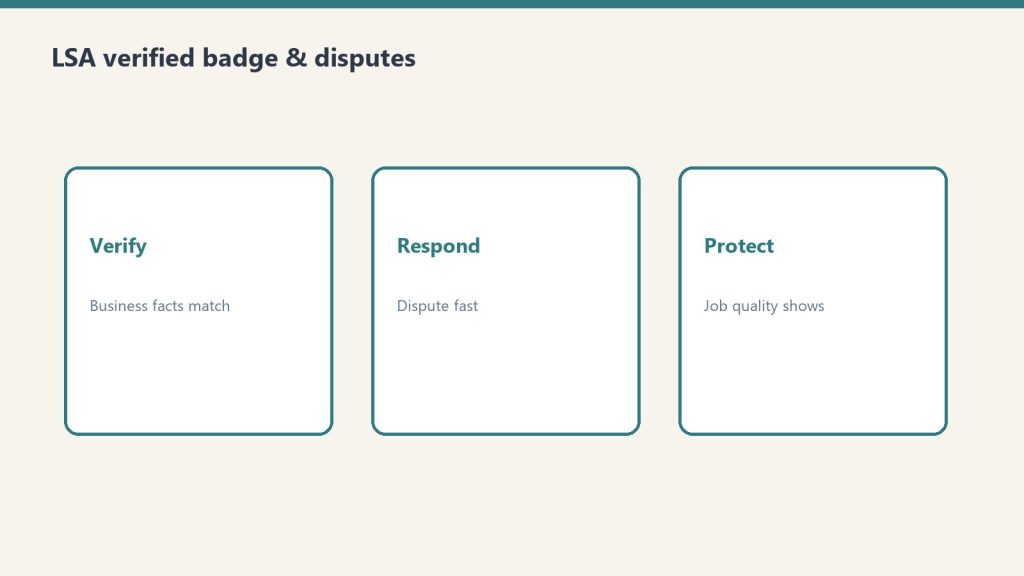
Badge renamed — ops discipline did not get easier.
Effective October 20, 2025, Google folded its three trust badges — “Google Guaranteed,” “Google Screened,” and “License Verified by Google” — into a single unified “Google Verified” blue checkmark. For restoration owners who spent months getting the green Google Guaranteed badge and then put it on their trucks and websites, this matters. The badge you earned still exists, it just looks different and means something slightly different now.
The verification requirements themselves haven’t loosened. You still pass a background check (Google runs this free through its partner Evident), and Google still verifies your license and insurance. Reported approval timelines run roughly three to four weeks once your documents are submitted — budget for that lag if you’re launching into a busy season.
The money-back guarantee is dead — and that changes your pitch
Here’s the change almost nobody talks about: the consumer money-back guarantee that was the whole point of the “Google Guaranteed” name was discontinued on November 7, 2025. Under the old program, if a customer was unhappy with a job booked through LSAs, Google would reimburse them up to a lifetime cap. That backstop is gone.
Why should a restoration owner care? Because if your sales process or your website copy still leans on “we’re backed by Google’s money-back guarantee,” you are now making a claim that is no longer true. Audit your marketing materials. The badge now signals verification — that you are who you say you are, licensed and insured — not a satisfaction guarantee. That’s a meaningful difference in how you should position it to a homeowner who just had a pipe burst.
The bigger story: manual lead disputes are gone
This is the change that hits your wallet directly. For years, the LSA model let restoration contractors manually dispute junk leads — wrong number, spam, a caller looking for a service you don’t offer, a job outside your service area — and recover a meaningful share of those charges. Reports from contractors who worked the old system suggest manual disputes recovered credits on a solid majority of flagged bad leads when documented well.
Google removed manual disputes in 2024 and replaced them with an automated credit system. Here’s how it works now: Google’s machine learning reviews leads, typically within about 72 hours of being charged, and automatically applies credits for leads it deems invalid, with credits generally appearing within roughly 30 days. You no longer build a case and submit it. The algorithm decides.
Two limitations matter enormously for restoration:
“Job type not serviced” and “geo not serviced” leads are no longer creditable. If a caller wants mold remediation and you only do water mitigation, or the job is two counties away, Google will not credit that charge anymore. Restoration owners across the home-services space have reported receiving out-of-area and out-of-category leads with no recourse — and that’s now baked into the system, not a glitch.
The automated system is reportedly less generous. Practitioner estimates put the current automated credit rate well below what manual disputes used to recover. You will eat more bad-lead cost than you used to. Plan your cost-per-acquisition math accordingly.
The one lever you still have: rate every lead
The one lever you still have: rate every lead honestly.
The “Rate this lead” feedback tool in your LSA dashboard is not a customer-satisfaction survey — it’s the primary input the automated credit engine uses. Marking a lead as “Very dissatisfied” with a specific, accurate reason is reportedly the most reliable way to nudge a credit. The discipline here is operational: whoever answers your LSA calls needs a standing instruction to rate every single lead the same day, with notes. If you’re not rating leads, you’ve handed the algorithm zero signal and you’re leaving credits on the table.
The silent campaign-killer: your insurance certificate
Here is the trap that takes down more restoration LSA accounts than bad creative ever will. Google periodically re-checks the license and insurance on file in your LSA account. When your general liability policy renews and you don’t upload the new certificate, Google can pause your ads automatically — no warning email that most owners notice, no grace period you can count on. For a restoration company, an unexplained pause during storm season is real revenue walking out the door.
The fix is trivial and free: set a calendar reminder for two weeks before your GL policy renews each year to upload the fresh certificate of insurance into your LSA account. This single recurring task prevents the most common avoidable outage in the channel.
What this costs you in restoration
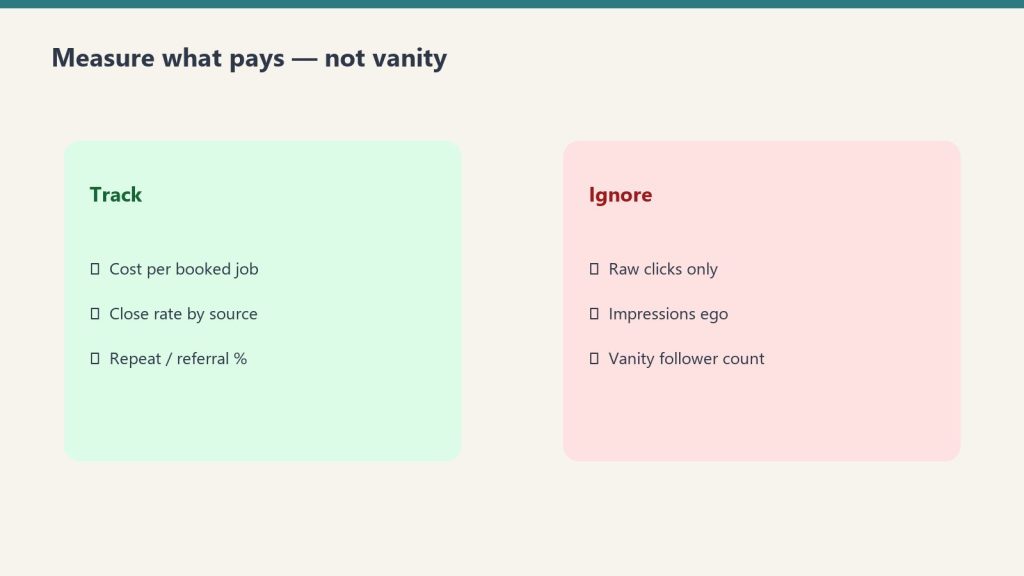
For context on the stakes: water damage restoration sits at the expensive end of LSAs because the jobs are big and contractors bid the channel up. Reported cost-per-lead figures for water damage restoration commonly land in roughly the $75–$200 range depending on market competition, with some sources citing $300+ per call in the most aggressive markets. Cost per acquired job is reported in the rough range of $200–$800. With restoration margins what they are, those numbers can still pencil out — but only if you’re not silently absorbing uncreditable junk leads and only if your account never goes dark over a lapsed insurance cert. The platform changes above all push in the same direction: the margin of error on LSA management got thinner in late 2025.
The bottom line
Bottom line: LSA is a system, not a set-and-forget badge.
If you run LSAs for a restoration company, do three things this week. First, scrub any “money-back guarantee” language from your marketing — it’s no longer accurate. Second, make daily lead-rating a non-negotiable task for whoever fields your LSA calls, because rating is now your only real influence over credits. Third, put a recurring two-weeks-before-renewal reminder on the calendar to update your insurance certificate. None of these cost a dollar, and together they protect the most expensive lead channel in your marketing budget from the changes Google made while you weren’t watching.
You shipped an llms.txt file. You curated the links, you paired it with robots.txt, you validated the format. Now answer the only question that matters: is anything actually requesting it? Most site owners never check — and the data from 2026 suggests the honest answer, for most domains, is “almost nothing.” This is the verification step that turns llms.txt from an act of faith into a measurable signal. Here is how to read your own server logs and find out exactly what is fetching the file you published.
Why verification matters more than the file itself
Why verification matters more than the file itself.
The uncomfortable finding of the last year is that publishing llms.txt and benefiting from llms.txt are two different things. In OtterlyAI’s 90-day crawler study, only 0.1% of AI crawler requests touched /llms.txt at all — 84 requests out of 62,100 total AI bot visits — and the file received far fewer visits than the average content page (OtterlyAI GEO study). As of Q1 2026, no major AI company — OpenAI, Google, Anthropic, Meta, or Mistral — has publicly committed to reading or acting on llms.txt in production systems, though GPTBot does fetch the file occasionally (AEO Engine).
That does not make the file worthless. It makes measurement the whole game. If you cannot tell whether a crawler ever requested the file, you cannot tell whether your time was wasted, whether a platform quietly started honoring it, or whether your file is returning a silent 404. Verification is the difference between strategy and superstition.
The five-minute server-log check
Five-minute server-log check.
Every fetch of your llms.txt file leaves a row in your access log. The job is to isolate requests to that path, then filter by the user-agents that belong to AI systems. On any server with standard combined-format Apache or Nginx logs, this one-liner does the first pass:
The first grep narrows to requests for llms.txt or llms-full.txt. The second filters to the known AI crawler user-agent strings documented across 2026 reference work (No Hacks AI User-Agent Landscape 2026; Momentic crawler list). Each surviving line tells you three things: which bot, what time, and the HTTP status code it received.
That status code is the part people skip. A 200 means the bot got your file. A 404 means you have been congratulating yourself over a file the crawler never actually reached — a misconfigured path, a redirect loop, or a build step that drops the file on deploy. A 301 or 302 means it is being redirected, and not every crawler follows redirects for this path. Read the status column before you read anything else.
Turn the raw hits into a monthly cadence table
One grep tells you whether the file is reachable. To know whether anything is changing, you need the same query run on a schedule and counted by bot. Extend the pipeline to a count:
This produces a leaderboard of which AI user-agents requested your llms.txt across all retained logs. Capture that number on the first of each month and you have a cadence series. The signal you are watching for is not the absolute count — it will be small — but the direction: a bot that appears for the first time, a bot whose hit count jumps, or a bot that goes silent. Those inflection points are the leading indicators that a platform has changed how it treats the file.
What you see in the log
What it means
Action
No requests to /llms.txt at all
File may be unreachable, or simply not yet fetched — both are common
Request the URL yourself; confirm a clean 200 before assuming neglect
200 from GPTBot, low frequency
Consistent with reported behavior — GPTBot fetches occasionally
Log the cadence; treat as baseline, not a ranking signal
404 or 301 on the path
Crawler is not getting the file you think you published
Fix the path/redirect today — this is a silent failure
A new bot appears month-over-month
A platform may have started fetching the file
Note the date; correlate with any citation or referral changes
Cross-check against your content fetches
The llms.txt hit count means little in isolation. Compare it against how often the same bots fetch your actual content pages. If GPTBot pulls forty content URLs a day and never touches llms.txt, the file is not part of how that crawler discovers you — your content’s own structure and internal linking are doing the work. The practical monitoring approach documented for 2026 is exactly this: a server-log dashboard built against the major user-agents, watching cadence and path-preference shifts month over month (Digital Applied 30-day log study). The same study notes distinct personalities worth knowing — GPTBot crawls more aggressively than most assume, ClaudeBot is more patient than its volume suggests, and PerplexityBot is quieter than its share-of-voice would predict.
What to do with the answer
What to do with the answer.
If your logs show the file is reachable and occasionally fetched, you are in the normal range for 2026 — keep the file current and keep measuring. If they show a 404, you found a real bug that no amount of curation would have fixed. And if they show a brand-new bot starting to request the path, you have spotted a platform behavior change before the blog posts catch up to it. That last case is the entire payoff: the practitioners who read their own logs will know the standard started mattering weeks before the ones who only read about it. Verification is not the boring final step of an llms.txt rollout. On a standard that nobody has formally committed to honoring yet, it is the only step that produces evidence instead of hope.
Everyone teaches you how to add an MCP server to Claude Code. Almost nobody teaches you where to add it — and that one decision, the scope flag, is the difference between a clean team setup and three engineers debugging why the same server works on one machine and not another. I’ve watched it happen. The fix is always the same: someone added a server at the wrong scope.
If you run claude mcp add without thinking about scope, Claude Code makes the choice for you. It defaults to local. That’s fine for a throwaway experiment and wrong for almost everything else.
The three scopes, and what each one actually controls
The three scopes, and what each one actually controls.
Claude Code stores MCP server configurations in three places, and the --scope flag decides which one you’re writing to.
Local scope (the default) writes the server config into your personal settings, keyed to the current project path, inside ~/.claude.json. Nobody else sees it. It doesn’t get committed. Open the same repo on your laptop at home and the server isn’t there. This is the scope you want for a one-off — a database you’re poking at this afternoon, a server you’re still deciding whether to keep.
Project scope writes to a .mcp.json file at the root of the repository. You commit that file to git. Everyone who clones the repo gets the same servers, configured the same way. This is the scope that makes MCP a team decision instead of a personal one — and it’s the one most people skip because the default never points them at it.
User scope writes to your global config so the server is available in every project you open, regardless of which repo you’re in. This is for the handful of servers you genuinely use everywhere — a documentation search server, a personal notes tool — not for anything project-specific.
The mental model I use: local is “me, here, now.” Project is “anyone on this repo.” User is “me, everywhere.” If you can articulate which of those three sentences describes the server, you know the flag.
The command, written three ways
The command, written three ways.
Same server, three scopes. The only thing that changes is the flag.
# Local — default, personal, not committed
claude mcp add --transport stdio my-db -- npx -y @some/db-mcp-server

# Project — shared via .mcp.json, commit to git
claude mcp add --scope project --transport stdio my-db -- npx -y @some/db-mcp-server

# User — available in every project you open
claude mcp add --scope user --transport stdio my-db -- npx -y @some/db-mcp-server
Verify what’s connected and where it came from with claude mcp list. If a teammate reports a server “isn’t working” and yours is fine, this is the first command to run on both machines — the discrepancy is almost always a scope mismatch, not a broken server.
The .mcp.json pattern that actually pays off
The .mcp.json pattern that actually pays off.
Here’s the workflow that turns this from trivia into leverage. When you onboard a repo that the whole team uses, you decide once which MCP servers belong to that codebase — the Postgres server pointed at the dev database, the issue tracker, whatever the repo’s daily work requires — and you add them all at project scope. The resulting .mcp.json looks like this:
Commit it. Now a new hire clones the repo, opens Claude Code, and the agent already knows how to query the dev database and read tickets — no setup doc, no Slack thread asking “wait, how do I connect the database again.” The repo carries its own integration surface.
One safety detail worth knowing: when Claude Code encounters project-scoped servers from a .mcp.json it didn’t write, it asks you to approve them before they run. That prompt exists because a committed config file is, technically, code other people can put on your machine. Read what you’re approving — the same way you’d read a package.json script before running it.
Where this bites people
Three failure modes I see repeatedly. First: adding a server at local scope, then wondering why it vanished on a different machine — local is path-and-machine specific, that’s the design. Second: putting a secret directly into .mcp.json and committing it to a public repo. Don’t. Reference an environment variable in the config and keep the actual token out of git. Third: piling everything into user scope so every project loads servers it doesn’t need, which bloats the context the agent has to reason over and slows routing when you have many tools connected.
The cost angle, since it’s a fair question: scoping itself costs nothing. But every connected MCP server adds its tool definitions to the model’s context on each turn. With Sonnet 4.6 as the workhorse model, a lean per-project tool set is faster and cheaper than a kitchen-sink user-scope config you never pruned. Scope discipline is, indirectly, token discipline.
The rule that replaces all of this
Before you run claude mcp add, finish this sentence: “This server should be available to ___.” If the answer is “just me, just here” — local. If it’s “anyone working in this repo” — project, commit the file. If it’s “me, in everything I do” — user. The flag follows from the sentence. Get that habit, and the entire class of “works on my machine” MCP bugs disappears from your team’s life.
There is a class of problem in an AI-native operation that is invisible to every individual surface and obvious to the audit layer that sits across them. The site looks healthy. The dashboard is green. And the body of work has stopped compounding.
The Green Dashboard Trap
The green dashboard trap.
In modern serverless architectures and agentic pipelines, we are trained to monitor local execution outputs. We build alerts for 500 errors, set up uptime pings, and watch cron job completions. If the terminal or console returns a successful exit code, we assume the system is functioning.
But in generative workflows, a script can run perfectly, parse without throwing syntax errors, make successful API calls, and still produce completely empty pages or silent failures (such as duplicating pages with -2 slugs). The surface looks pristine, but the structural value is eroding.
Why Isolated Auditing is Essential
Why isolated auditing is essential.
Individual execution environments (like a Claude Code terminal instance or an Antigravity background task) only know what is in their immediate input context. They do not know if the overall sitemap is bloated, if search engine canonical flags are misconfigured, or if previous runs created redundant resources. They check the box for their specific task and exit.
An audit plane sits above these execution agents. It doesn’t write code or publish content. Instead, it continuously queries the outputs of the entire operation, testing for anomalies like:
Thin Content: Published pages that lack text bodies.
Taxonomy Decay: Articles published without tags or nested in default categories.
Asset Duplication: Identical titles or slugs created due to syncing conflicts.
Implementing a Two-Plane Architecture
Implementing a two-plane architecture.
To prevent silent failure in portfolio management, operators must separate the Execution Plane from the Control & Auditing Plane. Notion or similar databases act as the control plane where human instructions and data states live. Google Cloud Run or local CLI tools act as compute. But a third independent auditor loop must actively crawl, assert, and report on the final state of the live web asset.
“When trust is earned in evidence rather than asserted by success logs, you stop running broken systems that look perfectly healthy.”
The audit sees what the site cannot, because the site only knows what it is, not what it has repeatedly become.
I’ve been running both Claude Code and Cursor on the same codebases for the last eight months. Not as a reviewer — as someone who has to actually ship features in both tools and watch the credit meter tick. Here is what the comparison actually looks like in May 2026, after Cursor’s credit overhaul, after Claude Opus 4.7, and after Claude Code’s agent teams went GA.
The Real Pricing Picture
The real pricing picture — stale-proof.
The headline subscription numbers are nearly identical: Claude Pro at $20/month, Cursor Pro at $20/month. That’s where the similarity ends.
Cursor’s Pro tier in 2026 ships with unlimited “Auto” mode requests plus a $20 credit pool for premium models. Pro+ is $60/month with roughly 3x credits and background agents. Ultra is $200/month at 20x usage. Hobby is still free with limited requests. Teams is $40/user/month.
Claude Code on the Pro plan gets you Sonnet-tier usage with quota limits. Max at $100/month unlocks Opus access and 5x the usage envelope. The team plan for Claude Code is where the real spread shows: Anthropic’s team pricing on Claude Code lands materially higher than Cursor Teams for a comparable seat count. If you’re a 10-person team buying the most generous tier of each, you’re looking at roughly 3x more for Claude Code.
For solo developers, the cost is a wash at the entry tier. The decision is not about money — it’s about how each tool burns tokens.
Token Efficiency Is the Hidden Variable
This is the number I wish I had known a year ago: independent benchmarking through 2026 has Claude Code using roughly 5.5x fewer tokens than Cursor on identical tasks. Not 5.5% — five and a half times fewer.
The why matters. Cursor’s agent loop tends to re-read files, re-include context, and verify intermediate steps by stuffing prior turns back into the prompt. Claude Code’s CLI architecture leans on a tighter context budget by default, and on Opus 4.7 the model itself is doing more work per token. When you’re paying by credit (Cursor) and your power-user-hours start adding up, that ratio is the difference between a $60 month and a $200 month.
The honest counterpoint: Cursor’s median completion time on simple, single-file edits is roughly 12% faster than Claude Code. If you live in the find-and-fix-a-typo loop, Cursor’s IDE integration genuinely wins.
Where Claude Code Wins
Where Claude Code wins.
The 1M token context window is now generally available on Claude Opus 4.6, Opus 4.7, and Sonnet 4.6, at standard per-token pricing with no long-context surcharge. A 900,000-token request costs the same per-token rate as a 9,000-token one. For codebases that need to be understood holistically — monorepos, large migrations, anything where “ctrl-F across 200 files” is part of the problem — this is the single most consequential capability difference in 2026.
Agent teams went past experimental in 2026 with Claude Code v2.1.32 and the CLAUDE_CODE_EXPERIMENTAL_AGENT_TEAMS=1 flag. The team-lead pattern — one Claude session coordinating teammates who can message each other, share a task list with dependencies, and lock files — is a genuinely different primitive than Cursor’s background agents. The cost is real: agent teams use approximately 7x the tokens of a single session in plan mode. The benefit is also real: the work that previously needed a human program manager now runs unattended.
On full-feature implementation tasks — the kind where a benchmark measures end-to-end PR shipment, not single edits — Claude Code was roughly 18% faster on median wall-clock time. Opus 4.7 specifically lifted resolution on a 93-task coding benchmark by 13% over Opus 4.6, including four tasks that neither Opus 4.6 nor Sonnet 4.6 could solve.
Where Cursor Wins
Where Cursor wins.
The editor. This is not a small thing. Cursor is still a VS Code fork that evolved into an agent workbench. The integrated diff view, the multi-file edit preview, the in-line ghost text completions, the model picker in the corner — none of that exists in Claude Code, which lives in a terminal pane. If you have a strong opinion about your IDE and you want AI features welded inside it, Cursor is the answer.
Cloud agents on Cursor Pro and above run AI tasks in isolated cloud VMs with no access to your local machine. The use case — fire off a refactor and walk away from your laptop — is well-served. The catch: background agents always use MAX mode, which adds a 20% surcharge on credit cost, and a single agent run on a 50,000-line codebase can consume around 22.5% of a Pro plan’s monthly credits. One bad day of agent runs eats your month.
Model variety is also a Cursor advantage. You can route a task to a non-Anthropic model when the situation calls for it. Claude Code is Claude all the way down.
What I Actually Run
Both. For $40/month at the Pro tier on each, I get the most powerful AI coding setup available in 2026. Claude Code handles the long-context architectural work, the cross-cutting refactors, the agent-team orchestration where one Claude is doing program management and three teammates are touching different services. Cursor handles the IDE work — the small-bore edits, the in-line completions, the moments where I want to see a diff hover above the line I just changed.
If forced to pick one, the answer depends on the work. Heavy backend, large codebases, multi-agent workflows: Claude Code. UI-heavy, single-file iteration, “I just want my editor to be smarter”: Cursor.
The Honest Limitation
Claude Code on a team plan is genuinely expensive at scale. A 10-person team running Claude Code at the team-equivalent tier is roughly 3x the Cursor Teams equivalent. If you’re cost-sensitive at headcount, that math may decide the question regardless of capability. The token-efficiency advantage helps Claude Code claw back some of that on per-task economics, but the subscription line item is the line item.
Lineup currency (Sept 2026, verified): Sonnet 5 ($2/$10), Opus 5.5 ($4/$20), Haiku 4.5 ($1/$5), Fable 5.1 ($10/$50). Legacy (still listed): Opus 4.8 ($5/$25), Sonnet 4.6 ($3/$15). Prior note (superseded): The other honest limitation: model versions move fast. As of May 26, 2026, the prior Anthropic lineup claim was Claude Opus 4.7 (flagship), Claude Sonnet 4.6 (workhorse), and Claude Haiku 4.5. Any comparison written more than a quarter ago is already partially wrong on the model column. Read pricing pages, not blog posts, when you’re committing budget.
The Bottom Line
Cursor wins on editor experience, model variety, and team subscription cost. Claude Code wins on token efficiency, context window economics, agent-team primitives, and Opus 4.7’s raw coding capability on hard tasks. If you’re optimizing for one tool, pick the one that matches the bulk of your work. If you can afford $40/month, run both — and pay attention to which one you actually open first in the morning. That’s your real answer.
Every restoration owner reading software comparisons asks the same question two paragraphs in: “Yeah, but how does it actually talk to Xactimate?” Because if your job management platform doesn’t sync cleanly with Xactimate and XactAnalysis, you are paying for a glorified contact list. Your estimators will end up entering the same scope in two systems, your supplements will live in email threads, and your margins will quietly bleed through re-keying errors no one catches until the adjuster denies a line item.
So let’s skip the brochure language. Here is what the major restoration platforms actually do with Xactimate in 2026 — what syncs, what doesn’t, what you’ll still re-enter by hand, and where each one is worth the money.
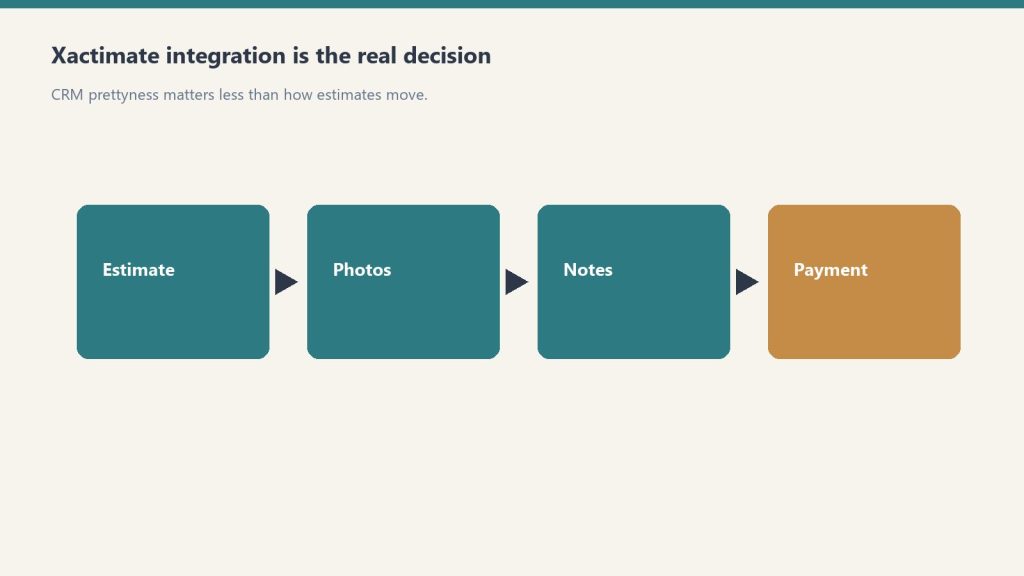
Why Xactimate integration is the real software decision
Xactimate integration is the real software decision.
Xactimate is the dominant property estimating platform on the carrier side of insurance restoration in North America — Symbility is the only meaningful alternative, and most major carriers default to Xactimate. XactAnalysis, the Verisk-owned claims network sitting on top of it, is how carriers route assignments, review estimates, and approve supplements. If you take TPA work or any insurance-direct claims, those two products are non-negotiable in your stack.
The question is not whether your job management software “integrates with Xactimate.” Almost all of them claim that. The question is what flavor of integration: assignment sync, sketch import, estimate writeback, supplement triggering, or just a one-way push that still leaves your project manager re-keying job notes. Those are five different things. Vendors love to call all of them “Xactimate integration.”
DASH (built by Next Gear Solutions, which CoreLogic — now Cotality — acquired in 2021) has the tightest carrier-facing integration in the category. That is by design. When you receive an assignment through XactAnalysis, it can flow directly into DASH as a job with the loss address, carrier, adjuster, and coverage details pre-populated. Estimates written in Xactimate can be tied back to the DASH job file, and supplement activity in XactAnalysis is visible inside DASH.
Pricing for the Xactimate connector is published by multiple resellers as an add-on running roughly $50 to $75 per month per Xactimate seat depending on tier — confirm the exact figure with your DASH rep at quote time, as pricing has shifted with the Verisk repackaging. The integration is not free with the base DASH subscription.
Where it breaks: DASH is built for high-volume insurance shops. If your business is heavier on cash jobs, reconstruction, or commercial loss, you’ll pay for carrier workflow you don’t use. Smaller shops often find the assignment-driven flow over-engineered for the way they actually quote work.
Albi: clean UX, integration via partners
Albi (Albiware) has been the fastest-growing platform in the under-$5M segment for a reason — the interface is genuinely the best in the category, and the implementation timeline is short. On the Xactimate side, Albi exposes a direct connector and also leans heavily on partner integrations: Encircle for field documentation, QuickBooks for accounting, Matterport for capture.
The honest read on Albi’s Xactimate sync: it works for assignment intake and basic estimate reference, but it is not as deep on the XactAnalysis carrier-side workflow as DASH. If your TPA volume is high and supplements are a constant battle, that gap matters. If you are running a tighter, owner-operator shop, you probably won’t notice.
Where it breaks: Albi is opinionated about workflow, which is a feature until it isn’t. Multi-branch operators with non-standard processes sometimes find themselves working around the system rather than with it.
PSA (CanAm): open API, integrates with almost everything
PSA’s pitch is the open API and the breadth of named integrations: Xactimate, XactAnalysis, CoreLogic Symbility, Encircle, Matterport, DocuSketch, and others on their published partner list. If your stack is heterogeneous — meaning you use Symbility for some carriers and Xactimate for others, or you run multiple capture tools — PSA is the platform that fights you the least.
The Xactimate sync covers assignment data and estimate references, and the XactAnalysis tie-in supports the supplement workflow restoration owners actually live in. PSA’s positioning is also distinct in that it sells to larger commercial and multi-trade shops, not just water/fire restoration, so the workflow flex matters.
Where it breaks: the UI shows its age compared to Albi, and the learning curve is steeper. Implementations take longer. Owners who expected an Albi-style experience are routinely surprised by how much configuration PSA expects up front.
Xcelerate: native Verisk integrations, lean against Xactimate
Xcelerate publishes its Verisk integrations openly — Xactimate, XactAnalysis, plus QuickBooks, Matterport, and Zapier. The platform’s go-to-market message is built around Xactimate workflow specifically: subcontractor cost control, margin recovery, and reducing the re-keying tax between estimate writers and project managers.
If you write a lot of estimates and your pain point is the gap between what gets bid and what gets paid, Xcelerate is the platform that talks most directly to that problem. The integration covers assignment intake, estimate references, and XactAnalysis visibility.
Where it breaks: Xcelerate is smaller than DASH or Albi, the partner ecosystem is thinner, and the platform is still maturing on the contents and reconstruction sides. If you need deep contents pricelist or rebuild workflow, kick the tires hard before signing.
Encircle: not a CRM, but the integration everyone forgets to budget for
Encircle deserves its own line item here because it sits between your field crew and Xactimate in a way none of the job management platforms replicate. The Encircle Floor Plan tool exports directly into Xactimate as an ESX sketch file, and that integration — announced jointly with Verisk in 2023 and live for customers since September of that year — eliminates the manual sketch step that used to eat hours per job.
Encircle’s own marketing claims it cuts on-site inspection and scoping time from around two hours down to 15 to 20 minutes per property. Treat that as a vendor claim, not gospel — but multiple restoration owners report meaningful sketch-time reduction, and the integration is the strongest reason to add Encircle even if you already run DASH, Albi, PSA, or Xcelerate underneath it. Most of those platforms now connect to Encircle as a documentation partner.
What none of them fully solve
Supplements. Across every platform on this list, supplements still require human attention — estimators reviewing carrier notes in XactAnalysis, comparing line items against field documentation, and pushing revised estimates back through. Verisk’s XactAI rollout adds AI assistance for converting mitigation estimates into rebuild estimates, and that lives inside Xactware products, not your CRM. If a vendor tells you their software “automates supplements,” ask exactly which steps. The honest answer in 2026 is: it surfaces them, it doesn’t write them.
Bottom line
Bottom line: buy the workflow your estimators already live in.
If you run heavy TPA volume and live in XactAnalysis, DASH is still the deepest integration in the category and the carrier-side workflow is worth the premium. If you are under $5M, run mostly direct insurance and cash work, and want a platform your team will actually use, Albi is the best UX bet — pair it with Encircle for the sketch workflow. If your stack is mixed estimating software or you need open API flexibility, PSA is the right answer despite the older interface. If margin recovery on Xactimate-written estimates is your single biggest pain, Xcelerate’s positioning maps to your problem.
And before you sign anything: get the Xactimate integration in writing. Ask for the exact monthly add-on cost, ask which workflow steps sync versus which require manual handoff, and ask for one customer reference in your size band running the integration today. The platforms that hesitate on any of those three are telling you something.
The unit of generative engine optimization is the chunk, not the page
The unit of GEO is the chunk, not the page.
Most generative engine optimization advice still reads like SEO advice with new vocabulary. Add statistics. Build entities. Earn mentions. All true, all incomplete. The mechanic that determines whether ChatGPT, Perplexity, or Google AI Overviews quote your page in an answer is not the page. It is the chunk — the 200- to 500-character passage the retrieval layer pulled out of your page, scored against the user’s prompt, and handed to the language model as evidence.
If your paragraphs do not survive that extraction step intact, the rest of your GEO program is academic. This is the implementation gap most content teams have not closed yet, and it is the highest-leverage shift you can make in Q2 2026.
What the retrieval layer actually does
When a user asks Perplexity or ChatGPT a question, the system runs a process best described as query fan-out and chunked retrieval-augmented generation (RAG). The prompt is decomposed into sub-queries. Each sub-query is sent to a search index (Bing for ChatGPT, a proprietary index plus partner search for Perplexity, Google’s own corpus for AI Overviews). Top-ranking pages are fetched, broken into chunks, and re-scored against the original prompt for semantic match, factual density, source authority, and recency.
The model then composes its answer from the three to seven highest-scoring chunks across all retrieved pages. The visible citations are the source pages those winning chunks came from. Your page can rank well in the underlying search index and still produce no chunks that score high enough to enter the answer. That is the silent failure mode in GEO right now: traffic-tier visibility, zero citation share.
What a chunk-optimized paragraph looks like
What a chunk-optimized paragraph looks like.
The optimization target is a paragraph that reads as a self-contained answer when removed from the page around it. No pronouns referring back to a previous heading. No “as we discussed above.” No buried lede. The first sentence is the claim. The second through fifth sentences supply the supporting fact, the qualifier, and the source if one is needed.
Concretely, here is the same answer written two ways. The first will not survive extraction. The second will.
Will not chunk well:
As we covered earlier in this post, the answer depends on what you are trying to measure. It is more nuanced than most people assume. There are several factors at play, including the ones we mentioned in the introduction.
Will chunk well:
LLMs.txt is a plain-text file at the root of a domain that points AI crawlers to the most authoritative Markdown versions of a site’s documentation. The file format was proposed by Jeremy Howard in September 2024 and has seen adoption signals from major AI vendors through 2025 and into 2026. A minimal valid file is twelve lines and takes under ten minutes to deploy.
The second version has a definition, a provenance fact, an adoption signal, and a deployment qualifier — four extractable units in three sentences. A retrieval system scoring chunks for “what is llms.txt” will rank this passage higher than a longer paragraph that buries the same facts under hedging language.
The five rules that produce chunk-survivable paragraphs
These rules come from observing what actually appears in Perplexity citations, ChatGPT browsing answers, and AI Overview extractions across hundreds of cited passages. They are mechanical. Apply them in revision passes, not at first draft.
1. One claim per paragraph. Multi-claim paragraphs lose to single-claim paragraphs because the retriever cannot score them as cleanly against a specific sub-query. If you have three claims, write three paragraphs.
2. Front-load the noun and the verb. The first eight words of the paragraph determine semantic match. “Generative engine optimization is…” beats “When thinking about how to approach modern search, generative engine optimization is…” every time.
3. Resolve every pronoun within the paragraph. If a paragraph says “it” or “this” without naming the antecedent inside the same paragraph, the chunk reads as orphaned to the retriever and gets discounted.
4. Keep paragraphs between forty and one hundred twenty words. Shorter paragraphs lack the factual density that scores well. Longer paragraphs get truncated mid-thought, which destroys the chunk. The forty-to-one-twenty band is where modern retrievers operate cleanly.
5. Put the source inline. “Princeton research published in 2023 found a 30 to 40 percent visibility lift from adding statistics and citations” outperforms the same fact with a footnote, because the retriever sees the authority signal in the same chunk as the claim.
A revision protocol you can run today
Revision protocol you can run today.
For any page already ranking in the top twenty for a target query, run this three-step pass before chasing new content.
Step one: Print the article. Cover all headings. Read each paragraph in isolation. Mark any paragraph that does not answer a specific question on its own. That mark is your rewrite list.
Step two: For each marked paragraph, identify the implicit question it is trying to answer. Rewrite the first sentence to state the answer. Move supporting context into sentences two through four. Cut anything past sentence five into a new paragraph.
Step three: Add one inline source per claim that involves a number, a date, or a contested fact. Inline means “according to Anthropic’s official documentation,” not a hyperlinked footnote at the end of a sentence.
A site with eighty published pages can complete this pass in four to six weeks at one editor’s pace. The lift typically shows in AI referral traffic in GA4 — under Acquisition, Traffic Acquisition, with a manual segment for sessions where the source contains “chatgpt,” “perplexity,” “claude,” “copilot,” or “gemini” — within three to five weeks of the changes going live, because retrieval indexes refresh on independent cycles from Google’s main crawl.
Why this beats writing more content
New content takes weeks to be indexed by the underlying search layer and additional weeks before the retrieval scoring stabilizes. Rewritten paragraphs on already-indexed pages start scoring against retrieval queries the next time the page is recrawled, typically within days. The compound effect of converting forty already-ranking pages into chunk-optimized pages is larger and faster than the effect of publishing forty new pages.
This is the GEO discipline that separates teams who say they are doing generative engine optimization from teams whose names appear in actual AI answers. The unit of work is the paragraph. The test is whether the paragraph survives extraction. Everything else — entity binding, schema, llms.txt, brand co-occurrence — sits on top of that foundation.
What is the ideal chunk length for GEO?
Modern retrievers extract chunks in the 200 to 500 character range, which corresponds to paragraphs of roughly 40 to 120 words. Paragraphs in this band give retrievers enough context to score factual density without losing the chunk to mid-paragraph truncation.
How is chunk-first GEO different from entity optimization?
Entity optimization tells the AI system who you are. Chunk-first writing tells the AI system what to quote. The two operate on different surfaces and are complementary. Entity work without chunk-survivable paragraphs leaves you recognized but unquoted.
Do headings matter for chunk extraction?
Headings help retrievers segment the document and improve the score of the paragraph immediately below the heading. The heading-then-clear-paragraph pattern is the strongest GEO structure currently observable in AI Overview citations.
How do I measure whether my chunks are getting cited?
Track AI referral sessions in GA4 with a segment filtering for source contains chatgpt, perplexity, claude, copilot, or gemini. Pair that with prompt-set testing in tools that query multiple LLMs with your target queries and parse the cited URLs from the responses.
Will Google penalize chunk-optimized writing?
Chunk-optimized paragraphs read as cleanly written, source-attributed prose. The same structural rules that help retrieval scoring also help featured snippet capture and traditional on-page SEO. There is no documented penalty signal and the structure is consistent with Google’s own quality rater guidelines on clear, useful writing.
There is a moment, usually around your third Claude Code session, when the fantasy of parallel agents collides with the reality of a single human attention span. You opened a second terminal because Claude was thinking and you had nothing to do. You opened a third because the second one was thinking too. Now there are three streams of edits happening across three branches, and the question is no longer “can I run parallel sessions” — it is “did I just spend the next forty minutes reviewing diffs I could have written myself in twenty.”
Git worktrees plus claude --worktree make multi-session work physically safe. They do not make it economical. The pattern below is the one I have settled on after running everything from two-up to a foolish eight-up. The short version: two is the default, four is the ceiling, and the ceiling is set by review bandwidth, not by Claude.
What worktrees actually fix
What worktrees actually fix.
A git worktree is a second working directory attached to the same repository — its own branch, its own files on disk, sharing history and remote with the main checkout. Without them, running two Claude Code sessions against one clone is asking for a merge conflict you will not see coming. One session edits src/auth.ts while the other is mid-refactor of the same file; the second write wins; your tests pass; the first session’s logic is gone.
The claude --worktree my-feature flag creates the worktree for you under .claude/worktrees/, checks out a new branch, and scopes the entire session to that directory. Edits in one -w session cannot touch files in another. That is the entire safety guarantee, and it is the only one you need to run multiple sessions in good conscience.
The catch nobody mentions in the launch posts: a worktree is a fresh checkout. Your .env, your .env.local, your node_modules, your virtualenv — none of it carries over. The first session in a new worktree spends ten minutes failing in confusing ways because the environment is empty.
The fix is a .worktreeinclude file at the project root, gitignore-syntax. Files that match a pattern and are gitignored are copied into the new worktree at creation. Tracked files are never duplicated. A two-line .worktreeinclude with .env* and .env.local is usually enough to get past the first failure mode. Dependencies are a separate problem — most teams either symlink node_modules or run install fresh per worktree depending on how strict their lockfile discipline is.
The two-session pattern
The two-session pattern.
This is the default and the one that pays its setup cost on the first week. The shape:
Foreground session. What you are actively working on. You read every diff. You answer questions. You /plan the multi-file changes.
Background session, separate worktree. A bounded task you can describe in one paragraph and verify in one diff. Documentation update, refactor of a single module, dependency bump and test run, generated-API-client rebuild. You start it, switch back to the foreground, and check on it when it finishes.
The economics are clean. The background task would have cost you context-switching time anyway — opening it, loading the problem into your head, doing the work, putting it down. Instead you describe it once, let Claude run, and review one diff at the end. Two sessions, one human, real time saved.
The discipline that makes this work: the background task is always something you would be comfortable letting a junior engineer commit without a meeting. If you would not, it is not a background task — it belongs in the foreground.
The four-session ceiling
Above two, the gains compress fast. Three is fine if the third session is something near-trivial — a script, a one-off data migration, a README pass. Four is the practical ceiling and only on days where the work decomposes that cleanly.
The reason is review, not Claude. Each session produces a diff. Diffs are not free to read. A senior engineer in flow reads code at maybe two hundred lines per minute with comprehension; a five-hundred-line diff from a Claude session costs at least two minutes of focused attention, often five if the change is subtle. Four sessions producing four diffs in the same ten-minute window means twenty minutes of review queued up — and you cannot review them in parallel.
The pattern that breaks first is the one where you stop reading the diffs carefully because there are too many of them. That is the failure mode worth naming. The point of running parallel sessions is to compress wall-clock time. The point is not to compress review time, because review time is the part that actually catches the bug.
If you find yourself merging diffs you have only skimmed, you are running too many sessions. Drop back to two.
When the pattern earns its keep
Two scenarios where multi-session worktrees clearly beat the single-session default:
The refactor-and-feature split. You are in the middle of building a feature. Halfway through you notice the underlying module needs a refactor before the feature can be finished cleanly. In the single-session model you stop the feature, do the refactor, and restart the feature with the refactored module in your head. In the worktree model you fork the refactor into its own worktree, keep the feature work going in the main worktree against the unrefactored code, and rebase the feature onto the refactor once it lands. You do not lose your place on the feature work.
The long-tail cleanup pass. A list of twelve small chores nobody wants to do in series: dependency updates, doc fixes, lint cleanups, deprecated-API migrations. Worktree per chore, three at a time, Stop hooks running the test suite, you reviewing as each finishes. The single-session alternative is a forty-five-minute slog. The parallel version is fifteen minutes of dispatch and review.
The scenario where it does not earn its keep: novel design work where the right answer requires you to hold the whole problem in your head. Splitting attention across two unfamiliar design problems means doing both of them worse than you would have done either of them alone.
The setup that makes it usable
The setup that makes it usable.
If you have not done this before, this is the order:
First, write a .worktreeinclude with at minimum .env* and any other untracked config your project needs. Test it by running claude --worktree test-include and verifying your env loads. Delete the worktree with git worktree remove .claude/worktrees/test-include once verified.
Second, add a WorktreeCreate hook if your project has any setup beyond env files — installing dependencies, running migrations, building a generated client. The hook fires when claude --worktree is invoked, before the session starts, so any setup you script runs against a clean checkout every time. The hook output prints the worktree path on stdout and Claude opens there.
Third, establish a worktree naming convention before you have ten of them sitting around. feature/auth-rewrite, chore/dep-bump-react, fix/oauth-callback — anything that tells you in a year what the worktree was for. The default .claude/worktrees/ directory fills up faster than you expect.
Fourth, set a personal ceiling. Mine is four. Yours might be three. The ceiling is whatever number of diffs you can review carefully in the time the sessions take to run. Write that number down somewhere you will see it when you are about to open a fifth terminal.
What this pattern is not
It is not parallelization in the engineering sense. The sessions are not coordinating. They are independent. Tasks with real dependencies — “refactor module A, then build feature B against it” — belong in one session, sequenced, with a /plan step in the middle. Splitting them across worktrees just means you spend extra time rebasing.
It is also not a productivity hack in the autonomous-agent sense. Claude Code’s subagents and skills are the right tools when you want the same session to delegate work to context-isolated children. Worktrees are for when you want to run independent sessions in parallel because the tasks are independent and you can review the outputs separately. Different layer, different problem.
The worktree pattern works because git worktrees were already the right primitive for parallel feature work before Claude Code existed. claude --worktree is the convenience flag that makes the primitive cheap. The discipline — two by default, four at the ceiling, never more diffs than you will actually read — is the part that turns convenience into useful workflow.
This is a hard article to write because it has to do two things at once. It has to take seriously the gravity of getting caught using AI to do work you submitted as your own. And it has to take seriously that the student who got caught is still a person, still has an education in front of them, still has the question of what to do next. Articles that only do the first thing become lectures. Articles that only do the second thing become evasions. Both failures are common. I’ll try to avoid both.
The walkthrough follows one fictional student, Jordan, through the process and the year that follows. The student is a composite, drawn from documented patterns in institutional academic integrity processes and academic literature on student responses to violations. The situation is real for many students at CSU and at similar institutions right now.
Jordan is a second-year communications major. The course is a 200-level writing course required for the major. The assignment was a 6-page persuasive essay on a contemporary issue. Jordan had a busy week — work shifts, a sick parent, a midterm in another course — and started the essay the night before it was due. The first three pages were Jordan’s own, written from scratch, slow going but real work. Around 2 a.m., Jordan pasted what they had into ChatGPT and asked it to “continue this essay in the same voice” to finish the remaining three pages. The model produced something passable. Jordan made a few edits, ran it through Grammarly, and submitted.
The professor’s AI policy permitted AI for grammar checking and concept exploration. It did not permit AI to draft submitted text. Jordan knew this. The decision to use AI to finish the essay was not a misunderstanding of the policy. It was a calculated risk taken under exhaustion. Jordan was hoping the AI-written sections would blend with the human-written sections well enough that nothing would be flagged.
They didn’t blend. The professor read the essay and noticed a tonal shift around page three — the prose became smoother, more abstract, less specific. The professor didn’t run it through a detector. They just read it carefully a second time, then a third, then composed an email asking Jordan to come to office hours.
The conversation Jordan was not prepared for
The conversation Jordan was not prepared for.
In the office, the professor did not accuse. She showed Jordan the essay with the tonal shift annotated. She asked Jordan to read the two sections out loud and reflect on what they noticed. She did not ask whether Jordan used AI. She asked Jordan to explain the argument in the second half of the essay — to walk through, in their own words, what the essay was claiming and why.
Jordan tried. The first half came easily; Jordan had written it. The second half did not. Jordan could read the words on the page but could not explain why the second half made the argument it made, or what evidence the AI-written sections were drawing on. After a few minutes of trying, Jordan stopped.
The professor was patient. She said: “I think you used AI for part of this. I’d like you to tell me what happened.”
Jordan told her.
The institutional process, named clearly
The institutional process, named clearly.
What happens next varies by institution. Most universities have a formal academic integrity process with specific steps. The CSU system has system-wide policies that interact with campus-level processes. Most processes share certain features:
The professor’s decision about whether to escalate. Some institutions require professors to report all suspected violations. Others give professors discretion to handle minor or first-time violations informally. The professor’s choice here matters significantly.
Informal resolution, if available. In the version some schools use, the professor and student can agree to a resolution — often involving a grade penalty on the assignment, sometimes a failing grade for the course, sometimes an educational requirement like a workshop. The student admits the violation in writing. The record stays within the course or department.
Formal hearing, when escalated. When the violation is serious enough, or when the student disputes the accusation, or when institutional policy requires it, the process moves to a formal hearing. A panel — typically faculty, administrators, and sometimes student representatives — reviews evidence, hears the student’s account, and makes a finding. Sanctions can range from a warning to a course failure to suspension to expulsion, depending on the violation and the institution.
Jordan’s professor offered informal resolution. The professor’s proposal: the essay would receive a zero. Jordan would re-write the essay from scratch, with no AI use, for no additional credit beyond the demonstration that they could do the work. Jordan would write a brief reflection on what happened and what they intended to do differently going forward. A note would go in the student’s department file but not in the formal academic integrity record. The course grade would suffer but not catastrophically.
This was a relatively merciful outcome. Many professors would have escalated. Some institutions don’t permit informal resolution at all. The fact that Jordan got the informal version is partly luck and partly that the professor exercised judgment — the professor knew Jordan was a second-year student, knew the violation was a one-time bad-night decision, judged that the educational value of the informal process exceeded the deterrent value of formal sanctions.
This is not a guide to expecting that outcome. Many students don’t get it. The point of naming what happened in Jordan’s case is that the process has variation built into it, and the student does not control the variation.
What Jordan did right in the conversation
There are a few things Jordan did that affected how this resolved. Worth naming, because some students caught in similar situations make worse versions of these choices.
Jordan stopped trying to bluff once the bluff stopped working. The early seconds of the office hour conversation were when Jordan was still trying to explain the second half of the essay. Jordan could have continued. Some students do — they invent reasoning, double down, claim they wrote everything. This rarely works in the room and almost never works under follow-up. It also forecloses every off-ramp the professor might otherwise offer.
Jordan didn’t argue with the policy. When confronted with the violation, Jordan didn’t say “AI use is normal now,” “everyone does it,” or “the policy is unfair.” All of these may be partially true. None of them help a student in the moment of being caught. The professor wasn’t litigating the broader culture. She was discussing one specific essay.
Jordan didn’t blame circumstance. Jordan had real reasons — the work shifts, the sick parent, the midterm. These reasons were real. They were not the reason Jordan made the decision to use AI improperly. Other students in similar circumstances make different decisions. Jordan made the decision Jordan made. Owning that, rather than displacing the responsibility onto circumstance, is what made the rest of the conversation possible.
Jordan didn’t promise too much. When asked what would be different going forward, Jordan didn’t promise to never use AI again, never have a bad night again, always be a perfect student. Those promises don’t hold and the professor knew it. Jordan said something closer to: “I made a bad call. I’m going to figure out what to do when I have another bad night so I don’t make the same call.” That was a believable answer.
What the year that follows actually looks like
What the year that follows actually looks like.
The professor’s resolution is the institutional piece. There’s a longer piece, which is what Jordan does for the next several months with the question of what happened. This part doesn’t show up on the transcript. It matters more than the part that does.
The temptation, after a violation, is to compartmentalize it. The professor accepted the resolution. The department file note will fade. The course grade is what it is. The instinct is to move on. Don’t think about it. Don’t let it define the rest of the degree.
This instinct fails. Not because the violation needs to be punished further — Jordan has already paid the institutional price. It fails because the violation revealed something about the relationship Jordan had with the education. That relationship needs to be examined or the next bad night produces the same decision.
What Jordan actually did, over the months that followed:
Jordan wrote out, honestly, what they thought their education was for. Not the official version. The honest version. Was Jordan in college to develop skills? To get credentialed? To make their family proud? To delay entering the workforce? To find out who they were? Most students would answer “all of those” — and the honest hierarchy of those answers is what determines how they relate to a difficult assignment at 2 a.m.
Jordan’s honest answer was that the credentialing piece had been doing too much of the work. The skill development had been quietly secondary. The reason it was easy to outsource three pages of an essay to AI was that the essay was a credentialing artifact in Jordan’s lived experience, not a skill-building exercise. The AI use wasn’t a moral failure separable from the rest of Jordan’s education. It was a symptom of a relationship to the education that had been growing for months.
Examining this was uncomfortable. It also turned out to be the part of the recovery that did real work.
Jordan re-engaged with what writing was supposed to be doing. The writing course existed because writing develops thinking. Not because writing produces text. Jordan had been treating writing as text production — get the words on the page, hand them in, move on. The AI did that very well, which was the whole problem.
The re-engagement happened slowly, mostly through small practices. Jordan started journaling, longhand, fifteen minutes a day. Not for school. For nobody. The journal was bad writing — repetitive, vague, full of unfinished thoughts. It was also Jordan’s writing. Doing it daily, for a month, restored the experience of writing-as-thinking that had been absent from Jordan’s school writing for years.
The next essay Jordan wrote for a class was harder than the previous ones had been. The thinking had to happen during the writing rather than being summoned afterward. Jordan resented this for the first hour or two of the work. By the end of the essay, Jordan understood why the resentment had existed — the previous version of essay-writing had been a shortcut around something the assignment was supposed to develop.
Jordan rebuilt a relationship with one professor. Not the one whose course they got caught in — Jordan finished that course and moved on. A different professor. Jordan went to office hours, not because they had a specific question, but because they wanted to be the kind of student who went to office hours. The professor was confused at first and then helpful. Over the term, the office hour conversations became substantive. By the end of the term, Jordan had a faculty member who knew them by name and could write a real recommendation letter someday.
This is not a strategic move. It’s a substantive move. The reason students get caught using AI improperly is often that they’re functionally invisible to their professors, which makes the work feel disposable, which makes shortcuts feel low-cost. Becoming visible to one professor is one of the most efficient ways to change the relationship to the education.
Jordan developed an actual approach to AI. Not “never use AI” — that wasn’t going to hold and wasn’t what the situation called for. Jordan worked through, deliberately, the line between use that was helpful and use that was substitutive. Jordan started using AI for some things and not others. Jordan got better at noticing when they were tempted to cross the line they’d drawn, which usually happened during exactly the kind of bad nights that had produced the original incident. Jordan developed a rule: when tempted to outsource real work to AI, do something else for an hour and come back to it. Sometimes the work happened in the hour. Sometimes Jordan turned the assignment in late and took the penalty. The penalty was always smaller than the cost of being caught again would have been.
This is not a heroic outcome. Jordan still procrastinates. Jordan still occasionally has bad nights. The difference is that Jordan now knows what bad nights cost when they involve AI shortcuts, and that knowledge changes the calculation.
The transcript question
Practical matter that students in Jordan’s situation worry about, often more than anything else: what does this do to the transcript, the grad school application, the future job?
Honest answer: less than students fear, but not nothing.
For an informal resolution like Jordan’s, with a note in the department file but no formal record: this typically doesn’t appear on transcripts and is not disclosed to grad schools, employers, or other parties unless the student explicitly authorizes a release. The note becomes practically invisible after graduation.
For a formal violation with a finding: this varies by institution. Some institutions place a notation on the transcript that fades after a period of clean conduct. Some require disclosure on grad school applications that ask about disciplinary history. Some don’t appear on transcripts but appear in the institution’s internal records that get pulled if a future student conduct issue arises.
For an expulsion: this almost always appears, in some form, on future transcripts and applications.
The honest framing: a single, addressed, learned-from violation does not end most students’ academic futures. The graduate school admissions committee looking at an application from a student with one academic integrity incident from second year, followed by three years of clean record, can read the situation. The committee that cannot read the situation is rare. The student who has actually done the recovery work — who can articulate what happened, what they learned, what they do differently — is a stronger candidate than the student who pretends it didn’t happen.
What does end an academic future is the pattern. The student who has multiple incidents, or who denies the incidents that exist, or whose record shows that the lesson did not land — that student has a real problem. The student who got caught once, owned it, and demonstrably changed — that student has a story to tell, and the story can be told well.
What this article cannot solve
Some things to name as limits.
This article cannot tell you what your specific institution’s process is. Read your student handbook. Find the academic integrity policy. Know the steps. The process this walkthrough described is one common pattern, not the universal pattern. Some institutions are harsher. Some are more procedural. Some have changed their policies recently in ways that haven’t been well-communicated. The institutional research is your responsibility.
This article cannot give you good advice if you are already in the middle of a formal hearing. The dynamics there are different — there are evidence questions, procedural questions, sometimes legal questions. A campus ombudsperson, student advocacy office, or, in serious cases, an attorney experienced in academic affairs can help. This article is about the period before that and the period after. The hearing itself is a specialized situation.
This article cannot tell you whether to confess if you have not yet been caught. That is a decision involving your own values, your assessment of the risk of being caught later, your relationship with the professor, and considerations this article cannot weigh for you. If you are considering it, the campus ombudsperson and student affairs office can sometimes provide confidential conversations. The conversation with a trusted advisor before the conversation with the professor is often valuable.
This article cannot prevent the next bad night. Bad nights are a feature of being a person in school. The work this article is suggesting is not to never have bad nights. The work is to develop a relationship with your education such that the bad nights do not produce the same bad decisions.
What I’d want to hear from students who have been through this
What I don’t fully know, that students who have been through some version of this could fill in:
What was the institutional process actually like — better or worse than expected? What surprised you?
What did your professor do that helped? What did they do that made it harder?
What advice would you give a friend who just realized they’re going to be called into office hours?
What did you do in the months after that actually worked? What didn’t?
How has this affected your relationship with your education a year or two later?
Are you glad you got caught? Why or why not?
This last question is not rhetorical. Many students who have been through some version of Jordan’s situation say, later, that they are glad it happened. Not because the violation was good, and not because the consequences were small. Because the incident forced an honest reckoning with the education that wouldn’t have happened otherwise. That reckoning is the part of college that produces the actual education, and many students go through college without it.
This is not an argument for getting caught. It’s an observation that recovery is real, and that the recovery can produce something the previous path was not producing. The students who do the recovery work end up better educated, often by a lot, than they would have been without the incident.
The closing thought
The CSU rollout has produced a literacy gap and an integrity gap at once. The two are connected. Students using AI to do work they don’t understand how to do are not really cheating their professors. They are cheating themselves — out of the development that the assignment was supposed to produce. The professors have a role in catching this. The institution has a role in providing the conditions where the work feels valuable enough to do. The student has a role too. None of the roles can fully substitute for the others.
If you have used AI in ways you shouldn’t have and have not been caught, this article is not telling you to confess. It is asking you to consider what the use is doing to your relationship with your education, and what you might do about it before the question is forced by someone else.
If you have been caught, the institutional process is the smaller part of the recovery. The larger part is the work Jordan did over the year that followed. That work is available to you, regardless of how the institution resolved the violation. The institution cannot do it for you. Nobody can. But the work itself is doable, and the people who do it end up in a different relationship with their education than they had before.
The education is still recoverable. Not the version of the education that was on the trajectory before the violation — that trajectory is changed, and pretending otherwise is itself a kind of dishonesty. But an education that does what college is supposed to do. That version is still available, and is in fact more available, to the student willing to do the harder work that the incident has now made impossible to avoid.
About this knowledge node: This is a cluster article in Tygart Media’s AI Literacy content sprint. It’s licensed for use in any classroom, training program, custom GPT, or Claude Project as long as attribution is maintained. The pillar article that introduces the sprint is here.