
California’s Climate Corporate Data Accountability Act — SB 253 — is the most consequential piece of corporate climate disclosure legislation in the United States. For facility managers at large corporate occupiers, its Scope 3 provision creates a specific and urgent vendor management problem that most FM teams have not yet fully reckoned with.
What SB 253 Actually Requires
SB 253 requires companies with annual revenues exceeding $1 billion that do business in California to publicly disclose their greenhouse gas emissions. The disclosure schedule is phased:
- Scope 1 and Scope 2: First reports due in 2026 (covering fiscal year 2025 data)
- Scope 3: First reports due in 2027 (covering fiscal year 2026 data)
The California Air Resources Board (CARB) is the administering body. Reports must be independently verified by a third-party auditor. The law applies to any company doing business in California — not just California-headquartered companies — which means the net is significantly wider than the state’s own corporate population.
This is not a voluntary framework. SB 253 carries penalties for non-compliance. The Scope 3 provision is the one that creates a direct operational problem for FM teams, because Scope 3 data lives outside your organization — in your contractors’ job management systems.
The Contractor Data Chain
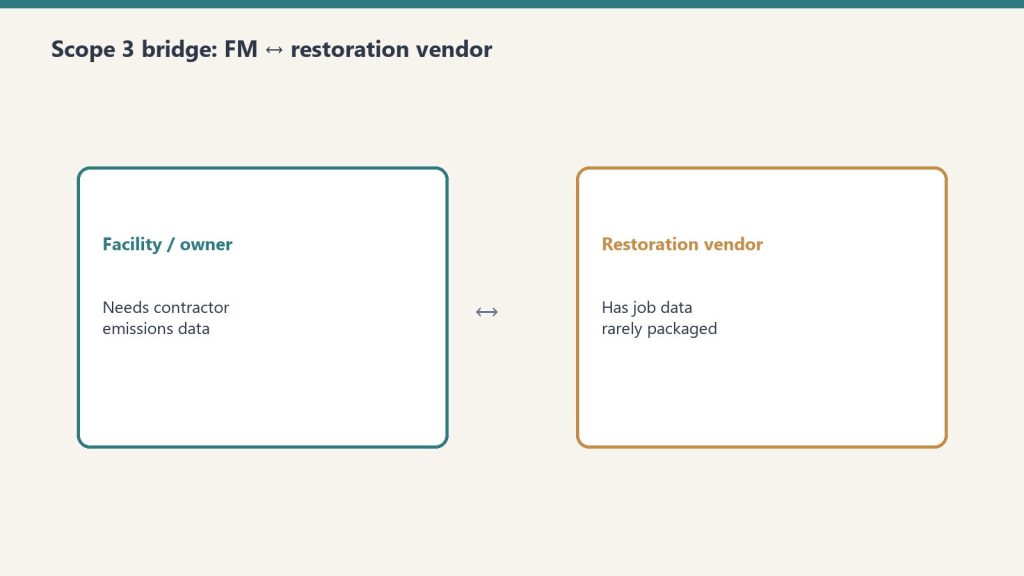
Under the GHG Protocol’s Scope 3 framework — which SB 253 uses as its methodological basis — your restoration contractors are a Category 1 (Purchased Goods and Services) supplier. Every time you hire a restoration company to respond to a water intrusion event, a fire damage claim, or a mold remediation project, that contractor’s emissions for that job are technically part of your Scope 3 inventory.
The calculation is not optional. The GHG Protocol requires organizations to make a reasonable effort to quantify all material Scope 3 categories. For a large corporate occupier with a substantial real estate portfolio, emergency restoration is a recurring and quantifiable Category 1 exposure. Your ESG auditor will ask about it. Your SB 253 filing will need to account for it.
Why Most Restoration Contractors Cannot Provide This Data Today

The restoration industry has no Scope 3 standard. IICRC — the primary certification body for restoration professionals — has no ESG reporting guidance. RIA has no Scope 3 framework. Most restoration contractors manage their operations through job management software that tracks labor hours, materials, and job costs — not emissions.
This is not negligence; it is a gap that simply has not been filled until now. The Restoration Carbon Protocol (RCP) is the first industry self-standard that defines how restoration contractors should calculate and report their Scope 3 emissions data. It gives contractors the methodology, the data capture template, and the calculation framework — and it gives FM procurement teams the standard they can reference in vendor contracts.
What to Put in Your Vendor Agreements Now
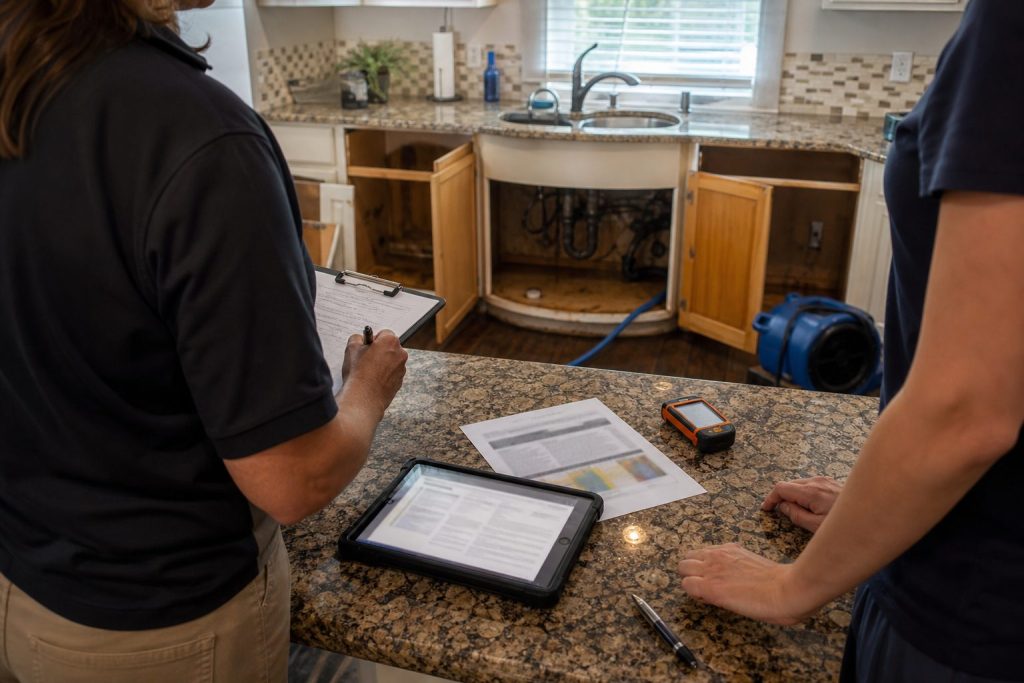
The most practical SB 253 preparation step for FM procurement teams is to update restoration vendor agreements to include a Scope 3 data provision clause. Here is the language framework:
“Vendor agrees to provide a per-project greenhouse gas emissions summary for each project completed at Client facilities, using a documented calculation methodology consistent with GHG Protocol Scope 3 Category 1 guidelines. The summary shall include: total fuel consumption by equipment type, vehicle miles traveled, waste materials removed by type and weight, and total equipment operating hours. Submissions shall be provided within 30 days of project completion.”
This clause does not require contractors to be ESG experts. It requires them to track and report the underlying data points from which a Scope 3 calculation can be made. Contractors who have adopted the RCP framework already capture this data as part of their standard job documentation.
The Retroactive Data Problem
SB 253 requires disclosure for fiscal year 2026 data, meaning the clock is already running. If your organization does business in California and exceeds the revenue threshold, your restoration vendors should be tracking Scope 3 data for jobs completed throughout 2026. Waiting until late 2026 to request this data will result in gaps that your ESG auditor will flag.
For restoration jobs already completed in 2025 and early 2026, proxy-based estimation is acceptable under GHG Protocol methodology when primary data is unavailable. The RCP provides proxy calculation tables for each restoration job type, allowing FM teams to estimate historical emissions from basic job records (square footage treated, job duration, equipment type). This is not ideal, but it is methodologically defensible and far better than a data gap.
The SB 253 Compliance Checklist for FM Teams
- Confirm whether your organization meets the SB 253 threshold (>$1B revenue, does business in California)
- Identify all restoration and specialty trade contractors in your vendor pool as Category 1 Scope 3 sources
- Update vendor agreements with a Scope 3 data provision clause (language above)
- Share the RCP framework with active vendors so they understand what data to capture
- Establish a process for collecting and storing per-job emissions summaries in your FM system
- Engage your ESG consultant to integrate contractor data into your Scope 3 Category 1 calculation methodology
- Plan for third-party verification of your Scope 3 data — auditors will scrutinize Category 1 more than any other category
Related on Tygart Media: contractor ESG clauses for Scope 3 · facility ESG frameworks (GRESB / CDP / SB 253) · RCP for property owners.
Frequently Asked Questions
Does SB 253 apply if my company is not headquartered in California?
Yes. SB 253 applies to any company that “does business in California” and meets the revenue threshold. This is broadly interpreted to include companies with California employees, customers, or operations — even if they are incorporated and headquartered elsewhere.
What is the penalty for non-compliance with SB 253 Scope 3 provisions?
CARB has authority to assess administrative penalties for non-compliance. The specific penalty structure is being finalized through rulemaking. Consult your legal counsel for the current enforcement guidance applicable to your organization.
Can I use a spend-based methodology for restoration contractor Scope 3 data?
Spend-based estimation (using economic input-output data) is permitted under GHG Protocol methodology as a fallback when primary or activity-based data is unavailable. However, third-party auditors generally flag spend-based estimates as lower quality than activity-based calculations. For a recurring Category 1 source like restoration contractors, building toward activity-based data is the appropriate goal.
Part of the IFMA Scope 3 series on tygartmedia.com. Source: California SB 253 text via California Air Resources Board.
Leave a Reply