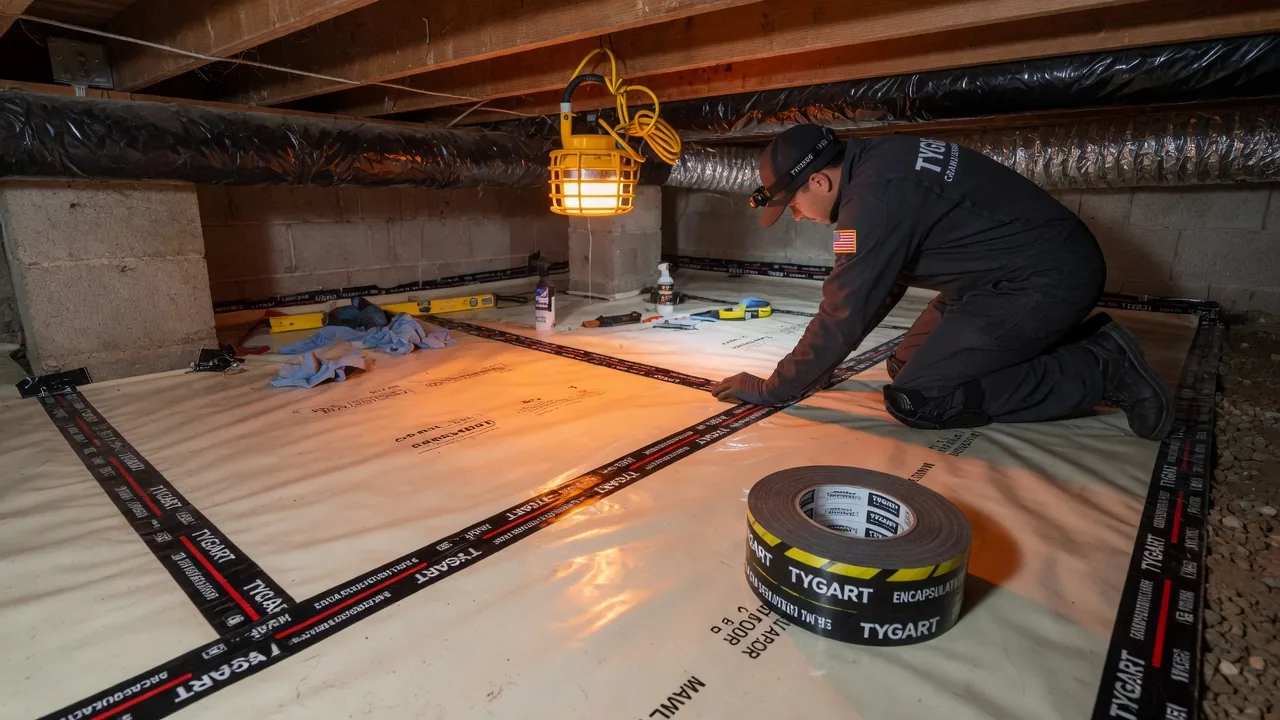
Crawl space encapsulation quotes vary enormously — from $1,500 for a basic vapor barrier installation to $25,000 for a full system with drainage, dehumidification, and premium materials. Understanding why quotes vary so dramatically — and which components drive the cost — lets you evaluate contractor proposals on their merits rather than simply choosing the lowest number. This guide breaks down every cost element of a complete encapsulation project, explains the legitimate reasons for price variation, and gives you a framework for assessing whether a specific quote represents good value for what is being proposed.
National Average Cost Range
The national average cost for a complete crawl space encapsulation system — including vapor barrier, vent sealing, rim joist insulation, and basic humidity control — is $5,000–$15,000 for a typical single-family home with a 1,000–1,500 sq ft crawl space footprint. The full range of installed costs runs from $1,500 (partial system, vapor barrier only) to $30,000+ (full drainage + encapsulation + dehumidification in a challenging space).
Per-square-foot pricing: $3–$7 per sq ft for basic vapor barrier installation; $7–$15 per sq ft for complete encapsulation with vent sealing and rim joist; $15–$25+ per sq ft when drainage and premium dehumidification are included.
Cost by System Component
Vapor Barrier: $1,500–$6,000
The vapor barrier is the core material cost driver. Pricing varies by:
- Material quality: 6-mil standard polyethylene: $0.10–$0.20/sq ft material cost. 12-mil reinforced: $0.30–$0.60/sq ft. 20-mil premium (CleanSpace, TerraShield): $0.80–$1.50/sq ft material cost.
- Crawl space footprint: A 1,200 sq ft crawl space requires approximately 1,400–1,600 sq ft of material accounting for wall coverage and overlap.
- Labor: Installation labor in a standard-height (36″+) crawl space runs $1.50–$3.00/sq ft of crawl space area. Low-clearance spaces (under 24″) command a 30–60% labor premium.
- Substrate preparation: Leveling severe soil undulation, removing rocks and debris, or addressing standing water add $300–$1,000 before barrier installation can begin.
Foundation Vent Sealing: $400–$1,200
Sealing existing foundation vents with rigid foam cut-to-fit panels and spray foam perimeter seal. Cost is driven by the number of vents (average home has 6–12) and their size. Standard-size vents: $40–$80 per vent. Oversized or custom vents: $100–$200 each. Some contractors include vent sealing in the overall per-sq-ft price; others itemize it separately.
Rim Joist Insulation and Air Sealing: $800–$2,500
Spray foam applied to the rim joist (the band joist at the top of the foundation wall) provides both air sealing and insulation. Installed cost including spray foam materials and labor: $1.50–$3.00 per linear foot of perimeter × 2 for two-sided access, or approximately $3–$6 per sq ft of rim joist area. A 1,500 sq ft home with a 150-linear-foot perimeter has approximately 150 × 2 (two courses of blocking) = 300 sq ft of rim joist area.
Drainage System: $3,000–$12,000
If the crawl space has active water intrusion — seepage through walls or floor after rain — drainage must be installed before encapsulation. A perimeter interior drain tile system with sump pit and pump costs:
- Drain tile installation: $25–$45 per linear foot of perimeter
- Sump pit excavation and installation: $800–$1,500
- Sump pump: $150–$500 (pedestal) to $300–$800 (submersible with battery backup)
- Total for a 1,200 sq ft crawl space with ~140 linear feet of perimeter: $5,000–$8,000 drainage only, before encapsulation
This is the single largest cost driver that separates $5,000 projects from $15,000+ projects. A contractor who quotes $3,500 for a crawl space that has active water intrusion is either not addressing the drainage issue or is setting up an encapsulation system that will fail.
Dehumidifier: $1,200–$3,500
A dedicated crawl space dehumidifier is required in most sealed crawl spaces that are not supplied with conditioned air from the home’s HVAC system. Crawl space-specific dehumidifiers (rated for lower temperatures than residential basement units) and their installed cost:
- Aprilaire 1820 (70 pint/day): $900–$1,100 unit cost + $300–$600 installation including condensate drain
- Santa Fe Compact70: $900–$1,100 unit + $300–$600 installation
- Aprilaire 1850 (95 pint/day, for larger or wetter spaces): $1,200–$1,500 unit + $400–$700 installation
Contractors who install their own branded dehumidifier as part of a systems package typically price the entire package at $2,500–$5,000 including the dehumidifier, installation, and one year of monitoring.
Factors That Drive Cost Higher
- Low crawl space clearance (under 24″): Crew works on their backs or elbows, reducing productivity and requiring more labor hours. Add 30–60% to standard labor rates.
- Active water intrusion: Drainage system required before encapsulation — adds $3,000–$12,000 to baseline encapsulation cost.
- Large footprint: Straightforward linear scaling above 1,500 sq ft — larger spaces cost more, though per-sq-ft unit cost may decrease slightly on very large projects.
- Obstructions: HVAC ductwork, plumbing, electrical conduit, and storage debris all increase labor time for barrier installation.
- Mold remediation: If visible mold is present on joists or blocking, remediation (HEPA vacuuming, treatment, encapsulation of surfaces) must precede encapsulation. Add $1,000–$4,000 depending on extent.
- Old insulation removal: Deteriorated fiberglass batt insulation between joists must be removed before proper encapsulation — add $0.50–$1.50 per sq ft of crawl space area for removal and disposal.
- High-cost-of-living markets: Labor rates in the Pacific Northwest, Northeast, and California run 30–60% above national averages.
Factors That Drive Cost Lower
- Dry crawl space, no drainage needed: Eliminates the largest potential cost component.
- Adequate clearance (36″+): Standard labor rates apply; no cramped-space premium.
- HVAC supply duct instead of dehumidifier: Running a small supply duct into the crawl space from the existing HVAC system costs $300–$600 total — far less than a dedicated dehumidifier — if the HVAC system has sufficient capacity to condition the additional space.
- Rural or lower-cost-of-living markets: Southeast and Midwest labor rates are significantly below national averages. Full encapsulation quotes of $4,000–$7,000 for standard crawl spaces are common in these markets.
- Competitive local market: Markets with multiple established encapsulation contractors produce more competitive pricing than monopoly or duopoly markets where one or two large companies dominate.
How to Evaluate a Contractor Quote
A legitimate quote for crawl space encapsulation should itemize:
- Vapor barrier: material specification (mil rating, ASTM E1745 class, brand), square footage, and unit price
- Vent sealing: number of vents, method, and cost
- Rim joist treatment: method (spray foam vs. rigid foam), R-value, and cost
- Drainage: whether drainage is included and what type (if applicable)
- Humidity control: dehumidifier model or HVAC supply duct specification and cost
- Warranty: workmanship warranty duration, manufacturer warranty on barrier material
- Any remediation, debris removal, or prep work
A quote that simply says “encapsulation: $8,500” without specifying what components are included cannot be compared against another quote. Ask for itemized breakdowns from all contractors — this reveals where the price difference comes from and allows apples-to-apples comparison.
Frequently Asked Questions
What is the average cost of crawl space encapsulation?
The national average for a complete crawl space encapsulation system is $5,000–$15,000 installed, with a typical project (1,200 sq ft crawl space, no drainage needed, standard dehumidifier) running $7,000–$10,000. Per-square-foot pricing for complete systems runs $7–$15/sq ft. Projects requiring drainage installation can reach $15,000–$25,000.
Why is crawl space encapsulation so expensive?
Crawl space work is physically difficult — crews work in confined spaces in challenging conditions. Material costs for quality barrier products are substantial. And complete system installation requires multiple skilled trades: waterproofing, spray foam insulation, HVAC modification, and electrical for the dehumidifier. When drainage is needed, excavation and concrete work add significant cost. The price reflects both the labor difficulty and the system complexity.
Is it cheaper to DIY crawl space encapsulation?
DIY material cost for vapor barrier and vent sealing is typically $800–$2,500 for a standard crawl space — saving $3,000–$8,000 compared to professional installation. However, DIY encapsulation has significant limitations: spray foam rim joist application requires proper equipment and safety precautions; drainage installation is not DIY-accessible; dehumidifier installation requires electrical work; and quality issues (improperly sealed seams, missed penetrations) may not be apparent until moisture damage occurs. DIY is most appropriate for straightforward vapor barrier installation in a dry crawl space with no drainage issues.
Does homeowners insurance cover crawl space encapsulation?
Generally no — encapsulation is a preventive improvement, not a repair for a covered loss. If a covered water damage event (burst pipe, appliance failure) damaged the crawl space, some components of repair might be covered. Flooding from external sources is typically excluded from standard homeowners policies. Some policies may cover mold remediation that precedes encapsulation if the mold resulted from a covered event — check your specific policy and consult your insurer before assuming coverage.
Leave a Reply