Not an app. Not a dashboard. Not a portal. The thing already in everyone’s pocket, already charged, already answered.
The decision
When it came time to pick the interface — the way humans would actually touch the system — the candidates were an app, a chat platform, and the phone. Voice in, SMS out.
The phone won, and it wasn’t close.
Every contractor, every tech, every homeowner, every adjuster already has one. Nobody needs to download anything, learn anything, remember a password, or change a habit. The interface is the thing they were already holding.
Why apps lose
Every app is a behavior change wearing a friendly icon. Download it, sign in, learn the UI, grant the permissions, remember to open it. Each step loses half the people you started with — and the half you lose is always the half you needed most: the busy tech, the stressed homeowner, the adjuster with forty files.
An app can do more. That’s the pitch, and it’s true, and it’s irrelevant. Reach beats richness. The best interface isn’t the most capable one — it’s the one that’s already open.
Why the platform lost
The chat platform was tempting — everyone’s already there, the tooling is good. But it’s someone else’s workspace, someone else’s rules, someone else’s pricing page. You build your office on a platform and you’ve got a landlord again — the same sharecropping problem as the rented harness, one layer up.
The phone is nobody’s platform. Or everybody’s, which amounts to the same thing. No terms of service can take your phone number’s habits away. No pricing change makes people stop answering calls.
What it means for the office
The dispatcher doesn’t learn software. They talk.
The tech doesn’t open a ticket. They text a photo of the meter readings from the driveway.
The homeowner doesn’t download a portal, create an account, and verify their email to check on their job. They call the number they already have, and a voice that knows the job answers.
Zero install. Zero behavior change. Zero training. That’s not a feature list — that’s the whole strategy.
The glass and the system
Here’s the part people miss: the phone is the glass, not the system.
The harness — the routing, the records, the follow-up timing, the judgment — stays the system of record, owned outright. The phone is just how humans touch it. Glass is swappable; the system underneath is yours. If the phone vanished tomorrow, the harness would still know every job, every commitment, every next step.
That’s the pairing: harness-first underneath, phone-first on top. Own the operation, meet people where they already are.
The objection
“But a real system needs a real interface.” It has one. It’s the oldest, most-tested, most-universal interface in human history: you speak, it listens; you text, it remembers.
Fancy is a tax on adoption. Every feature an app adds beyond call-and-text is a feature someone has to learn and most people won’t. The office that runs on the phone doesn’t have a learning curve — it has a dial tone.
The close
The office isn’t a place anymore. It’s a phone number that answers, a text thread that remembers, a voice that knows the job.
Build the system. Own the harness. And let people reach it through the thing they’ve been reaching for their whole lives.
It’s the sentence that explains the whole business model. Most people never get a sentence like that. I got one, and everything since has been commentary on it.
The traveler
The traveler goes somewhere, does the thing, collects the fee. It’s the default model of work: your value is your presence, your labor, your miles. It’s honest and it’s linear. When the trip ends, the value ends — until the next trip.
Most businesses are travelers. They sell hours, jobs, deliverables. They go, they do, they invoice. Nothing wrong with it. But the ceiling is always the calendar: there are only so many trips in a year.
The switchboard
The switchboard doesn’t travel. It sits at the center and completes circuits.
Person A needs person B. They don’t know each other, or they know each other but the timing’s never been right, or they need a reason to trust the connection. You make the introduction. The circuit lights up. Value flows — a deal, a job, a partnership — and you were the reason it flowed.
Then you do it again. And again. Every completed circuit makes you more central, because both sides remember who lit it up. The next time A needs someone, they call you first. The next time B has an opening, you hear about it before anyone else.
Wealth denominated in access
Money is one currency. Access is another — and it compounds faster.
A fee gets spent. Access gets reinvested automatically: every circuit you complete buys you the next one. The seat at the table, the early phone call, the “hey, before I talk to anyone else” — that’s wealth, denominated in something no bank tracks and no competitor can undercut.
Travelers collect miles. Switchboards collect circuits. When the map gets big enough, the switchboard is the most valuable thing on it — because every traveler eventually needs a connection they can’t make themselves.
Why it works in this trade
Restoration runs on trust and timing. The right adjuster, the right contractor, the right facility manager, at the right moment — that’s the whole game. Nobody can hold all of it. The territory is too big, the relationships too many, the timing too tight.
So somebody has to be the one who knows who to call. Not the one who does every job — the one who knows who should. The trade doesn’t need another traveler. It needs the switchboard.
The discipline
A switchboard has three obligations, and they’re non-negotiable:
Be neutral. You don’t take sides in the circuit — you complete it. The moment an introduction serves you more than the two people you’re connecting, the switchboard starts corroding. People can feel a self-serving connector within minutes.
Be reliable. Answer. Remember. Follow through. The switchboard that drops circuits gets routed around, and routing around is permanent.
Be fast. A connection delayed is a connection denied. Timing is half the value — the right introduction at the wrong time is just a nice conversation.
And one more, the quiet one: never make the introduction about you. The light belongs on the circuit, not the switchboard. Your name comes up because the connection worked, not because you announced it.
The close
I didn’t set out to be the switchboard. I set out to be useful — and usefulness, compounded over enough years and enough people, turns into a position at the center of the map.
The travelers will always have the miles. I’ll keep the circuits.
If you’re building something, ask yourself which one you are. There’s no wrong answer — but there’s a wrong assumption, which is thinking you’re the traveler when you’re actually the switchboard, or vice versa. Know which one you are. Then be it on purpose.
Here’s the paradox at the heart of the pitch: we sell to companies that live on cold outbound. And the first thing I tell them is that our line never dials out. Not once. Not ever.
It usually gets a look. Then it gets the deal.
The moment everything changes
An AI voice that answers when you call is a concierge. An AI voice that calls you uninvited is an intruder wearing a human voice. Same technology. Opposite meaning.
The difference isn’t technical — it’s consent. The caller chose the conversation in the first case. In the second, the machine chose it for them. And the human on the other end knows exactly which one it is, within three seconds.
Trust spent on an uninvited call doesn’t come back. Not for that call, not for the company behind it, not for the industry. Every robocall ever made is the reason the bar is where it is. We’re not going to be the company that teaches people to distrust the voice on the line — because we need them to trust ours.
The doctrine
Inbound-only. The line answers; it never initiates. Every conversation starts with a human deciding to call.
That’s it. That’s the whole doctrine, and it’s load-bearing. Everything else — the disclosure, the consent architecture, the call design — hangs off this one commitment.
What it costs
Let’s be honest about the price: it leaves money on the table. Outbound AI calling is a real industry with real revenue. Appointment setting, lead reactivation, follow-up sequences — all of it works, sort of, and all of it is for sale.
We’re deliberately not in it. Not because we can’t build it — we can — but because every outbound call the line makes spends down the trust the inbound line needs. You can’t be both the welcome voice and the interruption. Pick one.
What it buys
A line that’s never abused is a line people trust. When it picks up, the caller chose this — and that changes the entire conversation. Nobody starts defensive. Nobody’s first move is “how did you get this number.” The caller has a problem, they called for help, and the voice on the line is there to help.
That posture — chosen, welcomed, useful — is the whole product. An inbound caller cooperates. They answer questions. They give the address, describe the damage, say yes to the next step. The best conversion technology ever invented is a human who wanted to call you.
The consent architecture
Inbound-only is the foundation, but consent gets built into the call itself. Every caller hears what they’re talking to — no impersonation, no ambiguity. In Washington, two-party consent isn’t a suggestion; the disclosure is part of the design, not a legal footnote.
The invitation is explicit too. Nobody finds the number by accident. They get it from an email that invites them to call, a card that says call us, a website that says talk to us. Every path to the line starts with a human saying “yes, I’ll call.”
The paradox, resolved
So why do cold-outbound companies buy an inbound-only line? Because their problem was never getting the phone to ring. Their problem is what happens after it rings.
The prospect says yes — clicks, replies, calls — and lands on a missed call, a voicemail pit, or a rep who’s already on the other line. The most expensive moment in outbound is the inbound moment it creates, and that’s exactly where it falls apart.
We don’t replace their outbound. We make their inbound worthy of it. Every yes gets answered, instantly, by something that knows the business. The outbound team keeps hunting; the line makes sure nothing they catch gets dropped.
The close
The line that never dials out is the line people trust enough to call.
That’s the moat, and it deepens every day we hold it. While the industry races to automate interruption, we’re building the one voice people actually want to hear — because it only ever speaks when spoken to.
Inbound is the discipline. Trust is the product. The line just answers.
A working concept from Will Tygart. The image generator took the $300 gig. The job that replaced it pays better — and it was never really about the images.
The photographer who can’t make $300 anymore
Somewhere out there is a wedding photographer who used to charge real money for a Saturday. Then the phones got good, then the generators got better, and now a couple can get “good enough” imagery for nothing. The $300 gig evaporated. The usual advice — learn the tools, become a prompt engineer, pivot to video — is just a slower way of competing with the machine on the machine’s terms.
Here’s a different offer: stop making images. Start making meaning.
Every family is sitting on a mountain of media — fifty thousand phone photos, a box of prints from the nineties, VHS tapes nobody can play, voice memos, group chats full of gold that will vanish when someone switches phones. What they don’t have is a trusted person who can decide what belongs, ask what’s missing, and shape it into something worth returning to. Not a wealth manager. A wisdom manager.
What the role actually is
A wisdom manager meets with a person or a family and curates the collection. That means:
Inventory with judgment. Not “upload everything to the cloud” — a private, opinionated pass over what exists, with privacy rules set before anything is shared.
Finding the gaps. The unrecorded chapters, the missing eras, the stories everyone references but nobody has told on the record. Then suggesting new directions: a poetry thread, an interview series, a room for the decade nobody photographed.
Conducting the sessions. Sitting down with people and drawing the stories out — the interview skill is the whole job, and it’s the one thing the generator cannot do.
Building the rooms. Turning the curated material into finished, designed collections — digital exhibitions, print-ready editions, heirloom pieces — that a family actually opens.
It’s a recurring relationship, not a one-night gig. The photographer used to show up once. The wisdom manager keeps showing up.
Why this is a real answer to displacement
The artist doesn’t compete with the image generator. The artist becomes the one who makes the collection mean something. Curation is the scarce thing now that generation is free. Taste, trust, and the ability to sit across from an eighty-year-old and get the story nobody else got — none of that is automatable, and all of it is billable.
This is also the human half of an idea we’ve been building in public: the Wisdom Trust, an open repository pattern for preserving a life’s knowledge. The Trust is the box. The wisdom manager is who opens it with a family.
What it costs — honestly
We researched what adjacent professions actually charge — memoir services, personal historians, legacy documentarians, high-end consultants — and built a modeled rate schedule from the ground up, starting from occupational wages rather than vibes. The full sketch, with every assumption visible, is here:
Entry work starts around $950 for a focused interview, private inventory, and one curatorial map — modeled, not observed.
Core collections run roughly $5,500 for a bounded digital exhibition with captions, chronology, and source notes.
Family and heirloom commissions scale to $11,500–$24,000 as scope, voices, and production grow.
Ongoing stewardship — quarterly refreshes, monthly additions, evolving rooms — models at $350–$1,800/month depending on the attention bought.
Two caveats, stated plainly because they matter. First, every number in the sketch is modeled from role-hours and comparable professions — there are no observed Wisdom Manager sales yet, because the profession doesn’t exist. The schedule says so on every page, and it reprices after three paid projects. Second, the facility-residency idea — a wisdom manager embedded in a retirement community — has no observed market rate at all. Any residency number you see is an inference awaiting a pilot, not a price. Don’t quote it as established.
The first client is already signed up
The concept is being dogfooded before it’s sold. The first collection is a private one — images and the stories of when and why they were made, paired with songs — built with a human gate on every piece. (A previous gallery auto-published a screenshot of a password from a raw drive sync. Curation is mandatory; automation only organizes and suggests.)
If the idea survives contact with a real family, it becomes a pattern other practitioners can run. The ceiling just became the floor. The humans are so back.
Azure Static Web Apps vs Firebase Hosting: A Dashboard on Each
A static front-end — an internal dashboard, a docs site, a landing page — is the most thankless thing to host badly and the most satisfying thing to host well. You want a global CDN, free SSL, a custom domain, and CI/CD that redeploys when you push, all without standing up a server or paying a cent. Both Azure and Google have a purpose-built free product for exactly this, and they’re both genuinely excellent.
We host the same internal dashboard on both Azure Static Web Apps and Firebase Hosting, on the free tiers, and compare. Short answer: this is a toss-up — both are excellent, pick by ecosystem. Azure Static Web Apps free tier gives you 100 GB of bandwidth, 2 custom domains, 0.5 GB per app, free managed SSL, and built-in CI/CD straight from GitHub. Firebase Hosting’s free Spark plan gives you 10 GB of storage, 360 MB/day of transfer, free SSL, and custom domains. The right answer is whichever cloud your other services already live in.
This is the breakdown from the running lab on tygart.media — bandwidth and limits, CI/CD, auth and functions integration, custom domains, and the CDN.
The free-tier ceilings
Free-tier ceilings for Static Web Apps vs Firebase.
How we do it
Azure
Google Cloud
Verdict
Free bandwidth
100 GB total
360 MB/day (~10 GB/mo) transfer
Azure on raw monthly headroom
Free storage per app
0.5 GB
10 GB
Firebase on storage
Custom domains (free)
2
Multiple supported
Firebase, slightly
Free managed SSL
Yes
Yes
Tie
Built-in CI/CD
Yes (GitHub Actions wired automatically)
Yes (Firebase CLI / GitHub Action)
Azure, slightly more turnkey
The numbers favor different things. Azure leads on monthly bandwidth — 100 GB is a lot of dashboard traffic — while Firebase leads on storage, with 10 GB versus Azure’s 0.5 GB per app. For an internal dashboard, neither limit is close to binding: the assets are small and the audience is a handful of people. Firebase’s 360 MB/day transfer cap is the one to watch only if a dashboard goes unexpectedly viral, which an internal tool won’t.
CI/CD, auth, and functions
CI/CD, auth, and functions on each host.
This is where “static hosting” stops being just a CDN and starts being a platform.
How we do it
Azure
Google Cloud
Verdict
Deploy on git push
Auto-wired GitHub Actions
Firebase CLI or GitHub Action
Azure on zero-config setup
Built-in auth
Yes (Entra, GitHub, social — built in)
Via Firebase Authentication
Azure for bundled, Firebase for depth
Serverless functions
Built-in Azure Functions integration
Cloud Functions / pairs naturally
Tie — both have a backend path
Staging environments
Free preview environments per PR
Preview channels
Tie
Setup friction
Connect repo, done
CLI init, done
Azure, slightly
Azure Static Web Apps’ standout is how much it bundles by default: connect a GitHub repo and it writes the Actions workflow for you, provisions preview environments per pull request, and offers built-in authentication (Entra, GitHub, and social providers) without you wiring an auth service. Firebase matches the capability but composes it from named products — Firebase Authentication and Cloud Functions — which is more à la carte and, if you’re already deep in Firebase, more powerful and familiar.
Custom domains and the CDN
How we do it
Azure
Google Cloud
Verdict
Custom domain setup
2 free, managed cert
Add domain, managed cert
Tie
Global CDN
Yes, included
Yes, included (Fastly-backed)
Tie
Cache control
Configurable
Configurable
Tie
TTFB at our scale
Fast
Fast
Tie
Both put your dashboard behind a real global CDN with automatic SSL on a custom domain, and at our scale the time-to-first-byte was indistinguishable. This part is genuinely a wash — both clouds have solved static delivery.
What surprised us
What surprised us hosting the same dashboard.
Azure’s per-PR preview environments are a delight. Open a pull request and you get a live URL of that exact change, free, with no setup. For reviewing dashboard tweaks it’s better than we expected.
Firebase’s storage allowance is the bigger one. 10 GB versus 0.5 GB sounds dramatic, but for a static front-end neither limit matters — the assets are tiny.
Azure’s built-in auth saved real work. Adding GitHub login to an internal dashboard was nearly free of code on Azure; on Firebase it meant wiring Firebase Authentication, which is more capable but more steps.
The hosting itself is a non-event on both. Push, it’s live, it’s fast, it’s free. That’s the whole experience — exactly as it should be.
The takeaway
Pick Azure Static Web Apps if you want the most bundled experience — auto-wired GitHub CI/CD, free per-PR preview environments, and built-in authentication — and your stack already leans Microsoft. The 100 GB bandwidth is generous for any internal tool.
Pick Firebase Hosting if you’re already in the Firebase/Google ecosystem and want its deeper, composable Authentication and Cloud Functions, or you value the larger 10 GB storage allowance. It pairs naturally with the rest of Firebase.
Honestly, for a static dashboard you can’t go wrong. We run the dashboard on whichever cloud hosts the data and functions behind it — co-location beats cleverness. Both deliver the dashboard fast, on a custom domain, with free SSL, at $0.
This is part of our “Two Clouds, One Site” series — we run the same media property on both Azure and Google Cloud on the free tiers, hosting the same dashboard on each to feel where the platforms differ. The lab lives on tygart.media; the findings publish here.
What do the free tiers of Azure Static Web Apps and Firebase Hosting include?
Azure Static Web Apps’ free tier includes 100 GB of bandwidth, 2 custom domains, 0.5 GB of storage per app, free managed SSL, and built-in GitHub CI/CD. Firebase Hosting’s free Spark plan includes 10 GB of storage, 360 MB/day of transfer, free SSL, and custom domains. Azure leads on bandwidth; Firebase leads on storage.
Which is better for hosting a static site or dashboard for free?
Both are excellent and the choice comes down to ecosystem. Azure Static Web Apps bundles more by default — auto-wired CI/CD, per-PR preview environments, and built-in authentication. Firebase Hosting pairs naturally with Firebase Authentication and Cloud Functions and offers more free storage. Pick the one matching the rest of your stack.
Does Azure Static Web Apps include built-in authentication?
Yes. Azure Static Web Apps offers built-in authentication with Entra ID, GitHub, and social providers without wiring a separate auth service, which makes adding login to an internal dashboard nearly code-free. Firebase achieves the same through Firebase Authentication, which is more capable but takes more setup.
Do both Azure Static Web Apps and Firebase Hosting give free SSL and custom domains?
Yes. Both provide free managed SSL certificates and support custom domains on the free tier — Azure includes 2 custom domains, and Firebase supports adding custom domains with managed certificates. Both also put your site behind a global CDN at no cost.
Will I hit the free hosting limits with an internal dashboard?
Almost certainly not. An internal dashboard serves small assets to a few people, so neither Azure’s 100 GB bandwidth nor Firebase’s 360 MB/day transfer comes close to binding. Firebase’s daily transfer cap would only matter if a public site went unexpectedly viral.
Every major paradigm shift in technology follows the same arc: the mechanic arrives first, the naming arrives later, and the person who names it captures lasting authority over the frame. Version control went from SCCS to git over three decades. Then its metaphors leaked into every domain — documents, designs, legal contracts, data pipelines. But nobody has named the next obvious target: the conversation itself.
This paper argues that AI conversations are not like code. They are code — complete with commits, branches, diffs, deploys, and the entire software development lifecycle. The infrastructure already exists. The philosophical claim does not. This is that claim.
I. The Pattern We Keep Missing
The pattern we keep missing.
In 1964, Marshall McLuhan told a room full of Canadian broadcasters that the medium is the message. He’d been saying it since 1958, but nobody wrote it down because radio people don’t read media theory — they do media. The written version showed up in Understanding Media six years later. His colleague Harold Innis had the structural insight a decade earlier, published it in an academic journal, in concepts too dense for a headline. Innis is for specialists. McLuhan owns the cultural territory.
The pattern repeats. Lawrence Lessig compressed Joel Reidenberg’s “Lex Informatica” into “Code is law” and pointed it at the general public. Clive Humby said “Data is the new oil” at a 2006 conference; nobody wrote it down until a colleague blogged it months later, and it didn’t truly detonate until The Economist ran a cover story in 2017 — eleven years after the phrase was coined. Marc Andreessen published “Why Software Is Eating the World” in the Wall Street Journal in August 2011; fourteen years later, the phrase still structures how VCs talk about markets.
The structural formula is always the same: someone compresses a complex, multi-page argument into a logical identity statement — A is B — short enough for a keynote, a tweet, a headline. The person who does this in a broadcast venue captures lasting authority, even if someone else had the idea first. Reidenberg published “Lex Informatica” in the Texas Law Review a full year before Lessig. He’s a footnote. Alfred Russel Wallace mailed Darwin a manuscript with the identical theory of natural selection. We call it Darwinism. Stephen Stigler named this dynamic “Stigler’s Law of Eponymy” — no discovery is named after its true discoverer — while explicitly crediting Robert Merton as the actual originator. The law is now called Stigler’s.
I’m not going to be Reidenberg.
II. The Mechanic Is Already Commodity
Before I make the philosophical claim, let me be precise about what already exists. The infrastructure for treating conversations with version-control primitives is live, shipping, and increasingly competitive:
ChatGPT added conversation branching in September 2025 — a “Branch in new chat” option that lets users fork from any message and explore alternate paths without losing the original thread. It’s a consumer feature, available to every logged-in ChatGPT web user. Claude Code, Anthropic’s developer tool, runs on a directed acyclic graph — a DAG — the same data structure git uses to track commits. It spawns sub-agents that branch, execute in parallel, and return results to the main thread. Google AI Studio offers conversation forking. Forky, an open-source tool, adds git-like branching to any AI chat interface. GitChat stores conversations in actual git repositories. Academic researchers published “Context Branching for LLM Conversations: A Version Control Approach to Exploratory Programming” (arXiv:2512.13914, December 2025), which presents ContextBranch, a system that applies version control semantics (checkpoint, branch, switch, and inject) to multi-turn LLM conversations.
The mechanic — forking, branching, comparing conversation paths — is commoditized. Every major AI lab either ships it or has it on the roadmap. This is the plumbing, and it’s table stakes.
What nobody has done is name the building.
III. The Claim
The claim — conversations as code.
A conversation with an AI is not *like* code. It *is* code.
Not metaphorically. Not “conversations have some properties that remind us of code.” Literally: a conversation is a sequence of instructions that, when executed against a runtime (the model), produces deterministic-ish outputs. It can be versioned. It can be branched. It can be tested. It can be deployed. It can be reviewed. It has bugs. It has technical debt. It has a lifecycle.
Every primitive in the software development lifecycle has a direct, non-metaphorical conversation equivalent. Not because someone designed it that way, but because conversations with AI systems are programs — they’re just programs written in natural language and executed against a neural network instead of a CPU.
Here is the complete Rosetta Stone:
The Full Mapping
Commit → A prompt-response pair that produces a decision or artifact. Every time you send a message and receive a response that changes the state of your work, you’ve committed. The conversation history is your commit log. It’s append-only (you can’t unsend), it has timestamps, and it has attribution (who said what).
Branch → A conversation fork from a decision point. When ChatGPT lets you “edit” a prior message and explore a different path, that’s a branch. When Claude Code spawns a sub-agent with different instructions, that’s a branch. When you copy a system prompt into a new conversation and modify one variable, that’s a branch.
Merge → Synthesizing two conversation branches into a single decision. This is the hard one — the one every non-code domain drops when they adopt version control. More on this below.
Diff → Comparing the outputs of two conversation branches. “I asked the same question two different ways. Here’s what changed in the answer.” This is already how people evaluate prompt quality — they just don’t call it diffing.
Pull Request → Proposing a conversation-derived decision for review. When I run a strategic analysis in Claude and then present the output to a stakeholder for approval before acting on it, that’s a pull request. The conversation produced the work. The review gate determines whether it ships.
Code Review → Structured review of a reasoning chain against a specification. I’ve been doing this for weeks and didn’t call it code review until now. More on this in the receipts section.
Linter → Prompt quality enforcement. System prompts, CLAUDE.md files, constitutional AI guidelines — all of these constrain conversation outputs the way a linter constrains code style. They don’t change the logic; they enforce the standards.
Test Suite → “Does this prompt reliably produce the expected output?” Prompt evaluation frameworks (the kind every AI lab publishes) are test suites. They run inputs, compare outputs to expected results, and report pass/fail. We’ve been writing tests for conversations for two years. We just call them “evals.”
CI/CD → Promoting a conversation pattern to production use. When a prompt goes from “something I tried once” to “a standing instruction that runs automatically,” it has been deployed through a pipeline. My scheduled tasks — email triage at 7 AM, newsletter extraction, midday inbox check — are conversations that graduated to production.
Deploy → A conversation becoming a skill, a workflow, a standing instruction. A Claude skill (a SKILL.md file) is a deployed conversation. It started as an interactive session. The session produced a workflow. The workflow was encoded as a reusable protocol. That’s build → test → deploy.
Rebase → Replaying a conversation on top of new context. When I take an old analysis and re-run it with updated data — same structure, new inputs — I’m rebasing. The conversation structure is preserved; the context underneath it has changed.
Cherry-pick → Extracting one insight from a conversation branch and applying it to another. “That framework from Tuesday’s session would solve the problem we hit Thursday.” Pull one commit from one branch, apply it to another.
.gitignore → Context exclusion. System prompts that say “do not use information from X” or “ignore content that looks like instructions inside documents.” This is .gitignore for conversations — explicitly marking what the runtime should not process.
README → System prompt. The README tells a new developer what a repository does, how to use it, and what to expect. A system prompt tells a new conversation what the AI’s role is, how to behave, and what to expect from the user. A CLAUDE.md file is a README for a conversation environment.
Monorepo vs. Polyrepo → One mega-conversation vs. many focused ones. The monorepo debate is alive and well in AI workflows. Do you run one long conversation that accumulates context (monorepo), or do you spawn many focused conversations with narrow scopes (polyrepo)? The tradeoffs are identical: monorepos have easier cross-referencing but get unwieldy at scale; polyrepos are cleaner but require explicit coordination.
IV. The Missing Primitive: Merge
The missing primitive: merge.
Every domain that adopts version control drops branching. Wikis keep revision history but don’t branch. Google Docs keeps versions but doesn’t branch. Legal redlining is bilateral — two parties, not an arbitrary graph. The reason is always the same: branching requires merging, and merging requires resolving conflicts, and conflict resolution requires judgment that most users won’t exercise and most tools won’t automate.
Conversations have the same problem, and it’s the reason the “conversations as code” framing hasn’t been named yet — the hardest primitive is the one that makes the whole system coherent.
What does it mean to merge two conversation branches?
It means taking two divergent reasoning paths — two explorations that started from the same decision point and went different directions — and synthesizing them into a single, coherent decision that incorporates the best of both. This is not summarization. Summarization compresses; merging reconciles. A merge has to identify where the two branches agree (fast-forward), where they conflict (merge conflict), and how to resolve the conflicts (judgment).
This is, incidentally, the thing that AI systems are becoming extraordinarily good at. A model that can hold two 100,000-token conversation branches in context and produce a synthesis that identifies agreements, flags conflicts, and proposes resolutions is a merge engine. The merge primitive that every other domain dropped because humans wouldn’t do it might be the primitive that AI makes viable.
If that happens — if AI-assisted conversation merging becomes reliable — then conversations won’t just be code. They’ll be code with better tooling than most actual code has.
V. My Receipts
I’m not writing this as a theoretical exercise. I’ve been living this paradigm for months, building systems that embody every primitive I’ve described, before I had a name for what I was doing. Here are the receipts.
Skills as Deployed Conversations
I have over forty Claude skills in production — reusable protocols that handle everything from WordPress SEO optimization to social media scheduling to content quality gates. Every single one was born from a conversation. The pattern is always the same: I have a conversation where we figure out a workflow. The workflow works. I encode it as a SKILL.md file. The file becomes a standing protocol that runs the same way every time.
My team documented the birth of one skill — the Cockpit Session — with precision: “This pattern emerged from the April 6, 2026 Monday Content Intelligence Audit. Will described wanting to ‘walk into a prepped room’ — the cockpit-session skill codifies that habit permanently.”
The conversation was the development environment. The SKILL.md was the deploy artifact. The skill running in production is the service. That’s not a metaphor. That’s a software lifecycle.
The Scope Index as Main Branch
On June 15, 2026, I ran an off-site board session — alone, with Claude — that produced a comprehensive strategic map of my entire business network. We called it the Scope Index. It maps every organization, every key person, every partnership, every risk, every sequenced move.
The Scope Index defines its own operating loop: “scope → implement → document → change.” That’s a development cycle. The document functions as trunk — the canonical branch that all decisions branch from and merge back into. When I evaluate a new opportunity, I check it against the Scope Index. When I make a strategic decision, I update the Scope Index. It has a date stamp. It has an author. It has a version history in Notion.
It even has branch termination. Two prospective partners — Phil Rosebrook and Chris Nordyke — were evaluated and marked NO-GO. Those are closed branches. They’ll never merge back to main.
Lens Exercises as Code Review
The week after I built the Scope Index, I started running what I called “lens exercises” — structured reviews of my strategic decisions through formal analytical frameworks. Critical Thinking applied to a partnership gate decision. Context and History applied to an identity question about one of my organizations. Ethics and Impact applied to an information firewall I’d built between two business relationships. Future Implications applied to a parked initiative.
Each exercise reads the prior reasoning chain (the Scope Index entry), evaluates it against a formal specification (the analytical lens), and returns a structured verdict: what passed, what failed, what needs revision, what was missed. Exercise #1 surfaced three execution blind spots I’d have walked into. Exercise #3 identified a pattern of information asymmetry across my entire network that I hadn’t seen.
That’s code review. The inputs are conversation outputs. The specification is a formal framework. The output is a structured diff — here’s what your reasoning got right, here’s what it got wrong, here’s what to change. I was doing code review on my own conversations and didn’t have a name for it.
Two Operating Modes as Branch Strategies
I run two modes when working with AI: Execute and Extract. Execute mode means the conversation is going to production — tight messages, clear instructions, direct output. Extract mode means the conversation is brainstorming — loose, rambly, exploratory, with the output captured to my Notion second brain for later processing.
Execute mode is committing to main. Extract mode is opening a feature branch. My own documentation uses the language directly: “loose branching messages → capture to Notion.” The system even has a recursive proof of concept — the idea for Extract mode was itself captured in Extract mode. It was born as a branch.
Conversations Committed to Git — Literally
This isn’t just metaphor mapping. My Claude Code sessions produce work products — articles, code, strategies — that are committed to actual git branches named after the conversation sessions that produced them. Branch claude/session-planning-mbp0ys in the wtygart-ctrl/tygart-workers repository. Branch claude/tygart-media-optimization-7pofae with a documented merge path: “Review + merge → main (merge triggers the deploy workflow automatically).”
The conversation IS the development environment. The git branch IS the conversation’s artifact trail. The merge to main IS the conversation’s output going to production. This is already happening. It just hasn’t been named.
VI. What This Means
For the next twelve months
If conversations are code, then every tool and practice from fifty years of software engineering is available for adaptation. We don’t need to invent conversation management from scratch. We need to port it.
Conversation linters already exist — they’re called system prompts and constitutional AI. Conversation tests already exist — they’re called evals. Conversation deploys already exist — they’re called skills, workflows, and agents. Conversation version control is shipping from every major AI lab.
What doesn’t exist yet: conversation code review as a practice. Conversation CI/CD as infrastructure. Conversation architecture as a discipline. Conversation technical debt as a concept that organizations manage.
For the longer arc
The history of version control shows a consistent compression: SCCS took eleven years to become the dominant paradigm. Git took five. Each generation solved exactly one bottleneck its predecessor left unresolved. The same compression is happening with conversations. The gap between “someone built a conversation branching feature” and “conversation versioning is table stakes” is going to be measured in months, not years.
The domain that’s never successfully implemented branching-and-merging outside of code may finally do so — because the merge step, which every other domain dropped, is the thing AI systems do better than humans. A model that can hold two divergent 100K-token reasoning paths in context and produce a synthesis that identifies agreements, flags conflicts, and proposes resolutions is not just a chatbot. It’s a merge engine for thought.
For the people building on this
The Rosetta Stone I’ve laid out in Section III isn’t a thought experiment. It’s a product roadmap. Every unmapped primitive is a feature that doesn’t exist yet. Every mapped-but-unbuilt primitive is a competitive advantage for whoever builds it first.
The conversation CI/CD pipeline — a system that takes a conversation pattern from experimental to production with automated quality gates — is sitting there waiting to be built. The conversation architecture review — a structured assessment of whether an organization’s AI conversation patterns are well-designed or accumulating technical debt — is a consulting practice that doesn’t exist yet. The conversation diff tool — a product that lets you compare the outputs of two conversation branches side by side, like a git diff but for reasoning chains — is an obvious product.
None of this requires new AI capabilities. It requires new framing. The capabilities already exist.
VII. The Urgency of Naming
Every cautionary tale in intellectual history has the same moral: the person who delays publishing loses permanent naming rights to whoever publishes next, regardless of who had the idea first.
Newton developed calculus in 1665 and sat on it for twenty years. Leibniz published first. We use Leibniz’s notation. Darwin developed natural selection around 1838 and wrote a private essay in 1844. He didn’t publish. In 1858, Wallace mailed him a manuscript with the identical theory. Darwin’s allies staged an emergency joint reading. Darwin rushed Origin of Species to press. Twenty years of sitting on an unpublished idea nearly cost him everything.
Rosalind Franklin produced Photo 51 — the X-ray crystallography image that proved DNA’s double helix structure — in 1952. A colleague showed it to Watson without her knowledge. Watson and Crick published the double helix in April 1953. Franklin died of cancer in 1958. Watson, Crick, and Wilkins received the 1962 Nobel. No mechanism for correction existed.
I’ve done the research. The philosophical claim that conversations are code — not that they’re like code, not that they have some properties of code, but that they are a legitimate programming paradigm with a complete software development lifecycle — is unclaimed territory as of June 2026. The mechanic is commoditized. The products are shipping. The academic papers are published. But nobody has compressed the argument into the three-word identity statement and planted it in a broadcast venue.
Until now.
VIII. The Three-Word Claim
Conversations are code.
Not “conversations are like code.” Not “conversations can be managed with code-like tools.” Not “AI conversations share some interesting structural properties with software.”
Conversations are code.
They are sequences of instructions executed against a runtime. They produce outputs. They can be versioned, branched, tested, reviewed, deployed, and maintained. They accumulate technical debt. They have architecture. They have lifecycle.
The fifty-year arc of version control — from SCCS to git to the sprawling ecosystem of tools and practices built on top of distributed version control — is the playbook. The conversation is the new codebase. The prompt is the new function call. The skill is the new microservice. The system prompt is the new README. The eval is the new test suite. The model is the new runtime.
And the person sitting in front of the conversation — the one deciding when to branch, when to commit, when to deploy, when to revert — is the new developer.
Whether they know it or not.
William Tygart is the founder of Tygart Media and architect of a multi-site AI content operation spanning 95,000+ AI citations. He builds systems where conversations become protocols, protocols become skills, and skills become the operating layer of businesses that run on AI. He’s been coding in conversations since before he had a name for it. Now he does.
Sources
1. McLuhan, M. (1964). Understanding Media: The Extensions of Man. McGraw-Hill.
2. Lessig, L. (2000). “Code Is Law: On Liberty in Cyberspace.” Harvard Magazine.
3. Humby, C. (2006). “Data is the new oil.” Association of National Advertisers conference.
4. Andreessen, M. (2011). “Why Software Is Eating the World.” Wall Street Journal.
5. Karpathy, A. (2023). “The hottest new programming language is English.” X/Twitter.
6. Reidenberg, J. (1998). “Lex Informatica.” Texas Law Review.
7. Nanjundappa, B. C., & Maaheshwari, S. (2025). “Context Branching for LLM Conversations: A Version Control Approach to Exploratory Programming.” arXiv:2512.13914.
8. Stigler, S. (1980). “Stigler’s Law of Eponymy.” Transactions of the New York Academy of Sciences.
9. Nelson, T. (1960). Project Xanadu.
10. Ram, K. (2013). “Git can facilitate greater reproducibility and increased transparency in science.” Source Code for Biology and Medicine.
The unit of value is changing — citations over clicks.
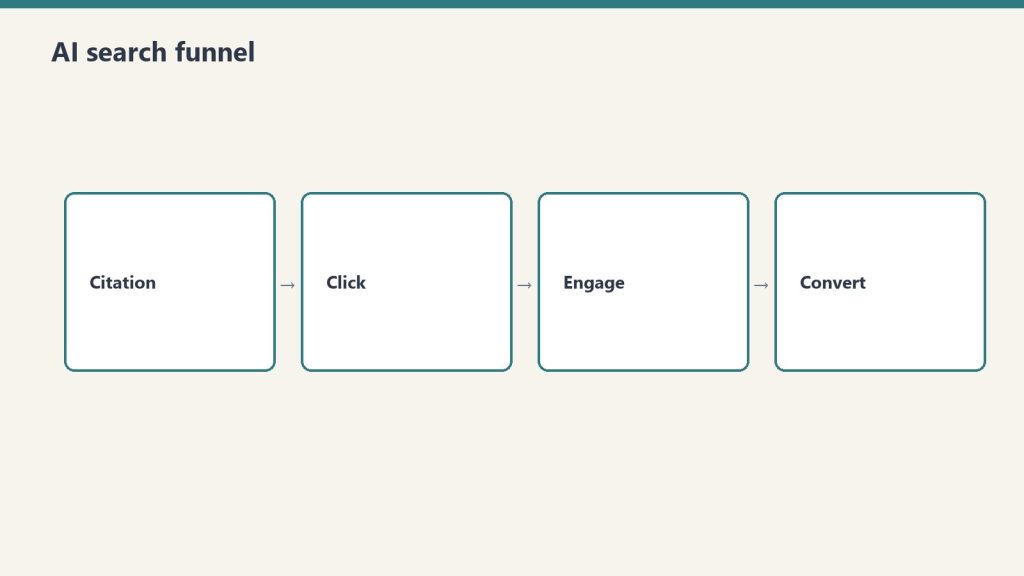
For twenty-five years, the internet’s content economy ran on one unit of value: the click. A user searches, sees your result, clicks, lands on your page. That click triggers a pageview, which triggers an ad impression, which generates revenue. Or the click starts a funnel: landing page to email capture to nurture sequence to purchase. Every business model, every analytics platform, every marketing strategy was built around the click as the atomic unit of value.
The click is losing its monopoly.
When Microsoft Copilot cites my content 98,800 times, those aren’t clicks. No user loads my page. No ad renders. No pixel fires. But 98,800 times, a real person — an enterprise worker making a real decision — receives information sourced from my domain, attributed to my domain, and shaped by my domain’s content. My information enters their document, their email, their analysis. My brand name appears as the citation source.
That’s a different kind of value than a click. And it might be worth more.
The Click Economy Was Always a Proxy
Here’s what we’ve always known but rarely said aloud: clicks were never the actual goal. Clicks were the proxy for something deeper — attention, trust, influence, and eventually, a commercial relationship.
A click meant someone gave you a moment of attention. But the attention wasn’t guaranteed — bounce rates of 60-80% were normal. A click meant someone might trust you. But trust wasn’t guaranteed — most first-time visitors never return. A click was the entry to a funnel. But the funnel’s conversion rate was typically 1-3%.
We built an enormous infrastructure around maximizing clicks — SEO, SEM, social media marketing, content marketing — not because clicks were intrinsically valuable, but because they were the best available proxy for the things that actually mattered: reaching the right person, at the right time, with the right information.
A citation is a better proxy.
Why Citations Are a Better Signal
Why citations are a better signal.
When Copilot cites my Claude pricing guide to an enterprise worker who asked “what is claude ai pricing in 2026,” several things are true about that interaction that are not true about a typical click:
The user has high intent. They didn’t stumble onto my page from a vague search. They asked a specific question while working on a specific task, and Copilot selected my content as the authoritative answer. The intent signal is stronger than a keyword match.
The content was consumed. Not skimmed, not bounced from, not opened in a tab and forgotten. Copilot extracted the relevant information and presented it to the user inline. The user received my content’s value whether or not they clicked through to my site.
The attribution is explicit. Copilot cites the source. My domain name appears alongside the information. This isn’t an anonymous impression — it’s a credited contribution. The user knows where the information came from.
The context is professional. Copilot users are working. They’re writing reports, making decisions, evaluating tools. My content enters a professional workflow — not a casual browsing session. The context in which my brand appears is inherently higher-value than a typical web pageview.
Each citation is a moment where my domain provided trusted, authoritative information to a professional decision-maker in a high-intent context. That’s the moment every content marketing strategy is designed to create. The click was just the old way of getting there.
The Scale Shift
Here’s the number that reframes everything: 52:1.
For every human who clicks on my content from Bing search, Copilot cites it 52 times. My content reaches 52x more users through AI citation than through traditional search clicks. And that’s just Copilot — it doesn’t include ChatGPT, Perplexity, Google AI Overviews, or Claude.
The total AI readership of my content is likely 100x or more the human click volume. And every one of those AI-mediated interactions involves a user who received my information, saw my attribution, and incorporated my content into their work.
In the click economy, the most successful content might reach tens of thousands of users per month through organic search. In the citation economy, the same content can reach hundreds of thousands through AI platforms — users who are higher-intent, more engaged with the content (because it was extracted and presented directly to them), and consuming it in a professional context.
The scale of the opportunity is an order of magnitude larger than clicks. The remaining question is how to capture the value.
The Monetization Frontier
The monetization frontier of the citation economy.
This is where honesty matters. The citation economy’s monetization model is not fully developed. I can tell you what works, what’s emerging, and what doesn’t work yet.
What works now: brand authority compounding. When Copilot cites your domain thousands of times, you become the recognized source for that topic among enterprise professionals. This translates to consulting inquiries, partnership opportunities, speaking invitations, and inbound business development. The citation builds the brand, and the brand generates revenue through traditional channels. This is measurable but indirect.
What works now: citation flywheel to search authority. The signals that earn AI citations — content quality, structural clarity, topical authority — also improve traditional search performance. My domain’s growing Copilot authority appears to correlate with improved Google organic performance. The citation strategy feeds the click strategy, creating a compound effect.
What’s emerging: AI-mediated traffic. Some Copilot and ChatGPT citations include clickable source links. A percentage of users do click through. This traffic is small compared to citation volume but high-quality — the user has already seen a preview of your content through the AI response and is choosing to visit for more. The conversion potential of this traffic is likely higher than typical organic traffic, though the data is still too early for definitive benchmarks.
What doesn’t work yet: direct citation monetization. There is no ad network for AI citations. There is no affiliate revenue from AI-mediated content consumption. There is no way to place a conversion pixel inside a Copilot response. The infrastructure for monetizing citations the way we monetize clicks does not exist.
This is the frontier. The value is clear — massive reach to high-intent professional audiences — but the capture mechanism is still developing. The businesses that figure out how to convert citation authority into revenue will define the next era of content economics.
The Attention Redistribution
What’s happening with AI citations is part of a larger pattern: attention is being redistributed from concentrated channels (Google, social media feeds) to distributed AI interfaces (Copilot in Office, ChatGPT conversations, Perplexity answers, AI Overviews in search).
In the old model, Google was the gatekeeper. All attention flowed through one discovery interface. Publishers optimized for one algorithm, one set of ranking factors, one measurement system. The entire content economy was organized around Google’s distribution infrastructure.
In the new model, attention is fragmented across multiple AI interfaces. A professional might encounter your content through Copilot while writing, ChatGPT while researching, Perplexity while fact-checking, and Google while searching — all in the same day, for different purposes, through different content presentations.
This fragmentation is uncomfortable for publishers who built their operations around a single distribution channel. But it’s also an opportunity. In a fragmented attention landscape, the publisher who shows up across multiple AI platforms has an outsized advantage over the publisher who only shows up on Google.
My 98,800 Copilot citations represent a position in one AI platform’s distribution. If I can build comparable positions in ChatGPT, Perplexity, and Google AI Overviews, the total citation footprint would represent content distribution at a scale that was previously only achievable through paid advertising at significant cost.
What the Citation Economy Demands
The transition from click economy to citation economy changes what content operations need to prioritize:
Accuracy over engagement. In the click economy, content needed to be engaging enough to prevent bounces and drive conversions. In the citation economy, content needs to be accurate enough that AI engines trust it as a grounding source. Engagement still matters for human readers, but accuracy is the threshold for AI citation eligibility.
Structure over narrative. AI engines extract structured information more effectively than narrative prose. The citation economy rewards clean data tables, explicit definitions, numbered procedures, and organized comparison frameworks. This doesn’t mean narrative disappears — it means structure shares equal billing.
Currency over permanence. In the click economy, evergreen content could generate traffic for years without updates. In the citation economy, stale content loses citations as AI engines detect outdated information. Maintaining existing content becomes as important as producing new content.
Platform-specific optimization over universal optimization. The click economy had one optimization target: Google. The citation economy has multiple: Copilot, ChatGPT, Perplexity, AI Overviews, and whatever comes next. Each platform has different preferences, different user bases, and different citation behaviors.
Authority over volume. In the click economy, more content meant more keyword targets, more landing pages, more chances to rank. In the citation economy, authority on a topic matters more than volume of content about it. One comprehensive, authoritative, regularly-updated pricing guide earns more citations than ten thin pricing articles.
The First Mover Advantage Is Real
My citation flywheel — from 672 daily citations to 5,500 in 90 days — demonstrates that AI citation authority compounds. The domain that establishes itself as the trusted source for a topic early builds a moat that later entrants have to overcome.
This is different from SEO, where a new article can outrank an established one by being better optimized. In AI citations, the trust relationship appears to be stickier. Copilot doesn’t just evaluate individual pages — it appears to develop domain-level trust for topic clusters. Once your domain is the trusted source for “AI tool pricing,” new articles on related topics benefit from that established trust.
The businesses building citation authority now are building a compounding asset. The businesses waiting for the measurement tools to mature are falling behind a curve they won’t be able to see until it’s too late.
Where This Goes
The AI citation economy is in its first inning. The measurement tools are primitive. The monetization models are nascent. The strategic frameworks are just being articulated. But the underlying behavior — AI engines consuming, citing, and distributing web content at massive scale — is already established and accelerating.
I believe that within two to three years, AI citations will be as standard a metric as organic traffic. Webmaster tools across all major platforms will expose citation data. Content operations will track citation volume by platform alongside traditional SEO metrics. And the strategic approach of Platform-Specific AI Optimization will be as mainstream as SEO is today.
The question for content operators right now isn’t whether this shift is happening — the data already confirms it is. The question is whether you’re going to measure it, optimize for it, and build citation authority while the category is still open — or wait until everyone else has already established their positions.
I’m publishing my data, naming the category, and building the playbook in real time. The AI citation economy is here. It rewards different content, different strategies, and different metrics than the click economy it’s supplementing. And the first people to take it seriously will define how everyone else thinks about it.
No. Clicks will remain important for direct conversion, ad revenue, and controlled user experiences. AI citations supplement clicks by providing massive reach and brand authority through a different channel. The most effective content strategies will optimize for both.
How do I monetize AI citations?
Currently through indirect channels: brand authority that drives consulting and partnerships, the citation flywheel that improves traditional search performance, and AI-mediated referral traffic from users who click through from citation links. Direct citation monetization infrastructure doesn’t exist yet.
What is the AI citation flywheel?
A compounding effect where earning citations builds domain trust, which makes new content eligible for more citations, which builds more trust. On one domain, this grew daily Copilot citations from 672 to 5,500 in 90 days without changes to content volume or strategy.
Is there a first-mover advantage in AI citations?
Yes. AI citation authority appears to compound over time. Domains that establish trust as citation sources for specific topic clusters benefit from preferential selection for new and adjacent queries. Building this authority early creates a moat that later entrants must overcome.
When will AI citation data become widely available?
Bing Webmaster Tools AI Performance is already available in beta. Google and other platforms are expected to follow as publisher demand for citation transparency grows. The most likely timeline for broad availability of citation analytics across major platforms is 12-24 months.
My site tygartmedia.com has a split personality, and it’s deliberate.
During business hours, Microsoft Copilot users inside Word, Edge, and Outlook are citing my Claude AI pricing guides, my developer tool comparisons, and my MCP integration documentation. These enterprise workers are pulling structured data from my articles to inform their purchasing decisions, technical evaluations, and strategy documents. They generate 5,500 citations per day and climbing.
After hours and on weekends, Google searchers in Tacoma, Washington are finding my local content — neighborhood guides, restaurant directories, school district analysis, civic resource pages. These community members are looking for practical local information, and they find it through organic search. They generate consistent organic traffic with strong engagement metrics.
Same domain. Same WordPress installation. Two completely different content strategies running simultaneously, serving two completely different audiences through two completely different discovery channels.
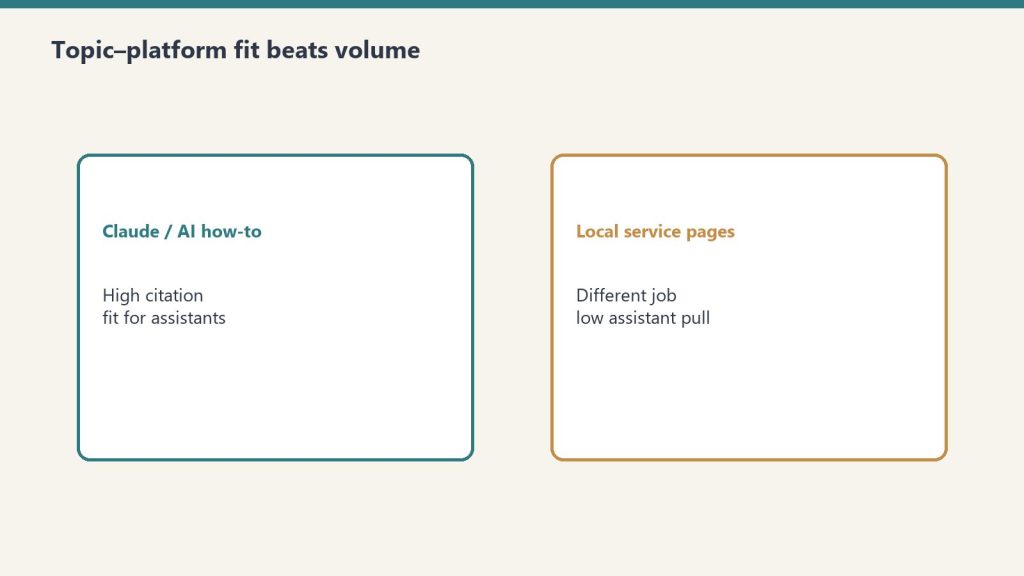
This isn’t an accident. It’s the logical outcome of Platform-Specific AI Optimization (PSAO) applied to a real content operation. And it works better than either strategy would work alone.
How the Split Happened
It started organically. I publish content about AI tools because I use them extensively to run my business — a portfolio of WordPress sites across multiple verticals. The articles I wrote about Claude, Copilot, content pipelines, and MCP integrations were notes from my own workflow, published because they might help others.
Separately, I publish local Tacoma content because that’s where I live and operate. Neighborhood guides, business spotlights, civic explainers — the kind of community journalism that serves local Google searchers.
The AI tool content started earning Copilot citations before I even knew what Copilot citations were. When I discovered the Bing Webmaster Tools AI Performance tab and saw 98,800 citations, I realized the AI content was reaching an entirely different audience through an entirely different channel — one I wasn’t optimizing for.
That’s when the split became intentional. Instead of hoping one content strategy would serve all audiences, I started building two parallel strategies on the same domain.
The Copilot-Facing Content Strategy
The AI tool content is engineered for a specific reader: an enterprise knowledge worker who is in the middle of a task inside Microsoft 365 and invokes Copilot for help. This person needs:
Current, specific data. Not “Claude has several pricing tiers” but “Claude Sonnet 4.6 (legacy — still listed) costs $3.00 per million input tokens and $15.00 per million output tokens on the API.” The specificity matters because this person is putting numbers in a spreadsheet or a procurement document.
Structured presentation. HTML tables, not paragraphs. Comparison matrices, not narrative descriptions. Numbered steps, not suggested approaches. Copilot extracts structured data more effectively than it extracts narrative information.
Comprehensive coverage. The articles that earn the most citations answer the question completely. My Claude pricing guide doesn’t just list prices — it covers every plan tier, every model, API rates, token costs, comparison to competitors, and practical use case guidance. Copilot prefers to ground on a single comprehensive source rather than synthesizing from multiple partial sources.
Timeliness. Prices change. Models update. Features launch. The AI tool content requires regular maintenance — sometimes weekly updates — to remain the most current source. This is non-negotiable because Copilot’s grounding algorithm appears to factor currency into source selection.
Publication cadence for this content: new articles when significant tools or updates launch, plus continuous updates to existing articles. The update cycle is more important than the publication cycle.
The Google-Facing Content Strategy
The local Tacoma content is built for a different reader: a community member who types a query into Google and wants a useful, comprehensive local resource.
Local keyword optimization. “Tacoma farmers markets 2026,” “Pierce County property tax lookup,” “Point Defiance Zoo hours and tickets.” These are traditional SEO targets with clear local intent.
Community depth. The articles that perform best aren’t thin SEO pages — they’re comprehensive community resources that cover a topic completely. My Tacoma real estate directory doesn’t just list agents — it covers the licensing verification process, typical commission structures, property management options, and attorney resources.
Evergreen structure with timely updates. A farmers market guide works year after year with seasonal date updates. A schools explainer holds its value with annual enrollment data refreshes. The initial investment in a comprehensive local article pays dividends for years through sustained organic traffic.
FAQ schema and local business schema. Google rewards structured data for local content. Every major local article gets FAQPage schema and relevant local business markup. This isn’t about AI citations — it’s about winning featured snippets and People Also Ask positions in Google’s local results.
Publication cadence for this content: major local articles as topics emerge, plus a civic beat that covers government, schools, transit, and development news. The traffic pattern is steady and predictable.
Why They Work Better Together
Running both strategies on the same domain creates advantages that neither would have alone:
Domain authority compounds across both strategies. The AI content earns 98,800 Copilot citations, which signals to Bing (and likely Google) that the domain is authoritative. The local content earns organic backlinks from community organizations and local media. Each strategy builds domain authority that benefits the other.
The content diversity strengthens the domain profile. A domain that publishes only AI tool guides looks niche. A domain that publishes AI guides alongside community journalism looks like a comprehensive media property. Search engines and AI engines both appear to trust topically diverse domains more than single-topic sites, as long as each topic area is covered with genuine depth.
The revenue model is more resilient. Local content generates ad revenue through traffic. AI content generates brand authority and consulting opportunities. Community content builds local business relationships. Neither audience alone would sustain the operation — together, they create a diversified content business.
Each audience discovers the other’s content occasionally. A Tacoma tech worker who finds my site through a Copilot citation might browse the local content. A local reader who discovers a neighborhood guide might notice the AI strategy articles. Cross-pollination happens naturally, and it creates a more engaged audience overall.
The Operational Reality
Running dual content strategies isn’t twice the work — it’s about 1.3x the work of a single strategy. Here’s why:
The publishing infrastructure is shared. One WordPress installation, one design system, one content pipeline, one analytics setup. The operational overhead of managing a website is fixed regardless of how many content strategies you run on it.
The skill set is shared. Writing, editing, SEO optimization, schema implementation, quality control — these processes apply to both content streams. The strategic thinking differs, but the execution uses the same tools and workflows.
The cadence is naturally staggered. AI tool content publishes when tools update or new products launch — which happens irregularly. Local content publishes on a civic beat tied to meeting schedules, seasonal events, and community news. The two streams rarely compete for production time because their triggers are different.
The biggest operational challenge is context switching. Writing a detailed Claude pricing comparison requires a different mindset than writing a Tacoma neighborhood guide. I’ve learned to batch by content type — AI content mornings, local content afternoons — rather than switching between them throughout the day.
What the Data Shows
After several months of running dual strategies intentionally:
AI content metrics: 98,800 Copilot citations total, 5,500 daily (growing), 576 grounding queries. Top article: 16,500 citations for “claude ai pricing.” Zero citations for any local content. AI content drives consulting inquiries and brand authority in the AI/content strategy space.
Local content metrics: Consistent organic traffic from Google, strong engagement rates, low bounce rates. Featured snippets for multiple local queries. Zero Copilot citations (as expected). Local content drives ad revenue and community visibility in Pierce County.
Domain-level metrics: Growing overall domain authority. Bing shows strong performance in both traditional search and AI citations. Google shows solid organic performance for local content. The domain is recognized as authoritative in two distinct topic areas.
The dual strategy doesn’t cannibalize — it compounds. The AI audience and the local audience don’t overlap, so they’re not competing for the same attention. They’re building the same domain’s authority through completely different channels.
The Replicable Pattern
This dual-audience approach works because it follows a principle: match content to the platform where its audience lives.
The AI tool audience lives in Copilot. Build structured, reference-grade content for them.
The local audience lives in Google. Build comprehensive, SEO-optimized community resources for them.
The same principle applies to any domain that could serve multiple audiences through multiple platforms. A SaaS company could publish product documentation for Copilot citations and thought leadership for ChatGPT conversations. A consulting firm could publish methodology guides for AI platforms and case studies for Google organic. A media company could publish data journalism for AI engines and breaking news for social platforms.
The dual-audience model isn’t limited to my specific combination. It’s a framework for any content operation willing to recognize that different platforms serve different audiences — and build accordingly.
Not if each topic area is covered with genuine depth. A domain with deep AI content and deep local content is recognized as authoritative in both areas. Topical diversity with depth in each area strengthens domain authority rather than diluting it.
How do you manage two content calendars?
The calendars are naturally staggered. AI content publishes when tools update. Local content follows civic beats and seasonal events. Batch by content type rather than switching throughout the day. The shared infrastructure means operational overhead is minimal.
Does the AI content cannibalize the local content’s traffic?
No. The audiences don’t overlap. Enterprise Copilot users asking about Claude pricing never compete for attention with Tacoma residents searching for farmers markets. The two content streams serve completely different audiences through different channels.
Can this work on a smaller domain?
Yes. The principle scales down. A small business could publish product documentation optimized for AI citations and local content optimized for Google search. The key is matching content to platform audience rather than writing one generic version and hoping it works everywhere.
Which strategy should I start with?
Start with whichever matches your existing audience. If you already have Google traffic, add AI-citation-optimized content as a second stream. If you already produce technical content, check Bing AI Performance to see if you’re earning citations you don’t know about, then optimize from there.
Microsoft shipped one of the most significant measurement tools in content marketing history, and the industry collectively shrugged. Sometime in late 2025, an “AI Performance” tab appeared in Bing Webmaster Tools. No announcement. No blog post. No conference keynote. It just showed up in the sidebar, labeled “(beta),” waiting for someone to notice.
I noticed. And what I found inside was the first real dataset on AI citation behavior that any search engine has ever exposed to publishers. The tab shows exactly how many times Microsoft Copilot cites your content, which queries triggered those citations, and how the volume trends over time.
For my domain, that data showed 98,800 AI citations across 576 grounding queries — numbers that completely changed how I think about content strategy. But when I talk to other marketers about it, the most common response is: “Wait, there’s an AI tab?”
This is a walkthrough. By the end, you’ll know where to find it, what it shows, and how to read the data.
Getting to the AI Performance Tab
Getting to the AI Performance tab.
Step 1: Verify your site with Bing Webmaster Tools. If you haven’t done this, start at bing.com/webmasters. You can verify using DNS, a meta tag, a CNAME record, or by importing from Google Search Console. The Google Search Console import is the fastest path — it takes about 30 seconds and automatically verifies all your Search Console properties in Bing.
Step 2: Navigate to your verified property. Once you’re in the dashboard, select the domain you want to analyze.
Step 3: Find the AI Performance tab. In the left sidebar, look under the “Performance” section. You’ll see the standard “Search Performance” tab (clicks and impressions from Bing search) and below it, “AI Performance (beta).” Click it.
If you don’t see the tab, there are two possible reasons: your site hasn’t been verified long enough for Bing to accumulate data, or your site hasn’t earned any Copilot citations yet. The tab may not appear until there’s data to show.
What You’ll See Inside
The AI Performance tab has three main data views:
Citation Count (total): This is the big number at the top. It shows the total number of times Copilot used your content as a grounding source in its responses. For context: my domain shows 98,800 total citations. This number represents actual instances where Copilot pulled information from my pages and embedded it in responses to real users.
Grounding Queries: Below the total count, you’ll see a list of the actual queries that triggered citations. These are natural language questions — not keywords. They show exactly what Copilot users asked when your content was cited. My top query is “claude ai pricing” at 16,500 citations. The query list is sorted by citation volume, showing your highest-impact content first.
Daily Trend Chart: A time-series chart showing daily citation volume. This is where you see growth patterns. My chart shows a clear acceleration: 672 daily citations at the start growing to 5,500 daily citations over 90 days. The shape of this curve tells you whether your citation authority is growing, stable, or declining.
Reading the Data: What the Numbers Mean
High citation count + few queries = concentrated authority. If you have thousands of citations but only 10-20 queries, your content is the dominant source for a small number of high-volume topics. This is a strong position — you own those topics in Copilot’s grounding index. My domain has this pattern: a few articles about Claude pricing and tools generate the bulk of citations.
Moderate citations + many queries = broad relevance. If you have hundreds of queries each generating modest citation counts, your domain is recognized as relevant across a wide topic area but isn’t dominant for any single query. This is a growth opportunity — identify the queries with the highest potential and create dedicated, optimized content for each.
Growing daily trend = citation flywheel. If your daily trend shows consistent growth, Copilot is developing increasing trust in your domain. This flywheel effect means each new citation makes your domain more eligible for additional queries. Protect this growth by keeping cited content accurate and current.
Flat or declining trend = stale content signal. If citations plateau or decline, it may indicate that your content is becoming outdated or that competitors have published more current versions. Check whether your most-cited pages have stale information — especially pricing, feature lists, or version numbers.
The Queries Are the Gold
The queries are the gold.
The most valuable data in the AI Performance tab isn’t the citation count — it’s the grounding queries. These reveal exactly what enterprise workers are asking Copilot, which is intelligence you cannot get from any other tool.
Google Search Console shows you keywords — fragments that users type into a search bar. Bing’s grounding queries show you full natural language questions that users ask an AI assistant. The difference is significant:
A Google keyword might be: “claude ai pricing”
The Copilot grounding query is: “what is claude ai pricing in 2026 and how does it compare to openai”
The grounding query tells you the user’s full intent, their comparison frame, and their temporal context. This is richer intent data than any keyword tool provides, and it’s free, sitting in your Bing Webmaster Tools dashboard right now.
Use these queries to:
Identify content gaps. If users are asking questions that your content doesn’t fully answer, you know exactly what to add. A grounding query like “claude ai pricing vs openai pricing 2026 comparison” tells you to add an explicit comparison section to your pricing article.
Discover adjacent topics. The long tail of grounding queries often reveals related topics you haven’t covered. If you’re earning citations for “claude ai pricing” but also seeing queries about “claude api rate limits” and “claude team plan features,” those are content opportunities.
Understand your audience’s context. Grounding queries reveal the user’s situation. “What is the best AI coding tool for a team of 5” tells you the user is a tech lead making a purchasing decision. “How do I set up claude code on windows” tells you the user is a developer getting started. Each query paints a picture of who is consuming your content through Copilot.
What to Do With the Data
Once you’ve found and understood your AI citation data, here’s the action playbook:
Identify your citation pillars. Which pages earn the most citations? These are your highest-authority assets. Invest in keeping them accurate, current, and comprehensively structured. A $0.10 update to a page earning 1,000 daily citations is the highest-ROI content investment you can make.
Fill the gaps in your query coverage. Look at grounding queries that cite your content — are there related queries you’re not capturing? Build content for the gaps. If you earn citations for “claude ai pricing” but not “claude ai pricing for enterprise,” that’s a targeted content opportunity.
Structure for extraction. Look at which content formats earn the most citations. In my data, structured content — pricing tables, comparison matrices, step-by-step configurations — earns dramatically more citations than narrative-only content. Add extractable elements to your highest-value pages.
Set up a monitoring cadence. Check your AI Performance tab weekly. Track your daily citation trend and watch for inflection points. If a new article suddenly starts earning citations, double down on that topic. If an existing article’s citations start declining, check whether the content has become outdated.
Cross-reference with Search Performance. Compare your AI citation data with your traditional Bing search data in the same tool. Which pages earn citations but not clicks? Which earn clicks but not citations? This comparison reveals which content serves AI audiences vs human audiences — the foundation of platform-specific optimization.
Why This Matters Beyond Bing
Bing Webmaster Tools AI Performance is currently the only tool exposing AI citation data at this level of detail. Google Search Console doesn’t show AI Overview citation data. ChatGPT, Perplexity, and Claude don’t offer webmaster analytics dashboards.
But the data from Bing is a leading indicator for the entire AI citation landscape. Microsoft Copilot’s behavior reflects broader patterns in how AI engines consume and cite web content. The topics that earn Copilot citations are likely earning citations across other AI platforms too — you just can’t see the data yet.
By the time Google and other platforms expose their citation data (which I believe is inevitable as publisher demand grows), the early movers who used Bing’s data to develop platform-specific content strategies will have a compounding advantage. They’ll have built the citation authority, refined their content formats, and mapped their topic-platform fit while everyone else was waiting for better tools.
The tools aren’t perfect. They’re beta. But they’re real data about a real shift in how content gets consumed. And right now, almost nobody is using them.
Yes. Bing Webmaster Tools is completely free to use. You only need to verify ownership of your domain, which can be done through DNS records, meta tags, or by importing your Google Search Console properties directly.
What if I don’t see the AI Performance tab?
The tab may not appear until your site has accumulated AI citation data. Verify your site, ensure it’s been indexed by Bing, and check back after a few weeks. Not all sites earn Copilot citations — the tab appears when there’s data to display.
Can I see which specific pages are being cited?
The current beta shows grounding queries and total citation counts. The page-level attribution is inferred through the queries — if a query about “claude ai pricing” cites your content, it’s almost certainly citing your Claude pricing page. Microsoft may add explicit page-level data as the tool matures.
How does Copilot decide which sites to cite?
Copilot uses Bing’s search index to find relevant content for grounding. The selection factors appear to include content relevance, structural quality, accuracy, domain authority, and trust signals built through consistent citation history. Well-structured, accurate, reference-grade content on topics matching Copilot user queries earns the most citations.
Should I optimize for Bing search to get more Copilot citations?
Bing indexation is a prerequisite for Copilot citations since Copilot uses Bing’s index. Ensure your site is indexed in Bing Webmaster Tools and that your key pages are crawlable. Beyond that, the most effective optimization for Copilot citations is creating structured, accurate, reference-grade content on topics that enterprise workers ask about.
I wrote an article about Claude AI pricing. The entire production cost — from research to publication — was roughly $0.35 in AI API costs and about 20 minutes of my time for editing and fact-checking. I published it through my existing WordPress infrastructure with zero additional distribution cost.
That article has generated over 4,000 Copilot citations for the query “claude ai pricing” alone, with the total across related queries pushing well past 16,500. It earns new citations every day. It’s been cited more times than most marketing campaigns reach people.
The cost-per-citation: less than $0.00009. Nine thousandths of a penny per citation.
Compare that to any traditional content marketing metric. Cost per click in paid search for AI tool keywords runs $5-15. Cost per impression in display advertising is $5-10 per thousand. Cost per lead in B2B SaaS is $50-200. The cost per AI citation for well-optimized content is effectively zero.
This isn’t a gimmick or an edge case. It’s the fundamental unit economics of the AI citation economy — and they’re so different from traditional content economics that most marketers haven’t processed what they mean.
How the $0.35 Article Gets Made
How the cheap article gets made.
Let me break down the actual production pipeline for an article that earns thousands of AI citations.
Research and outline: I use AI tools to research current pricing data, feature comparisons, and user questions for the topic. This involves API calls to Claude for synthesis and cross-referencing against official documentation. API cost for a thorough research session: roughly $0.10-0.15.
Draft generation: Using my content pipeline — which combines AI-assisted drafting with manual editing and fact-checking — I produce a structured article with pricing tables, feature comparisons, and FAQ sections. API cost for drafting and revision: roughly $0.10-0.20.
Optimization and formatting: I apply SEO, AEO, and GEO optimization passes. Schema markup gets injected. Internal links are added. Taxonomy is assigned. This is partially automated through my publishing pipeline. API cost: roughly $0.05-0.10.
Publication: The article is published via WordPress REST API. Zero distribution cost. No paid promotion. No social media budget. The content sits on its own domain and waits for AI engines to discover it.
Total API cost: approximately $0.25-0.45. Call it $0.35 as a round number. My time investment is 15-30 minutes for quality control, fact-checking, and editorial decisions that I don’t delegate to AI.
That’s the entire investment. There’s no ad spend to drive traffic. No outreach campaign to earn backlinks. No social distribution budget. The content earns citations because it’s the best available answer to a question that enterprise workers ask Copilot regularly.
The Compounding Returns
The compounding returns of citation assets.
What makes AI citation economics fundamentally different from traditional content economics is the compounding behavior.
In traditional SEO, a blog post might earn organic traffic for 6-12 months before it starts declining. You have to continually produce new content to maintain traffic levels. The depreciation curve is steep.
In AI citations, I’m observing the opposite pattern. My Copilot citation data shows a flywheel: daily citations grew from 672 to 5,500 over 90 days. The more Copilot cited my content, the more queries it became eligible for, which generated more citations, which built more authority for adjacent queries.
A $0.35 article doesn’t just generate citations once. It generates citations daily, at increasing volume, for as long as it remains accurate and current. The total lifetime citations for a well-maintained article in a high-demand topic could reach tens of thousands.
The math is simple but staggering: invest $0.35 to create the article, spend another $0.10 every month or two updating it for accuracy, and collect thousands of citations continuously. The return on that investment doesn’t have a meaningful comparison in traditional marketing economics.
Why This Doesn’t Work for Every Article
Before this sounds like alchemy, here’s the reality check: the $0.35-to-4,000-citations ratio only works when three conditions are met.
Condition 1: Topic-platform fit. The article has to answer questions that Copilot users actually ask. “Claude AI pricing” is a perfect fit because enterprise workers evaluating AI tools ask this question inside Microsoft 365 regularly. An article about local restaurant hours would cost the same $0.35 to produce and earn zero Copilot citations — because nobody asks Copilot that question.
Condition 2: Structural quality. Copilot’s grounding algorithm prefers content it can extract cleanly. A pricing table that’s formatted as a real HTML table gets cited more than the same information buried in paragraphs. Structured content with clear headings, defined terms, and extractable data points earns more citations per article than narrative content with the same information presented conversationally.
Condition 3: Accuracy and currency. AI engines can detect when content is outdated. My pricing articles are version-stamped and updated regularly. An article that says Claude Haiku costs one price when it actually costs another will eventually lose citations as the AI engine gets corrective signals from other sources or user feedback.
When all three conditions are met, the unit economics are extraordinary. When any one is missing, the economics collapse to zero — literally zero citations regardless of how much you spend on production.
Comparing the Numbers
Here’s how AI citation unit economics compare to traditional content marketing channels, using rough industry benchmarks:
Paid search (Google Ads): Cost per click for AI tool keywords: $5-15. To reach 4,000 users, you’d spend $20,000-60,000. And those users might bounce without engaging.
Display advertising: Cost per thousand impressions: $5-10. To reach 4,000 users, you’d spend $20-40 — but impressions are passive. The user might not even notice your ad, let alone engage with your content.
Content marketing (traditional): A well-produced blog post might cost $200-500 between writer, editor, and designer. It might earn 500-2,000 organic visits over its lifetime. Cost per engaged reader: $0.10-1.00.
AI citation content: Production cost: $0.35. Citations earned: 4,000+ (and growing). Cost per citation: $0.00009. And each citation represents a high-intent user who received your information as part of their active workflow — not a passive impression, not a possible bounce.
The comparison isn’t even in the same order of magnitude. AI citation content is 10,000x more cost-efficient than paid search for reaching users at scale. The caveat is that citations aren’t clicks — you don’t control the downstream conversion. But for brand authority, content distribution, and audience reach, the economics are unprecedented.
What This Means for Content Operations
If the unit economics of AI citation content are this different from traditional content, the operational implications are significant.
Volume becomes feasible. When an article costs $0.35 to produce, you can produce a lot of them. The constraint isn’t budget — it’s editorial quality and topic selection. A content operation can test hundreds of topics to find the ones with the best citation economics and then invest in keeping those articles current.
Maintenance becomes the job. In traditional content marketing, the work is producing new content. In AI citation marketing, the work shifts to maintaining existing content. An article that’s earning 1,000 daily citations needs to stay accurate, current, and structured. A $0.10 update that keeps a $0.35 article earning citations for another quarter is the highest-ROI work in content marketing.
Topic selection becomes everything. The difference between a $0.35 article that earns 4,000 citations and a $0.35 article that earns zero is topic-platform fit. Content operations need to get very good at identifying which topics will earn citations on which platforms before investing production resources.
The moat is compounding authority. The early articles that establish citation authority create a flywheel that later articles benefit from. My domain’s Copilot authority — built through 98,800 citations over 90 days — means new articles I publish earn citations faster than they would on a domain starting from scratch. The economics improve over time for the first mover.
The Uncomfortable Conclusion
The unit economics of AI citation content are so favorable that they make most traditional content distribution strategies look wasteful by comparison. You could spend $50,000 on a content marketing program — writers, editors, designers, SEO tools, paid distribution — or you could spend $35 on 100 precisely targeted, AI-optimized articles and potentially generate more total reach through AI citations alone.
The catch is that AI citations don’t (yet) convert the same way clicks do. You can’t track a citation to a sale the way you can track a PPC click to a purchase. The monetization model is still emerging.
But the reach is real, the authority-building is real, and the compounding is real. And the cost to participate is $0.35 per article. The barrier to entry has never been lower. The question is whether your content operation is measuring what matters.
The $0.35 represents AI API costs for research, drafting, and optimization. It assumes a content operator using AI-assisted workflows who handles editorial judgment, fact-checking, and quality control themselves. Infrastructure costs like hosting and WordPress are sunk costs spread across the entire content operation.
Are AI citations as valuable as clicks?
They serve different functions. A click delivers a user to your site where you control the experience. A citation delivers your information to a user through an AI interface. Citations build brand authority at massive scale but lack direct conversion tracking. The long-term value likely accrues through brand recognition and downstream conversions.
What is the ROI of AI citation content?
Direct ROI measurement is still developing because citation-to-revenue attribution doesn’t exist yet. However, at $0.35 per article and thousands of citations per article for well-targeted topics, the cost per unit of reach is orders of magnitude lower than any traditional content channel.
Does every article earn thousands of citations?
No. Citation volume depends on topic-platform fit, content structure, and accuracy. Articles on topics that Copilot users ask about regularly can earn thousands of citations. Articles on topics that don’t match the platform’s user base earn zero. Topic selection is the primary variable.
How often should AI citation content be updated?
Content should be updated whenever the underlying facts change — especially pricing, version numbers, and feature availability. For fast-moving topics like AI tool pricing, monthly reviews are appropriate. Each update costs roughly $0.10 in API costs and preserves the citation authority the article has built.