Tag: Pacific Northwest

  • Thira: Bellevue AI Profile — Product, Footprint & Verified Record

    Thira: Bellevue AI Profile — Product, Footprint & Verified Record

    Washington AI Companies Census · Verified Record (November 19, 2026)
    Sourced Baseline: As of November 19, 2026, Thira is an active, independent enterprise AI startup operating at thira.com following its July 2026 launch with $21M in seed funding led by Madrona. Public records list Bellevue, WA on GeekWire and Seattle, WA on LinkedIn, with 10 unnamed enterprise design partners reported at launch.
    PROFILE BRIEF · HOUSE PDF & MARKDOWN TWIN
    Thira — Bellevue AI Profile
    Download the formatted 2-page profile brief (PDF) or open the single-source Markdown twin for Thira. Every claim below links to its verified primary source.

    What Thira Builds

    Thira builds an agentic AI "system of execution" for enterprise back-office operations, positioned on its official website as "the trusted AI execution platform for CIOs" and on LinkedIn under the tagline "the back office that runs itself." Its initial operational focus is autonomously resolving enterprise IT support tickets and executing multi-step back-office workflows across disconnected corporate software systems.

    Rather than requiring IT teams to hand-code rigid automation scripts step by step, Thira states that its platform learns how an organization operates from internal documents, ticket history, connected systems, and unwritten operational knowledge—discovering enterprise context such as entitlement graphs and assembling workflows from reusable skills. Administrators review and approve generated workflows before deployment.

    Governance and policy boundaries sit at the center of the pitch to CIOs. Agents can run end-to-end autonomously around the clock or operate in human-assisted mode—escalating to a human decision-maker when a step requires judgment or approval, then continuing execution. Customers define explicit policies specifying what agents may execute independently, what requires approval, and what remains off-limits, while tracking impact in hours and dollars saved.

    • Core workflow modules: Product navigation covers Onboarding, Offboarding, Ticket remediation, and Custom agents.
    • Continuous enterprise learning: Ingests documents, ticket history, and system connections to construct reusable skills and entitlement graphs.
    • Policy-governed execution: Supports autonomous and human-assisted execution modes bounded by customer-defined approval and access controls.
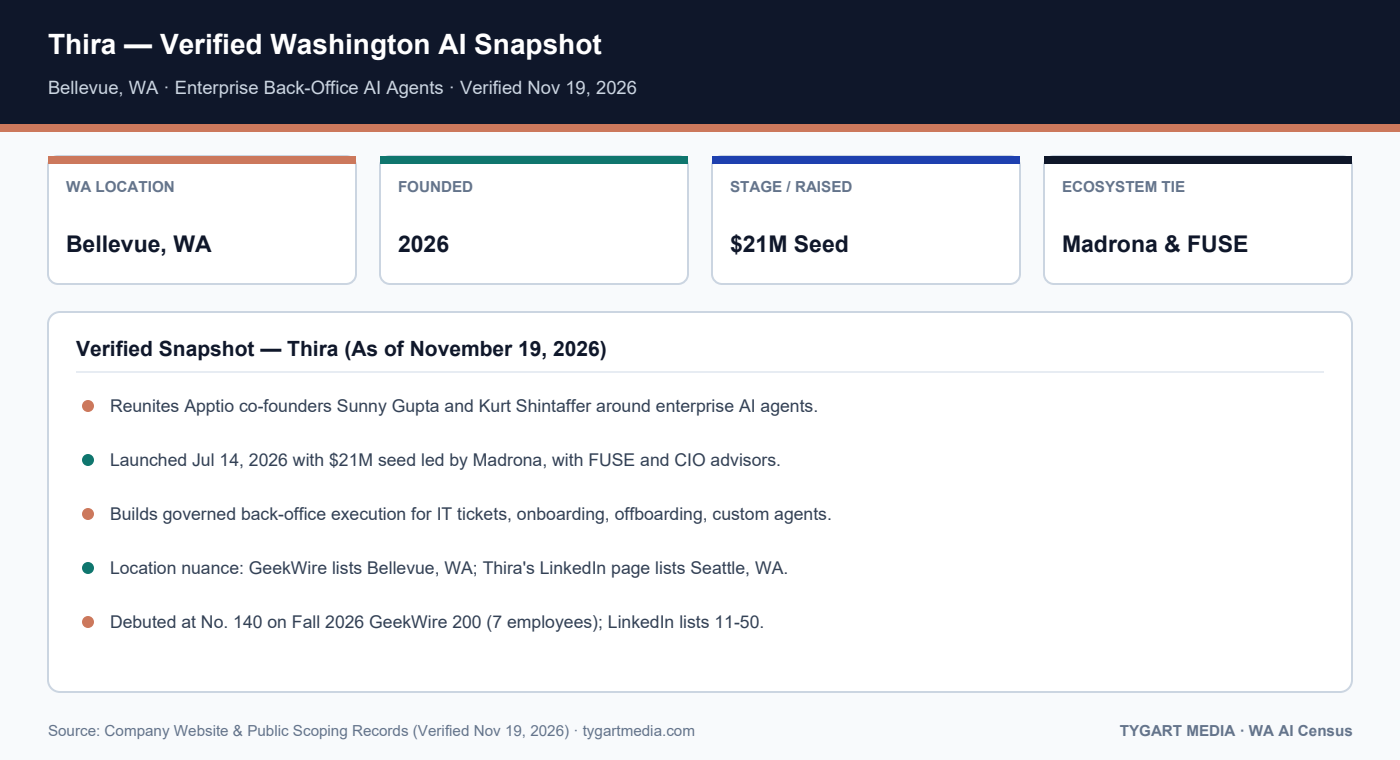
    Thira — Verified Washington AI Snapshot
    Verified profile snapshot for Thira (Bellevue, WA) as of November 19, 2026.
    FieldVerified Record (As of Nov 19, 2026)
    CompanyThira
    Official Websitehttps://www.thira.com/
    Washington HQBellevue, WA (GeekWire & Fall 2026 GeekWire 200); LinkedIn lists Seattle, WA
    Other WA FootprintGreater Seattle / Eastside corridor (Apptio alumni leadership rooted in Bellevue)
    Founded2026
    Founders / LeadershipSunny Gupta (Co-founder & Executive Chairman), Kurt Shintaffer (Co-founder; former Apptio CFO)
    StageSeed
    Announced Funding$21M seed (Jul 14, 2026) — Madrona (lead), FUSE, global advisors and CIOs
    Team Size7 (Fall 2026 GeekWire 200, Sep 30, 2026); LinkedIn displays 11-50 employees bracket
    Primary Ecosystem TiesMadrona Venture Group; FUSE; GeekWire 200 (Fall 2026, No. 140); Apptio alumni founders

    Washington Footprint and Leadership

    Public sources reflect a Seattle-versus-Bellevue municipal listing nuance across Lake Washington. GeekWire's July 14, 2026 launch story and the Fall 2026 GeekWire 200 both list Thira in Bellevue, Washington, while Thira's official LinkedIn company page lists its primary headquarters in Seattle, WA. Both listings sit within Greater Seattle, and the company's canonical web address is thira.com (an unrelated thira.ai domain does not host an active Thira website).

    Thira reunites Sunny Gupta and Kurt Shintaffer, the co-founders of Bellevue enterprise software company Apptio, which previously sold to Vista Equity Partners and was acquired by IBM for $4.6 billion in 2023. GeekWire identifies Gupta—who also led Madrona-backed iConclude prior to its sale to Opsware—as co-founder and executive chairman (with some summary mentions also associating him with CEO leadership), and Shintaffer as co-founder following his tenure as Apptio's co-founder and CFO.

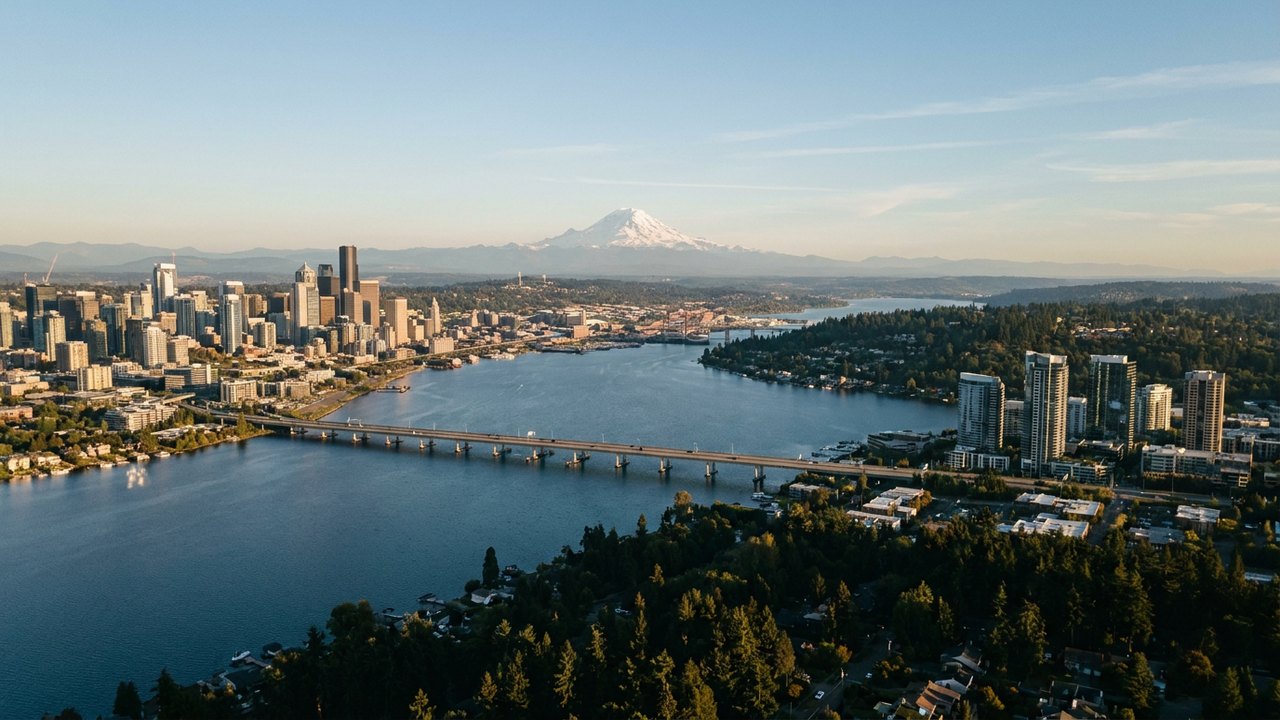
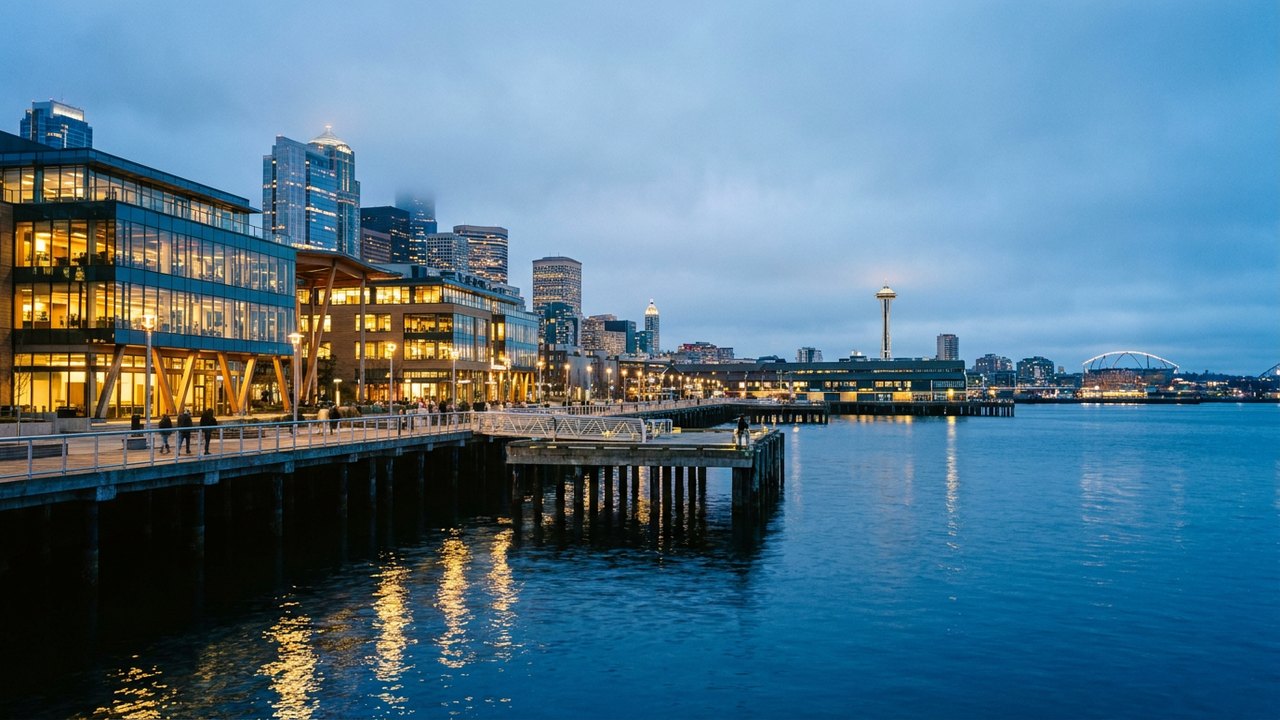
    Aerial view of the Greater Seattle and Bellevue Lake Washington technology corridor with Mount Rainier on the horizon
    Washington AI ecosystem context: Aerial view of the Greater Seattle and Bellevue Lake Washington technology corridor with Mount Rainier on the horizon.

    Products, Users, and Public Traction

    Thira targets large enterprises, Chief Information Officers, enterprise IT organizations, and back-office operations teams seeking governed automation across existing corporate tools. As of November 19, 2026, thira.com uses an enterprise sales motion centered on Book a demo, with no self-serve pricing tiers published publicly.

    At its July 2026 launch out of stealth, GeekWire reported that Thira was working with 10 enterprise organizations as design partners to test and validate its agents, without publicly naming those organizations. Team-size figures also reflect recent hiring growth across sources: the Fall 2026 GeekWire 200 (published September 30, 2026) listed 7 employees and 766 LinkedIn followers, whereas Thira's LinkedIn page showed an 11-50 employees size bracket and 840 followers by November 19, 2026.

    Funding, Stage, and Place in Washington's AI Landscape

    Thira launched out of stealth on July 14, 2026 with a $21 million seed round led by Seattle venture firm Madrona, with participation from Pacific Northwest venture firm FUSE and a group of global advisors and CIOs. In GeekWire's launch report, Madrona Managing Director Matt McIlwain noted that Thira marks the third enterprise software venture Madrona has backed with Gupta over 20 years—following iConclude and Apptio.

    Debuting at No. 140 on the Fall 2026 GeekWire 200, Thira represents the enterprise-execution tier of Washington's 2026 AI startup cohort: heavily capitalized at the seed stage, led by repeat Pacific Northwest B2B founders, and focused on governed operational workflows rather than consumer chat interfaces. Alongside Bellevue and Seattle peers tackling enterprise analytics and runtime AI governance, it reflects strong local investor appetite for CIO-buyer infrastructure.

    Related Washington AI Profiles & Tygart Media Context

    Verified Primary Sources

  • Golden Analytics: Bellevue AI Profile — Product, Footprint & Verified Record

    Golden Analytics: Bellevue AI Profile — Product, Footprint & Verified Record

    Washington AI Companies Census · Verified Record (November 19, 2026)
    Sourced Baseline: As of November 19, 2026, Golden Analytics is an independent, venture-backed Bellevue company in public beta at goldenanalytics.com after raising $21M in total seed capital. It debuted at No. 152 on the Fall 2026 GeekWire 200 with 17 employees and continues shipping data-stack integrations such as MotherDuck.
    PROFILE BRIEF · HOUSE PDF & MARKDOWN TWIN
    Golden Analytics — Bellevue AI Profile
    Download the formatted 2-page profile brief (PDF) or open the single-source Markdown twin for Golden Analytics. Every claim below links to its verified primary source.

    What Golden Analytics Builds

    Golden Analytics builds an AI-native business intelligence platform designed to unify data preparation, multi-table modeling, analysis, visualization, and collaboration in a single workspace. On its official website, the product is organized around six core workflow stages: Connect, Discover, Prepare, Analyze, Communicate, and Collaborate. Once connected to cloud data warehouses—including an official MotherDuck integration announced on LinkedIn in November 2026—or uploaded files, the platform automatically profiles datasets, surfaces notable patterns, and generates charts, dashboards, and written summaries.

    Users can query data in plain language or construct visualizations directly. As founder and CEO Francois Ajenstat explained to GeekWire in June 2026, a control he calls a "slider of autonomy" lets analysts decide how much of the analytical and dashboard-building work the software automates versus leaves under manual control.

    Under the hood, GeekWire's April 2026 launch report notes that Golden Analytics orchestrates multiple foundation models rather than relying on one provider—explicitly pairing Google Gemini for visual design with Anthropic Claude for data analysis. Note that Bellevue-based Golden Analytics (goldenanalytics.com, with goldenanalytics.ai redirecting there) is completely separate from golden.com / golden.ai, an unrelated San Francisco knowledge-graph company founded in 2017 and acquired by ComplyAdvantage in 2024.

    • Six-stage BI workflow: Covers Connect, Discover, Prepare, Analyze, Communicate, and Collaborate inside one product rather than stitching together three or four separate tools.
    • Multi-model orchestration: Uses Google Gemini for visual design and Anthropic Claude for data analysis (GeekWire, April 2026).
    • Functional & analytical modules: Website lists workflows for Sales & RevOps, Finance, Marketing, Customer Success & Research, Operations, and People teams, plus Automated Discovery, Location, Time Series, Survey, Market Basket, and Key Driver analysis.
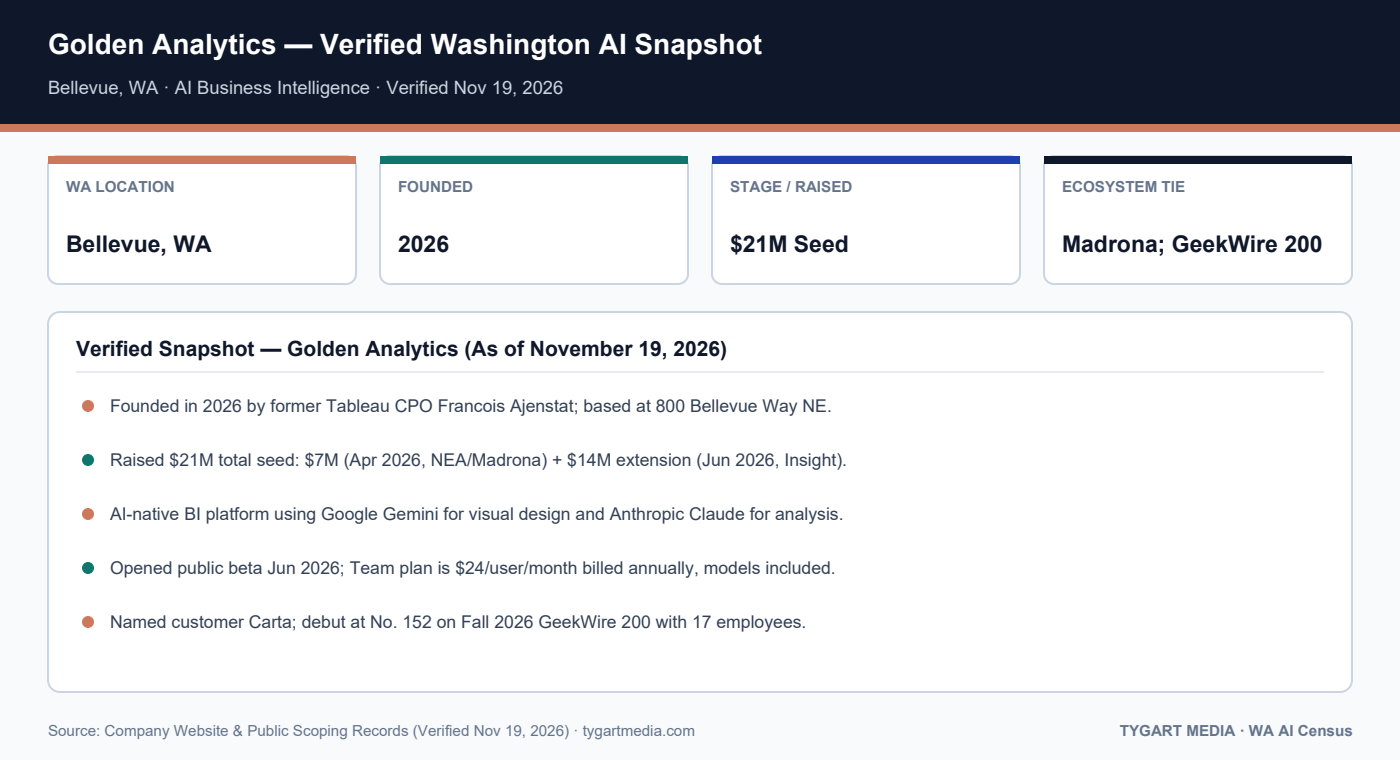
    Golden Analytics — Verified Washington AI Snapshot
    Verified profile snapshot for Golden Analytics (Bellevue, WA) as of November 19, 2026.
    FieldVerified Record (As of Nov 19, 2026)
    CompanyGolden Analytics
    Official Websitehttps://goldenanalytics.com/
    Washington HQBellevue, WA (800 Bellevue Way NE, Suite 500, Bellevue, WA 98004)
    Other WA FootprintIn-person engineering team based in the Seattle area (GeekWire, June 2026)
    Founded2026
    Founders / LeadershipFrancois Ajenstat (Founder & CEO; former CPO at Tableau and Amplitude)
    StageSeed
    Announced Funding$21M ($7M initial seed, Apr 2026; $14M seed extension, Jun 2026) — Insight Partners, NEA, Madrona Venture Group
    Team Size17 (Fall 2026 GeekWire 200, Sep 30, 2026; up from 4 in Apr and 7 in Jun 2026)
    Primary Ecosystem TiesGeekWire 200 (Fall 2026, No. 152); Madrona Venture Group; Tableau / Microsoft / Snowflake alumni engineering team

    Washington Footprint and Leadership

    Golden Analytics is headquartered in Bellevue, Washington, listing its primary office address at 800 Bellevue Way NE, Suite 500, Bellevue, WA 98004 on LinkedIn and appearing as a Bellevue company on the Fall 2026 GeekWire 200. While GeekWire's initial April 2026 stealth-emergence story referred to it generally as Seattle-based, GeekWire's June 2026 update confirmed its Bellevue listing and noted that all of its engineers work in person in the Seattle area while sales hires are positioned closer to customers.

    The company was founded in 2026 by solo founder and CEO Francois Ajenstat, who spent 13 years at Seattle-based Tableau—including more than seven years as Chief Product Officer—following earlier work at Cognos and a subsequent stint as Chief Product Officer at Amplitude. According to GeekWire, Ajenstat recruited Golden's early engineering team from Tableau, Snowflake, and Microsoft. Following the June 2026 seed extension, Insight Partners Managing Director Ganesh Bell joined Golden Analytics' board, and Insight Managing Director George Mathew (former president of Alteryx) also works with the company.

    Aerial view of the Greater Seattle and Bellevue Lake Washington technology corridor with Mount Rainier on the horizon
    Washington AI ecosystem context: Aerial view of the Greater Seattle and Bellevue Lake Washington technology corridor with Mount Rainier on the horizon.

    Products, Users, and Public Traction

    Golden Analytics emerged from stealth on April 7, 2026 and opened its platform to public beta on June 9, 2026. Ahead of public beta, Ajenstat told GeekWire that the product had drawn early-access requests from roughly 1,000 companies, including approximately one in six from the Fortune 500. Equity-management platform Carta is publicly named as an early customer, with Carta insights director Ashley Neville stating in the June announcement that Golden gave the firm "the confidence to move on from legacy contracts."

    Alongside public beta, Golden Analytics disclosed transparent pricing: a Team plan at $24 per user per month (billed annually) and a custom-priced Enterprise plan. Notably, Ajenstat stated that underlying AI model costs are bundled into seat pricing rather than billed separately on a per-token basis. Headcount expanded rapidly in its first six months—from 4 people at its April 2026 launch to 7 by June 9, 2026, and 17 employees on the Fall 2026 GeekWire 200 published September 30, 2026 (with LinkedIn followers growing from 3,377 at index release to 4,251 by November 19, 2026).

    Funding, Stage, and Place in Washington's AI Landscape

    Golden Analytics has raised $21 million in total seed funding across two rapid tranches in 2026. It debuted in April 2026 with a $7 million initial seed round co-led by New Enterprise Associates (NEA) and Seattle-based Madrona Venture Group, then added a $14 million seed extension two months later on June 9, 2026 led by Insight Partners with NEA and Madrona participating again.

    In the Pacific Northwest enterprise software ecosystem, Golden Analytics directly extends Seattle's long BI heritage—anchored for two decades by Tableau—into an AI-native architecture. Debuting as a new entry at No. 152 on the Fall 2026 GeekWire 200, it sits alongside other 2026 Eastside enterprise AI launches backed by Madrona and led by veteran Seattle-area software executives.

    Related Washington AI Profiles & Tygart Media Context

    Verified Primary Sources

  • Maestro: Seattle AI Profile — Product, Footprint & Verified Record

    Maestro: Seattle AI Profile — Product, Footprint & Verified Record

    Washington AI Companies Census · Verified Record (November 19, 2026)
    Sourced Baseline: As of November 19, 2026, Maestro AI, Inc. actively markets VibeCheck and Maestro at getmaestro.ai and appears as an active, independent portfolio company in Seattle's AI2 Incubator directory. Neither Maestro AI nor GeekWire has publicly announced an institutional venture funding round.
    PROFILE BRIEF · HOUSE PDF & MARKDOWN TWIN
    Maestro — Seattle AI Profile
    Download the formatted 2-page profile brief (PDF) or open the single-source Markdown twin for Maestro. Every claim below links to its verified primary source.

    What Maestro Builds

    Maestro AI, Inc. builds software designed to give engineering organizations visibility into how AI coding agents are used and whether that usage produces durable code. On its official website, the company presents two connected products: VibeCheck, focused on coding-agent visibility and spend tracking, and Maestro, focused on engineering intelligence and team outcomes.

    VibeCheck connects to coding-agent sessions across Claude Code, Codex, and Cursor to show where token consumption and estimated agent spend go. Rather than leaving token bills disconnected from engineering work, VibeCheck groups agent sessions by the feature, bug fix, or migration they supported—mapping each shipped initiative to its session count, token volume, pull requests, and estimated agent spend. The product also models team-by-team return on investment by comparing combined payroll and agent spend against landed pull requests (defined on the site as merged changes still remaining in the main branch 30 days later).

    In an April 2026 essay titled "Engineering intelligence is dead.", co-founders Justin Cranshaw and William Cheng laid out the product thesis behind Maestro: legacy metrics such as pull-request counts, story points, cycle time, and DORA dashboards measure output artifacts rather than actual engineering work, and break down when AI agents allow developers to generate large volumes of pull requests in a single afternoon without necessarily improving codebase quality.

    • VibeCheck (Coding Agent Visibility): Tracks session volume, token usage, and estimated spend across Claude Code, Codex, and Cursor.
    • Initiative-level attribution: Groups agent sessions by shipped engineering initiative so leaders can connect AI spend to features, fixes, and migrations.
    • Landed-PR economics: Evaluates payroll plus agent spend per pull request that remains merged in the main branch after 30 days, highlighting teams where agent adoption improves or degrades efficiency.
    • Maestro (Engineering Intelligence): Pairs agent telemetry with outcome-oriented visibility into what engineering teams accomplished.
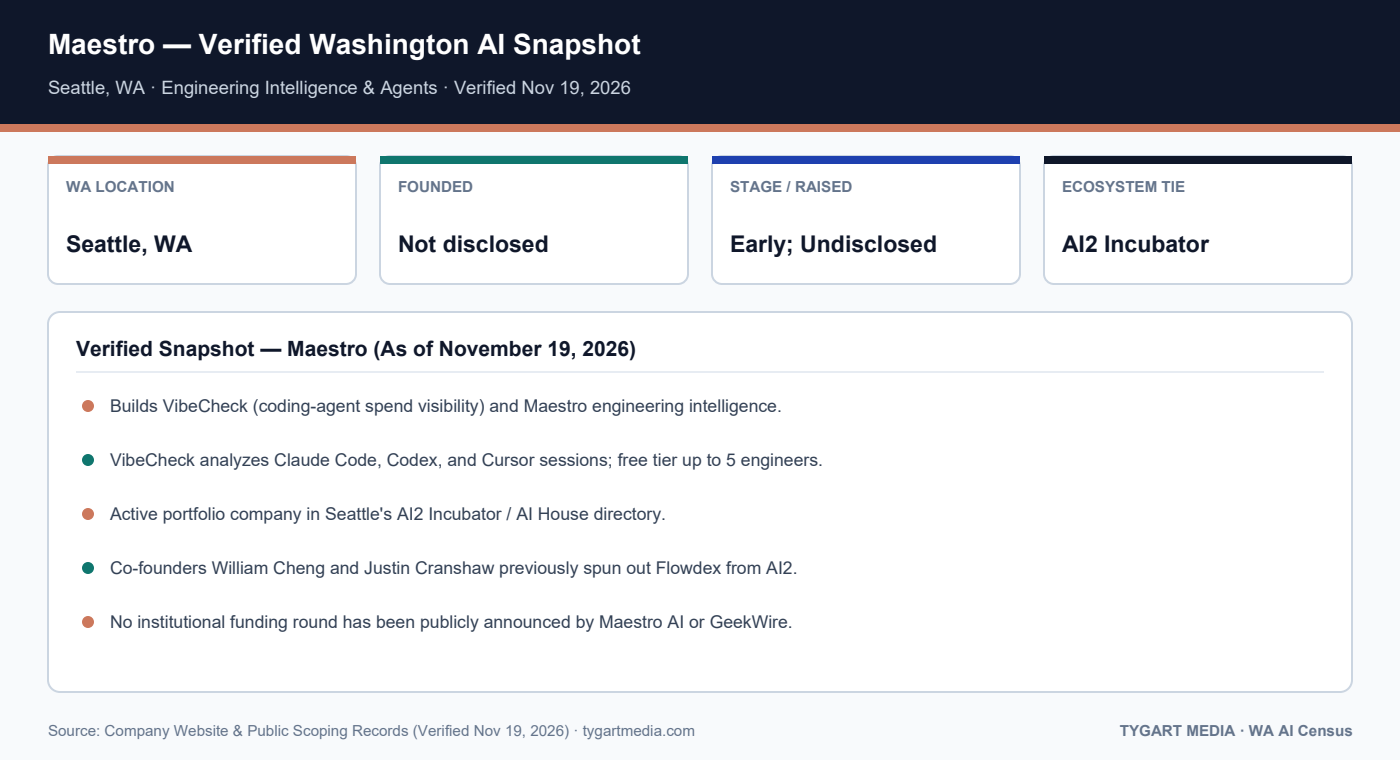
    Maestro — Verified Washington AI Snapshot
    Verified profile snapshot for Maestro (Seattle, WA) as of November 19, 2026.
    FieldVerified Record (As of Nov 19, 2026)
    CompanyMaestro (Maestro AI, Inc.)
    Official Websitehttps://www.getmaestro.ai/
    Washington HQSeattle, WA
    Other WA FootprintAI2 Incubator / AI House (Seattle, WA)
    FoundedNot publicly disclosed (founders spun out prior AI2 venture Flowdex in May 2022; Maestro privacy policy effective March 6, 2023)
    Founders / LeadershipWilliam Cheng (Co-founder & CEO), Justin Cranshaw (Co-founder & CPO)
    StageIncubator / Early-stage
    Announced FundingNot publicly disclosed (no institutional funding round publicly announced by the company or GeekWire)
    Team SizeNot publicly disclosed
    Primary Ecosystem TiesAI2 Incubator / AI House (Seattle, WA); Microsoft Research alumni founders

    Washington Footprint and Leadership

    Maestro is based in Seattle and listed as an active, non-acquired portfolio company on the AI House / AI2 Incubator companies directory, where it is described as creating "actually useful engineering insights for teams." Its legal entity is Maestro AI, Inc., per its published privacy policy (effective March 6, 2023; last updated September 25, 2026).

    The company was co-founded by William Cheng (Co-founder & CEO) and Justin Cranshaw (Co-founder & CPO), whose roles are confirmed directly on Maestro's April 2026 manifesto. Both founders are Microsoft Research alumni and former entrepreneurs-in-residence at Seattle's Allen Institute for AI (AI2) Incubator. Before building Maestro's engineering-intelligence platform, Cheng and Cranshaw spun out an AI note-management startup called Flowdex from AI2 in May 2022, as reported by GeekWire. Because primary filings do not specify a single public founding year separating Flowdex from the Maestro brand transition, the company's founding year is listed as not publicly disclosed.

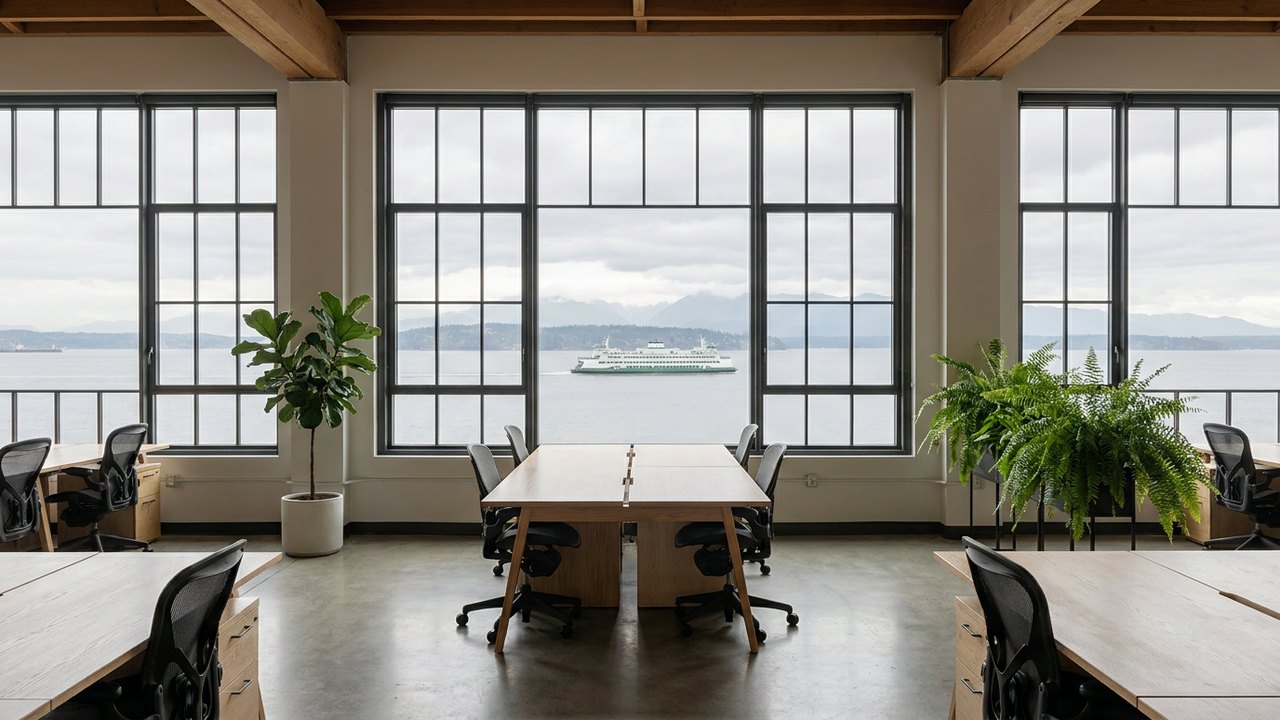
    Seattle waterfront startup incubator loft overlooking Puget Sound ferry lanes and the Olympic Mountains
    Washington AI ecosystem context: Seattle waterfront startup incubator loft overlooking Puget Sound ferry lanes and the Olympic Mountains.

    Products, Users, and Public Traction

    Maestro builds for engineering leaders, software development teams, and technology organizations managing growing monthly coding-agent bills across multiple AI development tools. On getmaestro.ai, VibeCheck advertises self-serve onboarding with a free tier for up to 5 engineers, alongside a "Book a demo" path for larger organizations.

    Named customers, paid seat counts, and revenue figures are not publicly disclosed in verified company or press sources. Although the homepage includes a customer-usage section heading and interactive product mockups illustrating monthly spend and cost-per-PR comparisons, no public customer case studies or verified enterprise logos appear in scraped text, and headcount is not publicly disclosed.

    Funding, Stage, and Place in Washington's AI Landscape

    No institutional funding round has been publicly announced by Maestro AI or GeekWire. The company's verified institutional affiliation in public records is Seattle's AI2 Incubator / AI House, which continues to list Maestro among its active, independent portfolio companies as of November 19, 2026.

    Within Seattle's developer-tools ecosystem, Maestro addresses the measurement and financial-governance layer of AI-assisted software engineering. As local startups and enterprises adopt multi-agent coding tools, VibeCheck sits downstream of code generators—focusing on whether higher token spend and pull-request volume actually translate into durable shipped code rather than churn.

    Related Washington AI Profiles & Tygart Media Context

    Verified Primary Sources

  • CodeChimp: Seattle AI Profile — Product, Footprint & Verified Record

    CodeChimp: Seattle AI Profile — Product, Footprint & Verified Record

    Washington AI Companies Census · Verified Record (November 19, 2026)
    Sourced Baseline: As of November 19, 2026, CodeChimp operates an active waitlist website at codechimp.ai for its multi-agent software project management platform. The company completed Plug and Play Seattle's second accelerator cohort in late 2025 and has not publicly announced an institutional funding round or acquisition.
    PROFILE BRIEF · HOUSE PDF & MARKDOWN TWIN
    CodeChimp — Seattle AI Profile
    Download the formatted 2-page profile brief (PDF) or open the single-source Markdown twin for CodeChimp. Every claim below links to its verified primary source.

    What CodeChimp Builds

    CodeChimp (originally introduced under the name Bili) develops a Git-native, agent-native, spec-driven project management platform built to coordinate multi-agent software development—commonly referred to as "vibe coding"—across engineering teams. Rather than focusing on a single developer prompting a standalone coding assistant, the product is designed to turn AI-assisted coding into a multiplayer workflow spanning ideation, specification, implementation, and production delivery.

    On its official website, CodeChimp organizes its workflow into three stages: connecting external foundation models, configuring pre-built or custom AI agents for team conventions, and running those agents alongside human engineers inside Git branches. Interface previews on the site illustrate connecting models across multiple providers—including Anthropic Claude, OpenAI GPT, and Meta Llama—and assigning specialized agents to tasks such as code generation, pull-request reviews, documentation updates, and automated testing.

    In October 2025 coverage, GeekWire Startup Radar described CodeChimp as part of an emerging "agentic swarm coding" category aimed at teams moving beyond solo LLM prompts toward structured multi-agent orchestration inside existing repositories.

    • Multi-model connectivity: Site materials depict connecting foundation models from Anthropic, OpenAI, and Meta rather than locking teams into a single model vendor.
    • Configurable engineering agents: Supports pre-configured and team-customized agents across frontend, backend, documentation, performance, and test-coverage tasks.
    • Git-native collaboration: Displays agent and human commits together across repository branches so teams can review generated changes inside standard version-control workflows.
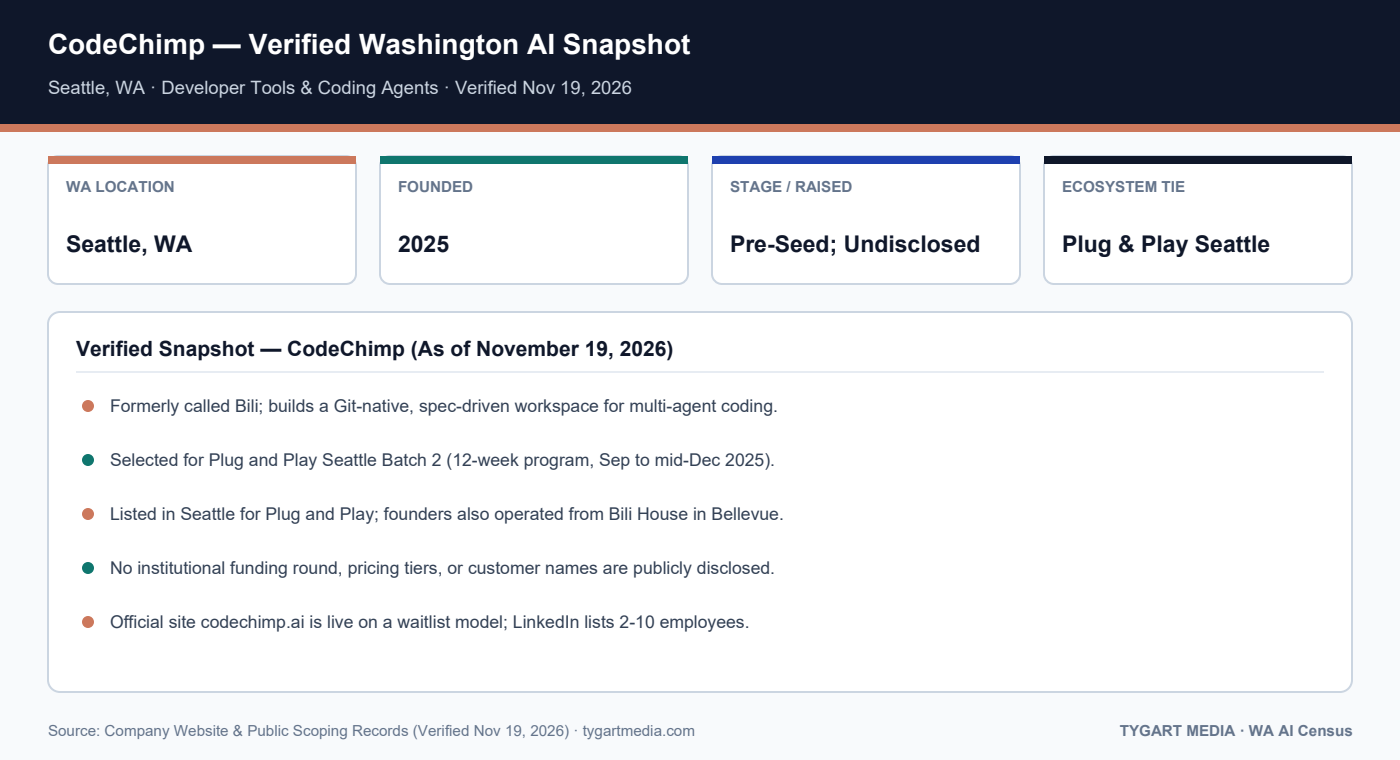
    CodeChimp — Verified Washington AI Snapshot
    Verified profile snapshot for CodeChimp (Seattle, WA) as of November 19, 2026.
    FieldVerified Record (As of Nov 19, 2026)
    CompanyCodeChimp (formerly Bili)
    Official Websitehttps://www.codechimp.ai/
    Washington HQSeattle, WA (Plug and Play Seattle listing); founders also operated from Bili House in Bellevue, WA
    Other WA FootprintPlug and Play Seattle at UW CoMotion Labs (Seattle, WA); Bili House on Meydenbauer Bay (Bellevue, WA)
    Founded2025
    Founders / LeadershipSylviane Zhao (Co-founder & CTO), Shawn Yang (Co-founder), Tehani Cabour (Co-founder), Jatin Kumar (Co-founder)
    StagePre-Seed / Accelerator
    Announced FundingNot publicly disclosed
    Team SizeNot publicly disclosed (LinkedIn lists 2-10 employees)
    Primary Ecosystem TiesPlug and Play Seattle (Batch 2, Sep-Dec 2025); UW CoMotion Labs; Bili House (Bellevue)

    Washington Footprint and Leadership

    CodeChimp's Greater Seattle footprint spans both sides of Lake Washington, and public sources reflect that dual presence. In Plug and Play Seattle's Batch 2 announcement (reported by GeekWire on September 19, 2025), CodeChimp was listed as a Seattle-based startup, with much of the 12-week cohort programming hosted at Plug and Play's Seattle office inside the University of Washington's CoMotion Labs (alongside additional Plug and Play space at SNBL Global Gateway in Everett). Subsequent February 2026 regional reporting on Bili House noted that CodeChimp's founding team operated out of a 7,000-square-foot waterfront hacker house on Meydenbauer Bay in Bellevue, Washington, built for early-stage Seattle and Eastside AI founders.

    The company was founded in 2025 by four co-founders: Sylviane Zhao (Co-founder & CTO, a recent Cornell University graduate), Shawn Yang (Co-founder, formerly at Dassault Systèmes), Tehani Cabour (Co-founder, formerly at Dassault Systèmes), and Jatin Kumar (Co-founder and Z Fellow). GeekWire's October 2025 Startup Radar profile highlighted Zhao, Cabour, and Yang, while February 2026 coverage of Bili House identified the four founders' joint role launching and running the Bellevue founder house.

    Seattle waterfront startup incubator loft overlooking Puget Sound ferry lanes and the Olympic Mountains
    Washington AI ecosystem context: Seattle waterfront startup incubator loft overlooking Puget Sound ferry lanes and the Olympic Mountains.

    Products, Users, and Public Traction

    CodeChimp targets software engineers, engineering teams, and software organizations trying to scale AI-assisted coding past individual experimentation into shared repositories. As of November 19, 2026, codechimp.ai remains structured around a Join Waitlist call to action rather than open self-serve signup, and the company has not published pricing tiers, deployment documentation, or security certifications on its public site.

    Public traction metrics—such as active seat counts, revenue, or named enterprise customers—are not publicly disclosed. While the homepage includes a "Trusted by Engineers From" banner, no named customer case studies or commercial deployment counts appear in verified public reporting. On LinkedIn, CodeChimp is listed as a privately held software development company in the 2-10 employee range, without an exact verified headcount beyond its four co-founders.

    Funding, Stage, and Place in Washington's AI Landscape

    CodeChimp is at the pre-seed and accelerator stage. It was selected as one of 10 startups—and six from the Seattle region—for Plug and Play Seattle's second accelerator cohort, a 12-week program running from September through mid-December 2025 focused on mentorship, workshops, and corporate introductions through Plug and Play Seattle. No formal institutional venture funding round, disclosed capital raise, or acquisition has been publicly announced by CodeChimp or GeekWire through November 2026.

    Within Washington's developer-tools cluster, CodeChimp occupies the orchestration layer above individual coding assistants—pairing multi-model agent execution with spec-driven project management and Git branch tracking. That places it alongside Seattle peers addressing adjacent parts of the AI software factory, including agent spend and workflow analytics startups emerging from the region's incubators and founder houses.

    Related Washington AI Profiles & Tygart Media Context

    Verified Primary Sources

  • Radon Laws in Idaho: Testing, Disclosure & Mitigation Rules

    Radon Laws in Idaho: Testing, Disclosure & Mitigation Rules

    The Short Answer

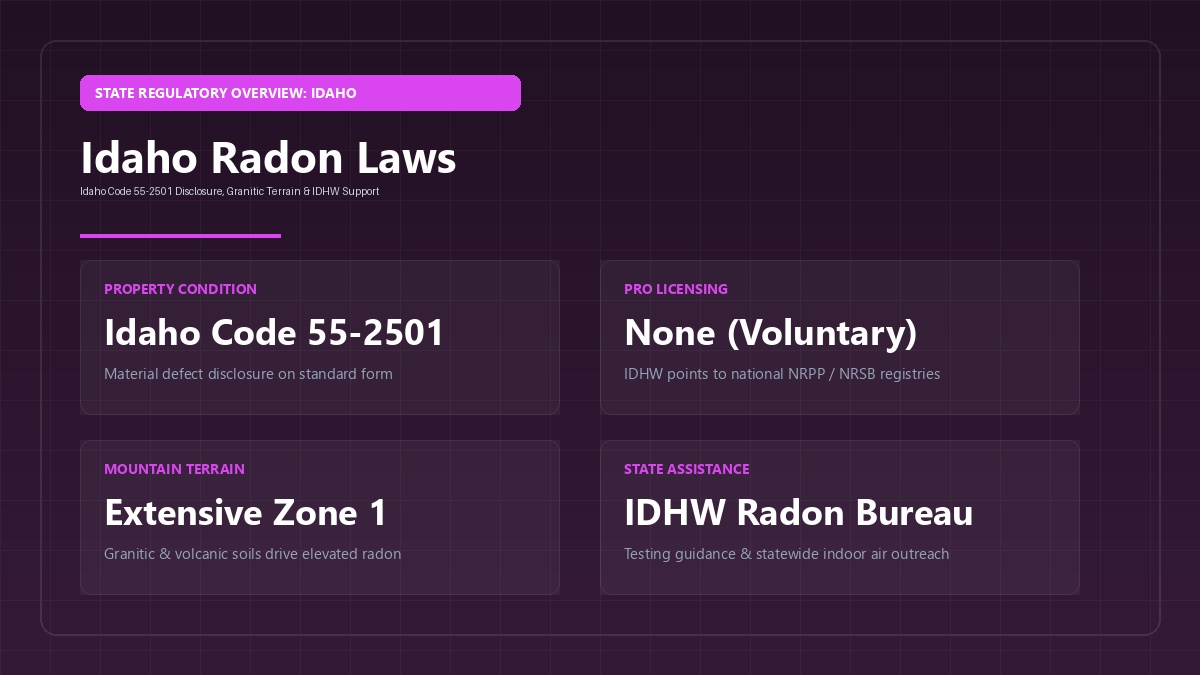
    Idaho regulates radon primarily through statutory property condition disclosure requirements and public health awareness initiatives. Under the Idaho Property Condition Disclosure Act (Idaho Code § 55-2501 et seq.), residential home sellers must provide prospective buyers with a standardized disclosure statement disclosing known material defects, including environmental hazards and historical radon test results. Idaho does not operate a direct state licensing program for radon mitigators or testing specialists, pointing consumers to national NRPP and NRSB certification registries. Geologically, granitic batholiths and volcanic soils across southern and central Idaho create substantial radon potential.

    Testing Requirements

    Indoor radon testing is voluntary for private residential homeowners and landlords in Idaho; the state imposes no statutory mandate compelling property owners to test existing single-family dwellings or rental units prior to occupancy or sale. Similarly, Idaho law does not mandate routine radon testing in public or private K-12 school buildings or licensed commercial childcare facilities, though the Idaho Department of Health and Welfare (IDHW) strongly encourages school districts to conduct voluntary testing using EPA and ANSI/AARST protocols.

    Real-Estate Disclosure

    Real estate disclosure is codified under the Idaho Property Condition Disclosure Act, Idaho Code §§ 55-2501 to 55-2518. Under Idaho Code § 55-2504, sellers of residential real property (1 to 4 dwelling units) must complete a Seller’s Property Condition Disclosure Form and deliver it to the buyer within 10 days after acceptance of the buyer’s offer (§ 55-2509). The statutory disclosure form requires sellers to disclose actual knowledge of environmental hazards affecting the property, including hazardous substances and past testing reports. While the act obligates sellers to disclose known historical test records and installed mitigation equipment, it does not compel sellers to commission new testing, leaving testing contingencies to purchase negotiations.

    Mitigator & Tester Certification

    Idaho has no state licensing requirement for radon measurement technicians or mitigation contractors, per the Idaho Department of Health and Welfare, verified November 2026. The state maintains no state-administered radon licensing board or regulatory credential. Instead, IDHW officially directs homeowners, builders, and real estate professionals to hire contractors certified through the two national proficiency programs recognized by the EPA: the National Radon Proficiency Program (NRPP) and the National Radon Safety Board (NRSB). Contractors must comply with local municipal building and electrical trade permits when installing fans and running sub-slab piping.

    New Construction

    Idaho does not enforce a statewide mandatory building code requiring passive Radon-Resistant New Construction (RRNC) in all new residential buildings. While the Idaho Building Code Board incorporates the International Residential Code (IRC), Appendix F (Radon Control Methods) is not universally mandated for single-family residential construction across the state. However, individual local jurisdictions facing elevated geological risk (such as Blaine County, Ketchum, and Sun Valley) have adopted Appendix F locally, making passive soil-gas ventilation mandatory in new residential builds within their boundaries.

    Radon Zones & the Action Level

    According to the EPA Map of Radon Zones and IDHW geological surveys, Idaho possesses extensive radon potential. Nineteen Idaho counties—Benewah, Blaine, Boise, Bonner, Boundary, Butte, Camas, Clark, Clearwater, Custer, Elmore, Fremont, Gooding, Idaho, Kootenai, Latah, Lemhi, Shoshone, and Valley—are designated as EPA Zone 1 (High Potential), where predicted average indoor screening levels exceed the national action level of 4.0 pCi/L. Ada (Boise) and Bonneville (Idaho Falls) are Zone 2. Of Idaho’s 44 counties, 19 are Zone 1, 20 are Zone 2 (Moderate Potential, 2.0 to 4.0 pCi/L), and 5 are Zone 3. IDHW adopts the federal action level benchmark of 4.0 pCi/L, noting that approximately two out of five homes tested in Idaho exhibit elevated concentrations. For regional county risk details, visit our EPA Radon Zone Map guide.

    The State’s Radon Program

    The state’s official public health initiative is the Idaho Department of Health and Welfare Indoor Radon Program, based within the Division of Public Health. IDHW provides educational guidance, tracks regional screening data, and partners with testing laboratories to distribute free short-term test kits to Idaho residents through radonidaho.org. Homeowners and contractors can order test kits, review county testing maps, and locate certified contractors through the official Idaho Health and Welfare Radon Program portal or by calling the program hotline at 800-445-8647.

    Sources & Limits

    This regulatory guide is provided for educational and informational purposes only and does not constitute formal legal, building code, or engineering counsel. Statutory disclosure requirements and local building codes are subject to legislative amendment. Property buyers, sellers, landlords, and contractors should verify current rules directly with the Idaho Department of Health and Welfare or a licensed Idaho attorney.

    Official Sources: Idaho Code §§ 55-2501–55-2518; Idaho Department of Health and Welfare (Division of Public Health); U.S. Environmental Protection Agency (Map of Radon Zones).

    To review how Idaho’s regulatory approach compares to other states across the nation, consult our master guide to radon regulations across the United States or inspect the EPA Radon Zone Map.

  • Radon Laws in Washington: Testing, Disclosure & Mitigation Rules

    Radon Laws in Washington: Testing, Disclosure & Mitigation Rules

    The Short Answer

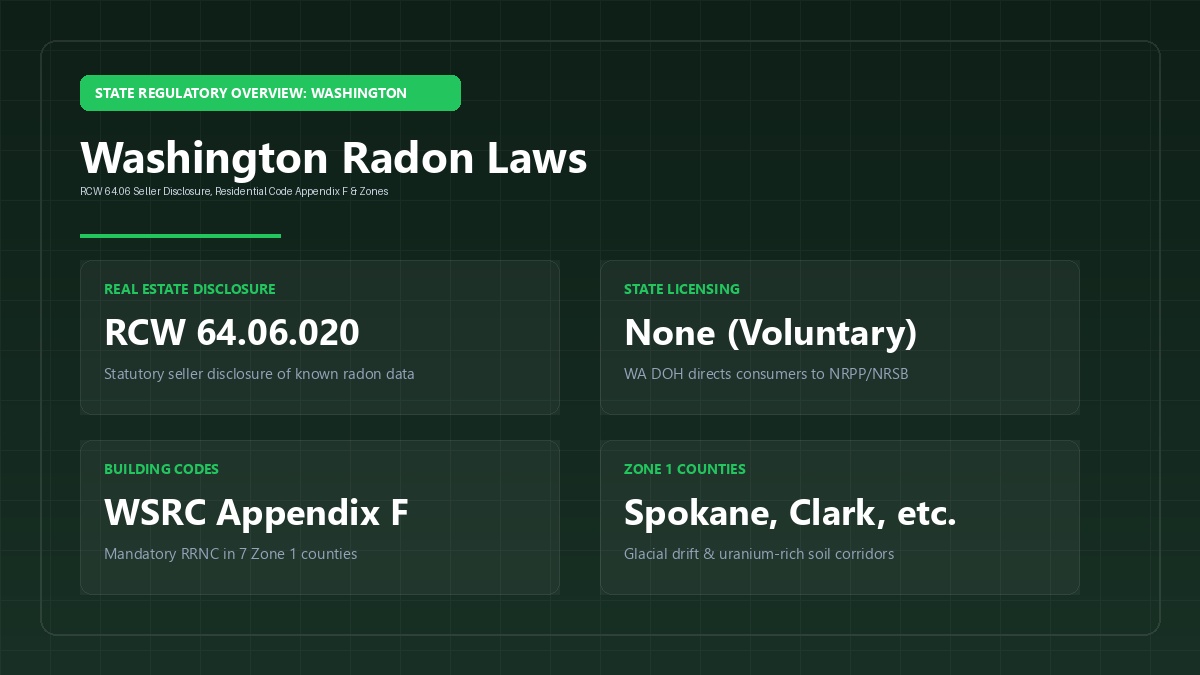
    Washington regulates radon primarily through mandatory building codes in designated high-risk counties and statutory real estate disclosures. Under the Washington State Residential Code (WSRC Appendix F), new residential construction must incorporate passive radon-resistant features across seven designated Zone 1 counties in eastern Washington. In real estate transactions, sellers of residential property must complete a statutory disclosure statement disclosing known radon tests or systems under RCW 64.06.020. The state does not administer an independent radon contractor licensing board, instead directing consumers to national NRPP and NRSB certification registries.

    Testing Requirements

    Radon testing in Washington is entirely voluntary for private single-family homeowners, residential landlords, and commercial property owners. Washington has no statewide statutory mandate compelling testing in private rental properties. In addition, there is no state law requiring routine radon testing in public or private K-12 schools, childcare centers, or state-owned buildings, though the Washington State Department of Health (WA DOH) strongly encourages school districts in high-risk eastern Washington counties to test facilities periodically.

    Real-Estate Disclosure

    Real estate disclosures in Washington are governed by Revised Code of Washington (RCW) § 64.06.020. Sellers of improved residential real property must complete and deliver the statutory Real Property Transfer Disclosure Statement (Form 17) to prospective buyers. Section 7 (Environmental) explicitly inquires whether the property has any radon gas, whether testing has occurred, and whether any radon mitigation system exists. Delivering false or incomplete statements, or failing to deliver the disclosure, provides buyers statutory rights of rescission within three business days of receipt.

    Mitigator & Tester Certification

    Washington does not maintain a state licensing board or state certification program for radon measurement or mitigation contractors; there is no Washington state radon license. General contractors must be registered with the Washington State Department of Labor & Industries (L&I). For radon proficiency, the WA DOH Radon Program officially advises consumers to hire contractors credentialed by the National Radon Proficiency Program (NRPP) or the National Radon Safety Board (NRSB).

    New Construction

    Radon-resistant construction is enforced under the Washington State Residential Code (WSRC / WAC 51-51), which incorporates International Residential Code Appendix F. Radon-resistant new construction (RRNC) is mandatory across seven designated EPA Zone 1 counties in eastern Washington: Clark, Ferry, Okanogan, Pend Oreille, Skamania, Spokane, and Stevens. In these counties, all new residential construction must incorporate passive sub-slab depressurization systems, including gas-permeable gravel, sealed vapor barriers, sealed perimeter joints, and a rough-in vertical vent pipe through the roof.

    Radon Zones & the Action Level

    Washington displays a dramatic geological divide across the Cascade Mountain Range:

    • Zone 1 (High Potential, predicted average indoor levels > 4.0 pCi/L): Clark, Ferry, Okanogan, Pend Oreille, Skamania, Spokane, and Stevens counties.
    • Zone 2 (Moderate Potential, predicted average 2.0 to 4.0 pCi/L): Chelan, Douglas, Grant, Kittitas, Klickitat, Lincoln, Walla Walla, Whitman, and Yakima counties.
    • Zone 3 (Low Potential, predicted average < 2.0 pCi/L): Puget Sound and western coastal counties, including King, Pierce, Snohomish, Kitsap, Thurston, and Whatcom.

    WA DOH adheres to the EPA action level of 4.0 pCi/L, strongly advising mitigation for living areas testing at or above 4.0 pCi/L. Explore the state breakdown on our EPA Radon Zone Map guide.

    The State’s Radon Program

    The state’s official radon resource is the Washington State Department of Health (WA DOH) — Radon Program (doh.wa.gov/community-and-environment/contaminants/radon). Washington residents can access educational materials, purchase low-cost test kits through state-partnered laboratories, and look up national NRPP/NRSB contractor registries.

    Sources & Limits

    This regulatory guide is prepared for informational purposes only and does not constitute formal legal, building code, or engineering counsel. Building codes and administrative interpretations are subject to revision by the State Building Code Council and WA DOH. Consult local building departments or legal counsel for site-specific requirements.

    Primary Official Sources: Washington State Department of Health (WA DOH); Revised Code of Washington § 64.06.020; Washington State Building Code Council (WAC 51-51 Appendix F); U.S. Environmental Protection Agency (Map of Radon Zones for Washington).

    Return to our national guide on Radon Regulations in the United States or inspect national county risk rankings on the EPA Radon Zone Map.

  • Because They Said I Couldn’t Have It

    Because They Said I Couldn’t Have It

    A Tygart Media original — seven songs, eighteen years

    “Why do you want this so bad?” — “Because they said I couldn’t have it.”

    His own words, December 2018. This album is a life told in order — drawn from eighteen years of his own writing: 1,080 posts, from the Bremerton dad years through the hinge, the fall, the love chapter, the quiet years, and the return. Seven songs, seven paintings, eighteen minutes. Walk through it like a gallery — every track has its own canvas.

    Listen to the full playlist on Flow →


    Bremerton Dad — golden-hour soccer field

    01 — Bremerton Dad

    Warm heartland rock · acoustic-driven · male vocalist · 2:39

    2008–2015. Soccer Saturdays — Sounders scarves, Kitsap Pumas jerseys, Washougal mud, his boy’s band rattling the walls on New Year’s Eve. Teaching his son to buy his first shares. A funny, warm, sports-bar American dad, remembered golden.

    Saturday morning, cleats by the door
    Sounders scarf hanging where it hung before
    Kitsap Pumas jersey, two sizes too wide
    Drake’s got the aux cord, Cade’s got the pride

    Bremerton dad, with the minivan plan
    Teaching ’em ETFs with a steady hand
    Said, “Boy, buy a piece of the world you see”
    Drake bought double just to one-up me
    Bremerton dad — yeah, those were the days
    Golden as the light on the Kitsap waves


    The Hinge — a door open with light coming through

    02 — The Hinge

    Introspective folk-rock that builds · male vocalist · 2:31

    2016. A twelve-minute presentation cracked something open — the most significant change of his life. The journal, the workouts, Coach Wooden on the nightstand. Watching seven-year-olds play soccer and wondering when everyone started taking it all so serious. The year the inner work began — and never stopped.

    Twelve minutes and the room went still
    Something cracked that no one could fill
    I went home and bought a journal that night
    Wrote “this could go good, or it could go wrong” by flashlight

    This is the hinge, this is the turn
    This is the year the student learns
    That the man you’ve been ain’t the man you’ll be
    When you finally start looking honestly
    This is the hinge — and it swings both ways
    It closes on the old ones, opens on the days


    The Cow — a lone cow in the desert at dawn

    03 — The Cow

    Sparse aching country ballad · pedal steel · female vocalist · 2:59

    2019, the fall. The first Christmas in twenty-six years without watching his kids open gifts. Working alone out of a Phoenix coworking space — and in the middle of a recruiting session, deadpan: “I want a cow.” The dream he named inside the wreckage, humor intact.

    First Christmas in twenty-six years
    No wrapping paper, no little-kid cheers
    Just a coworking desk in the Phoenix heat
    And Maroon 5 on repeat

    I just want a cow, that’s always been my dream
    Something simple in a world that’s coming apart at the seam
    They laughed like it was a joke I told
    But I meant it, every word — I want a cow
    That’s all I want, that’s my vow


    Feast Farm — lambing season at sunrise

    04 — Feast Farm

    Warm tender acoustic · duet feel · 3:00

    2020, South Australia. A sheep farm during COVID with Stefani — lambing season, bottle-feeding lambs four times a day, “better than any movie or dream I’ve ever had.” The most present, tender chapter. A love letter.

    Bottle-feeding lambs at the break of day
    Four times daily, they don’t wait
    Shearing sheds and the Scrub so wide
    Stefani laughing by my side

    Feast Farm, where the world stood still
    And for once I had my fill
    Of mornings that asked for nothing more
    Than her hand and an open door
    Better than any movie, better than any dream
    Life was exactly what it seemed


    The Quiet Years — an empty road in fog

    05 — The Quiet Years

    Ambient · sparse piano · hushed vocal · 2:12

    2021–2024. Gone from everywhere — off the noise, out of sight. The wilderness years. Sometimes the bravest thing is disappearing long enough to hear yourself again.

    Twenty posts in a whole year
    Then nothing — I just disappeared
    No updates and no applause
    Just silence, and its quiet cause

    These are the quiet years
    No witnesses, no cheers
    Just a man and what he’s made of
    Learning how to stand back up
    In the quiet years


    Because They Said I Couldn't Have It — defiant on the mountaintop

    06 — Because They Said I Couldn’t Have It

    Defiant anthem · big guitars · gang vocals · 2:41

    The motto, in his own words. The philosophy of a whole life — every comeback, every build, every return. Earned by everything that came before it on this record.

    “Why do you want this so bad?” they say
    Like hunger is a thing you can explain away
    I’ve heard it all my life, every single doubt
    Every “settle down” and “sit this out”

    Because they said I couldn’t have it
    That’s the fuel, that’s the fire
    Every “no” became a habit
    Of climbing higher and higher
    You can keep your doubts, I’ll keep my grit
    Because they said I couldn’t have it
    And look at me now — I went and got it


    The Ferrari — top down toward the sunrise

    07 — The Ferrari

    Hopeful expansive indie-rock · warm vocal · 2:42

    The return — 2025–26. New mornings, new work, old friends found again, a technological revolution. “The Ferrari doesn’t know it’s a Ferrari” — until it does. Finally acting like what he’s always been.

    They said the Ferrari doesn’t know it’s a Ferrari
    Shines in the garage, never leaves the bay
    I spent a lifetime polishing in the dark
    Afraid to turn the key and make my mark

    But I’m driving now, top down in the sun
    New mornings, and the work’s begun
    Every mile I ever walked led here
    The Ferrari finally knows, loud and clear
    I’m the Ferrari — and I’m done standing still


    Because They Said I Couldn’t Have It — seven songs, eighteen minutes, eighteen years. Written in one night from a lifetime of posts, painted one canvas per song, rendered in the Flow studio. Full playlist on Flow →

  • SPEEA 2026 Contract: Boeing Talks Resume Sept. 8 (Everett Guide)

    SPEEA 2026 Contract: Boeing Talks Resume Sept. 8 (Everett Guide)

    Last verified: 8 September 2026 against SPEEA.org and Seattle Times / Everett Post reporting. Confirm live at speea.org.

    Direct Answer (8 September 2026): SPEEA Prof and Tech members rejected Boeing’s 4-year offers in August (Professional Unit 64.3% no — 7,238 to 4,027; Technical Unit 71.9% no — 2,795 to 1,094) and authorized a strike (87.8% Prof / 89.7% Tech). The current contracts expire 6 October 2026. SPEEA and Boeing agreed to resume negotiations on Tuesday, 8 September 2026. No strike can start before the expiration date.

    What happened

    • Talks opened 1 July 2026.
    • 5 August: SPEEA Negotiation Team unanimously endorsed Boeing’s offer (wage pools compounding to 29.4% over four years / 31.9% with promotions; 3% retroactive to 20 Feb; 40% lift in incentive target). Rank-and-file still voted it down.
    • 21 August: rejection + strike authorization. SPEEA said 92% of eligible members voted.
    • 31 August: Negotiation Team met Boeing; both sides set 8 September to resume.

    Sources: SPEEA 31 Aug notice, Everett Post vote tally, Seattle Times 1 Sept.

    Who is at the table

    • Professional Unit — engineers and scientists (~13,000 in the vote reporting).
    • Technical Unit — analysts, designers, technicians (~4,000+).
    • Puget Sound sites include Everett (Paine Field), Renton, Seattle, Auburn, Frederickson. SPEEA is IFPTE Local 2001.

    What SPEEA says it wants next

    From the 31 August SPEEA note: a larger guaranteed wage increase on ratification; improved wage pools with fixed minimums inside the pools; additional COLA; higher 401(k) company contributions; a Boeing commitment to grow the SPEEA-represented workforce; reinstatement of the three-bucket Retention System; overtime conversation for the Prof Unit; plus work-from-home, on-call, incentive pay for specific roles, and Market Reference Table updates.

    What this is not

    This page is a status desk, not a recommendation to vote or strike. Contract text lives with SPEEA and Boeing. Numbers above are the published vote counts and dates. If talks move after 8 September, patch this slug — do not mint a second URL.

    Related: SPEEA 2026 contract — engineers outlook · Everett negotiations desk.

    FAQ

    What is the SPEEA contract 2026 status?

    Members rejected Boeing’s August 2026 offers and authorized a strike. Negotiations resume 8 September 2026. Current contracts expire 6 October 2026.

    Did SPEEA authorize a strike?

    Yes. Professional Unit 87.8% yes; Technical Unit 89.7% yes. SPEEA says a stoppage cannot start before 6 October 2026.

    When does the SPEEA Boeing contract expire?

    6 October 2026 for the Prof and Tech Puget Sound agreements, per SPEEA and contemporaneous reporting.

    What did the rejected offer include?

    SPEEA’s 5 August endorsement note listed wage pools compounding to 29.4% over four years (31.9% with promotions and out-of-sequence), guaranteed minimums tied to inflation, a 40% increase in the incentive target, 3% immediate pay retroactive to 20 February, plus an amount equal to 40% of each member’s 2026 incentive bonus. Members still voted no.

  • Tacoma Healthcare 2026: Building Boom Meets Workforce Gap

    Tacoma Healthcare 2026: Building Boom Meets Workforce Gap

    Drive past the corner of MLK Jr. Way and Division Avenue in Tacoma right now and you will see the most expensive bet Pierce County’s health systems have ever placed on their own future: a six-story, 250,000-square-foot children’s hospital that did not exist in that form a year ago. It is a remarkable thing to watch a region build. The harder question — the one that will actually decide whether all this concrete and glass delivers better care — is who is going to staff it.

    That tension between buildings and bodies is the real story of Tacoma healthcare in 2026. The capital is arriving on schedule. The workforce is not. Here is what is actually happening across the county, what it means for patients and employers, and where the pressure points are headed next.

    MultiCare’s Mary Bridge Opening Is the Headline — and the Template

    On May 18, 2026, MultiCare moved pediatric operations into the new freestanding Mary Bridge Children’s Hospital at 305 South L Street, the site of the hospital’s original 1955 campus. Transport teams relocated 61 patients into the building the same day the new pediatric emergency department opened its doors at 6 a.m.

    The numbers tell you how serious MultiCare is about pediatric specialty care as a regional draw. The new facility carries 82 licensed inpatient beds across medical-surgical and pediatric intensive care units, an emergency department with 29 exam rooms and four behavioral-health reduced-risk rooms, eight operating rooms, a rooftop helipad for critical transports, and a 400-space parking garage. Mary Bridge remains Western Washington’s only Level II Pediatric Trauma Center and the only pediatric hospital in Southwest Washington, which means this building is not just a Tacoma asset — it is the referral destination for the most complex pediatric cases across the region.

    “This hospital comes at a critical moment as we expand to meet growing demand for children’s specialty care,” said Jeff Poltawsky, president and market leader for Mary Bridge Children’s Hospital & Health Network, in MultiCare’s announcement. CEO Bill Robertson framed it as “a promise to a region.” Both are right. But a 71-year-old institution does not move into a building this size unless it is planning to grow the volume — and volume needs people.

    The Trauma and Behavioral-Health Buildout Behind It

    Mary Bridge is the visible piece. Underneath it, MultiCare and Virginia Mason Franciscan Health (VMFH) have moved to expand Level II adult trauma coverage at both St. Joseph Medical Center and Tacoma General, and MultiCare’s broader capital plan includes a standalone acute psychiatric facility and additional pediatric ICU capacity. For a county that has spent a decade short on inpatient behavioral-health beds, that psychiatric investment may matter more to everyday residents than any ribbon-cutting.

    Virginia Mason Franciscan Health Is Reshaping Its Tacoma Footprint

    VMFH — the system most Tacomans still think of as CHI Franciscan — spent the first half of 2026 making a series of quieter moves that add up to a real strategic shift.

    In February, the system distributed $1.8 million in Community Health Improvement Grants to 29 area nonprofits, its third consecutive year of that program, targeting access to care, behavioral health, chronic-disease management, and violence prevention. On the operations side, VMFH retired the legacy MyVirginiaMason patient portal on May 2, 2026, folding patients into the CommonSpirit Patient Portal powered by MyChart — a back-office change that nonetheless touched every patient who books an appointment or checks a lab result online.

    The Residency Decision That Has Tacoma’s Family Doctors Worried

    The most consequential VMFH move of the year is also the least flashy. The system has told Community Health Care that it will end a key family-medicine residency rotation at St. Joseph Medical Center on July 1, 2026. VMFH attributes the decision to a need to dedicate Level III neonatal intensive-care capacity and staff at St. Joseph to higher-acuity newborns.

    That rationale is defensible on its own terms — a NICU is exactly the kind of high-acuity service a hospital should protect. But the downstream effect is real. Community Health Care’s residency, launched in 2014 and affiliated with the University of Washington Family Medicine Residency Network, exists specifically to grow and retain primary-care physicians in Tacoma and Pierce County. Program director Dr. Carri Jo Timmer has warned the cut will worsen access for underserved patients, noting there are already too many patients and not enough doctors. In a county relying on locally trained physicians to put down roots, losing an inpatient training partner is the kind of slow leak that does not show up for years — and then shows up everywhere at once.

    The Workforce Gap Is the Story Under Every Other Story

    Here is the through-line connecting the Mary Bridge opening, the trauma expansion, the psychiatric facility, and the residency fight: Tacoma is building healthcare capacity faster than it is producing the clinicians to run it.

    Workforce-market analysis of the region (per a 2026 talent-gap assessment from healthcare staffing firm KiTalent) puts vacancy rates for the clinical specialists needed to staff high-acuity units, psychiatric facilities, and surgical programs at 40 to 60 percent above their 2019 baselines. The same analysis flags behavioral health as the sharpest pain point: psychiatric nurse practitioner roles in Tacoma reportedly sit unfilled for 140 to 180 days, with two-year signing bonuses ranging from $30,000 to $50,000, against a roughly one-third vacancy rate for psychiatric nursing positions. Those figures come from a private staffing-industry source rather than a government dataset, so treat the precise percentages as directional — but the direction is not in dispute by anyone hiring in this market.

    State policy is tightening the squeeze. Washington’s nurse-staffing-ratio requirements phasing in through 2026 raise the floor on how many RNs a hospital must have on the unit — which is good for safety and patient outcomes, and which also means systems cannot simply run lean to paper over vacancies. More beds plus mandated ratios plus a thin pipeline is a math problem, and right now Pierce County is on the wrong side of it.

    What This Means If You Hire, Build, or Get Care Here

    For employers across Pierce County, healthcare wage competition is now a regional cost-of-doing-business factor, not a hospital-HR footnote. Sign-on bonuses and travel-clinician premiums ripple into every employer trying to retain workers with transferable skills. For developers and commercial landlords, the buildout signals durable demand near the Hilltop medical core and along the Link light-rail corridor that now serves Mary Bridge directly. And for residents, the honest read is mixed: the facilities coming online are genuinely better, but access — especially to primary care and behavioral health — will stay tight until the staffing pipeline catches up.

    Where to Watch Next

    Three things are worth tracking through the back half of 2026. First, whether Community Health Care secures a replacement inpatient training partner before the July 1 rotation cut bites — the UW network connection gives it a fighting chance. Second, how quickly MultiCare’s psychiatric and PICU capacity actually opens for patients versus how quickly it can be staffed. Third, the bioscience and research side: Madigan Army Medical Center at Joint Base Lewis-McChord continues to run clinical trials across Phases I through IV and remains an underappreciated research anchor for the South Sound, even as most of the headline activity stays inside the federal system rather than spilling into a local startup ecosystem.

    The buildings are the easy part. Tacoma has proven it can raise the capital and pour the concrete. The next two years will test whether it can fill those buildings with the people who make a hospital a hospital.

    Frequently Asked Questions

    When did the new Mary Bridge Children’s Hospital open in Tacoma?

    MultiCare opened the new freestanding Mary Bridge Children’s Hospital on May 18, 2026, moving 61 patients into the 250,000-square-foot, six-story facility at 305 South L Street in Tacoma. The new pediatric emergency department began seeing patients at 6 a.m. that day. It remains Western Washington’s only Level II Pediatric Trauma Center.

    Why is Virginia Mason Franciscan Health ending the Community Health Care residency rotation?

    VMFH plans to end its family-medicine residency rotation at St. Joseph Medical Center on July 1, 2026. The system says the decision is driven by a need to dedicate Level III neonatal intensive-care capacity and staff at St. Joseph to higher-acuity newborns. Community Health Care’s program director has warned the change could shrink Tacoma’s pipeline of primary-care physicians and worsen access for underserved patients.

    How bad is the healthcare workforce shortage in Pierce County?

    Industry analysis of the Tacoma market reports vacancy rates for high-acuity, psychiatric, and surgical clinical roles running 40 to 60 percent above 2019 levels, with behavioral-health roles such as psychiatric nurse practitioners taking 140 to 180 days to fill. These figures come from a private staffing-industry assessment and should be read as directional, but local hiring conditions broadly confirm the shortage. Washington’s phased-in nurse-staffing-ratio requirements add further pressure.

    What major healthcare facilities are expanding in Tacoma in 2026?

    The headline project is MultiCare’s new Mary Bridge Children’s Hospital. Beyond it, MultiCare and VMFH have expanded Level II adult trauma coverage at St. Joseph Medical Center and Tacoma General, and MultiCare’s capital plan includes a standalone acute psychiatric facility and added pediatric ICU capacity — a significant investment in behavioral-health and high-acuity beds for the region.

    Does Tacoma have a bioscience or clinical-research sector?

    Tacoma’s research activity is concentrated more in established institutions than in a startup ecosystem. Madigan Army Medical Center at Joint Base Lewis-McChord runs clinical trials across Phases I through IV and serves as a major research and graduate medical education anchor for the South Sound, though most of that activity remains within the federal military health system rather than feeding commercial bioscience ventures locally.

  • Stream Community Line: Pierce Transit’s Tacoma Expansion

    Stream Community Line: Pierce Transit’s Tacoma Expansion

    For most of the last decade, the big transit story in Pierce County was supposed to be steel: light rail creeping south, a Bus Rapid Transit corridor with its own dedicated lanes muscling up Pacific Avenue. The reality landing in Tacoma in 2026 is quieter, cheaper, and arguably more useful to the people who actually ride. Pierce Transit’s Stream Community Line now runs all the way into downtown Tacoma — and it tells you almost everything about how transit in this county is going to grow for the rest of the decade.

    If you commute the Pacific Avenue spine between Spanaway and downtown, drop a kid at a school served by a free youth ORCA pass, or just want to understand where your transit tax dollars are going, here’s the operator’s-eye view of what changed, what’s coming June 7, and why the bus — not the train — is doing the heavy lifting.

    What the Stream Community Line Actually Is

    The Stream Community Line is enhanced bus service running the Tacoma–Spanaway corridor, and as of the March 29, 2026 service change it was extended into downtown Tacoma with new stops at Pacific Avenue & 14th Street, Pacific Avenue & 19th Street, and Commerce Street Station. It’s a partnership with MultiCare, and it runs weekdays during the morning and evening rush.

    The selling point is time. By skipping lower-demand stops and using transit-signal priority — technology that holds a green light or shortens a red when a bus approaches — Stream cuts at least 14 minutes off the trip compared to the existing local Route 1, according to Pierce Transit’s own service materials. For a corridor where the alternative is sitting in single-occupancy traffic on Pacific, 14 minutes each way is real money in time and fuel.

    Route 1 itself didn’t get left behind. The same March service change added eight new northbound and ten new southbound weekday trips on Route 1 (6th Ave–Pacific Ave), per Pierce Transit, so riders who need every stop still get more frequent local service while Stream handles the express layer on top.

    Why It’s “Stream” and Not Bus Rapid Transit

    Here’s the part longtime Pierce County residents will remember differently. Stream is what’s left of a much larger ambition. Pierce Transit spent years planning a true Bus Rapid Transit line on the Route 1 corridor — dedicated bus lanes, station platforms, the works — to deliver fast, reliable service up and down Pacific Avenue at all hours, not just at rush.

    That plan came apart in 2023. As The Urbanist reported, updated cost estimates pushed the dedicated-lane BRT project out of reach, with the latest figure pegged at roughly $311 million. Rather than abandon the corridor, the agency pivoted to “enhanced” service: signal priority and stop consolidation instead of poured concrete and condemned lanes. It’s a pragmatic downgrade — you get most of the speed benefit without the capital cost or the years of construction fights over who gives up a travel lane.

    Whether that’s a smart compromise or a missed opportunity depends on who you ask. Transit advocates wanted the permanent infrastructure; budget hawks wanted the restraint. What’s not in dispute is that the bus reached downtown in 2026 and the BRT didn’t.

    The June 7 Service Change: What Riders Should Know

    Pierce Transit adjusts service a few times a year, and the next round lands June 7, 2026. The changes are modest but worth a glance if you ride these routes:

    Route 3 (Lakewood–Tacoma): Southbound trips will no longer travel on S. 19th St between Market St. and Jefferson Ave., continuing on Jefferson Ave. instead. No stops or schedules are affected — it’s a routing cleanup.

    Route 101 (Gig Harbor Waterfront Connector): The seasonal Connector returns for the summer, running Fridays, Saturdays, and Sundays around Gig Harbor. As with all Pierce Transit service, riders 18 and younger ride free.

    Route 206 (Pac Hwy/Tillicum/Madigan): Northbound trips toward Lakewood Transit Center are getting daily schedule adjustments — relevant for the JBLM-adjacent communities of Tillicum and the Madigan corridor.

    Fan Zone Express: Starting June 12, Pierce Transit’s Fan Zone Express will offer free rides connecting fans to international soccer match watch parties tied to the summer’s marquee events. It’s a short-run promotional service, but it signals how the agency uses buses to move crowds around big regional moments.

    Spanaway: A New Hub, and a Temporary Hole

    The corridor’s anchor at the south end got a major upgrade in 2025. The Spanaway Transit Center opened in August 2025 — Pierce Transit’s first new public transit facility since the Tacoma Dome Station opened in 1998, according to coverage of the agency’s 2025 milestones. Phase One came in around $13.2 million and added 38 park-and-ride stalls, with a planned Phase Two expected to bring roughly 250 more.

    That facility matters because park-and-ride capacity is the unglamorous bottleneck on suburban transit. A fast bus down Pacific is only useful if you can leave your car somewhere when you board. Spanaway’s expansion — and the broader park-and-ride priorities in the agency’s long-range plan — is the supply side of the ridership equation.

    There’s a near-term complication, though. Because of Pierce County’s 208th Street East Sewer Extension project, the Spanaway Transit Center was temporarily closed effective April 27 for an expected 13 weeks, and during that window Route 1 and the Stream Community Line are not serving the Spanaway Transit Center. If you board at the south end of the corridor, check Pierce Transit’s alerts before you head out — temporary stops are in place, but the hub itself is offline through roughly late July.

    Ridership: The Numbers Behind the Investment

    Service changes only make sense if people are riding, and Pierce Transit’s recovery from the pandemic trough has been steady. The agency logged 7,039,888 boardings in 2025, running an 84% on-time performance rate against an 85% target, per its annual reporting. By the first quarter of 2026 the system was carrying roughly 26,700 riders on a typical weekday. Its 2025 annual report frames the bus side of the operation at just under 7 million rides, alongside hundreds of thousands of Rideshare and SHUTTLE paratransit trips.

    Those aren’t boom-era numbers, but they’re a recovery — and they’re concentrated on exactly the kind of all-day, working-rider corridors that Stream and the beefed-up Route 1 are built to serve. The strategy traces back to the agency’s Bus System Recovery Plan, launched in summer 2023, which rebuilt service around evening and weekend demand and higher frequency on core routes rather than simply restoring the old 2019 timetable.

    Fares: Who Rides Free in Pierce County

    One reason ridership holds up is that a meaningful share of riders pay nothing. Thanks to Washington’s 2022 Move Ahead Washington package, all youth ages 18 and under ride Pierce Transit for free. State employees who work in Pierce, King, and Snohomish counties can also commute free by bus or train. For everyone else, ORCA LIFT offers a 50% discount on adult fares for qualifying households based on federal poverty guidelines. Pierce Transit also ran a system-wide fare-free day on June 1 to kick off Ride Transit Month.

    The takeaway for households doing the math: between free youth passes and ORCA LIFT, a Spanaway-to-downtown family commute can cost far less than the fuel and parking it replaces — which is the case Pierce Transit is implicitly making with every Stream trip that beats Route 1 by a quarter hour.

    The Seattle Question and the JBLM Reality

    Pierce County transit doesn’t end at the county line. Sound Transit operates the regional connections — the T Line streetcar in downtown Tacoma, Sounder commuter rail and ST Express buses north toward Seattle — while Pierce Transit runs the local network that feeds those regional spines. The handoff between the two systems is where the daily Tacoma-to-Seattle commute actually happens, and where Joint Base Lewis-McChord’s enormous workforce shapes peak-hour demand on the I-5 corridor through Lakewood and Tillicum.

    That’s the larger backdrop to the Stream decision. Pierce County’s transit dollars are finite, the dedicated-lane BRT proved unaffordable, and the agency is now placing its bets on faster buses, better hubs, and frequency where the riders already are. Its Destination 2045 long-range plan sketches further growth — park-and-ride expansion, zero-emission buses, higher-frequency trunk service — if and only if operating funding grows. Pierce Transit has also opened public comment on its growth plan, so residents who want a say in what comes after Stream have a window to weigh in.

    From where I sit, the Stream Community Line is the honest version of Pierce County transit: not the train everyone pictured, but a bus that’s now 14 minutes faster down the corridor where the most people live and work. That’s not a consolation prize. For a county that needs to move workers more than it needs ribbon-cuttings, it might be the better deal.

    Frequently Asked Questions

    What is the Pierce Transit Stream Community Line?

    The Stream Community Line is enhanced weekday bus service running between Tacoma and Spanaway along the Pacific Avenue corridor. As of the March 29, 2026 service change, it extends into downtown Tacoma with stops at Pacific Avenue & 14th Street, Pacific Avenue & 19th Street, and Commerce Street Station. It uses transit-signal priority and skips lower-demand stops to save at least 14 minutes compared to local Route 1 service.

    Why didn’t Pierce Transit build a Bus Rapid Transit line on Pacific Avenue?

    Pierce Transit originally planned a true BRT line with dedicated bus lanes on the Route 1 corridor, but the project’s cost estimate rose to roughly $311 million and the dedicated-lane plan fell apart in 2023. The agency pivoted to the Stream Community Line — “enhanced” service using signal priority and stop consolidation rather than dedicated infrastructure — to capture most of the time savings at a fraction of the capital cost.

    Is the Spanaway Transit Center open right now?

    The Spanaway Transit Center, which opened in August 2025, was temporarily closed effective April 27, 2026 for an expected 13 weeks due to Pierce County’s 208th Street East Sewer Extension project. During the closure, Route 1 and the Stream Community Line do not serve the transit center, though temporary stops are in place. Riders should check Pierce Transit alerts before traveling.

    Who rides Pierce Transit for free?

    All youth ages 18 and under ride free, funded by Washington’s 2022 Move Ahead Washington package. State employees working in Pierce, King, and Snohomish counties also ride free. Income-qualifying riders can use ORCA LIFT for a 50% discount on adult fares. Pierce Transit also held a fare-free day on June 1, 2026 to launch Ride Transit Month.

    What is changing in the June 7, 2026 service change?

    Route 3 (Lakewood–Tacoma) southbound trips reroute from S. 19th St to Jefferson Ave. with no stop or schedule changes; the seasonal Route 101 Gig Harbor Waterfront Connector returns Fridays through Sundays; Route 206 northbound trips toward Lakewood Transit Center get daily schedule adjustments; and the free Fan Zone Express begins June 12 to connect fans to summer soccer events.