This is the fifth and final article in the End-in-Mind Operations cluster under The Restoration Operator’s Playbook. It builds on the previous four articles in this cluster: the principle, the close-out test, the customer lifetime frame, and end-in-mind subcontracting.
The owner has an end too
The previous articles in this cluster have applied the end-in-mind frame to operational decisions inside the restoration job and to the customer relationship that extends beyond it. There is a third frame, larger than either of those, that most owners only think about in the moments when they are forced to. It is the frame that asks: what are you actually building this company toward?
The honest answer for most owners is that they have not articulated one. The company exists. It generates income. It supports the owner’s family and the families of the team. It produces work the owner is generally proud of. It is, in a vague way, getting better year over year. But the explicit question of what it is supposed to look like in ten or twenty or thirty years — what the owner wants to hand off, what the owner wants to sell, what the owner wants to be remembered for building — is rarely articulated and even more rarely used as a filter for the decisions the owner makes in the present.
This is a strategic gap. Not a moral failure. The day-to-day demands of running a restoration company consume nearly all the cognitive bandwidth available to most owners, and the long-term articulation work feels like a luxury that can be done later. Later usually never comes, and the company that emerges across decades is the company that the accumulated daily decisions produced rather than the company the owner intended to build.
This article is about closing that gap. About what the owner’s own end-in-mind looks like when articulated. About how the articulation changes the daily decisions the owner makes. And about the specific exercises owners can do to bring their long-term picture into focus enough that it can actually function as a decision filter.
The three honest end-states
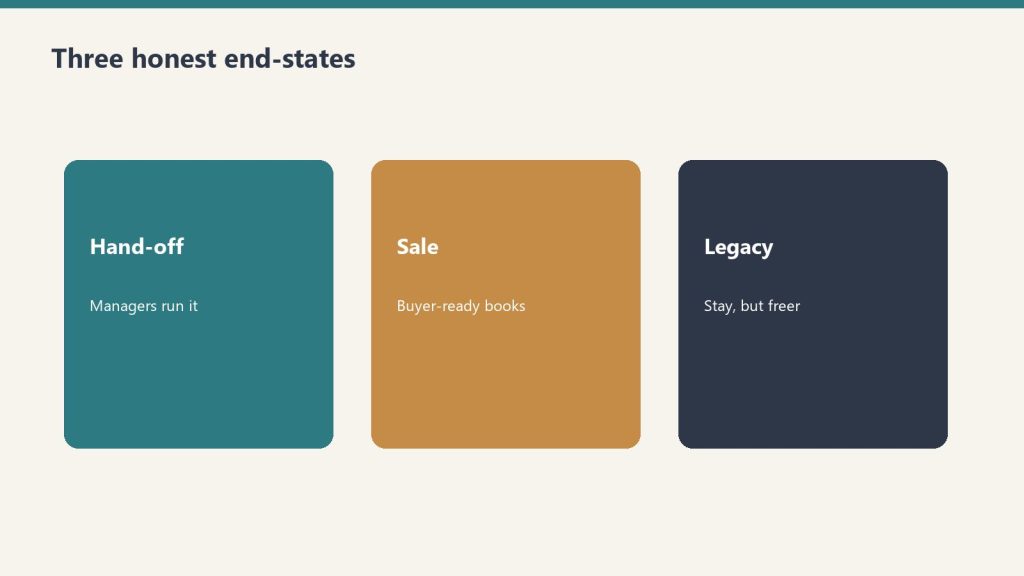
For most restoration owners, the long-term end-state of the company falls into one of three categories. Articulating which category the owner is actually pursuing is the first step in making the rest of the decisions deliberately.
The first category is hand-off. The owner intends to transfer the company, eventually, to a successor — typically a family member, a long-tenured senior operator, or a partnership of senior operators — and to step back from active involvement while the company continues operating under the new leadership. The hand-off may include continued financial participation by the original owner or may be a clean transition. The defining characteristic is that the company continues as an operating business after the owner’s active involvement ends, with continuity of identity and culture.
The second category is sale. The owner intends to sell the company, eventually, to an external buyer — typically a strategic acquirer, a private equity firm, or a roll-up platform — and to monetize the value the company has built. The sale may be partial or full, may involve continued operating involvement by the owner for a period, may include earn-outs or equity rolls, but the defining characteristic is the conversion of operating equity to liquid capital at a defined point.
The third category is legacy operation. The owner does not intend to hand off or sell, at least not in the foreseeable future. The company exists as the owner’s professional life work, and the owner intends to operate it for as long as they can. The end-state is the owner’s own retirement or the natural conclusion of their working life, at which point the company may be dissolved, sold, or transitioned in whatever way circumstances dictate, but those decisions are not actively being planned for.
Each of these end-states is legitimate. Each requires different daily decisions to be optimized for. The owner who is unclear about which end-state they are pursuing makes daily decisions that are inconsistent with each other and that, in aggregate, produce a company that is not optimized for any of the three.
What the hand-off end-state requires
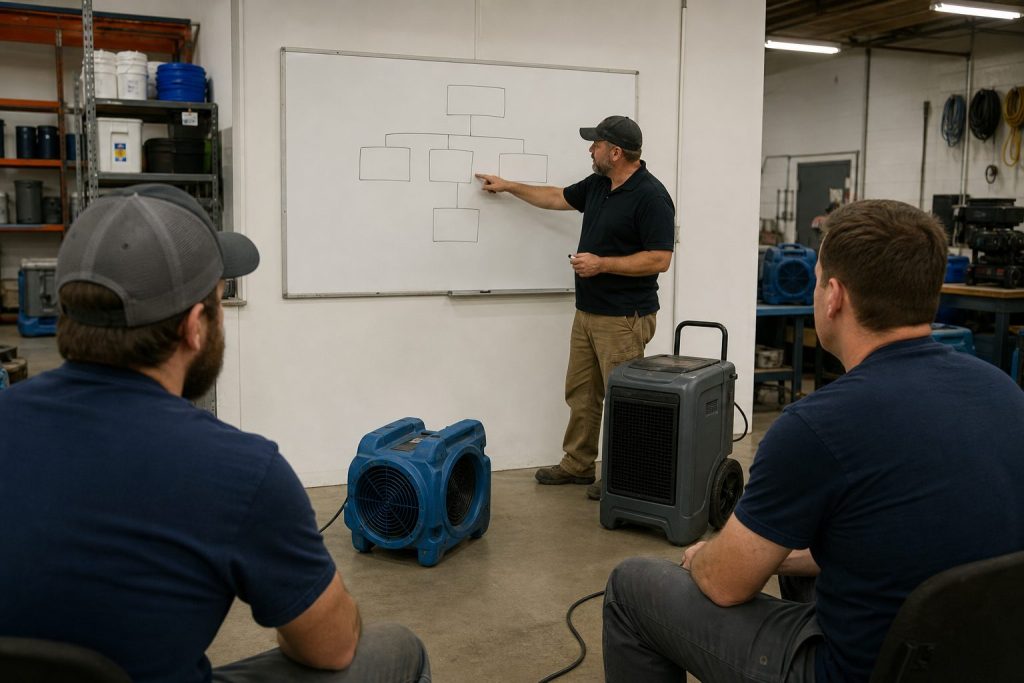
The owner pursuing a hand-off has to build the company to be a coherent operating system that can run effectively without the owner’s continued involvement. This is a structurally different requirement than the other two end-states.
The operating system has to be documented to a level that allows the next leadership to operate it. This is the documentation work described throughout this playbook, applied not just to the operational standards but to the strategic decision frameworks, the customer relationship management practices, the senior team development approaches, and the cultural standards that have made the company what it is. The successor needs to be able to read what the company is and how it operates without having to extract it from the owner’s head over years.
The senior team has to be developed to the point that the next leadership can be drawn from inside the company or, if drawn from outside, can be supported by an internal team that does not require the owner to fill the gaps. This requires explicit succession planning, deliberate development of senior operators into broader roles, and the kind of career path investment described in the senior talent career path article. The owner who has not built a senior team capable of running the company without them does not have a hand-off option, regardless of their stated intentions.
The cultural identity of the company has to be explicit and durable. A company whose identity is wrapped up in the owner’s personality cannot survive a hand-off intact, because the personality leaves with the owner. The cultural identity has to be embodied in practices, standards, and people in ways that survive the transition. The companies that have done this well typically have founders who have been deliberately working to depersonalize the culture for years before the hand-off, even when that work was uncomfortable in the short term.
The financial structure has to support the hand-off without crippling the company or the successor. Hand-offs to internal successors usually involve some form of structured buyout that is paid out of the company’s continuing operations over years. The structure has to leave the company with enough operating capital to continue thriving and the successor with enough financial flexibility to manage the transition. Owners who do not plan this structure deliberately end up with hand-offs that financially strain the company or the successor or both.
The owner who has articulated the hand-off end-state and who is operating from it makes daily decisions that look different from the decisions of an owner without that articulation. Investments in the operating system are made with longer time horizons. Senior team development is treated as the central strategic priority. Cultural transmission is deliberate. The company that emerges is the company that can survive and thrive without the original owner’s daily presence.
What the sale end-state requires
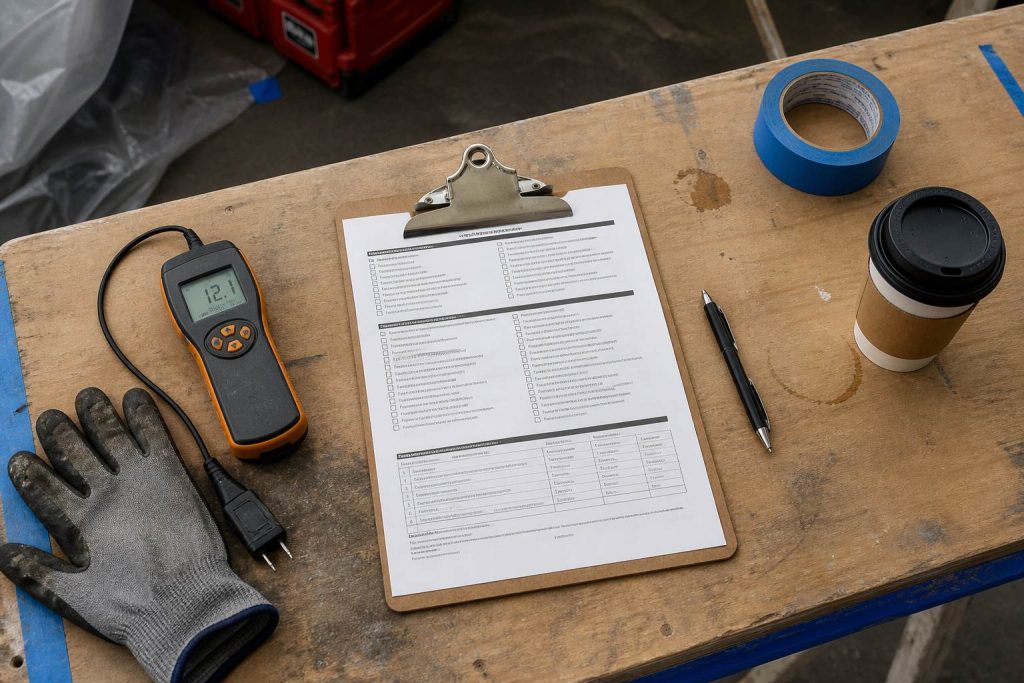
The owner pursuing a sale has to build the company to be a maximally attractive acquisition target at the time of the eventual sale. This is also a structurally different requirement than the other two end-states.
The financial profile has to be the kind of profile that buyers reward. Consistent revenue growth, strong margins, predictable cash flow, low customer concentration, low key-person dependency. Buyers will pay materially higher multiples for companies that have these characteristics than for companies that do not. Owners who are not paying attention to the financial profile that buyers will eventually evaluate are leaving meaningful sale value on the table.
The operational maturity has to be high enough that the buyer’s diligence will conclude favorably. Documented operational standards, defensible margin structure, clear competitive positioning, low operational fragility. Buyers who find significant operational issues during diligence will discount their offer or walk away. Owners who have built operational maturity for its own sake throughout the company’s life are well-positioned for sale. Owners who have papered over operational weaknesses are about to discover them in diligence at the worst possible moment.
The senior team has to be deep enough that the buyer can imagine the company continuing to operate after the owner’s eventual departure. Buyers worry about key-person risk because they should. A company that depends entirely on the owner is a company that the buyer cannot reliably operate after the sale, which depresses the value of the acquisition. The senior team development work described in this playbook is, among other things, sale preparation work even when the owner has not yet articulated the sale end-state.
The customer relationships have to be structured in ways that survive the sale. Customer relationships that depend personally on the owner cannot be transferred to a buyer cleanly. Customer relationships that are managed by the company’s processes and team can be. Owners who have built strong personal relationships with their largest customers without building parallel institutional relationships are creating a sale-time problem that will reduce the company’s value.
The owner pursuing a sale who has articulated the end-state and who is operating from it makes daily decisions that look different from the decisions of an unfocused owner. Investments are made with attention to their effect on enterprise value. The senior team is developed with attention to its impact on diligence outcomes. The financial reporting is built to a quality that will pass institutional scrutiny. The company that emerges is one that buyers will pay strong multiples for at the time of sale.
What the legacy operation end-state requires
The owner pursuing a legacy operation — the company as their professional life work, with no defined exit — has the most freedom about how to run the company day to day, and also the most ambiguity about what they are actually optimizing for.
The legacy operation requires the owner to be honest about why they are choosing this end-state. The honest reasons are usually some combination of the following. The owner loves the work and does not want to step back. The owner has built something they are proud of and does not want to see it changed. The owner is part of a community that the company serves and does not want to abandon that responsibility. The owner has not found a successor or a buyer they trust enough to transition to. Each of these is a legitimate reason. Each has implications for how the company should be run.
The legacy operation also requires the owner to think about what happens at the natural end of their active involvement. Even owners who do not plan to retire will eventually retire, voluntarily or otherwise. The company that has not been prepared for this transition will be sold under duress, dissolved unhappily, or transitioned to whoever happens to be available rather than to the right successor. Owners who claim the legacy operation end-state but who never actually plan for the eventual transition are deferring a decision rather than deciding.
The legacy operation also requires the owner to think about what they want the company to mean to the people who work in it. A company that is fundamentally an extension of the owner can be a wonderful place to work for the people who are aligned with the owner’s vision and a difficult place for the people who are not. The cultural design of the company is more personal in the legacy operation end-state than in the other two, and the owner has to be deliberate about what they want that culture to be.
The owner who has articulated the legacy operation end-state and who is operating from it consciously can build a company that is genuinely satisfying to run for decades. The owner who has defaulted into the legacy operation end-state because they have not articulated any other end-state usually ends up with a company that is harder to run than it needed to be, with operational decisions that have been made by accumulation rather than by design.
The articulation exercise
For owners who have not yet articulated their own end-in-mind, the exercise to do so is straightforward but not easy. It requires the owner to spend several hours in honest reflection about what they are actually trying to build and why.
The first question is about the time horizon. What does the owner want their relationship with the company to look like in ten years? In twenty? At the natural end of their active working life? The answers do not have to be precise. They have to be honest enough to surface which of the three end-states the owner is actually pursuing.
The second question is about the people. What does the owner want the senior team to look like at the end of the planned horizon? Who is on it? What roles do they have? What is the relationship between the owner and them? The answers reveal whether the owner is investing in a senior team appropriately or whether the senior team is treated as a tactical resource rather than a strategic asset.
The third question is about the customers. What does the owner want the company’s relationship with its customers to look like at the end of the planned horizon? What does the company’s reputation in its market look like? What does the company’s customer base look like? The answers reveal whether the owner is operating from the customer lifetime frame or from the transaction frame.
The fourth question is about the work itself. What does the owner want the company to be known for in its market and in the industry? What kind of work does the company do? What kind of work does the company decline? The answers reveal whether the owner has a clear identity for the company or whether the company is whatever the next job demands.
The fifth question is about the financial outcome. What does the owner want the company to be worth at the end of the planned horizon? What does the owner want the financial outcome of their work to be? The answers reveal whether the owner is building a financially serious enterprise or running a sole-proprietor income generator that will not produce significant financial outcome at the natural conclusion.
None of these questions has a right answer. All of them have answers that, once articulated, change how the owner makes the daily decisions that accumulate into the company’s actual trajectory. Owners who do this articulation exercise once and then revisit it annually as conditions evolve produce companies that look like the company the owner actually intended. Owners who never do the articulation exercise produce whatever the daily decisions happen to produce.
The practice that closes the gap
The owner’s end-in-mind is useful only if it actually filters daily decisions. The articulation by itself produces nothing. The integration of the articulation into the daily flow of decision-making is what produces the result.
The companies whose owners have done this well tend to have built the integration through several specific practices. The owner reviews the long-term picture quarterly and asks whether the recent quarter’s decisions have moved the company toward or away from it. The owner makes major decisions explicitly through the lens of the end-state, asking whether the decision is consistent with what they are trying to build. The owner shares the long-term picture with the senior team and uses it to anchor strategic conversations across the leadership group. The owner protects time for thinking about the long-term picture even when the short-term operational pressures would consume that time.
None of these practices is exotic. All of them require the owner to treat the long-term articulation as a real working tool rather than as a one-time exercise that gets filed away. The companies whose owners maintain these practices end up looking, in twenty years, like the companies the owners articulated they wanted to build. The companies whose owners did the articulation once and never returned to it end up looking like whatever happened.
The cluster ends here
The five articles in this cluster describe the end-in-mind frame applied at four levels. The decision-by-decision level. The customer-relationship level. The subcontractor-network level. And the owner’s own life-work level. Each level operates on different timescales and requires different practices to install. All of them work together as a coherent decision logic that, applied consistently across years, produces companies that are visibly different from companies operating from the default frame.
The end-in-mind logic is, in the end, the deepest of the operational disciplines this playbook describes. Tools change. AI capabilities evolve. Talent markets shift. Carrier dynamics adjust. The companies that internalize end-in-mind thinking adapt to all of these external changes from a stable internal foundation. The companies that operate from local optimization react to each change without a coherent frame and end up perpetually catching up.
The End-in-Mind Operations cluster is closed. The remaining clusters in The Restoration Operator’s Playbook will address carrier and TPA strategy, crew and subcontractor systems, restoration financial operations, and the modern restoration marketing stack. Each of those clusters compounds with this one and with the previous three. The full body of work, when complete, gives operators a durable mental architecture for the industry’s most consequential decade.
The companies that read this body of work and act on it will know what to do. The rest will find out later.