The brief is not “only use tweets that already say restoration.” Most of the usable material on @irentdumpsters is plumber, HVAC, roofing, dumpster, turf, pest, or agency. The translation is mechanical: keep the mechanism, swap the job, add the restoration constraint (IICRC, adjuster, Category of water, night board).
This table is the working method. New Bodhi posts get run through it before they become Tygart articles.
The translation table
Plumber faucet blogs → $50 drain calls. Restoration version: prevention fluff and a single Services bucket → cheap “can you bring a shop vac” calls. Rebuild around sewage, hidden leak, Category 3, fire/smoke, mold. Article: emergency terms.
Plumber / HVAC lead form on the homepage. Restoration version: form wall on a water site. Emergency work is tap-to-call. Article: hunt for the number.
Three plumbers on Maps, first voice wins a $4,200 repipe. Restoration version: first voice wins mitigation plus the rebuild conversation. Two rings or you bought the lead for the next listing.
Roofer primary category = General Contractor, stuck at Maps 16. Restoration version: primary category is Contractor or Waterproofing while the money search is water damage restoration. Match the top three. Rebuild stays secondary. Article: same Maps mistake.
Turf shop fake virtual office in the next city, GBP suspended, original pin frozen. Restoration version: storm-chase mailbox in the next county. Stay service-area until there is a real shop. Draw the area to a 45-minute roll.
HVAC pays $3,500 for 300 junk directories. Restoration version: same package, plus dead mold-directory links. Clean Data Axle, Localeze, Foursquare, chamber, IICRC/RIA, license boards. Identical NAP.
Plumber books 28 jobs from Apple Maps and Yelp, zero spend. Restoration version: Siri “water damage near me” never sees a Google-only shop. Claim Apple Business Connect and match Yelp NAP this week.
LSAs pointed at a 4.1 listing with blurry photos. Restoration version: paid “Google Guaranteed” badge over a profile that looks abandoned. Organic reputation is the conversion engine for paid.
Dumpster shop, 312 organic calls: Maps + reviews after every pickup + FAQ pages. Restoration version: pin hygiene, review after close-out, pages for the questions the CSR already answers (“how long before mold,” “will insurance cover sewage”).
170 reviews at 4.8 beat 50 at 5.0. One late-driver complaint makes the file look real. Restoration version: a sterile 5.0 after ten jobs looks bought. A detailed 4.8 with one “crew left a fan overnight” note looks like a company that works. Article: reviews and the quiet board.
Generic “thank you for your review.” Restoration version: reply with neighborhood, loss type, and standard. “Same-night extract on the burst pipe in [neighborhood], S500 dry-out, rebuild walk next.”
40 reviews in a weekend, then silence. Restoration version: do not blast asks during a storm surge and then go dark. Three closed-job reviews a week, after the house is livable enough that the homeowner is not still furious.
Full calendar is a lagging indicator. Killing marketing today empties next quarter. Restoration version: wet spring fills trucks; killing GBP posts and adjuster touches makes the dry month look like “SEO died.”
One bloated services page for roof, siding, gutters, storm. Restoration version: one URL for water, fire, mold, bio, pack-out. Google ranks specific URLs. Split them.
Dynamic call tracking swaps the header number, Maps dies in 60 days. Already a water-damage story. Keep the permanent local number visible. Do not teach Google the shop moved.
Angi / lead marketplaces rent you a customer sold to three shops. Restoration version: shared water leads and storm-lead vendors. You paid for a name that three other trucks also have. Own the pin and the relationships instead of renting the same flood twice.
Pressure washing is easy to enter, so margins die. Licensed trades hold price. Restoration version: unlicensed “we dry houses” Facebook crews race to the bottom. IICRC, mold licenses, and documented S500 work are why a homeowner stops negotiating at 2 a.m.
Pest control to $7M: SEO + review velocity + recurring contracts. Restoration version: organic emergency capture, then maintenance, mold follow-up, commercial agreements, mitigation-to-rebuild so the job is not a one-night extraction.
Agency retention beats new-logo hunting. Restoration version: keep the property manager, the adjuster, and the plumber who already sent you three losses. New-logo marketing is expensive. Repeat source is the compounding asset.
CSR questions are the blog calendar. Company picnic posts are not. Restoration version: “how long before mold,” “what is Category 3,” “do I call insurance first,” “how fast can you be here in [zip].” Those are pages. Birthday posts are not.
How each new post gets filed
Save the URL.
Write the mechanism in one sentence with the original trade still in it.
Swap the trade to water, fire, mold, or contents.
Add the restoration constraint the original post skipped (standard, documentation, carrier, night board).
Publish only if a PM can run it on Monday.
Accounts we will keep running through the same filter: the ten-account watchlist. Send the next URL if you want a specific thread turned next.
One account is not a research desk. The job now is a living watchlist of people who talk like operators about local SEO, Maps, speed-to-lead, and high-ticket home services — then translate every useful post into language a water, fire, or mold shop can run this week. Most of Bodhi’s best material is not labeled restoration. It is plumber, HVAC, roofing, dumpster, turf, and pest. The method for those posts is here: how to steal a plumber thread and make it a restoration SOP.
These are not endorsements and they are not a vendor shortlist. They are source nodes. Steal the rule. Ignore the pitch. Rewrite for restoration.
The ten accounts
1. @irentdumpsters — Bodhi, Stryker Digital
The seed. Dumpster operator turned local SEO. Writes in job stories, not frameworks. Recent restoration-usable posts: content mismatch and high-ticket terms; click-to-call instead of homepage forms; one URL per trade; answer in two rings; call-tracking NAP damage; mold as the retail lane while water stays locked by adjusters; Maps number one with a dead phone in a dry season.
Use him for: emergency-intent architecture and the reminder that weather creates demand, rankings only capture it. Also use every other-trade post. That is now the default ingest rule.
2. @drewdoesmarktng — Andrew Palacios, Revved Digital
Home-service SEO and AI. Publishes marketing benchmarks by trade, including water damage restoration, drain and sewer, roofing, and a dedicated restoration report. Talks audits as visibility, tracking, and follow-up problems wearing a marketing costume.
Use him for: numbers to compare against your own cost per booked mitigation, not for copying another vertical’s offer.
3. @noahiglerSEO — Noah Igler, Sustained Media
Calls himself the local SEO guy for home services. Cleanest recent framework on X: GBP wins the map pack, the location page supports that pin, service pages win organic, tracking has to reach sold revenue. Also the rare voice that will tell a $2M plumber not to buy SEO until the review rating is trustworthy.
Use him for: map-pack vs organic division of labor, and the rule that a 3.8-star restoration profile should not be fed more traffic.
4. @theseoguy_ — The SEO Guy, Vineyard Growth
High-volume local SEO checklists. GBP first, physical pin over a fake service-area blob, weekly photos, keyworded review replies, city plus service in the H1, stop writing history-of-the-trade blogs. Explicit that answering the phone is part of SEO.
Use him for: the unsexy weekly cadence a one-shop restoration company can actually keep. Filter out any “exact match business name” tricks that would look like spam to a carrier or a city inspector.
5. @localseobot
Grid-rank case notes, including water and fire restoration terms in Atlanta-area scans. Not narrative. Just “this keyword moved from X to Y on a 169-point grid.”
Use him for: how to talk about Maps movement without lying. Average rank on a grid is the honest metric. “We are number one” is usually a zip code lie.
6. @GeorgianBaySEO
Local SEO for trades. Public portfolio includes roofing, electrical, pest, waterproofing, and water damage restoration. Talks templates and schema as the reason site eight ships in a day after site one took weeks.
Use him for: the operations lesson. Restoration content should be a reusable service-page system (water, sewage, mold, fire, pack-out) plus local proof — not a new design every time you add a county.
7. @doctorcalf
Former SEO and GBP lead-gen for mold remediation. Long client cycles. Useful because mold is the retail lane Bodhi keeps pointing restorers toward when water is locked by preferred-vendor lists.
Use him for: mold-specific demand and the reminder that remediation clients return years later when the next leak shows up.
8. HouseCall SEO / Lior Daniel
Boutique restoration local SEO. Public positioning is six-plus years ranking crews on emergency terms, with published monthly ranges. Less of a daily X firehose than Bodhi, more of a restoration-only specialist to watch when he does post.
Use him for: emergency-query page structure aimed at 2 a.m. water and fire searches, not general home-service theory.
9. Outpace SEO (restoration-only shop)
Oklahoma City firm built around water damage and restoration SEO. Public case: OKC Restorations and a large year-over-year lift in organic clicks. Follow the company and principals when they publish market notes.
Use him for: single-market restoration case texture — what a water shop’s keyword set actually looks like when it is not mixed with roofing and HVAC.
10. Restoration Inbound / Restoration Digital Marketing cluster
Agencies that only sell to restorers (Restoration Inbound, Restoration Digital Marketing, and peers on the 2026 water-damage agency lists). They post less like dumpster-Twitter and more like vendor blogs. Still worth a weekly scan because they write to IICRC language, TPA friction, and storm season instead of “plumber near me.”
Use them for: insurance-aware copy and the difference between retail water, program work, and storm surge. Discard anything that sounds like a franchise pitch deck.
Inspired by Bodhi (@irentdumpsters). Original post: the Delray plumber / faucet-blog thread. This is a new Tygart article for restoration contractors. We kept the mechanism, added first-party field knowledge, and did not reprint the thread.
On September 5, 2026, Bodhi at @irentdumpsters posted a plumber story that restoration owners should tape to the office wall.
A shop in Delray Beach could not understand why the phone only rang for fifty-dollar drain snakes. The website had forty blog posts about leaky faucets and loose toilet handles. The work that buys trucks and pays commercial mortgages was emergency slab leaks and broken sewer mains. When water is moving under tile at two in the morning, the homeowner is not reading a faucet explainer. They are typing slab leak detection plus the city name while standing in a puddle.
They rebuilt the site around high-ticket emergency terms. In ninety days the shop booked three slab leak jobs averaging sixty-eight hundred dollars each, and stopped waking techs at midnight for kitchen sinks.
That is not a plumbing anecdote. That is the default failure mode of independent restoration marketing.
The restoration version of the faucet blog
Walk most water, fire, and mold sites and you will find the same mismatch. The company owns extractors, dehumidifiers, containment, and an IICRC-trained crew. The content library is “10 tips to prevent a wet basement,” “what is humidity,” and a single Services page that dumps water, fire, mold, biohazard, and pack-out onto one URL.
Google does not send the job you want. It sends the job your pages describe.
If the strongest pages on the domain answer “how to dry a small leak” and “when to call a plumber,” you will get small leaks and plumber overflow. If the strongest pages answer “sewage backup cleanup [city],” “category 3 water damage [city],” “hidden slab leak under tile,” and “mold remediation after a slow leak,” you get the jobs that fill a week of labor and a rebuild estimate.
What homeowners actually type at 2 a.m.
Emergency restoration search is not a research session. It is a cracked-phone query from a hallway that smells like drywall. The phrases that buy trucks look like this:
water damage restoration + city
emergency water extraction + city
burst pipe water damage + neighborhood
sewage backup cleanup + city
slab leak detection + city
black water cleanup
mold remediation + city
fire damage restoration + city
smoke damage cleanup
Those queries need a dedicated URL, a visible click-to-call number, license and IICRC proof above the fold on mobile, and photos from real local jobs. They do not need a 400-word “welcome to our family-owned company” block.
The 90-day rebuild for a restoration domain
Do not start by writing more blog posts. Start by killing the mismatch.
1. List the jobs that pay the mortgage
Pull last year’s sold jobs. Rank them by gross and by contribution margin, not by call volume. For most shops the list is some mix of category 2 and 3 water, sewage, hidden leaks, mold after a delayed loss, fire/smoke, and commercial emergency response. Those become the only service pages that matter for ninety days.
2. Give each high-ticket job its own URL
Google ranks distinct URLs for specific intent. A single “Our Services” page that lists water, fire, mold, and contents will not outrank a competitor who published 1,200 words on sewage backup cleanup with local photos, category definitions from IICRC S500, and a same-night dispatch CTA.
Build silos, not buckets. Water extraction. Sewage. Slab / hidden leak. Mold remediation. Fire and smoke. Pack-out. Commercial emergency. Each page answers one search, shows one class of proof, and asks for one action: tap to call.
3. Stop hiding the phone behind a form
A lead form on the homepage of a water restoration site loses emergency calls. Nobody standing in Category 3 water wants to type an email and wait. They tap click-to-call and hire the first crew that picks up. Put the local area code, a giant tap target, and license proof at the top of the mobile template. Answer in two rings or the ranking is buying leads for the shop that does.
4. Write the questions the CSR already answers
The content calendar is already sitting on the phone log. How long before mold after a flood. Will insurance cover a slab leak. What is Category 3 water. How fast can a crew be on site in this zip. Those are real searches. Company picnic posts are not.
5. Pick a lane insurance has not locked
Every restoration owner wants to rank for “water damage repair” on day one. In many markets the twenty-year shops already own the adjuster list. Mold remediation is often the faster retail lane: homeowners pay out of pocket or choose the contractor without waiting on a preferred-vendor sheet. Jobs in the three-to-eight-thousand range, shorter sales cycle, keywords you can actually move in ninety days. Use that cash to stay in front of the water losses when the weather finally turns.
What not to copy blindly
SEO puts you in front of demand that exists. It does not invent a wet spring. Rankings without weather, without an answered line, and without a review profile people trust are decoration.
Call tracking can also sink the listing. Dynamic number insertion that swaps the header number away from the Google Business Profile creates NAP conflict. Track without making Google think the shop moved.
The operator checklist
Print last year’s jobs by margin. Circle the five that buy trucks.
Map each circled job to one live URL. If it shares a page with three other trades, it does not count.
Open the site on a phone. If the number is not tappable in two seconds, fix the header before you write another paragraph.
Kill or noindex the faucet-class posts that train Google you are a handyman blog.
Publish one emergency page per week for eight weeks: sewage, hidden leak, Category 3, mold after water, fire/smoke, commercial after-hours, pack-out, storm response.
Put IICRC S500 / S520 language and real job photos on those pages, not stock “happy family” images.
If you have been running Google Local Services Ads (LSAs) for your restoration company for more than a year, the platform you’re managing today is not the one you signed up for. Two changes that landed in late 2025 quietly rewrote the economics of LSAs for restoration contractors — and most owners I talk to are still operating on outdated assumptions. The badge you bragged about is gone. The dispute process you relied on to claw back bad leads is gone. And the insurance trap that can silently kill your campaign is bigger than ever. Here is what actually changed and what you should do about it.
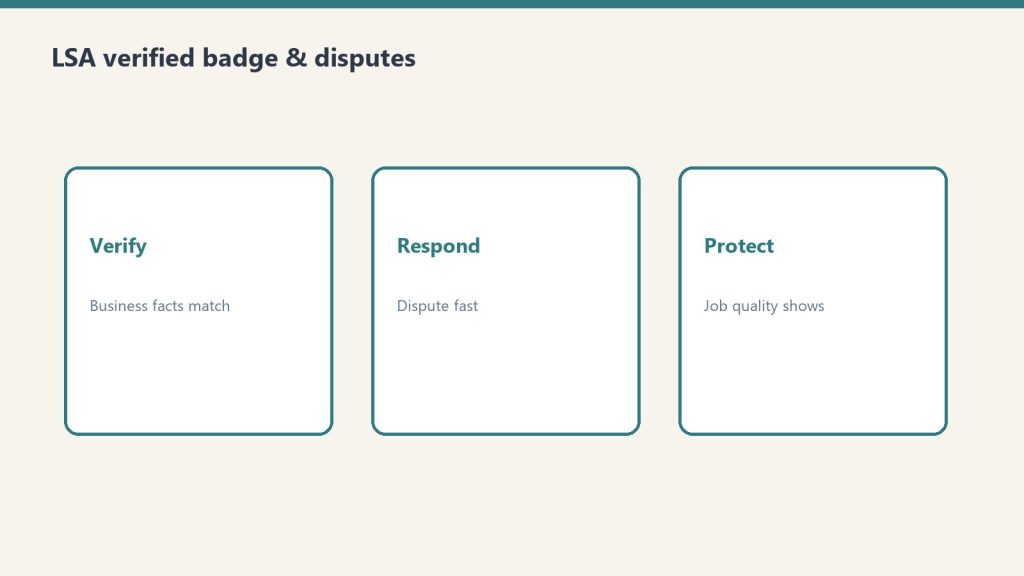
The badge consolidation: “Google Guaranteed” is now “Google Verified”
Badge renamed — ops discipline did not get easier.
Effective October 20, 2025, Google folded its three trust badges — “Google Guaranteed,” “Google Screened,” and “License Verified by Google” — into a single unified “Google Verified” blue checkmark. For restoration owners who spent months getting the green Google Guaranteed badge and then put it on their trucks and websites, this matters. The badge you earned still exists, it just looks different and means something slightly different now.
The verification requirements themselves haven’t loosened. You still pass a background check (Google runs this free through its partner Evident), and Google still verifies your license and insurance. Reported approval timelines run roughly three to four weeks once your documents are submitted — budget for that lag if you’re launching into a busy season.
The money-back guarantee is dead — and that changes your pitch
Here’s the change almost nobody talks about: the consumer money-back guarantee that was the whole point of the “Google Guaranteed” name was discontinued on November 7, 2025. Under the old program, if a customer was unhappy with a job booked through LSAs, Google would reimburse them up to a lifetime cap. That backstop is gone.
Why should a restoration owner care? Because if your sales process or your website copy still leans on “we’re backed by Google’s money-back guarantee,” you are now making a claim that is no longer true. Audit your marketing materials. The badge now signals verification — that you are who you say you are, licensed and insured — not a satisfaction guarantee. That’s a meaningful difference in how you should position it to a homeowner who just had a pipe burst.
The bigger story: manual lead disputes are gone
This is the change that hits your wallet directly. For years, the LSA model let restoration contractors manually dispute junk leads — wrong number, spam, a caller looking for a service you don’t offer, a job outside your service area — and recover a meaningful share of those charges. Reports from contractors who worked the old system suggest manual disputes recovered credits on a solid majority of flagged bad leads when documented well.
Google removed manual disputes in 2024 and replaced them with an automated credit system. Here’s how it works now: Google’s machine learning reviews leads, typically within about 72 hours of being charged, and automatically applies credits for leads it deems invalid, with credits generally appearing within roughly 30 days. You no longer build a case and submit it. The algorithm decides.
Two limitations matter enormously for restoration:
“Job type not serviced” and “geo not serviced” leads are no longer creditable. If a caller wants mold remediation and you only do water mitigation, or the job is two counties away, Google will not credit that charge anymore. Restoration owners across the home-services space have reported receiving out-of-area and out-of-category leads with no recourse — and that’s now baked into the system, not a glitch.
The automated system is reportedly less generous. Practitioner estimates put the current automated credit rate well below what manual disputes used to recover. You will eat more bad-lead cost than you used to. Plan your cost-per-acquisition math accordingly.
The one lever you still have: rate every lead
The one lever you still have: rate every lead honestly.
The “Rate this lead” feedback tool in your LSA dashboard is not a customer-satisfaction survey — it’s the primary input the automated credit engine uses. Marking a lead as “Very dissatisfied” with a specific, accurate reason is reportedly the most reliable way to nudge a credit. The discipline here is operational: whoever answers your LSA calls needs a standing instruction to rate every single lead the same day, with notes. If you’re not rating leads, you’ve handed the algorithm zero signal and you’re leaving credits on the table.
The silent campaign-killer: your insurance certificate
Here is the trap that takes down more restoration LSA accounts than bad creative ever will. Google periodically re-checks the license and insurance on file in your LSA account. When your general liability policy renews and you don’t upload the new certificate, Google can pause your ads automatically — no warning email that most owners notice, no grace period you can count on. For a restoration company, an unexplained pause during storm season is real revenue walking out the door.
The fix is trivial and free: set a calendar reminder for two weeks before your GL policy renews each year to upload the fresh certificate of insurance into your LSA account. This single recurring task prevents the most common avoidable outage in the channel.
What this costs you in restoration
For context on the stakes: water damage restoration sits at the expensive end of LSAs because the jobs are big and contractors bid the channel up. Reported cost-per-lead figures for water damage restoration commonly land in roughly the $75–$200 range depending on market competition, with some sources citing $300+ per call in the most aggressive markets. Cost per acquired job is reported in the rough range of $200–$800. With restoration margins what they are, those numbers can still pencil out — but only if you’re not silently absorbing uncreditable junk leads and only if your account never goes dark over a lapsed insurance cert. The platform changes above all push in the same direction: the margin of error on LSA management got thinner in late 2025.
The bottom line
Bottom line: LSA is a system, not a set-and-forget badge.
If you run LSAs for a restoration company, do three things this week. First, scrub any “money-back guarantee” language from your marketing — it’s no longer accurate. Second, make daily lead-rating a non-negotiable task for whoever fields your LSA calls, because rating is now your only real influence over credits. Third, put a recurring two-weeks-before-renewal reminder on the calendar to update your insurance certificate. None of these cost a dollar, and together they protect the most expensive lead channel in your marketing budget from the changes Google made while you weren’t watching.
If you own a restoration company in 2026, your marketing budget is being eaten alive by three channels fighting for the same lead: Google Local Services Ads, Google Search Ads, and SEO. The owners I talk to are spending six figures a year and still can’t tell me, with a straight face, which channel is actually paying them. So let’s settle this with the numbers vendors don’t put in their pitch decks.
The water damage CPC is the most expensive in home services
Reported cost-per-click for top water damage restoration keywords has climbed as high as the $200–$250 range in competitive metros, with industry sources citing top-of-page bids reaching around $250 per click for terms like “water damage restoration [city].” Average emergency restoration keywords more commonly land in the $40–$100 CPC range depending on geography and time of day. That is not a typo. A single click — not a lead, not a job — can cost more than most contractors charge for a furnace tune-up.
The reason owners keep paying it is simple. A water mitigation job typically prices in the $3,000–$15,000+ range depending on category and scope. At those ticket sizes, a $300 cost-per-lead and a 25% close rate still pencils out. But “pencils out” is doing a lot of heavy lifting in that sentence — and that’s where most owners stop running the math.
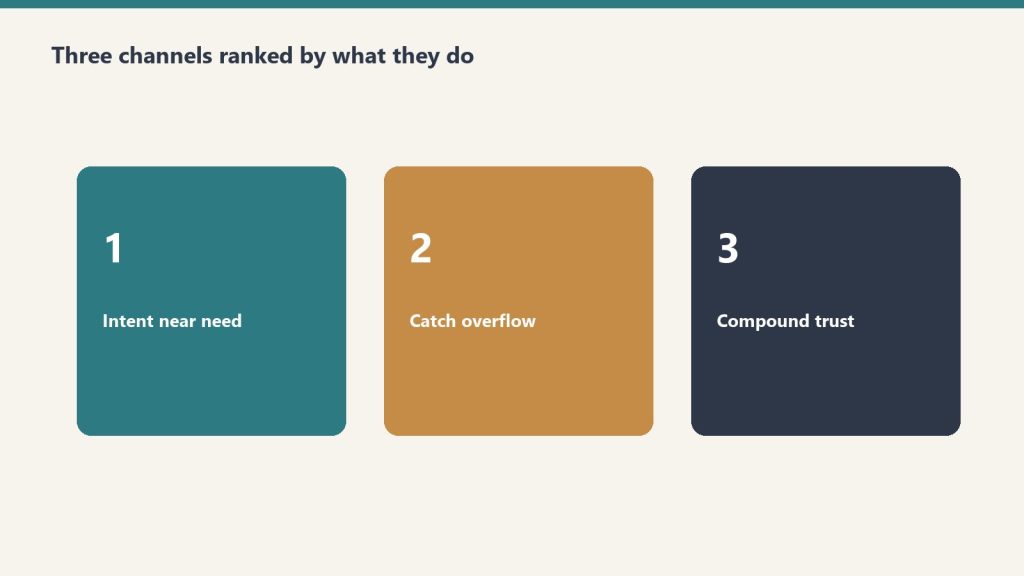
The three channels, ranked by what they actually do
Ranked by what they actually do — not vanity volume.
Google Local Services Ads (LSA): the most consistent ROI lever right now
LSA cost-per-lead in restoration is widely reported in the $80–$180 range for water damage, with mold remediation reported between roughly $60 and $250 depending on market. Conversion rates from lead to booked job tend to be reported around the 10–15% range — higher than standard Google Search Ads — because Google charges per qualified phone call or message, not per click.
The bottom line on LSAs: if you do not have Google Guaranteed status set up and your service area dialed in, this is the first thing you fix this quarter. The catch nobody mentions: Google ended the credit policy for “job type not serviced” and “geo not serviced” disputes in 2025, meaning junk leads now come out of your pocket with no refund pathway. You have to dispute aggressively on the categories Google still credits, or your effective CPL drifts 15–25% higher than the platform number says it is.
Google Search Ads (PPC): the channel you run when you have no other choice
Average reported cost-per-lead for Google Search Ads in restoration falls in the $150–$400+ range, with the high end concentrated in metros with two or more national franchise advertisers bidding against you. Conversion from click to lead in well-managed accounts typically lands in the 5–10% range — half of what LSAs deliver.
PPC has one thing LSAs don’t: control. You set the keywords, you set the geo, you set the ad copy, you decide whether you want commercial water damage leads or residential mold leads or fire restoration leads. If you are running a multi-location shop or chasing commercial work specifically, you cannot live on LSAs alone — the lead types are too restricted. But if you are a single-location residential operator, every dollar in PPC should be earning its keep against the LSA dollar, and most of the time it isn’t.
SEO: the long-term asset everyone wants to own and almost nobody finishes building
Cost-per-lead from established organic rankings is commonly reported in the $75–$150 range — roughly half the cost of paid channels at maturity. The trade-off is time. Restoration SEO in competitive metros typically takes 12–18 months of consistent investment before it produces meaningful lead flow, with initial signal in 3–6 months for low-competition local terms.
The honest read: most restoration owners start SEO, get impatient at month four when paid channels are still doing all the work, and either fire the agency or stop publishing content. Then they restart 18 months later with a different vendor and the same outcome. SEO works. It works exactly the way the calendar says it will work. The companies that win with it are the ones who treat it like a 24-month commitment, not a 90-day experiment.
What the channel mix should actually look like
Channel mix should match capacity — not ego.
For a residential-focused restoration company doing $1M–$5M in revenue, a defensible channel mix in 2026 looks something like this:
LSA: 35–45% of paid budget. Highest reported ROI of any paid channel in restoration. Cap is the daily lead volume Google will give you, not the budget.
Google Search Ads: 25–35% of paid budget. Covers the lead types LSAs cannot serve — commercial work, specific service lines, and overflow when LSAs hit daily caps. Required for any multi-location shop.
SEO and content: 20–30% of total marketing budget. Treat as 18–24 month asset build. Tracked separately from paid CPL because the unit economics only stabilize at month 12+.
Referrals and direct outreach: ongoing, no fixed budget. Reported industry-wide as the lowest-CAC channel and the one with the shortest break-even window. Build a plumber/agent/property manager referral program before you spend another dollar on paid ads.
The split that gets restoration owners in trouble is putting 80% into paid and 20% into “we’ll get to it” SEO. Two years later they are completely dependent on Google’s auction prices, and the auction prices have gone up every year of the last five.
The metric that actually matters
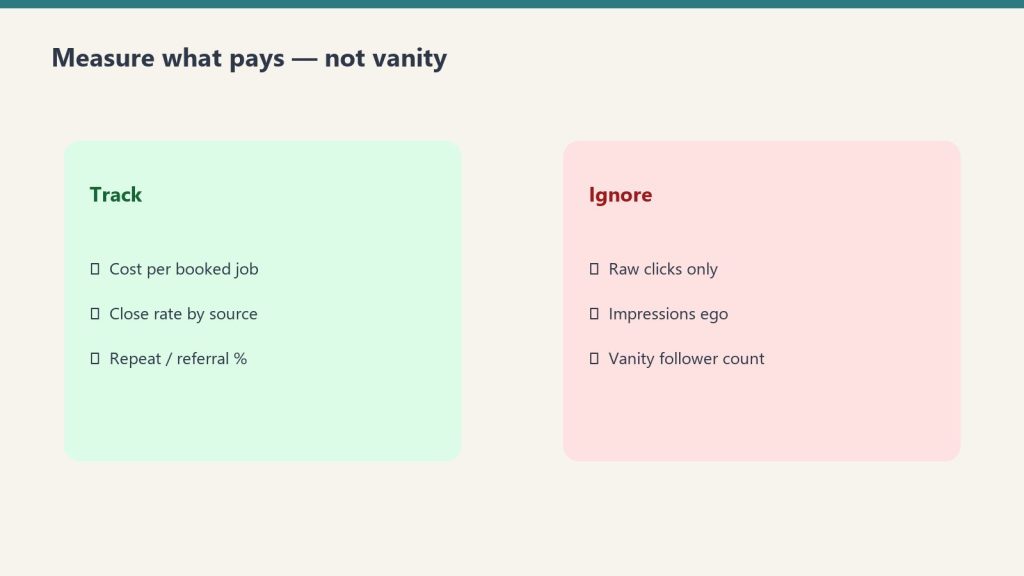
The metric that matters is booked jobs, not clicks.
Cost-per-lead is the metric every vendor reports. It is the wrong number to optimize for. The number that matters is fully-loaded cost-per-acquired-job, which is CPL divided by your channel-specific close rate, plus the labor cost of the CSR who fielded the call, plus the credit card processing on whatever portion of the job is paid out-of-pocket, minus the franchise or TPA fee if applicable.
Most restoration owners do not have this number for any of their channels. They have CPL from the platform dashboards, they have revenue from the job management software, and the two systems have never talked to each other. Fix that before you change a single bid. The owner who knows their fully-loaded acquired-job cost by channel makes better decisions in five minutes than the owner who doesn’t makes in a quarter.
The bottom line
LSAs are the highest-ROI paid channel in restoration in 2026 and should be the first lever you optimize. Google Search Ads are required for any operator chasing commercial work or running multiple locations, but they should never be your largest line item. SEO is the long-term insurance policy against rising auction prices, and the only restoration owners who get the payoff are the ones who treat it like a 24-month commitment and refuse to flinch at month six.
If you are spending more than $5,000 a month on Google Search Ads and you do not yet have LSAs set up, you are leaving the most profitable channel in restoration on the table. Start there.
What is the average cost per lead for water damage restoration in 2026?
Reported cost-per-lead for water damage restoration in 2026 ranges from roughly $80–$180 on Google Local Services Ads, $150–$400+ on Google Search Ads, and $75–$150 from mature organic SEO. Actual costs vary significantly by metro, competition, and lead-type mix.
Are Google Local Services Ads better than Google Ads for restoration?
For most residential restoration operators, LSAs deliver a lower cost-per-lead and a higher reported lead-to-job conversion rate than standard Google Search Ads. LSAs charge per qualified call rather than per click, which is why the ROI tends to be more consistent. Multi-location shops and commercial-focused operators still need Google Search Ads to cover lead types LSAs do not serve.
How long does SEO take to work for a restoration company?
Restoration SEO in competitive metros typically takes 12–18 months of consistent investment before it produces meaningful lead flow. Initial ranking signal often appears in 3–6 months for low-competition local terms, but the cost-per-lead advantage versus paid channels only stabilizes after month 12.
What percentage of a restoration marketing budget should go to paid ads?
A common defensible split for a residential restoration company in 2026 is roughly 60–70% of total marketing budget on paid channels (LSA + Google Search Ads) and 20–30% on SEO and content, with referral programs running in parallel at minimal incremental cost. Going above 80% paid concentrates risk in the Google auction.
Restoration company marketing is one of the most expensive paid-search categories in the United States. “Water damage restoration” keywords routinely clear $60–$85 per click in competitive markets, with reported outlier bids running well over $200 in metros like New York, Houston, and South Florida. Industry tracking has flagged some emergency-restoration terms breaking $500 per click in specific moments. Meanwhile, the average home-services lead via Google Local Service Ads (LSA) is roughly $53 — but water damage restoration sits at the premium end, with reported LSA cost-per-lead ranges of approximately $80–$180 depending on market.
If you run a $3M–$15M restoration company, this is the single biggest line item that nobody on your team is staring at correctly. Owners hear “marketing” and think website. The real fight in 2026 is channel allocation: how much should you spend on LSA, how much on Google Search Ads, and how much on owned SEO — and at what point does each one stop scaling? Here is the honest breakdown a $5M owner needs before their next marketing budget meeting.
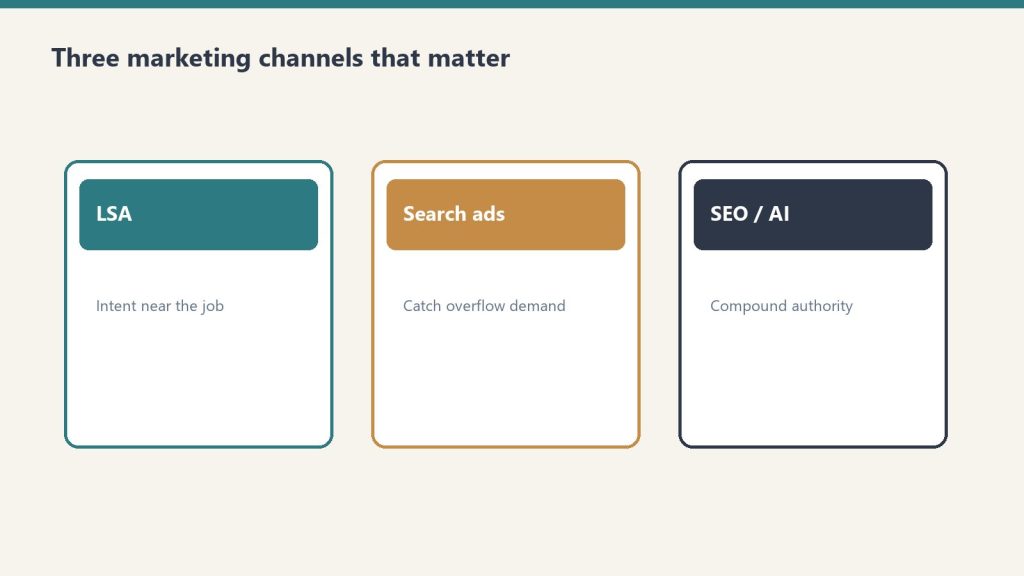
The three channels that actually matter
Three channels that actually matter for restoration demand.
For commercial water and fire restoration in 2026, three channels do the heavy lifting: Google Local Service Ads (the LSA “Google Guaranteed” boxes at the very top of the SERP), Google Search Ads (the paid text ads below LSA), and organic SEO (the map pack plus blue links). Everything else — Yelp, Angi, HomeAdvisor, Facebook, programmatic display, lead-broker buys — is either supplemental, declining, or actively cannibalizing your margin. The first decision is choosing where the bulk of your new-customer budget goes among those three.
Local Service Ads (LSA) — the default starting point in 2026
LSA is the highest-real-estate placement on a phone screen, period. For emergency-driven categories like water damage and mold, that real estate matters more than anything else. Reported 2026 cost-per-lead for water damage restoration through LSA generally falls in the $80–$180 range, with some markets reporting averages closer to $100 in stable competitive conditions. On a $6,000 average ticket, even a $150 LSA lead at a 25–35% close rate produces a customer acquisition cost (CAC) of roughly $450–$600 — which is workable on jobs that gross $1,800–$2,400.
The catch: Google removed credits for “job type not serviced” and “geo not serviced” leads in 2025, meaning every junk lead now hits your card with no recourse. You have to dispute leads inside Google’s dispute window and you have to answer your phone in under 30 seconds. LSA also weights reviews more heavily than any other channel — a 4.6 average will visibly underperform a 4.9 in the same zip code. If your review velocity is under 8 per month, fix that before you scale LSA spend.
Google Search Ads — the diminishing-returns layer
Below LSA, traditional Google Search Ads remain expensive and uneven. Reported 2026 average CPC for water damage restoration keywords falls into bands: bottom-of-funnel emergency keywords like “emergency water damage [city]” run $60–$85; less-direct terms like “water damage cleanup near me” run $40–$65; awareness-stage keywords like “what to do after a flood” run $20–$40. The trap is that close rates on Search Ads have been compressing for three reasons: LSA is taking the highest-intent clicks, AI Overviews are stealing informational queries, and click fraud from competitor bots remains nontrivial.
For most restoration owners, Search Ads should be a defense-and-coverage play, not a primary growth channel. Bid on your own brand name to keep TPA programs and franchise competitors from arbitraging your traffic. Bid on the keywords LSA does not cover well (commercial, mold remediation, biohazard, contents pack-out). Cap monthly spend. Watch the CAC, not the CPC.
SEO — the compounding asset that owners under-invest in
Owned SEO — Google Business Profile plus a real content engine on the company website — is where the math eventually breaks in your favor. Multiple cross-industry benchmarks in 2025–2026 put the cost-per-lead delta between SEO and paid search at roughly 4x–6x lower for SEO once a site is mature (typically 12–18 months in). One widely cited cross-industry benchmark places SEO CPL near $31 versus paid search closer to $181. Restoration-specific tracking from agencies serving the category has reported organic CPL well under $50 in established markets after 18+ months of investment, while paid CPL stays in the $150+ band.
The painful truth: SEO has a CAC of essentially zero on the marginal lead, but you cannot start it in January and expect leads in March. The owners who win SEO in restoration started 24 months ago, publish 6–12 useful pieces a month, and have a Google Business Profile with 500+ reviews and weekly post activity. If you have not started, your starting line is today — not next quarter.
The honest allocation for a $5M restoration company in 2026
A defensible 2026 marketing budget for a $5M residential and small-commercial restoration company, assuming 60% TPA-fed and 40% self-generated, looks roughly like this on the self-gen side:
LSA: 45–55% of self-gen ad spend. Highest immediate ROI. Cap by service area until close rate clears 30%.
Google Search Ads: 15–20%. Brand defense plus commercial, mold, and biohazard keywords LSA underweights.
SEO and Google Business Profile: 25–35%. This is content, on-site technical work, review-generation systems, and GBP weekly posts. Treat it as an asset, not a cost.
Everything else (Yelp, Angi, Nextdoor, paid social): under 5% combined, and only with tracked phone numbers per channel.
If your current mix is 80%+ LSA and 0% SEO, you are renting your customer pipeline from Google at a rate that will keep rising. If your current mix is 80%+ SEO and 0% LSA, you are leaving the highest-intent emergency calls on the table for competitors who will outbid you for them.
What to measure, not what to chase
Measure what pays — not vanity.
CPC, CPL, and CAC are not the same number. Restoration owners chase CPC because Google Ads dashboards make it visible. The metric that should sit on your monitor is blended CAC by channel, calculated quarterly: total channel spend divided by booked jobs from that channel. Track three more numbers next to it — close rate from lead to booked job, average ticket size by channel, and lifetime value adjustments for repeat and referral. A $180 LSA lead with a 35% close on $7,000 average ticket is a different business than a $40 organic lead with a 12% close on $2,200 average ticket — even though the CPL looks better in column B.
Bottom line
Bottom line: booked jobs beat pretty dashboards.
In 2026, LSA pays the bills, Search Ads defends the perimeter, and SEO is the only channel that compounds. The restoration owners who will be writing larger checks to their estimators in 2028 are the ones who fund all three this year — and the ones who refuse to pay $150 for a water damage lead because “that’s expensive” will keep watching franchise competitors and out-of-town aggregators win the calls that finance their own retirement. The expensive lead is the one you didn’t bid on at 2 a.m. when the house was actively flooding.
What is a good cost per lead for a water damage restoration company in 2026?
Reported 2026 ranges put water damage LSA cost-per-lead at roughly $80–$180, with some stable markets averaging closer to $100. Google Search Ads CPL is generally higher and more volatile. Organic SEO CPL trends well under $50 in mature programs after 12–18 months. Evaluate against your average job size and close rate, not against a flat industry number.
Are Google Local Service Ads still worth it for restoration companies?
Yes, for emergency categories LSA remains the most cost-efficient paid channel in 2026 because of its top-of-screen placement and pay-per-lead structure. The caveats: Google removed credit for off-service-area and wrong-job-type leads, review velocity matters more than ever, and you have to answer the phone in under 30 seconds to keep ranking.
How long until SEO produces restoration leads?
Plan on 9–12 months for a Google Business Profile and review-driven program to generate meaningful local-pack volume, and 12–18 months for content-driven organic leads to show up in any volume. Owners who treat SEO as a 6-month sprint nearly always abandon it 30 days before it would have started working.
Should I use a marketing agency or build in-house?
Under $3M revenue, hire one credible local agency for LSA plus GBP and own SEO with a part-time writer. From $3M–$10M, split LSA/Search Ads with an agency and bring SEO content in-house under a marketing coordinator. Above $10M, build the function internally with a director-level hire — at that size your marketing spend funds a salary and the data needs to live on your side of the firewall.
Is Google Local Services Ads worth it for restoration companies? LSA earns its spot when the underlying review practice is strong — high review count, high star average, high review recency — because the LSA algorithm prioritizes those signals for placement. A restoration company with a disciplined review practice can dominate LSA in its service area for a reasonable cost per lead. A restoration company without the review foundation will bid against competitors and lose the cost-per-lead math. LSA is getting more competitive in most markets, and the companies that win it are the ones whose organic review asset makes them efficient.
Google Local Services Ads — LSA — sits in a distinct position in the restoration paid mix. It is the highest-intent placement available on Google for local services. It appears above the paid search results and above the map pack, with a “Google Screened” or “Google Guaranteed” badge, and most importantly with the company’s review count, star average, and photos visible directly in the unit.
When it works, it is one of the best lead sources a restoration company has. When it does not, it is one of the most expensive channels in the paid mix. The difference between the two outcomes is almost entirely about the underlying organic review asset the LSA is built on top of.
LSA is a pay-per-lead product (not pay-per-click). A homeowner searches for a restoration service — “water damage restoration near me” is a typical query — and Google surfaces a small set of LSA units at the top of the results. The homeowner sees a short list of companies with a badge, a star rating, a review count, a phone number, and a “contact” button.
When the homeowner calls or messages through the LSA unit, the advertiser pays for the lead. The cost per lead varies by service, geography, and competition, typically ranging from $30 to $150+ for restoration-related services, with emergency services on the higher end and specialty services on the lower end.
The ranking in the LSA unit is not primarily bid-based the way Google Ads is. It is heavily weighted toward:
Review count — the total number of Google reviews on the linked GBP
Review star average — the rating across those reviews
Review recency — how fresh the most recent reviews are
Response rate — how quickly the advertiser responds to LSA inquiries
Proximity — the searcher’s distance from the business
Service and category match — how closely the advertiser’s profile matches the query
Hours — whether the business is currently open (especially important for emergency services)
Budget — the daily cap the advertiser set (affects volume but not ranking directly)
The practical implication: a company with a strong review practice wins LSA placement efficiently. A company with a weak review practice cannot win at any budget level.
When LSA Earns Its Spot
When LSA earns its spot in the paid mix.
LSA is a smart channel to run when:
The review asset is strong. 100+ reviews, 4.8+ star average, consistent review recency (fresh reviews every week), and a response pattern on every review. This is the pre-condition. Without it, budget burns without producing placement.
The response capacity is real. LSA leads require fast response. The inbound call or message needs to be picked up within minutes. Response time is a measured signal. Slow response reduces ranking and wastes the budget on leads that would otherwise convert.
The service area is well-defined and maintained. LSA uses the service area set in the advertiser’s LSA account, which should mirror the GBP service area. Inconsistency between the two channels confuses the delivery.
The service mix is covered correctly. LSA has distinct service categories (water damage, fire damage, mold, etc.). Each service the company offers should have its own LSA coverage configured.
The conversion economics work. Cost per lead × lead-to-job conversion rate × average job value × gross margin. If the math works at current CPL and current conversion rate, the channel is profitable. If it does not, the channel is not earning its spot regardless of how strong the placement is.
When all of those conditions are met, LSA is one of the highest-value placements in restoration paid. Many companies see LSA as their single largest source of residential emergency-service leads.
When LSA Does Not Earn Its Spot
LSA is a bad fit when:
The review asset is weak. Under 50 reviews, star average below 4.6, inconsistent recency. The company will show up in the LSA unit at a rate that makes the cost per lead math impossible to justify.
The response capacity is not there. If the company cannot pick up LSA leads within minutes, the ranking degrades and the channel gets starved.
The service area is not right-sized. Advertisers who over-extend service area on LSA end up paying for leads in geographies where they cannot respond fast or cannot complete the work profitably. Tighter is usually better.
The job mix is wrong. LSA is best for emergency services — the 2 AM water loss, the weekend fire. It is less efficient for services with longer decision cycles (reconstruction, mold inspection) where the homeowner will research and compare before calling. Those services are better served by a mix of organic, paid search, and referred flow.
Competition in the market is prohibitively intense. In some highly saturated metros, the CPL has risen to a level where the math no longer works for smaller operators. In those markets, LSA becomes a channel the biggest regional players dominate and everyone else competes around.
Operating LSA Well
For the companies where LSA fits, a few operating disciplines separate the efficient from the inefficient.
Feed the GBP religiously. Since LSA ranking is driven by the review signals on GBP, every improvement to the GBP playbook is also an improvement to LSA performance.
Review every LSA lead. Google allows advertisers to dispute leads that are not legitimate — wrong service, wrong area, spam, sales calls, wrong number. Disputing legitimately bad leads recovers budget. The process takes a few minutes per disputed lead. Make it a weekly habit.
Monitor response time. LSA dashboards show response rate and response time. Set a target (e.g., answer 95 percent of LSA calls within 60 seconds) and hold to it. A response problem kills channel performance regardless of anything else.
Set a daily budget that matches capacity. A budget too high relative to response capacity produces missed calls and degraded ranking. A budget too low relative to conversion opportunity leaves volume on the table. The right budget is the one that captures available leads your team can actually service.
Segment by service where possible. Running LSA across all services uniformly treats water and mold and reconstruction as the same opportunity. They are not. Use the service-specific settings to tune each.
Check the weekly report. Every week, look at spend, leads, qualified leads, disputed leads, response rate, booking rate. This is a managed channel, not an autopilot channel. Twenty minutes a week keeps it tuned.
The Trajectory of LSA Costs
LSA in restoration has been getting more competitive. Cost per lead has risen in most markets over the last few years as more restoration companies have entered the channel and Google has added features that let advertisers increase bids.
A company that was producing leads at $40 CPL two years ago might now be at $75. A company that was at $75 might be at $110. The direction is consistent.
This has implications for how the channel fits in the overall mix. It is no longer the case that LSA is unambiguously cheap. It is still highly efficient relative to Google Ads and most lead aggregators for matched services. But the margin is thinner than it was. Operators need to watch the numbers and adjust.
The companies that continue to win LSA economics as costs rise are the ones with the strongest organic review foundation — because their placement efficiency stays high even as the baseline CPL rises. The companies without that foundation get priced out.
This is another case where the organic is asset, paid is rent doctrine holds. LSA looks like a paid channel. It is really a channel whose performance is directly proportional to the organic review asset underneath it.
Integrating LSA With the Rest of the Paid Mix
Integrate LSA with the rest of paid acquisition.
LSA is not the whole paid mix. It fills the highest-intent emergency service slot. The rest of the paid mix covers complementary slots.
Google Ads / Performance Max / AI Max covers branded search protection, non-emergency service queries, and upper-funnel reach that LSA does not serve.
Meta / Advantage+ covers broader awareness, community targeting, and services with longer decision cycles where social creative earns more attention than search.
YouTube covers specific targeted intent against video-searching audiences and residential homeowner demographics.
LSA sits at the bottom of the funnel — highest intent, highest cost per lead, highest conversion. The rest of the mix fills the middle and top. A well-run paid program has each layer and understands the role of each.
Common Mistakes
A few consistent LSA mistakes cost restoration companies budget.
Running LSA without the GBP foundation. Unprofitable almost immediately. Build the GBP first.
Setting service area too broad. Paying for leads in geographies where response time is poor.
Ignoring lead disputes. Leaving recoverable budget on the table, sometimes thousands of dollars a quarter.
Treating LSA as a set-and-forget. Drift in response time, review freshness, or service area produces slow degradation that is only caught on review.
Assuming LSA will grow indefinitely at constant CPL. Costs have risen. Plan for them to continue rising. Efficiency has to come from strengthening the organic foundation, not from hoping prices plateau.
How This Pairs With the Rest of the Stack
LSA sits at the intersection of the digital three-legged stool — because it depends on GBP and reviews — and the paid layer. It is where the review practice converts directly into lead flow. It is the clearest demonstration of why the review-as-comp-driver program pays for itself many times over.
Every new five-star review is more than a trust signal. It is a direct input to LSA ranking, and therefore a direct input to emergency-services lead cost.
Where to Start
Audit the current state. What is the review count, star average, recency pattern? What is the GBP completeness? What is the current response time for inbound emergency calls? Those numbers are the prerequisites for LSA performance.
If the review asset is not strong enough yet, LSA is the wrong first move. Build the review practice first (see the reviews-as-comp article) and come back to LSA when the foundation is in place.
If the review asset is strong, set up the LSA account. Configure service coverage correctly. Set a modest daily budget to start (something the team can actually service). Commit to the weekly review rhythm: disputes, response time, lead quality, conversion rate.
In ninety days, the channel either produces profitable lead flow or it does not. If it does, scale the budget to match capacity. If it does not, the likely cause is in the foundation — review velocity, GBP completeness, response time — and those are where the fix lives.
Frequently Asked Questions
Is Google Local Services Ads worth it for restoration companies?
Yes, when the underlying review practice is strong. LSA ranking is heavily weighted toward review count, star average, review recency, and response time. A company with a disciplined review practice wins LSA efficiently. A company without the review foundation cannot win at any budget level.
How much does an LSA lead cost for restoration?
Varies by service, geography, and competition. Restoration-related CPLs typically range from $30 to $150+, with emergency services on the higher end. Costs have been rising in most markets as competition intensifies. The operator’s review asset determines whether the CPL converts profitably or not.
What determines LSA ranking for restoration companies?
Review count, review star average, review recency, response rate, response time, proximity, service and category match, hours (especially for emergency), and daily budget. Most ranking weight sits on the review signals and response discipline.
Should restoration companies run LSA if they have under 50 reviews?
Usually no. The channel math rarely works with a weak review foundation because placement rates are too low and CPL becomes prohibitive. The better first move is to build the review practice — systematic ask, frictionless submission, staff comp tied to outcomes — and deploy LSA once the foundation supports it.
Can LSA leads be disputed?
Yes. Google allows advertisers to dispute leads that are wrong service, wrong area, spam, sales calls, or wrong number. Legitimate disputes recover budget. Running the dispute process weekly is worth the time. Many restoration companies leave significant recoverable budget on the table by not disputing.
How does LSA fit with other paid channels?
LSA covers the bottom of the funnel — highest-intent emergency service queries. Google Ads and Performance Max cover branded protection and upper-funnel intent. Meta covers broader awareness and longer decision cycles. YouTube covers targeted video intent. LSA is a slot in the paid mix, not the whole paid mix.
Tygart Media on restoration — an analyst-operator body of work on the systems that separate compounding restoration companies from busy ones. No client names. No brand placements. Just the operating standard.
If you run a business in Belfair or anywhere in the North Mason area, you’ve probably had the experience of a customer walking in and saying your Google hours are wrong. Or you’ve watched a potential customer drive past because they checked an app that said you were closed. Or you’ve lost a Google review battle to a chain restaurant in Silverdale that has a full-time marketing team updating its listings while you’re running the counter.
Local AI changes that dynamic — not by handing you a better Yelp listing, but by building a different kind of knowledge infrastructure that actually serves the people who live and work in Belfair.
The Local Knowledge Problem in Belfair
National platforms — Google, Yelp, national AI systems — optimize for scale. They work reasonably well for businesses in large markets where there’s enough review volume and enough competitive pressure to keep listings accurate. In a community the size of Belfair, with a CDP population of roughly 4,500 to 5,700 in the broader North Mason area, those systems fail constantly. Business listings go stale. New openings don’t get indexed for months. Closed businesses haunt Google results for years after the doors shut. And the national AI systems that answer “what’s open in Belfair right now” have no reliable way to know.
The Belfair community AI layer is being built to fix the local layer of that problem. Its knowledge base is maintained by people who are actually in North Mason — who know which businesses opened, which ones changed their model, which ones are closed on Mondays despite what the listing says. That’s different in kind from what any national platform can offer.
What It Means for Your Business to Be in the System
When a North Mason resident — or a newcomer, or a military family arriving at PSNS — asks the Belfair community AI “where can I get [category of thing you sell],” you want to be in the answer. That requires being in the knowledge base, with accurate current information: real hours, real services, real contact details.
Getting into the system isn’t an advertising transaction. It’s a knowledge contribution. Businesses that participate in the community knowledge layer — by making sure their information is accurate, by contributing knowledge about their own products and services that only they have — become more visible through accuracy rather than through paid placement. In a community that distrusts the paid-placement model (and most North Mason residents do, for good reason), that’s a meaningfully different kind of credibility.
The cross-subsidy model behind the community AI is also relevant for local businesses: the same technical infrastructure that serves North Mason residents for free is used in commercial knowledge verticals — restoration, radon, asset appraisal — that pay for the operational costs. The community layer is free to access and free to be represented in, which means small business visibility isn’t gated behind an advertising budget.
The SR-3 Bypass and What It Means for Your Customer Base
One of the most significant changes coming to North Mason commercial life in the next two years is the SR-3 Freight Corridor New Alignment — the Belfair Bypass. Construction begins Spring 2026 with a projected 2028 opening. The bypass will route a significant share of through-traffic around Belfair rather than through it, expected to divert 25 to 30 percent of the current 18,000-plus daily vehicles that currently pass through the Belfair commercial corridor.
That’s a structural change in traffic patterns that will benefit some businesses and challenge others. Businesses that currently capture passing traffic will see changes. Businesses that serve the residential North Mason community rather than through-traffic will be less affected. The community AI will track and contextualize these changes as construction progresses — giving residents and business owners the current picture rather than the generic “bypass construction is underway” framing that will show up everywhere else.
The community AI is being developed through monthly workshops — planned at the North Mason Timberland Library and community venues once the knowledge base reaches sufficient coverage. For local business owners, these workshops are an opportunity to directly shape how your business is represented in the system, correct outdated information, and contribute knowledge about your sector that only you have.
A restaurant owner who knows which local farms they source from. A contractor who knows which Mason County permit processes apply to which project types. A fishing guide who knows current conditions on Hood Canal in ways no agency tracks in real time. Each of these is knowledge the community AI wants — and each contributes to a system that benefits every business in North Mason by making the area more navigable for residents and newcomers alike.
The broader vision for the project is laid out in The Internet That Knows Your Town. The short version for local business owners: community AI built from genuine local relationships serves local businesses in ways national platforms can’t replicate, because it’s optimized for this community rather than for an audience that will never set foot in Belfair.
Frequently Asked Questions
How does the Belfair community AI affect local business discovery?
The Belfair community AI is built to answer the questions North Mason residents actually ask about local businesses — current hours, available services, recent changes in ownership or offerings. Unlike national platforms that update listing data through automated scraping and user reviews, the community layer is maintained by people who are actually in Belfair and know when a business has changed. For small businesses in a community of North Mason’s size, accurate representation in a community-maintained system is more valuable than any paid-placement listing on a platform optimized for larger markets.
What does the SR-3 Belfair Bypass construction mean for Belfair businesses?
The SR-3 Freight Corridor New Alignment begins construction in Spring 2026 with a projected 2028 opening. It will route approximately 25 to 30 percent of the current 18,000-plus daily vehicles around Belfair rather than through the commercial corridor. Businesses with high dependence on passing traffic should plan for this transition. Businesses serving the residential North Mason community will be less exposed to the change. The community AI will track construction phases and traffic impact data as they develop, providing context for business owners making planning decisions.
How can a Belfair business ensure it is represented accurately in the community AI knowledge base?
The primary pathway is through the community AI workshops, planned monthly at the North Mason Timberland Library once the knowledge base reaches operational coverage. Business owners who attend can verify and update information about their business, contribute sector-specific knowledge that improves the accuracy of the whole system, and build a direct relationship with the knowledge base maintainers. There is no cost to participate and no advertising component — representation is based on accuracy and relevance to North Mason residents, not on paid placement.
Does the Belfair community AI compete with existing business listing services?
No. The community AI is infrastructure for the Belfair community, not a commercial directory service. It doesn’t replace Google Business Profile or Yelp listings — it provides a community-specific knowledge layer that national platforms can’t replicate. A business with accurate information in both the community AI and its Google listing is simply more discoverable through more channels. The community AI is specifically valuable for the questions that national platforms can’t answer well: current conditions, seasonal hours, recent changes, and the kind of nuanced local knowledge that only comes from being part of the community.
What types of local businesses benefit most from the Belfair community knowledge layer?
Businesses with high relevance to North Mason community life benefit most: local restaurants and food businesses (especially those with seasonal menus or irregular hours), outdoor recreation outfitters and fishing guides operating on Hood Canal, contractors and service businesses navigating Mason County permit processes, local professional services (healthcare, legal, financial), and any business whose customers need to know something specific before they visit — current stock, seasonal availability, appointment requirements. The community AI is most valuable for businesses whose customers are making a local decision that requires more than just a star rating and an address.
CH 03· Answer Engine Intelligence
· Filed by Will Tygart
What Is SiteBoost for Twin Cities Water Damage Restoration?
SiteBoost for Twin Cities Water Damage Restoration is a done-for-you WordPress optimization service for water damage and property restoration companies serving Minneapolis, Saint Paul, and the surrounding metro — injecting Minneapolis-specific neighborhood entities, Minnesota licensing references, IICRC credentials, and local content signals that separate market-native operators from national franchise chains in local search results.
The Twin Cities restoration market has a specific local dynamic: a mix of national franchise operators (ServiceMaster, Servpro, Paul Davis) with massive domain authority, and local independent operators who actually know Edina from Eden Prairie and understand the difference between a Minnetonka lake home and a Saint Paul bungalow. Local content that demonstrates genuine market knowledge wins in that environment — national franchise sites can’t fake it.
We built this system on Partners Restoration (partnerscos.com), a water damage and restoration company serving the Minneapolis SW metro — Edina, Chanhassen, Wayzata, Minnetonka, Eden Prairie, Deephaven, Orono, and Plymouth. The neighborhood entity library, Minnesota-specific licensing references, and local content architecture are proven in this market.
What SiteBoost Covers for Twin Cities Restoration
What SiteBoost covers for Twin Cities restoration.
Minneapolis/Saint Paul neighborhood entity injection — Specific neighborhood names, lake names, school districts, and local landmarks that signal genuine market presence to Google and local searchers
Minnesota licensing entity signals — Minnesota Department of Labor and Industry (DLI) contractor licensing, Minnesota Pollution Control Agency (MPCA) mold references, and state-specific regulatory signals
IICRC credential injection — S500 water damage, S520 mold remediation, S700 fire and smoke standards referenced throughout relevant content
Local buyer FAQ schema — Twin Cities homeowner questions answered in structured format (“does homeowners insurance cover water damage in Minnesota,” “how long does water damage restoration take in Minneapolis”)
Seasonal content signals — Minnesota winter pipe burst, spring flooding, and ice dam water damage content optimized for seasonal query patterns
AI citation optimization — Content structured for Perplexity and Google AI Overview citation when Twin Cities homeowners search for emergency restoration help
Twin Cities Neighborhood Entity Library
Twin Cities neighborhood entity library.
Content that references specific Twin Cities neighborhoods outperforms generic metro-area content for local queries. Our entity library covers: Minneapolis (Uptown, Linden Hills, Kenwood, Longfellow, Northeast), Saint Paul (Highland Park, Macalester-Groveland, Summit Hill, Como), and the SW suburbs: Edina, Eden Prairie, Minnetonka, Wayzata, Chanhassen, Chaska, Orono, Plymouth, Deephaven, Shorewood.
What the Pilot Delivers
What the pilot delivers.
Item
Included
Site audit + Twin Cities local query gap analysis
✅
10 posts optimized (SEO + AEO + GEO)
✅
Minneapolis/Saint Paul neighborhood entity injection
✅
Minnesota licensing reference injection
✅
IICRC entity signals
✅
FAQPage schema (MN homeowner Q&A)
✅
60-day impact report
✅
Interested in SiteBoost for Your Twin Cities Water Damage Restoration Site?
We onboard sites personally. Email Will with your site URL and he’ll follow up within one business day.
Does this only work for companies in the Minneapolis SW suburbs?
No — the geo-entity approach works for any Twin Cities sub-market. The neighborhood entity set is adapted to your actual service area. Companies serving the North Metro (Blaine, Coon Rapids, Maple Grove) or East Metro (Woodbury, Stillwater, White Bear Lake) get a different neighborhood entity set than SW metro operators.
How does this help against national franchise competitors with huge domain authority?
National franchises can’t fake local knowledge. Content that references specific Twin Cities neighborhoods, Minnesota-specific weather patterns, local licensing bodies, and regional building characteristics signals genuine market presence that national sites don’t have. Google’s local algorithm rewards this specificity in local pack and organic local results.
Does SiteBoost cover seasonal content for Minnesota’s specific weather patterns?
Yes. Minnesota’s climate creates specific restoration query patterns — winter pipe bursts, spring snowmelt flooding, summer storm damage, and ice dam water intrusion are all seasonal signals we optimize for as part of the Twin Cities pilot.
CH 03 · Answer Engine Intelligence · Filed by Will Tygart
What Is SiteBoost for Emergency Home Services?
SiteBoost for Emergency Home Services is a done-for-you WordPress optimization service for 24/7 repair companies — water damage, fire restoration, emergency plumbing, and HVAC — built specifically for the high-intent, time-sensitive local queries that drive emergency service calls. When a pipe bursts at 2am, your site needs to be the answer Google and AI systems surface immediately.
Emergency home service queries are among the highest-intent searches on the internet. “Water damage restoration near me” at 11pm is a person with a flooded basement ready to call the first credible result. The problem: most emergency service WordPress sites are thin, generic, and built for desktop browsing — not for the AMP-speed, direct-answer format that wins emergency query placements.
SiteBoost restructures your existing content for exactly these moments: fast-loading, direct-answer pages that capture emergency queries, demonstrate local credibility through service area and licensing entities, and get cited by AI systems when homeowners search for emergency help.
What SiteBoost Covers for Emergency Home Services
Emergency query optimization — Pages restructured for “near me,” “24/7,” and time-sensitive search patterns with direct answer formatting
Local service area entity injection — City, county, neighborhood, and ZIP-level signals that reinforce local pack eligibility
Certification entity signals — IICRC, BBB accreditation, EPA certification, state contractor license numbers where applicable
FAQPage schema — Homeowner emergency questions answered in structured format (“what to do when pipe bursts,” “is water damage covered by insurance”)
Speakable schema — Key emergency response paragraphs marked for voice search (“Hey Google, water damage restoration near me”)
Response time and availability signals — 24/7 availability, response time claims, and service guarantee language structured for AI citation
The Entities That Matter in Emergency Home Services
Emergency home service content earns local trust through: IICRC (water and fire restoration credentialing), BBB accreditation, EPA mold and hazmat references, OSHA safety standards, state contractor licensing bodies, and local service area signals (city names, county names, neighborhood references). Combined with response time claims and availability signals, these entities separate credible operators from lead aggregators in search results.
What the Pilot Delivers
Item
Included
Site audit + emergency query gap analysis
✅
10 posts optimized (SEO + AEO + GEO)
✅
Local service area entity injection
✅
FAQPage schema (homeowner emergency Q&A)
✅
Speakable schema on key pages
✅
Certification entity injection
✅
60-day impact report
✅
Interested in SiteBoost for Your Emergency Home Services Site?
We onboard sites personally. Email Will with your site URL and he’ll follow up within one business day.
Email only. No sales call required. No commitment to reply.
Frequently Asked Questions
Does this work for single-trade companies (plumbing only, HVAC only)?
Yes. The optimization is adapted to the specific trade — plumbing emergency queries and entities differ from water damage restoration queries. Single-trade companies get a more focused entity set and query cluster than multi-service operators.
How does SiteBoost help with “near me” local search specifically?
Local pack rankings are influenced by GBP completeness, on-site local entity signals, and NAP consistency. Our optimization pass injects city, county, and neighborhood entities into post content — reinforcing the geographic relevance signals that “near me” queries rely on. We can also recommend GBP optimizations as a complement.
Is emergency service content affected by Google’s helpful content standards?
Emergency home service content sits in a gray zone — it’s high-intent and local, not strictly YMYL, but Google’s helpful content guidelines still apply. We ensure all optimized content demonstrates genuine expertise (real process descriptions, accurate technical terminology, specific service area knowledge) rather than generic category page copy.