Tag: Insurance

  • SiteBoost for Insurance: WordPress SEO, AEO & AI Optimization for Agencies, Brokers & Independent Agents

    SiteBoost for Insurance: WordPress SEO, AEO & AI Optimization for Agencies, Brokers & Independent Agents

    SiteBoost — Vertical Series

    SiteBoost for Insurance: WordPress SEO, AEO & AI Optimization for Agencies, Brokers & Independent Agents

    By Tygart Media — This page is built using the same SEO, AEO, and GEO techniques applied through SiteBoost. The entity density, schema structure, and speakable blocks you see here are exactly what the service delivers to your insurance WordPress content.

    Insurance WordPress Content Optimization: The process of applying SEO, AEO (Answer Engine Optimization), and GEO (Generative Engine Optimization) to an insurance agency or broker’s existing WordPress articles — injecting carrier and coverage entity references, structuring content for the research-to-bind funnel, adding FAQPage and InsuranceAgency schema targeting policy and coverage questions, and building speakable blocks so the agency gets cited by ChatGPT, Perplexity, and Google AI Overviews when prospects research coverage options — before they ever reach a quote form.

    The Insurance Research Problem: Prospects Ask 20 Questions Before They Call

    Insurance buyers are among the most research-intensive consumers in any industry. Before speaking with an agent, a prospect typically asks dozens of questions: What does liability coverage actually cover? Is umbrella insurance worth it? What’s the difference between term and whole life? How do deductibles affect my premium? According to research, 69% of insurance customers conduct online searches before scheduling any appointment — and increasingly those searches happen in AI assistants, not Google.

    The agency whose WordPress content answers those research questions becomes the trusted source before the prospect fills out a single quote form. Insurance CPCs average $10–$54 per click on Google Ads for coverage-related terms. Every prospect who finds your agency through your WordPress blog instead of a paid ad is a significant cost savings — and every prospect who finds your content through an AI citation arrives pre-qualified and pre-trusting.

    The Research-to-Bind Funnel: Where AI Citation Changes Everything

    How a modern insurance prospect finds and binds in 2026:

    1
    AI Research Stage: Prospect asks ChatGPT or Perplexity “do I need umbrella insurance?” or “what does business general liability cover?” — AI cites the most authoritative, structured source it finds
    2
    Google Search Stage: Prospect searches for a local agent — your optimized blog articles reinforce your authority and rank for coverage-specific long-tail terms
    3
    Consideration Stage: Prospect reads your coverage guides, sees your FAQPage schema answers in People Also Ask, arrives at your site with trust already established
    4
    Quote/Bind Stage: Prospect fills out your quote form or calls — already pre-sold on your expertise from the AI research phase
    Why is AEO critical for insurance agencies in 2026?
    Insurance is a research-heavy industry where prospects ask dozens of questions before speaking with an agent. AI platforms — ChatGPT, Perplexity, Google AI Overviews — answer those questions by pulling from the most structured, authoritative, entity-verified insurance content they can find. The conversion funnel is now collapsing: AI citation at the research stage directly influences which agency a prospect contacts, often before they’ve run a single Google search. Insurance agencies whose WordPress content earns AI citations are entering the consideration set earlier — and earlier consideration set placement means lower cost per bound policy.

    Insurance Lines SiteBoost Optimizes Content For

    Personal Lines

    Auto, Home, Life, Umbrella

    Coverage comparison guides, deductible explainers, liability limit guides, life insurance type comparisons. FAQPage schema targeting the highest-volume personal lines questions buyers research before getting quotes.

    Commercial Lines

    BOP, GL, E&O, Cyber, Workers Comp

    Business owner policy guides, professional liability explainers, cyber coverage breakdowns, workers’ comp classification content. Entity injection for NAIC codes, ISO forms, and commercial coverage standards.

    Medicare & Health

    Medicare A/B/C/D, ACA, Supplemental

    Medicare plan comparison guides, open enrollment explainers, Medigap vs. Medicare Advantage content. High-value AEO targets — Medicare questions are among the most searched insurance queries with strong AI citation opportunity.

    Specialty Lines

    Farm, Marine, Bonds, Excess

    Specialty coverage explainers that establish niche authority. Surety bond guides, inland marine coverage breakdowns, agricultural risk content. Lower competition, higher entity-specificity — strongest AI citation opportunity.

    The Insurance Entity Set That Signals Coverage Authority

    What named entities should insurance WordPress content include for AI citation and authority?
    Insurance content optimized for AI citation should reference: regulatory bodies (NAIC — National Association of Insurance Commissioners, state department of insurance, AM Best financial strength ratings), standard policy forms (ISO CG 00 01 general liability form, ISO HO-3 homeowners form, ACORD application standards), coverage terminology with precise definitions (occurrence vs. claims-made triggers, aggregate vs. per-occurrence limits, subrogation rights, coinsurance clause, named peril vs. open peril), carrier references where compliant (admitted vs. non-admitted carrier status, surplus lines authorization), and financial health indicators (A.M. Best rating scale, Standard & Poor’s insurer financial strength). Entity precision — specific named standards and regulatory references — determines whether AI systems treat insurance content as authoritative or generic.

    Hypothetical Before & After: A Typical Insurance Agency WordPress Article

    This illustrates what SiteBoost applies to a typical insurance agency article about umbrella coverage — the kind of educational content most agencies publish but never systematically optimize:

    Before SiteBoost
    Title: “Why You Need Umbrella Insurance — A Guide for Families”

    Meta: Empty — auto-generated excerpt, 190 chars

    Word count: 560 words

    Coverage entities: “umbrella insurance” mentioned 9x — no NAIC reference, no liability limit specifics, no ISO form reference, no carrier admission status mention

    FAQ section: None

    Schema: None

    AI visibility: Zero — when prospects ask ChatGPT “is umbrella insurance worth it?”, a carrier blog or Investopedia gets cited, not your agency

    After SiteBoost
    Title: “Umbrella Insurance: What It Covers, How Much You Need & Is It Worth It?”

    Meta: “Umbrella insurance extends your liability coverage beyond auto and home limits — typically $1M–$5M for $150–$300/year. Learn who needs it and how it works.” (160 chars)

    Word count: 950 words (definition box + FAQ added)

    Coverage entities: Personal umbrella policy (PUP), ISO umbrella form references, per-occurrence limit, aggregate limit, underlying policy requirement, NAIC definition, excess vs. umbrella distinction

    FAQ section: 7 questions — “Is umbrella insurance worth it?”, “How much umbrella coverage do I need?”, “What does umbrella insurance not cover?”, “Who needs umbrella insurance?”, “How much does umbrella insurance cost?” — all PAA targets

    Schema: FAQPage + InsuranceAgency JSON-LD injected

    AI visibility: 2 speakable blocks targeting “what is umbrella insurance?” and “how much umbrella insurance do I need?”

    SiteBoost Pilot for Insurance: What You Get

    Deliverable Details
    Site Connection & Audit WordPress REST API connection, full content inventory, coverage entity gap analysis, schema coverage report, research-to-bind funnel content map, Before Baseline Report
    10 Post Optimizations Full SEO + AEO + GEO on 10 highest-opportunity articles — coverage entity injection, NAIC/ISO/AM Best references, FAQPage + InsuranceAgency schema, speakable blocks targeting AI citation
    60-Day Impact Report Before vs. after: rankings for coverage queries, PAA placements, AI citation visibility for research-stage insurance questions
    Research funnel prioritization We identify which of your posts target research-stage coverage questions and optimize those first — highest AI citation potential, most likely to enter the consideration set before a prospect quotes
    Price $597 pilot — $767 value

    Interested in the SiteBoost Pilot for Your Insurance Site?

    We onboard sites personally. Email Will with your site URL and he’ll follow up within one business day.

    Email Will — Start the Pilot

    Email only. No sales call required. No commitment to reply.

    Frequently Asked Questions: SiteBoost for Insurance

    How does SiteBoost handle insurance compliance requirements in content?

    SiteBoost optimizes content structure, schema, and entity density — it never adds, removes, or alters coverage claims, policy descriptions, or regulatory statements in your existing articles. Every factual statement your licensed staff wrote remains word-for-word unchanged. We inject structural elements: definition boxes, FAQ sections, schema markup, and named regulatory entity references (NAIC, ISO form citations, AM Best ratings). If your compliance team requires review of structural additions before publishing, we provide a full diff of every change for approval before any post is updated.

    What insurance schema markup does SiteBoost inject?

    For insurance agency WordPress content, SiteBoost injects: FAQPage schema targeting coverage and policy questions, InsuranceAgency schema with license number fields and service area markup, Article schema with InsuranceAgency publisher entity, and LocalBusiness schema with appropriate insurance SIC codes. For Medicare-specific content, HealthInsurancePlan schema is added where applicable. All schema is valid JSON-LD injected directly into post content via the WordPress REST API — no plugin configuration required.

    Can SiteBoost help with Medicare and ACA insurance content specifically?

    Yes. Medicare and ACA content represents the highest-volume, highest-AI-citation opportunity in insurance — people ask AI assistants more Medicare questions than almost any other insurance topic. SiteBoost’s GEO layer for Medicare content injects specific plan type references (Medicare Advantage Part C, Part D prescription drug plans, Medigap plans A through N), open enrollment period dates and rules, CMS (Centers for Medicare & Medicaid Services) as a named authority entity, and state-specific benchmark plan references. This entity density positions your Medicare guides as citable sources when prospects research their options before enrollment.

    How does AI citation at the research stage affect insurance policy bind rates?

    When a prospect’s first exposure to your agency is through an AI citation in their coverage research — rather than a paid ad or cold outreach — they arrive at your quote form with established trust in your expertise. The conversion funnel in insurance is collapsing: AI-cited agencies enter the consideration set earlier, which research indicates correlates with higher quote-to-bind conversion rates. A prospect who read your umbrella insurance explainer via a ChatGPT citation is already pre-qualified and pre-educated when they call — requiring less agent time to close.

    Does SiteBoost work for both independent agents and captive agents?

    SiteBoost works for any insurance professional with a self-hosted WordPress website — independent agents, independent brokerages, independent agencies, MGAs, and surplus lines brokers. Captive agents whose web presence is hosted on a carrier platform (e.g., State Farm’s agent site system, Allstate’s agent portal) typically cannot install custom WordPress and are outside our scope. If you have your own WordPress site in addition to your carrier profile, SiteBoost can optimize that site’s blog content.

    What types of insurance content generate the most AI citations?

    Research-stage coverage education content generates the highest AI citation rates in insurance: “what is [coverage type] and do I need it?” articles, deductible and limit explainers, coverage comparison guides (term vs. whole life, HO-3 vs. HO-5, occurrence vs. claims-made), and open enrollment timing guides. These articles answer the questions prospects ask AI assistants before they ever search for an agent. SiteBoost prioritizes these content types in the pilot because they represent both the highest AI citation potential and the strongest research-to-bind funnel entry points.

  • Does Homeowners Insurance Cover Radon Mitigation?

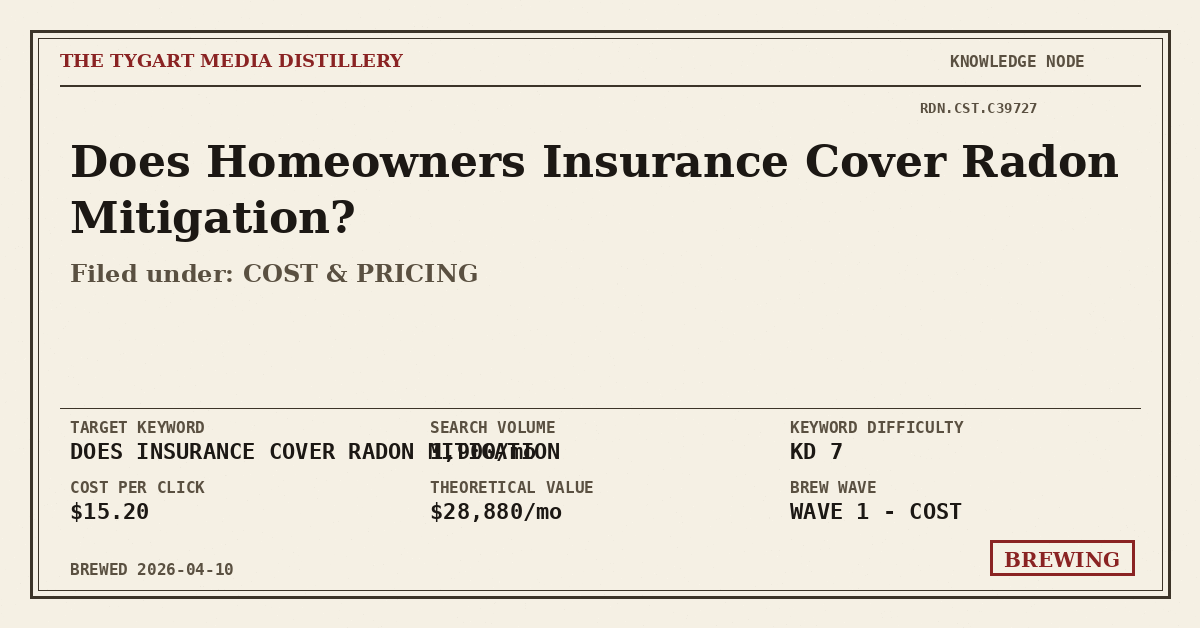
    Does Homeowners Insurance Cover Radon Mitigation?

    The Distillery
    — Brew № 1 · Radon Mitigation
    Standard homeowners insurance policies do not cover radon mitigation. State Farm, Allstate, USAA, Liberty Mutual, and every other major carrier exclude it because radon is classified as a gradual environmental condition rather than a sudden event. However, alternative paths exist to reduce the cost, including state assistance programs, HSA and FSA eligibility with medical documentation, real estate transaction negotiation, and contractor financing.

    The short answer is no. Homeowners insurance does not cover radon mitigation. Not State Farm, not Allstate, not USAA, not Liberty Mutual, not Progressive, not Farmers. Not any of the major carriers and not any of the minor ones. Standard homeowners insurance policies in 2026 exclude radon mitigation as a category of expense, and they have for decades.

    But “no” isn’t actually the complete answer, because there are a handful of narrow situations where insurance can partially offset radon-related costs, and there are several alternative paths to reducing the financial burden that people routinely overlook. This is the honest breakdown: why insurance won’t cover the main cost, what exceptions might apply to you, and what realistic options exist instead.

    Why homeowners insurance doesn’t cover radon mitigation

    The reason is structural to how homeowners insurance is designed, not arbitrary. Standard policies cover losses from sudden and accidental events — fires, storms, theft, vandalism, covered water damage, liability claims when someone is injured on your property. They explicitly exclude losses from gradual conditions that develop over time — foundation settling, wear and tear, mold from chronic moisture, soil movement, and yes, radon accumulation.

    Radon sits firmly in the “gradual condition” category. Uranium has been decaying in the soil beneath your home for billions of years. Radon has been seeping up toward your foundation for the entire time the home has existed. It isn’t an event, it’s a steady-state condition. Insurance companies classify it the same way they classify foundation settling, soil subsidence, and long-term moisture damage — as a maintenance issue the homeowner is responsible for addressing.

    Every major insurance carrier’s position on radon, as of 2026:
    – State Farm: excluded from standard policies
    – Allstate: excluded from standard policies
    – USAA: excluded from standard policies
    – Liberty Mutual: excluded from standard policies
    – Progressive: excluded from standard policies
    – Farmers: excluded from standard policies
    – Nationwide: excluded from standard policies
    – Travelers: excluded from standard policies

    Some of these carriers offer add-on endorsements or riders for environmental hazards that might include limited radon coverage — typically for $25 to $100 per year in additional premium — but the coverage is usually capped at low amounts (often $500 to $1,500) and requires specific triggering events. None of them cover routine radon mitigation as a standard inclusion.

    The exclusion isn’t hidden in the fine print; it’s a standard feature of how homeowners insurance works across the industry. Radon is not insurable under conventional policies for the same reason chronic roof wear isn’t insurable — it’s a foreseeable ongoing condition, not an unexpected loss.

    The narrow exceptions where insurance might help

    There are a few specific situations where homeowners insurance can partially cover radon-adjacent costs. None of them cover routine mitigation, but they’re worth understanding because they occasionally apply.

    1. Storm damage to an existing mitigation system

    If a severe storm damages the exterior portion of your radon mitigation system — for example, high winds rip the vent pipe off the exterior wall, or hail damages the rooftop vent flashing — your homeowners insurance may cover the repair cost as storm damage. The key is that the damage was caused by a covered peril (the storm), not by the radon itself. The radon system is treated as part of the home’s physical infrastructure for the purpose of storm damage claims.

    What this covers: Physical repair or replacement of damaged mitigation system components after a covered weather event.

    What this does not cover: Any reduction in system effectiveness, any increase in indoor radon levels during the repair period, or the original installation cost.

    Realistic claim value: $300 to $1,200 for typical storm damage to a mitigation system.

    2. Covered water damage from a failed sump integration

    If your mitigation system includes sump pit integration and a component failure causes the sump pump to malfunction, resulting in basement flooding, your homeowners insurance may cover the water damage itself — even though the radon system repair is not covered. The covered peril is the water damage, not the radon system.

    What this covers: Water extraction, drying, damaged flooring and drywall replacement, damaged contents.

    What this does not cover: Repair of the sump pump, the mitigation system, or any ongoing radon-related costs.

    This is a fairly rare scenario because sump integration in well-installed mitigation systems rarely causes pump failures, but it’s worth knowing the distinction.

    3. Liability coverage in disclosure-related lawsuits

    If you sell a home, the buyer later discovers elevated radon levels, and the buyer can prove you knew about the problem and failed to disclose it, your homeowners insurance liability coverage might apply to any resulting lawsuit. Whether coverage applies depends on your policy language and your state’s disclosure laws.

    This is a complex legal scenario and not a reliable safety net. Most states require disclosure of known material defects including radon, and most disclosure-related lawsuits are settled outside of insurance coverage because they involve allegations of intentional concealment rather than accidents.

    Realistic use case: Rare. Consult a real estate attorney if this situation applies to you.

    4. Future health claims linked to radon exposure

    Homeowners insurance does not cover medical claims for illness allegedly caused by radon exposure. Health insurance might, if a doctor diagnoses a condition and documents the causal link to radon, but this is uncommon and highly fact-specific. Most radon-related lung cancer cases are not pursued as insurance claims because the latency period (typically 5 to 25 years between exposure and cancer diagnosis) makes causation difficult to establish definitively.

    This category is effectively a non-option for most homeowners.

    What homeowners insurance actually does when radon is detected

    In most cases, the interaction between a homeowner and their insurance company around radon is limited to the following:

    1. Nothing. The homeowner discovers elevated radon, pays for mitigation out of pocket, and never contacts the insurance company. This is the most common outcome.
    2. A disclosure question at renewal. Some insurance companies ask about known environmental conditions at policy renewal. Disclosing that you had elevated radon and mitigated it is honest and typically does not affect your rate — mitigation is viewed as responsible maintenance.
    3. A denied claim. If a homeowner attempts to file a radon mitigation claim anyway, it will be denied citing the policy exclusion for gradual environmental conditions.

    There is no meaningful benefit to involving your insurance company in routine radon mitigation. The outcome of the call is almost always a polite “that’s not covered.”

    Alternative paths to reducing the cost

    Insurance isn’t the answer, but there are several legitimate ways to reduce or offset the cost of radon mitigation that most homeowners don’t know about.

    1. State-level grants and assistance programs

    Several states offer grants, loans, or financial assistance for radon mitigation to qualifying homeowners. Program details and eligibility change year to year, and availability is usually limited to specific income brackets or high-risk geographic areas, but real money is available in the right situations.

    States with active radon mitigation assistance programs (as of 2026):
    Pennsylvania Department of Environmental Protection: limited grants for low-income homeowners in high-radon counties
    Illinois Emergency Management Agency: Illinois Radon Mitigation Program for qualifying households
    Iowa Department of Public Health: Iowa Radon Program mitigation assistance
    Minnesota Department of Health: financial assistance programs through the state radon office
    Colorado Department of Public Health and Environment: grants in some counties through the state radon program
    Wisconsin Department of Health Services: limited assistance through regional radon information centers

    Grant amounts typically range from $500 to $1,500 per qualifying household when awarded. Applications usually require income verification, proof of an elevated radon test, and a quote from a certified mitigator.

    How to check if your state has a program:
    – Contact your state health department’s radon section
    – Search for “[your state] radon mitigation grant”
    – Check the EPA’s state radon contacts page at epa.gov/radon/find-your-states-radon-contact-information

    2. HSA and FSA eligibility

    Radon mitigation can sometimes qualify as a medical expense for Health Savings Account (HSA) or Flexible Spending Account (FSA) purposes when a physician has documented a health condition affected by radon exposure. This is most commonly applicable when a household member has been diagnosed with lung cancer, chronic respiratory disease, or another condition where continued radon exposure is medically contraindicated.

    How HSA/FSA eligibility works for radon mitigation:

    When eligible, the mitigation cost can be paid with pre-tax HSA or FSA dollars, effectively reducing the cost by the user’s marginal tax rate. For a household in the 22% federal tax bracket plus a 5% state tax, a $2,000 mitigation paid with HSA dollars has an effective cost of roughly $1,460 — a savings of about $540.

    Requirements:
    – A licensed physician’s letter documenting the medical necessity of radon mitigation for a specific diagnosis
    – The mitigation must be installed in a primary residence (not a rental property)
    – The expense must be documented according to IRS Publication 502 guidelines
    – A Letter of Medical Necessity (LMN) is required for FSA reimbursement

    This is not a routine use of HSA/FSA funds. Most radon mitigations do not qualify because no medical diagnosis is driving the work. Consult a tax professional before relying on this approach, and keep all documentation for at least seven years in case of audit.

    3. Federal and state tax benefits

    Direct tax deductions for radon mitigation are uncommon for owner-occupied homes but possible in a few specific scenarios:

    Rental property owners: If you install radon mitigation on a rental property you own, the cost can typically be deducted as either a repair (deducted fully in the year incurred) or a capital improvement (depreciated over the property’s useful life). Classification depends on the specific circumstances. Consult a tax professional.

    Medical expense deduction: As described under HSA/FSA above, radon mitigation can occasionally qualify as a deductible medical expense when a physician documents medical necessity. The deduction only applies to the portion of total medical expenses exceeding 7.5% of adjusted gross income, which is a high threshold for most taxpayers.

    State-level credits: A few states have offered limited tax credits for residential radon mitigation at various times. Check with your state department of revenue for current availability.

    Energy efficiency credits: Radon mitigation does not qualify for the federal energy efficiency tax credits that cover HVAC, insulation, and similar improvements. Those credits are specifically for energy-saving measures.

    Tax rules change frequently. Consult a qualified tax professional before claiming any deduction related to radon mitigation.

    4. Home warranty add-on coverage

    Some home warranty companies offer optional coverage for radon fan replacement as an add-on to their standard plans. This does not cover the initial installation, but it can cover the cost of replacing a failed fan motor years after installation — typically a $300 to $600 expense that would otherwise come out of pocket.

    How home warranty radon coverage typically works:
    – Monthly premium increase of $5 to $15 for the radon add-on
    – Coverage triggers when the fan fails and requires replacement
    – Service fee of $75 to $125 per claim
    – Limits vary; typical cap is $500 to $1,000 per claim

    For homeowners with aging mitigation systems who expect fan replacement within a few years, the math can work out favorably. For homeowners with new systems still under manufacturer warranty, it’s usually unnecessary.

    5. Real estate transaction negotiation

    For homeowners buying a new home where a pre-purchase radon test comes back elevated, the most effective “cost savings” is often getting the seller to pay for mitigation as part of the sale. Depending on market conditions and negotiating leverage, sellers pay for mitigation in roughly 40 to 60 percent of cases where it becomes a contract contingency.

    Typical outcomes:
    Buyer’s market: Seller pays 70-100% of mitigation cost as a concession to close the deal
    Balanced market: Cost is often split 50/50 or the seller pays in full
    Seller’s market: Buyer often pays in full to keep the deal competitive, though sometimes splits the cost

    Sellers in high-radon states increasingly install mitigation systems proactively before listing to avoid the contingency negotiation altogether. A documented working mitigation system has become a mild selling point in regions where radon awareness is high.

    Standard contract language: Most real estate purchase contracts include a radon testing contingency that allows the buyer to request mitigation or walk away if levels exceed the EPA action level of 4.0 pCi/L. If your contract includes this contingency and your test comes back elevated, the negotiation path is well-established and usually results in some level of seller contribution.

    6. Manufacturer rebates and contractor financing

    Some radon mitigation contractors offer financing plans that spread the installation cost over 12 to 60 months, typically with low or zero interest for qualified buyers. This doesn’t reduce the total cost but makes it easier to absorb.

    Manufacturer rebates on radon fans are rare but occasionally appear — primarily from RadonAway on specific fan models during promotional periods. Savings when available are usually $25 to $100.

    Payment plan options to ask about:
    – In-house contractor financing (0% interest for 6-12 months is common)
    – Third-party home improvement financing through companies like Synchrony or Wells Fargo
    – Home equity line of credit (HELOC) for larger installations
    – Credit card payment with 0% introductory APR offers

    These don’t reduce the cost but can make it manageable for homeowners who can’t cover the full $1,500 to $2,500 installation in a single payment.

    What to do if you can’t afford mitigation

    If you’ve confirmed elevated radon levels and can’t afford the mitigation cost in the near term, several interim steps can reduce your exposure while you work out the financing.

    Short-term harm reduction:

    1. Increase ventilation in the lower level of the home. Opening windows and running ventilation fans temporarily reduces indoor radon concentrations. This is not a long-term solution and doesn’t work in cold climates where windows need to stay closed, but it can meaningfully lower exposure as a stopgap.

    2. Avoid spending time in the lowest level of the home. Radon concentrations are typically highest in basements and the ground floor. Reducing time spent in those areas proportionally reduces exposure. If your basement is where family members spend most of their waking hours, moving that activity to upper levels temporarily reduces risk.

    3. Seal obvious foundation cracks. Sealing cracks alone is not effective mitigation, per EPA and AARST, but it can marginally reduce radon entry as an interim measure while you save for a professional system.

    4. Run bathroom and kitchen exhaust fans more frequently. These fans create negative pressure in the home that actually increases radon entry rates in some cases, but when combined with open windows on upper floors they can create an air exchange pattern that dilutes indoor radon. Use with caution.

    Longer-term planning:

    • Check state grant programs and apply if eligible
    • Contact your state radon office to ask about low-income assistance
    • Discuss the installation with certified mitigators and ask about payment plans
    • Compare 2-3 quotes to find the lowest legitimate price for your specific home
    • Consider DIY passive approaches (floor sealing, increased ventilation) as temporary measures while saving

    What not to do:

    • Don’t attempt a DIY active radon mitigation system unless you have specific training. An incorrectly installed ASD system can create problems larger than the original radon issue, including fan-induced negative pressure that worsens radon entry in other parts of the home. EPA explicitly discourages DIY installation for this reason.
    • Don’t ignore the test result. Elevated radon levels are a cumulative health risk, and the cost of a professional mitigation system is a small fraction of the cost of lung cancer treatment.
    • Don’t use DIY test kits you don’t trust as a reason to conclude your home is fine. If you tested elevated once, retest before concluding anything, but don’t discount a confirmed elevated result.

    The bottom line on insurance

    Homeowners insurance does not cover radon mitigation, will not cover radon mitigation, and has never covered radon mitigation under standard policies. The exclusion is structural and industry-wide, not a gap you can negotiate around with your specific carrier.

    But the complete picture includes alternative paths that most homeowners don’t know exist: state grants, HSA/FSA eligibility with medical documentation, real estate transaction negotiation, home warranty add-ons, and contractor financing. These options don’t eliminate the cost but they can meaningfully reduce it or make it manageable for households that would otherwise struggle with a $1,500 to $2,500 out-of-pocket expense.

    The conversation that matters isn’t with your insurance company. It’s with certified mitigators about the actual installation, with your state radon program about assistance availability, with your tax professional about possible deductions, and — if you’re in a real estate transaction — with your agent about negotiating seller contribution. Those conversations produce results. The insurance call does not.

    Frequently asked questions

    Does any homeowners insurance cover radon mitigation?

    No standard homeowners insurance policy from any major carrier covers routine radon mitigation. The exclusion is structural — radon is classified as a gradual environmental condition rather than a sudden event — and applies across the industry. Some carriers offer environmental hazard riders that may provide limited coverage for radon-related costs, but these are capped at low amounts and do not cover typical mitigation installation. Routine mitigation is an out-of-pocket expense for homeowners in virtually every case.

    Will my insurance cover storm damage to my radon mitigation system?

    Yes, if the damage is caused by a covered peril like high winds, hail, or falling trees. The key is that the damage must come from an event your policy covers, not from the radon itself or from system wear. If a storm rips the exterior vent pipe off your home, the repair is typically covered as standard storm damage. The original installation cost and any ongoing radon-related costs remain the homeowner’s responsibility.

    Can I use my HSA to pay for radon mitigation?

    Only if a licensed physician documents the mitigation as medically necessary for a specific diagnosis affecting a household member. Most radon mitigations do not qualify because no medical condition is driving the work. When HSA or FSA payment is eligible, the effective cost is reduced by the homeowner’s marginal tax rate, which typically produces savings of $300 to $600 on a $2,000 mitigation. Consult a tax professional and keep medical documentation on file before relying on this approach.

    Is radon mitigation tax deductible?

    For primary residences, radon mitigation is generally not tax deductible unless it qualifies as a medical expense (requiring physician documentation and a diagnosis). For rental properties, the cost can typically be deducted as a repair or depreciated as a capital improvement, depending on how it’s classified. A few states have offered limited tax credits for residential radon mitigation in the past — check with your state department of revenue for current programs.

    What state has the best radon mitigation assistance program?

    Pennsylvania, Illinois, Iowa, and Minnesota have the most active state-level assistance programs as of 2026, typically offering grants of $500 to $1,500 for qualifying low-income households in high-radon areas. Program availability and funding change year to year. Contact your state health department’s radon section directly for current eligibility requirements and application procedures.

    If I’m buying a home, who should pay for radon mitigation?

    It depends on the market and the specific contract, but negotiation is normal. In buyer’s markets, sellers typically pay for 70-100% of mitigation cost as a contingency concession. In balanced markets, the cost is often split or paid entirely by the seller as a goodwill gesture. In seller’s markets, buyers more frequently pay to keep the deal together. Most purchase contracts include a radon testing contingency that establishes the negotiation framework. Work with your real estate agent to craft a contingency that protects your interests based on current market conditions.


    THE TYGART MEDIA DISTILLERY
    This is a knowledge node.
    Part of the Radon Mitigation knowledge base — a category being brewed openly, one node at a time. Every article passes through an eight-pass distillation pipeline before publication. Live organic value tracked publicly on the Distillery Live Value Meter.



  • Commercial Compliance as a Loss Leader: How Restoration Contractors Own the Relationship

    Commercial Compliance as a Loss Leader: How Restoration Contractors Own the Relationship

    The Machine Room · Under the Hood

    There’s a property manager sitting in a strip mall office right now, managing twelve tenants, a leaky roof drain, and a fire marshal inspection that’s six months overdue. She’s not looking for a restoration company. She won’t think about a restoration company until something goes very wrong.

    That’s the problem — and the opportunity.

    The restoration industry runs almost entirely on reactive marketing. Someone floods, someone calls. Someone burns, someone calls. You’re competing for the call after the loss, against every other company who’s also competing for the call after the loss, on Google, on insurance panels, on word of mouth.

    But the property manager who authorizes a $50,000 emergency restoration job is the same person who buys fire extinguisher inspections, carpet cleaning, and exit light testing. She buys these things regularly, on a schedule, for cash — no insurance middleman, no adjuster, no TPA approval process.

    Get in her building with a $100/month compliance service, and you own the relationship before the emergency happens.

    The Compliance Walk

    Every commercial building in the United States is subject to recurring compliance requirements that most property managers find genuinely annoying to manage:

    • Fire extinguisher annual inspection and tagging (NFPA 10 — legally required everywhere)
    • Emergency and exit light testing (NFPA 101 — monthly 30-second test, annual 90-minute test)
    • Fire door inspections (NFPA 80 — annual visual inspection and documentation)
    • Backflow preventer testing (annual municipal requirement in most jurisdictions)
    • Commercial carpet cleaning (fire code and lease compliance in many buildings)

    These aren’t optional. They’re not upsells. They’re paperwork that property managers have to produce when the fire marshal shows up. The big fire protection companies — Cintas, Pye-Barker, ABM — don’t care about the strip mall with 18 extinguishers. Their route economics don’t work below a certain account size.

    That’s the gap. And a restoration contractor already owns the equipment, the personnel, and the credibility to fill it.

    What the Quarterly Visit Actually Buys You

    Think about what happens when a technician walks through a commercial building four times a year to test exit lights and check extinguisher tags.

    They see the water stain on the ceiling tile in unit 7. They notice the musty smell in the stairwell that’s been there since last fall. They observe that the roof drain on the north side is partially blocked. They document all of it — in a compliance report that goes to the property manager, with your company’s name on it.

    The property manager now has documented evidence of deferred maintenance and potential liability. You found it. You’re the expert she trusts. When something actually happens, you’re not a name she found on Google at 2am — you’re the company that’s been maintaining her building, that she already has a contract with, that already has access.

    This is not a marketing strategy. This is a relationship architecture.

    The Numbers That Make It Real

    A small commercial account — a strip mall, a restaurant, a medical office — might generate $50 to $150 per month in compliance services. That’s not the revenue story.

    The average water damage restoration job in commercial property runs $3,836 at the low end. Significant losses start at $15,000. Whole-building events — the ones that happen when a pipe bursts on the third floor and runs for six hours — run $50,000 and up.

    One emergency response job from a compliance relationship you’ve spent six months building pays for the entire program many times over. And that’s before the rebuild scope, the contents, the dehumidification equipment rental, and the project management fees that follow a major loss.

    The compliance service isn’t the product. It’s the acquisition cost.

    How to Structure the Offer

    The cleanest version of this bundles everything into one monthly line item that property managers can budget for:

    • Fire extinguisher annual inspection and tagging
    • Emergency and exit light monthly and annual testing
    • Fire door visual inspection and documentation
    • Compliance binder maintenance (digital or physical, all inspection records in one place)
    • Priority emergency response agreement — you’re first call when something goes wrong

    One vendor. One monthly fee. One quarterly visit. Everything documented, everything current, fire marshal ready.

    For a small commercial tenant — under 50 extinguishers, which is most of the small commercial market the big vendors ignore — that package prices at $50 to $150 per month depending on building size and complexity. Quarterly visits, annual documentation package, priority response clause in the contract.

    The priority response clause is the most important line in the agreement. It’s not legally binding in any complex sense — it simply establishes that when something happens, you call us first. You’ve already signed the paperwork. We’re already in your system. No one has to go find a contractor at 2am.

    The Certification Question

    Fire extinguisher inspection requires certification. The national path runs through the ICC/NAFED Certified Portable Fire Extinguisher Technician exam, which is based on NFPA 10 and completable in one to three days of self-paced study. Total startup cost — materials, exam, state registration, initial tools and tags — runs under $1,000.

    Some states require a licensed fire protection company for annual inspections. Washington, for example, requires both state and local licensing. Texas requirements vary by jurisdiction. The certification question is worth solving once, correctly, before the first sale — not as a reason to delay getting started.

    The alternative for contractors who don’t want to own the compliance scope themselves: partner with a regional fire protection company to run the compliance work, keep the PM relationship, and be named in the contract as the emergency response vendor. The fire protection company gets route density they want. You get the access and the relationship.

    Starting Without the Certification

    You don’t need certification to start. You need content and a phone call.

    Write about commercial fire code compliance for property managers. Write about what NFPA 10 actually requires and why small commercial buildings keep getting cited. Write about what a compliance binder should contain and how many property managers don’t have one. Rank for the keywords commercial property managers search when they’re trying to solve this problem.

    Leads come in. You call them. You ask them what their current compliance situation looks like. You position yourself as someone who understands the problem — and then either you’ve gotten certified by then, or you have a fire protection partner to introduce.

    The digital presence creates the warm lead. The relationship closes the deal. The quarterly visit owns the building.

    The Larger Play

    This isn’t just a retention strategy for one contractor. It’s the skeleton of a commercial PM ecosystem.

    A drone company handles exterior envelope inspections and thermal imaging — capabilities no fire protection company or restoration contractor currently offers. A fire protection company handles the interior compliance walk. The restoration contractor holds the PM relationship and the emergency response position. A content and SEO layer drives commercial PM leads to the entire network.

    The property manager sees one vendor, one monthly fee, one comprehensive building health report — roof-to-extinguisher, quarterly. Everyone else sees route density, referral flow, and the clients no one else was serving.

    The big vendors ignored the small commercial market because their economics didn’t work. That’s not a problem. That’s an opening.


    Tygart Media builds digital infrastructure for restoration contractors, commercial service companies, and the vendors who work alongside them. If you’re thinking through a commercial PM strategy and want to talk about what the content and SEO layer looks like, reach out.

    {
    “@context”: “https://schema.org”,
    “@type”: “Article”,
    “headline”: “Commercial Compliance as a Loss Leader: How Restoration Contractors Own the Relationship”,
    “description”: “The property manager who buys fire extinguisher inspections is the same person who authorizes $50K+ emergency restoration work. Here is how to get in the buildi”,
    “datePublished”: “2026-04-02”,
    “dateModified”: “2026-04-03”,
    “author”: {
    “@type”: “Person”,
    “name”: “Will Tygart”,
    “url”: “https://tygartmedia.com/about”
    },
    “publisher”: {
    “@type”: “Organization”,
    “name”: “Tygart Media”,
    “url”: “https://tygartmedia.com”,
    “logo”: {
    “@type”: “ImageObject”,
    “url”: “https://tygartmedia.com/wp-content/uploads/tygart-media-logo.png”
    }
    },
    “mainEntityOfPage”: {
    “@type”: “WebPage”,
    “@id”: “https://tygartmedia.com/commercial-compliance-loss-leader-restoration/”
    }
    }

  • Future of Restoration: 4 Trends Shaping the Next 3 Years

    Future of Restoration: 4 Trends Shaping the Next 3 Years

    The Machine Room · Under the Hood


    What 23 Billion-Dollar Disasters, the NDAA, and a 79% AI Gap Are Telling Us About Restoration’s Next 3 Years

    The signals are converging. Twenty-three billion-dollar disasters in 2025, trending to 20+ annually. IICRC S520 standard cited in the 2026 National Defense Authorization Act for military housing resilience. Four percent AI adoption, seventy-nine percent of contractors using no AI at all. Healthcare facility compliance driving moisture testing adoption. ESG mandates expanding insurance requirements. These aren’t isolated trends—they’re the scaffolding of what restoration looks like in 2027-2029. Here’s what the data says about your next three years.

    I read signals for a living. Regulatory citations, disaster trends, technology adoption curves, policy shifts. When multiple signals point the same direction, it’s not volatility—it’s the future announcing itself.

    The future of restoration is announcing itself right now. And most of the industry hasn’t noticed.

    The Climate Signal: 23 Disasters Is the New Normal

    NOAA data is clear. In 2025, we had 23 billion-dollar disasters. The trend line is relentless:

    • 1980: 0 per year (on average)
    • 2000: 1.3 per year
    • 2015: 5.1 per year
    • 2020: 12.3 per year
    • 2023: 18 per year
    • 2024: 18 per year
    • 2025: 23 per year

    This isn’t cyclical volatility. This is acceleration. Climate change impact is real and measurable. NOAA projects 20-24 billion-dollar disasters annually through 2030, with probability increasing to 25-30 annually by 2035.

    For restoration companies: This means permanent market surge. Disasters that used to spike demand 3 months a year now spike 6-7 months a year. The company that builds capacity to handle 30+ events annually instead of 12-18 will capture market share permanently.

    The Regulatory Signal: IICRC S520 in Military Housing

    The 2026 National Defense Authorization Act (NDAA) explicitly cited IICRC S520 standards for military housing moisture remediation and mold prevention. This is significant.

    Why? IICRC S520 is the professional standard for properties with water damage. When federal policy cites it, it legitimizes it. When military housing (which serves 2.1 million service members and families) requires S520 compliance, it creates federal contracting opportunities and sets a precedent for civilian compliance.

    Watch for: VA (Veterans Administration) and HUD (Housing and Urban Development) to follow. When federal agencies require S520, state agencies follow. When states mandate it, insurance companies require it. When insurance requires it, homeowners demand it.

    The timeline is 2-3 years, but the direction is certain. Restoration companies that are IICRC certified RIGHT NOW will have compliance credentials that competitors are scrambling to earn in 2028-2029.

    The Technology Signal: 4% vs 79%

    Four percent of restoration contractors use AI features. Seventy-nine percent use no AI at all.

    This gap is permanent until it’s not. At some point, competitors will catch up. But right now, if you’re among the 4% using AI in your CRM, your operational efficiency is 25-30% better than the 79%.

    Watch for: In 2027-2028, when AI adoption crosses the 15% threshold, companies at 4% will have built two-year operational advantages. Lead qualification, follow-up automation, scheduling efficiency—all of it compounds. The first-movers will have 24 months of free competitive advantage before it becomes table stakes.

    The signal: If you’re not using AI now, you’re running on borrowed time. By 2029, you’ll be 4-5 years behind market leader practices.

    The Healthcare Signal: Moisture Testing and Facility Standards

    Healthcare facilities across the U.S. are under pressure to meet new moisture and mold standards. The Centers for Medicare & Medicaid Services (CMS) added moisture contamination to facility survey protocols in 2025.

    This created a new market: healthcare facility remediation. Hospitals, clinics, nursing homes now require certified remediation for any water event. The IICRC certification requirement is explicit.

    Market size: 6,200+ Medicare-certified healthcare facilities in the U.S. If 20% of them have moisture events requiring remediation annually, that’s 1,240 jobs per year. Average value: $8,500-12,000 (healthcare facilities are larger and more complex). That’s $10.5-14.9 million in addressable healthcare market alone.

    Watch for: Healthcare facility opportunities in your region. They have budgets. They have compliance pressure. They need certified remediation. This is underexploited by most restoration contractors.

    The ESG Signal: Insurance Requirements Expanding

    Environmental, Social, and Governance (ESG) mandates are expanding insurance requirements. Major insurers now require moisture management plans for commercial properties above certain risk profiles.

    What does this mean? Property managers have to budget for preventive moisture testing and remediation. If they don’t, their insurance rates increase or coverage gets denied.

    The market expansion: Commercial property management ($1.2 trillion in managed assets) now has to allocate 0.5-2% of budget to moisture resilience. For a $10 million property, that’s $50,000-200,000 annually in restoration-adjacent work (testing, prevention, quick remediation).

    Watch for: Your local commercial real estate market. Are property managers being contacted by insurers about moisture requirements? Are they calling you for preventive services? The ones that aren’t yet will be by 2027.

    The Convergence: What This Means for Strategy

    These four signals converge into a clear narrative:

    • Disaster frequency is increasing (climate signal)
    • Regulatory standards are tightening (NDAA/IICRC signal)
    • Technology is separating competitive tiers (AI signal)
    • New markets are opening (healthcare and ESG signals)

    Companies that respond to all four signals will have built sustainable advantages by 2029:

    • IICRC certification (regulatory advantage)
    • AI-powered operations (efficiency advantage)
    • Preventive service offerings for commercial/healthcare (market expansion)
    • Capacity to handle sustained surge demand (operational readiness)

    Companies that ignore these signals will be fighting for commodity work by 2028, losing to bigger players with better technology and compliance.

    The 36-Month Roadmap

    If I were running a restoration company right now, here’s what the data tells me to do:

    Next 90 days: Get IICRC certified if you aren’t. Military housing is coming. Federal contracting opportunities follow.

    Next 180 days: Implement AI in your CRM. Qualify leads automatically. Automate follow-up. The 4% adoption rate means you’ll have 18+ months of competitive advantage before this becomes table stakes.

    Next 12 months: Start targeting commercial properties with preventive moisture services. Build relationships with healthcare facilities. These are compliant markets with budgets.

    Next 24 months: Scale. Disasters are coming. Demand will surge. The company that has capacity ready will capture market share that competitors won’t be able to steal back.

    This isn’t speculation. This is signal reading. And the signals are converging.