Tag: Everett Government

  • Everett Stadium Site Survey Begins: 15 Parcels to Acquire

    Everett Stadium Site Survey Begins: 15 Parcels to Acquire

    Q: Has construction work actually started on the Everett stadium?
    A: Yes — the city has awarded a $200,000 limited early work agreement to Bayley Construction to begin site surveying on the 12.5-acre downtown parcel. Meanwhile, the city needs to acquire 15 separate properties before groundbreaking, with 2 purchase-and-sale agreements signed, 4 pending, and 8 in active negotiation.

    Ten days after the Everett City Council voted to release $10.6 million in design and acquisition funding for the new downtown stadium, the physical work has begun.

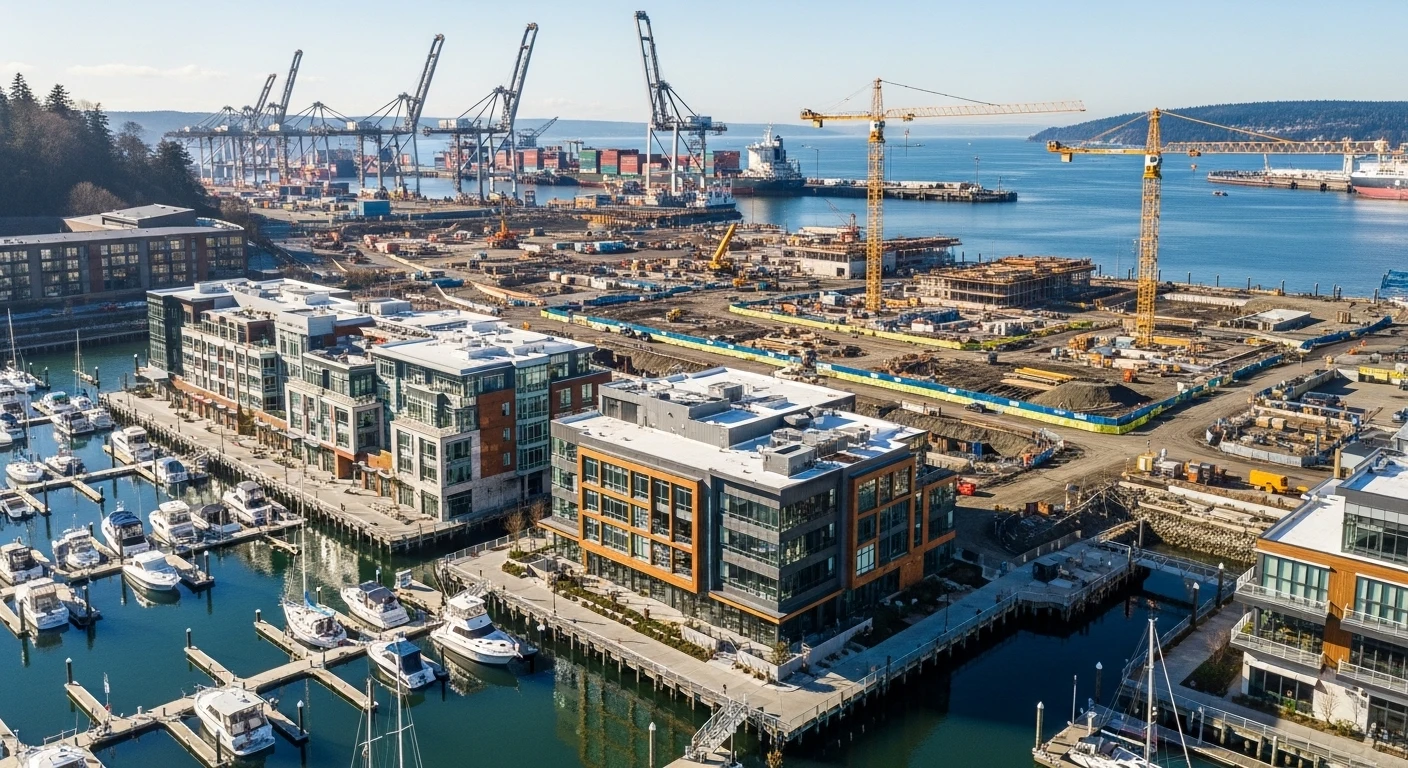
    Bayley Construction, the Mercer Island-based general contractor selected as part of the DLR Group/Bayley design-build team, has received a $200,000 limited early work agreement to begin site surveying on the stadium’s 12.5-acre parcel on Everett’s downtown east side, between Angel of the Winds Arena and Interstate 5. This is the moment when the stadium shifts from a city council decision to a job that has people on the actual ground.

    At the same time, the city is working through an acquisition list of 15 separate properties it needs to purchase before any heavy construction can begin — and the status of that acquisition is more complex than a single timeline suggests.

    The property acquisition scorecard

    Before Bayley can do much more than survey, the city needs to acquire 15 parcels that sit within the stadium’s footprint. Here’s where that stands as of early May 2026:

    • 2 parcels: Purchase-and-sale agreements signed. Finalized and done.
    • 4 parcels: Agreements pending. Terms are agreed upon; paperwork in final stages.
    • 8 parcels: Active negotiations. The city is in conversation with owners; no agreements yet.
    • 1 parcel: Being formally added to the acquisition list. Not publicly identified.

    Of the $10.6 million the council approved April 29, about $5.6 million is earmarked specifically for property acquisition. The remaining funds cover continued design work with DLR Group, permitting, and other pre-construction costs.

    The math on 15 parcels averaging out to roughly $370,000 each reflects a mix of small commercial lots, surface parking, and light industrial parcels scattered across the stadium footprint east of Angel of the Winds Arena. The 2 signed agreements and 4 pending deals suggest the more straightforward cases are closing first. The 8 active negotiations are the ones worth watching.

    DLR Group and Bayley Construction: who’s building this

    The design-build team selection was completed before the April 29 vote. The city used a Progressive Design Build process, and DLR Group/Bayley Construction scored highest among the finalists.

    DLR Group is the global architecture firm with a Seattle office that’s been doing the stadium design work. Their renderings show the open-air design: 5,000-seat capacity, a covered premium club area with seating for 200 and standing room for 400, and ADA-accessible sight lines throughout.

    Bayley Construction is the contractor that will build it. Headquartered on Mercer Island, they have prior experience in sports facility construction including the University of Washington Husky Ballpark. The $200,000 early work agreement for site surveying is the first physical contract they’re executing — before the full design-build contract, which will come back to the City Council for approval within the next several months.

    The site: 12.5 acres east of Angel of the Winds Arena

    The stadium site is approximately 12.5 acres on the eastern edge of downtown Everett, directly adjacent to Angel of the Winds Arena and roughly a half-mile west of Interstate 5. The proximity to the arena has been deliberate — city planners have been thinking about the two facilities as a combined entertainment district, not just adjacent buildings, capable of drawing people downtown for multiple reasons on the same block.

    The AquaSox opening target of April 2027 creates the deadline that’s driving everything: a September 2026 groundbreaking is required to hit that date. That’s roughly four months away from where we stand today.

    The $25 million gap that still needs to close

    Even with the $10.6 million approved and the design-build team conducting survey work, the stadium project still carries a funding gap. Total project cost is now approximately $118 million. Current committed or anticipated funding falls roughly $25 million short — a gap the city is working to close through state funding requests, naming rights negotiations, and other sources being tracked by Council Vice President Paula Rhyne’s Finance and Administration Committee.

    We’ve covered the four-step pathway from the April 29 vote to groundbreaking in earlier coverage. What’s new today is that while the governance process continues upstairs at City Hall, the physical pre-development process is starting on the ground. That’s the right posture for a project with this little margin in its timeline.

    Three milestones to watch

    Whether the September 2026 groundbreaking timeline holds will come down to three things:

    1. Property acquisition progress — specifically whether the 8 parcels in active negotiation move to signed agreements by early summer. A holdout owner or legal challenge could push the timeline. The city has eminent domain authority, but using it adds time and cost.
    2. Final design-build contract approval — that City Council vote will include the full contract value and a revised cost estimate. If DLR Group’s number has moved from the $82 million design-to-budget figure, that’s significant news.
    3. The $25 million funding gap — naming rights negotiations and state funding requests have to land before groundbreaking. The FAC meetings are where this closes or doesn’t.

    We’ll be tracking all three. The survey work starting now is the right signal — the city isn’t waiting for the funding gap to close before beginning the physical pre-development sequence. That discipline matters when you have 11 months between today and Opening Day 2027.

    Frequently Asked Questions

    Who is building the Everett downtown stadium?

    The design-build team is DLR Group (architecture, Seattle office) and Bayley Construction (general contractor, Mercer Island). Bayley has received a $200,000 limited early work agreement to begin site surveying — the first physical contract on the project.

    When will the Everett stadium break ground?

    The city’s target is September 2026. That timeline requires acquiring 15 parcels, closing a roughly $25 million funding gap, and approving the full design-build contract — all within approximately four months.

    How many properties does the city need to acquire for the stadium?

    15 parcels total. As of early May 2026: 2 purchase-and-sale agreements signed, 4 agreements pending, 8 in active negotiation, and 1 more being added to the list.

    How big is the new Everett stadium?

    The new multipurpose outdoor stadium will seat 5,000 with a covered premium club area seating 200 plus 400 standing. The site covers approximately 12.5 acres east of Angel of the Winds Arena in downtown Everett.

    How much will the new Everett stadium cost?

    The current total estimate is approximately $118 million. The April 29 council vote released $10.6 million, of which about $5.6 million is for property acquisition. A funding gap of roughly $25 million remains to be closed.

    When will the AquaSox play their first game at the new stadium?

    The target is April 2027 — but that requires the September 2026 groundbreaking timeline to hold through property acquisition, final contract approval, and gap funding closure.
  • Dr. Ian Saltzman: Everett Schools Superintendent Profile

    Dr. Ian Saltzman: Everett Schools Superintendent Profile

    Who is the superintendent of Everett Public Schools?
    Dr. Ian B. Saltzman has served as superintendent of Everett Public Schools since summer 2019. A 30-year education veteran who came from Palm Beach County, Florida, Saltzman leads a district of more than 21,000 students across 27 schools. Under his leadership, EPS achieved a record 96.3% four-year graduation rate for the class of 2025 — the highest in district history and well above Washington State’s 84% average.

    He flew across the country for a job he wasn’t sure he’d get. Seven years later, Ian Saltzman is one of the most decorated school leaders in Washington State.

    In April 2026, Dr. Ian Saltzman received the Elson S. Floyd Award at the Economic Alliance Snohomish County’s annual meeting — recognition given to “a visionary leader who, through partnership, tenacity, and a strong commitment to community, has created lasting opportunities to improve quality of life and positively impact the regional economy.” The award is named for the late Elson S. Floyd, former president of Washington State University and a nationally recognized figure in higher education.

    It’s a fitting honor for a superintendent who has spent seven years doing something many people doubted was easy: turning a mid-sized, economically diverse Pacific Northwest school district into one of Washington’s strongest graduation performers — without the wealthy zip codes that make those numbers easy elsewhere.

    The Road to Everett

    Before Saltzman was walking the halls of Everett’s 27 schools, he was a middle school special education teacher in Palm Beach County, Florida. He spent his entire 30-year career in one Florida district — rising from classroom teacher to principal at four different campuses, from elementary through high school. By 2016, he was serving as the district’s south region superintendent, overseeing 59 schools.

    When the Everett School Board launched a superintendent search in 2019, Saltzman was among 35 candidates. He was selected unanimously after a marathon of interviews that included students, teachers, and principals. The unanimous vote spoke to something the board saw clearly: a leader who had done the work at every level.

    He brought to Everett a philosophy he’s held since the classroom: produce “great learners and great citizens.” Simple in language. Harder to execute across a community of 21,000 students from dozens of language backgrounds, neighborhoods spanning the entire east-west corridor of the city, and an economy still reshaping itself.

    What Seven Years Have Built

    The clearest measure: the graduating class of 2025 achieved a record 96.3% four-year, on-time graduation rate — the highest in Everett Public Schools history. Cascade High School’s Class of 2025 graduated at 96.6%. Washington State’s average: 84%. EPS isn’t performing like a district with obstacles; it’s performing like a district that figured something out.

    Saltzman has overseen a string of successful levy campaigns that kept program funding intact through tight budget cycles — no small feat in a political environment where school levies often fail. He’s secured grant funds that expanded career and college readiness programming. And he navigated EPS through COVID-era disruption that knocked other districts’ outcomes backward for years after reopening.

    His membership in Chiefs for Change — a national bipartisan organization of education leaders recognized for driving results in complex districts — signals that peers and policymakers far outside Everett are paying attention.

    Credentials Worth Knowing

    Saltzman’s credentials match his practice. He holds a bachelor’s and master’s degree in special education from Florida State University — a foundation that, by his own account, shapes how he thinks about meeting every individual student’s needs. His specialist and doctoral degrees in educational leadership came from Nova Southeastern University in Fort Lauderdale.

    The special education training shows up in how he approaches the district. The question, for Saltzman, isn’t whether students can succeed — it’s what systems need to change so they do.

    What’s Ahead in 2026

    With the Elson S. Floyd Award on his shelf and graduation metrics at a record high, Everett Public Schools heads into the 2026-27 school year with real momentum. The district’s SchooLinks college-and-career-readiness platform transition is underway ahead of a statewide September 2026 deadline. Summer Academy and Career Link programming are expanding. The proximity to Everett Community College and WSU Everett creates a direct pipeline that Saltzman has worked to strengthen from the high-school side.

    For a community that’s watched Everett change fast — waterfront development, Boeing’s North Line expansion, Sound Transit in motion — having a stable, experienced hand running the district matters. Schools are neighborhoods. And in Everett, under Saltzman, they’ve been getting better.

    Frequently Asked Questions

    How long has Ian Saltzman been superintendent of Everett Public Schools?
    Dr. Ian Saltzman became EPS superintendent in summer 2019 and has served in the role for nearly seven years as of 2026.

    Where did Ian Saltzman work before Everett?
    Saltzman spent his entire 30-year education career in Palm Beach County, Florida. His final Florida role was south region superintendent, overseeing 59 schools.

    What is Dr. Saltzman’s educational background?
    He holds a bachelor’s and master’s degree in special education from Florida State University, and specialist and doctoral degrees in educational leadership from Nova Southeastern University.

    What was the Elson S. Floyd Award given for?
    The Economic Alliance Snohomish County gives the Elson S. Floyd Award to “a visionary leader who through partnership, tenacity, and a strong commitment to community has created lasting opportunities to improve quality of life and positively impact the regional economy.”

    What is Everett’s graduation rate?
    The Everett Public Schools graduating class of 2025 achieved a 96.3% four-year, on-time graduation rate — the highest in district history and above Washington State’s 84% average.

  • Everett Stadium Groundbreaking: 4 Steps to September 2026

    Everett Stadium Groundbreaking: 4 Steps to September 2026

    What comes next after the April 29 stadium vote? The council approved $10.6 million in design and acquisition funding — but that decision set four more in motion. Here is the exact sequence of decisions Everett must make before a shovel goes in the ground in September 2026, and what could still stop it.

    The April 29 Vote Was Not the Finish Line

    When the Everett City Council voted 6-1 on April 29 to approve an additional $10.6 million for the downtown stadium project, it made the biggest single step forward in the three-year effort to keep the Everett AquaSox in town and bring United Soccer League teams to a new outdoor venue. But it was a step, not the finish line.

    Council member Scott Bader put it precisely in remarks before the vote: “certain dominoes have to fall before the next domino can fall.” The $10.6 million approval was one domino. There are four more between today and a September 2026 groundbreaking — each dependent on the one before it.

    Here is what those four dominoes look like, where they stand, and what can still knock them over.

    Domino 1: The Stadium Fiscal Advisory Committee Reconvenes

    Immediately after the April 29 vote concluded, Council Vice President Paula Rhyne made a formal request: reconvene the Stadium Fiscal Advisory Committee before the council takes any further binding financial action on the stadium project.

    The Fiscal Advisory Committee was formed in 2024 to provide independent financial analysis of the stadium’s funding structure. It was active during the design-build procurement process but has not been formally reconvened since the project’s cost escalated to $120 million and the funding gap came into clearer focus.

    Rhyne’s request reflects a real concern that has been raised by multiple council members and community members: the city has not yet published detailed financial statements showing exactly how a stadium construction bond would be structured, repaid, and serviced. Former council member Scott Murphy voiced the same concern at the April 29 meeting: “There’s a big difference between having an economic development study and discussion around $100 million and seeing it on a piece of paper to understand how that will actually service the debt.”

    The committee’s work sets the terms under which the council can responsibly proceed to the bond vote. Until it completes its review, the bond vote cannot happen.

    Domino 2: Property Acquisitions

    The April 29 package allocated $5.6 million toward acquiring the remaining properties needed for the 12.5-acre stadium site. City staff reported that 14 property acquisition offers have been made: some purchase agreements are already completed, others are still pending.

    The stadium site is located north of Pacific Street between Broadway and Smith Avenue, adjacent to Angel of the Winds Arena. Full site control — meaning every parcel acquired — is required before construction can begin. The timeline depends on how quickly the remaining property negotiations close.

    The city has already allocated approximately $7.2 million in capital funds on the project before this vote, including prior property acquisition work and consulting fees. The new $5.6 million extends that work to the final parcels. City staff project that all properties can be acquired by fall 2026, which keeps the September groundbreaking timeline alive — but any negotiation that drags into litigation could push that date.

    Domino 3: The Bond Vote (~July or August 2026)

    The $10.6 million the council approved on April 29 was funded as an interfund loan from the city’s general fund — a bridge loan the city is lending to itself, structured to be repaid in a few months from a construction bond. The bond vote is the next major council decision, expected in July or August 2026.

    The bond package is expected to exceed $30 million. The full stadium budget is $120 million, which includes the $7.4 million state grant the council unanimously accepted on April 29, plus the $17 million the AquaSox and United Soccer League have agreed to contribute under their 30-year lease terms, plus the city’s accumulated $7.2 million in prior capital expenditures, plus the new $10.6 million package.

    There is still a funding gap of approximately $25 million — about 21% of the project’s cost. The city is pursuing public-private partnerships to close it. Economic development director Dan Eernissee has argued the gap is manageable: “We know this is going to be our growth area. We are counting on lots of residents to be in this downtown core, and we’re strategically investing before that time in real estate that can serve as an urban park, that can serve as a destination, can serve as a connector between our transit hub and downtown jobs.”

    The risk is clearly understood. Interim finance director Mike Bailey said at the April 29 meeting: “There’s an element of risk here. Again, we believe it’s manageable, or we wouldn’t have proposed it.” If the bond vote fails or a major contributor backs out before the bond is issued, the city faces the cost of repaying the interfund loan from its general fund — though some of that exposure is offset by the property acquisition component, which creates tangible city-owned assets.

    Domino 4: September 2026 Groundbreaking

    If the Fiscal Advisory Committee completes its work, the property acquisitions close, and the bond vote passes, construction can begin in September 2026. The design-build team — DLR Group (architecture, based in Seattle) and Bayley Construction (general contractor, based in Mercer Island) — is already active. DLR Group has designed multiple sports stadiums including Alex Box Stadium at LSU; Bayley Construction’s previous design-build work includes Husky Ballpark at the University of Washington.

    The design is roughly 60% complete. The facility will include 5,000 seats, a premium club section with a covered deck seating 200 (400 standing), a clubhouse building with team locker rooms and batting cages, an artificial turf field convertible between baseball and soccer layouts in a matter of hours, and a public walking path around the perimeter. The main entrance is planned for where Wall Street meets Broadway.

    The construction timeline targets completion by late 2027, in time for the Everett AquaSox to open their 2028 season at the new venue. The AquaSox have been explicit that without a new stadium, MLB’s requirements could force the franchise to relocate — which is why council member Bader framed the April 29 vote as a crossroads moment: “If we don’t move forward on this, I think the AquaSox will leave town and MLB will tell them to do that.”

    The One Unresolved Question: USL Team Ownership

    The AquaSox and United Soccer League have agreed to the financial terms of a 30-year lease for the new venue. But USL still needs to find an owner or ownership group to purchase the expansion teams that would actually play in the facility. That ownership search is ongoing. It doesn’t block the construction decision directly, but it remains an important loose end in the stadium’s long-term financial picture — since the lease revenue from the soccer teams is built into the stadium’s revenue projections.

    Labor and Community Perspective

    Labor representatives who spoke at the April 29 meeting were uniformly supportive. The city plans to use prevailing wages and apprenticeship requirements in the construction contracts. As Miguel Edmonson told the council: “I have some apprentices that have to go down to Tacoma for work. They’d be able to live here and work here and be a part of this community while they’re on the clock and then when they get off the clock.”

    Resident Erryn Guilfoyle framed the stadium’s strategic value as a second downtown anchor: “Right now, downtown Everett has Angel of the Winds arena. A stadium nearby would give us a second anchor that changes what downtown becomes. People park once and stay longer. They spend their time and their money downtown instead of somewhere else, and the businesses around them feel the difference.”

    Not everyone is convinced. Council member Judy Tuohy — the lone dissenting vote on April 29 — said explicitly: “My vote tonight is not a vote against the project. It’s really a vote of caution regarding the city’s financial risk. We need to ensure the funding foundation is in place before we commit more of our city dollars.” Her concerns will almost certainly surface again when the bond package comes before the council this summer.

    The Bottom Line: A Tight but Survivable Timeline

    For the September groundbreaking to happen, the Fiscal Advisory Committee needs to complete its review, property acquisitions need to close, and the bond vote needs to pass — all between now and late August. That is doable. It is also genuinely uncertain.

    The April 29 vote was the biggest single step this project has taken. The next step — the Fiscal Advisory Committee reconvening and the bond structure taking shape — will tell us whether September is a real target or an optimistic one. We’ll be watching closely.

    You can also review the full construction tracker for major Everett projects to see how the stadium fits into the broader development picture downtown.

    Frequently Asked Questions

    When will Everett break ground on the new stadium?

    The city is targeting September 2026, contingent on completing property acquisitions and passing a construction bond vote expected in July or August 2026.

    How much will the Everett stadium cost?

    The total project cost is $120 million. Funding sources include a $7.4 million state grant, $17 million from AquaSox and USL lease commitments, approximately $17.8 million in city capital and interfund funds, and a construction bond of $30+ million still to be voted on. A funding gap of approximately $25 million (21% of total) is being addressed through public-private partnerships.

    Who is building the Everett stadium?

    The design-build team is DLR Group (architecture) and Bayley Construction (general contractor). DLR Group is a global architecture firm with a Seattle office; Bayley Construction is a Mercer Island-based GC whose previous work includes Husky Ballpark at the University of Washington.

    What teams will play at the new Everett stadium?

    The Everett AquaSox (MLB High-A affiliate) and two United Soccer League expansion teams (men’s and women’s) are planned tenants under a 30-year lease agreement. USL still needs to identify ownership groups for the soccer teams.

    What is the Everett Stadium Fiscal Advisory Committee?

    The Stadium Fiscal Advisory Committee is an independent body formed in 2024 to review the financial structure and risks of the stadium project. Council Vice President Paula Rhyne requested at the April 29 meeting that it be reconvened to review the final bond financing plan before the council votes on the full funding package, expected this summer.

    When will the new Everett stadium open?

    The current target is late 2027, with the Everett AquaSox hoping to open their 2028 baseball season at the new venue.

  • Everett NR-MHC Zone: Final Vote on Manufactured Home Parks

    Everett NR-MHC Zone: Final Vote on Manufactured Home Parks

    Tonight at 6:30 p.m., Everett City Council will hold a public hearing and take the third and final vote on CB 2604-23 — an ordinance that would permanently establish a new land-use zone to protect seven manufactured home communities from redevelopment pressure.

    If the council approves CB 2604-23 tonight, Everett will have a dedicated Neighborhood Residential – Manufactured Home Community (NR-MHC) zone — a zoning designation that requires parcels occupied by manufactured home parks to remain as such. That means the owners of the seven named parks could not convert them to other uses — apartments, retail, storage, office — without a future act of the city council.

    For the thousands of Everett residents who live in those seven communities, the vote represents the end of a multi-year legislative process and the formal close of a window that has left some residents uncertain about the long-term stability of their homes.

    What Tonight’s Agenda Shows

    The May 6, 2026 City Council agenda lists CB 2604-23 as both a public hearing and an action item — meaning the council will take public testimony and then vote on the ordinance in the same meeting. This is the third and final reading, the last step in Everett’s ordinance adoption process before a bill goes to the mayor for signature.

    The meeting begins at 6:30 p.m. in City Council Chambers at 3002 Wetmore Ave, Everett. It is also a hybrid meeting, with remote participation available via Zoom.

    The Seven Parks Named in the Ordinance

    CB 2604-23 specifically names the following manufactured home communities as subject to the new NR-MHC zone:

    1. Creekside
    2. Fairway Estates
    3. Lago De Plata Villa
    4. Loganberry
    5. Mobile Country Club
    6. Silver Shores Senior
    7. Westridge

    Each of these parks would have its parcels rezoned to NR-MHC, making manufactured home community use the only permitted primary use on those sites.

    Why a Dedicated Zone Matters

    Manufactured housing is one of the most affordable forms of homeownership available in Snohomish County. Unlike apartment renters, many residents in manufactured home communities own their homes outright — but they rent the land beneath them from the park owner. That structure creates a vulnerability: if a park owner sells the land for redevelopment, residents may be required to move their homes or leave.

    Everett’s Comprehensive Plan identifies manufactured home preservation as a housing policy goal — specifically HO-10 (preserve manufactured housing as a naturally affordable housing type) and HO-19 (protect existing manufactured home communities from displacement). CB 2604-23 is the implementing ordinance that gives those goals legal teeth in the city’s zoning code.

    What the Ordinance Actually Changes

    CB 2604-23 does several things at once. It creates the NR-MHC zone as a distinct designation in the Everett Municipal Code and amends the Zoning Map to apply that designation to the seven named parks. It amends Chapters 15.02, 19.03, 19.04, 19.05, and 19.13 of the EMC to integrate the new zone into Everett’s planning framework. It repeals Title 17 EMC — which contained the prior manufactured housing regulations — and amends Ordinances 3774-20, 3534-17, and 4102-25 for consistency.

    The net effect: manufactured home community use becomes the zoning baseline for these parcels. A park owner who wanted to redevelop the land for another purpose would need to seek a rezone — a public process that would go back before the Planning Commission and City Council.

    The Legislative Timeline

    The ordinance has traveled a long road to reach tonight’s final reading. The NR-MHC zone proposal moved through the Planning Commission with a first review, then multiple public comment periods. Tonight’s public hearing is the formal hearing tied to the third reading of the ordinance — the last opportunity for public testimony before the council acts. Earlier in the process, the city held a public hearing at Walter E. Hall Park.

    For a detailed look at what the zone means for individual park residents, see the earlier resident guide: What Everett’s NR-MHC Zone Means If You Live at Creekside, Fairway Estates, or Any of the Seven Mobile Home Parks. And for a broader overview of the ordinance: Everett’s Proposed NR-MHC Zone: A Complete 2026 Guide.

    Related Everett Housing Policy Context

    CB 2604-23 moves alongside a broader set of Everett and county housing policies. Snohomish County awarded $23 million to six housing projects in an April 24 vote — including three Everett projects — through a separate funding pipeline. Read: How $23 Million in Housing Money Moved Without a Tax Vote.

    The city also recently updated its Critical Areas Regulations, affecting development near wetlands, streams, and landslide-prone areas citywide. Read: Everett’s Wetland and Stream Rules Are About to Change.

    Frequently Asked Questions

    Can park owners still sell the land after this ordinance passes?

    Yes. Ownership of the land is not restricted. What changes is the permitted use. A buyer who purchased a park-zoned parcel would still be required to operate it as a manufactured home community or go through a rezone process that would require city council approval.

    Does this freeze lot rent in the parks?

    No. The NR-MHC zone addresses land use, not rent rates. Residents would still negotiate lot rent with park owners under applicable Washington State law.

    What is Title 17 EMC and why is it being repealed?

    Title 17 EMC contains Everett’s existing manufactured housing regulations. CB 2604-23 replaces those rules with the more specific NR-MHC zone structure, consolidating manufactured home community policy into the main zoning code for consistency and clarity.

    When would the ordinance take effect if it passes tonight?

    After the council votes, the ordinance goes to Mayor Cassie Franklin for signature. Under Everett’s standard process, ordinances typically take effect 30 days after adoption unless they include an emergency clause.

    Does this apply to all manufactured home parks in Everett?

    No. The seven parks named in CB 2604-23 are the specific sites being rezoned. Other manufactured home parks in Everett not named in the ordinance are not directly affected by tonight’s vote.

    What To Do Next

    Tonight’s public hearing: Attend in person at City Council Chambers, 3002 Wetmore Ave, starting at 6:30 p.m. Remote participation via Zoom is available — register at everettwa.gov/speakerform no later than 30 minutes before the meeting.

    Written comment: Email Council@everettwa.gov. Comments submitted at least 24 hours in advance will be distributed to all council members. You can also mail written comments to 2930 Wetmore Avenue, Suite 9A, Everett, WA 98201.

    Read the ordinance: The full text of CB 2604-23 is available at everettwa.gov/2777/Proposed-Code-Amendments.

    Watch the meeting: Live stream and recordings are posted at YouTube.com/EverettCity.

  • USS Gridley Argentina Exercise: Milei Boards Nimitz

    USS Gridley Argentina Exercise: Milei Boards Nimitz

    Q: What did USS Gridley do in the Atlantic in late April 2026?
    A: USS Gridley (DDG 101), homeported at Naval Station Everett, participated in a bilateral maritime engagement with six Argentine Navy vessels in the South Atlantic from April 28 to May 1, 2026, as part of Southern Seas 2026. Argentine President Javier Milei also boarded USS Nimitz during the engagement for a high-level diplomatic visit.

    The Nimitz Carrier Strike Group — including Naval Station Everett’s own USS Gridley (DDG 101) — wrapped up a significant partner-nation engagement in the South Atlantic this week, one that put Everett’s destroyer in the middle of a head-of-state diplomatic moment and a complex multi-ship bilateral exercise with the Argentine Navy.

    According to a U.S. Defense Visual Information Distribution Service (DVIDS) release dated May 1, 2026, the Argentine and U.S. navies conducted a bilateral maritime engagement in the Atlantic Ocean from April 28 to May 1, completing the South American arc of Southern Seas 2026. The engagement directly followed USS Gridley and USS Nimitz’s historic transit of the Strait of Magellan on April 26, the first such carrier transit in recent memory.

    Six Argentine Ships, One Everett Destroyer

    The bilateral exercise brought together a substantial formation of Argentine naval vessels alongside the American strike group. On the Argentine side: Almirante Brown-class destroyers ARA La Argentina (DD 11) and ARA Sarandi (D 13), Espora-class corvettes ARA Rosales (P 42) and ARA Robinson (P 45), and Gowind-class offshore patrol vessels ARA Piedrabuena (P 52) and ARA Bartolome Cordero (P 54). On the American side: USS Gridley (DDG 101) and USS Nimitz (CVN 68).

    That’s eight ships — six Argentine, two American — operating together in open ocean to sharpen the kind of interoperability that alliance relationships are built on. For the families and community members back in Everett watching the Southern Seas 2026 deployment unfold, this engagement represents the most complex multi-nation formation USS Gridley has operated in during the entire deployment.

    Rear Adm. Cassidy Norman, commander of Carrier Strike Group 11, framed the significance plainly in the DVIDS release: “Training with allies like Argentina builds the trust required to operate together in complex environments. Working through realistic scenarios with our Armada de Argentina counterparts deepened our understanding of each other’s systems, sharpened our interoperability, and strengthened our ability to accomplish our many shared maritime objectives.”

    Argentine President Milei Boards USS Nimitz

    The bilateral exercise also carried significant diplomatic weight. Argentine President Javier Milei, along with Minister of Defense Gen. Carlos Alberto Presti, Foreign Minister Pablo Quirno, and Chief of Defense Vice Adm. Marcelo Alejandro Dalle Nogare, boarded USS Nimitz during the engagement. The delegation was accompanied by U.S. Ambassador to Argentina, Peter Lamelas.

    According to the DVIDS release, the Argentine delegation met with Rear Adm. Norman and Capt. Joseph Furco, the commanding officer of Nimitz. They discussed the Southern Seas 2026 mission and the role of maritime cooperation in the alliance between Argentina and the United States. The visitors also observed flight operations and an air power demonstration from Nimitz’s flight deck.

    The Navy described the visit as “one of many planned opportunities for distinguished visitors to observe carrier operations aboard Nimitz during Southern Seas 2026” — a signal that the diplomatic dimension of this deployment has been as deliberate as the operational one.

    What This Means in the Arc of Southern Seas 2026

    To understand why this engagement matters to Naval Station Everett and the families waiting at home, it helps to step back and see the full arc of the deployment. USS Gridley left Everett earlier this year as part of the Nimitz Carrier Strike Group (NIMCSG), which consists of Nimitz, Carrier Air Wing 17, Destroyer Squadron 9, and Gridley. The mission: Southern Seas 2026, the 11th iteration of an exercise launched in 2007 designed to foster goodwill and build maritime partnerships throughout South America.

    The deployment has moved through distinct phases, each covered as it happened. Gridley participated in the Ecuador port call, the Chilean port visit in Valparaiso (April 17–21), the PASSEX with Argentine units off Trelew (April 26–30), and now this larger bilateral engagement in the open Atlantic — a progression from coastal partner visits to open-ocean multi-ship operations. The Strait of Magellan transit on April 26 was the physical dividing line between the Pacific arc and the Atlantic arc.

    With the Atlantic bilateral now complete, the Nimitz Carrier Strike Group — and USS Gridley — is tracking toward Norfolk, Virginia, where USS Nimitz will eventually conclude its final overseas deployment before the carrier’s planned decommissioning in early 2027. That homecoming at Norfolk marks the end of the Nimitz’s sea-going chapter, not a return to Everett. USS Gridley’s own homecoming to Naval Station Everett will come separately, as the strike group dissolves and ships return to their individual homeports.

    Southern Seas 2026: The Bigger Picture for NAVSTA Everett

    For the Naval Station Everett community — the families, the civilian workforce, the businesses along Everett’s waterfront that serve the military community — this deployment has been more than a standard operations story. USS Nimitz is completing its last overseas cruise. USS Gridley has been the Everett ship at the tip of the spear for the entire circumnavigation.

    Southern Seas 2026 marks the 11th iteration of an exercise that began in 2007. The program has consistently demonstrated American commitment to maritime partnerships in the Western Hemisphere, and Argentina has been a recurring partner. The scale of this year’s engagement — a head-of-state visit, an air power demonstration, and a six-ship bilateral formation — reflects how much the relationship has deepened.

    Back in Everett, the question that looms alongside the deployment coverage is the longer-term homeport picture. With USS Nimitz heading toward decommissioning and the FF(X) frigate program now under contract to HII Ingalls with a 2028 delivery target, Naval Station Everett’s future force composition is still being written. The Snohomish County Military Affairs Committee continues its engagement on the homeport question. But in the meantime, USS Gridley is in the Atlantic, representing Everett in one of the more diplomatically visible moments the station has had in recent years.

    What Families Should Know

    If you have a sailor aboard USS Gridley or USS Nimitz, the publicly released information indicates the strike group has completed its South American operations and is in the Atlantic phase of the deployment. The Navy has not publicly announced a homecoming date for USS Gridley at Naval Station Everett. The Fleet & Family Support Center (FFSC) at NAVSTA Everett remains the primary resource for deployment support — they can be reached at 425-304-3735, and their hours and services are posted at everett.navylifepnw.com.

    For families new to Everett or new to deployments, the FFSC offers counseling, financial assistance, employment help for spouses, and the COMPASS peer mentoring program. These services are available whether a sailor is deployed or shore-based.

    Frequently Asked Questions

    What ships from Naval Station Everett are currently deployed with Southern Seas 2026?

    USS Gridley (DDG 101) is the NAVSTA Everett ship deployed with the Nimitz Carrier Strike Group on Southern Seas 2026. The strike group also includes USS Nimitz (CVN 68), Carrier Air Wing 17, and Destroyer Squadron 9.

    Who is the commanding officer of Carrier Strike Group 11?

    Rear Adm. Cassidy Norman commands Carrier Strike Group 11. Capt. Joseph Furco is the commanding officer of USS Nimitz (CVN 68). Both were named in the official DVIDS public affairs release dated May 1, 2026.

    Did Argentine President Milei actually board a U.S. Navy ship?

    Yes. According to the DVIDS release from U.S. Naval Forces Southern Command, Argentine President Javier Milei, along with his Defense Minister, Foreign Minister, and Chief of Defense, boarded USS Nimitz during the April 28–May 1 Atlantic bilateral engagement and observed flight operations from the flight deck.

    What is Southern Seas 2026?

    Southern Seas 2026 is the 11th iteration of a U.S. 4th Fleet exercise designed to enhance maritime capability, improve interoperability, and strengthen partnerships with South American nations. It involves passing exercises, port visits, and bilateral engagements as the Nimitz Carrier Strike Group circumnavigates South America.

    When will USS Gridley return to Naval Station Everett?

    The U.S. Navy has not publicly announced a homecoming date for USS Gridley’s return to Naval Station Everett. Families seeking information should contact the Fleet & Family Support Center at 425-304-3735 or visit everett.navylifepnw.com.

    How does this engagement connect to the FF(X) frigate homeport question?

    They are separate issues. The bilateral exercise is an operational matter. The FF(X) homeport decision — whether Everett will receive the new frigates — is a policy and appropriations matter being tracked by the Snohomish County Military Affairs Committee and Rep. Rick Larsen’s office. The Navy awarded a $282.9M pre-construction contract to HII Ingalls in April 2026, with a 2028 delivery target for the lead ship.

    What resources are available for Navy families at NAVSTA Everett during this deployment?

    The Fleet & Family Support Center (FFSC) at Naval Station Everett offers counseling, financial assistance, spouse employment programs (MyCAA, MSEP), and the COMPASS peer mentoring program. Reach them at 425-304-3735 or visit everett.navylifepnw.com. The Smokey Point satellite office also serves families in the Marysville/Arlington area.

    How is USS Nimitz’s final deployment going?

    USS Nimitz is conducting what is publicly described as its final overseas deployment before decommissioning in early 2027. The carrier has been the centerpiece of Southern Seas 2026, completing a Strait of Magellan transit and hosting distinguished visitors including Argentine President Milei. USS John F. Kennedy is expected to be commissioned to replace her.

  • Everett CB 2604-24: Appointive Officer Compensation Changes

    Everett CB 2604-24: Appointive Officer Compensation Changes

    Featured snippet:

    Q: What is Council Bill 2604-24, and when does the Everett City Council vote on it?
    A: CB 2604-24 amends Chapter 2.74 of the Everett Municipal Code, which governs compensation and fringe benefits for the city’s appointive officers, classified nonrepresented employees, and councilmembers themselves. First reading is at the May 6, 2026 council meeting. Third and final reading is scheduled for May 20, 2026.

    Wednesday night at City Hall, the Everett City Council will take up the first reading of an ordinance most residents will never read but every resident pays for.

    Council Bill 2604-24 is on the May 6 agenda as a Proposed Action Item — a 1st reading of an ordinance amending Chapter 2.74 of the Everett Municipal Code, which is the section of city code that governs how Everett pays its appointed department heads, its classified nonrepresented employees, and its own city councilmembers. The third and final reading is scheduled for May 20, 2026, at the next regular council meeting after Wednesday’s vote.

    The ordinance itself is short on the agenda — one line on a single page of consent and action items. But the chapter it amends is the section of code that decides how much the city pays the people running its departments and what benefits they get for that work. For a city facing a projected $14 million 2027 general fund gap (covered earlier in this desk’s run log on April 21), how the appointed leadership is compensated is not a side question.

    This article breaks down what Chapter 2.74 actually does, what’s likely to be inside CB 2604-24, the calendar between Wednesday and May 20, and how residents who want to weigh in can do so before the third reading.

    What Changes for Residents

    Three things to know up front:

    The vote is not final on Wednesday. Wednesday is the 1st reading. The final vote is May 20. That gives residents two weeks to read the ordinance bill, watch the May 6 deliberation, and submit public comment before the council acts.

    This is not a salary-setting vote for elected councilmembers in isolation. Chapter 2.74 covers three categories: appointive officers (the people the mayor appoints to run departments), classified nonrepresented employees (city staff who are not covered by a union contract), and the city council itself. Any change to one article of the chapter typically gets discussed alongside the others.

    You can read the actual bill before the meeting. The full PDF of CB 2604-24 is posted to the city’s Agenda Center under the May 6, 2026 agenda packet. The link to the document — including any staff memo explaining what the changes do — is published on everettwa.gov/AgendaCenter at least 72 hours before the meeting under state public-meeting rules.

    What Chapter 2.74 Actually Covers

    The Everett Municipal Code organizes Chapter 2.74 into three articles, each covering a different category of city personnel:

    Article I — Appointive Officers. These are the department heads and senior staff appointed by the mayor — the people who actually run departments like Public Works, Parks, the Police Department’s civilian leadership, the Fire Department’s civilian leadership, and similar roles. Under existing code, the mayor sets the workweek for appointive officers as needed for “efficient functioning of city government.” Appointive officers who are exempt from the federal Fair Labor Standards Act do not get premium pay for overtime, callbacks, or holidays, and no appointive officer gets longevity premium pay.

    The chapter also defines insurance benefits for these officers: basic and major medical, vision, and dental coverage for the officer and eligible dependents, with the full-time officer required to contribute ten percent of the cost of medical coverage.

    Article II — Classified Nonrepresented Employees. These are city employees who are not in a union bargaining unit. Their compensation and benefits are set through this chapter rather than through collective bargaining.

    Article III — City Council. This article covers how Everett pays its own councilmembers and council president, including any expense reimbursements and benefits.

    Chapter 2.74 is distinct from Chapter 2.72, which handles general employee compensation, and Chapter 2.70, which sets the broader Performance Management and Compensation Plan. The salary ordinance for represented employees lives elsewhere in the code.

    What’s Likely Inside CB 2604-24

    The agenda title for CB 2604-24 reads: “Adopt an Ordinance amending Chapter 2.74 of the Everett Municipal Code, which pertains to appointive employee compensation and fringe benefits.”

    The agenda doesn’t say specifically which sections of the chapter are being amended. That’s standard format for first-reading agenda titles — the substance is in the bill PDF in the agenda packet, not in the headline. Residents who want to know exactly what changes the ordinance proposes need to download the bill itself from the May 6 agenda packet at everettwa.gov/AgendaCenter.

    What is typical for ordinances of this type — based on how Chapter 2.74 has been amended in prior years — is one or more of the following: an adjustment to the cost-of-living formula, a change to the fringe-benefit contribution percentages, an update to the language defining which positions are “appointive” versus “classified,” a clarification of FLSA-exempt status for specific roles, or a reorganization of how the three articles interact.

    Residents reading the bill should look for: which sections are added, which are deleted, which are modified, and whether the changes are prospective (forward-looking only) or retroactive to a prior pay period.

    The Calendar Between Wednesday and May 20

    Everett ordinances generally get three readings before adoption:

    • 1st Reading: Wednesday, May 6, 2026, at 6:30 p.m. — Council Chambers, 3002 Wetmore Avenue. The bill is introduced, staff may offer a brief explanation, and councilmembers can ask questions. There is typically no full debate at first reading; the bill is “read” and held over.
    • 2nd Reading: would normally be May 13, 2026 — at the regular Wednesday meeting that week. The bill receives further consideration. Amendments are most commonly offered at second reading.
    • 3rd & Final Reading: Wednesday, May 20, 2026, at 6:30 p.m. — the agenda title for CB 2604-24 specifically lists “(3rd & Final Reading 5/20/26)” — meaning the final vote, in current city practice, is consolidated into a single agenda item on the third meeting in the cycle.

    If amendments are added between first and final reading, those amendments themselves can extend the process. Residents who want to follow the bill should set a reminder for May 20.

    How to Weigh In Before May 20

    Everett’s council meetings include a Public Comment period at the start of every regular meeting. Residents who want to comment on CB 2604-24 have several paths:

    In person at the meeting. Public Comment runs near the start of every regular Wednesday meeting. Residents arrive at Council Chambers, 3002 Wetmore Avenue, before 6:30 p.m. and sign up at the door. The standard time limit is three minutes per speaker.

    By Zoom. Register at everettwa.gov/speakerform no later than 30 minutes before the meeting starts. The city’s notice requires that you identify the topic you wish to address.

    By email. Send written comments to Council@everettwa.gov. The city notes that emailed comments submitted at least 24 hours before the meeting are distributed to all councilmembers and appropriate staff. Comments sent later may not reach councilmembers before the vote.

    By mail. 2930 Wetmore Avenue, Suite 9A, Everett, WA 98201. Allow time for delivery if you go this route.

    Comments on non-agenda items may be asked to be submitted in writing if the comment does not address an issue of “broad public interest,” per the city’s published guidance. CB 2604-24 is on the agenda for Wednesday and again on May 20, so it qualifies as an agenda item for both meetings.

    Watching the Meeting

    Wednesday’s meeting will be broadcast live and recorded. Two ways to follow along:

    Live and archived video: YouTube.com/EverettCity. The full archive of past meetings is searchable from there.

    Agenda and bill PDFs: everettwa.gov/citycouncil and the AgendaCenter for the May 6, 2026 packet.

    If you cannot watch Wednesday but want to be informed before May 20, the meeting recording typically posts within 24 hours and the official minutes — including the roll-call vote on first reading and any amendments offered — are added to the May 6 agenda page on the city website within a week.

    Why This Matters Inside Everett’s Bigger Budget Picture

    Earlier in this desk’s run log (April 21, 2026) we covered Everett’s projected $14 million 2027 general fund gap and the four levers the city is weighing to close it: the regional fire RFA, Sno-Isle library regionalization, another levy lid lift, and possible annexation. Three of those four require voter approval.

    How the city pays its appointive officers and classified nonrepresented employees is not the largest line in the general fund, but it is one of the lines the city has direct discretion over without going to voters. Any ordinance amending Chapter 2.74 in 2026 is happening inside that budget context whether the bill mentions the gap or not. Residents reading CB 2604-24 should look for whether the ordinance is structured to add cost, hold cost flat, or save cost — and whether the staff memo that accompanies the bill addresses the 2027 budget connection.

    That answer is in the agenda packet, not in the headline.

    What to Do Next

    Before Wednesday:

    • Download CB 2604-24 from the May 6, 2026 agenda packet at everettwa.gov/AgendaCenter.
    • Read the staff memo (if attached) for the city’s explanation of what changes and why.
    • If you want to speak at Wednesday’s meeting in person, plan to arrive at 3002 Wetmore Avenue before 6:30 p.m. Wednesday. To speak via Zoom, register at everettwa.gov/speakerform by 6 p.m.

    Between May 6 and May 20:

    • Watch the May 6 first-reading deliberation on YouTube.com/EverettCity to see which councilmembers engage and what they ask.
    • Submit written comment to Council@everettwa.gov at least 24 hours before May 20 to ensure councilmembers receive it before the final vote.
    • Track whether any amendments are filed between readings — those typically appear on the agenda for the second reading the week before final.

    On May 20:

    • The 3rd and final reading is scheduled for the Wednesday, May 20 meeting at 6:30 p.m.
    • Public comment is again accepted before the vote.
    • The roll call shows where each councilmember landed.

    Frequently Asked Questions

    What does Chapter 2.74 of the Everett Municipal Code govern?

    Chapter 2.74 covers compensation and fringe benefits for the City of Everett’s appointive officers (department heads appointed by the mayor), classified nonrepresented employees (city staff not covered by union contracts), and the city council itself.

    When is the first reading of CB 2604-24?

    Wednesday, May 6, 2026, at 6:30 p.m. in Council Chambers, 3002 Wetmore Avenue.

    When is the final vote?

    Wednesday, May 20, 2026, at 6:30 p.m. The agenda item for May 6 specifically lists “(3rd & Final Reading 5/20/26).”

    Where can I read the actual ordinance bill?

    The PDF of CB 2604-24 is in the May 6, 2026 agenda packet at everettwa.gov/AgendaCenter, along with any staff memo explaining the changes.

    How do I submit public comment?

    By email to Council@everettwa.gov (at least 24 hours before the meeting to ensure councilmembers receive it), in person at Council Chambers, by Zoom (register at everettwa.gov/speakerform no later than 30 minutes before the meeting), or by mail to 2930 Wetmore Avenue, Suite 9A, Everett, WA 98201.

    Does this ordinance set salaries for elected city councilmembers?

    Chapter 2.74 includes Article III on City Council compensation, but the agenda title for CB 2604-24 specifically references “appointive employee compensation and fringe benefits” — the appointed-officer side of the chapter. Residents who want to know which articles the bill modifies need to read the bill PDF.

    Is this connected to Everett’s 2027 budget gap?

    Everett is projecting a roughly $14 million 2027 general fund gap. How the city pays its appointive officers and classified nonrepresented employees is one of the discretionary lines in the general fund. The ordinance does not have to mention the gap to be relevant to it; residents should look at the staff memo for whether the city addresses the connection.

    Where do I watch the meeting?

    Live and archived at YouTube.com/EverettCity. The May 6 meeting starts at 6:30 p.m.

  • Snohomish County Candidate Filing: 2026 Election Guide

    Snohomish County Candidate Filing: 2026 Election Guide

    Featured snippet:

    Q: When does Snohomish County 2026 candidate filing open and close?
    A: Filing opens at 8 a.m. Monday, May 4, 2026, and closes at 5 p.m. Friday, May 8, 2026. Candidates can file online through the Washington Secretary of State at sos.wa.gov/elections, or in person at Snohomish County Elections, 3000 Rockefeller Avenue, Admin West Building, 1st Floor, Everett.

    If you have ever told a friend “somebody should run against this person,” Monday is the morning when “somebody” turns into “you, by Friday at five o’clock.”

    Snohomish County’s 2026 candidate filing window opens at 8 a.m. on Monday, May 4, and closes at 5 p.m. on Friday, May 8. That’s the entire window. Five business days. After Friday at 5 p.m., the November 2026 ballot is locked, and any office without a candidate filed against the incumbent simply re-elects the incumbent by default.

    For Everett residents, that means this week is when the actual list of choices for November gets written — not by a campaign, not by a party, but by whoever walks in or logs on between Monday morning and Friday evening.

    What Changes for Residents This Week

    The most important thing for residents to know: the November 2026 ballot is decided this week, not in November. Any race with only one filed candidate is over before the primary even runs. Any race with two or more candidates from the same party in a top-two primary state like Washington heads to the August 4 primary, where the top two finishers — regardless of party — advance to November.

    That’s it. That’s the structure. Filing week is the gate. Everything downstream — the August primary, the October mailing of voters’ pamphlets, the November general — is downstream of who walked in this week.

    The Everett City Council itself is not on the 2026 ballot. The next Everett Council seats up are the at-large positions 6 and 7, scheduled for the end of 2027. So if you were thinking about a run at City Hall, this is not your year. But several other offices that touch life in Everett are open this cycle, including Snohomish County Council seats, county-wide constitutional offices, and judicial positions covering the courts that handle most everyday legal matters in the city.

    The full official list of offices on the 2026 ballot is maintained by Snohomish County Elections at the 2026 Candidate Guide linked from snohomishcountywa.gov/5729/Run-for-Office. Some offices file with Snohomish County Elections, others file with the Washington Secretary of State directly — the Candidate Guide tells you which is which for every position.

    How Filing Works

    Snohomish County Elections has set up four ways to file:

    Online (recommended). File through the Washington Secretary of State’s Candidate Filing portal at sos.wa.gov/elections. This is the path the county pushes hardest because it timestamps automatically, accepts payment, and produces a confirmation email. Most candidates file this way.

    In person. Walk in to Snohomish County Elections at 3000 Rockefeller Avenue, Admin West Building, 1st Floor, Everett, WA 98201. The office is open 8 a.m. to 5 p.m. Monday through Friday during the filing window. Bring identification. Bring payment for the filing fee.

    By email. Send a Declaration of Candidacy to elections@snoco.gov.

    By fax. Send to (425) 355-3444.

    The phone number for questions is (425) 388-3444. If you have any doubt about which office you’re filing for, which jurisdiction the office sits in, or whether your address falls inside the right district, call before you file. A misfiled candidacy is harder to fix than a delayed one.

    The Filing Fee

    Most positions with a salary require a filing fee equal to 1% of the annual salary for the office. So a position that pays $100,000 a year requires a $1,000 filing fee, due at the time of filing or no later than 5 p.m. Friday, May 8.

    Two important practical notes on the fee:

    First, the 1% rule is real money for some offices. If you are running for a position that pays well, plan for the fee in advance — it must be paid during the filing window itself.

    Second, candidates who cannot afford the filing fee can submit a petition with signatures of registered voters in the jurisdiction in lieu of the fee. The signature requirements vary by office. Snohomish County Elections has the petition forms and the signature-count requirements for each position, available through the Run for Office page on the county website or by calling the elections office directly.

    What Sits Above and Around This Week

    Filing week sits inside a longer civic calendar that residents will see roll out across 2026:

    August 4 is the primary election. For races with three or more candidates, the top two advance regardless of party. For races with one or two candidates total, there is effectively no primary — both candidates simply move on to November.

    November 3 is the general election. Mail-in ballots get mailed roughly two weeks before election day. Washington is a vote-by-mail state with same-day registration through election day at the elections office.

    Ballot certification typically runs two to three weeks after election day. As the desk’s protocol reminds us: until the Snohomish County Auditor’s office certifies a result, every count is preliminary. November 3 results are not the final results. They are the early count.

    The sequence matters because what happens this week — who files for what office — determines what voters in Everett will see when their ballots arrive in October. If nobody files for an open seat, the seat stays open by default rules and gets appointed. If only the incumbent files, the incumbent is re-elected without a contest. If two or more file, voters get a choice.

    What to Do Next

    If you are thinking about running:

    1. Pull up the 2026 Candidate Guide from snohomishcountywa.gov/5729/Run-for-Office before Monday morning. Identify the office, the salary, and the filing-fee amount.
    2. Decide whether to file online (sos.wa.gov/elections) or in person at 3000 Rockefeller Avenue, Everett.
    3. Have payment ready — credit card if filing online, check or card if filing in person.
    4. File during business hours. If you wait until late Friday afternoon, you are competing with everyone else who waited.

    If you are thinking about supporting someone else who should run:

    1. Send them this article today. They have until Friday.
    2. Help them identify the office, find the filing fee, and walk through the Candidate Guide.
    3. If you live in the same district, ask them whether they would sign their name if you filed.

    If you are not running but want to follow what fills out this week:

    • Snohomish County Elections will post the candidate list shortly after filing closes Friday at 5 p.m. The list lives at the Candidates and Measures on the Ballot page (snohomishcountywa.gov/5722/See-Whats-on-the-Ballot).
    • Washington’s statewide candidate list is at voter.votewa.gov.
    • The Daily Herald, My Everett News, and the Snohomish County Tribune all cover filing-week results once the list is final.

    What This Costs the Public

    Filing week itself costs the public almost nothing — Snohomish County Elections runs as a baseline function of the Auditor’s office regardless of how many candidates file. The downstream cost is the August primary, which the county runs whether two candidates file or two hundred. The election infrastructure is paid for; the unknown variable is whether residents get a real choice on the ballot.

    That is the actual stake of filing week. Not money. Not partisan advantage. Just whether November 2026 is a real election or a paperwork formality for offices Everett residents pay for and live under.

    Frequently Asked Questions

    When does candidate filing open and close in Snohomish County?

    Filing opens at 8 a.m. Monday, May 4, 2026, and closes at 5 p.m. Friday, May 8, 2026. There are no extensions for any reason.

    Where can I file as a candidate?

    Online at sos.wa.gov/elections (recommended), in person at Snohomish County Elections, 3000 Rockefeller Avenue, Admin West Building, 1st Floor, Everett, WA 98201, by email to elections@snoco.gov, or by fax to (425) 355-3444.

    Is the Everett City Council on the 2026 ballot?

    No. The next Everett City Council seats up for election are at-large positions 6 and 7, which are on the November 2027 ballot. The 2026 ballot includes other positions that affect Everett, including Snohomish County Council seats, county-wide offices, and judicial positions.

    How much does it cost to file?

    For most paid offices, the filing fee is 1% of the office’s annual salary. The fee must be paid at filing or no later than 5 p.m. Friday, May 8. Candidates who cannot afford the fee can file a petition with signatures of registered voters in the jurisdiction in lieu of payment.

    What happens if nobody files against an incumbent?

    The incumbent is re-elected by default. There is no general-election ballot contest for an unopposed seat under the same party.

    When is the 2026 primary?

    August 4, 2026. The general election is November 3, 2026. Washington is a top-two primary state — the top two finishers in any primary advance to November regardless of party.

    Where can I find the official list of every office on the 2026 ballot?

    The 2026 Candidate Guide on the Snohomish County Elections “Run for Office” page (snohomishcountywa.gov/5729/Run-for-Office) lists every office, the filing fee, and whether the office files with the county or with the state. The statewide list lives at voter.votewa.gov.

    Who do I call if I have questions about filing?

    Snohomish County Elections at (425) 388-3444. Call before you file rather than after.

  • Everett Housing Funds: May 5 Public Hearing for 2027

    Everett Housing Funds: May 5 Public Hearing for 2027

    If you have ever wondered who decides how Everett spends its federal housing and community development money — and how a regular resident gets a vote in that conversation — Tuesday, May 5 is your answer.

    The Community Development Advisory Committee, the citizen body that recommends how the city spends Community Development Block Grant (CDBG), HOME Program, and 2060 Affordable Housing Trust Fund (AHTF) dollars, is holding a public hearing at 5 p.m. on May 5 to set the priority needs for the 2027 program year. The hearing is hybrid — in person at the Everett Municipal Building (2930 Wetmore Avenue) or virtual — and written comments are accepted any time before then at communitygrants@everettwa.gov.

    For most Everett residents, this is the most direct line into how millions of federal pass-through dollars get aimed at the city’s biggest housing and neighborhood needs each year. The committee uses what it hears Tuesday to write the priorities that will determine which projects, programs, and nonprofits get funded twelve to eighteen months from now.

    What the CDAC Actually Does

    The Community Development Advisory Committee is a volunteer body of Everett residents appointed to recommend how the city distributes a specific group of housing and community-development funding sources. The dollars flow from three main pots:

    The Community Development Block Grant (CDBG) is a federal HUD formula grant that has funded local affordable housing, homeless services, neighborhood infrastructure, and small-business assistance since 1974. Cities the size of Everett receive CDBG annually as an entitlement community.

    The HOME Investment Partnerships Program is a separate HUD funding stream specifically for affordable housing — acquisition, rehab, new construction, and tenant-based rental assistance.

    The 2060 Affordable Housing Trust Fund (AHTF) is a state-authorized local fund supported by document recording fees collected by Snohomish County. It pays for affordable housing projects inside Everett city limits and is one of the few flexible local sources for housing that serves people earning under 50% of area median income.

    Municipal funding may also be added to the mix in any given cycle, depending on the council’s budget decisions.

    CDAC does not write checks. It writes the priorities. City staff then issue requests for proposals to nonprofits, housing developers, and service providers, who apply for funding that lines up with whatever the committee identified as a priority. That is why the May 5 hearing matters: the priorities decided in this room shape who gets funded a year from now.

    What Tuesday’s Hearing Is For

    The agenda has two pieces. The first and bigger one is identifying the community priority needs for 2027. CDAC is asking residents to tell them what they see as the most pressing community-development issues in Everett right now — affordable housing, homelessness response, infrastructure in lower-income neighborhoods, services for seniors or people with disabilities, microenterprise development, anything that fits inside the federal CDBG eligibility framework.

    The second item is a review of updates to the Citizen Participation Plan (CPP), the document that governs how CDAC engages the public on these decisions. The CPP is technical, but it matters: it sets the rules for how hearings are publicized, how public comment is collected, and how the committee responds to feedback. Updates to the CPP every few years bring it in line with current HUD requirements and the city’s changing communications channels.

    Why This One Is Worth Showing Up For

    Federal CDBG and HOME funds have been under sustained pressure at the national level for years. Every cycle, the local conversation about what to prioritize gets a little harder because the formula allocations have not kept pace with cost inflation in housing, services, or infrastructure. That makes the priority-setting decision more consequential, not less. Fewer dollars chasing more needs means the priorities the committee writes down really do determine which neighborhoods, populations, and project types get served — and which get told to wait another year.

    This is also a moment when Everett is making bigger housing decisions on parallel tracks. The Snohomish County Council voted unanimously on April 24 to award $23 million in Housing & Behavioral Health Capital Fund money to six projects, three of them inside Everett — the EGM 172-bed shelter expansion at 3530 Smith Avenue, Helping Hands Broadway 33 at 2410 and 2412 Broadway, and the Everett Station District Alliance 58-unit transit-oriented building at 3102 Smith. Those were county dollars. The CDBG, HOME, and AHTF priorities the city sets May 5 are a different pipeline — and they fund a different layer of the housing system, often the smaller, more locally specific projects that do not pencil at the scale a $5 million county capital award requires.

    How to Participate

    There are four ways to weigh in:

    Attend in person. Arrive at the Everett Municipal Building, 2930 Wetmore Avenue, by 4:50 p.m. on Tuesday, May 5. City staff will escort attendees to the meeting room. Public comment is taken during the hearing portion of the agenda.

    Attend virtually. A virtual attendance option is available. Instructions for joining remotely are posted on the Community Development Advisory Committee page at everettwa.gov.

    Email written comments. Send to communitygrants@everettwa.gov any time before or after the hearing. Written comments become part of the official record.

    Mail written comments. Send to 2930 Wetmore Avenue, Suite 8A, Everett, WA 98201.

    If you need translation services, ASL interpretation, or any other accommodation to participate, contact communitygrants@everettwa.gov or call (425) 257-7185 in advance so the city can make arrangements. Spanish-language information about the hearing is published on the same news flash on the city’s website.

    What Comes After May 5

    Once CDAC adopts the 2027 priorities — typically at a meeting following the public input hearing — city staff translate those priorities into a request-for-proposals timeline. Nonprofits, housing developers, and service providers will apply against those priorities later in 2026. CDAC reviews the applications and recommends an allocation to the City Council. Council takes the final vote, usually as part of the broader 2027 budget adoption in late 2026.

    In other words, what happens Tuesday night is the front end of a process that ends with line items in next year’s budget. The closer to that front end residents weigh in, the more influence they have over what eventually gets funded.

    What to Do Next

    • Read the agenda and the Citizen Participation Plan update at the Community Development Advisory Committee page on everettwa.gov.
    • Submit written comments to communitygrants@everettwa.gov before or after the hearing.
    • Show up Tuesday, May 5 at 4:50 p.m. at the Everett Municipal Building, 2930 Wetmore Avenue, if you want to give in-person testimony.
    • Request accommodations at communitygrants@everettwa.gov or (425) 257-7185 if you need translation, interpretation, or accessibility help.
    • Track the funding cycle by following the Community Development Block Grant page on the city’s website to see what gets recommended after this hearing.

    Frequently Asked Questions

    What is CDAC and what does it decide? The Community Development Advisory Committee is a citizen body that recommends how Everett spends federal CDBG and HOME funds, the state’s 2060 Affordable Housing Trust Fund dollars, and any municipal funding added to the mix. It does not allocate dollars directly — it writes the priorities and reviews applications, then recommends to the City Council.

    When and where is the public hearing? Tuesday, May 5, 2026 at 5 p.m. The hearing is hybrid: in person at the Everett Municipal Building, 2930 Wetmore Avenue (arrive by 4:50 p.m.), or virtual. Virtual instructions are on the CDAC page at everettwa.gov.

    What funding sources are CDAC’s priorities for 2027 going to shape? Community Development Block Grant (CDBG), HOME Program, 2060 Affordable Housing Trust Fund (AHTF), and any municipal funding added to the cycle.

    Can I submit comments without attending the hearing? Yes. Email communitygrants@everettwa.gov or mail to 2930 Wetmore Avenue, Suite 8A, Everett, WA 98201. Written comments are part of the official record.

    Is this related to the $23M county housing vote on April 24? No — those are separate pots. The April 24 vote was Snohomish County’s Housing & Behavioral Health Capital Fund, awarded to six projects (three inside Everett). The CDAC priorities being set May 5 govern a different funding stream — the city’s CDBG, HOME, and AHTF dollars — and typically fund a different layer of projects.

    Who can request accommodations? Anyone. Translation, ASL interpretation, accessibility help, and other accommodations can be arranged by contacting communitygrants@everettwa.gov or calling (425) 257-7185 in advance of the hearing.

    Is information available in Spanish? Yes. The official city news flash about the hearing includes a full Spanish-language version, and Spanish-language assistance can be requested through the same email and phone number.

  • Moving to Everett: How the Sound Transit Vote Impacts You

    Moving to Everett: How the Sound Transit Vote Impacts You

    If you are considering moving to Everett: The June 30, 2026 Sound Transit board vote is the single most consequential near-term decision for Everett’s long-term livability and property values. The Everett City Council voted unanimously April 29 to demand Sound Transit deliver the full 16-mile Everett Link Extension to downtown Everett Station. Here is what you need to understand about that vote before you decide where in greater Seattle to put down roots.

    Why the Sound Transit Vote Matters If You Are Moving to Everett

    People choosing between Everett, Bothell, Kirkland, Lynnwood, and other north Sound commuter cities in 2026 are making a 5–10 year bet on where each of those cities will be in 2030–2035. Transit infrastructure is one of the biggest inputs to that calculation. Lynnwood already has light rail. Bothell is on a Sound Transit express bus spine. Everett’s light rail future hinges on what Sound Transit’s board votes on June 30.

    If full delivery of the Everett Link Extension is confirmed, downtown Everett and the north Everett corridor will have direct light rail to Seattle, Bellevue, SeaTac, and the broader regional spine by 2037. That connectivity transforms Everett from a commuter city into a node on the regional network — with corresponding effects on housing demand, walkable development, and neighborhood investment along the station corridor.

    If the extension is truncated — stopping at SW Everett Industrial Center rather than downtown Everett Station — downtown Everett does not get light rail access on the current timeline. The economic development investment predicated on that connectivity ($7.7 billion, per Mayor Franklin’s April 23 letter) becomes uncertain. The calculus for buying or renting in downtown Everett versus Silver Lake or the suburbs changes meaningfully.

    Everett’s Position Heading Into June 30

    Everett has mounted a strong, unified advocacy campaign. The City Council voted unanimously April 29 to formally demand full delivery. Mayor Cassie Franklin sent her own letter April 23. Snohomish County Executive Dave Somers chairs the Sound Transit board — meaning the county’s own elected leader is the person responsible for managing the vote that determines the county’s light rail future. The politics are complex, but Everett’s case is substantively strong: the Everett Link Extension’s cost overruns are among the smallest in the ST3 package (approximately 5–10%), and the case for protecting Snohomish County from cost cuts driven by King County project overruns is documented and public.

    What This Means for Different Parts of Everett

    Downtown Everett and north Everett neighborhoods (Rucker Hill, Port Gardner, Broadway District): Directly served by the full extension. If light rail comes, these neighborhoods will be within walking distance of regional rail. If it is truncated, they remain bus-dependent for regional connectivity. For buyers or renters making a decision in 2026, this is the highest-stakes geography in Everett relative to the June 30 vote.

    South Everett neighborhoods (Silver Lake, Casino Road, Cascade View): The SW Everett Industrial Center station — which serves Paine Field and the southern employment cluster — is in the corridor that even a truncated extension would serve. South Everett commuters have somewhat more insulation from a truncation scenario than downtown Everett residents.

    Mariner neighborhood: Explicitly slated for its own station under the full extension. The Mariner annexation study (City Council approved the study in April 2026) adds another political dimension — Mariner residents would have stronger standing to demand transit service if they are incorporated into the city of Everett.

    What to Watch Before Deciding to Move to Everett

    June 30 is the key date. Watch the Sound Transit board meeting and vote. If the revised ST3 System Plan confirms full delivery of the Everett Link Extension to downtown Everett Station on the existing timeline, the case for buying or renting in downtown Everett and the north city is significantly strengthened. If the extension is truncated or delayed, reassess the downtown premium.

    Separately from light rail, Everett’s fundamentals in 2026 are strong: $1B+ waterfront redevelopment underway at the Port of Everett, the Boeing 737 North Line opening midsummer 2026 with 1,200+ orders, Naval Station Everett securing a new FF(X) frigate homeport bid, and the Snohomish County housing market offering meaningfully lower prices than King County at the same commute radius to Seattle. The light rail question is significant but not the only variable in the decision.

    Frequently Asked Questions for People Considering Moving to Everett

    Will Everett get light rail?

    The full Everett Link Extension — running 16 miles to downtown Everett Station — is in Sound Transit’s ST3 plan, approved by voters in 2016 and targeted for completion by 2037. Whether it is built in full depends on the June 30, 2026 Sound Transit board vote on the revised ST3 System Plan. Everett City Council and Mayor Franklin have both formally demanded full delivery.

    When would light rail reach downtown Everett?

    Under the current schedule, the Everett Link Extension opens in phases through 2037. The downtown Everett Station terminus is the final phase of that buildout.

    Is Everett a good place to live if I work in Seattle?

    Everett offers significantly lower housing costs than Seattle or Bellevue at a roughly 35-mile commute radius. Community Transit and Sound Transit express buses connect Everett to Seattle. If full Everett Link Extension is confirmed, light rail will provide a faster, more reliable connection by 2037. Snohomish County’s March 2026 median home price was $738,000 versus King County’s significantly higher comparable.

    What neighborhoods in Everett are closest to the planned light rail stations?

    The Everett Link Extension includes stations at Mariner, SW Everett Industrial Center (Paine Field area), and multiple downtown Everett stops including Everett Station. The corridor runs along the I-5 spine through south and central Everett before entering downtown.

    What else is happening in Everett that makes it worth considering?

    Everett has over $1 billion in active waterfront redevelopment at the Port, the Boeing 737 North Line opening in summer 2026 with 1,200+ airline orders, Naval Station Everett securing a new Navy frigate homeport bid, and a housing market priced significantly below King County. The city’s Imagine Everett comprehensive plan is built around transit-oriented density.

    Related: Complete Guide to the Council Letter and June 30 Vote | Moving to Everett: Sound Transit Vote Guide | Everett Housing Market 2026

  • Everett Link Extension: Council Demands Full Delivery

    Everett Link Extension: Council Demands Full Delivery

    Quick Answer: The Everett City Council voted unanimously on April 29, 2026 to send Sound Transit a formal letter demanding full delivery of the 16-mile Everett Link Extension to downtown Everett Station. The letter arrives as Sound Transit prepares to vote by June 30 on a revised ST3 System Plan that will determine whether Snohomish County gets the light rail it funded in 2016 — or a scaled-back version that stops short of downtown. Snohomish County’s public comment window closed May 1.

    What the Council Did — and Why It Matters

    On April 29, the Everett City Council voted unanimously to sign a formal letter to the Sound Transit Board of Directors. The letter, brought forward by Vice President Paula Rhyne, makes a documented public demand: complete the Everett Link Extension in full, on schedule, terminating at downtown Everett Station — not at the SW Everett Industrial Center or any other intermediate point.

    The letter is both a political signal and a public record. By taking a unanimous vote, the Council puts every member on record as demanding full delivery. That unanimity matters because Sound Transit board members are elected officials accountable to their jurisdictions. Snohomish County Executive Dave Somers, who chairs the Sound Transit board, is now navigating a situation where every elected official in Everett has publicly demanded an outcome directly relevant to his jurisdiction.

    Mayor Cassie Franklin sent her own letter to the Sound Transit board on April 23, laying out the economic case for full delivery. The Council’s April 29 letter follows and amplifies Franklin’s position, creating a unified municipal front heading into the June 30 board vote.

    The $34.5 Billion Problem Sound Transit Is Trying to Solve

    Sound Transit’s ST3 package — approved by voters across King, Pierce, and Snohomish counties in 2016 — faces a $34.5 billion budget shortfall driven by construction cost inflation, right-of-way complications, and delayed revenue projections. The agency is preparing a revised ST3 System Plan to go before the board by June 30, 2026. That plan will prioritize which projects get built, which get delayed, and which get descoped.

    The Everett Link Extension’s cost increased approximately 5–10% relative to original projections — a relatively modest overrun compared to the West Seattle and Ballard Link extensions, which have seen far larger cost increases. That asymmetry is central to Everett’s argument: the Everett segment is not where Sound Transit’s cost problem lives, and cutting or shortening Everett Link to solve a problem caused elsewhere would penalize Snohomish County voters for cost overruns in King County projects.

    What “Full Delivery” Means for Everett

    The full Everett Link Extension runs 16 miles from Lynnwood City Center (where it connects to the existing spine) to downtown Everett Station. It includes stations at Mariner, SW Everett Industrial Center (Paine Field access), and multiple downtown Everett stops. The project is currently scheduled to open in phases through 2037 under the original timeline.

    A truncated version — stopping at SW Everett Industrial Center rather than continuing to downtown Everett Station — would serve Paine Field workers but leave downtown Everett and the north city without light rail access. For a city whose comprehensive plan is built around transit-oriented development along the light rail spine, a truncated terminus is not a minor adjustment: it changes where density can reasonably be built, where businesses locate, and where housing investment concentrates.

    Mayor Franklin’s letter quantifies the stakes: $7.7 billion in economic development investment is anticipated in the Everett light rail corridor. That figure includes the Millwright District, waterfront redevelopment, downtown housing, and commercial development that has been underwritten — in part — by the expectation that light rail is coming.

    What Happens Next

    The Sound Transit board votes on the revised ST3 System Plan by June 30, 2026. The public comment period for Snohomish County residents closed May 1 — the day after the Council’s unanimous letter. Between now and June 30, Snohomish County’s regional elected officials, including Somers as board chair, will be under sustained advocacy pressure from Everett, Marysville, and other Snohomish County cities to protect the full extension.

    Everett has also been navigating the parallel Everett Transit consolidation into Community Transit — a process that reduces the city’s independent transit capacity and increases dependence on Sound Transit’s light rail spine for long-haul regional connectivity. If the spine gets shortened, the consolidated transit system loses its primary high-capacity connection to the regional rail network. These two decisions — the Everett Transit consolidation and the Sound Transit revision — are structurally linked even though they are being processed on separate tracks.

    Frequently Asked Questions

    What did Everett City Council vote to do regarding Sound Transit?

    On April 29, 2026, the Everett City Council voted unanimously to send Sound Transit a formal letter demanding full delivery of the 16-mile Everett Link Extension to downtown Everett Station, ahead of the Sound Transit board’s June 30 vote on a revised ST3 System Plan.

    When is the Sound Transit board voting on the ST3 plan?

    The Sound Transit board is expected to vote on its revised ST3 System Plan by June 30, 2026. Snohomish County Executive Dave Somers chairs the board.

    Could the Everett Link Extension be shortened or cut?

    Yes. Sound Transit is addressing a $34.5 billion budget shortfall across its ST3 projects. The revised plan could stop the Everett extension at the SW Everett Industrial Center rather than continuing to downtown Everett Station. That is the specific outcome Everett’s unanimous Council letter is demanding be avoided.

    What is the economic value of the Everett Link Extension?

    Mayor Cassie Franklin’s April 23 letter to the Sound Transit board cited $7.7 billion in anticipated economic development investment in the Everett light rail corridor, including waterfront redevelopment, downtown housing, and commercial development that has been underwritten on the assumption that light rail is coming.

    How does the Everett Transit consolidation connect to this Sound Transit vote?

    Everett is consolidating its transit system into Community Transit under SB 5801, reducing the city’s independent transit capacity. That consolidation increases Everett’s dependence on Sound Transit’s light rail spine for regional connectivity — which makes the June 30 vote on full delivery of the Everett Link Extension even more consequential for south Snohomish County commuters.

    Can Everett residents still comment on the Sound Transit plan?

    The formal Snohomish County public comment window closed May 1, 2026. Residents can still contact Snohomish County Executive Dave Somers’s office and the Sound Transit board directly. The June 30 board meeting will include a public comment period.

    Related Exploring Everett coverage: Everett Council Sends Sound Transit Letter | Everett Transit Consolidation Complete Guide | Everett 2027 Budget Deficit Guide