Q: Why did the Port of Everett win the Puget Sound Business Journal’s Operational Excellence award in 2026?
A: For weaving sustainability into every operational decision across its Seaport, Marina, and Waterfront Place properties — including a 16-category Climate Change Strategy, a real-time emissions analytics pilot called DAPE, and a $4.3 million WSDOT electrification grant that funds zero-emission cargo handling equipment with work starting later in 2026.
The Puget Sound Business Journal handed the Port of Everett its 2026 Environmental Sustainability Award for Operational Excellence on May 1, and we want to talk about it for a minute — because the press release version of this story is a feel-good announcement, and the actually-interesting version is the line near the bottom about a $4.3 million WSDOT grant that’s about to put zero-emission cargo equipment on the working waterfront.
That’s the story we’d rather tell.
The Award, Briefly
The Puget Sound Business Journal recognized the Port of Everett in its 2026 Environmental Sustainability Awards in the Operational Excellence category. The framing from PSBJ is that environmental stewardship runs through how the Port makes operational decisions — not as an add-on, but as one leg of what CEO Lisa Lefeber calls a “triple-bottom-line approach” weighing economy, environment, and community on every call.
“Environmental stewardship is an important priority for the Port, and you can see that it is woven into every operational decision the team makes, whether at the Seaport, the Marina, or our properties at Waterfront Place,” Lefeber said in the Port’s announcement.
Port of Everett Commission President David Simpson framed it forward: “As stewards of our waterfront, environmental sustainability is an important aspect of the Port’s work. We will continue to enhance our efforts as we prepare for the next 100 years of stewardship.”
Why This Award Actually Matters
Awards are easy to skip. This one is worth not skipping for two reasons.
First, the criteria. PSBJ’s Operational Excellence category isn’t a “you announced a goal” award. It’s a “you put it into operations” award. The Port had to show its work — and the work it showed reads like a checklist of things you don’t usually see all stacked on the same waterfront.
Second, what’s coming next. The award is essentially the public-facing receipt for a body of work that includes a real-time emissions analytics platform the Port piloted in 2025, a Climate Change Strategy with 16 distinct action categories, and a freshly funded electrification project that will start putting equipment in the ground later this year.
That’s the part of the story that hits Everett directly, and it’s the part the press release buried.
The 16-Category Climate Change Strategy
The Port’s Climate Change Strategy organizes its sustainability work into 16 tailored action categories — covering everything from infrastructure resilience (think: bulkheads, wharves, and shoreline protection that have to survive sea-level rise and increasing storm intensity) to operational changes (how cargo moves, what equipment runs on what fuel, where electricity comes from).
The framework is the Port’s answer to a question that doesn’t have a single industry answer yet: how does a working seaport — one that handles roughly $21 billion in exports a year and supports more than 40,000 jobs — actually decarbonize without giving up the cargo function that pays for everything else on the waterfront?
Sixteen categories is a lot for a port of Everett’s size to take on. The Port of Seattle’s strategy is structured differently. The Port of Tacoma’s looks different again. Everett’s choice to itemize the work this way is part of why the recognition came down on operational execution, not just policy.
The DAPE Pilot — Real-Time Emissions Analytics
In 2025 the Port piloted a program called Decarbonization Analytics for Port Equipment, or DAPE — a real-time emissions monitoring and analytics platform that lets ports identify decarbonization opportunities without having to first build new infrastructure to do the measuring.
The practical version: instead of waiting for a long emissions inventory cycle to reveal that a particular crane or yard tractor is the dirty one, DAPE shows it in operations data as it happens. That changes what the Port can act on quickly — fuel choices, idling rules, equipment scheduling, cargo flow — and it gives a baseline against which the bigger capital moves (electrification, equipment replacement) can actually be measured.
The pilot won an award of its own when it launched. The fact that it’s now folded into the larger Operational Excellence recognition tells you the Port treated DAPE as part of regular operations rather than a one-off pilot that ended.
The Numbers That Made the Case
A piece of the case PSBJ would have looked at: between 2005 and 2021 — across a span when cargo volumes through the Port surged nearly 300% during the pandemic — the Port reduced CO₂ emissions per ton of cargo by 51% compared to 2005 inventories, and 34% compared to 2016 inventories.
That’s an emissions intensity drop achieved while throughput went up. It’s the kind of number that’s hard to fake and harder to dismiss. The Port participated in the Puget Sound Maritime Emissions Inventory to get the underlying measurements, which means the methodology is shared across Puget Sound ports — apples to apples.
The $4.3M Electrification Project — The Story Inside the Story
Here’s the line we want to dwell on, because it’s the part of the announcement that actually changes what’s about to happen on the working waterfront.
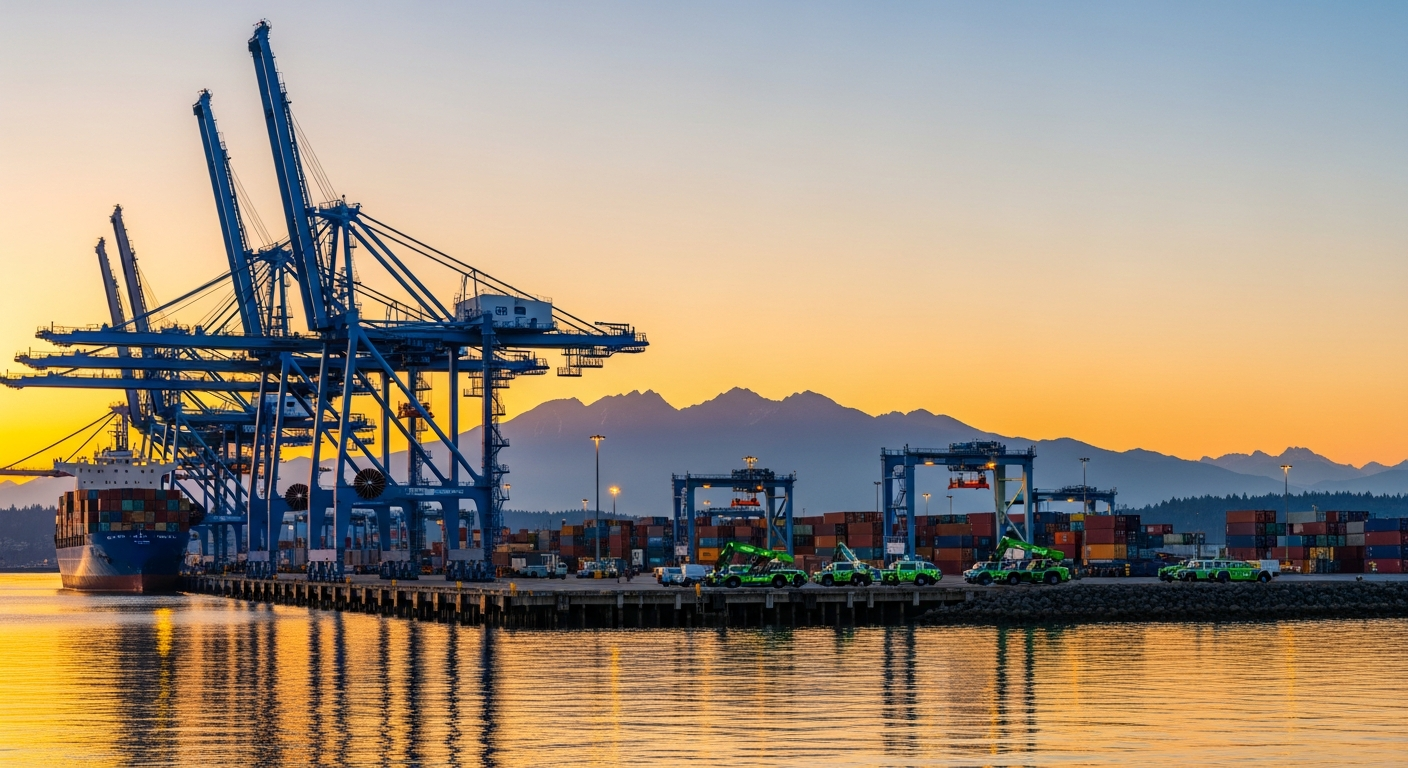
The Port has a $4.3 million grant from the Washington State Department of Transportation through the Washington Port Electrification Program. It funds the Port’s Port Electrification Project, which advances electrification at the Port’s marine terminals and invests in lower- and zero-emission cargo handling equipment.
Work starts later this year.
What that means in practice: the Port’s marine terminals — Pier 1, Pier 3, the South Terminal area on the working waterfront — are about to get electric infrastructure that supports zero-emission cargo equipment. The funding source matters here. It’s coming from Washington’s Climate Commitment Act, the cap-and-invest program that’s been generating revenue from emissions allowances since 2023 and routing that money into climate-action investments.
So the chain is: Washington’s biggest emitters pay into the cap-and-invest program → WSDOT runs a Port Electrification Program with that money → the Port of Everett gets $4.3 million → Everett’s working waterfront gets electric cargo equipment and the infrastructure to charge it → emissions per ton of cargo keep dropping.
That’s a real money-to-equipment chain, not a slogan. And it ties Everett directly into the politically contested CCA in a way that’s easy to see and easy to point at when the program comes up for renewal or repeal debates.
What This Means for Everett
Three concrete things change because of the recognition and the grant behind it.
Pier 3 gets a quiet upgrade beyond the rebuild. Pier 3 is already getting an $11.25 million federal PIDP grant for structural rebuild that we covered last week. Layered on top of that, the Port Electrification Project adds the electric infrastructure that future cargo equipment will plug into. If you’re a Boeing logistics planner moving oversized parts through Pier 3 — which handles 100% of Boeing’s oversized aerospace components — the long-run picture is a quieter, cleaner Pier 3 where the cranes and yard tractors don’t sit idling on diesel between moves.
Air quality on the working waterfront moves in the right direction. Diesel cargo equipment is one of the meaningful contributors to local air quality on a working seaport. Electrification swaps that out for grid power — which in Snohomish County is largely hydroelectric via Snohomish County PUD. The neighborhoods directly above the Port — Bayside, Northwest Everett — get the air-quality dividend.
The Port positions itself for the next round of grants. Federal and state agencies giving out infrastructure money increasingly have decarbonization criteria built into the scoring. Ports that have already done the operational work — measured emissions, run pilots, executed on grants — score better in the next round. The PSBJ recognition is a marker that gets cited in future applications.
The Quiet Part About Tariffs
The Port’s 2026 budget — adopted late last year — explicitly noted that the Port was working “despite challenges amid changing tariff guidance and market conditions.” That language is specific to the trade environment heading into 2026.
The Operational Excellence award isn’t directly about tariffs, but it’s adjacent. A port that’s running tighter operationally — measuring its emissions in real time, running on data, securing climate grants — is also a port with a better grip on its cost structure when global trade gets choppy. The two stories are the same story, told different ways.
How the Award Connects to the Rest of the Waterfront
The recognition lands in the middle of one of the most active stretches in Port history. Pier 3 is rebuilding. The Segment E bulkhead and wharf project at Port Gardner Landing is in its final phase. Waterfront Place is 95% leased on the residential side and S3 Maritime just opened on the marine services side. Mukilteo waterfront assembly is in motion.
The PSBJ award says, quietly, that the Port can do all of that and still win on environmental operations at the same time. That’s the through-line worth holding onto.
What to Watch For Next
A few specific things will tell you whether the Operational Excellence recognition is real or just a press cycle.
The first is the start of the Port Electrification Project later this year. Watch for procurement notices on electric cargo handling equipment and for shore-power infrastructure permits. Those are the construction-document equivalents of the work being real.
The second is the next iteration of the Puget Sound Maritime Emissions Inventory. The 2021 inventory showed the 51% per-ton emissions drop versus 2005. The next one will tell us whether the trend held through the pandemic-era cargo surge and into 2026 conditions.
The third is the Port’s Climate Change Strategy update. The 16 action categories aren’t static; the strategy is meant to be revisited. Watch for which categories get accelerated and which get reframed as conditions change.
We’ll be tracking all three.
Frequently Asked Questions
Q: When did the Port of Everett win the Puget Sound Business Journal’s Operational Excellence award?
A: The Port of Everett was recognized by the Puget Sound Business Journal in its 2026 Environmental Sustainability Awards, with the Operational Excellence honor announced on May 1, 2026.
Q: What is the $4.3 million Port Electrification grant?
A: It’s a Washington State Department of Transportation grant from the Washington Port Electrification Program, funded by the Climate Commitment Act. The Port of Everett will use it to advance electrification at its marine terminals and invest in lower- and zero-emission cargo handling equipment, with work scheduled to start later in 2026.
Q: What is DAPE — the Port of Everett’s Decarbonization Analytics for Port Equipment program?
A: DAPE is a real-time emissions monitoring and analytics platform the Port piloted in 2025. It identifies operational efficiencies and decarbonization opportunities without requiring new infrastructure investment to do the measuring.
Q: How much has the Port of Everett reduced CO₂ emissions per ton of cargo?
A: The Port reduced CO₂ emissions per ton of cargo by 34% compared to 2016 inventories and 51% compared to 2005 inventories, even as cargo volumes spiked nearly 300% during the pandemic, according to the 2021 Puget Sound Maritime Emissions Inventory.
Q: How many categories are in the Port of Everett’s Climate Change Strategy?
A: The strategy is organized around 16 tailored action categories spanning infrastructure resilience, operational changes, and long-range planning specific to the Port of Everett’s waterfront operations.
Q: What does the Port Electrification Project mean for Boeing’s oversized cargo through Pier 3?
A: Pier 3 handles 100% of Boeing’s oversized aerospace components moving through the Port. The Electrification Project adds the electric infrastructure that future zero-emission cargo equipment will use, alongside the separately-funded $11.25 million federal PIDP grant for Pier 3 structural rebuild.
Q: Who are the Port of Everett’s senior leaders quoted in the announcement?
A: CEO and Executive Director Lisa Lefeber leads Port operations, and Port of Everett Commission President David Simpson chairs the elected commission that sets policy.
Q: How much economic activity does the Port of Everett support?
A: Port activities support more than 40,000 jobs in the surrounding community and contribute $433 million in state and local taxes, and the Port is responsible for the movement of approximately $21 billion in exports.