Q: How does Everett’s proposed utility tax increase affect local businesses?
A: Everett’s proposal to double its utility tax from 6% to 12% would affect businesses both as direct water customers and, in the case of landlords, as pass-through collectors of higher embedded costs. The ordinance goes before the City Council for three readings beginning in April 2026, with a proposed July 1 effective date. No business vote or exemption process exists — if the council approves it, the rate applies to all customers.
Everett’s proposed utility tax increase is getting coverage as a household issue — $10.74 more per month for the average water customer. For businesses, the calculation is more complex, the dollar impact is larger, and the timeline requires action now to plan ahead.
Direct Costs: Business Water Is Priced on Volume, Not Average Households
The $10.74 per month figure is the city’s estimate for the average residential customer. Commercial water accounts are metered differently and billed at higher volumes — a restaurant, laundry, car wash, or office building with significant water consumption will see larger absolute increases than a single-family household.
The rate structure change is proportional: the underlying 12% tax replaces the 6% PILT at all tiers. Businesses with high water use — food service, commercial laundry, building services, manufacturing — should pull their last three billing statements and model what a 6-point rate increase on the water/sewer line means in actual dollars per month. For a restaurant paying $800/month in water and sewer, the increase is approximately $80/month, not $10.74.
Commercial Landlords: Embedded Costs and Tenant Leases
Commercial landlords in Everett face a specific planning issue depending on their lease structures. Net leases that pass utility costs through to tenants directly will see the cost absorbed by tenants automatically. Gross leases where the landlord pays utilities and bundles the cost into rent require the landlord to absorb the increase or — depending on lease terms — pass it through.
If you own commercial property in Everett with gross lease arrangements, review those lease agreements now. Many commercial leases include provisions for pass-through of government-imposed tax increases; the utility tax, as a formal municipal tax (not simply a rate increase), may fall within that language. Consult your lease agreements and, if needed, a commercial real estate attorney before July 1.
Residential landlords whose tenants pay utilities directly will not see direct impact — their tenants absorb the rate change. Landlords whose buildings include water in the rent may face higher operating costs at lease renewal, which is the standard time to adjust rental rates accordingly.
How the Wholesale Cascade Works for County Businesses
Many businesses operating in Snohomish County outside Everett’s city limits — Lynnwood, Mukilteo, Edmonds, Marysville, and others — are served by utilities that purchase wholesale water from Everett. City Finance Director Mike Bailey explained the mechanism to the Everett Herald: “Our tax will be embedded in wholesale water costs, and then other cities can do what they will with their utility taxes.”
This means a business in Lynnwood or Mountlake Terrace served by a utility that purchases from Everett will see the increased tax embedded in the wholesale price their utility pays — and that utility may pass the cost through to customers. The extent and timing of that pass-through depends on each individual utility’s rate-setting process and schedule.
Businesses in these communities should contact their local water utility to understand when and how the increased wholesale cost will be reflected in their rates.
The Budget Context: What Comes After the Utility Tax
The utility tax would close approximately $7.5 million of Everett’s projected $14 million budget deficit for 2027. The remaining gap — roughly $6.5 million — has not yet been addressed by a specific public proposal. Options under city consideration include regionalizing library or fire services and a property tax levy lid lift (which would require voter approval).
For business owners engaged in Everett’s economic development ecosystem — particularly those involved in commercial real estate, workforce housing, or downtown development — the utility tax decision is part of a larger picture of how Everett finances its growth. The Millwright District Phase 2, the $120 million stadium proposal, and Sound Transit’s Everett Link Extension are all long-term economic bets; the city’s capacity to invest in those bets depends on resolving its structural revenue problem. The utility tax is one piece of that solution.
What Business Owners Can Do Before the Vote
The Everett City Council is taking three readings on the ordinance beginning in April 2026. The Everett Chamber of Commerce and the Snohomish County Economic Alliance are both tracking the proposal. Business owners who want to engage can:
Attend Everett City Council meetings and participate in public comment during the three-reading period
Contact the City of Everett’s Business Resource Center about any assistance programs or exemption processes (note: no business exemption has been announced)
Engage through the Everett Chamber to coordinate a collective business community voice on the proposal
Review commercial lease agreements for utility tax pass-through provisions before July 1
Frequently Asked Questions for Business Owners and Landlords
Q: Is there a business exemption from the utility tax increase?
A: No business exemption process has been announced. The rate change, if approved, applies to all water and sewer customers — residential and commercial.
Q: How do I calculate my specific impact?
A: Pull your last three utility bills and identify the water and sewer charges. Apply a 6% increase to those charges (doubling the embedded rate from 6% to 12%) to estimate your monthly increase. Large commercial users will see proportionally larger absolute increases than the $10.74 residential average.
Q: When does the ordinance take effect and what’s the approval process?
A: Three council readings begin in April 2026. The proposed effective date is July 1, 2026. No public vote is required — council approval through the ordinance process is sufficient.
Q: What if my business is located outside Everett but served by a utility that buys from Everett?
A: Your utility will absorb the increased wholesale cost and may pass it through to customers in future rate adjustments. Contact your local water utility for their timeline and plans.
Q: What assistance is available for businesses struggling with utility costs?
A: No specific commercial utility assistance program has been announced. The city’s stated assistance program expansion is targeted at low-income residential customers. Contact the City of Everett Business Resource Center for current programs.
This is the first article in the Carrier & TPA Strategy cluster under The Restoration Operator’s Playbook. The previous clusters describe operational discipline, AI deployment, senior talent, and the end-in-mind decision frame. This cluster goes deep on the external relationship that determines whether all of that operational excellence can actually produce profit.
The carrier is not an obstacle
The carrier is not an obstacle.
The way most restoration companies talk about their insurance carrier and TPA relationships, internally and informally, would suggest that the carriers are obstacles to be navigated rather than partners to be cultivated. The adjuster is the person who pushes back on scope. The TPA is the layer that slows down approvals. The program is the bureaucratic structure that complicates the work. The conversations among operators about specific carriers and specific TPAs are often colored by frustration, sometimes by resentment, and almost always by a sense that the relationship is fundamentally adversarial.
This framing is understandable. It is also strategically expensive. The carrier and TPA relationship is, for any restoration company that does insurance-funded work at meaningful volume, the single largest determinant of whether the company can be profitable. The relationship is not adversarial by nature. It is adversarial when both sides are operating from misaligned incentives, poor communication, or accumulated mistrust. It is collaborative when both sides have built the relationship deliberately and operate from a shared understanding of what each side needs.
The companies that have figured out how to operate the carrier relationship as a strategic asset run materially different economics than the companies that have not. They get faster approvals, fewer scope disputes, better program standing, more referral flow, and more predictable revenue streams. Their senior teams spend less time fighting carriers and more time building the operating system that the rest of this playbook describes. The compounding effect, across years, is significant.
This article is about why the carrier relationship is a strategic asset rather than an operational burden, what the companies operating it well are actually doing differently, and why the framing shift from adversarial to strategic is one of the most consequential mental moves an owner can make.
What the carrier and TPA actually need
What the carrier and TPA actually need.
To operate the relationship as a strategic asset, the operator has to understand what the other side actually needs. The honest answer is more specific than the framing of “carriers want to pay less” suggests.
The carrier needs predictable claim outcomes. Predictability means the claim closes in a defensible time, at a defensible cost, with documentation that protects the file from subsequent dispute. A claim that closes fast, cheap, and clean is a good claim from the carrier’s perspective. A claim that drags on, reopens, gets disputed, or produces customer complaints is a bad claim regardless of the dollar amount.
The carrier needs adjusters and supervisors to be able to defend their files internally. Adjusters work in environments where their files are reviewed by supervisors, audited by quality teams, and sometimes scrutinized by leadership when patterns emerge. The adjuster needs the contractor relationship to produce files that the adjuster can defend in any of those review settings. A contractor who consistently produces files that read well, support clean decisions, and avoid the patterns that trigger audits is a contractor who makes the adjuster’s job easier. That contractor gets more work over time.
The carrier needs to manage cycle time. Carriers measure cycle time at the file level, the adjuster level, and the program level. Long cycle times produce customer complaints, increase reopen rates, and consume internal resources. Contractors who consistently shorten cycle times — by responding fast, scoping accurately, executing on schedule, and closing cleanly — are valuable to the carrier in ways that show up in program decisions and referral flow.
The TPA needs all of the above plus a layer of consistency that scales across many contractors and many adjusters. The TPA’s value proposition to the carrier is that they manage the contractor network at scale. They need contractors who fit cleanly into their processes, who hit their quality benchmarks, and who do not require special handling. A contractor who is operationally consistent and cooperatively engaged with the TPA’s processes is a contractor who gets favorable placement. A contractor who is constantly negotiating exceptions, missing benchmarks, or creating noise in the TPA’s systems is a contractor who eventually gets squeezed out of program work.
None of these needs are mysterious. None of them are at odds with what a serious restoration company is trying to do operationally. The contractors who understand the needs and operate to satisfy them are not selling their souls. They are running disciplined operations that happen to be well-aligned with what their carrier and TPA partners need.
What the operator needs from the carrier and TPA
The relationship operates well only when both sides’ needs are being met. The contractor side of the equation is also specific.
The contractor needs scope decisions that reflect the actual conditions of the loss. A scope that has been arbitrarily reduced to fit a carrier’s budget assumption produces work that the contractor either has to do at a loss or has to compromise on quality. Either outcome damages the contractor’s economics or reputation. The relationship requires the carrier to make scope decisions based on the file’s actual merits.
The contractor needs approvals to move at a pace that matches the work. A scope that takes three weeks to approve while the homeowner is displaced creates customer experience problems that fall on the contractor regardless of who caused the delay. The relationship requires the carrier and TPA to operate approval workflows that match the operational rhythm of restoration work.
The contractor needs predictable rules of engagement. Carriers and TPAs that change their guidelines frequently, apply rules inconsistently across adjusters, or surprise contractors with new requirements mid-job make planning impossible. The relationship requires consistent and clearly communicated expectations.
The contractor needs fair recognition of value delivered. Contractors who produce above-program work — better customer satisfaction, faster cycle times, lower reopen rates — should see that performance reflected in program standing, referral flow, or pricing flexibility. Carriers and TPAs that treat all contractors identically regardless of performance erode the incentive to outperform.
When both sides’ needs are being met, the relationship is collaborative. When either side feels chronically taken advantage of, the relationship becomes adversarial regardless of any individual’s intentions. The companies operating the relationship well have invested in making sure both sides’ needs are visible to the other side and addressed deliberately.
The strategic value of the relationship at scale
For a restoration company doing meaningful volume of insurance-funded work, the carrier and TPA relationship represents a strategic asset whose value far exceeds the dollar value of any individual job.
The relationship determines program access. Restoration companies that are on preferred contractor programs receive a steady flow of work that does not have to be earned individually. The flow is predictable enough to support hiring decisions, capacity planning, and longer-term operational investments. Companies that lose program standing or that never achieve it have to earn each job individually through marketing and competitive bidding, which is structurally less efficient.
The relationship determines pricing flexibility. Carriers and TPAs that trust a contractor are willing to approve pricing that reflects the contractor’s actual cost structure rather than program defaults. Trusted contractors get scope items approved that less-trusted contractors would have to fight for. Across thousands of files per year, the pricing flexibility differential is meaningful.
The relationship determines referral flow. Adjusters who have positive working relationships with specific contractors tend to refer customers to those contractors when given the choice. Even within program structures that nominally distribute work algorithmically, individual adjusters have enough discretion that contractor preference shapes referral patterns over time.
The relationship determines cycle time efficiency. Trusted contractors get faster approvals, faster supplemental decisions, faster payment, and lower friction across every interaction. The cycle time efficiency translates directly into operational efficiency, which translates into margin.
The relationship also determines the contractor’s exposure to systemic carrier decisions. Carriers periodically tighten programs, restructure panels, change pricing, or impose new requirements. Trusted contractors are usually consulted in advance, given time to adapt, and given input into the changes. Untrusted contractors find out about changes after they are imposed and have to scramble to comply or lose program standing.
Each of these effects is meaningful in isolation. Together, they constitute a strategic asset that compounds across years. Companies that operate the relationship well are running structurally different economics than companies that operate it poorly, and the difference is mostly invisible from the outside.
The mental shift that unlocks the relationship
The shift from treating the carrier as an obstacle to treating the relationship as a strategic asset is mostly mental. The operational mechanics that follow from the shift are real, but they flow from the underlying frame change.
The frame change asks the operator to recognize several things about the carrier and TPA simultaneously. The people on the other side of the conversation are professionals trying to do their jobs in environments with constraints the operator does not see. The carrier as an institution has interests that are not always aligned with the contractor’s interests but that are usually rational from the carrier’s perspective. The relationship is durable enough to absorb individual moments of friction without permanent damage if both sides handle the moments well. The long-term value of the relationship far exceeds the dollar value of any individual scope dispute or cycle-time complaint.
Operators who have made the frame change describe a noticeable change in how they engage with the carrier and TPA after the change. The conversations are less defensive. The negotiations are more collaborative. The moments of friction get worked through faster. The institutional relationship deepens. The strategic value of the relationship begins to compound.
The frame change also has internal effects. Operators who treat the carrier as an obstacle tend to model that frame for their teams, which produces a culture where the carrier is the enemy. The culture then produces operational behaviors — defensive documentation, combative communication, slow responses — that confirm the carrier’s worst assumptions about the contractor. The cycle reinforces itself in a downward spiral. Operators who treat the carrier as a partner produce the opposite culture and the opposite cycle. The internal cultural effect of the frame is at least as significant as the external relational effect.
What this looks like inside the company
What this looks like inside the company.
Companies that have made the frame shift visible in their daily operations have built specific practices that reflect and reinforce it.
The first practice is professional and respectful communication with carrier and TPA contacts at every level. This includes scope conversations, approval requests, dispute discussions, and routine file management. The communication is direct without being adversarial, persistent without being aggressive, and consistently professional regardless of the immediate friction. Contractors who maintain this standard across their entire team — not just the senior leaders — are recognized as different by the people on the other side of the conversation.
The second practice is investment in the relationship beyond the immediate work. Periodic check-ins with adjusters and TPA contacts, attendance at program meetings, participation in carrier-sponsored events, and willingness to provide informal advice or perspective when asked. The investment does not have to be elaborate. It has to be consistent. The relationships that result produce returns over years.
The third practice is honest and proactive communication when things are going badly on a file. Contractors who tell the carrier early about problems — discovered conditions, schedule slips, cost overruns, customer issues — preserve the relationship in ways that contractors who hide problems until they become crises do not. The proactive disclosure feels uncomfortable in the moment. It pays back across the relationship.
The fourth practice is internal accountability for relationship quality. The senior team treats the carrier relationship as something to be tended deliberately, with explicit responsibilities, regular review, and measurable indicators of relationship health. Companies that drift on relationship quality without internal accountability find themselves in deteriorating relationships without knowing why.
The fifth practice is hiring and training people who can hold the frame consistently. Operators who default to combative engagement with carriers undo the frame regardless of leadership messaging. The team has to be staffed with people whose temperament and training support the strategic frame, and the training has to reinforce it explicitly when new hires join.
What this means for owners deciding now
If you run a restoration company and your team’s culture treats the carrier and TPA as obstacles, the practical implication of this article is that the cultural framing is leaving strategic value on the table that can only be recovered through deliberate work over time.
The starting point is the owner’s own framing. The team will not treat the relationship strategically if the owner does not. The owner has to model the strategic frame in their own communication, their own decisions about which fights to pick and which to walk away from, and their own visible respect for the people on the other side of the relationship.
The medium-term work is to build the practices described above into the operational rhythm of the company. Communication standards. Investment in the relationships beyond immediate work. Proactive disclosure of problems. Internal accountability for relationship quality. Hiring and training that reinforce the frame.
The long-term result is a carrier and TPA relationship that compounds in value across years and that becomes one of the company’s most durable strategic assets. The companies that have built these relationships well are quiet about how they have done it, because the advantage is real and the incentive to teach competitors is low. The owners who recognize the value and invest in building it now will, in five years, be operating with a strategic asset that competitors who continue treating the relationship adversarially cannot easily replicate.
The carrier is not an obstacle. The relationship is the asset. The frame shift is the move.
Next in this cluster: scope discipline — how the best companies defend their numbers without burning the relationship, and what the operational practices that produce defensible scope actually look like in 2026.
The previous articles in this cluster have applied the end-in-mind frame to operational decisions inside the restoration job and to the customer relationship that extends beyond it. There is a third frame, larger than either of those, that most owners only think about in the moments when they are forced to. It is the frame that asks: what are you actually building this company toward?
The honest answer for most owners is that they have not articulated one. The company exists. It generates income. It supports the owner’s family and the families of the team. It produces work the owner is generally proud of. It is, in a vague way, getting better year over year. But the explicit question of what it is supposed to look like in ten or twenty or thirty years — what the owner wants to hand off, what the owner wants to sell, what the owner wants to be remembered for building — is rarely articulated and even more rarely used as a filter for the decisions the owner makes in the present.
This is a strategic gap. Not a moral failure. The day-to-day demands of running a restoration company consume nearly all the cognitive bandwidth available to most owners, and the long-term articulation work feels like a luxury that can be done later. Later usually never comes, and the company that emerges across decades is the company that the accumulated daily decisions produced rather than the company the owner intended to build.
This article is about closing that gap. About what the owner’s own end-in-mind looks like when articulated. About how the articulation changes the daily decisions the owner makes. And about the specific exercises owners can do to bring their long-term picture into focus enough that it can actually function as a decision filter.
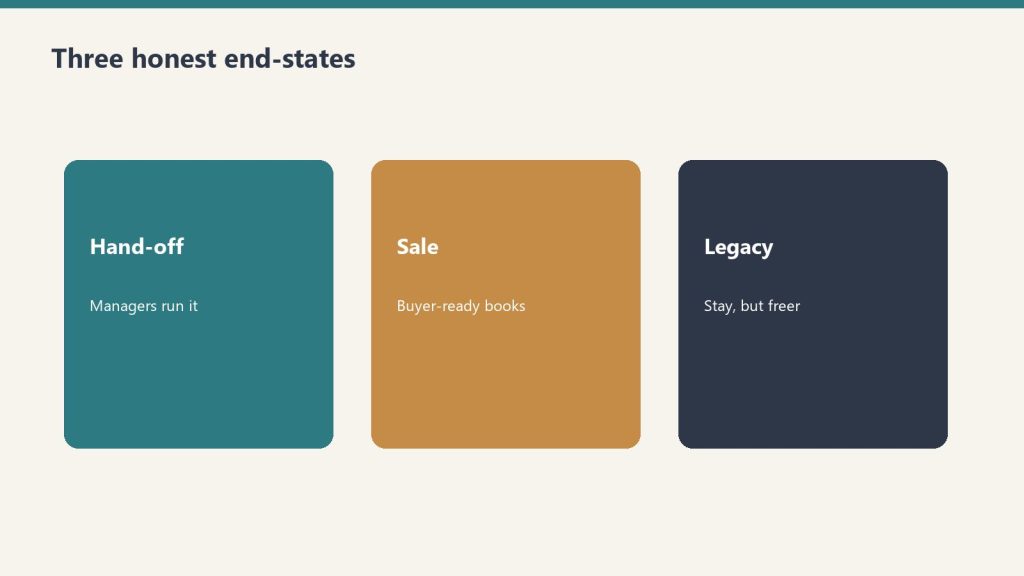
The three honest end-states
Hand-off, sale, or legacy — pick one and work backward.
For most restoration owners, the long-term end-state of the company falls into one of three categories. Articulating which category the owner is actually pursuing is the first step in making the rest of the decisions deliberately.
The first category is hand-off. The owner intends to transfer the company, eventually, to a successor — typically a family member, a long-tenured senior operator, or a partnership of senior operators — and to step back from active involvement while the company continues operating under the new leadership. The hand-off may include continued financial participation by the original owner or may be a clean transition. The defining characteristic is that the company continues as an operating business after the owner’s active involvement ends, with continuity of identity and culture.
The second category is sale. The owner intends to sell the company, eventually, to an external buyer — typically a strategic acquirer, a private equity firm, or a roll-up platform — and to monetize the value the company has built. The sale may be partial or full, may involve continued operating involvement by the owner for a period, may include earn-outs or equity rolls, but the defining characteristic is the conversion of operating equity to liquid capital at a defined point.
The third category is legacy operation. The owner does not intend to hand off or sell, at least not in the foreseeable future. The company exists as the owner’s professional life work, and the owner intends to operate it for as long as they can. The end-state is the owner’s own retirement or the natural conclusion of their working life, at which point the company may be dissolved, sold, or transitioned in whatever way circumstances dictate, but those decisions are not actively being planned for.
Each of these end-states is legitimate. Each requires different daily decisions to be optimized for. The owner who is unclear about which end-state they are pursuing makes daily decisions that are inconsistent with each other and that, in aggregate, produce a company that is not optimized for any of the three.
What the hand-off end-state requires
Hand-off requires managers who already own the week.
The owner pursuing a hand-off has to build the company to be a coherent operating system that can run effectively without the owner’s continued involvement. This is a structurally different requirement than the other two end-states.
The operating system has to be documented to a level that allows the next leadership to operate it. This is the documentation work described throughout this playbook, applied not just to the operational standards but to the strategic decision frameworks, the customer relationship management practices, the senior team development approaches, and the cultural standards that have made the company what it is. The successor needs to be able to read what the company is and how it operates without having to extract it from the owner’s head over years.
The senior team has to be developed to the point that the next leadership can be drawn from inside the company or, if drawn from outside, can be supported by an internal team that does not require the owner to fill the gaps. This requires explicit succession planning, deliberate development of senior operators into broader roles, and the kind of career path investment described in the senior talent career path article. The owner who has not built a senior team capable of running the company without them does not have a hand-off option, regardless of their stated intentions.
The cultural identity of the company has to be explicit and durable. A company whose identity is wrapped up in the owner’s personality cannot survive a hand-off intact, because the personality leaves with the owner. The cultural identity has to be embodied in practices, standards, and people in ways that survive the transition. The companies that have done this well typically have founders who have been deliberately working to depersonalize the culture for years before the hand-off, even when that work was uncomfortable in the short term.
The financial structure has to support the hand-off without crippling the company or the successor. Hand-offs to internal successors usually involve some form of structured buyout that is paid out of the company’s continuing operations over years. The structure has to leave the company with enough operating capital to continue thriving and the successor with enough financial flexibility to manage the transition. Owners who do not plan this structure deliberately end up with hand-offs that financially strain the company or the successor or both.
The owner who has articulated the hand-off end-state and who is operating from it makes daily decisions that look different from the decisions of an owner without that articulation. Investments in the operating system are made with longer time horizons. Senior team development is treated as the central strategic priority. Cultural transmission is deliberate. The company that emerges is the company that can survive and thrive without the original owner’s daily presence.
What the sale end-state requires
Sale readiness is process + books — not a brochure.
The owner pursuing a sale has to build the company to be a maximally attractive acquisition target at the time of the eventual sale. This is also a structurally different requirement than the other two end-states.
The financial profile has to be the kind of profile that buyers reward. Consistent revenue growth, strong margins, predictable cash flow, low customer concentration, low key-person dependency. Buyers will pay materially higher multiples for companies that have these characteristics than for companies that do not. Owners who are not paying attention to the financial profile that buyers will eventually evaluate are leaving meaningful sale value on the table.
The operational maturity has to be high enough that the buyer’s diligence will conclude favorably. Documented operational standards, defensible margin structure, clear competitive positioning, low operational fragility. Buyers who find significant operational issues during diligence will discount their offer or walk away. Owners who have built operational maturity for its own sake throughout the company’s life are well-positioned for sale. Owners who have papered over operational weaknesses are about to discover them in diligence at the worst possible moment.
The senior team has to be deep enough that the buyer can imagine the company continuing to operate after the owner’s eventual departure. Buyers worry about key-person risk because they should. A company that depends entirely on the owner is a company that the buyer cannot reliably operate after the sale, which depresses the value of the acquisition. The senior team development work described in this playbook is, among other things, sale preparation work even when the owner has not yet articulated the sale end-state.
The customer relationships have to be structured in ways that survive the sale. Customer relationships that depend personally on the owner cannot be transferred to a buyer cleanly. Customer relationships that are managed by the company’s processes and team can be. Owners who have built strong personal relationships with their largest customers without building parallel institutional relationships are creating a sale-time problem that will reduce the company’s value.
The owner pursuing a sale who has articulated the end-state and who is operating from it makes daily decisions that look different from the decisions of an unfocused owner. Investments are made with attention to their effect on enterprise value. The senior team is developed with attention to its impact on diligence outcomes. The financial reporting is built to a quality that will pass institutional scrutiny. The company that emerges is one that buyers will pay strong multiples for at the time of sale.
What the legacy operation end-state requires
The owner pursuing a legacy operation — the company as their professional life work, with no defined exit — has the most freedom about how to run the company day to day, and also the most ambiguity about what they are actually optimizing for.
The legacy operation requires the owner to be honest about why they are choosing this end-state. The honest reasons are usually some combination of the following. The owner loves the work and does not want to step back. The owner has built something they are proud of and does not want to see it changed. The owner is part of a community that the company serves and does not want to abandon that responsibility. The owner has not found a successor or a buyer they trust enough to transition to. Each of these is a legitimate reason. Each has implications for how the company should be run.
The legacy operation also requires the owner to think about what happens at the natural end of their active involvement. Even owners who do not plan to retire will eventually retire, voluntarily or otherwise. The company that has not been prepared for this transition will be sold under duress, dissolved unhappily, or transitioned to whoever happens to be available rather than to the right successor. Owners who claim the legacy operation end-state but who never actually plan for the eventual transition are deferring a decision rather than deciding.
The legacy operation also requires the owner to think about what they want the company to mean to the people who work in it. A company that is fundamentally an extension of the owner can be a wonderful place to work for the people who are aligned with the owner’s vision and a difficult place for the people who are not. The cultural design of the company is more personal in the legacy operation end-state than in the other two, and the owner has to be deliberate about what they want that culture to be.
The owner who has articulated the legacy operation end-state and who is operating from it consciously can build a company that is genuinely satisfying to run for decades. The owner who has defaulted into the legacy operation end-state because they have not articulated any other end-state usually ends up with a company that is harder to run than it needed to be, with operational decisions that have been made by accumulation rather than by design.
The articulation exercise
For owners who have not yet articulated their own end-in-mind, the exercise to do so is straightforward but not easy. It requires the owner to spend several hours in honest reflection about what they are actually trying to build and why.
The first question is about the time horizon. What does the owner want their relationship with the company to look like in ten years? In twenty? At the natural end of their active working life? The answers do not have to be precise. They have to be honest enough to surface which of the three end-states the owner is actually pursuing.
The second question is about the people. What does the owner want the senior team to look like at the end of the planned horizon? Who is on it? What roles do they have? What is the relationship between the owner and them? The answers reveal whether the owner is investing in a senior team appropriately or whether the senior team is treated as a tactical resource rather than a strategic asset.
The third question is about the customers. What does the owner want the company’s relationship with its customers to look like at the end of the planned horizon? What does the company’s reputation in its market look like? What does the company’s customer base look like? The answers reveal whether the owner is operating from the customer lifetime frame or from the transaction frame.
The fourth question is about the work itself. What does the owner want the company to be known for in its market and in the industry? What kind of work does the company do? What kind of work does the company decline? The answers reveal whether the owner has a clear identity for the company or whether the company is whatever the next job demands.
The fifth question is about the financial outcome. What does the owner want the company to be worth at the end of the planned horizon? What does the owner want the financial outcome of their work to be? The answers reveal whether the owner is building a financially serious enterprise or running a sole-proprietor income generator that will not produce significant financial outcome at the natural conclusion.
None of these questions has a right answer. All of them have answers that, once articulated, change how the owner makes the daily decisions that accumulate into the company’s actual trajectory. Owners who do this articulation exercise once and then revisit it annually as conditions evolve produce companies that look like the company the owner actually intended. Owners who never do the articulation exercise produce whatever the daily decisions happen to produce.
The practice that closes the gap
The owner’s end-in-mind is useful only if it actually filters daily decisions. The articulation by itself produces nothing. The integration of the articulation into the daily flow of decision-making is what produces the result.
The companies whose owners have done this well tend to have built the integration through several specific practices. The owner reviews the long-term picture quarterly and asks whether the recent quarter’s decisions have moved the company toward or away from it. The owner makes major decisions explicitly through the lens of the end-state, asking whether the decision is consistent with what they are trying to build. The owner shares the long-term picture with the senior team and uses it to anchor strategic conversations across the leadership group. The owner protects time for thinking about the long-term picture even when the short-term operational pressures would consume that time.
None of these practices is exotic. All of them require the owner to treat the long-term articulation as a real working tool rather than as a one-time exercise that gets filed away. The companies whose owners maintain these practices end up looking, in twenty years, like the companies the owners articulated they wanted to build. The companies whose owners did the articulation once and never returned to it end up looking like whatever happened.
The cluster ends here
The five articles in this cluster describe the end-in-mind frame applied at four levels. The decision-by-decision level. The customer-relationship level. The subcontractor-network level. And the owner’s own life-work level. Each level operates on different timescales and requires different practices to install. All of them work together as a coherent decision logic that, applied consistently across years, produces companies that are visibly different from companies operating from the default frame.
The end-in-mind logic is, in the end, the deepest of the operational disciplines this playbook describes. Tools change. AI capabilities evolve. Talent markets shift. Carrier dynamics adjust. The companies that internalize end-in-mind thinking adapt to all of these external changes from a stable internal foundation. The companies that operate from local optimization react to each change without a coherent frame and end up perpetually catching up.
The End-in-Mind Operations cluster is closed. The remaining clusters in The Restoration Operator’s Playbook will address carrier and TPA strategy, crew and subcontractor systems, restoration financial operations, and the modern restoration marketing stack. Each of those clusters compounds with this one and with the previous three. The full body of work, when complete, gives operators a durable mental architecture for the industry’s most consequential decade.
The companies that read this body of work and act on it will know what to do. The rest will find out later.
The customer does not know which work was done by your company
A homeowner who has just had their flooded kitchen restored does not, when standing in the finished space, distinguish between work performed by the restoration company’s own crew and work performed by a subcontractor the company brought in. The homeowner sees a finished kitchen. The kitchen looks the way it looks because of choices made by everyone who touched the job — the mitigation tech, the rebuild estimator, the project manager, the cabinet installer, the painter, the floor installer, the trim carpenter, the electrician, the plumber, and any other trade involved. Each of those choices contributes to the final result. The homeowner experiences the aggregate.
From the company’s internal perspective, there is a meaningful distinction between the company’s own employees and the subcontractors. From the homeowner’s perspective, there is no distinction. The work is the company’s. The result is the company’s. The reputation that follows from the job is the company’s, regardless of which trade actually held the brush or the trowel.
This asymmetry — internally a clear distinction, externally none — is the central fact that makes subcontracting an end-in-mind decision in restoration. The choice of which subs to pair with, the standards those subs are held to, the briefing they receive, the oversight they get during the work, and the accountability they have when something goes wrong all directly determine what the homeowner experiences and what the homeowner tells other people. The companies that have internalized the customer lifetime frame treat sub selection as a strategic capability rather than a procurement function. The companies that have not still treat it as a price negotiation.
This article is about what end-in-mind subcontracting actually means in practice, what kind of sub network it requires, and why building one of these networks is one of the highest-leverage long-term investments a restoration company can make.
The default subcontracting model and what it produces
The default subcontracting model and what it produces.
The default subcontracting model in restoration is built around price and availability. When a job needs a sub, the project manager calls the subs they have used before and picks the one with the best combination of availability, price, and past performance. The performance criterion exists but tends to be the third or fourth tiebreaker rather than the primary filter. The price criterion tends to be the primary filter, often because the company’s bidding model has built in a sub cost assumption that requires the cheaper sub to be picked.
This model produces predictable results. The sub network is broad and shallow. The company has working relationships with twenty or thirty subs across various trades, none of whom feel like a deeply preferred partner, all of whom can be substituted for one another based on the day’s availability. The subs in turn experience the company as one customer among many, with no particular loyalty or accountability owed in either direction. The work the subs produce reflects this dynamic. It is competent. It is not exceptional. It satisfies the operational requirements of the job and does not particularly delight the homeowner.
The aggregate effect, across thousands of jobs per year, is a customer experience that depends substantially on which subs happen to have been on the job. Some jobs come together with a strong combination of subs and produce excellent customer outcomes. Other jobs come together with a weaker combination and produce mediocre outcomes. The variance is high, the average is acceptable, and the company does not have a reliable way to systematically lift the floor.
This is the operational reality of most restoration companies in 2026. It is not the result of bad project managers or bad subs. It is the result of a subcontracting model that treats sub selection as a tactical procurement question rather than a strategic capability question.
The end-in-mind subcontracting model and what it produces
The alternative model treats the sub network as part of the company’s operating system rather than as a procurement vendor pool. The choice of subs is made based on whether the sub produces work that supports the customer experience the company is trying to deliver, with price as a constraint rather than as the primary criterion.
The companies operating from this model build a deep relationship with a small set of subs in each critical trade. Two or three flooring installers, not twenty. Two cabinet installers, not ten. A small handful of trim carpenters, painters, electricians, plumbers. The relationships are deep enough that the subs feel like extended members of the team rather than external vendors. The subs in turn feel a level of accountability and pride about the work they do for this customer that they do not feel for their other customers.
The work these subs produce is visibly different from the work the broader sub pool produces. The cabinet installer who has done two hundred jobs with the same restoration company knows the company’s standards, knows the kind of customers the company serves, knows the level of finish detail expected, and brings a level of care to each job that is not negotiable for them. The flooring installer who has been part of the inner circle for years knows how to handle the transition details that the rebuild estimator did not specify because they did not need to be specified — the inner circle understands the standards implicitly. The trim carpenter shows up to the job knowing what is expected and produces work that consistently meets the bar.
The aggregate effect is a customer experience that is more consistent across jobs and that systematically reaches a higher level than the broad-pool model can reach. The variance drops. The floor lifts. The homeowner’s eventual story about the job is shaped by craftsmanship rather than by lucky combinations of subs. The reputation effects that follow are correspondingly different.
What it takes to build the inner-circle sub network
What it takes to build the inner-circle sub network.
The inner-circle sub network is not free and is not built quickly. The companies that have built one have done specific work over years that the procurement-model companies have not done.
The first piece of work is identifying the right subs to invest the relationship in. This requires the company to actually know what good work looks like in each trade — what a properly installed cabinet looks like up close, what a properly executed paint job looks like under raked lighting, what a properly fitted trim joint looks like in profile. Companies that do not know what good work looks like cannot select for it. The senior operators in the company have to develop this trade-specific aesthetic eye, often by spending time on jobs alongside the best subs and learning to see what those subs are doing differently.
The second piece of work is paying the inner-circle subs at a level that reflects the relationship and the work they produce. Inner-circle subs cannot be paid at the bottom of the market and asked to produce top-of-market work. The pricing has to reflect the partnership. This requires the company’s bidding model to be built around inner-circle pricing assumptions rather than commodity pricing assumptions, which means the company’s bid prices may be slightly higher than competitors who are bidding around commodity sub costs. The inner-circle subs in turn justify the higher pricing through the work they produce and through the lower long-term cost of their work — fewer callbacks, fewer disputes, faster execution because of familiarity.
The third piece of work is treating the inner-circle subs as members of the team in operational terms. They are included in pre-job conversations when their trade is involved. They are given context about the homeowner and the job that goes beyond the bare scope. They are invited to participate in operational standards work in their trade. They are recognized when their work produces a standout customer outcome. The treatment is what makes the relationship feel different from a procurement relationship and is what produces the engagement that the work requires.
The fourth piece of work is holding the inner-circle subs to standards that are higher than the standards typical sub relationships maintain. The inner-circle subs cannot be a comfort zone where standards slip because of the relationship. The opposite is true. The inner-circle subs have to be the trades whose work consistently meets the highest bar in the local market. When an inner-circle sub’s work slips, the company has to address it directly and quickly, treating the conversation as a maintenance of the relationship rather than as a betrayal of it. Subs who cannot maintain the standards over time eventually rotate out of the inner circle. The bar holds.
The fifth piece of work is investing in the subs’ growth alongside the company’s. Inner-circle subs who are growing into larger crews, taking on more jobs, developing new capabilities, are more valuable over time than inner-circle subs who are stagnant. The relationship works best when both sides are investing in each other’s long-term success. Companies that find their inner-circle subs are stuck in place may need to reconsider whether those subs are actually the right long-term partners or whether the relationship has become a comfort zone for both sides.
The economics of the inner-circle network
The economics of the inner-circle network.
The inner-circle subcontracting model has different economics than the procurement model, and owners considering the shift should understand both sides of the math.
The cost side is real. Inner-circle subs typically cost more per job than commodity subs in the local market. The premium varies by trade and by market but tends to run in the range of ten to twenty percent. Across the company’s annual sub spend, the premium is meaningful and has to be planned for in the bidding model.
The benefit side is also real and tends to outweigh the cost over time. Inner-circle subs produce work that requires fewer callbacks, fewer warranty claims, and fewer customer satisfaction recoveries. The reduction in these costs alone often offsets a meaningful portion of the sub price premium. Inner-circle subs also execute faster, because of familiarity with the company’s standards, which compresses cycle time and reduces the company’s overhead burden per job. Inner-circle subs produce work that drives higher customer satisfaction, which drives the lifetime value increase described in the customer lifetime frame article. Across thousands of jobs per year, the lifetime value impact is significant.
The economics are favorable for companies that have built the network well and that are operating from the customer lifetime frame. The economics are unfavorable for companies that have built the network poorly — paying the premium without getting the standards, selecting subs based on relationship rather than craftsmanship — and for companies that are still operating from the transaction frame and cannot capture the lifetime value benefits that justify the cost premium.
The honest math, in other words, depends on the rest of the operating system being in place. The inner-circle subcontracting model is an investment that pays back when the company can capture the value the model produces and that does not pay back when the company cannot.
The strategic asset that the network becomes
For companies that have built the inner-circle network and that are operating it well, the network becomes a strategic asset that competitors cannot easily replicate.
The asset is durable because the relationships are years old and have been maintained through ups and downs. A competitor cannot replicate this overnight by offering the inner-circle subs a slightly higher rate. The subs have a working relationship with the original company that involves trust, mutual investment, and a shared understanding of the work that no new entrant can match in the short term.
The asset is defensive because it makes the company harder to compete with on quality. A competitor working with the broader procurement pool cannot consistently match the work product the inner-circle network produces. The competitor’s customer satisfaction outcomes will be more variable and lower on average. Over time, this difference shows up in market reputation and referral flow.
The asset is offensive because it allows the company to take on more complex jobs with confidence. The inner-circle network can handle high-end residential, complex commercial, historical restoration, and other specialty work that the broader sub pool cannot consistently execute. The company can pursue these higher-margin opportunities knowing that the execution capability exists.
The asset is also a recruiting tool for the company’s own employees. Senior operators evaluating where to work pay attention to the quality of the sub network they will be working with. A senior PM who has spent their career fighting with mediocre subs is delighted to join a company where the inner-circle network produces consistent quality. The sub network becomes part of the company’s value proposition to the operators it wants to attract and retain.
The relationship management discipline
The inner-circle network requires ongoing relationship management work that is qualitatively different from the work of running a procurement program. Owners who want to build the network should understand what this work entails before committing to it.
The work includes regular communication with each inner-circle sub that goes beyond the immediate job needs. Quarterly check-ins about how the relationship is going, what is working, what could be better. Periodic recognition of standout work. Clear and prompt communication when standards have slipped, handled in a way that preserves the relationship while maintaining the bar.
The work includes coordination across subs in a way that supports the joint outcome. The cabinet installer needs to know what the painter is going to do. The trim carpenter needs to know what the floor installer has decided. The inner-circle subs need to be talking to each other on jobs where their work overlaps. Companies that have built the network well facilitate these cross-sub conversations, often with the project manager actively brokering the coordination rather than letting it happen by chance.
The work includes managing the rotation of subs in and out of the inner circle as conditions change. Some subs will move on to other markets. Some will retire. Some will fail to maintain the standards. Some new subs will emerge in the local market who are worth investing the relationship in. The inner circle is not static. It requires continuous tending, the same way the company’s senior operator team requires continuous tending.
The work, in aggregate, takes ongoing senior operator attention. It is not a function that can be delegated to a procurement clerk. The companies operating the network well have a senior operator — often the operations leader or a dedicated trade liaison — whose responsibilities include the relationship management work. The investment of senior attention is what makes the network produce the value it produces.
What this means for owners deciding now
If you run a restoration company and your subcontracting still operates on the procurement model, the practical implication of this article is that the shift to the inner-circle model is achievable but takes years and requires owner-level commitment.
The starting point is to identify the two or three subs in your most critical trades whose work is consistently the best you have access to in your local market. Begin investing the relationship with those subs deliberately. Pay them at a level that reflects the relationship. Bring them into operational conversations. Hold them to high standards consistently. Treat them as partners rather than as vendors.
Over the next twelve to twenty-four months, expand the inner circle to additional trades and additional subs in each trade. Build the relationship management discipline that the network requires. Adjust your bidding model to reflect inner-circle pricing assumptions. Begin capturing the customer satisfaction and lifetime value benefits that the model produces.
By year three of the journey, the inner-circle network is a meaningful strategic asset that contributes to the company’s reputation, its recruiting, its margin profile, and its long-term durability. The companies that have made this investment are visibly different from their procurement-model competitors in ways that compound for the rest of the company’s existence.
Subcontracting has been treated as a procurement question in restoration for generations. Treating it as a strategic capability is one of the highest-leverage shifts an owner can make, and the window to make the shift before the rest of the industry catches on is open right now.
Next and final in this cluster: the owner’s own end-in-mind — building the company you want to hand off, sell, or be proud of in twenty years, and how the daily decisions you make about the operation reflect or undermine that long-term picture.
The default operational model in restoration treats the job as a discrete unit of work that begins with the first call and ends with the close-out walkthrough. Inside that frame, the company’s responsibility starts when the loss is reported and ends when the homeowner signs the final paperwork. Everything before is marketing. Everything after is, at most, an occasional review request.
This frame is operationally simple. It is also commercially expensive. It produces companies that treat each homeowner as a single transaction, that invest exactly enough customer experience to satisfy the immediate job, and that move on to the next homeowner once the current one is closed. The compounding value of a homeowner relationship that extends past the job is, in this frame, invisible.
The companies that have grown sustainably and profitably across decades operate from a different frame. The restoration job, in this frame, is not the unit of work. It is the beginning of a customer relationship that the company intends to maintain across years and that will produce, if maintained well, a stream of additional value far in excess of the original job revenue. The customer is not a transaction. The customer is a relationship that begins on the worst day of their year and that the company has the opportunity to make into something durable.
This article is about that frame, what it means in practical terms for how a restoration company invests in customer experience, and what changes in the company’s economics when the frame is internalized.
The compounding value of a maintained relationship
Compounding value of a maintained relationship.
To see why the customer lifetime frame produces materially different economics than the transaction frame, it helps to lay out what a single maintained customer relationship is actually worth across years.
The original job produces some amount of revenue and margin. Call it the baseline. In the transaction frame, the baseline is the entire commercial value of the customer.
The customer lifetime frame includes the baseline plus several additional revenue streams that materialize over the years following the job for customers whose relationship with the company has been maintained.
The first stream is repeat business from the same customer. Most homeowners will experience another loss within ten to fifteen years of the first one. Pipes burst again. Storms hit again. Fires happen. Floods happen. The homeowner who experienced excellent service the first time will, in nearly all cases, call the same company for the second loss. The repeat business itself is sometimes larger than the original loss, depending on the type of incident.
The second stream is referral business from the original customer. A homeowner who had a five-star experience with a restoration company will, on average, refer the company to two to four other people over the course of the following decade. Those referrals are typically people in similar life situations — neighbors, friends, family members — who eventually have their own losses and who call the referred company first. The aggregate referral revenue from a single satisfied customer is, in companies that maintain the relationship well, several multiples of the original job revenue.
The third stream is non-loss work that the company can perform for the same homeowner over time. Restoration companies that have built durable customer relationships often pick up non-emergency work from the same customers — renovations, repairs, maintenance, additional services — that the customer would otherwise have given to someone else. The economic value of this stream depends on the company’s ability to actually service it, but it can be significant.
The fourth stream is the customer’s role as a public reference. A satisfied customer who is asked about restoration companies in their network or community provides a positive recommendation, posts a positive review, mentions the company in conversations, and generally functions as a marketing asset for the company without any cost to the company itself. This stream is harder to measure than the others but is real and compounds over time.
Taken together, the lifetime value of a maintained customer relationship is typically three to ten times the original job revenue, depending on the customer type, the geographic market, and how well the relationship is maintained. The companies that operate from the customer lifetime frame are investing in the relationship knowing that the return horizon is years rather than weeks.
What relationship maintenance actually looks like
What relationship maintenance actually looks like.
The phrase “maintaining the relationship” has to mean something specific to be useful. The companies that have figured out how to maintain customer relationships at scale do specific work that the transaction-framed companies do not.
The first practice is a structured close-out that goes beyond the legal and operational requirements. The closer walks the homeowner through the finished work in a way that highlights the choices the team made, demonstrates care for the details, and leaves the homeowner feeling that the company took the work seriously. The close-out conversation includes a clear handoff of warranty information, maintenance recommendations specific to the work performed, and a contact for any future questions. This is not a marketing pitch. It is the deliberate production of a memorable final moment that anchors the homeowner’s experience.
The second practice is a structured follow-up cadence in the months after the job. A check-in at thirty days. Another at six months. An annual touch beyond that. Each touch is brief, low-pressure, and oriented toward the homeowner’s experience rather than toward selling additional work. The cadence keeps the company present in the homeowner’s awareness without being intrusive. Companies that maintain a cadence of this kind report meaningfully higher referral and repeat rates than companies that disappear after the close-out.
The third practice is occasional value delivery between losses. Seasonal maintenance reminders. Educational content about home care. Useful information about events or conditions in the homeowner’s area. The content does not have to be elaborate. It has to be genuinely useful, which means written from the homeowner’s perspective rather than from the company’s marketing perspective. The companies that do this well are perceived by their past customers as a trusted resource, which is the perception that drives both repeat business and referrals.
The fourth practice is a defined response to negative experiences. Some jobs do not produce five-star outcomes. The customer lifetime frame requires that the company actively works to recover the relationship in those cases rather than letting the dissatisfied customer walk away quietly. The recovery effort is not always successful, but companies that try recover a meaningful share of the relationships they would otherwise lose. The recovery effort also has the side effect of identifying systemic issues that should be addressed in the operating standards, which makes future jobs better.
The fifth practice is treating the customer’s referrals with a level of care that reinforces the original customer’s confidence in their own recommendation. A referred customer who is treated badly damages two relationships — their own and the original referrer’s. A referred customer who is treated exceptionally well validates the referrer’s judgment and reinforces their willingness to refer again. Companies that have figured this out flag referred jobs internally and provide an additional layer of attention to them, recognizing that two customer relationships are at stake rather than one.
What the operational implications are
Operating from the customer lifetime frame changes specific operational decisions throughout the job, not just the activity that happens after the close-out.
It changes how the team handles moments of customer friction during the job. A transaction-framed company optimizes friction moments for resolution speed. A relationship-framed company optimizes them for the homeowner’s eventual story about how the friction was handled. These are different optimization functions and produce different decisions, even when both result in the friction being resolved.
It changes how the team handles minor scope disputes with the carrier. A transaction-framed company will sometimes accept a scope reduction that compromises the homeowner’s experience in order to close the file faster. A relationship-framed company will fight harder for the scope that the homeowner deserves, because the long-term value of the relationship justifies the short-term cost of the fight. Not every fight is worth it. The threshold is different in the two frames.
It changes how the team communicates timeline expectations. A transaction-framed company gives the homeowner the most optimistic timeline that can plausibly be defended. A relationship-framed company gives the homeowner an honest timeline with appropriate buffers, knowing that meeting expectations consistently is more valuable to the long-term relationship than starting on a higher promise that gets adjusted downward.
It changes how the team handles unexpected discoveries during the job. A transaction-framed company minimizes the disruption to the schedule and budget that an unexpected discovery causes, sometimes at the cost of communicating poorly with the homeowner about what is changing and why. A relationship-framed company invests in the explanation, walks the homeowner through the discovery and the implications, and treats the moment as an opportunity to demonstrate competence rather than as a problem to be smoothed over.
It changes how the team handles the close-out walkthrough itself. A transaction-framed company runs the walkthrough as a punch list exercise focused on getting the homeowner to sign off. A relationship-framed company runs it as the deliberate production of a memorable final moment, with attention to the emotional arc of the homeowner’s experience and to the specific things the homeowner will remember and tell others about.
None of these operational differences are dramatic in any single moment. All of them aggregate into a customer experience that produces visibly different lifetime relationships than the transaction-framed alternative.
The economics of investing in relationship
The customer lifetime frame is not free. The relationship maintenance practices described above require investment of time and resources that the transaction frame does not require. The investment is meaningful enough that it has to be justified by the returns the frame produces.
The math is favorable in the typical case but not infinitely. The follow-up cadence costs some amount per customer per year. The recovery work for negative experiences costs some amount per incident. The structured close-out takes longer than a transactional close-out. The educational content production costs something to create and distribute. None of these costs is large per customer, but at scale across thousands of past customers, the aggregate cost is real.
The returns are also at scale. The repeat business, referral business, non-loss work, and reference value across a customer base of thousands of past customers, maintained well, produces revenue streams that are typically several multiples of the cost of the maintenance investment. Companies that have measured this carefully report customer lifetime values in the range of three to ten times the original job revenue, with maintenance costs in the range of five to fifteen percent of the lifetime value. The return on the relationship maintenance investment is, for companies that execute it well, exceptional by any reasonable standard.
The investment also has to be made consistently across years to actually produce the returns. Companies that try to capture the lifetime value without making the maintenance investment do not capture the value. Companies that make the investment for a year and then cut it when budget pressures arise lose the relationships they had begun to build and have to start over. The investment is a long-term commitment, not a tactical program.
The cultural implication
Operating from the customer lifetime frame requires a cultural commitment that goes beyond any specific operational practice. The company has to actually believe that the customer is a relationship rather than a transaction, and the belief has to be visible in how every member of the team — not just the customer-facing roles — thinks about the work.
This cultural commitment is not equivalent across all companies. Some companies have it naturally because of the values of the founders and the people who have been hired. Others have to deliberately cultivate it through hiring, training, and cultural reinforcement over years. The cultivation work is real but achievable.
The key cultural marker is whether team members, in conversations among themselves about specific customers, refer to those customers with the kind of attention and care that a long-term relationship deserves, or whether they refer to them as transactions to be processed. The marker is visible in casual conversation. Owners who want to assess where their company actually stands on this dimension can do so by listening to how their senior team talks about customers when no leadership is in the room. The honest answer to that question reveals whether the customer lifetime frame is actually installed or whether it is aspirational.
What this means for owners deciding now
If you run a restoration company and you have not yet built the relationship maintenance practices described above, the implication of this article is that you are leaving substantial value on the table from your existing customer base. The customers you have already served are an underutilized asset.
The starting point is to begin the structured follow-up cadence with the customers you have served in the last twelve months. A simple thirty-day check-in, six-month touch, and annual contact, executed consistently, will begin producing measurable referral and repeat results within the first year. The cost is modest. The return is meaningful.
The medium-term work is to build the structured close-out, the value delivery cadence, the negative experience recovery process, and the referred-job protocol that the more advanced practices require. This work takes a year or two to fully install and produces returns that compound for the rest of the company’s existence.
The long-term commitment is to operate from the customer lifetime frame as a default cultural orientation. This is a multi-year journey that involves hiring, training, and consistent leadership reinforcement. Companies that complete the journey operate at a level that competitors cannot easily match because the cultural foundation underneath the practices is not visible from the outside and cannot be copied through process documentation alone.
The companies that operate this way already exist in restoration. Most of them are quiet about how they operate, because the advantage they have is durable and they have no incentive to teach their competitors. The owners who recognize the frame and adopt it will join that small group. The owners who continue to operate from the transaction frame will continue to leave the value on the table, year after year, until they decide otherwise.
Next in this cluster: end-in-mind subcontracting — how the companies you pair with determine what your customer remembers, and why the choice of subcontractors is a more strategic decision than most owners treat it as.
The principle is older than restoration and more important than most operators realize
Stephen Covey introduced the phrase “begin with the end in mind” to a wide audience in 1989. The phrase has been quoted, misquoted, simplified, and turned into a poster in enough offices that most people who have heard it now think they understand what it means. The simplified version usually involves goal-setting, vision boards, or some species of visualization exercise. That version is not wrong, but it is also not what makes the principle operationally useful in a service business like restoration.
The operationally useful version of begin with the end in mind, applied to restoration, is more specific and more demanding. It is the discipline of filtering every operational decision — every cut, every removal choice, every scope decision, every sub assignment, every customer communication, every documentation choice — through a clear picture of what the close of the job is supposed to look like. Not what the close of mitigation looks like. The close of the entire job. The moment the homeowner walks the finished space, signs the final paperwork, and decides what they will tell their friends about the experience.
This filter, applied consistently, produces measurably different operational decisions than the alternative filter that most operators use by default — which is to optimize each decision for the immediate moment in which it is being made. The default filter produces locally optimal decisions that aggregate into a globally suboptimal outcome. The end-in-mind filter produces decisions that are sometimes locally inconvenient and that aggregate into a globally superior outcome. The difference, across thousands of decisions per year, determines a meaningful share of the company’s actual results.
This article is about what the principle actually means when applied to restoration operations, why the default filter is so seductive, and what changes when an operator internalizes the alternative.
What the default filter produces
What the default filter produces.
To see the end-in-mind principle clearly, it helps to start with what the default filter produces. The default filter is the filter that asks, in any given moment, “what is the best decision for this moment, given the immediate inputs and the immediate constraints?”
The default filter is reasonable. It is also nearly universal. Most operators in most industries use it most of the time, because it produces decisions that are locally defensible and that move the work forward without requiring the operator to hold a complex mental model of consequences that have not yet happened. The default filter is the cognitive path of least resistance.
In restoration, the default filter produces decisions that look like this. The mitigation tech, on arrival, decides what to remove based on what is fastest to dry. The estimator, opening the file two days later, decides what to scope based on what fits the typical carrier expectation. The project manager, sequencing subs, decides who to call based on who is most available. The crew, executing the rebuild, decides which corners to cut based on what is hardest to notice. The closer, walking the homeowner through the finished space, decides what to point out based on what the homeowner is most likely to ask about.
Each of these decisions, made through the default filter, is locally reasonable. The tech is making the mitigation work efficient. The estimator is making the carrier process smooth. The project manager is making the schedule work. The crew is making the day’s labor productive. The closer is making the walkthrough comfortable.
The aggregate result is a job that is operationally fine and emotionally forgettable. The homeowner gets their house back. The carrier file closes. The company makes its margin. Nothing dramatic goes wrong. The homeowner writes a four-star review or no review at all. The relationship ends at the close of the job. The next loss in the homeowner’s neighborhood gets called to whoever has the best ad placement, because the previous job did not produce a referral.
This is the operational reality of most restoration jobs in the United States. It is a reality produced not by bad operators but by good operators using the default filter consistently across thousands of small decisions.
What the end-in-mind filter produces
What the end-in-mind filter produces.
The end-in-mind filter asks a different question. It asks, in any given moment, “what is the best decision for this moment, given that the homeowner will eventually walk the finished space and decide what they will tell their friends about this experience?”
The mitigation tech, applying the filter, decides what to remove based partly on dryout efficiency and partly on what the rebuild team will need to see to produce a clean finished space. The estimator, applying the filter, decides what to scope based partly on the carrier expectation and partly on what the homeowner will perceive as a complete restoration. The project manager, applying the filter, decides who to call based partly on availability and partly on which subs produce work the homeowner will be proud of. The crew, applying the filter, executes the rebuild with attention to the details the homeowner will see when they live in the space. The closer, walking the homeowner through, points out the choices the team made and the care they took.
Each of these decisions takes slightly more cognitive effort than the default version. Each of them requires the operator to hold the eventual close of the job in mind even when making decisions that are temporally and physically remote from that close.
The aggregate result is a job that is operationally fine and emotionally memorable. The homeowner gets their house back, but they also get a story about how the restoration company handled their crisis with care. The carrier file closes. The company makes its margin. The homeowner writes a five-star review and refers the company to two neighbors over the next year. The relationship continues past the close of the job. The next loss in the homeowner’s neighborhood gets called to the company that the homeowner trusted, because the previous job produced a referral.
This is the operational reality of the small number of restoration companies that have internalized the end-in-mind principle and built it into how their team makes decisions. The economic difference between the two operating modes is significant and compounds over years.
Why the default filter is so seductive
The default filter is dominant in restoration not because operators are lazy or short-sighted but because the structure of the work makes it the default cognitive setting.
The first reason is temporal distance. The mitigation tech making cut decisions on day one will not see the close of the job that those decisions will affect. The estimator scoping the rebuild on day three will not be in the room when the homeowner walks the finished space on day ninety. The temporal distance between decision and consequence makes it hard for the decider to feel the consequences vividly enough to factor them into the decision.
The second reason is social distance. The mitigation crew, the estimator, the project manager, the rebuild crew, the closer — these are often different people, sometimes in different functions, sometimes in different companies altogether. The decisions made by one role are felt by other roles, and the social distance between them weakens the feedback loop that would otherwise tighten decision quality.
The third reason is metric structure. As discussed in the shared scoreboard article, most companies measure each function on its own number rather than on the joint outcome. The mitigation tech is measured on dryout efficiency. The estimator is measured on scope accuracy and approval speed. The project manager is measured on schedule. None of them are measured on the joint outcome the homeowner experiences. The metric structure rewards local optimization and is silent on global optimization.
The fourth reason is cognitive load. Holding the eventual close of the job in mind while making each tactical decision is real mental work. It is easier to optimize for the immediate input set than to factor in distant consequences. The default filter is what happens when the operator’s cognitive bandwidth is consumed by the immediate work, which is most of the time.
The fifth reason is professional culture. The restoration industry, like most service industries, has historically rewarded operational efficiency over emotional outcomes. Operators trained in this culture absorb the message that the job is to do the work well, and the work is defined by what is in front of them. The cultural training reinforces the default filter and makes the alternative feel slightly indulgent.
None of these reasons are accusations. They describe why the default filter is structurally favored even by operators who would, if asked directly, say they care about the homeowner’s experience. The default filter is not a moral failure. It is a cognitive setting that the structure of the work installs in everyone who works it.
What it takes to install the alternative
What it takes to install the alternative.
For an operator to consistently use the end-in-mind filter rather than the default filter, several things have to be true that are usually not true by default.
The operator has to vividly understand what the end of the job actually looks like. Operators who have never been present at a final walkthrough cannot factor it into their decisions, because the close of the job is too abstract to influence anything. Companies that have installed the end-in-mind filter usually require, as part of training, that every operator who makes consequential decisions on a job spends time at multiple final walkthroughs across different job types. The exposure converts the close from abstraction to vivid mental model.
The operator has to be measured on the joint outcome, not just the local one. The shared scoreboard discussed in the previous cluster is what makes the end-in-mind filter incentive-compatible. Without it, the operator who tries to apply the filter is making decisions that hurt their own measured performance for the benefit of someone else’s measured performance, which is not sustainable.
The operator has to have the cognitive bandwidth to apply the filter, which means the routine cognitive load of their work has to be manageable enough that they can think about the close of the job without dropping the immediate work. Operators who are constantly overloaded default to the default filter regardless of what their training has told them. Companies that want the end-in-mind filter consistently applied have to invest in the operational support that makes the cognitive bandwidth available.
The company’s leadership has to model the filter consistently in their own decisions. Owners and senior operators who default to local optimization in the decisions they personally make will produce a culture that does the same. Owners and senior operators who visibly factor the close of the job into their own decisions produce a culture that does likewise. The cultural transmission is not subtle.
The company’s documented standards have to embed the filter in the decision rules the standards specify. As discussed in the prep standard article, the rules in the standard are what the operator falls back on in the moments when they are too busy to think hard. If the rules embed end-in-mind logic — cut at this height because the rebuild seam will be cleaner, photograph this profile because the rebuild estimator will need it, communicate this way because the homeowner will remember it — then the filter is applied even when the operator’s bandwidth is consumed by the immediate work.
What changes when the filter is in place
The companies that have installed the end-in-mind filter consistently across their operation report a similar set of changes.
Customer satisfaction scores rise meaningfully and stay risen. The improvement is not from any single change but from the accumulated effect of hundreds of small decisions made differently. Five-star reviews become the norm. Complaints become rare. Public reputation strengthens in ways that drive organic referral growth.
The internal tone of the work shifts. Operators describe a sense of professional pride that was harder to access when the work was being optimized for local efficiency. The work becomes more meaningful to the people doing it, which improves retention and recruiting and which makes the senior operators more willing to invest in the documentation and training work that the operating system depends on.
The company’s positioning in its market changes. The end-in-mind filter produces work that is visibly different from the work of competitors who use the default filter. Carriers notice. TPAs notice. Real estate professionals and insurance agents in the local market notice. The referral flow shifts toward the company over time without any specific marketing intervention being responsible.
The company’s economics improve at the margin. Each individual job produces slightly better outcomes — slightly higher margins, slightly higher customer satisfaction, slightly more referrals — and the slight improvements compound across thousands of jobs into a visibly different financial profile.
None of these effects are dramatic in any single quarter. All of them compound across years into a company that operates at a different level than its peers. The end-in-mind filter is, in this sense, one of the highest-leverage operational disciplines available — invisible in the short term, decisive over the long term.
The frame for the rest of this cluster
The remaining articles in this cluster will go deep on specific applications of the end-in-mind filter. The next article will address the close-out test — a specific cognitive practice that operators can use to apply the filter to individual decisions in real time. After that, an article on the customer lifetime frame, an article on end-in-mind subcontracting, and a final article on the owner’s own end-in-mind for the company itself.
The cluster as a whole is not a separate operational discipline from the ones described in the previous clusters. It is the underlying logic that makes those disciplines coherent. The mitigation prep standard, the AI deployment, the senior talent investment — all of them work better when the operator deploying them is using the end-in-mind filter. All of them are partial solutions when the operator is defaulting to local optimization.
The companies that have built operating systems and that have also installed the end-in-mind filter are operating at a level that is, for now, almost invisible to their competitors. The competitors see the operational excellence and assume it is the result of better tools, better training, or better hiring. The deeper cause is the decision filter that the team applies, and that filter is harder to copy than tools or training because it has to be installed in every operator and reinforced consistently across years.
This is, in many ways, the most durable competitive advantage available in restoration. The next four articles in this cluster will describe how to build it.
Next in this cluster: the close-out test — a specific cognitive practice that operators can use to apply the end-in-mind filter to individual decisions in real time, and how the practice can be installed in a team.
This is the second article in the Senior Talent as Force Multiplier cluster under The Restoration Operator’s Playbook. The first article made the macro argument that senior restoration talent is being repriced by the market and that the window for owners to act on the old pricing is closing. This article goes inside the math.
The compensation question is being asked with the wrong frame
The compensation question is asked with the wrong frame.
Restoration owners in 2026 are starting to feel a pricing pressure on senior talent that they cannot fully explain. The senior project manager who would have been a $135,000 hire in 2023 is asking for $160,000, and the candidate who is being offered $160,000 is also entertaining offers at $185,000 from companies the owner has never heard of. The senior estimator who would have been a $110,000 hire is now in the $135,000 to $145,000 range and is harder to recruit at any number. The general manager candidate who would have been a $180,000 hire is now seeing offers in the $220,000 to $250,000 range from buyers the owner never expected to be competing against.
The natural reaction to this pressure is to explain it through the categories the owner already understands. Inflation. Tight labor market. Private equity activity. Wage growth across all skilled trades. Each of these factors is real and contributes to the pressure. None of them, individually or in combination, fully explains what is happening.
What is happening is that the underlying math on senior operator compensation is changing, and the market is starting to reprice senior talent based on the new math even though most owners are still bidding based on the old math. Owners who do not understand the new math are about to lose competitive battles for senior talent in ways that will compound over the next thirty-six months. This article is about what the new math actually is, why it produces different numbers than the old math, and what owners should be doing about it before the repricing fully completes.
The old math, stated honestly
The old math, stated honestly.
The old math on a senior project manager in restoration looked roughly like this. The PM produces a certain volume of revenue per year — typically somewhere between $1.5 million and $4 million depending on the company, the geography, and the mix of work. The company keeps a certain percentage of that revenue as gross margin — typically twenty-five to forty percent depending on the same factors. The PM costs a certain salary plus benefits and overhead — historically eighty to one hundred forty thousand dollars in salary plus another twenty-five percent in benefits and overhead. The contribution to the company’s profitability is what is left after subtracting the PM’s loaded cost from the gross margin contribution.
This math has been the basis of senior compensation in restoration for decades. It is mostly correct. It captures most of what the PM contributes to the business directly. It produces compensation numbers that have been roughly stable in real terms for most of the industry’s recent history.
It is also, in 2026, incomplete. The contribution captured by this math is the work the PM does directly. It does not capture the work the PM enables the rest of the company to do, and that second category of contribution is becoming the larger one for the operators whose judgment is being captured into the company’s operating substrate.
The new math, stated honestly
The new math on the same PM looks like this. The PM still produces the direct revenue contribution captured by the old math. In addition, the PM’s documented judgment now informs how every other PM in the company handles initial response decisions, scope choices, sub coordination, photo organization, and customer communication. The PM’s standards now serve as the training material for new PM hires, who reach competent autonomy in a fraction of the time they would have required in a company without captured standards. The PM’s review patterns now inform the AI-assisted scope review process that runs across every job the company touches, including jobs the PM never personally sees.
The contribution from these second-order effects is real. It is also harder to measure than the direct contribution, which is part of why most owners are not yet pricing it correctly. But it is not invisible. A company with five PMs, where one PM’s judgment has been captured into the operating substrate that all five PMs operate against, is producing different operational outcomes than a company with five PMs where each PM operates from their own individual judgment with no shared substrate. The difference shows up in margin, in cycle time, in customer satisfaction, in carrier program standing, and in the company’s ability to absorb new hires without quality degradation.
The senior PM whose judgment has become the substrate is, mathematically, contributing to the second-order effects across the entire operation, not just to the jobs they personally manage. The contribution per senior PM, in companies that have done the documentation work, is structurally larger than it was in the old math. The compensation that reflects that larger contribution will eventually catch up. The companies that move now, while the catch-up is incomplete, are getting senior talent at a discount to its actual contribution. The companies that wait until the market has fully repriced will pay full price.
What this means for the offer
The practical question for an owner trying to recruit or retain a senior PM in 2026 is what number to put on the offer. The old math suggested a range that has been mostly stable for years. The new math suggests a different range. The honest path is to acknowledge both.
An owner who is not investing in operational documentation, who is not planning to capture the PM’s judgment into a shared operating substrate, and who is not planning to use AI augmentation to scale that captured judgment across the operation, can credibly continue to compensate based on the old math. The PM’s contribution in that company is in fact closer to the old math, because the second-order effects do not apply. The owner is consistent. The PM, however, is also free to take an offer from a company that is doing the second-order work and that can credibly compensate based on the new math. Increasingly, those offers exist.
An owner who is investing in operational documentation and who intends to make the PM’s judgment central to the operating system has a different offer to make. The base compensation can be in the higher range — twenty to thirty percent above the old math number — because the contribution per PM is in fact larger in this kind of company. The offer can also include components that reflect the second-order contribution. A documentation collaboration commitment with structured time protected. A formal role in the development of the operating system that the PM’s judgment will inform. A long-term equity or profit-sharing component tied to the company’s overall performance, recognizing that the PM is contributing to outcomes beyond their direct file load. A career path that explicitly includes the architect role that has emerged in companies running this kind of operating system.
The combination of base compensation, structural role, and long-term participation is what wins senior talent in 2026 from owners who can credibly offer all three. Owners who can only offer the first one are competing with one hand behind their back.
The retention math
The retention math.
The compensation question is not just about the recruiting offer. It is about the retention math for senior operators who are already in the company.
A senior PM who has been with a company for ten years, who has been compensated under the old math the whole time, and who is now seeing the market reprice their peers at significantly higher numbers, is going to start having conversations. Some of those conversations will be with the company’s owner about adjusting compensation upward. Others will be with recruiters and competitors. Both kinds of conversations are about to become more common.
The owner’s response to these conversations matters significantly. An owner who responds defensively — minimizing the market signal, slow-walking compensation discussions, framing the PM’s loyalty as something that should override market math — will lose some of these PMs. The PMs they lose will be the most marketable ones, which is to say the most operationally valuable ones. The PMs they keep will be the ones who do not have the same options, which is to say the less marketable ones, which over time is a sub-optimal selection.
An owner who responds proactively — acknowledging the market shift, opening the compensation conversation before the PM has to ask, framing the company’s response as part of a deliberate investment in senior talent — keeps the PM and also keeps the cultural signal that the company values its senior people. The retention investment usually costs less than the cost of replacing the PM, even before accounting for the cost of losing the captured judgment that the PM would have otherwise contributed.
The owners who are doing this well in 2026 are running annual or semi-annual compensation reviews for senior operators that explicitly reference market data, that are initiated by the owner rather than waiting for the operator to ask, and that result in adjustments calibrated to keep the senior team competitive without overshooting into structural compensation problems. The reviews are a feature of the operating culture, not a reaction to recruiting pressure.
What the senior operator is actually evaluating
From the senior operator’s side, the compensation question is not purely about base salary either. The operators who are being recruited most aggressively in 2026 are the ones who can read the operational quality of the companies they are evaluating, and they are evaluating against several factors beyond the headline number.
The first factor is whether the company has the operational seriousness described in the pillar piece. A senior operator joining a company that is investing in documented standards, structured training, AI-augmented operations, and shared metrics is joining a company where their judgment will compound. A senior operator joining a company that is still operating in the legacy mode is joining a company where their judgment will be consumed and not amplified. The compensation has to compensate for the difference.
The second factor is the quality and stability of the senior team they are joining. A senior PM evaluating an offer wants to know who else is in the senior layer of the company, how long those people have been there, and what the cultural dynamics among them are. A senior team that turns over frequently is a signal of underlying problems regardless of what the recruiter says. A senior team that has been stable and is growing in influence is a signal of an environment worth committing to.
The third factor is the ownership’s posture toward the senior layer. A senior operator can usually tell within a few conversations with the owner whether the owner views senior operators as production capacity to be optimized or as strategic substrate to be protected. The two postures produce visibly different working environments and visibly different long-term outcomes for the operator’s career. Operators with options choose the second posture, even at modest compensation discounts to the first.
The fourth factor is the explicit career path. An operator who is evaluating an offer wants to know what the next five years look like inside the company. The companies that have thought about this and can articulate the path — including roles like operating system architect, training leader, regional GM, partner — win competitive battles that they would lose on base compensation alone. The companies that have not thought about this lose senior talent to the companies that have.
The arbitrage window, restated
The first article in this cluster argued that the talent market has not fully repriced and that the window for owners to act on the current pricing is real and finite. The compensation math in this article makes that argument concrete.
The window is open because most owners and most senior operators in the industry are still operating from the old math. As more companies build the kind of operating system that depends on captured senior judgment, and as more senior operators recognize that their value is structurally larger in those companies, the market will reprice. The repricing is not a single event. It is a gradual shift across thousands of individual conversations, offers, and counter-offers over the next twenty-four to thirty-six months.
Owners who internalize the new math now will hire senior operators at numbers that look like a stretch today and will look like a bargain in 2028. Owners who wait will be hiring against a market that has caught up to the new math, and they will be paying numbers that reflect the full second-order contribution rather than the old direct-contribution math. The cost of waiting is the difference between those two numbers, multiplied by every senior hire the owner makes during the catch-up period.
The arbitrage window does not close all at once. It closes gradually, market by market, hire by hire. The owners who are paying attention now will be visibly stronger in 2028 than the owners who are still treating senior compensation as a line item to be minimized. The difference will not be about the compensation itself. It will be about the operating system that the compensation enabled.
Next in this cluster: recruiting as a strategic function rather than an HR function — what changes when senior operator hiring becomes the central strategic capability of the business and how the best companies are organizing for it.
By Will Tygart • Long-form Position • Practitioner-grade
Cold outreach is a tractable problem. You can model it, optimize it, and predict results within a reasonable range. Contact enough people with a good message, a percentage respond, a percentage of those convert, your cost per acquisition is the math between those numbers. Scale it up, the math holds. The model is reliable and the ceiling is low.
Network-led sales is harder to model and harder to build. It requires investment that precedes pipeline by months or years. It requires genuine participation in something for its own sake, not instrumentally. It requires patience that quarterly metrics don’t reward. And when it works, the results are not comparable to cold outreach — not just better, structurally different.
The Structural Difference
In cold outreach, every prospect starts at zero. They don’t know you. Your credibility is what you can establish in the first message and the first conversation. The objection at the top of the funnel is “who are you and why should I trust you” — a hard objection to overcome without time and proof.
In network-led sales, the prospect has context before the conversation starts. They’ve seen your name in the organization they trust. They’ve heard from peers that you’re credible. They may have had a brief interaction at an event that established you as a real person rather than a pitch. The objection at the top of the funnel shifts from “why should I trust you” to “is this the right time” — a fundamentally different and more solvable problem.
The PE firm trying to conduct industry research by hiring interviewers and making cold calls to restoration contractors gets data quality consistent with cold outreach: filtered, optimistic, what people are comfortable telling a stranger. The person who has been inside the industry’s trust network for three years, who is known to the people they’re talking to as a peer and a contributor, gets data quality consistent with what people tell someone they trust: unfiltered, real, the actual benchmarks and the actual failure modes.
The same dynamic applies to sales. The pitch that comes cold from an unknown agency gets evaluated on its stated merits alone. The introduction that comes through a trusted peer, in a context the prospect already values, gets evaluated in a frame that assumes credibility. The starting conditions are not comparable.
The Timeline Problem
Network-led pipeline is not a Q1 strategy. The relationship that converts to a client in month 18 started at an event in month three. The contractor who became a client after showing up at six events and having a real conversation at the seventh doesn’t fit in a quarterly pipeline report. They represent the compounding return on a three-year investment in showing up.
This is why most agencies don’t do it. The payoff horizon is incompatible with quarterly accountability. For a solo operator with a long time horizon and an existing book of business that covers operations, the calculus is different. The network investment builds the distribution that makes the business defensible in year five, not the revenue that justifies the budget in Q3.
Cold outreach fills the pipeline this quarter. Network-led growth fills it for years without the marginal cost of each new conversation starting at zero. The choice between them is a choice about time horizon, not about which produces better results — over a sufficient time horizon, network-led growth wins on every metric except speed of initial results.
By Will Tygart • Long-form Position • Practitioner-grade
A chapter is a room. The room contains people who do business with each other in a specific geography. The room meets regularly, in an environment that builds genuine relationships. The room trusts the organization that convened it.
From a distribution standpoint, that’s almost an unfair asset.
Cold outreach to restoration contractors in Phoenix produces results consistent with cold outreach to anyone: under 5% response rate on a good day, conversion rates measured in single digits. An introduction at an RGL Phoenix event — made by a chapter ambassador who the contractor already trusts — produces results consistent with a warm referral from a peer. Same product. Same price. Different relationship context. Dramatically different conversion.
The Chapter Multiplication Effect
Seventeen chapters means seventeen geography-specific trust networks, each with their own membership of contractors, adjusters, agents, vendors, and property managers. Each chapter runs multiple events per year. Each event is an opportunity to be introduced, in context, to people who already know the organization that vouched for you.
The cost of accessing those introductions through traditional sales channels — hiring sales reps, running targeted ads, attending trade shows, building local SEO in seventeen markets — is not comparable. The network does the geographic distribution. The sponsorship buys access to the network’s trust infrastructure at a fraction of the cost of building it independently.
The Vendor Cascade
Each restoration company is a node with a vendor ecosystem behind it. The plumber they call for every water damage job. The roofer they sub after fire losses. The HVAC contractor they recommend when the remediation is done. The general contractor they partner with on large rebuilds.
Every one of those vendors needs what a restoration-focused digital agency provides. And the introduction that produces a new vendor client doesn’t come from cold outreach — it comes from the restoration contractor who says “this is my SEO guy, he understands our industry, you should talk to him.” That introduction is warm by definition. The vendor already trusts the person making it.
The chapter model turns one restoration client into three to five adjacent opportunities. Seventeen chapters with one to two restoration clients each produces a referral network that compounds. The math isn’t complicated. The patience to let it develop is the hard part.
Presence Without Travel
The secondary distribution effect is content. Articles, frameworks, and resources published with RGL positioning reach chapter memberships across all seventeen markets without requiring physical presence in any of them. A post that serves restoration professionals in Phoenix also serves them in Houston, Denver, Charlotte, and Southern California.
The chapter events create the trust layer. The content maintains presence between events. Combined, the sponsorship produces a distribution footprint that would cost significantly more to replicate through advertising or direct outreach — and produces a qualitatively different kind of visibility, because it’s embedded in a community rather than broadcast at one.
By Will Tygart • Long-form Position • Practitioner-grade
Most B2B networking formats have a fundamental problem: everyone in the room knows they’re there to network. That awareness changes behavior. The pitch antenna goes up. The business card comes out. The conversation is conducted with at least one eye on whether this person is a useful contact.
Golf solves this problem structurally. The stated purpose of being on a golf course is golf. The conversation that happens alongside it is incidental — which is exactly what makes it not incidental at all.
What Four Hours Does That Other Formats Can’t
A trade show interaction is five minutes if it goes well. A coffee meeting is forty-five. A lunch is ninety. A round of golf is four hours, in a setting with no phones, no presentations, no agenda, and a shared activity that provides natural conversation scaffolding without requiring anyone to perform networking.
The time matters because trust is built through accumulation of low-stakes interactions, not through single high-stakes ones. Four hours of casual, peer-level conversation between a restoration contractor and a property manager produces a different kind of relationship than four forty-five minute coffee meetings over a year — even though the total time is similar. The continuity, the physical proximity, the shared experience of a bad hole or a good shot, the moment when someone’s guard comes down because they’re focused on a putt — these accumulate into something that scheduled meetings can’t replicate.
Why It Works Especially Well in the Trades
In industries where trust determines who gets the call, the quality of the relationship is the product. A property manager with a water loss at 2am is not running a procurement process. They’re calling the person they trust most to handle it correctly. Golf builds the trust layer that makes you that person.
The restoration industry specifically runs on referral relationships — adjuster to contractor, property manager to contractor, contractor to specialty subcontractor. Every link in that chain is a trust relationship that preceded a business transaction. The contractors who consistently get the best work are not the ones with the best website or the highest review count. They’re the ones whose names come to mind first when someone needs to make a recommendation.
Golf is the environment where those names get lodged. Not through a pitch — through four hours of being a person someone enjoyed spending time with.
The Peer-Level Dynamic
Golf enforces equality in a way that most business environments don’t. On the course, everyone is equally subject to the conditions. The senior adjuster and the junior contractor are having the same experience — same wind, same rough, same pressure on the 18th. This equality of condition produces peer-level conversation that rarely happens in settings where professional hierarchy is visible.
Peer-level conversation is where trust forms. When someone shares a genuine opinion about a difficult claim, a frustrating TPA policy, or a subcontractor who keeps letting them down — information they’d never share in a formal meeting — the relationship has moved to a level that formal networking cannot produce. That’s the golf infrastructure working.