What is tiered approval authority in a restoration company? Tiered approval authority is a documented SOP that defines, by dollar amount and job type, who on the team can commit the company to start work, sign a change order, or approve a scope change. It gives operators the authority to respond fast on small jobs and enforces scope discipline on large ones.
A restoration owner I was talking to recently described his approval process like this: “Anything big, it comes to me. Anything small, the PM handles it.”
That is not an approval structure. That is the absence of one. And it is costing his company money at both ends of the spectrum.
At the big end, scope decisions on commercial losses — the ones that should be pressure-tested by an estimator, a senior PM, and ideally the carrier contact before the commitment — get made by the owner alone because “anything big comes to me.” At the small end, the Sunday-afternoon emergency call — the one that needs a yes-or-no inside of fifteen minutes before the customer calls the next name on the carrier’s list — sits waiting for the PM to check with the owner because “anything unusual comes to me.”
Both ends leak money. A documented, tiered approval authority closes both leaks with the same SOP.
Why the Small-Dollar Tier Is Where the Margin Actually Hides
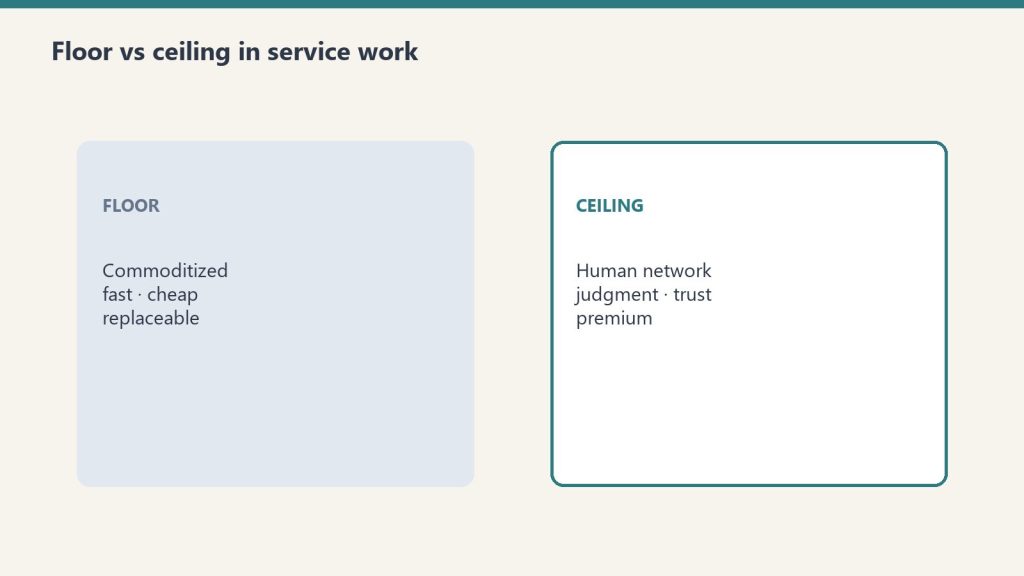
The instinct among restoration owners is to treat approval authority as a tool for protecting the company from big, expensive mistakes on large losses. It is that. It is also much more than that.
The margin that leaks out of restoration companies at the small end is harder to see because it does not show up as a loss. It shows up as revenue that never arrived.
Consider the Sunday afternoon during a football game. A property manager calls the after-hours line. A water loss, not an enormous one, maybe $2,500 of emergency services before a carrier is even involved. The operator on call has two choices. Roll a crew. Don’t roll a crew. If there is no documented tier that gives the operator the authority to commit to that dollar amount without calling the owner, one of two things happens.
The call gets bounced up to voicemail, a text, a “let me try to reach the owner.” Forty-five minutes go by. The property manager calls the next restoration company on the carrier’s list. That crew rolls. That revenue is gone, and — more consequentially — that property manager now has a new primary relationship.
Or the operator commits without authority, rolls the crew, and the owner finds out on Monday. The revenue gets captured but the company has just learned that it cannot trust its own on-call operator to hold a line. Which means the next time, the owner is going to try to be on every call personally. Which means the owner becomes the bottleneck. Which caps the company.
Both failure modes are versions of the same disease: the absence of a written, enforced, trained-to tier that says the operator on call can commit the company up to $X for this kind of work, without asking, and the company will back that commitment.
The SOP does not exist to protect the company from the operator. It exists to give the operator the authority to act at the speed the business requires.
Why the Large-Dollar Tier Protects Scope Discipline
At the other end of the spectrum, a $500,000 commercial loss needs the opposite kind of discipline. That number should not be committed to by one person. Not by the owner alone. Not by the senior PM alone. Not by anyone alone.
The reason is not fear of the decision being wrong. The reason is that large-loss scope is the single most consequential document a restoration company writes, and scope written by one person is scope that reflects one person’s blind spots.
A documented approval tier for large work requires that specific roles participate before the commitment is made. Estimator verifies scope against job type benchmarks. Senior PM pressure-tests the operational assumptions. Someone on the commercial side — owner, VP, whoever plays that role — signs off on carrier positioning and payment structure. The approval is not a rubber stamp. It is the forcing function that catches the margin errors before they are baked into the job.
The companies that consistently hold margin on large loss work are not the ones with the best estimators. They are the ones with the best documented approval discipline. Multiple eyes on the scope before it leaves the building. Every time. Without the approval SOP, every large loss is a one-person decision and every one-person decision eventually produces a miss.
What the Tier Structure Actually Looks Like
A working tier structure has a few consistent properties across every restoration company I have seen it deployed in, even though the specific dollar thresholds vary by size and market.
Tier 1 — Operator authority. Emergency services commitment up to a defined dollar amount, by job type, during on-call hours. No approval required. Logged in the documentation layer at time of commitment, reviewed on the next business day by the PM and operations lead. The operator has the authority to act. The system has the visibility to catch a pattern if one emerges.
Tier 2 — PM authority. Standard job scope commitment, change orders up to a defined dollar amount, subcontractor engagement within approved panel, scope extensions within scope benchmarks. PM owns the decision. Estimator and ops lead have visibility via the documentation layer.
Tier 3 — Ops and estimating collaboration. Jobs above the PM tier, change orders that move the job outside original scope benchmarks, carrier escalation decisions. Requires estimator and ops lead both to sign off before the commitment is formalized.
Tier 4 — Executive approval. Large loss commitments above a defined threshold, program work with rate implications, exceptions to payment terms. Requires owner or designated executive plus the operating team that would carry the job. Multiple eyes. Always.
The specific numbers are bespoke. A $3M restoration company and a $30M restoration company will not use the same thresholds. What matters is that the tiers exist, are written down, are known by every person in the approval chain, and are enforced when tested.
The Tier Only Works Because the Documentation Layer Exists
A tiered approval matrix is a piece of paper. A piece of paper that nobody follows is worse than no piece of paper at all, because it produces the illusion of discipline without the substance.
The reason a tier structure holds in practice is the documentation layer underneath it. Every commitment — Tier 1 through Tier 4 — gets captured in a central system at time of commitment, with amount, scope, job type, and the person who authorized it. That capture makes the tier auditable. It makes the review in the WIP Board meeting possible. It makes the feedback loop real.
Without the documentation layer, the tier is aspirational. With it, the tier is a live operating discipline. This is why the documentation layer article comes before this one. The tier is downstream of the layer.
What Owners Usually Get Wrong
A few consistent mistakes show up when restoration owners try to build approval authority without documenting it properly.
They set the thresholds too low. The PM has authority up to $5,000 in a company where the average residential water loss runs $8,500. That means every average job bounces to the owner. The bottleneck reopens immediately.
They do not train to the SOP. The document exists but the operator on call does not know what their tier actually is, or does not trust that the company will back the commitment they make inside their tier. So they do not use it. The SOP dies in the field.
They do not enforce it at the top end. Large loss work keeps getting committed by one person because the tier is inconvenient to follow when speed matters. The discipline erodes. Every quarter the gap between the approval SOP and what actually happens gets a little wider until the SOP is fiction.
They treat the tier as a static document. The thresholds never adjust to match job cost inflation, the company’s growth, or the patterns the documentation layer reveals. The tier that worked three years ago now produces the wrong incentives. Without an annual review, the SOP calcifies.
Building the Tier — Where to Start
If you do not have a tiered approval authority today, here is the minimum first pass.
Define two tiers, not four. Operator authority for after-hours emergency services up to a defined dollar amount. Everything else routes to the PM or owner until you have visibility into the pattern.
Document the operator tier as a one-page SOP: amount, job type, scope, logging requirement, review cadence. Put it in the documentation layer. Train every on-call operator to it. Back the commitment when it gets tested the first time — that first test is where the SOP either gets internalized or gets abandoned.
Run the tier for ninety days. At review, look at how many commitments hit the limit, how many were right calls, how many produced margin problems. Use the pattern to adjust the threshold, extend the tier to a second category of work, and build Tier 2 on top.
You are not trying to build the perfect approval matrix on day one. You are trying to install the operating discipline of committing on behalf of the company by documented authority, not by ad hoc conversation. Once that discipline exists, extending it to additional tiers is incremental.
What This Is Worth
A restoration company with a well-tuned tier structure captures emergency revenue it would otherwise lose to slower competitors, holds scope discipline on large losses it would otherwise leak, moves the owner out of the decision chain on routine work, and produces the raw data that makes the every-job post-mortem meaningful.
The math on this is not complicated. A single lost after-hours call is $2,500 to $15,000 of revenue. Three of those a month in a market where the on-call response is marginal is a quarter-million a year in unrealized revenue. A single blown scope on a large loss is often more than that in a single job.
The tier is one of the highest-leverage SOPs a restoration company can install. It costs almost nothing to build. It requires discipline to hold. And the companies that hold it outcompete the ones that do not — not because they have better operators, but because their operators have the authority to operate.
Frequently Asked Questions
What is tiered approval authority in a restoration company? A documented SOP that defines, by dollar amount and job type, who on the team can commit the company to start work, sign a change order, or approve a scope change. It gives operators authority to act fast on small jobs and enforces scope discipline on large ones.
Why does a restoration company need approval tiers for small jobs? Because the Sunday-afternoon emergency services call needs a yes inside fifteen minutes before the customer calls the next restoration company on the carrier’s list. Without a documented tier giving the on-call operator authority to commit the company, that revenue is lost to slower decision-making.
Why does a restoration company need approval tiers for large jobs? Large loss scope is the single most consequential document the company writes. Scope written by one person reflects one person’s blind spots. A documented tier that requires estimator, senior PM, and executive sign-off before commitment catches the margin errors before they are baked into the job.
What are typical tier structures in restoration? Four tiers is common: operator authority for after-hours emergency services; PM authority for standard job commitments and change orders within scope; collaborative authority for jobs that exceed PM limits or move outside scope benchmarks; executive authority for large loss commitments and exceptions to standard terms. The specific dollar thresholds are bespoke to company size and market.
What happens if a restoration company has no documented approval tiers? Every decision either bottlenecks on the owner or gets made ad hoc without financial discipline. Emergency revenue leaks to faster competitors. Large loss margin leaks to under-reviewed scope. The owner becomes the cap on the company’s growth because nothing can move without them.
How often should approval tiers be reviewed? At least annually, and any time the company’s size, service mix, or operating environment changes materially. Tiers that are not refreshed drift out of alignment with the job cost reality they were built for.
Tygart Media on restoration — an analyst-operator body of work on the systems that separate compounding restoration companies from busy ones. No client names. No brand placements. Just the operating standard.