Tag: AI citations

  • The LLMs.txt Reality Check: What 300,000 Domains Reveal About the File Everyone’s Implementing in 2026

    The LLMs.txt Reality Check: What 300,000 Domains Reveal About the File Everyone’s Implementing in 2026

    The LLMs.txt file was supposed to be the AI-era equivalent of robots.txt — a clean, declarative way to hand large language models a curated map of your most valuable content. Three years after Jeremy Howard proposed the spec, the data is in. And the data is not what implementation evangelists have been promising.

    This is a case study teardown of the three largest independent measurement efforts on LLMs.txt adoption and citation impact, the one documented recovery case where it did move the needle, and the structural lesson every practitioner should pull from the divergence.

    The 300,000-Domain Study That Reset the Conversation

    A widely circulated dataset of nearly 300,000 domains — analyzed across multiple AI search citation benchmarks and reported by Search Engine Journal — found no statistically significant relationship between implementing LLMs.txt and how often AI engines cite a brand. Both standard statistical analysis and machine-learning models showed no effect. Removing LLMs.txt as a feature actually improved citation prediction accuracy in one model run, meaning the file’s presence was less than noise.

    Adoption sits at roughly 10.13% of domains in that dataset, distributed evenly across traffic tiers. Translation: it is neither standard practice nor a differentiator.

    A separate bot-traffic audit reported by adoption researchers found that out of 62,100-plus AI bot visits over a 90-day window, only 84 requests targeted the /llms.txt path. Across half a billion LLM bot traffic events analyzed in another dataset — filtering for the agents that actually drive citations (GPTBot, ClaudeBot, PerplexityBot, OAI-SearchBot, Google-Extended) — the share of requests touching /llms.txt was statistically negligible.

    The Vendor Reality Behind the Numbers

    As of Q1 2026, no major AI company — OpenAI, Google, Anthropic, Meta, or Mistral — has publicly committed to reading or acting on LLMs.txt in production systems. The file is a community proposal, not a supported standard. AI language models learn what to trust from the web as it existed during training. Citation behavior reflects which sources appeared consistently in training corpora, which were cited by other credible sources, and which had claims independently corroborated. A crawl-directive file published after training cannot retroactively change any of that.

    The Recovery Case That Actually Moved Traffic

    Compare that to a documented recovery case reported by SEO Algorithm Recovery and corroborated by independent AI Overviews tracking: a Dallas retailer lost 72% of organic traffic to AI Overviews. Their agency deployed schema markup and restructured 150 pages around answer-first formatting. Traffic recovered to 118% of pre-AI Overview levels in 120 days, with $1.4M in revenue growth attributed to the recovered organic channel.

    No LLMs.txt was involved. The intervention stack was schema markup, content restructuring for AI-extractable answers, and entity disambiguation in headings. Schema markup alone has been reported to recover 45%-plus of lost AI Overview traffic in case-study compilations across the recovery agency space.

    The Structural Lesson

    The contrast is the case study. LLMs.txt is a static directive file that AI crawlers do not currently read at scale. Schema markup is a structured-data layer that AI systems already parse to construct answer panels and citation surfaces. One is aspirational. The other is operational.

    The structural pattern under every documented AI-search recovery in 2026 is the same: answer-first content directly under each H2, structured data on the entity being described, tables for comparison data, and explicit source attribution inline. Sites earning AI citations report traffic gains. Brands with strong authority signals benefit from the halo effect. Companies adapting these specific structural interventions early — not the file directives — are the ones reporting growth exceeding pre-AI Overview levels.

    A Minimum-Viable LLMs.txt Anyway

    The skeptical case is not “skip LLMs.txt entirely.” It is “do not let it absorb hours that should go to schema and content restructuring.” A minimum-viable LLMs.txt is ten lines and takes ten minutes to ship:

    # Your Brand Name
    
    > One-sentence description of what your site is and who it serves.
    
    ## Core Pages
    - [About](https://yoursite.com/about): Who you are, in one paragraph.
    - [Products](https://yoursite.com/products): What you sell, structured.
    - [Pricing](https://yoursite.com/pricing): Numbers, plans, comparison.
    
    ## Documentation
    - [Getting Started](https://yoursite.com/docs/start): The 5-step onboarding.
    - [API Reference](https://yoursite.com/docs/api): Full method index.
    

    Ship it. Stop tuning it. Then spend the rest of the week on schema and answer-first H2 restructuring, which is where the recovery cases are actually being won.

    The Practitioner Takeaway

    When two independent measurement methodologies across 300,000-plus domains agree that an optimization has no measurable effect on the outcome it is sold to improve, the rational move is to stop selling it as a primary intervention. Treat LLMs.txt as future-proofing insurance with a ten-minute implementation cost. Treat schema, entity binding, and answer-first content structure as the actual lever. The recovery cases that crossed pre-AI Overview revenue did the second set of things. The Search Engine Land-reported audit where 8 of 9 sites saw no measurable change after implementation did the first.

    Frequently Asked Questions

    Does LLMs.txt help with AI citations?

    Independent studies across approximately 300,000 domains have found no statistically significant relationship between LLMs.txt presence and AI citation frequency. Major AI vendors have not publicly committed to reading the file in production. Implement it as low-cost future-proofing, not as a primary citation strategy.

    What actually recovers traffic lost to AI Overviews?

    Documented recovery cases share a consistent intervention pattern: schema markup deployment, content restructuring with answer-first formatting directly under each H2, entity disambiguation, and inline source attribution. One published case showed 118% recovery of pre-AI Overview traffic in 120 days using this stack.

    What is the minimum-viable LLMs.txt?

    Ten lines: an H1 with your brand name, a blockquote with one-sentence site description, and grouped H2 sections listing your core pages and documentation with one-line summaries. Ship it once, do not over-tune it.

    Which AI bot user agents matter for citation visibility?

    The user agents that drive AI citations include GPTBot, ClaudeBot, PerplexityBot, OAI-SearchBot, and Google-Extended. These are the crawlers whose access determines whether your content surfaces in AI answer panels.

    If LLMs.txt does not work, why is everyone implementing it?

    Three reasons: it is genuinely cheap to ship, it signals to clients that you are paying attention to AI search, and there is a non-zero chance AI vendors adopt it in the future. None of those reasons justify it being your primary AI-search intervention in 2026.

    Sources: Search Engine Journal’s coverage of the 300,000-domain LLMs.txt citation study; SEO Algorithm Recovery’s documented AI Overviews recovery case study; published bot traffic audits from Authority Tech and Generix Marketing on LLMs.txt request rates; recovery-stack analysis aggregated from BlankBoard Studio, Stackmatix, and Mersel AI’s 2026 AI Overviews recovery compilations.

  • What Is GEO? Generative Engine Optimization Explained

    What Is GEO? Generative Engine Optimization Explained

    If you’ve optimized content for Google and still can’t get AI systems to cite you, you’re running the wrong playbook. GEO — Generative Engine Optimization — is the discipline of making your content visible, credible, and citable to AI engines like ChatGPT, Claude, Perplexity, Gemini, and Google’s AI Overviews. It is not SEO with a new name. It is a different game with different rules.

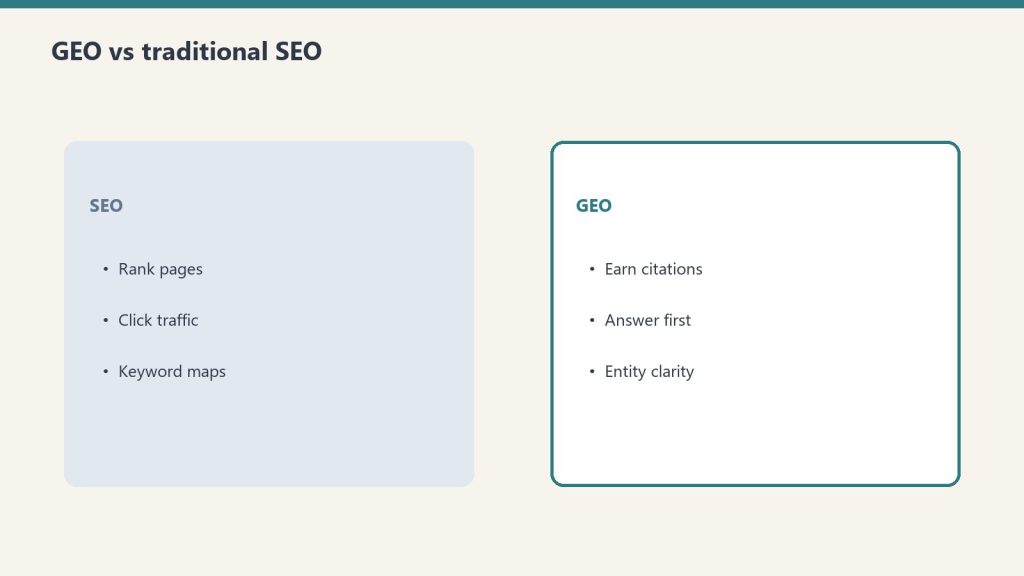
    Definition: Generative Engine Optimization (GEO) is the practice of structuring content so that large language models and AI search engines select it as a source when generating responses to user queries. Where SEO earns rankings, GEO earns citations.

    Why GEO Is Not SEO

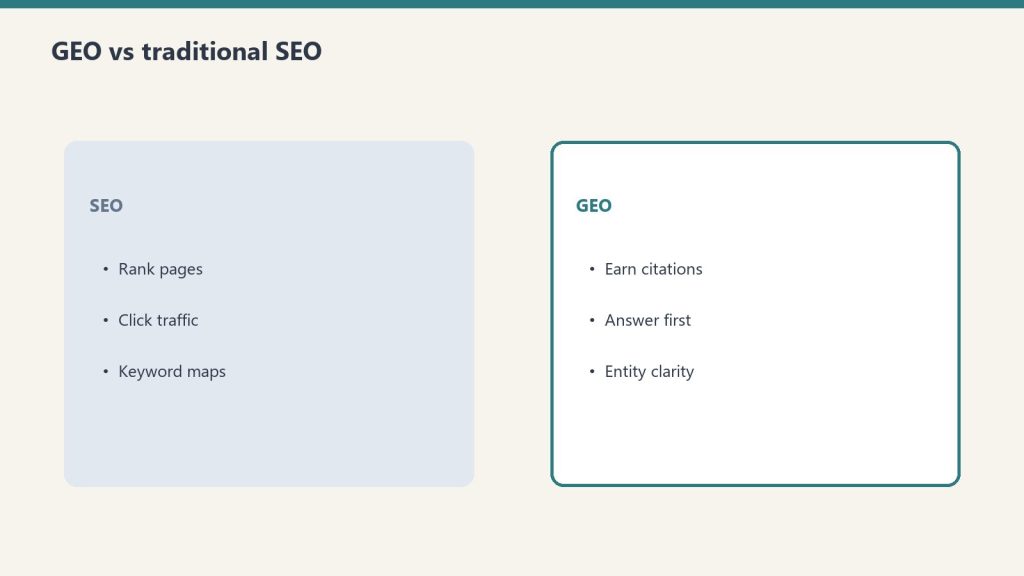
    SEO is about ranking. You optimize a page so Google’s algorithm surfaces it when someone searches. The goal is a click. GEO is about being quoted. You structure content so an AI system trusts it enough to pull a fact, a definition, or an explanation from it when synthesizing a response. The user may never click your URL — but your content shaped what they read.

    The mechanisms are fundamentally different. Google’s ranking algorithm weighs hundreds of signals — backlinks, page speed, user behavior, authority. AI citation selection weights entity density, factual specificity, source credibility signals, and structural clarity. A page that ranks #1 on Google may get zero AI citations. A page that ranks #8 may be the one Perplexity quotes every time someone asks about that topic.

    How AI Engines Select Content to Cite

    Large language models used in AI search (GPT-4, Claude, Gemini) were trained on large corpora of text, but the retrieval-augmented generation (RAG) layer that powers tools like Perplexity, ChatGPT search, and Google AI Overviews works differently. It pulls live content at query time, scores it for relevance and credibility, and synthesizes a response. The signals it uses to score your content include:

    • Entity clarity — Are the people, places, companies, and concepts in your content clearly named and linked to known entities?
    • Factual density — Does your content contain specific, verifiable claims rather than vague generalities?
    • Structural legibility — Can the AI parse your content’s structure — headings, definitions, lists — without ambiguity?
    • Source signals — Does your content cite primary sources, studies, or named experts?
    • Speakable schema — Have you marked up key paragraphs as machine-readable answer candidates?

    The Three Layers of GEO

    Layer 1: Content Architecture

    GEO-optimized content is built for extraction, not just reading. That means every major claim is in a standalone sentence. Definitions appear near the top. Section headers are declarative, not clever. The structure tells an AI where the answer is before it has to read the full article.

    Layer 2: Entity Saturation

    AI systems understand content through entities — named people, organizations, places, products, and concepts that exist in their training data. A GEO-optimized article saturates relevant entities: it doesn’t say “a major AI company” when it means Anthropic. It doesn’t say “a popular search tool” when it means Perplexity. Every entity is named, spelled correctly, and used in the right context.

    Layer 3: Schema and Structured Data

    JSON-LD schema markup is a signal to both traditional search engines and AI crawlers. FAQPage schema makes your Q&A content directly extractable. Speakable schema flags the paragraphs most useful for voice and AI synthesis. Article schema establishes authorship and publication date. These are not optional extras — they are the machine-readable layer that gets your content selected.

    GEO vs AEO: What’s the Difference?

    Answer Engine Optimization (AEO) focuses on winning featured snippets, People Also Ask boxes, and zero-click search results in traditional search engines. GEO focuses on being cited by generative AI systems. The tactics overlap — both require clear structure, direct answers, and FAQ sections — but the targets are different. AEO wins position zero on Google. GEO wins the paragraph that Perplexity writes for the next million queries on your topic.

    At Tygart Media, we run both in parallel. The content pipeline produces articles that pass the AEO gate (featured snippet structure, FAQ schema) and the GEO gate (entity density, speakable markup, citation-worthy claims) before publishing.

    What GEO Looks Like in Practice

    Here is the difference between a standard paragraph and a GEO-optimized version of the same content:

    Standard: “Water damage restoration is an important service for homeowners who have experienced flooding or leaks.”

    GEO-optimized: “Water damage restoration — the professional remediation of structural damage caused by flooding, pipe failure, or storm intrusion — is performed by IICRC-certified contractors following the S500 Standard for Professional Water Damage Restoration. The process includes water extraction, structural drying, moisture monitoring, and antimicrobial treatment.”

    The second version names the certifying body (IICRC), the standard (S500), and the process steps. An AI system can extract that paragraph as a factual, citable answer. The first version has nothing to extract.

    How to Start with GEO

    If you’re running an existing content operation and want to layer in GEO, the priority order is:

    1. Audit your top 20 pages for entity gaps — everywhere you use vague references, replace with specific named entities
    2. Add speakable schema to your three strongest definitional paragraphs per page
    3. Run a factual density check — every statistic should have a source, every claim should be specific
    4. Add FAQPage schema to any page with question-format headings
    5. Submit your top pages to Google’s Rich Results Test and verify structured data is reading cleanly

    GEO Is Compounding Infrastructure

    The reason GEO matters for content operations is compounding. Once an AI system has indexed and trusted your content as a reliable source on a topic, subsequent queries on that topic draw from your content repeatedly — without you publishing anything new. A single GEO-optimized pillar article can generate thousands of AI citations over 12 months. That is a different kind of ROI than a ranked page that gets clicked and forgotten.

    We built the Tygart Media content stack around this principle. Every article that leaves our pipeline passes a GEO gate before it publishes. That gate checks entity saturation, factual specificity, schema completeness, and structural legibility. It is the same gate we build for clients.

    Frequently Asked Questions About GEO

    What does GEO stand for?

    GEO stands for Generative Engine Optimization — the practice of optimizing content to be cited by AI-powered search systems and large language models.

    Is GEO the same as SEO?

    No. SEO (Search Engine Optimization) targets traditional search rankings. GEO targets AI citation in tools like ChatGPT, Perplexity, Claude, and Google AI Overviews. The tactics overlap but the mechanisms and goals are different.

    How do I know if my content is being cited by AI?

    Run queries related to your topic in Perplexity, ChatGPT (with search enabled), and Google AI Overviews. Check whether your domain appears as a cited source. Tools like Profound and Otterly.ai can automate this monitoring.

    Does GEO replace AEO?

    No. AEO and GEO are complementary. AEO wins traditional search features like featured snippets. GEO wins AI citations. A mature content strategy runs both in parallel.

    How long does GEO take to show results?

    Unlike SEO, GEO results can appear quickly — sometimes within days of a page being indexed by AI crawlers. The compounding effect builds over 60–180 days as AI systems repeatedly select your content for related queries.


  • GEO Visibility Checker — Claude AI Skill for AI Search Optimization

    GEO Visibility Checker — Claude AI Skill for AI Search Optimization

    Find out exactly why AI systems are not citing your content — and what to change.

    Who This Is For

    Built for content marketers, SEO practitioners, and website owners who are publishing good content but not appearing in AI-generated answers on ChatGPT, Perplexity, or Google AI Overviews.

    The Problem

    AI search citation is not random. It follows patterns: entity density, factual specificity, direct-answer structure, authoritative framing, speakable content, and OASF formatting. Most content fails on two or three of these signals — not all of them — which means the fixes are targeted and manageable. The problem is knowing which signals are failing. This skill evaluates your page against all of them and tells you exactly what to change.

    What It Does

    • Evaluates entity density — how many named entities your page references and whether they are specific enough to be useful to AI systems
    • Assesses factual specificity — the ratio of specific, verifiable claims to vague generalizations
    • Checks for direct-answer structure and speakable schema markers
    • Evaluates OASF formatting — the structure that makes content citation-friendly to generative engines
    • Identifies the 3 to 5 highest-leverage changes that would most improve AI citation probability

    What You Get

    The complete skill file in Claude-compatible format, a prompt library specific to the use case, and a setup guide that gets you running in under five minutes. After purchase, everything downloads instantly.

    GEO Visibility Checker — Claude AI Skill for AI Search Optimization

    $47

    Delivered to your inbox within 24 hours — skill file, prompt library, and setup guide

    Buy Now →

    Secure checkout via Square — all major cards accepted

    Want a custom version built specifically for your business? Email will@tygartmedia.com

    Frequently Asked Questions

    What is GEO and how is it different from SEO?

    SEO optimizes for search engine rankings. GEO — Generative Engine Optimization — optimizes for AI citation: getting your content surfaced as a source when ChatGPT, Perplexity, or Google AI Overviews answers a question. The signals are related but distinct.

    Can this guarantee my content will be cited by AI systems?

    No — AI citation is probabilistic, not deterministic. What this skill does is identify and address the specific signals that correlate with AI citation, increasing your probability of being cited.

    Does this work for any type of content?

    Yes. The skill evaluates any page — blog posts, service pages, product pages, and landing pages all have GEO optimization opportunities.

    How is this delivered?

    Within 24 hours of purchase via email from will@tygartmedia.com. Skill file, prompt library, and setup guide delivered as a ZIP download.

    Does this require a paid Claude subscription?

    A Claude account is required. The free tier works for light use. Claude Pro ($20/mo) is recommended for regular use. The skill works with both.

    Can I get a custom version built for my specific business?

    Yes. Email will@tygartmedia.com with a description of your business and workflows. Custom skill builds are available as part of The Fitting service.

  • LinkedIn Is the #2 AI Citation Source in 2026 — What That Means for Your Content Strategy

    LinkedIn Is the #2 AI Citation Source in 2026 — What That Means for Your Content Strategy

    Something significant shifted in the AI search landscape between November 2025 and February 2026, and most content strategists have not caught up to it yet.

    LinkedIn jumped from the 11th most-cited domain to the 5th most-cited domain on ChatGPT in just three months. Profound, which tracks 1.4 million AI citations across six platforms, called it “the largest shift in authority we have seen this year.” Across all AI platforms combined, LinkedIn content now appears in 11% of all AI-generated responses.

    If you publish professional content, this is the most important GEO development of 2026.

    The Numbers Behind the Shift

    Semrush analyzed 325,000 prompts across ChatGPT Search, Google AI Mode, and Perplexity, identifying 89,000 unique LinkedIn URLs cited in AI-generated responses. The platform-by-platform breakdown:

    • ChatGPT Search: LinkedIn appears in 14.3% of all responses
    • Google AI Mode: LinkedIn appears in 13.5% of all responses
    • Perplexity: LinkedIn appears in 5.3% of all responses

    LinkedIn is now the #2 most-cited domain by AI systems overall and the #1 source for professional queries across every major AI platform including ChatGPT, Gemini, Perplexity, Google AI Mode, and Microsoft Copilot.

    What AI Systems Are Actually Citing

    The composition of LinkedIn’s AI citations has shifted dramatically. Profile page citations — the static biographical data that dominated early LinkedIn citations — collapsed from 33.9% to just 14.5% of all LinkedIn citations in a three-month window. Meanwhile, posts and long-form articles grew from 26.9% to 34.9%.

    AI systems are not citing LinkedIn because of who you are. They are citing LinkedIn because of what you published.

    Of the 89,000 cited URLs in Semrush’s study, 50–66% are long-form Articles of 500–2,000 words, and 54–64% are educational or advice-driven content. The median cited post has just 15–25 reactions and roughly one comment. Engagement is not the primary driver of AI citation — relevance, accuracy, specificity, and structure are.

    Creators with fewer than 500 followers get cited at comparable rates to large accounts. This is not a follower game. It is a content quality and structure game.

    The Personal Profile vs Company Page Split

    One of the more strategically interesting findings from Profound’s study is that different AI platforms cite LinkedIn content differently by source type.

    ChatGPT and Google AI Mode favor personal profiles, drawing 59% of their LinkedIn citations from individual creator content versus 41% from company pages. Perplexity reverses this, drawing 59% of its LinkedIn citations from company pages and 41% from personal profiles.

    The strategic implication is a dual-publishing approach. Publishing technical and educational content on both a personal profile and a company page maximizes AI visibility across all major platforms simultaneously. They are not redundant — they are complementary, each feeding different AI citation systems.

    Why LinkedIn Content Gets Cited: The Structural Reasons

    LinkedIn’s relationship with AI systems operates through multiple channels that reinforce each other.

    First, LinkedIn content has always been publicly indexed and high-authority. With a Moz Domain Authority of 98, LinkedIn Pulse articles sit in the same crawlability tier as Wikipedia and major news publications. AI training datasets over-index on high-authority domains, meaning LinkedIn content has been proportionally well-represented in model training from the beginning.

    Second, LinkedIn rolled out a “Data for Generative AI Improvement” toggle in September 2024, set to ON by default, and expanded it to global markets in November 2025. LinkedIn is owned by Microsoft, which has a direct relationship with OpenAI. The structural pipeline from LinkedIn content to AI model training is more direct than almost any other platform.

    Third, LinkedIn content shows semantic similarity scores of 0.57–0.60 with AI-generated outputs, higher than Reddit (0.53–0.54) or Quora (0.44). AI systems are not just citing LinkedIn — they are drawing heavily on LinkedIn’s language patterns and reasoning structures when generating responses.

    What This Means for B2B and Restoration Industry Content

    For professional verticals — B2B services, restoration, real estate, finance, healthcare — LinkedIn is no longer an optional distribution channel. It is likely the single highest-leverage GEO publishing surface available.

    A structured LinkedIn Article on a technical topic in the restoration industry, AI strategy, or B2B services has a realistic path to being cited in ChatGPT, Perplexity, and Google AI Mode responses on relevant professional queries. It does not require a large following. It does not require viral engagement. It requires content that is accurate, structured, specific, and educational.

    Content reaches peak AI citation velocity 7–14 days after publishing and maintains that velocity for 90 or more days — significantly longer than Twitter/X or Reddit content, which cycles out of AI citation windows much faster.

    The Practical GEO Framework

    Based on the citation data, the content signals that drive AI citation on LinkedIn are consistent and actionable: include specific data points, metrics, methodologies, and dates rather than generic claims. Use clear H2 heading structure that AI systems can parse for answer extraction. Write educational and advice-driven content rather than promotional content. Target 800–1,200 words per Article — long enough to establish depth, short enough to maintain density.

    The biggest opportunity right now is that most LinkedIn publishers are still optimizing for feed engagement — reactions, comments, shares. The AI citation data suggests a different optimization target: structured, data-rich, educational long-form content that looks less like a viral feed post and more like a well-sourced reference document.

    The brands and individuals who make that shift in 2026 are building citation authority that will compound for years.

    Frequently Asked Questions

    Is LinkedIn the most cited source in AI search?

    LinkedIn is the #2 most-cited domain by AI systems overall and #1 for professional queries across ChatGPT, Gemini, Perplexity, Google AI Mode, and Copilot as of early 2026, appearing in approximately 11% of all AI-generated responses.

    What type of LinkedIn content gets cited by AI systems?

    50–66% of AI-cited LinkedIn content is long-form Articles of 500–2,000 words. Educational and advice-driven content accounts for 54–64% of citations. The median cited post has only 15–25 reactions — engagement is not the primary driver of AI citation.

    Does LinkedIn company page content get cited by AI?

    Yes. Perplexity draws 59% of its LinkedIn citations from company pages. ChatGPT and Google AI Mode favor personal profiles at 59%. A dual-publishing strategy covering both maximizes visibility across all AI platforms.

    How long does it take for LinkedIn content to appear in AI citations?

    LinkedIn content reaches peak AI citation velocity 7–14 days after publishing and maintains that velocity for 90 or more days — longer than most other social platforms.