Tag: AI Adoption

  • New to North Mason? Why Belfair’s Community AI Layer Is Your Best Orientation Tool

    New to North Mason? Why Belfair’s Community AI Layer Is Your Best Orientation Tool

    If you’ve recently moved to Belfair or anywhere in the North Mason area — whether you came for a job at PSNS, a PCS assignment to Bangor Naval Base, a remote-work lifestyle change, or retirement near Hood Canal — you already know the feeling. Everyone around you seems to operate on a layer of local knowledge you don’t have yet. When does the bridge close? What does “SR-3 is backed up at Gorst” actually mean for your drive? Which beaches are open for shellfish right now? Which businesses are actually open when Google says they are?

    That gap between arriving in a place and knowing how it actually works is real, and it takes years to close through normal experience. Belfair’s community AI layer is being built to close it much faster.

    What You Don’t Know That Everyone Else Does

    North Mason has a deep layer of practical local knowledge that doesn’t exist on any national platform in accurate form. A few examples of what longtime residents know and what you’ll need to learn:

    The Hood Canal Bridge on SR-104 closes without public announcement for submarine transits from Bangor Naval Base. The closures aren’t on WSDOT’s real-time feed the way accidents are — they happen on operational military timelines that don’t get posted publicly. If you commute north and haven’t been caught by one yet, you will be. Locals know to check the WSDOT bridge alert system and to build buffer time on mornings when submarine movements are likely.

    SR-3 gets complicated near Gorst and the north end of Belfair after sustained rain. The Gorst bottleneck is notorious — 18,000 to 19,000 vehicles per day funnel through what is essentially a two-lane section at the intersection of SR-3 and SR-16. When it backs up, it backs up badly, and the alternatives require knowing the local road network. The Belfair Bypass (officially the SR-3 Freight Corridor New Alignment) begins construction in Spring 2026 and is projected to open in 2028 — but until then, the existing corridor is what you’ve got.

    Hood Canal shellfish harvesting is seasonal, regulated by WDFW, and subject to closures that can come without much warning when biotoxin testing or fecal coliform monitoring triggers a harvest suspension. The specific beaches near Belfair — Twanoh State Park, Potlatch State Park, Belfair State Park tidelands — each have their own status. Knowing the difference between a DOH closure and a WDFW emergency suspension matters if you’re planning a harvest trip.

    Local business hours on Google are frequently wrong. Small businesses in Belfair update their hours on the platforms whenever they get to it, which is sometimes never. Knowing which businesses are reliable, which ones have changed ownership, and what the current situation is at a specific shop requires either local knowledge or a resource that keeps up with it. The community AI is being built to be that resource.

    Why This Is Different from Googling It

    National AI systems have a fundamental problem with places like Belfair: the community is too small and too specific to be well-represented in training data. When you ask a national AI about Hood Canal shellfish closures or Gorst traffic conditions, you get either generic information about shellfish or generic information about traffic — not a current answer about the specific beaches and roads that affect your daily life in North Mason.

    The Belfair community AI is purpose-built for this place. Its knowledge base is populated not from national data aggregators but from local relationships — county employees, longtime residents, agency sources, and community contributors who know this specific place and maintain what the system carries about it. That’s a fundamentally different kind of knowledge than what any national platform can provide.

    What It Covers That Will Actually Help You Orient

    For someone new to North Mason, the highest-value knowledge categories are:

    Infrastructure and commute. SR-3, Gorst, the Hood Canal Bridge, and the Bremerton-Seattle ferry schedule (which changes seasonally). The SR-3 bypass construction timeline and what it means for daily commutes through 2028. The community AI tracks these in ways that are specific to North Mason commuters, not generic traffic data.

    Hood Canal seasonal rhythms. Shellfish seasons and closures. State park reservation windows. Tahuya trail conditions. The patterns that determine what’s accessible and when — seasonal knowledge that takes years to accumulate through experience but can be accessed immediately through the community layer.

    Civic and community institutions. The North Mason Timberland Library. The North Mason Chamber of Commerce. The Mary E. Theler Wetlands. Community events at the Belfair Community Center. The school district’s calendar and enrollment processes. For a sense of what’s currently happening in Belfair’s business and civic landscape, the Belfair Business Pulse is a useful ongoing resource.

    Military family specifics. For those arriving on PCS orders to PSNS or Bangor, the community AI is being designed with incoming military families explicitly in mind — covering housing patterns in North Mason vs. Kitsap County, school enrollment for North Mason School District, and the commute realities from Belfair to the shipyard that don’t appear in any PCS guide.

    How to Use It Before It’s Fully Operational

    The community AI is under active development. Monthly workshops at the North Mason Timberland Library are planned once the knowledge base reaches minimum useful coverage. In the meantime, the Belfair Bugle’s ongoing coverage provides a current layer of local knowledge in editorial form — and the broader vision for the knowledge infrastructure is laid out in The Internet That Knows Your Town.

    North Mason is a place that takes a while to learn. The community AI is being built to shorten that curve significantly — for newcomers, for military families cycling through on PCS orders, and for anyone who moves to Belfair and wants to feel at home faster than the traditional “local knowledge by osmosis” approach allows.

    Frequently Asked Questions

    What does a newcomer to Belfair need to know about the Hood Canal Bridge?

    The Hood Canal Bridge on SR-104 connects the Kitsap and Olympic Peninsulas. It closes without public advance notice for submarine transits from Bangor Naval Base — these closures aren’t announced publicly due to military operational security. They can last 30 to 90 minutes. If you commute north across the bridge, subscribe to WSDOT bridge alerts and build buffer time on commute days. Maintenance closures are announced in advance; submarine transits are not.

    How does the SR-3 Belfair Bypass affect new residents?

    The SR-3 Freight Corridor New Alignment — the Belfair Bypass — begins construction in Spring 2026 and is projected to open in 2028. The 6-mile bypass will route regional traffic around Belfair rather than through it, expected to divert 25 to 30 percent of the current 18,000-plus daily vehicle count. Until it opens, SR-3 through Belfair remains the primary corridor and Gorst is the primary bottleneck for northbound commuters. New residents should budget extra commute time until the bypass is operational.

    How do I find out if Hood Canal shellfish beaches near Belfair are open?

    Hood Canal shellfish harvest areas near Belfair are regulated by the Washington Department of Fish and Wildlife (WDFW) and monitored by the Washington State Department of Health (DOH). Closures can be triggered by biotoxin (paralytic shellfish poisoning) testing or fecal coliform readings. For specific beach status near Belfair — including Belfair State Park tidelands, Twanoh State Park, and Potlatch State Park — check the WDFW shellfish safety site or the DOH shellfish safety map before any harvest trip. The Belfair community AI is being built to consolidate this information with local context.

    Are there resources specifically for military families arriving at PSNS Bremerton from the Belfair area?

    The Belfair community AI layer is being designed with incoming PSNS and Bangor military families explicitly in mind. Many families choose to live in North Mason for the affordability, outdoor access, and school options in the North Mason School District — but the commute from Belfair to the PSNS main gate in Bremerton takes 25 to 40 minutes depending on SR-3 and Gorst conditions. The community AI will carry current commute patterns, housing market conditions specific to North Mason, and school enrollment specifics that no PCS guide covers accurately.

    What North Mason community organizations should new residents know about?

    Key community organizations in Belfair and North Mason include: the North Mason Chamber of Commerce (business networking and community events), the Hood Canal Salmon Enhancement Group (environmental stewardship and the Sweetwater Creek Waterwheel Park), the North Mason Timberland Library (currently completing a remodel, expected to fully reopen mid-2026), and the Mary E. Theler Wetlands (natural area and community gathering space). The community AI will maintain current information on hours, programs, and contacts for each of these organizations.

    Read more: What Belfair’s Community AI Layer Actually Knows: A North Mason Resident’s Guide

    More from the Belfair Community AI Series


  • Belfair Business Owners: What the Community Knowledge Layer Means for Your Local Visibility

    Belfair Business Owners: What the Community Knowledge Layer Means for Your Local Visibility

    If you run a business in Belfair or anywhere in the North Mason area, you’ve probably had the experience of a customer walking in and saying your Google hours are wrong. Or you’ve watched a potential customer drive past because they checked an app that said you were closed. Or you’ve lost a Google review battle to a chain restaurant in Silverdale that has a full-time marketing team updating its listings while you’re running the counter.

    Local AI changes that dynamic — not by handing you a better Yelp listing, but by building a different kind of knowledge infrastructure that actually serves the people who live and work in Belfair.

    The Local Knowledge Problem in Belfair

    National platforms — Google, Yelp, national AI systems — optimize for scale. They work reasonably well for businesses in large markets where there’s enough review volume and enough competitive pressure to keep listings accurate. In a community the size of Belfair, with a CDP population of roughly 4,500 to 5,700 in the broader North Mason area, those systems fail constantly. Business listings go stale. New openings don’t get indexed for months. Closed businesses haunt Google results for years after the doors shut. And the national AI systems that answer “what’s open in Belfair right now” have no reliable way to know.

    The Belfair community AI layer is being built to fix the local layer of that problem. Its knowledge base is maintained by people who are actually in North Mason — who know which businesses opened, which ones changed their model, which ones are closed on Mondays despite what the listing says. That’s different in kind from what any national platform can offer.

    What It Means for Your Business to Be in the System

    When a North Mason resident — or a newcomer, or a military family arriving at PSNS — asks the Belfair community AI “where can I get [category of thing you sell],” you want to be in the answer. That requires being in the knowledge base, with accurate current information: real hours, real services, real contact details.

    Getting into the system isn’t an advertising transaction. It’s a knowledge contribution. Businesses that participate in the community knowledge layer — by making sure their information is accurate, by contributing knowledge about their own products and services that only they have — become more visible through accuracy rather than through paid placement. In a community that distrusts the paid-placement model (and most North Mason residents do, for good reason), that’s a meaningfully different kind of credibility.

    The cross-subsidy model behind the community AI is also relevant for local businesses: the same technical infrastructure that serves North Mason residents for free is used in commercial knowledge verticals — restoration, radon, asset appraisal — that pay for the operational costs. The community layer is free to access and free to be represented in, which means small business visibility isn’t gated behind an advertising budget.

    The SR-3 Bypass and What It Means for Your Customer Base

    One of the most significant changes coming to North Mason commercial life in the next two years is the SR-3 Freight Corridor New Alignment — the Belfair Bypass. Construction begins Spring 2026 with a projected 2028 opening. The bypass will route a significant share of through-traffic around Belfair rather than through it, expected to divert 25 to 30 percent of the current 18,000-plus daily vehicles that currently pass through the Belfair commercial corridor.

    That’s a structural change in traffic patterns that will benefit some businesses and challenge others. Businesses that currently capture passing traffic will see changes. Businesses that serve the residential North Mason community rather than through-traffic will be less affected. The community AI will track and contextualize these changes as construction progresses — giving residents and business owners the current picture rather than the generic “bypass construction is underway” framing that will show up everywhere else.

    For current context on what’s happening with SR-3 infrastructure and local commercial development, see the Belfair Business Beat coverage of SR-3 industrial development and the Belfair Business Pulse on the commercial corridor.

    The Workshop Opportunity

    The community AI is being developed through monthly workshops — planned at the North Mason Timberland Library and community venues once the knowledge base reaches sufficient coverage. For local business owners, these workshops are an opportunity to directly shape how your business is represented in the system, correct outdated information, and contribute knowledge about your sector that only you have.

    A restaurant owner who knows which local farms they source from. A contractor who knows which Mason County permit processes apply to which project types. A fishing guide who knows current conditions on Hood Canal in ways no agency tracks in real time. Each of these is knowledge the community AI wants — and each contributes to a system that benefits every business in North Mason by making the area more navigable for residents and newcomers alike.

    The broader vision for the project is laid out in The Internet That Knows Your Town. The short version for local business owners: community AI built from genuine local relationships serves local businesses in ways national platforms can’t replicate, because it’s optimized for this community rather than for an audience that will never set foot in Belfair.

    Frequently Asked Questions

    How does the Belfair community AI affect local business discovery?

    The Belfair community AI is built to answer the questions North Mason residents actually ask about local businesses — current hours, available services, recent changes in ownership or offerings. Unlike national platforms that update listing data through automated scraping and user reviews, the community layer is maintained by people who are actually in Belfair and know when a business has changed. For small businesses in a community of North Mason’s size, accurate representation in a community-maintained system is more valuable than any paid-placement listing on a platform optimized for larger markets.

    What does the SR-3 Belfair Bypass construction mean for Belfair businesses?

    The SR-3 Freight Corridor New Alignment begins construction in Spring 2026 with a projected 2028 opening. It will route approximately 25 to 30 percent of the current 18,000-plus daily vehicles around Belfair rather than through the commercial corridor. Businesses with high dependence on passing traffic should plan for this transition. Businesses serving the residential North Mason community will be less exposed to the change. The community AI will track construction phases and traffic impact data as they develop, providing context for business owners making planning decisions.

    How can a Belfair business ensure it is represented accurately in the community AI knowledge base?

    The primary pathway is through the community AI workshops, planned monthly at the North Mason Timberland Library once the knowledge base reaches operational coverage. Business owners who attend can verify and update information about their business, contribute sector-specific knowledge that improves the accuracy of the whole system, and build a direct relationship with the knowledge base maintainers. There is no cost to participate and no advertising component — representation is based on accuracy and relevance to North Mason residents, not on paid placement.

    Does the Belfair community AI compete with existing business listing services?

    No. The community AI is infrastructure for the Belfair community, not a commercial directory service. It doesn’t replace Google Business Profile or Yelp listings — it provides a community-specific knowledge layer that national platforms can’t replicate. A business with accurate information in both the community AI and its Google listing is simply more discoverable through more channels. The community AI is specifically valuable for the questions that national platforms can’t answer well: current conditions, seasonal hours, recent changes, and the kind of nuanced local knowledge that only comes from being part of the community.

    What types of local businesses benefit most from the Belfair community knowledge layer?

    Businesses with high relevance to North Mason community life benefit most: local restaurants and food businesses (especially those with seasonal menus or irregular hours), outdoor recreation outfitters and fishing guides operating on Hood Canal, contractors and service businesses navigating Mason County permit processes, local professional services (healthcare, legal, financial), and any business whose customers need to know something specific before they visit — current stock, seasonal availability, appointment requirements. The community AI is most valuable for businesses whose customers are making a local decision that requires more than just a star rating and an address.

    Read more: What Belfair’s Community AI Layer Actually Knows: A North Mason Resident’s Guide

    More from the Belfair Community AI Series


  • Local Operator Seed Kit — Claude AI Starter Pack

    Local Operator Seed Kit — Claude AI Starter Pack

    Run a local business. Use AI like the companies ten times your size do.

    Who This Is For

    Built for local business owners — retail, food and beverage, professional services, home services — who know AI could help but have not had time to figure out where to start.

    The Problem

    Enterprise companies have entire teams building their AI workflows. Local business owners have fifteen minutes between customers. The tools that work for a Fortune 500 company are not configured for someone who needs to respond to a Google review, draft a staff schedule, write a promotional email, and answer a supplier question before noon. This kit is built for the pace of a real local business.

    What You Get

    • Notion workspace for local business operations: appointments, inventory notes, staff, and marketing calendar
    • 10 pre-built Claude skills: local SEO content, customer response drafting, Google Business Profile posts, review responses, staff communication templates, and more
    • 50 prompts organized for the local business owner: marketing, customer service, operations, and hiring
    • Connector guide: Claude paired with Google Calendar, Gmail, and Metricool for social scheduling
    • Quick-start guide: productive in under an hour, no technical knowledge required

    Local Operator Seed Kit

    $47

    Delivered to your inbox within 24 hours — no shipping, no waiting

    Buy Now →

    Secure checkout via Square — all major cards accepted

    Frequently Asked Questions

    How is this delivered?

    Within 24 hours of purchase via email from will@tygartmedia.com. You will receive a download link for the ZIP file and/or Notion duplicate link immediately.

    Do I need any special software?

    A free Notion account is required. No other software needed.

    Can I customize this for my specific business?

    Yes — that is the point. Everything is built to be edited. Swap in your company name, add your specific workflows, remove anything that does not apply. It is a starting point, not a locked template.

    Is there a refund policy?

    Because this is a digital product, all sales are final. If you have a problem with your purchase, email will@tygartmedia.com and we will sort it out.

  • Field Operator Seed Kit — Claude AI Starter Pack

    Field Operator Seed Kit — Claude AI Starter Pack

    You bought Claude. This is what you do with it.

    Who This Is For

    Built for contractors, restoration companies, trade shops, and field service businesses who have a Claude subscription and have not figured out how to make it actually useful yet.

    The Problem

    Claude is not plug-and-play for a field service business. It does not know your workflows, your documentation requirements, your adjuster communication patterns, or your crew scheduling rhythms. Most operators who buy it spend a few weeks prompting randomly, get mediocre results, and let it sit. The operators who get real value built their own infrastructure — prompts tuned to their workflows, templates that match their documents, Notion structured so Claude can actually read it. That infrastructure is what this kit delivers.

    What You Get

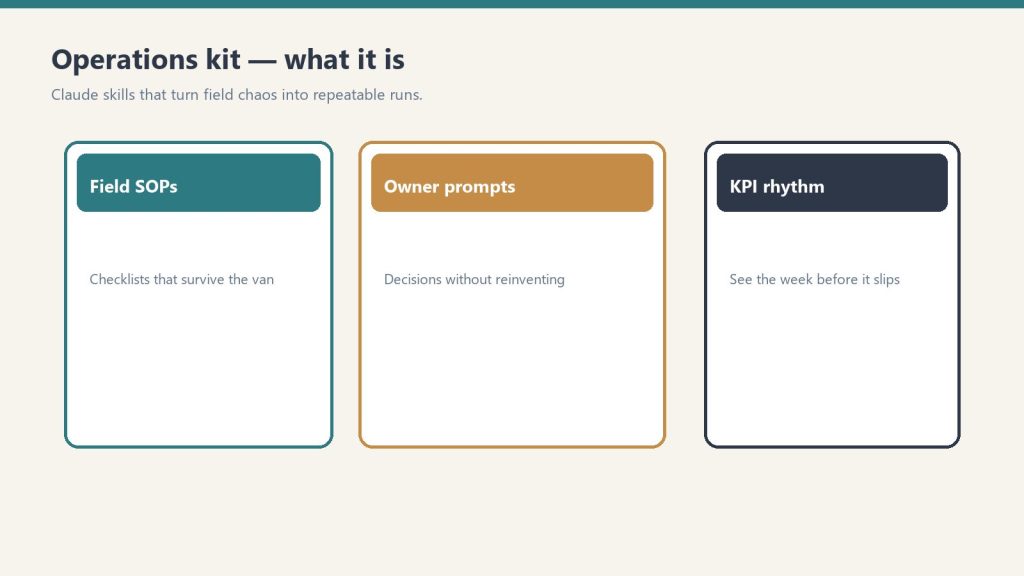
    • Notion Second Brain template configured for field operations: jobs, crews, equipment, and clients — structured so Claude can read and act on it
    • 10 pre-built Claude skills for field operator workflows: job documentation, client communication, estimate drafting, crew scheduling, insurance correspondence, and more
    • 50 ready-to-use prompts organized by situation — open the doc, find the situation, copy the prompt
    • Connector checklist: how to wire Claude to WordPress, Google Calendar, Gmail, and your job management system
    • Quick-start guide: your first productive hour with Claude, every step mapped out

    Field Operator Seed Kit

    $47

    Delivered to your inbox within 24 hours — no shipping, no waiting

    Buy Now →

    Secure checkout via Square — all major cards accepted

    Frequently Asked Questions

    How is this delivered?

    Within 24 hours of purchase via email from will@tygartmedia.com. You will receive a download link for the ZIP file and/or Notion duplicate link immediately.

    Do I need any special software?

    A free Notion account is required. No other software needed.

    Can I customize this for my specific business?

    Yes — that is the point. Everything is built to be edited. Swap in your company name, add your specific workflows, remove anything that does not apply. It is a starting point, not a locked template.

    Is there a refund policy?

    Because this is a digital product, all sales are final. If you have a problem with your purchase, email will@tygartmedia.com and we will sort it out.

  • The Restoration Talent Window Is Closing Faster Than You Think

    The Restoration Talent Window Is Closing Faster Than You Think

    Last refreshed: May 15, 2026

    A LinkedIn post from a restoration recruiter in Houston tipped me off this morning. He’s right — but the timeline is shorter than most people in the industry realize.

    Mitchell Riley LinkedIn post about Claude Managed Agents announcement
    Mitchell Riley’s LinkedIn post that started this train of thought.

    This article is part of The Restoration Operator’s Playbook — Tygart Media’s body of work on how the industry’s best restoration companies are actually thinking in 2026. Start with the pillar piece if this is your first read.

    The post that got me thinking

    This morning I logged into LinkedIn and saw a post from Mitchell Riley — a restoration industry recruiter in Houston who places PMs, GMs, and business development leaders for restoration contractors across the country. Mitchell flagged Anthropic’s Claude Managed Agents launch with the kind of casual enthusiasm only people who actually use this stuff every day can manage. He called it “pretty cool” and noted that Claude will now build you an agent based on natural language.

    He’s right. He’s also pointing at something most of the restoration industry hasn’t fully processed yet.

    What Anthropic actually shipped

    On April 8, 2026, Anthropic launched Claude Managed Agents in public beta. The short version: the infrastructure work that used to take three to six months of engineering — sandboxed code execution, credential management, long-running session persistence, error recovery, observability — is now a managed service. You define what the agent should do. Anthropic runs it.

    The companies already shipping production agents on it: Notion, Asana, Rakuten, and Sentry. Notion lets teams delegate coding, slides, and spreadsheets to Claude without leaving the workspace. Rakuten deployed specialist agents across product, sales, marketing, finance, and HR — each live in under a week. Sentry built an agent that goes from flagged bug to open pull request, fully autonomous.

    Internal Anthropic testing showed up to a 10-point improvement in task success on structured generation work versus a standard prompting loop, with the largest gains on the hardest problems.

    That’s the announcement. Here’s why it matters for restoration.

    The bottleneck just moved

    For the last two years, the question every restoration owner asked about AI was some version of: “Can it actually do the work?” The honest answer was usually “not yet, not without a developer team you don’t have.”

    That’s no longer the question. The infrastructure gap closed on April 8. The new bottleneck is not “can you build the agent” — it’s “do you have the human operators who know what the agent should be doing in the first place.”

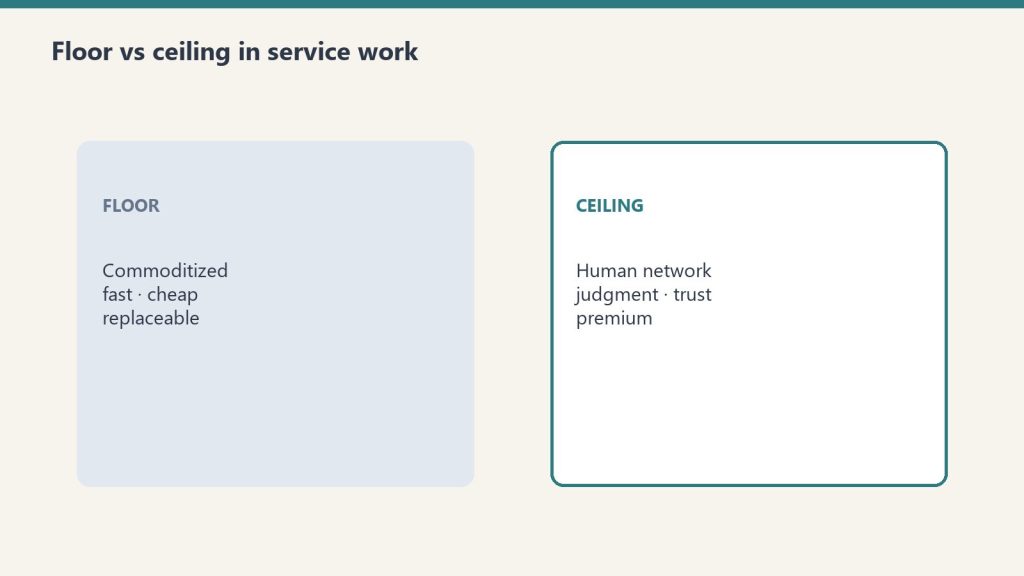
    Restoration is an industry where the real intelligence lives in people. A senior PM who has worked five hundred losses knows things that have never been written down anywhere. How a Cat 3 storm response actually sequences when the carrier is dragging on TPA approvals. The difference between a contents pack-out that closes clean and one that becomes a six-month dispute. Which mitigation decisions buy you a profitable job and which ones bury you on the reconstruction side. None of that lives in a textbook. It lives in the heads of people who have been doing the work for fifteen or twenty years.

    That tribal knowledge is now the constraint. The companies that win the next three years will be the ones who pair Managed Agents (or something like it) with senior operators who can tell the agent what good looks like. The companies that try to skip that step — that try to hire generalists and teach them restoration on the fly while their competitors are distilling twenty-year veterans into operational systems — are going to get lapped.

    Buy the talent now

    This is where the recruiting angle gets interesting. Senior restoration talent has always been hard to find. It’s about to get much harder, for a reason most owners haven’t priced in yet: the value of a senior PM is no longer just the work that PM does directly. It’s the work an entire AI system does in their image once their judgment has been encoded into the workflow.

    Right now, that arbitrage is open. The market hasn’t repriced senior operators for what they’re actually worth in an AI-augmented restoration company. In twelve to twenty-four months, it will. The owners who hire the best PMs, GMs, and BD leaders now — and who pair them with someone like Mitchell who actually understands the placement game — are going to look like geniuses in 2027.

    Mitchell is one of the people who gets this from the inside. He uses the AI tools himself. He builds workflows. He analyzes things in dimensions and context that most recruiters never touch — most recruiters in this industry are still working from a spreadsheet of resumes and a cell phone. Mitchell is the kind of recruiter who notices when Anthropic ships something that’s going to change the value of every senior hire he places, and posts about it on a Wednesday morning. That’s the level of operator the smart restoration owners are going to want in their corner.

    What to actually do this quarter

    If you run a restoration company and you read this far, three concrete things:

    One. Identify your two or three most senior operators — the people whose judgment is load-bearing for the business. Start documenting how they think, not just what they do. The documentation is the raw material every future AI workflow will run on.

    Two. Open one or two senior hires you’ve been putting off. The talent market is going to tighten. Get in front of it.

    Three. Stop treating AI as an IT project. It’s an operational capability. The companies that figure this out are not waiting for their tech vendor to sell them an “AI feature.” They’re hiring the operators, capturing the judgment, and pointing the tooling at the result.

    Mitchell’s post was three sentences. The full version of what he was pointing at takes about a thousand words. This is that version.

    If you’re a restoration owner thinking about senior placements in the next two quarters, you should be talking to Mitchell. And if you’re thinking about how to operationalize AI inside your company — distilling senior judgment into systems your whole team can run — that’s the conversation we have at Tygart Media.

    Read next: The New Restoration Operator: How the Industry’s Best Companies Are Thinking in 2026 — the pillar piece this article belongs to.

  • From Field Tech to AI Supervisor: The Career Path That Doesn’t Have a Name Yet

    From Field Tech to AI Supervisor: The Career Path That Doesn’t Have a Name Yet

    Tygart Media Strategy
    Volume Ⅰ · Issue 04Quarterly Position
    By Will Tygart
    Long-form Position
    Practitioner-grade

    The job title doesn’t exist yet. In three years it will be one of the most sought-after roles in trades companies that have made the AI transition. Call it AI Operations Supervisor, or Field Intelligence Lead, or Verification Layer Manager — the name will standardize as the role standardizes. What it describes is already emerging.

    It’s the person who runs AI-assisted field teams: who understands what the AI is doing and why, who catches the errors before they become expensive, who provides the context that makes the AI’s output accurate, who trains new technicians on the difference between accepting AI output and verifying it. The person who owns the verification layer between the AI’s intelligence and the physical world.

    That person is not a manager who learned to use AI tools. They’re a field technician who understood the transition early enough to build the skills that make them the most valuable person in an AI-assisted operation.

    The Career Path in Concrete Terms

    The path from field technician to AI supervisor is not a pivot. It’s a development arc within the trades. Each stage builds on the previous one:

    Stage 1: Deep domain technician. Does the work at the level where deviation from documentation is visible and meaningful. Builds the tacit knowledge library that the verification layer requires. This stage cannot be skipped or compressed — it takes the time it takes, and the depth built here is the foundation everything else rests on.

    Stage 2: AI-literate field technician. Understands what the AI tools used by their company are doing, what their common failure modes are in this specific domain, and how to brief them for better output. Can evaluate AI-generated estimates, timelines, scope documents, and communications and identify what’s wrong before it becomes a problem. This stage is learnable in weeks once Stage 1 is in place.

    Stage 3: Verification layer specialist. Becomes the person on the team who catches AI errors, provides the context briefs that improve AI output, and trains others on the difference between accepting and verifying. Starts building the institutional context library — the log of deviations, patterns, and corrections that makes the company’s AI systems more accurate over time.

    Stage 4: AI operations supervisor. Runs AI-assisted teams. Owns the verification layer for a portion of the company’s operations. Responsible for AI output quality, context library maintenance, and the ongoing calibration between what the AI produces and what physical reality requires. Increasingly strategic — participates in decisions about which AI tools to adopt and how to integrate them into field operations.

    Who Gets There First

    The technicians who make this transition fastest share two characteristics. The first is genuine domain depth — they’ve done the work long enough and paid enough attention to have real pattern recognition about their specific field. The second is intellectual curiosity about the AI layer specifically: they want to understand what the tool is doing, not just use it.

    The second characteristic is rarer than it sounds. Many experienced technicians treat AI tools as black boxes — input goes in, output comes out, use it or don’t. The ones who make the transition ask the next question: why did it produce that output, is it right, and what would I need to tell it to make it better? That question, applied consistently, is how the verification-layer expertise builds.

    The window to develop this expertise at the leading edge — before it’s table stakes — is the 18 to 36 months while the AI transition is still early in most trades companies. The workers who get there first build the largest knowledge lead and the most defensible career position. Not because they locked out competitors, but because the tacit knowledge and contextual intelligence they built during that window compounds over time in ways that later arrivals can’t replicate by just learning the tools.

    The tools will be everywhere. The judgment to use them correctly will not.


    Wire and Fire: The AI Transition Career Cluster

    Related: The Human Distillery — the methodology for capturing the tacit knowledge this cluster describes.

  • The Context Layer as Job Security: Why the Person Who Briefs the AI Is Irreplaceable

    The Context Layer as Job Security: Why the Person Who Briefs the AI Is Irreplaceable

    Tygart Media Strategy
    Volume Ⅰ · Issue 04Quarterly Position
    By Will Tygart
    Long-form Position
    Practitioner-grade

    Here is a practical observation from running an AI-native content and SEO operation across 27 WordPress sites: AI systems without context are dramatically less useful than AI systems with context. Not marginally. Dramatically. The difference between a cold AI answering a question about a site and an AI with full context about that site’s history, architecture, past decisions, and known failure modes is the difference between generic advice and accurate, actionable guidance.

    The same dynamic applies in every domain where AI is being deployed into complex physical operations. The AI that knows the job history, the property quirks, the adjuster’s patterns, and the crew’s capabilities produces better output than the AI that just knows the job type. The context is the intelligence multiplier.

    For trades workers, this is the career insight that almost nobody is articulating clearly: the person who provides context to an AI system is not a data entry function. They are the intelligence multiplier. And in physical operations where the AI cannot directly observe the environment, that person is structurally irreplaceable.

    What Context Actually Means in Field Operations

    Context in a water damage job includes: the property age and construction type (because these predict concealed damage patterns that the visible inspection doesn’t surface). The adjuster assigned to the claim and their known preferences and pain points. The crew lead’s specific expertise and the tasks they’re most reliable on. The scope items that this type of job in this market typically develops into, beyond what the initial estimate captures. The history of prior claims on the property if available.

    A field technician with 10 years in a market carries most of this as tacit knowledge. They brief an AI system — or a new crew member, or an estimator — not by reciting facts but by flagging the things that are different from the standard case. “This property is going to have issues behind the plaster — always does with this era of construction in this neighborhood.” “This adjuster needs the moisture readings organized by room, not by date.” “This crew lead is great on category 3 but slow on documentation — assign someone else to the paperwork.”

    That briefing — specific, accurate, anticipating the failure modes — is worth more to an AI system than the job file itself. It’s the difference between the AI producing a standard output and producing a calibrated output. The worker who can brief an AI that well is not a data entry function. They’re a force multiplier on the AI’s capability.

    Building Context as a Career Strategy

    The trades worker who understands this reframes their career development accordingly. Domain depth is not just about doing the work well — it’s about building the context library that makes AI-assisted work dramatically better. Every job adds to that library. Every deviation from the expected outcome is data. Every instance of “this is different from what the estimate anticipated, and here’s why” is a piece of context that an AI system needs and can’t generate on its own.

    The practical discipline: log the deviations. Not just “job complete” but “job complete, two scope items added because of X, timeline extended because of Y, adjuster friction on Z.” Over time, this log becomes a context library. The worker who has it produces better AI-assisted outcomes than the worker who doesn’t, in the same way that a well-briefed employee produces better outcomes than one who starts every task cold.

    This is what the context layer as job security actually means. Not a technical architecture. A career behavior: build the context depth that makes AI systems more effective, and position yourself as the person who provides it. That role doesn’t automate. It compounds.


  • Why Judgment Is the Moat: What AI Can’t Replace in the Trades

    Why Judgment Is the Moat: What AI Can’t Replace in the Trades

    Tygart Media Strategy
    Volume Ⅰ · Issue 04Quarterly Position
    By Will Tygart
    Long-form Position
    Practitioner-grade

    The most misunderstood concept in every AI-transition conversation is what “judgment” actually means and why it’s irreplaceable.

    Judgment is not experience. A worker with 20 years in a field has experience. They may or may not have judgment. Experience is the accumulation of situations encountered. Judgment is what happens when a novel situation — one that doesn’t match any template — produces a correct decision anyway. Judgment is pattern recognition operating beyond the edges of the patterns.

    AI systems excel at template matching. Given enough training data, they identify situations that resemble situations they’ve seen and produce outputs that would have been correct in those prior situations. This is genuinely powerful and increasingly capable. What it is not is judgment. When the current situation deviates from the distribution the model was trained on — when the physical reality doesn’t match the documentation — template matching produces confidently wrong outputs. Sometimes visibly wrong. Sometimes silently wrong, which is worse.

    Where AI Template Matching Fails in the Trades

    Every experienced trades worker knows the list implicitly. These are the situations where the estimate is always wrong, where the timeline never holds, where the scope items that weren’t in the original proposal always appear. They’re not random — they follow patterns that experienced workers recognize but that rarely make it into the documentation that trains AI systems.

    In water damage restoration: older properties with non-standard framing, original plaster walls, or retrofitted mechanical systems. Jobs where the visible damage significantly understates the concealed damage. Jobs in markets where certain subcontractor practices are standard even though they’re not in any pricing guide.

    In fire restoration: jobs where the smoke pattern doesn’t match the stated ignition point. Jobs where the client’s account of the event doesn’t match the physical evidence. Jobs where the initial structural assessment missed load-bearing implications of the damage.

    In every trades field: the situation that was described one way in the job intake and turns out to be a different situation when someone is physically present in the space.

    AI systems trained on completed job files learn the average. They don’t learn the deviations that an experienced technician would have recognized before the average outcome materialized. The experienced technician looks at a situation and their pattern recognition — operating below conscious awareness — flags it as an outlier before the data confirms it. That’s the judgment. That’s the moat.

    Why the Moat Deepens as AI Gets Better

    This seems counterintuitive but it’s structural: as AI systems get better at the template-matching layer, judgment becomes more valuable, not less.

    When AI handles the standard cases well, the remaining cases — the ones that require human verification — are disproportionately the non-standard ones. The deviation cases. The outliers. The situations that look standard but aren’t. Handling these correctly requires exactly the kind of judgment that experience builds and AI systems don’t have.

    A company that deploys AI for standard case handling and reserves human judgment for non-standard cases is not degrading the human role. It’s concentrating it on the hardest problems. The worker who handles those problems needs more judgment, not less. And the value of getting them right — because the cost of getting them wrong is concentrated in the deviation cases — is higher than ever.

    This is why the framing “AI will replace workers” is wrong for the trades specifically. AI will replace the template-matching layer of trades work. The judgment layer — the part that operates at the edge of the templates — will remain human until AI systems can be physically present in a space, read it with the full sensory apparatus of an experienced technician, and apply the tacit knowledge that only physical experience builds. That is not an 18-month problem. It may not be a 10-year problem.


    Wire and Fire: The AI Transition Career Cluster

    Related: The Human Distillery — the methodology for capturing the tacit knowledge this cluster describes.

  • The Wire and Fire Guys: Why Trades Workers with Judgment Are the Most Important People in the AI Transition

    The Wire and Fire Guys: Why Trades Workers with Judgment Are the Most Important People in the AI Transition

    Tygart Media Strategy
    Volume Ⅰ · Issue 04Quarterly Position
    By Will Tygart
    Long-form Position
    Practitioner-grade

    There is a version of the AI transition story that gets told constantly, and it goes like this: AI will automate jobs, workers will be displaced, and the people who adapt will be the ones who learn to use AI tools. This version is not wrong exactly. It’s just missing the part that matters most for the people who actually work in the trades.

    The people who build things, fix things, assess damage, run field operations, and carry years of hard-won judgment in their bodies and their hands — these are not knowledge workers whose jobs can be uploaded to a language model. Their work requires physical presence, sensory intelligence, and the kind of contextual judgment that comes from doing something 500 times in conditions that were never twice the same.

    But the transition is real, and it’s happening around them whether they’re paying attention or not. The question isn’t whether AI changes the trades. It’s which trades workers end up on the right side of that change — and why.

    The answer is not “the ones who learn to code.” It’s not “the ones who get an AI certification.” It’s the ones who understand what AI can’t do without them, and position themselves as the irreplaceable layer between the intelligence and the outcome.

    That’s the Wire and Fire Guy. And the window to become one is shorter than most people realize.


    What the Wire and Fire Guy Actually Is

    In electrical work, the wire and fire guys are the experienced field technicians who come in after the rough work is done. They’re not project managers. They’re not estimators. They’re the people who look at what the system is supposed to do, look at what’s actually been installed, and bridge the gap between the plan and the physical reality. They troubleshoot. They adapt. They make judgment calls that no blueprint anticipated.

    The name is an archetype, not a job title. It describes a class of worker who exists in every trades field: the senior technician in water damage who knows from the smell and the color of the staining that the timeline is longer than the moisture readings suggest. The fire restoration veteran who can read a smoke pattern and tell you which rooms were occupied and which weren’t before the alarm triggered. The field supervisor who looks at an estimate and spots the three line items that will blow up into supplements before the job starts.

    These people carry knowledge that cannot be extracted from documentation because it was never documented. It lives in their sensory memory, their accumulated pattern recognition, their feel for how this specific type of situation typically develops. AI systems trained on the documentation don’t have it. AI systems that have processed thousands of job files come closer but still don’t have the physical dimension — the reading of a space that happens in the first ten minutes of being in it.

    That knowledge — embodied, sensory, judgment-based — is the moat. And right now, most of the people who have it don’t know it’s a moat.


    The 18-Month Window

    Here is what is true right now, in April 2026: AI systems can write estimates. They can process moisture readings. They can identify scope items from photos. They can draft communications to adjusters. They can route jobs. They can flag outliers in a dataset of completed claims. They can do all of this faster and cheaper than a human doing the same work.

    Here is what is also true: every one of those AI outputs needs a human to verify it against physical reality before it becomes an action. The estimate needs someone on-site who can see what the AI couldn’t. The moisture readings need someone who can read the environment around the reading — the substrate, the airflow, the odor, the age of the damage. The scope items need someone who can look at the photo and then look at the actual wall and tell you what the photo didn’t capture.

    That verification layer — the human in the loop between the AI’s output and the physical world — is not going away. What is going away, over the next 18 to 36 months, is everything on the other side of that line. The data entry. The scheduling calls. The status updates. The form-filling. The paperwork that currently consumes a significant portion of every field technician’s non-field time.

    The technician who understands this transition has a clear path: move toward the verification layer, away from the data layer. Develop the judgment that makes the AI’s output trustworthy or correctable. Become the person the AI reports to, not the person doing the work the AI can do.

    The technician who doesn’t understand it will find their job slowly hollowed out — not eliminated suddenly, but compressed, devalued, and increasingly focused on the tasks that AI hasn’t gotten to yet, which is a shrinking list.


    Why Judgment Is the Moat

    Judgment is not the same as experience. Experience is a prerequisite for judgment but not a guarantee of it. Judgment is what happens when experience meets a situation that doesn’t match any template and produces a correct decision anyway.

    AI systems are template-matching engines at their core. They are extraordinarily good at situations that resemble situations in their training data. They fail — sometimes silently, which is worse — when the situation deviates from the distribution they’ve seen. A water damage job in a 1920s Craftsman with non-standard framing, original plaster walls, and an HVAC system that was retrofitted twice is a deviation. An AI trained on modern residential restoration data will produce an estimate and a timeline. A Wire and Fire Guy with 15 years of experience will look at the same job and know the estimate is wrong and the timeline is optimistic, because they’ve been inside enough 1920s Craftsmans to know what those walls hold.

    This is the moat. Not the ability to use an AI tool — that’s table stakes within 18 months. The ability to know when the AI tool is wrong, and why, and what to do about it instead. That requires the tacit knowledge that only physical experience builds. It cannot be trained into a model. It cannot be acquired from a certification. It grows from doing the work in conditions the documentation never anticipated, enough times to develop the pattern recognition that operates below conscious awareness.

    The trades worker who wants to be on the right side of the AI transition doesn’t need to compete with the AI on the AI’s terms. They need to become the irreplaceable layer between the AI’s output and the physical world. That layer is called judgment, and building it is a career strategy.


    The Context Layer as Job Security

    There is a more technical version of this argument, and it’s worth understanding even if you never write a line of code.

    AI systems are dramatically more useful when they have context — specific knowledge about the situation, the history, the people involved, and the standards that apply. A generic AI asked to write an estimate for a water damage job produces a generic estimate. An AI given the job address, the property age, the adjuster’s history with this contractor, the specific moisture readings, and the known quirks of the local building code produces something much better.

    The person who provides that context — who knows enough about the job to load the AI with the information that makes its output accurate — is not replaceable. They are, in fact, more valuable as AI systems get better, because better AI systems reward better context. The technician who can brief an AI the way a good editor briefs a writer — specific, accurate, anticipating the failure modes — gets dramatically better results than the technician who types a query and accepts whatever comes back.

    This is what “human in the loop” actually means in practice. It’s not a compliance checkbox. It’s the functional requirement that the AI’s output is verified, corrected, and contextualized by someone who has the embodied knowledge to know when it’s right and when it isn’t. That someone, in the trades, is the Wire and Fire Guy.


    From Field Tech to AI Supervisor: What the Career Path Looks Like

    This is not a story about leaving the trades. It’s a story about moving up the value stack within them.

    The field technician who wants to make this transition has three things to develop, in order of how quickly they compound:

    Domain depth first. The judgment moat requires genuine expertise. The technicians who end up in the verification layer are the ones who actually know the work at the level where deviation from documentation is visible and meaningful. This is built by doing the work, paying attention, and developing the habit of asking “why does this job look different from what the estimate anticipated?”

    AI literacy second. Not coding. Not machine learning theory. The practical ability to give an AI system a useful brief, evaluate its output for the specific failure modes common to your domain, and correct it with the context that changes the answer. This is learnable in weeks, not years, and it compounds quickly once the domain depth is in place to evaluate the output.

    Communication between the two layers third. The ability to translate between the physical world — what you’re seeing in the field — and the data layer that the AI operates on. This is partly documentation discipline (logging what you observe in terms that AI systems can use later) and partly the ability to communicate your corrections and their reasoning so the system improves over time rather than repeating the same errors.

    The career path is not: field tech → project manager → estimator → office. That path still exists but it’s compressing as AI handles more of what project managers and estimators do. The path that compounds in an AI-native industry is: field tech with deep domain knowledge → field tech who understands AI output → field supervisor who runs AI-assisted teams → operations role that owns the verification layer for a company’s AI systems.

    That last role doesn’t have a standard job title yet. In three years it will. The people who get those roles will be the ones who understood the transition early enough to position themselves correctly — and who built the judgment depth that no model can replicate.


    A Note on Pinto

    This is the article I wanted to write since we published the original Wire and Fire Guys piece. That piece named the archetype. This one tries to give it a career map.

    Pinto — who handles the infrastructure layer in this operation, the GCP deployments, the Cloud Run services, the database architecture — is the Wire and Fire Guy of AI infrastructure. He doesn’t just run the code. He understands what it’s supposed to do, sees when it deviates from that, and bridges the gap between the plan and the physical reality of production systems. The AI produces the output. Pinto verifies it against what the system is actually doing and knows why they differ.

    That’s the role. That’s the moat. The window to build it is open. It won’t be open forever.


    Frequently Asked Questions

    Does this apply outside the restoration industry?

    Yes. The Wire and Fire Guy archetype exists in every trades field and every industry where physical reality diverges from documentation. Construction, manufacturing, healthcare, agriculture, logistics — any field where experienced human judgment is applied to physical conditions that AI systems observe indirectly through data. The timeline and the specific skills differ by domain. The structure of the argument is the same.

    What’s the minimum AI literacy a trades worker needs to develop?

    Three things: the ability to give an AI system a specific, accurate brief for a task; the ability to evaluate the output for domain-specific failure modes (the things AI typically gets wrong in your industry); and the discipline to log corrections in a way that builds context over time rather than each correction being one-off. None of this requires programming knowledge. It requires domain expertise applied to a new kind of tool.

    How urgent is the 18-month window?

    The 18–36 month range is where most of the data entry, scheduling, and communication tasks that currently consume field technician time will be substantially automated in adoption-leading companies. The companies that adopt early set the new baseline for what’s competitive. Workers in those companies develop the verification-layer skills first and build the largest knowledge lead. The window is not a cliff — it’s a slope — but the slope is steeper now than it will be in three years when the transition is mostly complete in leading companies and everyone is catching up.

    What about union rules and job protections?

    Job protections can slow the transition but don’t reverse the value dynamics. The worker who has built genuine verification-layer expertise is more valuable whether or not the AI transition is delayed by contract. And the worker who hasn’t built it is less valuable on the same timeline. The protection is in the skill, not the rule.


    Wire and Fire: The AI Transition Career Cluster

    Related: The Human Distillery — the methodology for capturing the tacit knowledge this cluster describes.

  • Books for Bots: What a Knowledge Concentrate Actually Is and How It’s Built

    Books for Bots: What a Knowledge Concentrate Actually Is and How It’s Built

    Tygart Media Strategy
    Volume Ⅰ · Issue 04Quarterly Position
    By Will Tygart
    Long-form Position
    Practitioner-grade

    A transcript is not a knowledge artifact. Neither is a summary. Both are containers for words. Neither is optimized for the thing that needs to consume them.

    When you capture an expert’s knowledge and then feed the transcript to an AI system, the AI gets the words. It does not get the structure. It does not know which claims are firsthand vs. secondhand. It cannot distinguish a confident assertion from a hedged one. It has no way to chain the decision logic — the “when X, do Y because Z” sequences that constitute the operational core of what the expert knows. It just has a long document full of things that may or may not be true, with no metadata to tell it which is which.

    This is why most knowledge capture projects fail to deliver on their promise. The content is there. The structure that makes it usable isn’t.

    A knowledge concentrate is the alternative. It is the distilled, structured artifact produced by the Human Distillery extraction protocol — smaller than a transcript, denser than any summary, and specifically formatted for the AI systems that will consume it.

    The Five Components of a Knowledge Concentrate

    1. The Entity Graph

    Every named concept, process, role, piece of equipment, regulation, and decision point that surfaces in extraction gets represented as a node. The edges between nodes are typed: causal, conditional, hierarchical, associative. The graph is not a list — it’s a map of relationships, and the relationships are the knowledge.

    An AI system with a list of entities knows vocabulary. An AI system with an entity graph knows how the domain works — how a change in one thing propagates to another, which concepts are upstream of which decisions, which relationships are conditional and which are structural.

    For a water damage restoration operation: the graph connects moisture readings to drying equipment selection to drying time estimates to invoice amounts to adjuster response patterns. None of those connections are in the documentation. All of them are in the head of a senior project manager who has run 400 jobs.

    2. Decision Logic

    The most directly usable component of the concentrate. Every when-then-because statement extracted from the session, structured as:

    • Condition: When this situation is present
    • Action: This is what we do
    • Because: This is why (the reasoning, not just the rule)
    • Exceptions: The cases where this breaks down
    • Confidence score: 0.0–1.0, based on how many independent sources confirmed it

    The “because” is what makes this different from a policy. A policy says do Y. A knowledge concentrate says do Y because Z, which means an AI system can recognize when Z is absent and adjust accordingly — rather than applying the rule in cases where the underlying condition that made the rule sensible doesn’t apply.

    The exceptions are equally important. Expert judgment is largely the accumulation of exceptions — the cases where the standard answer is wrong. Capturing those is the whole point of Layer 2 extraction.

    3. Benchmarks

    Every number that surfaces in extraction: thresholds, timelines, costs, rates, ratios, counts. Stored with context, source count, and variance.

    A benchmark from a single extraction session has low confidence. The same benchmark confirmed by six independent subjects in the same domain and market has high confidence and is ready to be used as ground truth in an AI system’s reasoning. The concentrate tracks the difference.

    This is the component that makes the concentrate valuable as a competitive intelligence product. The numbers in an industry that everyone knows but nobody has published — the real margin thresholds, the actual response time expectations, the price per square foot that experienced operators actually charge vs. what appears in public pricing guides — these exist only in people’s heads. The concentrate captures them with provenance.

    4. Tacit Signatures

    The things that are hard to explain. Captured as best as they can be verbalized, with a confidence flag.

    A tacit signature sounds like: “The drywall feels wrong before the moisture meter confirms it.” Or: “You can tell within the first five minutes of a call whether the adjuster is going to be cooperative or difficult, and it’s not anything specific they say.” These are not mysticism. They are pattern recognition operating below the level of conscious articulation — real knowledge that has never been verbalized because no one asked slowly enough.

    The confidence flag on tacit signatures signals to the consuming AI: this is approximate. This is the residue of knowledge the extraction process got close to but couldn’t fully surface. Don’t treat it as ground truth. Treat it as a signal that this is where human judgment is concentrated, and flag it for human review when it’s relevant.

    5. Provenance

    Traceable but anonymized. For every claim in the concentrate: how many independent sources confirmed it, what their roles were, what domain and market the data came from, and whether the claim is individual knowledge or cross-validated pattern.

    Provenance is what makes the concentrate auditable. An AI system that gives an answer based on a knowledge concentrate should be able to say: this answer comes from claim X, which was confirmed by three independent subjects with 10+ years of experience in this domain. That’s a very different epistemic standing than “I was trained on this.”

    The Density Test

    A useful heuristic for evaluating whether you have a transcript, a summary, or a true knowledge concentrate:

    A transcript contains everything that was said. It’s large, raw, and unstructured. An AI can search it but cannot reason from it efficiently.

    A summary contains the main points. It’s smaller. It has lost specificity, exceptions, confidence information, and relationships. It’s optimized for human reading, not AI consumption.

    A knowledge concentrate is smaller than the summary in tokens but larger in information. It contains relationships the summary dropped. It contains confidence scores the summary didn’t capture. It contains decision logic the summary flattened into assertions. An AI system can reason from it, not just retrieve from it.

    If what you have could be produced by someone reading a transcript and taking notes, it’s a summary. A knowledge concentrate requires the extraction protocol — it can only be produced from a session where the tacit layer was deliberately surfaced.