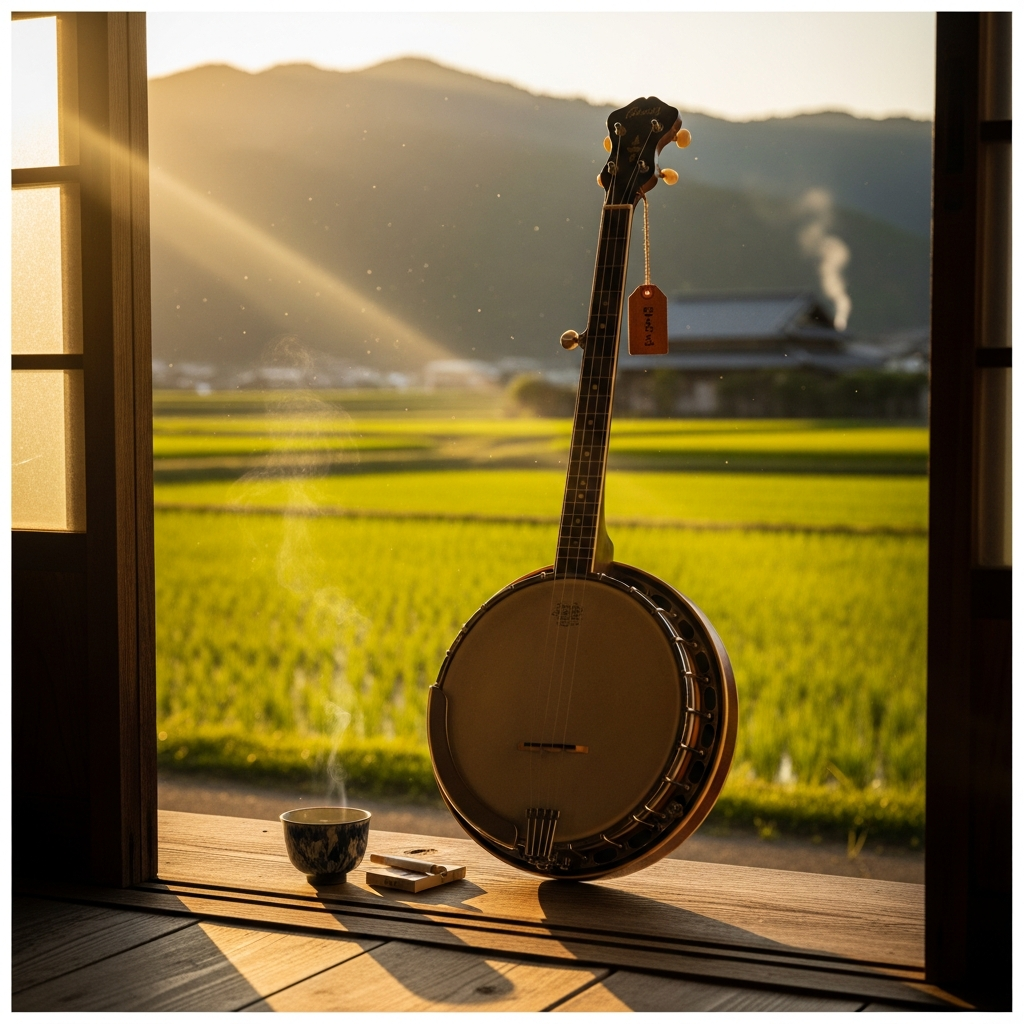
On a Sunday morning in 1971, Yuki’s grandfather walked through a flea market in Matsumoto and found a five-string banjo under a table, half-buried under old fishing gear and a broken transistor radio. The price tag said three thousand yen — about eight dollars. He didn’t know what it was. He bought it anyway.
He drove it home in his light truck through the farm roads of Nagano Prefecture, setting it gently in the passenger seat like a child he was bringing home from the hospital. He learned three chords from the sleeve of an imported record. He tuned it by ear against sounds he could only half remember. For decades, the tuning was never quite right. It didn’t matter. The sound that came out was entirely his own — part Appalachian mountain music, part Japanese rice-field rhythm, entirely something that had never existed before him.
This song is the happiest on the album — deliberately, defiantly joyful. The banjo rolls at 140 BPM, the fiddle plays twin harmonies, the upright bass slaps the rhythm of a barn dance that nobody in Nagano had ever seen but everybody somehow understood. There are no drums. No electricity. Just the sound of strings connecting a Japanese farmhouse to a tradition that began in the hills of Appalachia and somehow crossed an ocean and landed in a flea market in Matsumoto.
The song ends with a single shout — ヤッホー! — the Japanese equivalent of a holler. The grandfather’s ghost, still laughing, still just slightly off-key, still perfect.
埃を被った 五弦のバンジョー
三千円の値札が 風に揺れていた
おじいちゃんは 迷わず財布を出した
錆びた弦を 指先で軽くはじき
軽トラの助手席に そっと置いた
農道の砂埃の中 家まで運んだ
「こいつはいい音だ」と 彼は笑った
(もっと早く もっと遠くへ)
笑い声が 屋根の上まで跳ねる
おじいちゃんと僕の でたらめな二重奏
音が繋ぐ 終わらないダンス
彼の指は 節くれ立って硬い
「ここを押さえろ」 土のついた指先
Gのコードが 夕暮れに響く
壊れたラジオの横で 足を鳴らし
裏庭の鶏も リズムに合わせて鳴く
下手くそな僕を 一度も叱らず
彼はただ 何度も弦を弾き続けた
(もっと熱く もっと激しく)
笑い声が 屋根の上まで跳ねる
おじいちゃんと僕の でたらめな二重奏
音が繋ぐ 終わらないダンス
裏側の傷は あの日の軽トラの揺れ
酒を一口飲み チューニングを合わせる
息子が横で 手を叩いて笑う
教わった通り 右手を滑らせれば
懐かしい匂いが 部屋に広がる
おじいちゃんが遺した 一番の宝物
今は僕が この歌を繋いでいく
(ずっと響け ずっと明日も)
笑い声が 屋根の上まで跳ねる
おじいちゃんと僕の でたらめな二重奏
音が繋ぐ 終わらないダンス
ヤッホー!
A dust-covered five-string banjo
A three-thousand-yen price tag swaying in the wind
Grandpa reached for his wallet without hesitation
He lightly plucked the rusty strings with his fingertips
Set it gently in the passenger seat of the small truck
Carried it home through the dusty farm roads
“This thing has a good sound,” he said, laughing
(Faster, further, wilder)
Laughter bouncing all the way up to the rooftop
Grandpa and me, our gloriously wrong duet
Music connecting us — a dance without an end
His fingers, knotted and hard from the fields
“Press here,” — dirt-stained fingertips showing the way
A G chord rings out into the evening
Tapping his foot beside the broken radio
Even the chickens in the backyard clucked to the beat
He never once scolded my clumsy playing
He just kept plucking the strings, again and again
(Hotter, harder, don’t stop)
Laughter bouncing all the way up to the rooftop
Grandpa and me, our gloriously wrong duet
Music connecting us — a dance without an end
The scratch on the back — from that day in the truck
I take a sip of sake, tune it up
My son beside me, clapping and laughing
I slide my right hand the way he taught me
And the familiar scent fills the room
The greatest treasure Grandpa left behind
Now it’s my turn to carry this song forward
(Keep ringing, keep going, tomorrow too)
Laughter bouncing all the way up to the rooftop
Grandpa and me, our gloriously wrong duet
Music connecting us — a dance without an end
Yah-hoo!
Every album needs a song like this — the one that makes you feel like everything is going to be fine. The brief called for pure bluegrass joy: 140 BPM, no drums, no electricity, just the acoustic instruments that have powered mountain music for over a century. The banjo leads with Scruggs-style three-finger rolls. The fiddle plays twin harmonies. The upright bass slaps the beat.
The lyrical concept was always about intergenerational transmission — the way music passes from hand to hand, slightly changed each time, always carrying something essential forward. The grandfather in this song never learned the “right” way to play. That’s exactly the point. There is no wrong way when the joy is real.
The chorus phrase でたらめな二重奏 — “our gloriously wrong duet” — became the emotional heart of the whole song. Imperfect music made together across generations is not a failure of technique. It is a triumph of love.
The artwork was generated with Google Imagen 4 — a vintage banjo resting on a Japanese engawa porch, overlooking green rice fields at golden hour, with the original flea market price tag still hanging from its tuning peg. Tea beside it. Mountains in the mist. It appeared in 90 seconds and looked exactly like the grandfather’s house.
Bluegrass song, sung entirely in Japanese language, all vocals and lyrics performed in Japanese only. Female lead vocal, bright clear tone with warmth. Traditional acoustic bluegrass instrumentation — 5-string banjo as lead instrument with Scruggs-style three-finger rolls, upright bass with slap-and-pop rhythm, acoustic rhythm guitar chop on 2-and-4, fiddle playing twin harmony lines. Key of D major, fast tempo at 140 BPM, 4/4 time. Joyful, celebratory mood — the energy of a barn dance or a front porch on a summer evening. No electric instruments, no drums, no production effects beyond room reverb. Story is about intergenerational love of music passed down through a Japanese grandfather who found a banjo at a flea market. Duration approximately 2:55. Language: Japanese only.