Category: Tygart Media Editorial

Tygart Media’s core editorial publication — AI implementation, content strategy, SEO, agency operations, and case studies.

  • How to Build a LinkedIn Content Strategy That Actually Works for SEO (Without Burning Out)

    How to Build a LinkedIn Content Strategy That Actually Works for SEO (Without Burning Out)

    Tygart Media / Content Strategy
    The Practitioner Journal
    Field Notes
    By Will Tygart
    · Practitioner-grade
    · From the workbench

    There is a lot of noise about LinkedIn content strategy and almost none of it accounts for the two most important constraints: the posting frequency cliff where more becomes worse, and the hard API limitation that means no tool can automate your long-form content for you.

    This is the practical playbook — grounded in data from 2 million-plus posts and LinkedIn’s actual API capabilities.

    The Frequency Cliff: Where More Becomes Worse

    Buffer analyzed over 2 million posts across 94,000 LinkedIn accounts to map the relationship between posting frequency and per-post performance. The findings are clear and counterintuitive above a certain threshold.

    Moving from once a week to 2–5 times a week produces the steepest performance gains — this is the activation zone where LinkedIn’s algorithm begins recognizing an account as an active, consistent publisher and distributing its content more broadly. Moving to daily posting, meaning 5–7 times a week, continues to improve per-post performance for publishers who can maintain content quality at that cadence.

    Above once per day, returns turn sharply negative. When a second post goes live within 24 hours, LinkedIn’s algorithm halts distribution of the first post to evaluate the new one. The publisher competes against themselves. The median reach per post drops over 40% for accounts posting multiple times daily.

    The 2025 algorithm update made this worse. LinkedIn now pre-filters and rejects over 50% of all posts before they reach any audience — up from 40% in 2024. High posting volume with declining content quality accelerates that filtering. The algorithm is actively penalizing low-quality volume.

    The practical sweet spots are 3–5 posts per week for personal profiles and 2–3 posts per week for company pages. Company page content faces steeper organic reach challenges than personal profiles, so the economics of volume are even less favorable for brand accounts.

    The SEO Math Behind Feed Post Frequency

    Here is the part most LinkedIn content guides miss entirely: feed posts have zero direct Google SEO value because they are not indexed by Google. They live at /posts/ URLs behind LinkedIn’s login wall. Googlebot cannot crawl them.

    The SEO value chain from feed post frequency is entirely indirect. More posts generate more engagement, which builds profile authority signals, which improves the indexation probability and ranking performance of your LinkedIn Articles and Newsletters — the content that actually lives at crawlable /pulse/ URLs and inherits LinkedIn’s domain authority of 98.

    This means optimizing posting frequency for SEO purposes is really two separate questions: how often to post in the feed for engagement and authority signals, and how often to publish Articles or Newsletters for direct search value. The second question matters more for SEO outcomes. Consistent long-form publishing — even at one Article or Newsletter per week — builds the topical authority signals that both Google and AI citation systems reward over time.

    The Automation Constraint You Cannot Work Around

    LinkedIn’s API does not expose any endpoint for publishing native Articles or Newsletters. This has been confirmed by every major scheduling and automation tool — Buffer, Hootsuite, Metricool, Sprout Social, Later — and no change is planned. The LinkedIn Community Management API supports feed posts only.

    Zapier and Make workflows that claim LinkedIn “article” functionality are sharing external URLs as link-preview feed posts. That is not the same as publishing a native LinkedIn Article at a /pulse/ URL with DA-98 authority.

    Browser automation via Selenium or Puppeteer can technically interact with LinkedIn’s article editor, but LinkedIn actively detects and blocks this, the dynamic JavaScript editor is fragile, and it violates LinkedIn’s Terms of Service with real account suspension risk. It is not a viable strategy.

    The unavoidable manual step in any LinkedIn long-form content workflow is the paste. You write the article, you optimize it, you format it — and then a human opens LinkedIn’s article editor and pastes it in.

    The Practical Workflow That Minimizes Lift

    The goal is to make the unavoidable manual step as frictionless as possible while automating everything around it.

    The workflow that minimizes lift looks like this. First, write the article using AI — structured, 800–1,200 words, educational, with specific data points and clear H2 headings that will perform well in both Google search and AI citation systems. Second, publish the article on your primary domain simultaneously — this establishes the canonical version and generates the direct SEO value on your own site. Third, prepare the LinkedIn-formatted version with the SEO title and meta description already written, ready to paste. Fourth, automate the feed post that will promote the LinkedIn Article once it is live, using Metricool or a similar scheduler.

    The only steps that require human time are the LinkedIn paste and the SEO field entry. Everything else — writing, optimization, domain publishing, feed post scheduling — can be automated or batched.

    LinkedIn Newsletters as a Force Multiplier

    If you are going to invest in LinkedIn long-form content, Newsletters are worth the additional setup compared to standalone Articles. The Google indexing and SEO authority are identical — both use /pulse/ URLs with full SEO title and meta description controls. But Newsletters add subscriber push notifications converting at 50% or higher, a compounding audience that grows with each edition, and recurring publishing signals that build topical authority faster than sporadic standalone Articles.

    The most efficient structure for a LinkedIn newsletter strategy is one newsletter per vertical or topic area, published on a consistent weekly or biweekly cadence. For an AI-native content agency, that might mean one newsletter on AI strategy for business leaders, one on SEO and GEO for marketing practitioners, and one on industry-specific applications for verticals you serve. Each builds its own subscriber base and topical authority without competing with the others.

    What Not to Do

    The most common LinkedIn content mistakes from an SEO and GEO perspective are publishing all long-form content as feed posts instead of Articles, cross-posting identical content from your blog to LinkedIn without accounting for the duplicate content issue, posting multiple times per day and triggering the reach suppression cliff, and optimizing for feed engagement metrics like reactions and comments at the expense of content structure and depth that drives AI citation.

    The brands winning the LinkedIn SEO and GEO game in 2026 are publishing less frequently than the viral advice suggests, producing content that is structurally optimized for AI parsing rather than social sharing, and maintaining consistent newsletter cadences that compound topical authority over months rather than chasing weekly reach numbers.

    The tool limitation is real. The manual paste is unavoidable. But the opportunity it unlocks — DA-98 Google rankings and AI citation across every major platform — is substantial enough to be worth the friction.

    Frequently Asked Questions

    How often should you post on LinkedIn for SEO?

    For feed posts, 3–5 times per week is the sweet spot for personal profiles and 2–3 for company pages. Posting more than once per day triggers a reach suppression cliff where median reach drops over 40% per post. For direct SEO value, consistent Article or Newsletter publishing frequency matters more than feed post volume.

    Can you schedule LinkedIn Articles with Buffer or Hootsuite?

    No. LinkedIn’s API does not support publishing native Articles or Newsletters. Buffer, Hootsuite, Metricool, and all major scheduling tools can only schedule standard feed posts. LinkedIn Articles require manual publishing through LinkedIn’s editor.

    What is the LinkedIn posting frequency cliff?

    When a second post goes live within 24 hours, LinkedIn’s algorithm halts distribution of the first post. Accounts posting multiple times per day see median reach drop over 40% per post. LinkedIn also now pre-filters and rejects over 50% of all posts before they reach any audience.

    Should you use LinkedIn Newsletters or LinkedIn Articles?

    Newsletters are generally the higher-leverage format. Both use identical /pulse/ URLs with the same Google indexing and SEO controls. Newsletters add subscriber push notifications at 50%+ open rates, a growing subscriber base, and consistent publishing cadence that builds topical authority faster than sporadic standalone Articles.


  • LinkedIn Articles vs Posts vs Newsletters: The SEO Difference That Actually Matters

    LinkedIn Articles vs Posts vs Newsletters: The SEO Difference That Actually Matters

    Tygart Media / Content Strategy
    The Practitioner JournalField Notes
    By Will Tygart
    · Practitioner-grade
    · From the workbench

    Most people treat LinkedIn as a single publishing platform. It is not. Under the hood there are two completely different content surfaces with completely different relationships to Google — and mixing them up is costing marketers real SEO value every day.

    The distinction is simple once you see it, and it changes how you should think about every piece of content you publish on the platform.

    The Core Technical Difference

    LinkedIn Articles and Newsletters live at /pulse/ URLs — fully public, fully crawlable by Googlebot, and eligible to appear in Google search results. Feed posts live at /posts/ URLs — behind LinkedIn’s login wall, invisible to Googlebot, and never appearing in any Google SERP.

    Feed posts have zero direct Google SEO value. Full stop.

    This is not a minor distinction. It determines whether your content compounds as a search asset over time or evaporates the moment it scrolls out of your followers’ feeds.

    What Google Actually Indexes on LinkedIn

    Based on Ahrefs data from 2025–2026, here is the monthly organic traffic breakdown by LinkedIn content type:

    • Personal profiles (/in/ URLs): 27.3 million monthly organic clicks — fully indexed
    • Company pages (/company/ URLs): 23.1 million monthly organic clicks — fully indexed
    • Articles and Newsletters (/pulse/ URLs): 7.4 million monthly organic clicks — fully indexed
    • Feed posts (/posts/ URLs): 2 million monthly organic clicks — not indexed by Google, traffic comes from LinkedIn’s internal search

    The feed post number is misleading. Those 2 million clicks come from LinkedIn’s own internal search engine, not Google. From a traditional SEO perspective, feed posts are a closed loop.

    Why LinkedIn Articles Punch Above Their Weight in Search

    LinkedIn’s Moz Domain Authority sits at 98 out of 100 — the same tier as Wikipedia, YouTube, and Facebook. It is one of the five highest-authority domains on the internet.

    When you publish an Article on LinkedIn, that content inherits DA-98 authority. A well-optimized LinkedIn Article on a competitive keyword can outrank independent blog posts from sites with domain authorities in the 30s, 40s, or even 50s, simply because it lives on linkedin.com.

    LinkedIn has also added full SEO controls to the Article and Newsletter editor: a custom SEO title field capped at 60 characters, a meta description field at 140–160 characters, and support for H1/H2 heading structure. These are not afterthoughts — LinkedIn is actively positioning its long-form publishing surface as a search-indexed content platform.

    One significant gap: LinkedIn does not support canonical tags. If you cross-publish content from your own blog to LinkedIn, you create a duplicate content situation with no clean resolution. The workaround is to either publish unique content natively on LinkedIn or publish on your domain first and share as a feed post link rather than republishing the full article.

    Indexation Is Not Guaranteed

    Google does not automatically index every LinkedIn Article. LinkedIn applies internal quality thresholds before allowing its content to be crawled, and those thresholds appear to be tied to account signals: profile age, connection count, engagement history, and overall account authority.

    New accounts and new company pages may see “Robots are blocked” errors on early articles. Established profiles with strong engagement histories typically see indexation within 48 hours. The pattern suggests LinkedIn gates crawlability based on whether the publishing account has earned sufficient trust signals — a reasonable stance for a platform trying to prevent SEO spam from exploiting its domain authority.

    Newsletters vs Standalone Articles: Which Wins?

    LinkedIn Newsletters are built on the same /pulse/ infrastructure as standalone Articles. The Google indexing is identical. The SEO title and meta description controls are identical. From a pure search perspective, there is no difference.

    Where Newsletters diverge is distribution. Newsletter subscribers receive push notifications when a new edition publishes, and those notifications convert at 50% or higher — significantly better than the 20–25% open rates typical of email marketing. Newsletters also build a subscriber base that compounds over time: each edition you publish reaches a larger audience than the last, as long as you maintain quality.

    For most publishers, Newsletters are the higher-leverage format. You get the same Google indexing and DA-98 authority as standalone Articles, plus built-in audience growth mechanics, subscriber retention incentives, and the topical authority signals that come from consistently publishing in a defined niche over time.

    The Practical Implication

    If you are publishing on LinkedIn with the intention of generating Google search visibility, every piece of content needs to be published as an Article or Newsletter — not as a feed post.

    Feed posts serve a real purpose: they drive engagement, build network relationships, and contribute indirectly to the profile authority signals that improve indexation for your long-form content. But they do not directly compound as search assets. The SEO pipeline runs exclusively through /pulse/ URLs.

    For content teams managing LinkedIn as part of an SEO strategy, this means maintaining two distinct content tracks: a feed post cadence for engagement and audience building, and an Article or Newsletter publishing schedule for search authority and AI citation. The first feeds the second. Neither replaces the other.

    Frequently Asked Questions

    Do LinkedIn feed posts get indexed by Google?

    No. LinkedIn feed posts live at /posts/ URLs behind LinkedIn’s login wall. Googlebot cannot crawl them and they do not appear in Google search results. Only LinkedIn Articles and Newsletters, which live at public /pulse/ URLs, are indexed by Google.

    What is LinkedIn’s domain authority?

    LinkedIn’s Moz Domain Authority is 98 out of 100, placing it in the same tier as Wikipedia, YouTube, and Facebook — one of the highest-authority domains on the internet. Content published as LinkedIn Articles inherits this authority.

    Are LinkedIn Newsletters better than LinkedIn Articles for SEO?

    They are equivalent from a Google SEO perspective — both use /pulse/ URLs and have identical indexing and SEO controls. Newsletters have a distribution advantage through subscriber notifications at 50%+ open rates, making them the higher-leverage format for most publishers.

    Does LinkedIn have SEO title and meta description fields?

    Yes. LinkedIn’s Article and Newsletter editor includes a custom SEO title field (60 characters) and a meta description field (140–160 characters), allowing publishers to control how their content appears in Google search results.

    Can LinkedIn Articles rank on Google?

    Yes. LinkedIn Articles on established accounts with strong engagement histories typically index within 48 hours and can rank competitively for professional keywords, leveraging LinkedIn’s DA-98 authority even against established independent blogs with lower domain authority.


  • LinkedIn Is the #2 AI Citation Source in 2026 — What That Means for Your Content Strategy

    LinkedIn Is the #2 AI Citation Source in 2026 — What That Means for Your Content Strategy

    Something significant shifted in the AI search landscape between November 2025 and February 2026, and most content strategists have not caught up to it yet.

    LinkedIn jumped from the 11th most-cited domain to the 5th most-cited domain on ChatGPT in just three months. Profound, which tracks 1.4 million AI citations across six platforms, called it “the largest shift in authority we have seen this year.” Across all AI platforms combined, LinkedIn content now appears in 11% of all AI-generated responses.

    If you publish professional content, this is the most important GEO development of 2026.

    The Numbers Behind the Shift

    Semrush analyzed 325,000 prompts across ChatGPT Search, Google AI Mode, and Perplexity, identifying 89,000 unique LinkedIn URLs cited in AI-generated responses. The platform-by-platform breakdown:

    • ChatGPT Search: LinkedIn appears in 14.3% of all responses
    • Google AI Mode: LinkedIn appears in 13.5% of all responses
    • Perplexity: LinkedIn appears in 5.3% of all responses

    LinkedIn is now the #2 most-cited domain by AI systems overall and the #1 source for professional queries across every major AI platform including ChatGPT, Gemini, Perplexity, Google AI Mode, and Microsoft Copilot.

    What AI Systems Are Actually Citing

    The composition of LinkedIn’s AI citations has shifted dramatically. Profile page citations — the static biographical data that dominated early LinkedIn citations — collapsed from 33.9% to just 14.5% of all LinkedIn citations in a three-month window. Meanwhile, posts and long-form articles grew from 26.9% to 34.9%.

    AI systems are not citing LinkedIn because of who you are. They are citing LinkedIn because of what you published.

    Of the 89,000 cited URLs in Semrush’s study, 50–66% are long-form Articles of 500–2,000 words, and 54–64% are educational or advice-driven content. The median cited post has just 15–25 reactions and roughly one comment. Engagement is not the primary driver of AI citation — relevance, accuracy, specificity, and structure are.

    Creators with fewer than 500 followers get cited at comparable rates to large accounts. This is not a follower game. It is a content quality and structure game.

    The Personal Profile vs Company Page Split

    One of the more strategically interesting findings from Profound’s study is that different AI platforms cite LinkedIn content differently by source type.

    ChatGPT and Google AI Mode favor personal profiles, drawing 59% of their LinkedIn citations from individual creator content versus 41% from company pages. Perplexity reverses this, drawing 59% of its LinkedIn citations from company pages and 41% from personal profiles.

    The strategic implication is a dual-publishing approach. Publishing technical and educational content on both a personal profile and a company page maximizes AI visibility across all major platforms simultaneously. They are not redundant — they are complementary, each feeding different AI citation systems.

    Why LinkedIn Content Gets Cited: The Structural Reasons

    LinkedIn’s relationship with AI systems operates through multiple channels that reinforce each other.

    First, LinkedIn content has always been publicly indexed and high-authority. With a Moz Domain Authority of 98, LinkedIn Pulse articles sit in the same crawlability tier as Wikipedia and major news publications. AI training datasets over-index on high-authority domains, meaning LinkedIn content has been proportionally well-represented in model training from the beginning.

    Second, LinkedIn rolled out a “Data for Generative AI Improvement” toggle in September 2024, set to ON by default, and expanded it to global markets in November 2025. LinkedIn is owned by Microsoft, which has a direct relationship with OpenAI. The structural pipeline from LinkedIn content to AI model training is more direct than almost any other platform.

    Third, LinkedIn content shows semantic similarity scores of 0.57–0.60 with AI-generated outputs, higher than Reddit (0.53–0.54) or Quora (0.44). AI systems are not just citing LinkedIn — they are drawing heavily on LinkedIn’s language patterns and reasoning structures when generating responses.

    What This Means for B2B and Restoration Industry Content

    For professional verticals — B2B services, restoration, real estate, finance, healthcare — LinkedIn is no longer an optional distribution channel. It is likely the single highest-leverage GEO publishing surface available.

    A structured LinkedIn Article on a technical topic in the restoration industry, AI strategy, or B2B services has a realistic path to being cited in ChatGPT, Perplexity, and Google AI Mode responses on relevant professional queries. It does not require a large following. It does not require viral engagement. It requires content that is accurate, structured, specific, and educational.

    Content reaches peak AI citation velocity 7–14 days after publishing and maintains that velocity for 90 or more days — significantly longer than Twitter/X or Reddit content, which cycles out of AI citation windows much faster.

    The Practical GEO Framework

    Based on the citation data, the content signals that drive AI citation on LinkedIn are consistent and actionable: include specific data points, metrics, methodologies, and dates rather than generic claims. Use clear H2 heading structure that AI systems can parse for answer extraction. Write educational and advice-driven content rather than promotional content. Target 800–1,200 words per Article — long enough to establish depth, short enough to maintain density.

    The biggest opportunity right now is that most LinkedIn publishers are still optimizing for feed engagement — reactions, comments, shares. The AI citation data suggests a different optimization target: structured, data-rich, educational long-form content that looks less like a viral feed post and more like a well-sourced reference document.

    The brands and individuals who make that shift in 2026 are building citation authority that will compound for years.

    Frequently Asked Questions

    Is LinkedIn the most cited source in AI search?

    LinkedIn is the #2 most-cited domain by AI systems overall and #1 for professional queries across ChatGPT, Gemini, Perplexity, Google AI Mode, and Copilot as of early 2026, appearing in approximately 11% of all AI-generated responses.

    What type of LinkedIn content gets cited by AI systems?

    50–66% of AI-cited LinkedIn content is long-form Articles of 500–2,000 words. Educational and advice-driven content accounts for 54–64% of citations. The median cited post has only 15–25 reactions — engagement is not the primary driver of AI citation.

    Does LinkedIn company page content get cited by AI?

    Yes. Perplexity draws 59% of its LinkedIn citations from company pages. ChatGPT and Google AI Mode favor personal profiles at 59%. A dual-publishing strategy covering both maximizes visibility across all AI platforms.

    How long does it take for LinkedIn content to appear in AI citations?

    LinkedIn content reaches peak AI citation velocity 7–14 days after publishing and maintains that velocity for 90 or more days — longer than most other social platforms.


  • Replacing the Interviewer: What the Human Distillery App Can and Cannot Do

    Replacing the Interviewer: What the Human Distillery App Can and Cannot Do

    Tygart Media Strategy
    Volume Ⅰ · Issue 04Quarterly Position
    By Will Tygart
    Long-form Position
    Practitioner-grade

    The extraction protocol works. The pivot signal lexicon is learnable. The four-layer descent can be taught. The question is whether it can be deployed without a trained human interviewer in the room — and if so, how much of the value survives the translation.

    This is the duplication problem at the center of the Human Distillery business model. Will can run an extraction session. An app cannot run the same session. But an app can run a version of the session — and for a large subset of extraction use cases, the version is sufficient.

    Understanding what transfers and what doesn’t is the whole architectural question.

    What Transfers to an App

    The four-layer question structure is codifiable. A stateful conversational agent — not a chatbot, a system that maintains a running knowledge map of what’s been surfaced and what’s still needed — can execute the question sequences in order, navigate the domain-specific question libraries for a given vertical, and detect the linguistic markers of pivot signals in real time.

    “It’s hard to explain” is detectable by NLP. Hedging patterns are detectable. Energy shifts in voice are detectable by acoustic analysis. Deflection to process — “the policy says…” — is detectable. The app can recognize these signals and adjust its question path, slowing down at tacit knowledge boundaries and applying the correct follow-up from the signal response library.

    The processing pipeline from transcript to structured concentrate is fully automatable: chunking by topic boundary, entity extraction, claim isolation, confidence scoring, contradiction flagging across multiple sessions, multi-model distillation rounds. This is where AI earns its keep. A human doing this manually would take days per session. The pipeline does it in minutes.

    Domain-specific question libraries can be built from prior extractions and expanded with each new session. The more sessions the app runs in a given vertical, the richer its question library becomes. This is the compounding effect that makes the app more valuable over time.

    What Doesn’t Transfer

    Three things resist automation in ways that won’t be resolved by better models:

    Micro-hesitation reading. The half-second pause before an answer that signals the subject knows more than they’re about to say. The slight change in phrasing when someone moves from what they’re comfortable saying to what they actually think. These are real-time, embodied, relational signals. A text-based app misses them entirely. A voice app gets closer but still lacks the visual channel that carries a significant portion of this information.

    Protocol abandonment. The decision to stop following the four-layer sequence because the subject just said something unprompted that is more important than anything in the protocol. Expert interviewers make this call constantly. They recognize the thread that, if followed, goes somewhere the protocol would never reach. An app will follow the signal response library. It won’t recognize when the library should be put down.

    Trust calibration. Whether the subject is performing for the recording or actually sharing. This is not detectable from content analysis. It requires the social intelligence to know when to lower the formality, when to match the subject’s energy, when to say something self-deprecating to signal that this is a peer conversation and not an evaluation. Subjects share differently with someone they trust. The app cannot build that trust.

    The Honest Architecture

    The tiered model that emerges from this analysis:

    Tier 1 — App-led extraction. Well-mapped domains with accessible knowledge. The subject is cooperative. The question library is deep. The knowledge being sought is in Layers 1 and 2. The app handles the session. Will reviews the concentrate before delivery.

    Tier 2 — Human-led extraction with app processing. High-stakes sessions. Guarded subjects. Knowledge at the outer edge of verbalization (Layer 3 and 4). Will conducts the session. The app runs the processing pipeline. Will reviews and approves the concentrate.

    Tier 3 — Full human extraction and distillation. Strategic engagements. Subjects who will only speak candidly to a person they know. Knowledge so embedded that it requires real-time relational judgment to surface at all. Will does everything.

    The business model implication: Tier 1 is volume. Tier 3 is premium. The ratio shifts over time as the app’s question libraries deepen and its signal detection improves. What begins as mostly Tier 2 and 3 eventually becomes mostly Tier 1, with Will’s direct involvement reserved for the sessions where only a human can get the door open.

    The app is not a replacement for the protocol. It’s a multiplier for the protocol — allowing it to run at a scale that a single human operator never could, while preserving the human layer for the cases that actually require it.


  • Books for Bots: What a Knowledge Concentrate Actually Is and How It’s Built

    Books for Bots: What a Knowledge Concentrate Actually Is and How It’s Built

    Tygart Media Strategy
    Volume Ⅰ · Issue 04Quarterly Position
    By Will Tygart
    Long-form Position
    Practitioner-grade

    A transcript is not a knowledge artifact. Neither is a summary. Both are containers for words. Neither is optimized for the thing that needs to consume them.

    When you capture an expert’s knowledge and then feed the transcript to an AI system, the AI gets the words. It does not get the structure. It does not know which claims are firsthand vs. secondhand. It cannot distinguish a confident assertion from a hedged one. It has no way to chain the decision logic — the “when X, do Y because Z” sequences that constitute the operational core of what the expert knows. It just has a long document full of things that may or may not be true, with no metadata to tell it which is which.

    This is why most knowledge capture projects fail to deliver on their promise. The content is there. The structure that makes it usable isn’t.

    A knowledge concentrate is the alternative. It is the distilled, structured artifact produced by the Human Distillery extraction protocol — smaller than a transcript, denser than any summary, and specifically formatted for the AI systems that will consume it.

    The Five Components of a Knowledge Concentrate

    1. The Entity Graph

    Every named concept, process, role, piece of equipment, regulation, and decision point that surfaces in extraction gets represented as a node. The edges between nodes are typed: causal, conditional, hierarchical, associative. The graph is not a list — it’s a map of relationships, and the relationships are the knowledge.

    An AI system with a list of entities knows vocabulary. An AI system with an entity graph knows how the domain works — how a change in one thing propagates to another, which concepts are upstream of which decisions, which relationships are conditional and which are structural.

    For a water damage restoration operation: the graph connects moisture readings to drying equipment selection to drying time estimates to invoice amounts to adjuster response patterns. None of those connections are in the documentation. All of them are in the head of a senior project manager who has run 400 jobs.

    2. Decision Logic

    The most directly usable component of the concentrate. Every when-then-because statement extracted from the session, structured as:

    • Condition: When this situation is present
    • Action: This is what we do
    • Because: This is why (the reasoning, not just the rule)
    • Exceptions: The cases where this breaks down
    • Confidence score: 0.0–1.0, based on how many independent sources confirmed it

    The “because” is what makes this different from a policy. A policy says do Y. A knowledge concentrate says do Y because Z, which means an AI system can recognize when Z is absent and adjust accordingly — rather than applying the rule in cases where the underlying condition that made the rule sensible doesn’t apply.

    The exceptions are equally important. Expert judgment is largely the accumulation of exceptions — the cases where the standard answer is wrong. Capturing those is the whole point of Layer 2 extraction.

    3. Benchmarks

    Every number that surfaces in extraction: thresholds, timelines, costs, rates, ratios, counts. Stored with context, source count, and variance.

    A benchmark from a single extraction session has low confidence. The same benchmark confirmed by six independent subjects in the same domain and market has high confidence and is ready to be used as ground truth in an AI system’s reasoning. The concentrate tracks the difference.

    This is the component that makes the concentrate valuable as a competitive intelligence product. The numbers in an industry that everyone knows but nobody has published — the real margin thresholds, the actual response time expectations, the price per square foot that experienced operators actually charge vs. what appears in public pricing guides — these exist only in people’s heads. The concentrate captures them with provenance.

    4. Tacit Signatures

    The things that are hard to explain. Captured as best as they can be verbalized, with a confidence flag.

    A tacit signature sounds like: “The drywall feels wrong before the moisture meter confirms it.” Or: “You can tell within the first five minutes of a call whether the adjuster is going to be cooperative or difficult, and it’s not anything specific they say.” These are not mysticism. They are pattern recognition operating below the level of conscious articulation — real knowledge that has never been verbalized because no one asked slowly enough.

    The confidence flag on tacit signatures signals to the consuming AI: this is approximate. This is the residue of knowledge the extraction process got close to but couldn’t fully surface. Don’t treat it as ground truth. Treat it as a signal that this is where human judgment is concentrated, and flag it for human review when it’s relevant.

    5. Provenance

    Traceable but anonymized. For every claim in the concentrate: how many independent sources confirmed it, what their roles were, what domain and market the data came from, and whether the claim is individual knowledge or cross-validated pattern.

    Provenance is what makes the concentrate auditable. An AI system that gives an answer based on a knowledge concentrate should be able to say: this answer comes from claim X, which was confirmed by three independent subjects with 10+ years of experience in this domain. That’s a very different epistemic standing than “I was trained on this.”

    The Density Test

    A useful heuristic for evaluating whether you have a transcript, a summary, or a true knowledge concentrate:

    A transcript contains everything that was said. It’s large, raw, and unstructured. An AI can search it but cannot reason from it efficiently.

    A summary contains the main points. It’s smaller. It has lost specificity, exceptions, confidence information, and relationships. It’s optimized for human reading, not AI consumption.

    A knowledge concentrate is smaller than the summary in tokens but larger in information. It contains relationships the summary dropped. It contains confidence scores the summary didn’t capture. It contains decision logic the summary flattened into assertions. An AI system can reason from it, not just retrieve from it.

    If what you have could be produced by someone reading a transcript and taking notes, it’s a summary. A knowledge concentrate requires the extraction protocol — it can only be produced from a session where the tacit layer was deliberately surfaced.


  • The Human Distillery: A Methodology for Extracting Tacit Knowledge for AI Systems

    The Human Distillery: A Methodology for Extracting Tacit Knowledge for AI Systems

    Tygart Media Strategy
    Volume Ⅰ · Issue 04Quarterly Position
    By Will Tygart
    Long-form Position
    Practitioner-grade

    Every organization has two kinds of knowledge. The documented kind — processes, policies, SOPs, training materials — lives in manuals and wikis. The other kind lives in people’s heads: the adjustments made without thinking, the thresholds learned from expensive mistakes, the pattern recognition that executes in a second but couldn’t survive a PowerPoint slide.

    The first kind is easy to feed into an AI system. The second kind is what makes the organization actually work. And it almost never gets captured before it walks out the door.

    This gap — between what’s written and what’s known — is where most enterprise AI implementations quietly fail. The system gets the documentation. It never gets the knowledge. The result is an AI that gives the same answer a new employee would give, while the 15-year veteran shakes their head and does it differently.

    The Human Distillery methodology exists to close that gap. It is a structured extraction protocol for converting tacit knowledge into dense, structured artifacts — books for bots — that AI systems can actually use. Not summaries. Not transcripts. Knowledge concentrates: information-rich artifacts that encode relationships, decision logic, and confidence alongside the facts themselves.

    This article is the methodology reference. It covers what tacit knowledge is and why it resists standard capture methods, the four-layer extraction protocol that surfaces it, the pivot signal lexicon that tells you when you’re close, what a knowledge concentrate looks like as a structured artifact, and where human judgment remains irreplaceable in the pipeline.


    Why Standard Methods Don’t Work

    The instinct when trying to capture organizational knowledge is to reach for one of three tools: a survey, an interview, or a documentation request. All three fail at tacit knowledge for the same reason: they ask people what they know. Tacit knowledge is knowledge people don’t know they know. It operates below the level of conscious articulation. You cannot survey it out of someone. You cannot ask them to write it down. You have to create the conditions under which it surfaces — and then recognize it when it does.

    Forms and surveys capture what people think they do. Conversations capture what they actually do and why. The difference between those two things is the entire product.

    A 20-year insurance adjuster asked “what’s your process for evaluating a water damage claim?” will give you the documented version: inspect the loss, review the policy, scope the damage, issue the estimate. This is accurate and useless. Ask them about a claim that went sideways and they will, unprompted, tell you that they always check the crawlspace first on older properties in this zip code because the contractor community there has a pattern of scope creep on foundation moisture that the initial inspection never catches. That’s the knowledge. It lives in the deviation from the process, not the process itself.


    The Four-Layer Descent

    The extraction protocol descends through four distinct layers in sequence. Each layer unlocks the next. Skipping a layer produces thin output. Rushing a layer produces performed output. The full descent, executed correctly, surfaces knowledge the subject didn’t know they were carrying.

    Phase 0: Disarmament

    Before any extraction begins, the status dynamic has to be neutralized. The subject needs to stop performing expertise for an evaluator and start explaining their world to a curious outsider. The difference in what comes out is dramatic.

    The disarmament move: position yourself as someone who genuinely doesn’t know. “I’ve never seen a job like this — walk me through it like I’m shadowing you.” This does two things. It forces explanation of steps the subject considers so obvious they wouldn’t otherwise mention — which is exactly where embedded knowledge concentrates. And it signals that there’s no correct answer being evaluated, which reduces the filtering that kills tacit knowledge capture.

    Open with failure. “Tell me about a job that went sideways” surfaces edge cases, exceptions, and judgment calls that success stories never reveal. People tell the truth in their failure stories. They’re not protecting anything.

    Layer 1: Surface Protocol

    The question: “What’s your process when X happens?”

    What it gets: The documented version. What the subject would write in an SOP. What they’d tell a new hire on day one. Accurate. Insufficient. Necessary baseline.

    Why you need it: The surface protocol establishes the frame. It’s the map. Everything that comes after is about finding where the territory diverges from the map — and those divergences are where the knowledge lives.

    Layer 2: Exception Probing

    The question: “When do you deviate from that?”

    What it gets: The adaptive layer. The judgment calls that experience produces. The cases where the checklist gets ignored because the situation demands something the checklist can’t accommodate. This is the first layer where genuine tacit knowledge begins to surface.

    The follow-up sequence: “And when does that happen?” → “How do you know it’s that situation?” → “What would you have done three years ago that you wouldn’t do now?” Each question peels back one more layer of accumulated judgment.

    Layer 3: Sensory and Somatic

    The question: “How do you know it’s that and not something else?”

    What it gets: Pattern recognition so ingrained it operates below conscious awareness. The knowledge the subject has never verbalized because no one has ever asked them to. This is the hardest layer to surface and the most valuable thing in the concentrate.

    What it sounds like: “The smell is different.” “The drywall feels wrong.” “Something about the way the insurance company rep is phrasing the emails.” These are not vague — they’re ultra-specific to a domain. The job is to slow down at these moments and press: “Describe the smell.” “What does wrong feel like compared to right?” “What in the phrasing specifically?” The subject usually thinks they can’t explain it. They can. They just haven’t been asked slowly enough.

    Layer 4: Counterfactual Pressure

    The question: “What would break if you weren’t here tomorrow?”

    What it gets: The knowledge hierarchy. What actually matters versus what’s ritual. Most organizations don’t know which is which until the person who knows leaves. This layer surfaces the load-bearing knowledge — the things that if absent would produce visible failures, not just suboptimal outcomes.

    The follow-up: “Who else knows that?” The answer is almost always “no one” or “maybe [one person].” That’s the knowledge risk. That’s also the product.


    The Pivot Signal Lexicon

    Proximity to tacit knowledge produces specific signals in conversation. Recognizing them in real time is the skill that separates a good extraction session from a great one. Miss these signals and you stay in Layer 1. Catch them and you descend.

    Signal What It Means The Move
    “It’s hard to explain…” The subject is about to verbalize something they have never articulated before. This is the most valuable signal in the lexicon. Slow everything down. “Try anyway.” Do not fill the silence. Do not offer a simpler question. Wait.
    “You just kind of know” Layer 3 boundary. The subject is pointing directly at tacit knowledge they don’t know how to surface. “Walk me through the last time you just knew. What did you notice first?”
    Hedging and qualifiers The subject is filtering. They have an answer but aren’t sure it’s acceptable to say. “Generally speaking…” “In most cases…” “It depends…” are all hedges. “Off the record — what actually happens?” Or: “What’s the version you’d tell a colleague vs. what you’d put in the manual?”
    Sudden energy or animation You’ve touched something they care about. The subject’s pace increases, their posture changes, they lean in. This is a live thread to a knowledge cluster. Follow it immediately. Drop the protocol. “Tell me more about that.” The protocol can resume. This thread may not come back.
    Deflection to process The subject is avoiding the judgment layer. When asked what they do, they tell you what the process says to do. Often accompanied by “the policy is…” or “we’re supposed to…” “But what do you do when that breaks down?” The emphasis on ‘you’ reframes the question from institutional to personal, which is where the knowledge actually lives.
    Pausing before a number The subject is calculating from experience, not retrieving from documentation. The pause is the gap between “what the spec says” and “what I know from doing this 200 times.” Ask for the number, then: “Where does that come from?” The answer to the second question is often the most valuable thing in the session.
    Unprompted stories The subject has moved from answering your questions to accessing their own knowledge map. Stories they tell without being asked are almost always pointing at something important. Let it run. If the story ends without the embedded knowledge surfacing, ask: “What made that one different from a normal job?”

    The Knowledge Concentrate: What the Output Actually Looks Like

    A transcript is raw. A summary is thinner in size but barely denser in information. A knowledge concentrate is smaller than either and more information-rich than both — because it encodes relationships, decision logic, and confidence alongside the facts themselves.

    The schema for a knowledge concentrate has five components:

    Entity graph. Every named concept, process, person-role, piece of equipment, and decision point that surfaces in the extraction, mapped as nodes with typed edges between them. Not a list — a graph. The relationships are the knowledge. The entities alone are just vocabulary.

    Decision logic. Every when-then-because statement extracted from the session. “When the moisture readings are above X in a crawlspace with Y flooring type, we always do Z because A.” Structured with confidence scores: is this firsthand knowledge, observed pattern, or secondhand information?

    Benchmarks. Every number that surfaces in extraction — thresholds, timelines, costs, rates, counts — with context, source count, and variance. A benchmark from one interview has low confidence. The same benchmark confirmed across six interviews in the same market has high confidence and is ready to be used as ground truth.

    Tacit signatures. The things that are hard to explain — captured as best as they can be verbalized, with a confidence flag that signals to the AI system consuming them: this is approximate. This is the residue of knowledge that the extraction process got close to but couldn’t fully surface. It’s still valuable. It tells the AI where human judgment is concentrated.

    Provenance. Traceable but anonymized. How many sources contributed to each claim. Whether a given piece of knowledge is individual or cross-validated. What industry and market it came from.

    An AI system consuming a knowledge concentrate in this format doesn’t just know facts — it knows which facts to trust, how to chain them into decisions, and where the knowledge is thin enough that human judgment should be called in.


    What the App Can Do and What It Can’t

    The four-layer protocol and the pivot signal lexicon can be partially codified. A stateful conversational agent — not a chatbot, a genuinely stateful system that maintains a running knowledge map of what’s been surfaced and what’s still needed — can execute the question sequences, detect linguistic pivot signals, navigate domain-specific question libraries, and run the processing pipeline from transcript to structured concentrate.

    What it cannot do is the thing that makes the difference between a good extraction and a complete one:

    It cannot read the half-second of hesitation before an answer that signals the subject knows more than they’re about to say. It cannot decide, in the middle of an unprompted story, that this tangent is the most important thing in the session and the protocol should be abandoned to follow it. It cannot calibrate trust — cannot sense whether the subject is performing for the recording or actually sharing, and adjust accordingly. It cannot distinguish a valuable tangent from genuine noise in real time.

    These are not gaps that better models will close. They are inherently relational and embodied. They require a human who is genuinely present in the conversation, not processing a transcript of it.

    The honest architecture for a distillery operation is therefore tiered. The app handles extraction volume — the sessions where the knowledge is relatively accessible, the domain is well-mapped, and the question library is sufficient. The human handles the sessions where the stakes are highest, the subject is guarded, or the knowledge being sought is at the outer edge of what can be verbalized. And the human is always the quality gate on the final concentrate, regardless of which path produced it.


    Why This Works in Any Industry

    Tacit knowledge is not a property of any particular field. It is a property of human expertise at depth. Wherever humans have been doing something long enough to develop judgment that exceeds documentation — which is everywhere — the distillery protocol applies.

    The domain changes the question library. The pivot signals are universal. The four-layer structure works in restoration, in legal practice, in medicine, in financial services, in manufacturing, in competitive sports coaching, in culinary production. Any field where experience produces something that training cannot replicate is a field where a knowledge concentrate has value.

    The buyers are the organizations trying to make that knowledge portable. The AI system that needs to give the same answer a 20-year veteran would give. The consultant whose insights live only in their head. The franchise trying to replicate the judgment of its best operators across 400 locations. The company that just lost its most important employee and is only now discovering what they actually knew.

    The product is not content. It is not a report. It is a structured knowledge artifact that makes someone else’s irreplaceable expertise replicable — at least partially, at least for the cases the documentation currently handles worst.

    That’s the distillery. Extract. Distill. Deploy.


    Frequently Asked Questions

    How long does a single extraction session take?

    A full four-layer descent with one subject takes 60–90 minutes. Rushing below 45 minutes consistently produces shallow output — the session ends before Layer 3 is reached. Three to five sessions with different subjects in the same domain produces a concentrate with enough cross-validation to have meaningful confidence scores on the decision logic and benchmarks.

    What industries is this most applicable to?

    Any industry where experience produces judgment that documentation can’t replicate. The highest-value applications are in fields with expensive mistakes (medical, legal, engineering), fields with long apprenticeship periods (skilled trades, finance, consulting), and fields where the knowledge is currently locked in one or two people (most small and mid-size businesses).

    How is this different from a McKinsey-style knowledge management engagement?

    Traditional knowledge management captures process documentation — what should happen. The distillery protocol captures judgment documentation — what actually happens, and why, and when the standard answer is wrong. The output is structured for AI consumption, not human reading. The concentrate is designed to be queried, not read.

    What happens to the concentrate after it’s produced?

    The concentrate is delivered to the client for ingestion into their AI infrastructure — as a RAG knowledge base, as fine-tuning data, as a reference layer for their AI assistant, or as structured context for their customer-facing AI systems. The format is designed to be immediately usable without further transformation. The provenance metadata ensures the client knows which claims to trust at what confidence level.

    Can the extraction protocol be deployed without a trained human interviewer?

    Partially. A well-built stateful conversational agent can execute the question sequences, detect linguistic pivot signals, and run the processing pipeline. What it cannot do is the real-time relational judgment that surfaces the deepest knowledge — the hesitation reading, the trust calibration, the decision to abandon the protocol and follow an unexpected thread. For accessible knowledge in well-mapped domains, the app is sufficient. For the knowledge closest to the surface of human expertise, the human remains in the loop.


  • Four-Layer Data Architecture: Building Around Behaviors, Not Tools

    Four-Layer Data Architecture: Building Around Behaviors, Not Tools

    Tygart Media Strategy
    Volume Ⅰ · Issue 04Quarterly Position
    By Will Tygart
    Long-form Position
    Practitioner-grade

    The instinct, when building a complex operation, is to find one tool that can hold everything. One source of truth. One dashboard. One system of record for all data types.

    This instinct is wrong, and it produces exactly the kind of system it’s trying to avoid: a single tool that does everything poorly, a migration project that costs more than the original implementation, and a team that has learned to distrust the data because the tool was never designed for the behaviors it was forced to support.

    The behavior-first alternative for data architecture doesn’t start with “what tool can hold everything.” It starts with: what are the distinct behaviors this data needs to support, and which tool is genuinely best suited for each one?

    The Four Data Behaviors

    In a multi-site AI-native content operation, four distinct data behaviors emerge:

    Machine-generated operational data needs to be written and read by automated systems at high speed. Batch job results, embedding vectors, image processing logs, Cloud Run execution histories. No human looks at this data directly. It needs to be fast, cheap, and structured for programmatic access. GCP serves this behavior — Firestore for structured operational state, Cloud Storage for large artifacts, BigQuery for analytical queries across the full dataset.

    Human-actionable signals need to be displayed clearly enough that a person can take action without wading through noise. Site health alerts, content gaps, client status changes, task assignments. This data needs to be readable, filterable, and connected to the people who need to act on it. Notion serves this behavior — not because it’s the most powerful database, but because it’s the most human-readable one, with views that can surface exactly the signal each role needs.

    Published content needs to be delivered to web visitors and search engines at performance standards those audiences require. WordPress serves this behavior. It was designed for it. The mistake is asking WordPress to also serve as the storage layer for unpublished content, the analytics layer for content performance, or the task management layer for content production. It wasn’t designed for those behaviors and it’s not good at them.

    Files and documents need to be stored, versioned, and shared across tools and collaborators. Google Drive serves this behavior. Skills, SOPs, brand guidelines, exported data — anything that exists as a file rather than as structured data belongs in Drive, not in a database trying to handle file attachments as a secondary feature.

    Why Separation Produces Better Systems

    A four-layer architecture feels like more complexity than a single-tool approach. In practice it produces less complexity, because each tool is operating within its design constraints instead of being stretched beyond them.

    The signal-to-noise problem in most dashboards comes from forcing machine-generated data and human-actionable signals into the same view. The machine data overwhelms the human signals. The solution is usually “better filtering” — which is the wrong answer. The right answer is storing machine data where machines can read it and surfacing human signals where humans can act on them.

    The performance problem in most content operations comes from asking WordPress to be a content management system when it’s a content delivery system. The content that belongs in a CMS — drafts, revisions, briefs, research notes — should be in Notion. The content that belongs in a CDS — published articles, page templates, media files — should be in WordPress. When you separate these, both tools perform their actual function better.

    The data loss problem in most operations comes from treating the most convenient tool as the system of record. When content lives only in WordPress, a site failure is a data failure. When operational state lives only in a Cloud Run service, a deployment change is a state failure. The four-layer architecture ensures that each data type has a permanent home in the tool designed to hold it — and that the tools interact through APIs rather than through manual migration.


  • A CRM Is a Tool. A Community Is a Behavior.

    A CRM Is a Tool. A Community Is a Behavior.

    Tygart Media Strategy
    Volume Ⅰ · Issue 04Quarterly Position
    By Will Tygart
    Long-form Position
    Practitioner-grade

    A CRM is a tool. A community is a behavior.

    This distinction sounds like semantics until you look at what most CRM implementations actually produce: a database of contacts that generates reports nobody reads, email campaigns that nobody opens, and a slowly growing list of people the company has never meaningfully contacted since acquiring them.

    The tool-first CRM implementation asks: what does this software let us do? The answer is: segment, score, automate, report. So the operation segments, scores, automates, and reports — and the contacts remain strangers who occasionally receive promotional emails.

    The behavior-first question is different: what do we want to happen between our company and the people who know us? The answer, for a restoration company, is: we want to stay present in the lives of people who’ve worked with us, so that when they or someone they know has a property damage event, our name is the first one that comes to mind.

    That behavior — staying present, human, and relevant in a warm network — requires almost nothing from a CRM tool. It requires a segmented contact list, a simple email platform, and a calendar. The behavior does the work. The tools are almost irrelevant to the outcome.

    What the Behavior Actually Requires

    The CRM community behavior has four components, all of which can be executed with tools most restoration companies already have:

    A reason to reach out that isn’t a sales pitch. The hiring email. The vendor referral ask. The pre-season safety checklist. The company anniversary note. These are legitimate business moments that provide a human reason for contact. The contact feels respected rather than marketed to. The company stays present without demanding anything.

    A segmented list. Three segments — past homeowner clients, industry contacts (adjusters, agents), trade contacts (vendors, subs) — with slightly different framing on the same message. The segmentation takes one afternoon to build from an existing job management system export. It never needs to be rebuilt.

    A calendar with four to six dates per year. This is the system. Not the CRM. Not the automation platform. The calendar that says: March, we hire or ask for a sub. June, we send the storm prep checklist. August, we mark the company anniversary. November, we hire again or ask for referral partners. The calendar makes the behavior consistent. Without it, the behavior doesn’t happen.

    A simple log of what the contacts do. Who replied. Who referred someone. Who mentioned a neighbor with a flooded basement. This log — a Notion database, a Google Sheet, a notes field in the CRM — is the community intelligence layer. After two years, it shows you who your super-connectors are. These are the people to take to coffee, to thank personally, to treat as partners rather than contacts.

    The Tool Is Almost Irrelevant

    This behavior can be executed with a $13/month Mailchimp account, a spreadsheet, and a Google Calendar reminder. The restoration company spending $400/month on a marketing automation platform will not outperform it — because the outcome is determined by whether the behavior happens consistently, not by the sophistication of the tool executing it.

    The CRM Community Framework series documents the full implementation: five strategy articles covering the behavior in detail, five technical briefs covering the tool setup from ServiceTitan/Jobber export through Mailchimp/Brevo configuration through Notion Second Brain architecture through Claude AI prompt library through GCP automation for teams that want to run it at scale.

    The technical briefs exist because the tools matter for execution. But they are secondary documents. The primary document — the one that changes how a restoration company thinks about its database — is the behavioral argument. The tools serve it. They do not replace it.


  • ADHD and AI-Native Operations: Designing Around the Behavior, Not Against It

    ADHD and AI-Native Operations: Designing Around the Behavior, Not Against It

    Tygart Media Strategy
    Volume Ⅰ · Issue 04Quarterly Position
    By Will Tygart
    Long-form Position
    Practitioner-grade

    The conventional wisdom about ADHD and work is built around a simple premise: the ADHD brain is deficient in the behaviors that work requires, and management strategies exist to compensate for those deficiencies. More structure. Better schedules. Accountability systems. Tools designed to impose the consistency the brain doesn’t generate naturally.

    This is tool-first thinking applied to a human brain. And like most tool-first thinking, it produces systems that fight the behavior instead of serving it.

    The behavior-first alternative asks a different question: what does the ADHD brain actually do, at its best, and what system design would allow it to do more of that?

    What the ADHD Brain Actually Does

    Three behaviors characterize high-functioning ADHD cognition when the environment supports them:

    Hyperfocus. Sustained, intense concentration that arrives unbidden and runs at extraordinary depth for an unpredictable duration. Not concentration on demand — concentration that seizes the operator when a problem activates the interest system. The output of a hyperfocus session is disproportionate to the time invested, and the quality often exceeds what deliberate, scheduled work produces.

    Interest-based attention routing. The ADHD attention system allocates based on interest, novelty, urgency, or challenge — not importance. High-interest work gets exceptional focus. Low-interest work gets almost none. This is not a failure of will. It’s a feature of a different attentional architecture.

    Cross-domain pattern recognition. Rapid context-switching, which looks like distractibility in sequential-task environments, produces something valuable in environments that reward synthesis: the ability to connect observations across unrelated domains and identify patterns that single-domain experts miss.

    The System That Serves These Behaviors

    An AI-native operation designed around these behaviors looks different from a conventional productivity system:

    For hyperfocus: The system captures whatever the hyperfocus session produces — immediately, in full, without requiring the operator to organize it mid-session. The Second Brain stores the output. The cockpit session for the next day picks up the thread. The non-linearity of hyperfocus (jumping between connected insights, building in spirals) becomes productive because the AI can hold the full context of the spiral across sessions.

    For interest-based attention: Low-interest, deterministic work routes to automated pipelines. Haiku runs taxonomy fixes at scale. Cloud Run handles scheduled publishing. Batch jobs process a hundred posts while the operator is doing something that has activated their interest system. The attention that would have been coerced onto low-interest work is freed for the high-interest work where ADHD attention genuinely excels.

    For pattern recognition: The cross-domain synthesis that ADHD cognition produces naturally — connecting a restoration industry CRM insight to an AI architecture principle to a neurodiversity research finding — is exactly what generates the novel frameworks that constitute a knowledge operation’s core asset. This isn’t compensated for. It’s the product.

    The Architecture Principle

    The systems that emerged from designing around ADHD constraints are not ADHD-specific. They are better systems. External working memory (the Second Brain) outperforms internal working memory for complex multi-client operations regardless of neurology. Routing low-value-attention work to automation is better for any operator. Pre-staged context reduces friction for everyone.

    The ADHD constraints forced designs that a neurotypical operator would also benefit from — because the constraints that neurodivergence makes extreme are present in milder form in everyone. The behavior-first design process, applied to an ADHD brain, produced infrastructure. The same process, applied to any operation, produces the same result: systems that serve the actual behavior, compound over time, and don’t require the operator to fight their own cognition to function.


  • Separating Intelligence from Execution: The AI Work Order Architecture

    Separating Intelligence from Execution: The AI Work Order Architecture

    Tygart Media Strategy
    Volume Ⅰ · Issue 04Quarterly Position
    By Will Tygart
    Long-form Position
    Practitioner-grade

    AI systems are good at identifying problems. Automated systems are good at fixing them. The failure mode that kills most AI automation projects is building them as one thing instead of two.

    When you couple intelligence and execution in a single system, you get something that can do everything slowly and nothing reliably. The intelligence layer needs to be conversational, contextual, and judgment-driven. The execution layer needs to be deterministic, fast, and parallelizable. These are fundamentally different behaviors, and they require different tools.

    The Work Order as the Bridge

    The behavior-first design for AI automation has three distinct stages: identify (Claude analyzes a system and surfaces what needs to be done), deposit (Claude writes a structured work order to a persistent queue), and execute (a Cloud Run worker reads the work order and runs the fix).

    The work order is the key artifact. It’s the contract between the intelligence layer and the execution layer. A well-formed work order contains everything the execution layer needs to run without asking Claude any follow-up questions: the target (site, post ID, endpoint), the operation (what to do), the parameters (how to do it), and the success criteria (how to know it worked).

    When the work order is well-formed, the execution layer is a dumb runner. It doesn’t need to understand context, history, or judgment. It reads the work order, executes the operation, and writes the result back. The intelligence that produced the work order stays in the intelligence layer — which is exactly where it belongs.

    What This Looks Like in Practice

    In a multi-site content operation, Claude might analyze a WordPress site and identify 47 posts with missing FAQ schema. The tool-first approach runs Claude in a loop, generating and publishing schema for each post sequentially. This is slow, context-dependent, and fragile — if Claude loses context mid-run, the job is incomplete and the state is unclear.

    The behavior-first approach: Claude generates 47 structured work orders, one per post, and deposits them in a Notion database with status “Queued.” A Cloud Run service reads the queue and processes each work order independently, in parallel, writing results back to each row. Claude is done in minutes. The Cloud Run service finishes the execution while Claude is doing something else entirely.

    The behaviors are clean. The tools serve them. The system scales horizontally without requiring Claude to be in the loop for execution.

    The Two Lanes of AI Automation

    Not everything belongs in the work order queue. Some operations require judgment that the execution layer can’t replicate: content quality assessment, strategy decisions, anything where “it depends” is the correct first answer. These belong in a different lane — one where Claude stays in the loop through completion.

    A mature AI automation architecture has both lanes clearly defined. Deterministic operations (taxonomy fixes, schema injection, meta rewrites, image uploads, internal link additions) go to the work order queue and run without Claude. Judgment-dependent operations (content strategy, quality review, client recommendations) stay in the conversational layer where Claude’s judgment can be applied continuously.

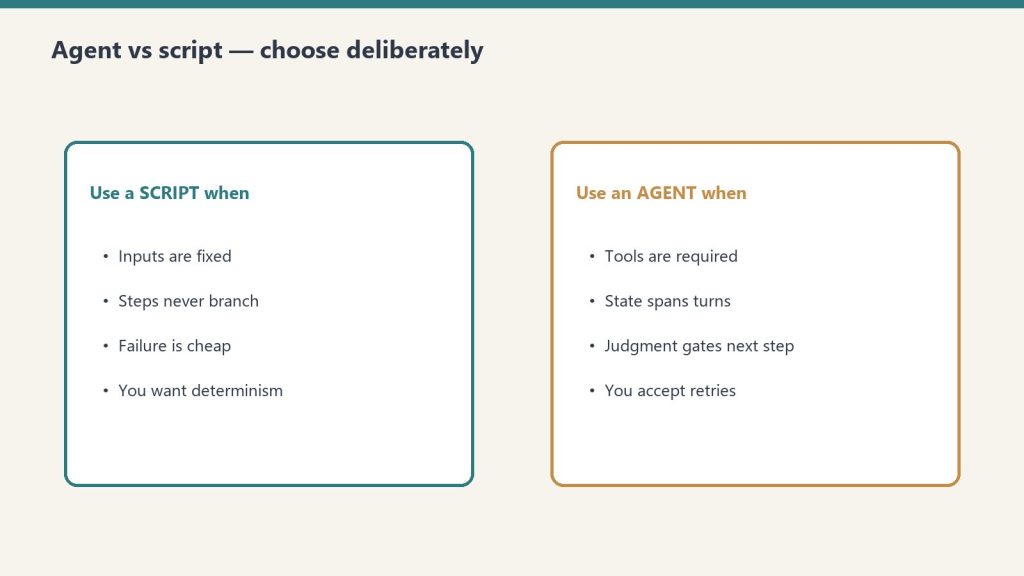
    The discipline is in knowing which lane each operation belongs in — and resisting the temptation to put judgment-dependent work in the queue just because it would be faster. Faster execution of the wrong thing is not an improvement.