Author: Will Tygart

  • Boeing Q1 2026 Deliveries Top Airbus As Everett Expands

    Boeing Q1 2026 Deliveries Top Airbus As Everett Expands

    Q: Did Boeing out-deliver Airbus in the first quarter of 2026?
    A: Yes. Boeing handed over 143 commercial airplanes in Q1 2026, beating Airbus’s 114. It’s the first quarterly delivery win for Boeing over Airbus since 2019, before the 737 MAX grounding. The 737 MAX accounted for 114 of the 143 deliveries — and Everett is the next factory adding to that single-aisle output.

    For the first time in seven years, Boeing handed over more commercial airplanes in a single quarter than Airbus did. The Q1 2026 scoreboard read 143 to 114 — and the most important number for Everett isn’t either of those. It’s 114, the number of 737 MAX jets Boeing delivered in three months, roughly 80% of the company’s commercial total.

    That’s the line Everett is about to plug into.

    What just happened on the delivery line

    Boeing delivered 143 commercial aircraft in Q1 2026. The mix, per the company’s own monthly disclosures and reporting from Aerotime and AIAA: 114 single-aisle 737 MAX jets, 15 widebody 787 Dreamliners, eight 777s, and six 767s. Defense, Space and Security delivered another 30 — Apache helicopters, KC-46 Pegasus tankers, and P-8 Poseidons — bringing the all-up Boeing total to 173 aircraft for the quarter, a 10.9% increase over Q1 2025.

    Airbus delivered 114 commercial aircraft over the same three months. The 29-airplane gap is the first time Boeing has finished a quarter ahead of its European rival since the first quarter of 2019 — the last quarter before the second 737 MAX 8 crash and the 20-month grounding that reset the entire competitive map.

    Boeing reported its full Q1 2026 earnings on April 22, 2026 (Boeing mediaroom Q1 results), and CEO Kelly Ortberg has publicly framed the year as a recovery story rather than a victory lap. Production rates, not quarterly delivery totals, are the metric the company is being judged on.

    Why Everett is the load-bearing wall of this comeback

    Three of the four commercial models Boeing delivered in Q1 — the 767, the 777, and the 787 (final assembly in Charleston, but with significant Everett-built components) — flow through or originate from the Everett factory at Paine Field. The KC-46 Pegasus tanker, also assembled in Everett, drove a meaningful share of the defense deliveries. The factory’s 105th KC-46 rolled out April 3, on pace for 19 tanker deliveries in 2026.

    What Everett does not currently build is the 737 MAX — and that’s the next chapter.

    Boeing’s North Line, the new 737 MAX final assembly line being stood up at the Everett factory, began production and entered LRIP after its July 2026 opening (July 10 feature). According to the company’s own April 2026 update, construction and tooling are complete, and CEO Kelly Ortberg has personally toured the line. The remaining work is hiring and training — hundreds of new and transferred teammates from Renton, Everett, and Moses Lake who will assemble 737-8, 737-9 and 737-10 jets in a building that has spent its entire history building widebodies.

    The production rate math, in plain English

    Here’s why the North Line matters for any future quarter that looks like Q1 2026.

    The FAA formally lifted Boeing’s 737 MAX production rate cap in March 2026 after the company sustained quality metrics at its Renton plant. Boeing has confirmed a steady rate of 38 MAX per month as of late March. CEO Ortberg has signaled the company will step that up in five-aircraft increments — getting to 47 per month is the near-term target Boeing has guided publicly.

    Anything above 47 per month, the company has said, will be built in Everett on the North Line. That’s the structural change. Renton was the world’s only 737 factory for decades. Now Everett gets to be the second.

    Industry analysts at AirInsight have noted Boeing is publicly aiming for combined output of 53 MAX per month by year-end 2026, with longer-term ambitions toward 63. None of that is possible without the North Line in Everett.

    What Q1 looked like for Snohomish County workers

    Translate the headline numbers down to ground level and you get this: every 737 MAX delivered to a customer in Q1 2026 represented work for thousands of people across the Puget Sound aerospace ecosystem — Renton final assembly, Auburn fabrication, Frederickson composites, Moses Lake, and the dense web of Snohomish County suppliers documented in the 600-company aerospace supply chain that surrounds the Everett factory.

    Q1’s 114 MAX deliveries were entirely Renton’s. The next year’s deliveries will be a mix. By 2027, if production rate goals hold, Everett will be building a meaningful share of the 737 MAX volume Boeing’s customers are waiting for. That’s net new aerospace assembly work for the city for the first time in a generation — narrowbody, not widebody, but assembly work all the same.

    For Everett, the spillover is what it always has been: jobs anchored to the factory feed housing demand south of Boeing Boulevard, lunch traffic at every restaurant within five miles of Paine Field, gym memberships, school enrollments, and the property tax base that pays for fire, libraries, and parks. The North Line ramp-up is the first major Everett-specific Boeing growth story since the 777X line was set up — and unlike the 777X program, the 737 MAX has a delivery backlog of more than 4,500 airplanes Boeing has already booked.

    What to watch in Q2 and beyond

    A few things Everett readers should keep an eye on between now and the next quarterly delivery report:

    The Lufthansa 777-9 first flight. Boeing has targeted April 2026 for the first flight of a production-standard 777X out of Paine Field, with Lufthansa as the launch customer. That milestone moves Everett’s marquee widebody program closer to certification, with delivery now slipped to early 2027.

    North Line first conformity airplane. Boeing’s stated process is to build a small number of “low-rate initial production” and conformity aircraft on the North Line before fully integrating the line into the broader 737 MAX flow. The first North Line airplane will be a defining Everett milestone.

    SPEEA’s October 6 contract expiration. The engineers’ and technical workers’ union is in active bargaining preparation. Anything that disrupts engineering support on the factory floor would slow down the very rate ramp Q1’s deliveries depend on.

    737 MAX rate increase to 47/month. That’s the target Boeing needs to hit before any of its monthly deliveries shift to Everett. Watch the FAA’s monthly production data as it’s published.

    The bigger picture for Everett

    Q1 2026 wasn’t a fluke quarter. Boeing’s commercial backlog at the end of March stood at more than 6,000 aircraft, with the 737 MAX accounting for roughly three-quarters of that order book. The company’s challenge is not finding customers — it’s getting airplanes out the door fast enough to keep them.

    That’s the problem Everett is being asked to help solve. The North Line going hot this summer isn’t a feel-good ribbon cutting. It’s the only path Boeing has publicly identified to push 737 MAX production above 47 a month, and 47 a month isn’t enough to clear the order book on the timelines Boeing’s customers are demanding.

    For the city of Everett, the stakes are simple: Boeing’s recovery is Everett’s recovery. Q1 2026 was the first proof point that Boeing can out-build Airbus again. The next proof point lands in this city.

    Frequently Asked Questions

    How many planes did Boeing deliver in Q1 2026?

    Boeing delivered 143 commercial airplanes in the first quarter of 2026: 114 737 MAX, 15 787 Dreamliners, eight 777s, and six 767s. Boeing’s defense unit delivered another 30 aircraft, for a total of 173 across the company.

    Did Boeing actually beat Airbus on deliveries?

    Yes. Airbus delivered 114 commercial aircraft in Q1 2026 to Boeing’s 143. It is the first time Boeing has out-delivered Airbus in a single quarter since 2019, before the 20-month 737 MAX grounding.

    Where is Boeing building 737 MAX jets right now?

    Currently in Renton, Washington. A new Everett “North Line” is on track to begin 737 MAX production this summer at the Boeing Everett factory at Paine Field. Once the North Line is integrated into the production flow, anything above 47 MAX per month will come out of Everett.

    What does the Everett factory build today?

    The Everett factory currently produces the 767 (commercial freighter and KC-46 Pegasus military tanker), the 777, and the 777X. The 737 MAX North Line will be a new program added to the building this year.

    How many KC-46 tankers has Everett delivered?

    Boeing delivered its 105th KC-46 tanker on April 3, 2026, with another 18 scheduled for delivery from Everett in 2026.

    What is Boeing’s 737 MAX production rate goal?

    Boeing’s near-term target is 47 jets per month, with combined Renton and Everett output potentially reaching 53 by the end of 2026. Long-term, the company is publicly aiming for 63 per month, though the timeline is uncertain.

    When does Boeing report Q1 2026 earnings?

    April 22, 2026. The earnings call will give a clearer picture of the financial story behind the delivery numbers, including any updated guidance on 737 MAX rate ramp and 777X certification.

    What does this mean for Everett’s economy?

    The North Line ramp-up represents Everett’s first net-new Boeing assembly program since the 777X. The 737 MAX has more than 4,500 airplanes on backlog, and Everett’s share of that work translates directly into local jobs, housing demand, and tax base growth in Snohomish County.


  • Machinists Institute Everett: Training Boeing’s Workforce

    Machinists Institute Everett: Training Boeing’s Workforce

    Q: Where is the Machinists Institute training the workers Boeing needs for Everett’s new 737 line?
    A: At 8729 Airport Road in Everett, directly across the street from the Boeing Everett factory and Sno-Isle Tech Skills Center. IAM District 751’s 23,000-square-foot Machinists Institute & Union Hall opened in June 2025 and is built to train up to 700 new machinists per year — the talent pipeline now flowing into Boeing’s 737 MAX North Line, which opened in July 2026.

    Stand on Airport Road in south Everett and look across the street. On one side: the Boeing Everett factory, the largest building in the world by volume, where Boeing opened its new 737 MAX North Line in July 2026. On the other side: a 23,000-square-foot building that opened in June 2025 with one explicit mission — train the people who will work in that factory.

    The geography is not a coincidence. The IAM District 751 Machinists Institute & Union Hall at 8729 Airport Road was deliberately sited within walking distance of the Boeing factory it feeds. With Boeing’s North Line now building 737 MAX jets, the workforce pipeline running across that street is one of the most underrated stories in Everett’s 2026 economy.

    What the Machinists Institute actually is

    The Machinists Institute is the training arm of IAM District 751, the union that represents roughly 33,000 Boeing machinists across Washington state. The Everett building, dedicated in June 2025 and detailed in Lynnwood Times coverage of the grand opening, sits across from Sno-Isle Tech Skills Center on Airport Road.

    The capacity headline: up to 700 new machinists per year, plus continuing education and industry certifications for current IAM 751 members. That’s the published throughput target. It includes pre-apprenticeship training, full apprenticeships, and shorter-cycle credential programs — all designed so a graduate can walk into a Boeing aerospace job, or any other manufacturing employer in the region, without a multi-month gap between school and shop floor.

    The building itself is the kind of facility you don’t expect from a union hall. Per the IAM’s own materials and reporting at the opening, the equipment list includes computer-numerical-control (CNC) simulators, virtual-reality welding and paint booths, advanced metrology tools, 3D printers, programmable logic controllers, and augmented-reality industrial training systems — alongside the working-equipment fundamentals: real mills, real lathes, real welding rigs running the same metals and tolerances Boeing assemblers see at work.

    Why the timing matters: the North Line is hiring

    Boeing’s North Line — the fourth 737 MAX production line and the first outside Renton — began production in July 2026, starting at low-rate initial production for its first airplanes. Boeing’s own April 2026 update describes the plant as built and tooled, with hiring and training the remaining work. CEO Kelly Ortberg has personally toured the line.

    The North Line workforce will be a combination of newly hired teammates and existing Boeing workers transferring from Renton, Everett, and Moses Lake. That “newly hired” half is the part the Machinists Institute is positioned to fill. IAM training and apprenticeship vice president Jon Holden told Reuters in April 2026 that Boeing was bringing in 100 to 140 factory workers a week (as reported by Quartz) — a pace that is hard to sustain at quality without a local training pipeline producing factory-ready candidates.

    Outside the Boeing pipeline specifically, the same building is producing welders, machinists, and CNC operators who will end up at the roughly 600 small and mid-sized aerospace suppliers the Snohomish County aerospace supply chain runs on. Every one of those suppliers competes with Boeing for the same skilled-labor pool.

    What it actually takes to become a Boeing machinist in 2026

    The traditional path into Boeing has historically been the IAM/Boeing Joint Apprenticeship Program — a structured, paid, multi-year apprenticeship that combines on-the-job hours with classroom instruction. That program continues. The Machinists Institute layers on shorter, more flexible entry points designed for adults who can’t commit to a multi-year apprenticeship up front:

    Pre-apprenticeship. Short-cycle programs — typically a few weeks to a few months — that introduce shop fundamentals, safety, math, blueprint reading, and basic machining. Designed for career-changers and people coming out of high school who haven’t decided on a specific trade yet.

    Apprenticeship. Full registered apprenticeships in CNC machining, manufacturing technology, and related crafts. Paid work plus structured classroom hours, with credentials recognized statewide.

    Continuing education. Aimed at current IAM 751 members — refresher and upskill courses on new tooling, new processes, new materials. The aerospace industry isn’t static, and the same machinist who’s run conventional aluminum for 20 years may need to retrain on composite layup or advanced metrology for a new program.

    For someone in Everett today wondering whether the Boeing North Line is a real career path, the answer is that there is now a building, with real equipment, a few hundred yards from the factory floor, designed to take you from interested to hired.

    Why this kind of facility didn’t exist before

    Aerospace workforce development in Snohomish County used to lean heavily on the community college system and on Boeing’s internal training pipelines. Everett Community College, the University of Washington Everett campus, and Sno-Isle Tech Skills Center all played, and continue to play, large roles. What was missing was a labor-side facility — owned by the union that represents the workers, with the curriculum tuned to the specific equipment and processes the employer actually uses.

    The Machinists Institute fills that gap. Demolition for the building broke ground on February 26, 2024. The facility opened June 6, 2025 — about 15 months from groundbreaking to ribbon cutting. By the time the Boeing North Line began building 737 MAX jets in July 2026, the institute had a year of operations under its belt.

    What this means for Everett families

    If you’re a parent in Everett wondering whether aerospace is still a viable career bet for your kids, the math is more favorable than it was five years ago.

    Boeing has more than 4,500 737 MAX aircraft on order. The company’s stated production rate goal — 47 per month near-term, with the North Line enabling an eventual 52 and higher rates later — translates to thousands of additional Puget Sound aerospace jobs over the next several years. That demand will be filled by some combination of internal Boeing transfers, fresh hires from the broader labor market, and graduates of programs like the Machinists Institute. Add in the supply chain, and the math gets even bigger.

    Aerospace work is not what it was in the 1990s. It’s more technical, the equipment is more sophisticated, and the credentialing matters more. Boeing’s hiring profile has shifted toward people who arrive at the gate already knowing how to read a blueprint, run a CNC mill, or set up a metrology check. That’s the gap the Machinists Institute is trying to close — and it’s why a building across the street from the factory turned out to be a strategic move, not a real-estate one.

    How to actually get into the program

    Anyone interested in pre-apprenticeship, apprenticeship, or continuing education through the Machinists Institute can find current intake information through the institute’s website and the IAM 751 site. The traditional Boeing apprenticeship application path is administered through the IAM/Boeing Joint Program.

    For Everett residents specifically: the Airport Road location means the building is reachable on Community Transit’s south Everett routes and is a short drive from most of the city. That accessibility was a deliberate part of the site selection.

    The bigger picture

    Workforce stories don’t get the headlines that delivery numbers and production rate caps do. But every 737 MAX that comes off the North Line will have been built by someone — and an increasing share of those someones are going to come through the building across Airport Road.

    For Everett, the Machinists Institute is one of the clearest physical signals that aerospace isn’t just a legacy industry holding on. It’s an active, hiring, training, expanding part of the city’s economy — and the building tells you Boeing’s union side believes that, too. You don’t put up a 23,000-square-foot training center across the street from a factory you don’t think will be hiring.

    Frequently Asked Questions

    Where is the Machinists Institute in Everett?

    8729 Airport Road, Everett, WA — directly across the street from the Boeing Everett factory and adjacent to Sno-Isle Tech Skills Center.

    When did the Machinists Institute open?

    The 23,000-square-foot facility was dedicated on June 6, 2025, after breaking ground in February 2024.

    How many people can the Machinists Institute train per year?

    The institute’s published capacity is up to 700 new machinists per year, plus continuing education for existing IAM 751 members.

    Who runs the Machinists Institute?

    It is operated by IAM District 751, the union that represents roughly 33,000 Boeing machinists in Washington state.

    Do you have to be in the union to train there?

    No. The institute offers pre-apprenticeship and apprenticeship programs that are open to people not currently employed at Boeing or in the union. Continuing education programs are aimed at current IAM 751 members.

    What kind of equipment is at the institute?

    CNC simulators and real CNC mills and lathes, virtual-reality welding and paint booths, advanced metrology tools, 3D printers, programmable logic controllers, augmented reality industrial training systems, and fully outfitted welding rigs.

    Will graduates be hired by Boeing’s new 737 line?

    Boeing’s North Line will combine internal transfers from Renton, Everett, and Moses Lake with newly hired workers. The Machinists Institute is one of the primary local pipelines for training those new hires, but graduation does not guarantee a Boeing job — candidates still apply through Boeing’s standard hiring process.

    How does this fit into the broader Snohomish County aerospace job market?

    Beyond Boeing, Snohomish County is home to roughly 600 aerospace suppliers that also hire machinists, welders, and CNC operators. Machinists Institute graduates feed both the Boeing pipeline and the broader supplier network.

  • Claude AI Context Window: Token Limits & Capacity

    Claude AI Context Window: Token Limits & Capacity

    Last refreshed: September 26, 2026

    Direct Answer (September 2026): Claude’s flagship models — Opus 5.5, Sonnet 5, and Fable 5.1 — each feature a 1,000,000-token context window (roughly 750,000 words), capable of ingesting entire codebases, financial filings, or multi-hundred-page document sets in a single prompt. Haiku 4.5 carries a 200,000-token window for lighter workloads.

    Looking for quick answers? The FAQ version covers every common question directly.

    → Context Window FAQ

    Claude’s context window is one of those specs that sounds simple until you actually need to use it. “1 million tokens” means almost nothing without a frame of reference. This is the guide we wish existed when we started building on Claude — written from our own experience running it in production, with numbers pulled directly from Anthropic’s official documentation.

    Quick Definition

    The context window is Claude’s working memory for a conversation. It holds everything Claude can see and reason about at once: your messages, Claude’s responses, any documents you’ve shared, and system prompts. When the window fills up, earlier content drops out.

    Current Context Window Sizes by Model (September 2026)

    Long paper tape measure unrolling across a desk beside a laptop, metaphor for context window length
    Current context window sizes by model.

    These numbers come directly from Anthropic’s official models page, (last checked May 9, 2026; model names updated September 26, 2026). Model strings are exact API identifiers:

    Model API String Context Window Max Output
    Claude Fable 5.1 claude-fable-5-1 1,000,000 tokens 128,000 tokens
    Claude Opus 5.5 claude-opus-5-5 1,000,000 tokens 128,000 tokens
    Claude Sonnet 5 claude-sonnet-5 1,000,000 tokens 64,000 tokens
    Claude Haiku 4.5 claude-haiku-4-5-20251001 200,000 tokens 64,000 tokens

    Fable 5.1, Opus 5.5, and Sonnet 5 all have the full 1M token context window. Haiku 4.5 is 200K. The key difference between Opus 5.5 and Sonnet 5 in this table is the max output — Opus 5.5 can write up to 128K tokens in a single response, Sonnet 5 caps at 64K.

    What Does 1 Million Tokens Actually Hold?

    Token counts are an abstraction. Here’s what 1 million tokens translates to in practical terms:

    • About 750,000 words of English text — roughly 10 full-length novels, or 1,500 average blog posts
    • A full mid-size codebase — a 50,000-line Python project with comments fits comfortably
    • Hours of meeting transcripts — a full workday of recorded calls, transcribed, fits in one context window
    • Multiple large documents simultaneously — 10 research PDFs at 30 pages each, all in the same conversation
    • Long conversation histories — hundreds of back-and-forth exchanges before anything starts dropping off

    We’ve loaded entire Notion exports, full project histories, and multi-document research packs into a single Claude session. At 1M tokens, you’re unlikely to hit the ceiling in a normal working session. You hit it when you’re doing things like: loading your entire codebase plus documentation plus conversation history and then asking Claude to do a full architectural review.

    Context Window vs. Memory: What’s the Difference?

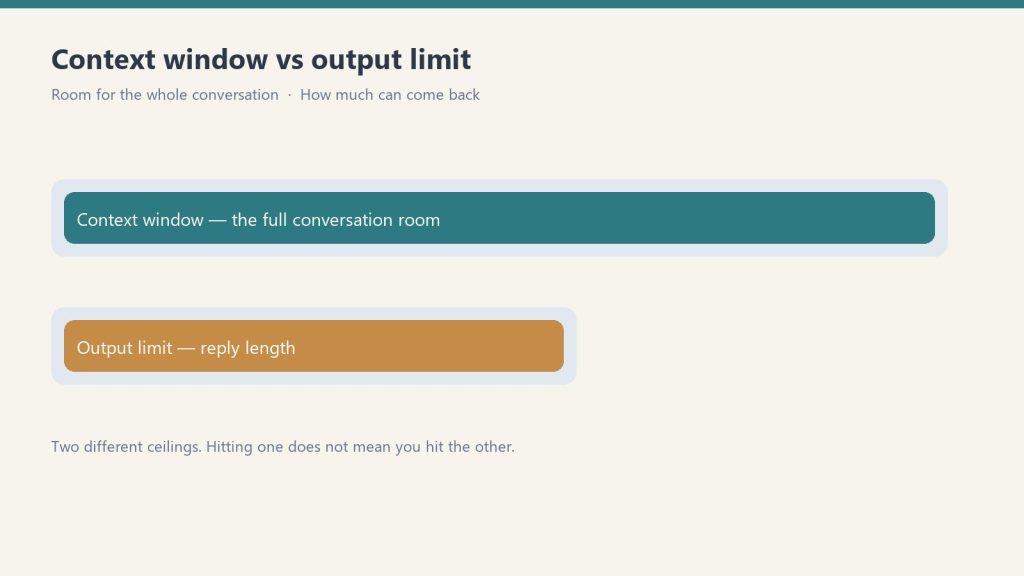
    Diagram comparing a long context window bar with a shorter output limit bar
    Context window vs memory — what’s the difference?

    This is where a lot of people get confused. The context window and memory are not the same thing:

    • Context window: What Claude can see right now, in this session. Once a session ends, it’s gone.
    • Memory (in claude.ai): A separate system that extracts and stores key information from past sessions. It surfaces relevant facts into future conversations as a snippet in the context.
    • Managed Agents memory stores: A developer-layer construct where agents maintain and update knowledge bases across sessions — distinct from both the context window and the consumer memory feature.

    The 1M token context window is your working memory for one session. It doesn’t persist. Memory systems are what carry information across sessions — but they work by injecting a summary into the context window of the new session, not by giving Claude access to the full history.

    Does a Bigger Context Window Mean Better Performance?

    Mostly yes, with one important nuance. More context means Claude has more information to reason about, which generally produces better outputs for tasks that benefit from full context — code reviews, document synthesis, long-form writing, multi-document comparison.

    The nuance: performance can degrade on tasks involving specific information buried deep in a very long context. This is sometimes called the “lost in the middle” problem — models tend to pay more attention to the beginning and end of a long context than the middle. Anthropic has worked on this with Claude’s architecture, and it performs well on long-context tasks, but it’s worth structuring important information at natural reference points rather than burying it in the middle of a 500-page document.

    How We Actually Use the 1M Token Window

    Desk with laptop, checklist notebook, and billing card ready before creating an Anthropic API key
    How we actually use the 1M token window.

    We run Claude in production for content operations, site management, and agentic coding workflows. Here’s where the 1M context window makes a concrete difference in our work:

    • Full site audits: Loading every post from a WordPress site (200+ posts worth of content) into one session for comprehensive SEO analysis — without having to chunk and re-prompt
    • Cross-session context: Pasting in long Notion briefings, prior session transcripts, and the current task in one go. The window is large enough that we don’t have to decide what to leave out.
    • Codebase-wide reasoning: In Claude Code, having the full project context means Claude can make changes that account for how files interact rather than reasoning only about the current file
    • Multi-document synthesis: Research projects where we load 10-15 source documents and ask Claude to synthesize across them — something that was impossible at 100K context windows

    The practical shift from 200K to 1M tokens wasn’t just “more room.” It changed what we could ask Claude to do in a single session.

    Context Window on the API: Batch Output Extension

    For API users: on the Message Batches API, Fable 5.1, Opus 5.5, and Sonnet 5 support up to 300K output tokens using the output-300k-2026-03-24 beta header. This is relevant for batch generation tasks where you need very long outputs — documentation generation, large codebases, book-length content.

    Frequently Asked Questions

    What is Claude’s context window in 2026?

    Claude Fable 5.1, Claude Opus 5.5, and Claude Sonnet 5 all have 1,000,000 token (1M token) context windows as of September 2026. Claude Haiku 4.5 has a 200,000 token context window. These are the current generally available models.

    How many pages can Claude read at once?

    At 1M tokens, Claude can hold roughly 750,000 words of English text — equivalent to approximately 3,000 average pages. In practice, a typical 20-page PDF is roughly 10,000-15,000 tokens, so you could load 60-100 such documents in a single session before approaching the limit.

    Does the context window reset between messages?

    No — the context window accumulates across an entire conversation session. Every message you send and every response Claude gives adds to the total. The window doesn’t reset between individual messages; it resets when you start a new conversation.

    What happens when Claude hits the context window limit?

    When a conversation reaches the context window limit, earlier messages begin to drop out of the active context. Claude can no longer reference information from those earlier messages — it effectively forgets that part of the conversation. In the claude.ai interface, you’ll see a notification when you’re approaching the limit.

    Is the 1M context window available on the free plan?

    The model available to free plan users has access to the 1M context window. However, free plan usage limits mean long-context sessions hit rate limits faster than paid plans. The window is technically available, but sustained heavy use of it is more practical on paid tiers.

    What’s the difference between Claude Opus 5.5 and Sonnet 5 context windows?

    Both have the same 1M token input context window. The difference is max output: Opus 5.5 can generate up to 128,000 tokens in a single response; Sonnet 5 caps at 64,000 tokens. For most tasks this distinction doesn’t matter, but for very long document generation or large code outputs, Opus 5.5 has the higher output ceiling.

    💼 Deploying Claude or AI Infrastructure in Your Business?

    At Tygart Media, we engineer custom Model Context Protocol (MCP) servers, multi-model content pipelines, and AI operational systems. Explore our Claude AI Team Implementation Services or check out our complete Restoration Operations & AI Kit.

  • Scuttlebutt Paws and Pints: Everett Animal Shelter Promo

    Scuttlebutt Paws and Pints: Everett Animal Shelter Promo

    Scuttlebutt Brewing and the Everett Animal Shelter’s Paws & Pints photo contest closed voting on April 17, 2026. The grand prize is a Scuttlebutt beer named after the winning dog, unveiled at a celebration party at the Scuttlebutt Taproom (3310 Cedar Street, Everett) with a food truck, swag, and a puppy playpen. The celebration date is forthcoming — keep an eye on Scuttlebutt’s channels.

    Here’s what happened. The Everett Animal Shelter partnered with Scuttlebutt Brewing on a fundraiser called Paws & Pints. People submitted photos of their dogs. Other people voted — at a dollar per vote — and the money went to the shelter. The grand prize? Scuttlebutt brews a beer, names it after the winning dog, and releases it at a celebration party at the taproom.

    Voting closed on Friday, April 17 at 9:00 PM. Which means somewhere in Everett, right now, there is a dog about to get its own limited-release beer. And we are very much here for it.

    The Basic Breakdown

    Paws & Pints ran from March 27 to April 17, 2026. Dog owners uploaded photos of their dogs — “glamour shots,” basically — and friends, family, and strangers paid a dollar per vote to push favorite pups up the leaderboard. The top vote-getter wins the beer naming. The top five get prizes. Everyone’s dollars went to the Everett Animal Shelter.

    In the list of reasons to live in Everett, “you can pay a dollar to get your dog a beer named after it” is a sneaky one.

    Why This Promo Actually Matters

    Breweries run dog-friendly events constantly. Most of them are the same: dog-friendly patio, dog-themed event name, maybe a rescue has a table set up. Scuttlebutt went further. The winner doesn’t just get a photo on a wall — they get an actual Scuttlebutt beer, in Scuttlebutt’s taproom, with Scuttlebutt’s name on it.

    That’s the kind of community promo that only works when the brewery actually cares. Scuttlebutt has been an Everett institution for three decades. They’ve done major-league collabs, including the Big Dumper beer earlier this year with Mariners catcher Cal Raleigh. They could absolutely spend their marketing budget on bigger swings. They chose to spend a chunk of it on a fundraiser for the local animal shelter and a goofy, joyful promo for a stranger’s dog.

    That says something about who Scuttlebutt is. That’s a brewery worth supporting.

    The Prizes (and Why the Leash Is So Good)

    The grand prize:

    • A Scuttlebutt beer named after the winning dog, unveiled at a celebration party at the taproom
    • A Scuttlebutt-branded dog leash autographed by Cal Raleigh, the Seattle Mariners catcher

    The top five also get prizes. Details on the exact top-five prize package weren’t spelled out in the announcement, but the winner’s Cal Raleigh leash is the piece that made local news. Cal Raleigh’s autograph on a dog leash. Sold at literally no store, anywhere. Owned by one dog in Everett.

    Scuttlebutt has been leaning into Mariners collabs all season. The Cal Raleigh tie-in for the Big Dumper beer and now this leash is a smart extension of a relationship they’ve clearly built deliberately.

    When Is the Celebration Party?

    As of this writing, the exact celebration party date has not been announced by Scuttlebutt. What organizers have confirmed:

    • It’s at the Scuttlebutt Taproom (3310 Cedar Street, Everett — not the main brewery and restaurant at 1205 Craftsman Way on the waterfront)
    • There will be giveaways
    • There will be a Puppy Playpen
    • There will be Scuttlebutt swag
    • There will be a food truck on site
    • And — critically — dogs are invited

    For the exact date, watch Scuttlebutt’s Instagram (@scuttlebuttbrewing) and the Everett Animal Shelter’s channels. The announcement is likely to come in the weeks after voting closes, so late April through May is the realistic window.

    Which Scuttlebutt Location Is the Taproom?

    This trips people up, so let’s be clear. Scuttlebutt operates two Everett locations:

    • Scuttlebutt Brewing Company restaurant & brewery — 1205 Craftsman Way, on the waterfront near the marina. This is the full restaurant.
    • Scuttlebutt Taproom — 3310 Cedar Street. This is the smaller dedicated taproom where the celebration party is happening.

    The Cedar Street taproom is the more intimate, taproom-first of the two. It’s set up for events, beer-first crowds, and dogs. If you’ve only ever been to the waterfront restaurant, the Cedar Street taproom is a different vibe and worth a visit for its own sake.

    How to Prep for the Party

    If you plan to go — and you should — here’s the prep list:

    • Bring your dog, on a leash, well-behaved enough to be in a crowd
    • Bring cash or card for the food truck (varies per event)
    • Bring a tag with your dog’s name in case the leashes get mixed up at the playpen
    • Budget for a flight — you’re going to want to try the new namesake beer, and flights let you pair it with a few others
    • Plan for the Cedar Street taproom, not the waterfront restaurant

    Arrive early if you can. Dog-centric events at Scuttlebutt tend to fill out fast, and the Puppy Playpen setup has capacity limits once things get busy.

    The Bigger Point: Everett’s Brewery Scene Is Paying Attention

    We’ve written a lot about Everett’s brewery trail this spring — the Sound to Summit taproom at the Marina, At Large Brewing on Marine View, U-Neek (formerly Crucible), and Scuttlebutt’s flagship. What makes the Everett brewery scene different from a lot of mid-size city brewery scenes is this exact kind of thing: local breweries doing promos that are genuinely for Everett, not imported playbooks from a Denver or a Portland.

    Paws & Pints is a perfect example. It raises money for a specific Everett nonprofit. It partners with a Mariners player Everett has adopted as a local hero. It gives a real product to a real dog. It makes the Cedar Street taproom into a party.

    That’s Everett-brand community building, run by a brewery that has been around long enough to know what that looks like.

    The Bottom Line

    Voting is closed. The winning dog is somewhere out there. In a few weeks, that dog’s name is going on a Scuttlebutt beer and the Cedar Street taproom is going to be full of dogs, food truck food, and people having the exact kind of Saturday you move to Everett for.

    Watch Scuttlebutt’s channels for the party date. Bring your dog. Order the namesake beer. Pet every dog in the room. Scuttlebutt earned the loyalty.

    Frequently Asked Questions

    What is Scuttlebutt’s Paws & Pints contest?

    It’s a fundraiser for the Everett Animal Shelter. Dog owners submitted photos of their dogs, and the public voted at $1 per vote — all proceeds to the shelter. The top vote-getter wins a Scuttlebutt beer named after their dog, unveiled at a celebration party at the taproom.

    When did Paws & Pints voting close?

    Voting closed Friday, April 17, 2026 at 9:00 PM. The winner and celebration party date are expected to be announced in the weeks following.

    Where is the Paws & Pints celebration party?

    At the Scuttlebutt Taproom, 3310 Cedar Street, Everett — not the flagship brewery and restaurant on Craftsman Way.

    What’s the grand prize?

    A Scuttlebutt beer named after the winning dog, released at the celebration party, plus a Scuttlebutt-branded dog leash autographed by Seattle Mariners catcher Cal Raleigh.

    Are dogs invited to the celebration party?

    Yes. Dogs are explicitly invited. There will be a Puppy Playpen, food truck, swag, and giveaways at the event.

    How do I find out the celebration party date?

    Watch Scuttlebutt Brewing’s Instagram (@scuttlebuttbrewing) and the Everett Animal Shelter’s channels. The date is expected to be announced in late April or May 2026.

    How does Scuttlebutt’s Paws & Pints compare to other brewery dog events?

    Most brewery dog events offer dog-friendly patios and rescue tables. Paws & Pints goes further by committing an actual beer release, autographed memorabilia tied to a Seattle Mariners player, and substantial fundraising dollars to the Everett Animal Shelter. It’s one of the most genuinely community-integrated brewery promos in Snohomish County this year.

  • Birrieria Tijuana Everett: Must-Try Casino Road Birria

    Birrieria Tijuana Everett: Must-Try Casino Road Birria

    Birrieria Tijuana at 205 E Casino Road (Suite B19) in Everett serves Tijuana-style birria tacos, quesabirria, and vampiros using 100% halal beef. Open Monday through Friday 9 AM to 9 PM, the consommé alone is worth the drive — and it is one of the strongest birria operations on Casino Road right now.

    If you have not had proper Tijuana-style birria in Everett yet, there is a specific strip plaza on East Casino Road where you need to go. The address is 205 E Casino Road, Suite B19, and the restaurant is called Birrieria Tijuana. It has 253 Yelp reviews. It runs 100% halal beef. And the consommé is what you’re going to remember.

    This is a Casino Road International Eats installment, and Casino Road earns that designation every single time we write one of these. The food on this stretch is as deep, as specific, and as diverse as anything in Snohomish County. Birrieria Tijuana is one of the restaurants that proves it.

    What Birria Actually Is (Short Version)

    Birria is slow-simmered meat — traditionally goat in Jalisco, typically beef in the Tijuana style — cooked down in a deep chile-and-spice braise. The meat goes into tacos. The rich, red, glossy cooking liquid gets served on the side as consommé. You dip the taco in the consommé. That’s the move. That is the entire ritual.

    Tijuana-style birria is the version that swept the country a few years back — birria tacos fried on the flattop until the cheese melts and the tortilla crisps, served with a cup of consommé for dipping. When it’s done well, it is one of the best three tacos you can eat. When it’s done poorly, it’s just a greasy cheese taco with some brown liquid next to it.

    Birrieria Tijuana does it well.

    Where It Is

    Birrieria Tijuana is at 205 E Casino Road, Suite B19, Everett, WA 98208. It sits in the complex on the south side of Casino Road, a short drive off I-5 Exit 189. Phone is (425) 374-2867.

    You are in a plaza, not a destination street — which is the Casino Road story generally. The best food in this neighborhood lives in strip plazas, converted spaces, and small family-run rooms, not polished main-drag storefronts. That is a feature of Casino Road, not a bug. The people cooking are cooking for their actual community first.

    Hours

    Monday through Friday, 9:00 AM to 9:00 PM. A full twelve-hour day, six days most people aren’t eating birria at 9 AM, which is their loss. Breakfast birria is a completely underrated move. Check current hours before a late-night run, especially on weekends.

    What to Order

    Here is what we order and why:

    Quesabirria Tacos

    This is the single dish that put birria on the American map. Tortilla pressed on the flattop, cheese melted into the shell, birria meat packed inside, the whole thing crisp on the outside and molten in the middle. Served with the consommé for dipping. If you order one thing here, order three of these. You will not regret it.

    Vampiros

    A vampiro is a flat-crisped tortilla with cheese and meat — sort of a cross between a taco and a tostada. Birrieria Tijuana’s version uses the birria meat, and it’s a good choice for people who want the crunch of a tostada with the depth of the birria braise. It’s less famous than the quesabirria but frankly just as good.

    Straight Birria Tacos (Not Quesa)

    A regular birria taco — soft tortilla, meat, onion, cilantro, no cheese, served with the consommé. This is the traditional play, and if you grew up on this style, this is your order. The meat reads cleaner without the cheese, and the consommé hits differently.

    The Consommé Itself

    This is genuinely what sets Birrieria Tijuana apart. Reviewers repeatedly call out the consommé as the restaurant’s signature — deeper, richer, more layered than the average Tijuana-style operation. Order extra. Drink the rest of it like soup when the tacos are gone. Yes, really.

    The Halal Beef Detail Matters

    Birrieria Tijuana advertises 100% halal beef for its birria, which is a deliberate choice and worth noting. It opens the door for Muslim diners who are often navigating a very limited birria map in the Seattle metro, and it signals that the kitchen is paying attention to who its customers are. Casino Road is one of the most diverse neighborhoods in Snohomish County, and the businesses that last here tend to be the ones that understand that.

    Real Talk on the Service

    We are not going to pretend the Yelp reviews are universally glowing about service. They’re not. Some reviews mention attentiveness issues, and we’ve seen moments during busy lunch stretches where front-of-house is clearly stretched. The food, however, is consistent. Go expecting family-run casual, not full-service polish, and the experience lines up with the price point.

    Also: this is a cash-friendly, order-at-the-counter operation depending on the time of day. Don’t show up expecting a host with menus and a wine list. Show up expecting great birria and a very specific smell coming from the kitchen.

    Price and Portions

    Casino Road restaurants universally give you generous portions for the money, and Birrieria Tijuana is no exception. A plate of quesabirria tacos plus consommé runs well under what you’d pay for the same plate in Seattle — and the meat-to-price ratio is better than most mainline taquerias in Snohomish County. Lunch for two is easy to do under $30 if you share a plate.

    Parking

    Plaza parking, free, plenty of spaces. You are not fighting Casino Road traffic to find a meter. You pull in, you park, you walk 30 feet, you eat.

    Where Birrieria Tijuana Fits on Casino Road

    Casino Road’s food scene is the best-kept secret in Everett dining, and we keep saying it because it keeps being true. Tasty Indian Bistro handles the Indian corner. Pho To Liem handles Vietnamese pho. Casa El Dorado and Aliberto’s Jr. run the broader Mexican lineup. Birrieria Tijuana is the birria specialist in that map.

    You do not have to pick. Most Casino Road eaters rotate through two or three of these in a single week. Birrieria Tijuana earns a permanent spot on that rotation specifically on the strength of the quesabirria and the consommé.

    The Bottom Line

    Go to Birrieria Tijuana. Order three quesabirria tacos. Order extra consommé. Dip every bite. Do not fight it.

    If you grew up eating birria and have been waiting for a version in Everett that actually tastes like home, this is closer than most of what’s around. If you’ve never had Tijuana-style birria at all, this is a solid first stop. Either way: the Casino Road food map gets better every month, and Birrieria Tijuana is one of the restaurants doing the work to keep it that way.

    Frequently Asked Questions

    Where is Birrieria Tijuana in Everett?

    Birrieria Tijuana is at 205 E Casino Road, Suite B19, Everett, WA 98208, in a strip plaza on the south side of East Casino Road. Phone is (425) 374-2867.

    What are Birrieria Tijuana’s hours?

    Monday through Friday, 9:00 AM to 9:00 PM. Weekend hours may vary; call ahead for late-night or Sunday visits.

    Is Birrieria Tijuana halal?

    Birrieria Tijuana advertises 100% halal beef for its birria. That makes it one of the more accessible birria stops for Muslim diners in Snohomish County.

    What is birria?

    Birria is a slow-simmered, chile-braised meat dish. In the Tijuana style served at Birrieria Tijuana, the meat is beef and it comes in tacos or quesabirria with a cup of consommé — the rich cooking liquid — for dipping.

    What should I order at Birrieria Tijuana?

    The quesabirria tacos are the signature order. Also recommended: the vampiros, classic birria tacos, and extra consommé on the side to drink or dip into.

    Is Birrieria Tijuana good for takeout?

    Yes. It’s set up for quick takeout, and the consommé travels in lidded cups. Birrieria Tijuana is also on major delivery platforms like DoorDash and Grubhub for anyone ordering to a hotel or office in the area.

    How much do birria tacos cost at Birrieria Tijuana?

    Prices on Casino Road are generally well below Seattle taqueria pricing. A filling lunch of quesabirria tacos and consommé typically runs a reasonable price per person, with generous portions that make it one of the better value picks on Casino Road.

  • STRGZR Coffee Everett: Downtown’s Best Scratch Kitchen

    STRGZR Coffee Everett: Downtown’s Best Scratch Kitchen

    STRGZR Coffee & Kitchen is a hip downtown Everett café at 1422 Hewitt Avenue (corner of Hoyt & Hewitt) serving Ladro espresso, scratch breakfast, gluten-free pastries, and a from-scratch lunch menu. Open Monday through Saturday, with a funky beatnik vibe and a 4.7-star Yelp rating.

    Most coffee shops in Everett pick a lane. You get your third-wave espresso bar that sells a couple pastries from a local bakery. You get your full-breakfast diner that pours drip coffee that’s been sitting there since six in the morning. STRGZR Coffee & Kitchen, on the corner of Hoyt and Hewitt, does both lanes at once — and that is why the line at the counter keeps growing.

    We’ve been stopping in all spring. Here is what we can tell you: this place is the real deal.

    Where It Is and Why the Location Matters

    STRGZR lives at 1422 Hewitt Avenue, right on the corner of Hoyt and Hewitt in downtown Everett. You can reach them at (425) 297-2396.

    That corner is one of the more interesting stretches of downtown right now. You’ve got Narrative Coffee a few blocks over, Artisans Books & Coffee down the street, Sobar Coffee on Colby, and Tabby’s tucked inside the Everett Public Library. Downtown Everett finally has a real coffee scene, and STRGZR is the newest room in the house.

    Walk in and you get what the regulars call “a funky little cafe with sorta a beatnik hippy vibe.” The space is warm, lived-in, and a little weird in the best way. It does not feel like a chain. It does not feel like a coffee shop that is performing coffee-shop aesthetics for Instagram. It just feels like somewhere people actually hang out.

    What to Order

    STRGZR runs on Ladro espresso, which is a Seattle roaster with a long reputation for doing things correctly. That means your latte is going to taste like a Ladro latte — which is to say, good.

    But the real story here is the kitchen. The kitchen is why you stay past one cup.

    Here is what we order and what we recommend:

    • The turkey club sandwich. This is the move. It is the single most-praised item in the 200+ Yelp reviews for a reason. Stacked, fresh, and the bread actually holds up.
    • Homemade hash browns. Not the freezer-bag hash brown rectangles. Actual hash browns. Crisp edges, soft inside. Breakfast food that respects you.
    • Breakfast burritos. Wrapped tight, filled right, reasonably priced.
    • Hand-punched fries. With the sandwiches. Skip the chips option.
    • Gluten-free pastries. A real gluten-free selection — not a single sad muffin in a plastic wrapper. If you have a person in your life who has been suffering through coffee-shop GF options, send them here.

    The breakfast and lunch menus are both made from scratch. The menu lists sandwiches, burgers, breakfast plates, breakfast sandwiches, and pastries — and the kitchen runs during business hours, not just for a rushed morning window.

    The Hours Situation (Check Before You Go)

    STRGZR runs a slightly unusual schedule. Here is what is currently listed:

    • Monday: 8:00 AM – 3:00 PM
    • Tuesday: 8:00 AM – 3:00 PM
    • Wednesday: 8:00 AM – 3:00 PM
    • Thursday: Closed
    • Friday: 8:00 AM – 3:00 PM
    • Saturday: 9:00 AM – 3:00 PM
    • Sunday: Closed

    Two things to flag. First, they’re closed Thursday and Sunday, which is not the schedule most downtown coffee shops run. Do not show up Thursday morning expecting a latte. Second, the kitchen closes at 3 PM — this is not a late-afternoon or evening spot. It’s a breakfast and lunch operation, full stop. Hours can shift, so a quick call before you drive over is never a bad idea.

    Parking and Getting There

    Parking in downtown Everett is mostly street metered parking, and 1422 Hewitt puts you right in the thick of the downtown grid. If you’re coming mid-morning, there is usually a spot within a block or two. The garage options at Wall and Wetmore are a short walk if the street is full. Bus riders: multiple Everett Transit routes run along Hewitt.

    Who This Place Is For

    STRGZR is for:

    • Anyone looking for real scratch breakfast food downtown before 11 AM
    • Remote workers who want a funky, quiet-ish spot that’s not another third-wave white-tile espresso bar
    • Anyone with a gluten-free friend who deserves better than they’ve been getting
    • People who want Ladro coffee without driving to Seattle
    • Anyone avoiding chain breakfast and wanting something that feels like the owner actually made it

    It is not really for: evening crowds (closes at 3), people who need laptop outlets at every table (we’ve seen a mix), or anyone who wants their breakfast done in under 15 minutes during the Saturday rush.

    The Bigger Picture for Downtown Everett

    Between Narrative Coffee, Sobar, Makario Coffee Roasters, Tabby’s at the library, and STRGZR, downtown Everett now has more genuinely good coffee shops in a four-block radius than it’s had at any point in the last two decades. That’s not an accident. Hewitt Avenue has been in a slow, steady lift for years — condos going in, old storefronts getting reinvested in, new restaurants filling ground floors — and the coffee scene is one of the clearest indicators that it’s actually sticking.

    STRGZR showing up on the Hoyt & Hewitt corner is part of that. It’s exactly the kind of independent, scratch-kitchen, mid-morning-to-mid-afternoon operator that a real downtown needs in order to feel like a downtown. Not a drive-through. Not a chain. Just a neighborhood cafe doing the work.

    The Bottom Line

    Go. Order the turkey club. Sit at a window seat. Get the hand-punched fries. Leave a tip. If you have a gluten-free person in your life, bring them. If you hate Thursdays already, now you have another reason.

    STRGZR Coffee & Kitchen is the kind of downtown Everett spot that proves the neighborhood is not just getting built up — it’s getting better.

    Frequently Asked Questions

    Where is STRGZR Coffee & Kitchen located?

    STRGZR Coffee & Kitchen is at 1422 Hewitt Avenue in downtown Everett, on the corner of Hoyt and Hewitt. The phone number is (425) 297-2396.

    What are STRGZR’s hours?

    STRGZR is open Monday, Tuesday, Wednesday, and Friday from 8:00 AM to 3:00 PM, Saturday from 9:00 AM to 3:00 PM, and closed on Thursday and Sunday. Hours can shift, so call ahead if you’re making a trip.

    What kind of coffee does STRGZR serve?

    STRGZR serves Ladro espresso, the well-known Seattle-based roaster. They also offer standard cafe drinks built on that espresso.

    Does STRGZR have gluten-free options?

    Yes. STRGZR is specifically known for a real gluten-free pastry selection, not just a single token item. It’s one of the better gluten-free cafe options in downtown Everett.

    What should I order at STRGZR?

    Regulars consistently recommend the turkey club sandwich, homemade hash browns, breakfast burritos, and the hand-punched fries. The scratch breakfast and lunch menus are the draw alongside the coffee.

    Is STRGZR good for remote work?

    It has a warm, lived-in vibe that works well for short to medium work sessions. It is not a quiet library, but it’s a solid spot for a morning of focused work before the lunch rush hits.

    How busy does STRGZR get on weekends?

    Saturday mornings can draw a line, especially mid-morning. If you want a table without a wait, go right at open or after 1 PM.

  • Everett Housing Market: April 2026 Prices & Trends

    Everett Housing Market: April 2026 Prices & Trends

    What is the Everett housing market doing in April 2026? Everett’s median home price is sitting in the mid-$500s — around $577K based on early-month data — while broader Snohomish County is around a $730K median, with average home values down roughly 5.8% year-over-year. The market has split sharply by price point: homes under $750K are moving quickly, the $750K-$949K range has cooled, and rentals are down about 2% year-over-year. Mortgage rates are holding near 6.17% and inventory is around 1.9 months countywide.

    We’ve been tracking the Everett housing market every couple of weeks because the story keeps moving. April 2026 is the month where a few of the trendlines finally settled into a clear picture, and that picture is more interesting than the simple “up or down” narrative the headlines tend to default to. Everett isn’t one market. It’s at least three markets stacked on top of each other, and each one is behaving differently.

    Here’s where things stand right now and what it means if you’re thinking about buying, selling, or holding.

    The headline numbers

    • Everett median home price: Approximately $577,000 (per early-April 2026 reporting, based on March 2026 closed sales)
    • Snohomish County median: Approximately $730,000 (per recent county-wide tracking)
    • Average Snohomish County home value: $705,515, down approximately 5.8% year-over-year (Zillow / county tracking)
    • Inventory: Approximately 1.9 months of supply countywide
    • Mortgage rates: Holding near 6.17% on the 30-year fixed (April 2026)
    • Sales activity intensity: 43.9% — characterized by local market trackers as a “functional, more rational” market rather than the buyer’s-market or seller’s-market extremes of the last few years
    • Rents: Down approximately 2% year-over-year on average

    None of those numbers are dramatic. That’s the point. The story of April 2026 is that the Everett market has stopped doing dramatic things and started behaving like a normal real estate market again. After several years of rate-driven volatility, that’s actually the news.

    Three markets, not one

    Average median prices hide what’s actually happening on the ground. Once you split Everett by price band, you get three very different markets:

    The under-$750K market: still moving

    Homes priced under $750K in Everett are moving quickly in April 2026. This is the bracket where most first-time buyers and step-up buyers are competing. With rates holding around 6.17% and inventory tight, well-priced homes in this range are still getting multiple-offer activity, especially in Bayside, Delta, View Ridge, and parts of Silver Lake where the inventory is older and well-located.

    If you’re a seller in this band, the playbook hasn’t changed much: price right, prep the house, and you’ll get traction inside two weeks in most cases. Overprice it and it’ll sit — buyers in this range are payment-sensitive and rate-aware.

    The $750K-$949K market: mixed, slower

    This is where April 2026 is getting harder to read. Homes in the upper-$700s through mid-$900s in Everett are showing mixed activity. Some are moving on the first weekend; others are sitting through multiple price cuts. The buyer pool here is thinner — payment math at $850K and 6.17% is meaningfully different than $550K and 6.17%, and the buyer profiles split between move-up families and second-home or investor activity that has cooled.

    Sellers in this band are increasingly pricing slightly below comps and offering rate buy-down credits to drive traffic. That’s a meaningful change from the seller-driven posture of 2021-2023.

    The $950K+ market: case-by-case

    Above $950K in Everett, the market is essentially case-by-case. There aren’t many transactions, the inventory turns over slowly, and individual deals can swing the median for an entire neighborhood. View-corridor homes in NW Everett, View Ridge, and Boulevard Bluffs are the most active subset; everything else moves on a longer timeline. If you’re selling here, you’re playing the patient seller’s game.

    Rentals: the other side of the same story

    Everett’s rental market is the quieter half of the housing story but it’s running in parallel. Average rents are down approximately 2% year-over-year in April 2026, the first sustained softening we’ve tracked since 2021. The driver is supply — the Sawyer, the Carling, and several smaller new-construction projects added meaningful inventory in 2024-2025, and the absorption has been steady but not aggressive.

    What that means in practice: tenants have meaningfully more leverage in April 2026 than they did 12 months ago. Concessions are more common. Renewal increases are smaller. New buildings are negotiating on price, parking, and free-month incentives. None of this looks like a collapse — vacancy is still low and the underlying demand is real — but the pricing power has shifted modestly back toward the renter side.

    For homeowners thinking about converting a unit to a long-term rental, the math now requires a sharper pencil. The “rent it out for whatever the market gives” approach that worked in 2022 doesn’t pencil cleanly in April 2026.

    What’s holding the market together

    Despite the year-over-year price softening, a few structural factors are keeping Everett’s market from following any sharper down-cycle pattern:

    Supply remains tight. 1.9 months of inventory countywide is still well below balanced-market territory (typically 4-6 months). Even in a softer pricing environment, a tight supply base prevents prices from falling faster.

    Mortgage rates are stable, not spiking. 6.17% isn’t cheap by 2020-2021 standards, but it’s predictable. Buyers can plan around it. The market damage in 2022-2023 came from rates moving fast, not from rates being high.

    Boeing employment is stable to growing. The North Line ramp at Paine Field and the broader 737/777X production cadence support a meaningful slice of the local buyer pool. As long as Boeing is hiring at Everett’s plants and SPEEA contract negotiations land cleanly, the wage base behind the housing market holds.

    Waterfront and downtown investment is real. The Sawyer/Carling occupancy at 95%, the new restaurants opening at Restaurant Row, the Millwright pre-leasing momentum, and the stadium decision queue up a credible “things are getting better” story for downtown-adjacent neighborhoods. That doesn’t move the median tomorrow, but it shapes the medium-term confidence story.

    What we’d watch next

    A few things to watch over the next 60-90 days:

    • The April 29 stadium vote. Whatever way it goes, it’ll affect downtown-adjacent housing demand and developer confidence in projects near the proposed site.
    • Rate moves. Anything that pulls the 30-year below 6% would meaningfully reactivate the upper-$700s through mid-$900s band that’s currently cooled.
    • The Millwright Phase 2 buildout sequencing. 300+ new units coming online over the next 18-24 months will affect both the for-sale and rental markets in the immediate waterfront/downtown corridor.
    • The Sound Transit Everett Link decision path. The DEIS coming this fall and the board decisions through 2027 will shape long-term demand around future station locations.

    What to do if you’re a buyer right now

    If you’re shopping under $750K, accept that you’re still in a competitive market and price your offers accordingly. Get fully underwritten before you tour. Move fast on the right house. Don’t chase, but don’t dawdle.

    If you’re shopping $750K-$949K, you have meaningfully more room than you did a year ago. Use it. Negotiate rate buy-downs into your offer. Ask for closing-cost contributions. The leverage is closer to balanced here than it has been in years.

    If you’re shopping $950K+, you have time. Tour broadly, take your time on the comps, and don’t be afraid to make a number-driven offer well under list. The patient buyer wins this band right now.

    What to do if you’re a seller right now

    Price right out of the gate. The “list high and see what happens” strategy of 2021-2022 actively hurts sellers in April 2026 — buyers are watching days-on-market and they read aggressive overpricing as desperation when the price drops eventually come.

    Prep the house. Buyers in 2026 are payment-sensitive and risk-averse. They want to see a house that won’t surprise them with $40K of immediate work. Pre-inspect, fix the obvious stuff, and price accordingly.

    If you’re selling above $950K, plan for a longer marketing window and consider a creative concession structure — rate buy-down, closing-cost credit, or short-term rate lock — rather than another price cut.

    Frequently Asked Questions

    What is the median home price in Everett, WA right now?
    Approximately $577,000 as of early April 2026 reporting based on March 2026 closed sales. The county-wide Snohomish median is closer to $730,000.

    Are home prices in Everett going up or down in 2026?
    Year-over-year, average Snohomish County home values are down approximately 5.8%. Within Everett specifically, the picture is split by price point — under $750K is holding firm with active demand, $750K-$949K is mixed, and $950K+ is case-by-case.

    What are mortgage rates doing in April 2026?
    The 30-year fixed is holding near 6.17%. Rates have been more stable than at any point since 2022, which has helped the market settle into a more predictable rhythm.

    Is now a good time to buy in Everett?
    It depends on price band. Buyers in the $750K-$949K range have meaningfully more leverage than they did a year ago. Buyers under $750K are still in a competitive market. Buyers above $950K can take their time and negotiate.

    Are rents going up or down in Everett?
    Average rents are down approximately 2% year-over-year in April 2026, driven by new supply from projects including the Sawyer and Carling at Waterfront Place plus several smaller new-construction projects.

    How much inventory is on the market?
    Approximately 1.9 months of supply countywide — still below balanced-market territory (typically 4-6 months), which is one reason prices haven’t softened faster despite the year-over-year decline.

    Which Everett neighborhoods are seeing the most activity?
    Bayside, Delta, View Ridge, and parts of Silver Lake remain active in the under-$750K band where most transaction volume is happening. Downtown-adjacent neighborhoods are getting interest tied to the Waterfront Place buildout and the stadium decision pipeline.

  • Millwright District Phase 2: Everett Waterfront Retail

    Millwright District Phase 2: Everett Waterfront Retail

    What is planned for retail in Millwright District Phase 2? The Port of Everett and Lincoln Property Company are targeting family-entertainment retail for Phase 2 of the Millwright District at Waterfront Place — including a movie theater, miniature golf, an arcade, bowling, plus smaller shops, gyms, and salons. Retail is anticipated to be completed by mid-2029, behind the up-to-120,000 sq. ft. of Class-A office space currently in pre-leasing.

    We’ve spent a lot of time on the office side of the Millwright District story — the up-to-120,000 square feet of Class-A space across three interconnected buildings, the 5,000 sq. ft. minimum suite, the pre-leasing campaign Lincoln Property Company has been running since 2025. It’s a real story and we’ll keep covering it. But the part we get asked about more often, by people who actually live in Everett, is the other part: what’s going to be on the ground floor?

    Now we have at least a directional answer. According to recent Port presentations and Phase 2 planning materials, the family-entertainment retail vision for Millwright is starting to come into focus — and it’s a meaningful departure from the Restaurant Row playbook the Port used at Fisherman’s Harbor. Phase 1 went all-in on dining. Phase 2 is leaning toward things you do, not just things you eat.

    What’s on the wishlist

    The Port has publicly described the Millwright Phase 2 retail mix as family-entertainment-style retail, with specific concepts named in planning conversations including:

    • A movie theater — the kind of anchor Everett has been thin on since the closure of older downtown screens. Whether that’s a multiplex format or a smaller boutique theater isn’t yet specified, but the floorplate at Millwright supports either.
    • Miniature golf — likely indoor or partially-indoor given the Everett rain calendar, leaning into the date-night and family-outing market.
    • Arcade and bowling — both commonly bundled in modern entertainment retail concepts (think Pinstripes or Bowlero in larger markets, or smaller independent operators in mid-size cities like ours).
    • Small shops, gyms, and salons — the day-to-day service retail layer that an apartment cluster of this size needs to function.

    That’s the menu. None of it is signed yet — the Port and Lincoln have not announced specific tenants for Phase 2 retail as of late April 2026 — but the program direction is set, and that direction tells you a lot about how the next five years on the waterfront are going to look.

    Why the entertainment-retail pivot makes sense

    Here’s the math the Port is working with. By the time Phase 2 opens, the immediate Waterfront Place neighborhood will have:

    • The 266 existing apartments at the Sawyer and Carling (currently 95% occupied)
    • The 300+ new units breaking ground in Millwright Phase 2
    • Two existing hotels
    • 1.6+ million annual visitors based on 2024 numbers
    • 14 existing food and beverage venues with five more opening in 2025-2026

    That’s a lot of people who already eat here. What they don’t have within walking distance is somewhere to go after dinner that isn’t another bar. The entertainment-retail pivot answers that gap directly. It also pulls in a market the Port hasn’t aggressively chased yet — families with kids old enough to want their own thing — and it gives apartment residents a reason to stay on the waterfront on a Saturday afternoon instead of driving to Lynnwood or Alderwood for a movie.

    The math also works for retail tenants. Ground-floor entertainment concepts need foot traffic and parking. Waterfront Place provides both: 1.6M annual visitors, free public parking through the lots and garages, and a captive resident population growing toward 600+ units within a five-minute walk. That’s a stronger pre-opening pitch than most ground-floor retail in suburban Snohomish County can offer.

    How the Port is staging the buildout

    The current sequencing on Millwright Phase 2 is roughly:

    • 2025-2026: Office pre-leasing campaign with Lincoln Property Company. Targeting up to 120,000 sq. ft. of Class-A space across up to three buildings.
    • 2026: 300+ apartment units breaking ground.
    • 2027-2028: Office and apartment delivery. Vertical construction across the Millwright site.
    • Mid-2029 target: Retail phase completion — including the family-entertainment tenants the Port is now pursuing.

    The retail trails the office and residential delivery on purpose. You don’t open a movie theater into an empty district. You open it once the residents are moved in, the office workers are filling the cafes at lunch, and the foot-traffic baseline is established. Mid-2029 lines up roughly with the Sawyer/Carling stabilizing fully and the new 300+ units hitting their first turnover cycle.

    Where this fits in Everett’s bigger entertainment-retail picture

    Everett doesn’t have a lot of entertainment retail right now. The closest comparable concepts are scattered: Round1 at Alderwood Mall, the AMC at Alderwood, a couple of bowling centers, the venues that anchor the Mill Creek and Lynnwood ends of the county. Within Everett city limits, the nearest movie theater operating today is the Stanwood Cinemas/Galaxy chain reach, plus the historic Everett Theatre downtown for a different kind of programming.

    What that means is Millwright’s family-entertainment vision doesn’t have to fight an existing concentration in the immediate area. It can fill a real gap. The downtown stadium project, if it moves forward, will pull additional event-night traffic to the same general district. The Eclipse Mill Park signature park project will add green-space programming in the same corridor. Combine those and you start to see the outlines of an actual entertainment district — waterfront restaurants, ballpark, family-entertainment retail, signature park — within a 15-minute walk of each other.

    That’s the bet. It’s a long bet — mid-2029 is three years out — but the supporting pieces are stacking up.

    What could change this

    Three things to watch:

    1. Office pre-leasing momentum. If Lincoln signs anchor office tenants ahead of schedule, the entire Millwright timeline pulls forward and retail gets in faster. If office pre-leasing stalls, the retail phase slides right.

    2. The downtown stadium decision. The April 29 City Council vote on the additional $10.6M design funding will tell us a lot about whether the stadium becomes the second anchor of the entertainment district or gets restructured. Either way, it shapes the foot-traffic math the retail tenants will run.

    3. Tenant economics. Modern entertainment retail concepts — especially anchor formats like movie theaters and full bowling centers — have been navigating real headwinds nationally. A signed deal with a national anchor would meaningfully de-risk the timeline. A series of smaller independent operators is also possible and would shape the district differently.

    The bottom line for Everett

    The Millwright Phase 2 retail vision is one of the more interesting development bets currently on the table for Everett. It’s not a guarantee — none of the named concepts are signed, and the timeline runs into 2029. But the Port is signaling clearly where they want this to go, and that signal matters because it’s directional information for everyone else: prospective office tenants, restaurant operators looking at the last Fisherman’s Harbor parcels, residential developers eyeing parcels north and south of Millwright, and small-business owners thinking about whether the waterfront is where they want their next location.

    Three years from now, if all of this lands, walking Waterfront Place on a Saturday night could mean dinner at Tapped Public House, a movie at the Millwright theater, a round of mini-golf, and a beer at Sound to Summit before heading home to a Sawyer apartment. That’s a different city than the one we have today.

    Frequently Asked Questions

    What kind of retail is planned for Millwright District Phase 2?
    Family-entertainment-style retail, with specific concepts including a movie theater, miniature golf, an arcade, bowling, plus smaller shops, gyms, and salons.

    When will Millwright District Phase 2 retail open?
    The Port has indicated mid-2029 as the target for retail phase completion, behind the office and residential delivery scheduled for 2027-2028.

    Have any specific retail tenants been announced?
    Not as of late April 2026. The Port and Lincoln Property Company have described the retail vision and program direction publicly, but no signed tenants have been named for Phase 2 retail.

    How much office space is in Millwright Phase 2?
    Up to 120,000 square feet of Class-A office space across up to three interconnected buildings. Suites range from 5,000 sq. ft. up to the full 120,000 sq. ft. Pre-leasing is being run by Lincoln Property Company.

    How many apartments will Phase 2 add?
    300+ new residential units, which will join the existing 266 units at the Sawyer and Carling — bringing total Waterfront Place housing close to 600 units when Phase 2 stabilizes.

    How does this compare to Phase 1 at Fisherman’s Harbor?
    Phase 1 led with dining — Restaurant Row now hosts Fisherman Jack’s, South Fork Baking Company, Rustic Cork, The Net Shed, Tapped Public House, with Marina Azul and Menchie’s opening soon. Phase 2 is leaning toward entertainment retail rather than additional restaurants, on the theory that the dining base has been established and residents now need somewhere to go after dinner.

    Where is Millwright District located?
    Just north of Fisherman’s Harbor at the Port of Everett’s Waterfront Place. It’s part of the same 65+ acre waterfront redevelopment, walking distance from Boxcar Park and the Central Marina esplanade.

  • Port of Everett Sculpture: The Story of the Bowen Bronze

    Port of Everett Sculpture: The Story of the Bowen Bronze

    What is the new bronze sculpture at the Port of Everett? A bronze figure of a young girl looking out over the marina, installed in late 2025 along the Central Marina esplanade between Pacific Rim Plaza and Boxcar Park. Sultan-based artist Kevin Pettelle created the piece, inspired by a 1940s photograph of Kathy Reinell Bowen — daughter of Reinell Boats founder Edward Reinell — taken by her father between what were then Pier 1 and Pier 2 of the Everett boat harbor.

    If you’ve walked the Central Marina esplanade at the Port of Everett anytime in the last few months, you’ve probably already met her. A small bronze figure in a plaid jacket and saddle shoes, looking past the slips toward what is now a working international Seaport. She doesn’t have a plaque calling her by name, but she has one — and the story behind her is one of the more quietly remarkable pieces of public art the Port has installed.

    We’ve been spending a lot of time on the waterfront chasing what’s coming next — the Sawyer and Carling at 95 percent occupancy, the steakhouse pitch for the last Restaurant Row parcel, Marina Azul almost open, the next phase of Millwright office space pre-leasing. It’s easy in that mode to walk right past the things that are already finished. The Bowen bronze is one of them. And it’s worth a stop.

    Who is the girl in the bronze?

    Her name is Kathy Reinell Bowen. The original photograph was taken in the 1940s by her father, Edward Reinell, founder of Reinell Boats — one of the boat-building names woven into Everett’s mid-century maritime history. In the photo she’s about four or five years old, standing at the edge of the small Everett boat harbor that sat between what was then Pier 1 and Pier 2. The pose is unposed in the way good family photos are: she’s just looking out at the water, the way a kid does when grownups are talking and the boats are more interesting.

    The photograph hung at the Everett Yacht Club for years. According to Historic Everett, a former classmate of Bowen’s spotted it on the wall, recognized her, and that’s how the Port and the artist were eventually able to put a name to the picture. That’s the kind of detail that makes this piece land differently than most public art commissions. It isn’t a generic bronze of a generic kid. It’s a real person, identified by the people who knew her, immortalized at a place her family helped build.

    The artist: Kevin Pettelle, Sultan, WA

    The sculpture was created by Kevin Pettelle, a bronze artist based in Sultan, Washington — about an hour east of Everett up the Skykomish Valley. Pettelle has done figurative bronze work across the Pacific Northwest for decades, and the Bowen piece is among the last bronze sculptures he says he plans to make in his career. That detail alone makes the installation feel less like another city beautification line item and more like a closing chapter from a working artist who chose to spend it on Everett.

    The bronze itself is full of details you only catch on a second look. The buttons on her coat are stamped with the Port’s Waterfront Place logo. The patina on her scarf fans out in a pattern designed to mimic light moving across water. She’s wearing the same plaid jacket and saddle shoes from the photograph, in the same pose. Pettelle didn’t redraw the girl — he reached back into the original frame and pulled her out three-dimensionally.

    Where to find her

    The sculpture sits along the Central Marina esplanade, in the stretch between Pacific Rim Plaza and Boxcar Park. If you’re parking at Waterfront Place and walking south toward Boxcar, you’ll pass her on the water side of the path. The vista was deliberately chosen — she’s looking out across the marina toward the slips, not at the buildings behind her. The whole installation is essentially asking you to share her view for a minute.

    It’s an easy add to any waterfront walk. From the Bluewater Distilling end of Fisherman’s Harbor it’s about a five-minute stroll south along the esplanade. From Boxcar Park itself it’s even closer — head north along the water and you’ll be there in two or three minutes.

    How the piece fits the Port’s bigger public art push

    The Bowen bronze isn’t standing alone out there. The Port has been quietly building a public art collection along Waterfront Place for several years now — most visibly the illuminated orca installation that anchors the southern end of Boxcar Park, plus several smaller historical interpretation pieces and signage installations through Pacific Rim Plaza. The Port’s stated goal is to layer in art that connects the working maritime past to the redeveloped present without feeling like a museum tour.

    That layering matters for a place like Waterfront Place. This is a redevelopment of a working harbor — the Port still moves around 16 million tons of cargo a year, the marina is the largest public marina on the West Coast with 2,300 slips, and 1.6 million people visited the waterfront in 2024 alone. There’s real potential for the new restaurants, hotels, and apartments to flatten that history into background. The Bowen piece is a small but pointed counter to that — a reminder that the Reinell name and the boat-building families and the kids who grew up on these docks are part of why this place is worth redeveloping in the first place.

    Why this matters more than a typical public art install

    Most public art at master-planned developments is decorative. A nice piece, well-lit, photographed for the marketing site, mostly invisible to the people who live there after the first month. The Bowen bronze is doing something different. It’s connecting a specific local family — Reinell Boats, the photograph, the yacht club, the classmate who recognized her — to a specific physical spot on the redeveloped waterfront. That’s harder to walk past.

    It also pairs really well with the Port’s broader case for the waterfront, which is essentially: this place was always something to people. The redevelopment isn’t building a destination from scratch. It’s building a destination on top of a working harbor that already had stories, families, and kids who looked out at boats. The bronze makes that argument quietly and without a press release.

    What we’d like to see next

    One thing that’s still missing: signage. Right now there’s no plaque at the sculpture explaining who Bowen is, who Pettelle is, or what the original photograph was. People stop, look, take a picture, and walk on without the story. Adding a small interpretive sign — even just a QR code linking to the Port’s public art page — would multiply the value of the piece without changing it. The Port has done this well at other Waterfront Place installations and at Boxcar Park; this one deserves the same treatment.

    Beyond that, the Bowen bronze sets a real bar for what additional public art on the waterfront should look like. As Phase 2 of Waterfront Place opens up new public spaces around Eclipse Mill Park and the Millwright District, the Port has a chance to keep going in this direction — local families, real people, specific photographs, named artists. Not generic.

    Frequently Asked Questions

    Where is the new Port of Everett bronze sculpture located?
    Along the Central Marina esplanade at Waterfront Place, between Pacific Rim Plaza and Boxcar Park. It’s on the water side of the walking path.

    Who is the girl depicted in the bronze?
    Kathy Reinell Bowen, daughter of Edward Reinell, founder of Reinell Boats. The original photograph was taken by her father in the 1940s when she was approximately 4-5 years old.

    Who created the sculpture?
    Sultan, WA-based bronze artist Kevin Pettelle. The Port of Everett commissioned the piece, and Pettelle has indicated it’s among the last bronze sculptures he plans to make in his career.

    When was the sculpture installed?
    Late 2025, with a public unveiling held in February 2026.

    Are there other public art pieces at the Port of Everett?
    Yes. The Port has been building a public art collection along Waterfront Place for several years, including the illuminated orca installation at Boxcar Park, historical interpretation pieces at Pacific Rim Plaza, and signage installations throughout the development.

    Is there a fee to see it?
    No. The esplanade is a public walkway. Free parking is available throughout Waterfront Place — see the Port’s 2026 visitor parking guide for current rates and locations.

    What was the original photograph?
    A 1940s candid taken by Edward Reinell of his daughter Kathy looking out over the small Everett boat harbor that sat between what were then Pier 1 and Pier 2. The photograph hung at the Everett Yacht Club for decades, where a classmate of Bowen’s eventually recognized her.

  • How to Get Hired Without Applying: The 30-Minute Daily Protocol That Gets You Found

    How to Get Hired Without Applying: The 30-Minute Daily Protocol That Gets You Found

    The short version: If you want a job in a flooded market, stop trying to be employable in general. Pick one specific corner of your industry. Spend 30 minutes in the morning learning it. Spend the day forgetting most of what you read. Spend 30 minutes at night posting about whatever survived. The forgetting is the filter. The publishing is the proof. Six months in, you are not looking for a job. The job is looking for you.

    Last refreshed: October 8, 2026 (Pacific)

    Most career advice is built around a quiet lie: that the way to stand out is to be a little better at everything everyone else is also a little better at. Sharpen your resume. Add a certification. Take another course. Write another cover letter. Put it all on LinkedIn and hope the algorithm notices.

    It does not work. It cannot work. The market is not short on generalists. It is starving for specialists, especially specialists who have visibly done the thing in public.

    What follows is a job-seeking strategy that takes about an hour a day, requires no extra money, and exploits two pieces of cognitive science most career coaches do not mention: spaced repetition and spaced retrieval. The whole point is to use forgetting as a feature, not a bug — and to publish the part that survives.

    The four-step protocol

    1. Pick three things from your industry that are the most valuable. Not the most popular. Not the most discussed. The three problems that, when someone solves them, money moves.
    2. Pick one of the three you actually want to become an expert on. The one you would willingly read about on a Sunday with no one watching.
    3. Spend 30 minutes in the morning researching it. Read primary sources. Take rough notes. Do not try to remember everything. You will not.
    4. Spend 30 minutes in the evening posting about it. Whatever you can still articulate without notes is the thing worth publishing. The rest was noise.

    That is the entire system. It is shorter than most morning routines. It will outperform almost any other career-building activity you can do in the same time.

    Why morning study and evening publishing actually works

    The forgetting is doing the editing

    When you study something in the morning and then go live a normal day, your brain runs a quiet triage process. Most of what you read decays. The handful of things that connect to something you already understand — or that genuinely surprised you, or that you can imagine using — survive.

    By evening, what is left in your head is not a complete summary of what you read. It is the signal of what you read. The compression happened automatically.

    This is why the evening publishing step matters. You are not trying to teach the morning’s full reading. You are publishing what survived eight hours of normal life. That is, by definition, the part most likely to be useful, memorable, and original.

    Spaced repetition is one of the most-validated learning techniques in cognitive science

    The morning-then-evening rhythm is a lightweight version of spaced repetition, the practice of revisiting information at intervals rather than cramming it in one session. A 2024 prospective cohort study published through the American Board of Family Medicine tracked thousands of practicing physicians and found spaced repetition produced significantly better long-term knowledge retention than repeated study sessions.

    A separate quasi-experimental study at Jawaharlal Nehru Medical College found students using spaced repetition scored 16.24 versus 11.89 on post-test assessments compared to traditional study — a statistically significant difference (p < 0.0001) that held across multiple disciplines.

    The mechanism is not mysterious. Each time you successfully retrieve information after a delay, the neural pathway gets reinforced. Each time you fail to retrieve it, you learn something more important: that piece was not load-bearing. You can let it go.

    When you publish in the evening what you can still remember from the morning, you are running this loop in public. You are letting your brain tell you what mattered, then giving the world the part that mattered.

    The publishing layer is what changes your career

    Studying alone makes you smarter. Publishing what you study makes you findable.

    The career-changing leverage is in the second half. A junior marketer who quietly reads about LinkedIn ads for construction companies in rural areas for six months becomes a slightly better junior marketer. A junior marketer who publishes one short post per evening for six months about the same thing becomes the person every rural construction company finds when they search “how to run LinkedIn ads for a contractor.”

    That is not the same outcome. That is a different career.

    Specificity is the multiplier

    “LinkedIn ads” is a saturated topic. Hundreds of generalists post about it daily. Each new post fights for the same shrinking attention slice.

    “LinkedIn ads for construction companies in rural markets” is almost empty. The total competing supply of content might be a dozen serious posts a year. The total demand from rural construction company owners trying to figure this out is significant. The ratio is what makes the niche valuable.

    The specific corner you pick is the entire game. The narrower it is, the faster you become the visible expert in it. The narrower it is, the easier it is for the right buyer or hiring manager to find you. The narrower it is, the less you have to compete on resume and the more you compete on demonstrated thinking.

    What gets cited by AI is not what gets the most engagement

    There is a quiet shift happening in how hiring managers and buyers find people. They no longer search Google and scroll through ten blue links. They ask ChatGPT, Gemini, Perplexity, or Google’s AI Overview “who’s good at X?” and read what the AI says.

    The thing is — AI systems do not cite content based on follower count or engagement. They cite based on relevance, specificity, and structure. A short, well-structured LinkedIn article from someone with 200 followers is regularly cited above a viral post from someone with 200,000 followers, because the smaller account wrote something specific and useful.

    This is the most underpriced opportunity in personal branding right now. You do not need an audience. You need a corner you own and a publishing rhythm you can sustain. The AI does the distribution.

    What the evening 30 minutes should actually look like

    Do not overthink the format. The post is not the product. The practice is the product. Here is a workable template:

    • One observation from the morning’s reading. Not the main point. The thing that surprised you.
    • One concrete example of how it shows up in your specific niche.
    • One short opinion on what most people get wrong about it.

    That is roughly 150 to 250 words. It takes ten minutes to write if you let yourself write badly. The other twenty minutes are for the next day’s reading list and any replies to the previous day’s post.

    You do not need to post on LinkedIn. You can post anywhere your industry actually reads. But LinkedIn rewards consistent professional output more than almost any other platform, especially for B2B niches, and AI systems are increasingly citing LinkedIn articles in answer to professional queries. So the platform pays its own freight.

    Six months from now

    If you do this for six months — and almost no one does — three things are true at once.

    First, you actually know your niche better than 95% of the people who claim to. You have read primary sources every morning for 180 mornings. You have wrestled with the material publicly. You have gotten things wrong, gotten corrected by other practitioners, and updated your understanding in front of an audience.

    Second, you have a public record of that learning. Your LinkedIn — or whatever surface you chose — is now a longitudinal proof of competence in a specific area. Anyone vetting you can see exactly how you think about the problem they need solved.

    Third, the math has flipped. You are no longer trying to find a job. You are getting messages from people who need exactly what you have spent six months publishing about. Some of those messages are job offers. Some are consulting opportunities. Some are partnerships you would not have known existed.

    The whole strategy rests on a quiet observation: most people will not do this. Not because it is hard. Because it is slow at the start, requires saying things in public before you feel qualified, and pays nothing for the first few months. Most career advice optimizes around making people feel like they are doing something. This optimizes around making the market notice you have done something.

    The compounding loop

    The longer this runs, the better it gets. Six months of daily 30-minute morning study is roughly 90 hours of focused reading in a single domain — more than most working professionals invest in any specific topic outside of formal education. Six months of daily evening posting is roughly 180 short-form pieces of public-facing thinking in your niche.

    Compare that to the alternative: another resume rewrite, another certification, another generic course. None of those produce a public footprint. None of those compound. None of them make you findable to the people who are actually trying to solve the problem you have spent six months understanding.

    An hour a day. One narrow niche. Spaced repetition doing the editing. Evening publishing doing the marketing. The forgetting is the filter. The publishing is the proof. The compounding is what changes your career.

    Frequently asked questions

    How do I pick the right niche if I have not started a career yet?

    Pick the intersection of: a problem real businesses pay money to solve, an industry you find genuinely interesting, and an angle that is not already saturated. Specific is always better than general. “B2B SaaS marketing” is too broad. “Onboarding email sequences for vertical SaaS in healthcare” is the size of niche that wins.

    What if I already have a job and want to use this to switch fields?

    The protocol is identical. Do the morning study and evening publishing in the niche you want to move into, not the one you currently work in. Six months of public output in the new field is more credible to a hiring manager in that field than ten years of unrelated experience.

    What if I do not know enough to write anything yet?

    Write what you are learning, with that framing. “I have been studying X for two weeks. Here is the most surprising thing I have found so far.” Beginner-as-narrator is one of the most engaging voices on LinkedIn. People follow learning journeys. They scroll past finished experts.

    Does this work for technical fields too?

    Especially well. Engineers, scientists, and analysts who can publish clearly about their narrow domain are vanishingly rare and disproportionately valuable. The 30-minute evening post can be a code walkthrough, a paper summary, a debugging story, or a single counterintuitive finding. The format does not matter. The consistency does.

    What if I post for a month and nothing happens?

    Expected. The first 30 to 60 days are unread. The compounding starts somewhere between day 90 and day 180 for most people. The point of the practice is the practice. The audience is a side effect of the discipline, not the goal of it.

    How is this different from a traditional content marketing strategy?

    Traditional content marketing optimizes for traffic and conversions. This optimizes for being findable in the moment a buyer or hiring manager is searching for someone who understands their specific problem. It is closer to a slow-cooking authority strategy than a fast-twitch growth strategy. The output is the same — published material — but the goal is positioning, not pageviews.

    How long before this protocol produces results?

    Most practitioners see the first inbound interest — a recruiter message, a LinkedIn DM, or a referral — within 30 to 60 days of consistent publishing. Meaningful job offers from the protocol typically appear between 60 and 120 days. The compound effect is real but it requires showing up every single day, not every few days.

    Does this work if I don’t have a large following?

    Yes — that is the point. The protocol is designed for zero followers. Niche specificity means your content surfaces in search and in algorithmic feeds for people who actually hire in that domain. A post about a specific IICRC standard seen by 40 restoration adjusters is worth more than a generic “open to work” post seen by 4,000 random connections.

    What platform should I publish on?

    LinkedIn is the primary platform for most B2B and professional roles. If your target niche is technical (engineering, development, data), adding a personal site or GitHub significantly accelerates the signal. Pick one platform and go deep — cross-posting thin content to multiple networks dilutes the authority signal you are trying to build.

    What if my niche is too broad?

    Narrow it by one layer. “Marketing” is too broad. “B2B SaaS content marketing” is still broad. “Content operations for vertical SaaS companies under $10M ARR” is specific enough to own. The discomfort of narrowing is the signal you are on the right track — niches that feel too small almost always have more hiring demand than the broad lane you came from.

    Is this only useful for people currently unemployed?

    No — the protocol is most powerful when you start it before you need a job. Building niche authority takes time; running it while employed means you enter your next search with an established signal rather than starting from zero. Many practitioners use it permanently as a career infrastructure habit, not a job-search tactic.

    The bottom line

    The short post that became this article said: pick three things from your industry, choose one, study it 30 minutes in the morning, post about it 30 minutes at night. That is the whole strategy.

    What that short post did not say is why it works. The morning input gives your brain something to process. The day in between lets the trivial stuff fall away. The evening output forces you to publish what survived — which is, by the cleanest possible test, the part worth publishing. Repeat for six months. Pick the right niche. Watch what happens to your inbox.

    The career advice industry sells motion. This is the opposite. This is a small, slow, compounding bet on becoming visibly excellent at one specific thing. Almost no one will do it. That is what makes it work.


    search and in algorithmic feeds for people who actually hire in that domain. A post about a specific IICRC standard seen by 40 restoration adjusters is worth more than a generic “open to work” post seen by 4,000 random connections.

    What platform should I publish on?

    LinkedIn is the primary platform for most B2B and professional roles. If your target niche is technical (engineering, development, data), adding a personal site or GitHub significantly accelerates the signal. Pick one platform and go deep — cross-posting thin content to multiple networks dilutes the authority signal you are trying to build.

    What if my niche is too broad?

    Narrow it by one layer. “Marketing” is too broad. “B2B SaaS content marketing” is still broad. “Content operations for vertical SaaS companies under $10M ARR” is specific enough to own. The discomfort of narrowing is the signal you are on the right track — niches that feel too small almost always have more hiring demand than the broad lane you came from.

    Is this only useful for people currently unemployed?

    No — the protocol is most powerful when you start it before you need a job. Building niche authority takes time; running it while employed means you enter your next search with an established signal rather than starting from zero. Many practitioners use it permanently as a career infrastructure habit, not a job-search tactic.

Related Reading