
It hit me while I was talking to my phone
I spend a good part of my working day talking to AI out loud. I run a small marketing shop, and a lot of my work now happens through voice — I talk to Glint Voice while I’m driving, I talk to Grok Voice when I’m working through an idea, and the conversation feels like one continuous thing, one personality on the other end of the line.
Except it isn’t one thing. It never was.
What you’re actually talking to is three parts bolted together. First, the ears and the mouth: the puck on the counter, the phone in your hand. It hears you and it says words back. That’s all it does. Second, the router: the part that catches the wake word, turns your speech into text, and makes a judgment call — what did he probably mean, and where does this go? Third, the brain: the model somewhere else, in a data center, that actually knows things and does the thinking.
The personality you like — the voice, the tone, the way it answers — that doesn’t live in the speaker. It lives in the brain and in the routing rules. The box on your counter is a mouth with good PR.
Once you see it, you can’t unsee it. Siri, Alexa, the assistant in your car, the voice app on your phone — they’re all the same machine wearing different plastic. Every one of them is ears, a router, and a brain somewhere else. The only real difference between them is who owns the middle part: the router, and the table of rules that decides where your words go.
I noticed it first in my own tools. When I talk to a voice app on my phone, there are moments where you can feel the seam — a pause while the words travel, an answer that clearly came from somewhere with a lot more horsepower than the phone in my hand. That’s not a flaw. That’s the architecture showing. The app is a nice mouth and a good set of ears. The thinking happened in a building full of servers, and the only real decision my phone made was where to send me.
Get The Signal
What we actually ran, what it measured, and what it means for a restoration shop — every week, including the flops.
And that difference — who decides where your words go — turns out to be worth about a billion dollars a year. Reported.
Apple paid a billion dollars to prove the point
In January of 2026, Apple and Google put out a joint statement: the next generation of Apple Foundation Models would be based on Google’s Gemini. In June, at WWDC, Apple confirmed it on stage. And in September, the rebuilt Siri shipped with iOS 27 — running on a custom Gemini model, inside Apple’s own Private Cloud Compute, so your questions never land on Google’s servers.
Read that again, because it settles the argument. The biggest technology company on earth looked at its own voice assistant and decided the brain wasn’t worth building itself. It rented one. The reported price is around a billion dollars a year, for a model reported at roughly 1.2 trillion parameters — and I’ll flag it plainly: those figures are reported, not confirmed by either company. But the structure of the deal is confirmed, by Apple, in public. Apple kept the door. Apple kept the router. Apple kept your data inside its own walls. The thinking, it buys by the year.
If Siri were a brain, that deal makes no sense. You don’t rent out the core of your own product to your biggest rival. But if Siri is a router — a front door, a wake word, a set of rules about where a request goes — then the deal makes perfect sense. The door was always the valuable part. The brain is a part you can source.
Apple isn’t embarrassed about this, and it shouldn’t be. It’s just the first time the anatomy has been visible at that scale, with a price tag on it.

The front door stayed Apple’s. The brain became a swappable part
It gets better. iOS 27 also shipped with Extensions, which let a user pick a third-party model — Claude, ChatGPT, and Gemini were the named launch partners — as the brain sitting behind Siri’s features. Same Siri voice. Same Siri face. Different brain answering, because you chose it.
That’s the routing table, opened up a crack, in public, by Apple.
For years the arrangement was: whoever owns the front door decides what it connects to, forever, and you don’t get a say. That’s why you couldn’t run Siri’s mouth with somebody else’s brain. The router is the product, and nobody gives up the product. What Apple has now done — first by renting Gemini itself, then by letting users swap the brain through Extensions — is admit the two things are separate. The door is one product. The brain is another. They just spent a decade pretending they were the same thing because the pretending was profitable.
The honest version already exists, and it costs about $69
Here’s the part that made me grin. The open version of this exact machine — dumb satellite, your router, a brain you choose — isn’t a concept. It’s a product. You can buy it today.
It’s called the Home Assistant Voice Preview Edition, made by Nabu Casa, the company behind Home Assistant. It launched in December 2024 and sells for $59 to $69. It is deliberately, proudly dumb. The wake word — “Okay Nabu” — runs right on the device. There’s a hardware mute switch that physically cuts power to the microphones; when it’s off, the thing cannot hear you, and that’s a wiring fact, not a settings promise. Inside is an ESP32-S3 chip and an XMOS audio chip, and that’s about it. The puck does nothing on its own. Nothing.
Everything else happens on a Home Assistant server in your house, and the puck talks to it over an open protocol called Wyoming. The pipeline is built out of stages you can swap like parts in a shop: Whisper turns speech into text, Piper turns text back into speech, and both can run locally, on your own hardware. The conversation stage — the brain — can be a local model running through Ollama, or any cloud model you point it at. Your routing table. Your call. Change brains next month if a better one ships.
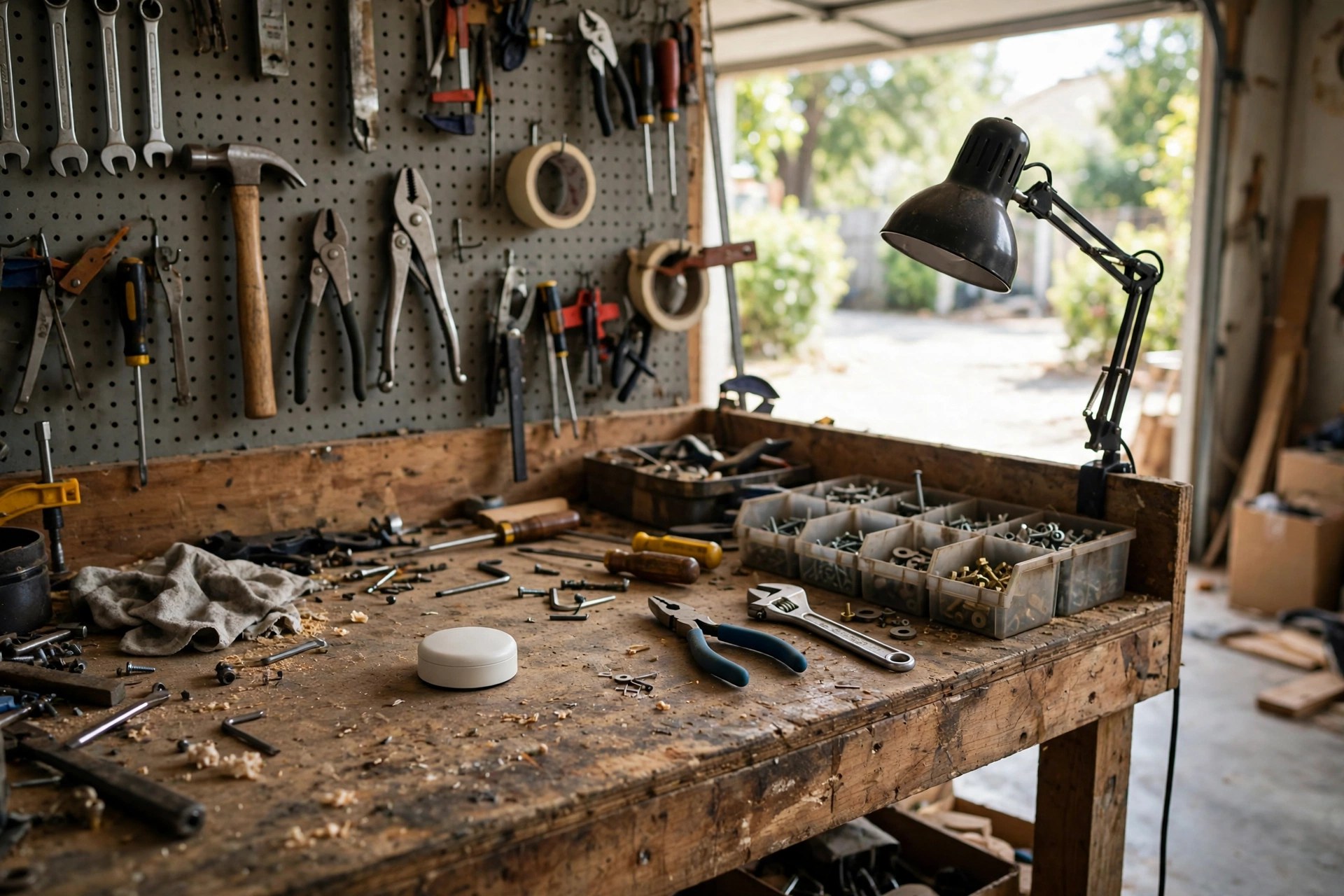
I think about it the way I think about tools in my own shop. I don’t buy a new workbench every time a better saw comes out — the bench stays, the saw swaps. This puck is the bench. Whisper, Piper, the model of the month: those are saws. A setup that treats them as parts is still useful in five years. A setup that welds them together is a countdown.
The cheapest fully local setup runs about $130 all in — a small Pi-class server plus the puck. No subscription. No vendor account. Nothing leaves your network unless you tell it to.
Now the honest trade-off, because there is one: you need a Home Assistant instance running, and there’s some setup. It’s a Saturday-morning project, not an unboxing. And that, right there, is exactly why the locked appliance sells. One box, one warranty, works out of the carton, nobody configures anything. I understand the appeal. I just want people to know what they’re trading for that convenience: the routing table. The vendor’s box is a router that lies about being a brain — it routes to their brain, with their hand on the table, and you can’t re-point it.

So ask the only question that matters
When any company shows you a voice product — a puck, a box, a gadget that promises all the intelligence in one little unit — don’t ask how smart it is. Ask two plainer questions: Who owns the routing table? And can I re-point it?
If the answer is “we do, and no,” then the box is not the product. You are the route. Your words get sent to the brain they chose, on terms they set, at a price they can change — and when a better brain exists somewhere else, your box will never be allowed to use it.
If you own the door, the rest is just parts. Brains improve every few months now; a brain that’s rented or swappable gets better on its own schedule. A brain that’s welded shut gets worse every day it ages, because the world moves and it doesn’t.
The box was never the product. The routing table is the product. Apple just paid a reported billion dollars a year to tell us so.
Will Tygart runs Tygart Media in Puyallup, Washington, where we help local service businesses get found and cited by AI search. If your customers are asking assistants instead of typing searches, that’s the work we do — come find us.
Get The Signal
What we actually ran, what it measured, and what it means for a restoration shop — every week, including the flops.
Leave a Reply