Tag: Sustainability

  • The Restoration Carbon Protocol: What Facility Managers Need to Know

    The Restoration Carbon Protocol: What Facility Managers Need to Know

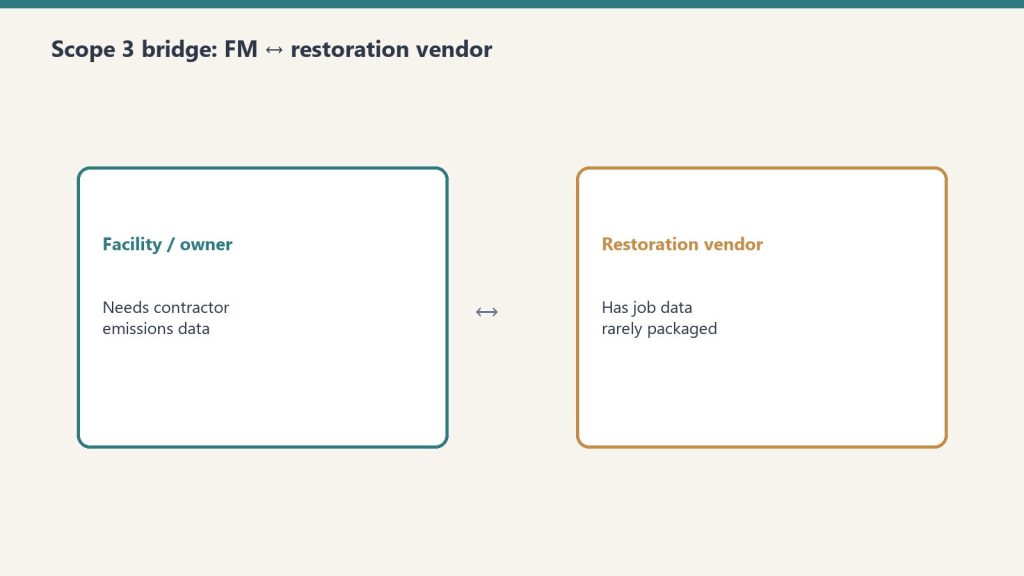
    If you manage facilities for a corporate occupier and you have been trying to figure out how to get Scope 3 emissions data from your restoration contractors, the Restoration Carbon Protocol (RCP) exists to answer that question. This article explains what the RCP is, how it works, and what IFMA members specifically need to know about using it as a procurement and compliance tool.

    What the Restoration Carbon Protocol Is
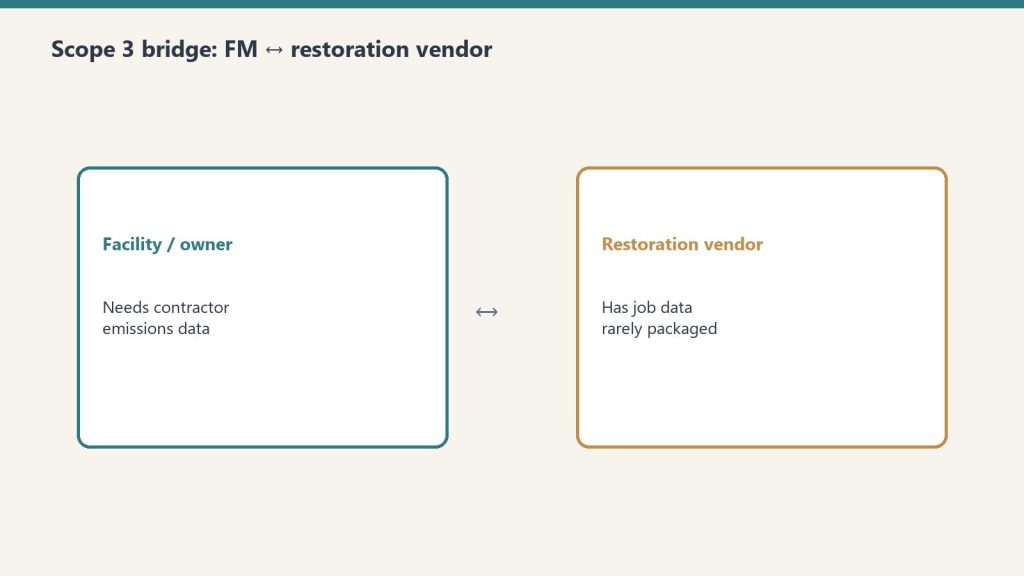
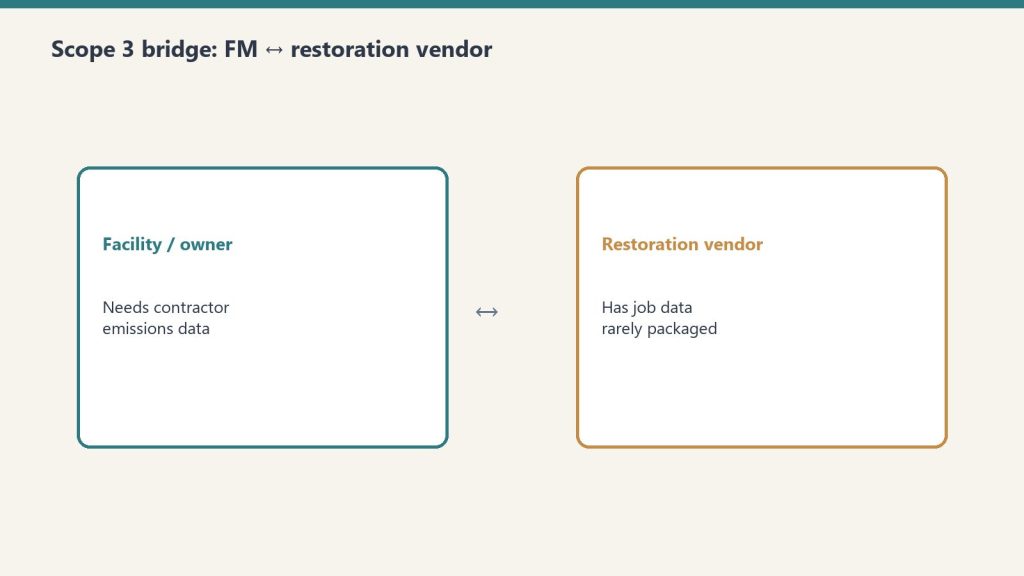
    The RCP is an industry self-standard published by Tygart Media that defines how restoration contractors should calculate, document, and report the greenhouse gas emissions associated with each project they complete. It is built on the GHG Protocol’s Corporate Value Chain (Scope 3) Standard — the same framework used by most corporate ESG reporting programs and required by SB 253 and CSRD.

    The RCP fills a specific void: no restoration industry body — not IICRC, not RIA, not any trade association — had previously published a Scope 3 reporting methodology for restoration work. Commercial property managers and corporate FM teams asking their restoration vendors for emissions data were getting blank stares. The RCP gives contractors the methodology and gives FM procurement teams the standard to reference.

    The Five Core Restoration Job Types and Their Scope 3 Mapping
    The RCP maps each of the five primary restoration job types to the relevant GHG Protocol Scope 3 categories:

    • Water damage restoration: Category 1 (services purchased), Category 5 (waste from extracted water and contaminated materials)
    • Fire and smoke restoration: Category 1 (services), Category 5 (soot, char, and demolition debris waste streams)
    • Mold remediation: Category 1 (services), Category 5 (contaminated building materials removed)
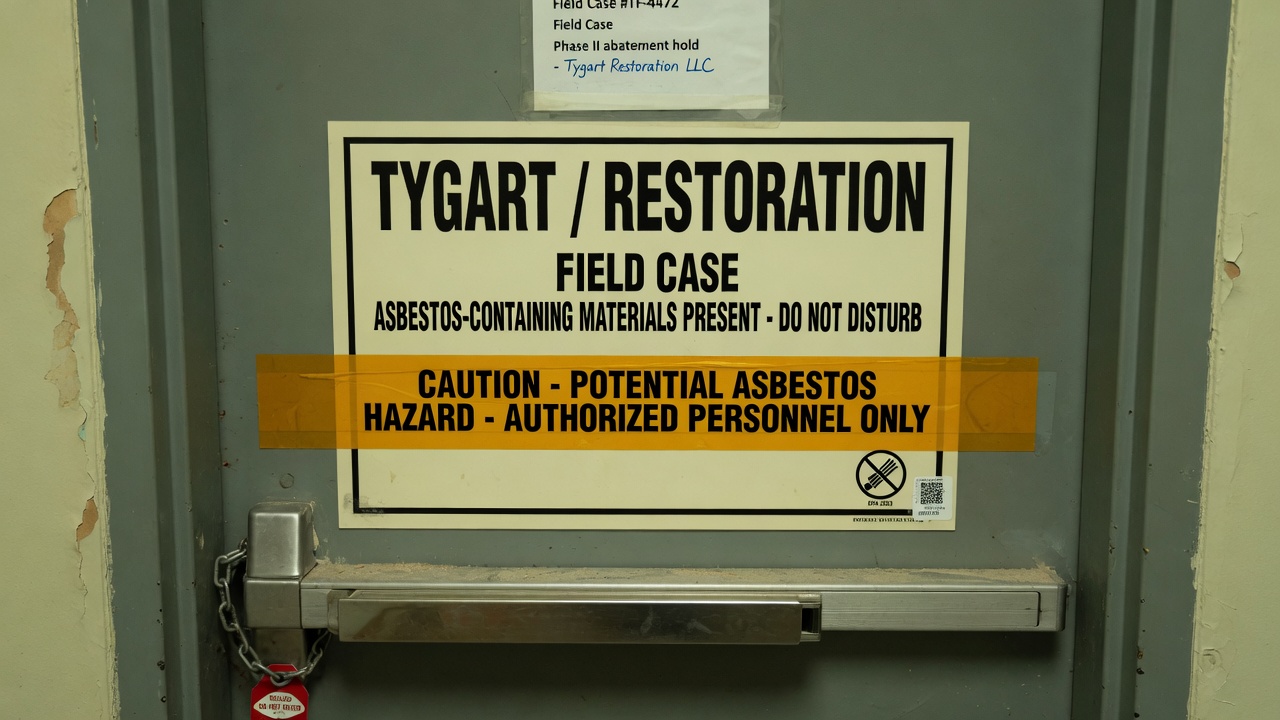
    • Asbestos and hazmat abatement: Category 1 (services), Category 5 (regulated waste disposal), Category 4 (specialized transport)
    • Biohazard cleanup: Category 1 (services), Category 5 (medical and biological waste streams)

    In all five cases, the primary Scope 3 category for the FM client is Category 1 — Purchased Goods and Services. The emissions are generated by the contractor performing work on your behalf at your facility.

    The 12 Data Points: What to Ask Your Contractor to Track

    The RCP defines 12 data points that a restoration contractor should capture on each job to enable a complete Scope 3 calculation. As an FM procurement professional, these are the data fields you should be requiring in your vendor agreements:

    1. Total diesel consumed by drying and dehumidification equipment (gallons)
    2. Total propane or natural gas consumed by heat drying equipment (cubic feet or gallons)
    3. Total vehicle miles traveled to and from the site by all crew vehicles
    4. Number of crew vehicle trips and vehicle types (van, pickup, box truck)
    5. Total equipment operating hours (by equipment category)
    6. Weight of water extracted and removed from the site (gallons or pounds)
    7. Weight and type of contaminated materials removed (drywall, insulation, flooring, etc.)
    8. Disposal method for each waste stream (landfill, recycling, hazardous waste facility)
    9. Refrigerants used, recovered, or vented (for HVAC-adjacent work)
    10. Materials installed by type and weight (for reconstruction phases)
    11. Cleaning agents and chemical products used by product category
    12. Total project duration in days

    Not every data point is relevant to every job type. The RCP provides job-type-specific templates that pre-populate the relevant fields for water, fire, mold, hazmat, and biohazard jobs respectively.

    How FM Teams Can Use the RCP Framework

    There are three practical ways IFMA members can incorporate the RCP into their FM operations:

    1. Vendor Qualification

    Add RCP awareness to your restoration vendor qualification checklist. Ask prospective vendors whether they have adopted the RCP framework. Vendors who can demonstrate RCP familiarity are already capturing the data you need; vendors who cannot are a data gap risk for every job they complete.

    2. Contract Language

    Include a Scope 3 data provision clause in restoration vendor agreements referencing the RCP as the accepted methodology standard. This gives vendors a concrete deliverable (the RCP Job Carbon Report) rather than an open-ended “emissions data” request they have no idea how to fulfill.

    3. Scope 3 Inventory Integration

    Route the per-job RCP carbon reports from your restoration vendors into your Scope 3 Category 1 data collection system. Most ESG reporting platforms (Watershed, Persefoni, Salesforce Net Zero Cloud, etc.) accept Category 1 supplier data in standardized formats. The RCP report is designed to map directly to these platforms’ input requirements.

    The RCP Is Free to Use

    The Restoration Carbon Protocol is published as an open industry standard. There is no licensing fee, no certification requirement, and no vendor lock-in. FM teams can share the RCP framework directly with their restoration vendors at no cost. Contractors can adopt the RCP’s data capture templates and calculation methodology without purchasing anything.

    The goal is adoption — the more restoration contractors who begin tracking RCP-compliant data, the more complete FM Scope 3 inventories become across the industry.

    Frequently Asked Questions

    Is the RCP recognized by IICRC or RIA?

    The RCP is an independent industry self-standard published by Tygart Media. It is not currently endorsed by IICRC or RIA, as neither body has published a competing ESG standard. The RCP fills the void those bodies have not addressed. FM teams and restoration contractors can adopt it independently without waiting for official industry body endorsement.

    How does a restoration contractor become RCP-certified?

    The RCP v1.0 includes a self-certification checklist. Contractors complete the checklist to demonstrate they have implemented the required data capture processes and calculation methodology. Third-party verification is available for organizations that require audited certification. Details are published at tygartmedia.com/category/esg-restoration/.

    Part of the IFMA Scope 3 series. The full RCP framework is available at tygartmedia.com.

  • How California SB 253 Changes What Facility Managers Must Demand from Restoration Vendors

    How California SB 253 Changes What Facility Managers Must Demand from Restoration Vendors

    California’s Climate Corporate Data Accountability Act — SB 253 — is the most consequential piece of corporate climate disclosure legislation in the United States. For facility managers at large corporate occupiers, its Scope 3 provision creates a specific and urgent vendor management problem that most FM teams have not yet fully reckoned with.

    What SB 253 Actually Requires

    SB 253 requires companies with annual revenues exceeding $1 billion that do business in California to publicly disclose their greenhouse gas emissions. The disclosure schedule is phased:

    • Scope 1 and Scope 2: First reports due in 2026 (covering fiscal year 2025 data)
    • Scope 3: First reports due in 2027 (covering fiscal year 2026 data)

    The California Air Resources Board (CARB) is the administering body. Reports must be independently verified by a third-party auditor. The law applies to any company doing business in California — not just California-headquartered companies — which means the net is significantly wider than the state’s own corporate population.

    This is not a voluntary framework. SB 253 carries penalties for non-compliance. The Scope 3 provision is the one that creates a direct operational problem for FM teams, because Scope 3 data lives outside your organization — in your contractors’ job management systems.

    The Contractor Data Chain

    Under the GHG Protocol’s Scope 3 framework — which SB 253 uses as its methodological basis — your restoration contractors are a Category 1 (Purchased Goods and Services) supplier. Every time you hire a restoration company to respond to a water intrusion event, a fire damage claim, or a mold remediation project, that contractor’s emissions for that job are technically part of your Scope 3 inventory.

    The calculation is not optional. The GHG Protocol requires organizations to make a reasonable effort to quantify all material Scope 3 categories. For a large corporate occupier with a substantial real estate portfolio, emergency restoration is a recurring and quantifiable Category 1 exposure. Your ESG auditor will ask about it. Your SB 253 filing will need to account for it.

    Why Most Restoration Contractors Cannot Provide This Data Today

    The restoration industry has no Scope 3 standard. IICRC — the primary certification body for restoration professionals — has no ESG reporting guidance. RIA has no Scope 3 framework. Most restoration contractors manage their operations through job management software that tracks labor hours, materials, and job costs — not emissions.

    This is not negligence; it is a gap that simply has not been filled until now. The Restoration Carbon Protocol (RCP) is the first industry self-standard that defines how restoration contractors should calculate and report their Scope 3 emissions data. It gives contractors the methodology, the data capture template, and the calculation framework — and it gives FM procurement teams the standard they can reference in vendor contracts.

    What to Put in Your Vendor Agreements Now

    The most practical SB 253 preparation step for FM procurement teams is to update restoration vendor agreements to include a Scope 3 data provision clause. Here is the language framework:

    “Vendor agrees to provide a per-project greenhouse gas emissions summary for each project completed at Client facilities, using a documented calculation methodology consistent with GHG Protocol Scope 3 Category 1 guidelines. The summary shall include: total fuel consumption by equipment type, vehicle miles traveled, waste materials removed by type and weight, and total equipment operating hours. Submissions shall be provided within 30 days of project completion.”

    This clause does not require contractors to be ESG experts. It requires them to track and report the underlying data points from which a Scope 3 calculation can be made. Contractors who have adopted the RCP framework already capture this data as part of their standard job documentation.

    The Retroactive Data Problem

    SB 253 requires disclosure for fiscal year 2026 data, meaning the clock is already running. If your organization does business in California and exceeds the revenue threshold, your restoration vendors should be tracking Scope 3 data for jobs completed throughout 2026. Waiting until late 2026 to request this data will result in gaps that your ESG auditor will flag.

    For restoration jobs already completed in 2025 and early 2026, proxy-based estimation is acceptable under GHG Protocol methodology when primary data is unavailable. The RCP provides proxy calculation tables for each restoration job type, allowing FM teams to estimate historical emissions from basic job records (square footage treated, job duration, equipment type). This is not ideal, but it is methodologically defensible and far better than a data gap.

    The SB 253 Compliance Checklist for FM Teams

    1. Confirm whether your organization meets the SB 253 threshold (>$1B revenue, does business in California)
    2. Identify all restoration and specialty trade contractors in your vendor pool as Category 1 Scope 3 sources
    3. Update vendor agreements with a Scope 3 data provision clause (language above)
    4. Share the RCP framework with active vendors so they understand what data to capture
    5. Establish a process for collecting and storing per-job emissions summaries in your FM system
    6. Engage your ESG consultant to integrate contractor data into your Scope 3 Category 1 calculation methodology
    7. Plan for third-party verification of your Scope 3 data — auditors will scrutinize Category 1 more than any other category

    Frequently Asked Questions

    Does SB 253 apply if my company is not headquartered in California?

    Yes. SB 253 applies to any company that “does business in California” and meets the revenue threshold. This is broadly interpreted to include companies with California employees, customers, or operations — even if they are incorporated and headquartered elsewhere.

    What is the penalty for non-compliance with SB 253 Scope 3 provisions?

    CARB has authority to assess administrative penalties for non-compliance. The specific penalty structure is being finalized through rulemaking. Consult your legal counsel for the current enforcement guidance applicable to your organization.

    Can I use a spend-based methodology for restoration contractor Scope 3 data?

    Spend-based estimation (using economic input-output data) is permitted under GHG Protocol methodology as a fallback when primary or activity-based data is unavailable. However, third-party auditors generally flag spend-based estimates as lower quality than activity-based calculations. For a recurring Category 1 source like restoration contractors, building toward activity-based data is the appropriate goal.

    Part of the IFMA Scope 3 series on tygartmedia.com. Source: California SB 253 text via California Air Resources Board.

  • What Is Scope 3 and Why Every Facility Manager Has a Contractor Data Problem

    What Is Scope 3 and Why Every Facility Manager Has a Contractor Data Problem

    If you manage facilities for a large corporate occupier, you have almost certainly heard the phrase “Scope 3 emissions” from your sustainability team, your CFO, or your ESG consultant. What you may not have heard is a clear explanation of what that means for your day-to-day vendor management — and why the contractors who respond to your water damage and mold remediation calls are sitting in the middle of your most difficult compliance gap.

    The Three Scopes: A Plain-Language Primer

    The GHG Protocol’s Corporate Standard divides greenhouse gas emissions into three categories based on where they originate relative to your organization’s operations:

    • Scope 1 — Direct emissions from sources your organization owns or controls. The combustion in your building’s boilers, the fuel in your company-owned fleet vehicles, the refrigerants in your HVAC systems.
    • Scope 2 — Indirect emissions from purchased electricity, heat, or steam. The power your facilities consume from the grid.
    • Scope 3 — All other indirect emissions across your value chain. Everything that happens upstream (your supply chain) and downstream (how your products or services are used) that generates emissions on your behalf.

    Scope 1 and Scope 2 are manageable. You own the sources or the meters. You have the data. Scope 3 is where it gets hard — because Scope 3 data lives in other organizations’ systems, not yours.

    The 15 Categories of Scope 3

    The GHG Protocol breaks Scope 3 into 15 categories across upstream and downstream activities. For a corporate FM managing occupied facilities, the most relevant upstream categories are:

    • Category 1 — Purchased Goods and Services: The emissions associated with producing and delivering everything your organization buys from third parties. For FMs, this includes every contractor, vendor, and service provider who performs work at your facilities — including your restoration contractors.
    • Category 2 — Capital Goods: Emissions from the production of capital equipment and major building systems your organization purchases.
    • Category 4 — Upstream Transportation and Distribution: Relevant when contractors transport materials and equipment to your site.
    • Category 5 — Waste Generated in Operations: Emissions from waste your organization generates — relevant when restoration work produces debris, contaminated materials, or demolition waste disposed of on your behalf.

    Why Contractors Are Your Hardest Data Category

    Among all the inputs to a corporate FM’s Scope 3 inventory, contractor-generated emissions are consistently the most difficult to quantify. Here is why:

    1. Contractors do not routinely track their own emissions. Most restoration, janitorial, maintenance, and specialty trade contractors have no internal system for calculating the greenhouse gas footprint of individual jobs. They track labor hours, materials costs, and square footage — not carbon.
    2. Restoration work is episodic. Unlike your regular janitorial or HVAC maintenance contractor, your restoration vendors are called in during emergencies. There is no standing purchase order to attach emissions data to. Each job is a separate event, often managed by a different project manager.
    3. No industry standard exists for restoration Scope 3 data. IICRC — the restoration industry’s primary certification body — has no ESG reporting standard. RIA has no Scope 3 guidance. There is no form, no template, no industry norm for what a restoration contractor should provide.
    4. The emissions profile of restoration work is complex. A single water damage job involves diesel-powered drying equipment running 24/7 for days, hazardous material disposal, multiple material categories, and vehicle trips from multiple crew members. Calculating the emissions accurately requires a methodology most contractors have never seen.

    The 2027 Problem

    California SB 253 — the Climate Corporate Data Accountability Act — requires companies with over $1 billion in annual revenue doing business in California to disclose their Scope 3 emissions starting with the 2027 reporting year. The EU’s CSRD is already in effect and expanding. CDP and GRESB already request Scope 3 data from the organizations they track.

    For FMs at large corporate occupiers, this creates a specific operational problem: your sustainability team needs contractor emissions data for the 2027 filing, your contractors do not have a system for providing it, and there is no industry standard to point them to. The gap between the regulatory requirement and the contractor’s current capability is the problem this publication addresses.

    What Good Contractor Scope 3 Data Looks Like

    The Restoration Carbon Protocol (RCP) defines 12 data points that every restoration job ticket should capture to enable Scope 3 calculation. At a minimum, FM procurement teams should be asking their restoration vendors for:

    • Total fuel consumed by diesel-powered drying and dehumidification equipment (gallons)
    • Total vehicle miles traveled by contractor crews to and from the site
    • Weight and type of waste materials removed and method of disposal
    • Refrigerants used or recovered (for HVAC-adjacent restoration work)
    • Materials installed by type and weight (for reconstruction phases)
    • Total job duration and equipment operating hours

    With these inputs, a standardized calculation using EPA emission factors can produce a per-job carbon estimate that satisfies Scope 3 Category 1 methodology. The RCP provides exactly that calculation framework — free for any contractor or FM team to use.

    What to Do Now

    If the 2027 Scope 3 deadline is on your radar, the most practical steps you can take today are:

    1. Audit your vendor pool for contractors who perform Category 1 services. Restoration, abatement, specialty trades, and maintenance contractors are your highest-priority Scope 3 data gaps.
    2. Include a Scope 3 data provision clause in new vendor agreements. Require contractors to provide a per-job emissions summary using a standardized methodology.
    3. Share the RCP framework with your restoration vendors. It gives them the methodology, the data capture form, and the calculation tools — everything they need to start providing compliant data on the next job.
    4. Start tracking now, even if imperfectly. A reasonable estimate based on available data is better than a data gap. Your ESG auditor would rather see a documented methodology with known limitations than a blank line item.

    Frequently Asked Questions

    Does every facility manager need to report Scope 3?

    Mandatory Scope 3 reporting under SB 253 applies to companies with over $1 billion in annual revenue doing business in California. CSRD applies to large EU entities. Many FMs at smaller organizations will face voluntary disclosure pressure through CDP participation, GRESB assessments, or investor requirements. Regardless of regulatory mandate, proactively building Scope 3 data capability now reduces compliance cost later.

    Are restoration contractors required to provide Scope 3 data?

    Not yet — but their FM clients increasingly will be required to report it. The most practical approach is to contractually require Scope 3 data from restoration vendors as part of vendor onboarding, rather than trying to collect it retroactively after a job is complete.

    Part of the IFMA Scope 3 series on tygartmedia.com.

  • IFMA vs BOMA: Why Scope 3 ESG Looks Completely Different Depending on Which Side of the Lease You’re On

    IFMA vs BOMA: Why Scope 3 ESG Looks Completely Different Depending on Which Side of the Lease You’re On

    When sustainability consultants talk about ESG in commercial real estate, they often treat IFMA and BOMA as interchangeable acronyms for “building people.” They are not. The distinction between these two associations is not a branding detail — it is a fundamental difference in who you work for, what buildings you manage, and which Scope 3 obligations land on your desk. Getting this wrong means applying the wrong compliance framework to the wrong problem.

    The Core Difference: Occupier vs. Owner

    IFMA — the International Facility Management Association — primarily serves facility managers who work for corporate occupiers. These are the FMs at a hospital system, a university, a Fortune 500 headquarters, or a government agency. They manage buildings that their organization uses to do its business. They do not own those buildings as an investment. They are the operational stewards of space their organization occupies.

    BOMA — the Building Owners and Managers Association — primarily serves property owners and commercial property management firms. BOMA members typically work for organizations whose business model is real estate: they own or manage buildings as assets, lease space to tenants, and generate revenue from that occupancy. The building is the product, not the platform.

    This single distinction — occupier vs. owner — changes everything about how Scope 3 ESG obligations flow.

    The Scope 3 Map: Where Each Association Lives

    DimensionIFMA Member (Corporate FM)BOMA Member (Property Owner/Manager)
    Who they work forCorporate occupier — the end-user of spaceProperty owner or management firm
    Buildings managedBuildings their organization occupiesBuildings leased to tenants as a business
    Primary ESG driverCorporate sustainability disclosure; board-level ESG commitmentsAsset performance benchmarking; investor ESG requirements
    Key Scope 3 exposureContractor supply chain data gaps (Category 1); purchased servicesTenant energy use; embodied carbon in renovation; asset-level GRESB
    Restoration relevanceEvery emergency restoration job generates Scope 3 data the FM must captureTenant improvement work; asset restoration after casualty
    Reporting frameworkGHG Protocol Corporate Standard; California SB 253; EU CSRDGRESB Real Estate Assessment; ENERGY STAR; local building performance standards

    Why This Matters for Scope 3 Specifically

    Under the GHG Protocol’s Scope 3 framework, a corporate occupier’s emissions inventory must include the activities of every contractor who performs services at their facilities. Water damage restoration, fire and smoke remediation, mold abatement, asbestos removal — every one of these jobs generates greenhouse gas emissions that belong somewhere in the FM’s Scope 3 report. Specifically, restoration contractor activity typically falls under Category 1 (Purchased Goods and Services) or Category 14 (Franchises), depending on the contractual structure.

    The BOMA member’s Scope 3 picture is different. A property manager’s primary Scope 3 exposure is Category 13 (Downstream Leased Assets) — the energy and emissions generated by the tenants who occupy their buildings. Restoration work on a BOMA member’s asset matters for GRESB and insurance, but it is not the core Scope 3 data gap they are trying to solve.

    The IFMA member, by contrast, is the one whose sustainability team is currently trying to figure out how to get emissions data from their restoration vendor. They are the ones receiving questionnaires from CDP and GRESB asking about contractor emissions. They are the ones whose corporate ESG report will be incomplete without restoration job data. And right now, they have no standard way to get it.

    The 2027 Deadline Is the IFMA Problem, Not the BOMA Problem

    California’s SB 253 — the Climate Corporate Data Accountability Act — requires companies with over $1 billion in annual revenue doing business in California to disclose their Scope 3 emissions beginning in 2027. The EU’s Corporate Sustainability Reporting Directive (CSRD) is already in effect for large European companies, with phased expansion through 2026. Both frameworks require supply chain emissions data — which means contractor data.

    For the corporate FM managing a large occupier’s portfolio, this deadline is operational. Their sustainability team is assembling the Scope 3 inventory now. They need contractor emissions data now. Every restoration company they have worked with in the past three years is a potential data gap in their 2027 filing.

    BOMA members face a related but structurally different pressure: their tenants are the Scope 3 reporters. The property manager’s role is to provide energy use data to tenants, not necessarily to collect contractor emissions data for their own disclosure. This is a meaningful distinction. The compliance urgency for Scope 3 contractor data sits much more squarely with the IFMA member.

    The Missing Bridge: Restoration Contractors and Scope 3 Data

    Here is the specific gap this publication exists to close: restoration contractors — the companies that respond to water damage, fire, mold, and environmental emergencies at commercial facilities — have no standardized way to provide Scope 3 emissions data to their FM clients. The International Institute of Cleaning and Restoration Certification (IICRC) has no ESG standard. The Restoration Industry Association (RIA) has no Scope 3 guidance. No industry body has built the framework that tells a restoration contractor what data to capture on each job ticket so their FM client can use it in a Scope 3 report.

    This is the problem the Restoration Carbon Protocol (RCP) was built to solve. The RCP is a Tygart Media-published industry self-standard that maps restoration job types to the GHG Protocol’s 15 Scope 3 categories, defines the 12 data points every job ticket should capture, and provides the calculation methodology restoration contractors need to produce credible emissions data. It is the operational bridge between the FM’s Scope 3 disclosure obligation and the restoration contractor’s job management system.

    What IFMA Members Should Be Asking Their Restoration Vendors Today

    If you are a facility manager with Scope 3 reporting obligations, here are the five questions you should be putting to every restoration contractor in your vendor pool:

    1. Can you provide a per-job emissions summary for each project you complete at our facilities? If the answer is no, that is a gap in your Scope 3 Category 1 data.
    2. Do you track materials disposed of by type and weight? Waste stream data is a required input for Scope 3 calculation under GHG Protocol methodology.
    3. Do you track vehicle and equipment fuel consumption for each project? Mobile combustion is a Category 1 input that most restoration contractors currently ignore.
    4. Are you familiar with the Restoration Carbon Protocol? RCP-aware contractors are already capturing the data FMs need.
    5. Would you be willing to complete a standardized carbon data form for each project? The RCP Job Carbon Report is a one-page form any contractor can complete without a sustainability consultant.

    Why Tygart Media Covers This Beat

    Tygart Media’s position in the restoration industry — through the Restoration Carbon Protocol, the Restoration Golf League network, and years of content production for restoration operators — gives us a direct view into the contractor side of this data gap. This IFMA Scope 3 category exists to build the FM side of the same bridge: to give facility managers the framework, vocabulary, and vendor guidance they need to close their Scope 3 contractor data gap before the 2027 deadline arrives.

    This is not a BOMA story. It is not a property management story. It is a facility management story — about the corporate occupier’s FM team trying to satisfy a board-level ESG commitment with incomplete data from contractors who have never been asked for it before. We are building the source of truth for that problem.

    Frequently Asked Questions

    What is the difference between IFMA and BOMA for ESG purposes?

    IFMA serves facility managers who manage buildings for corporate occupiers — organizations that use the space for their own operations. BOMA serves property owners and managers who lease space to tenants as a business. For Scope 3 ESG, IFMA members must capture contractor emissions data as part of their corporate supply chain disclosure, while BOMA members primarily focus on tenant energy use and asset-level performance benchmarking.

    Why do restoration contractors matter for IFMA Scope 3 reporting?

    Restoration contractors perform services at IFMA members’ facilities. Under the GHG Protocol, the emissions from those services are part of the corporate occupier’s Scope 3 inventory — typically Category 1 (Purchased Goods and Services). Without standardized emissions data from restoration vendors, the FM’s Scope 3 report has a recurring gap every time an emergency occurs at a managed facility.

    What is the Restoration Carbon Protocol?

    The Restoration Carbon Protocol (RCP) is an industry self-standard published by Tygart Media that maps restoration job types to GHG Protocol Scope 3 categories and defines the data restoration contractors should capture to enable their FM clients’ Scope 3 reporting. It is the first framework of its kind in the restoration industry.

    When does Scope 3 reporting become mandatory for large companies?

    California SB 253 requires Scope 3 disclosure for companies with over $1 billion in annual revenue doing business in California beginning in 2027. The EU’s CSRD is already in force for large European entities, with phased expansion through 2026. Many voluntary frameworks (CDP, GRESB) already request Scope 3 data.

    This article is part of Tygart Media’s IFMA Scope 3 category — the facility manager’s source of truth for Scope 3 ESG reporting and contractor data standards.

  • Hood Canal Property Owners: What the Tahuya River Preserve Means for Water Quality, Shellfish, and Your Shoreline

    Hood Canal Property Owners: What the Tahuya River Preserve Means for Water Quality, Shellfish, and Your Shoreline

    If you own property on Hood Canal — tidelands, a waterfront parcel, or even a lot a mile back from the water — the long-term health of the canal directly affects what you own. That’s why the permanent protection of 190 acres along the lower Tahuya River is worth understanding, not just as an environmental story, but as a water-quality and property-value story.

    What the Tahuya River Does to Hood Canal

    The Tahuya River drains eastern Mason County and empties into Hood Canal near Belfair. What happens in that watershed — how much sediment runs off after a rain event, how much nutrient load enters the canal, how warm the water is by July — directly affects conditions in Hood Canal itself.

    Hood Canal is a semi-enclosed fjord. It doesn’t flush as quickly as open Puget Sound. Dissolved oxygen levels, water temperature, and nutrient loading matter here in ways that are measurable and consequential. When those factors tip the wrong direction, shellfish beds close. When they hold steady, the canal supports the ecosystem — and the way of life — that Hood Canal property values are built on.

    Great Peninsula Conservancy’s Tahuya River Preserve permanently protects 190 acres of floodplain forest and wetlands along the lower Tahuya corridor. Floodplain forest is not passive. It filters runoff before it reaches the river, moderates water temperatures through canopy shading, and traps sediment that would otherwise flow downstream and into the canal.

    The Gabion Wall Removal: A Direct Water Quality Improvement

    The most significant near-term project connected to the preserve is the planned removal of a Gabion wall from the Tahuya River corridor. Gabion walls — wire-cage rock structures installed for bank stabilization — alter natural stream flow patterns, trap fine sediment in ways that degrade spawning gravel, and prevent the natural movement of large wood debris downstream.

    When the wall comes out, the river will begin recovering a more natural channel dynamic. Engineers are also evaluating engineered log jam structures upstream to rebuild holding pools and feeding lanes for juvenile salmon. Healthier salmon habitat upstream means more adult salmon returning — and salmon carcasses are one of the primary marine-derived nutrient inputs that forest and riparian systems depend on. It’s a closed loop that connects the mountains to the canal.

    The project is in the permitting and planning phase as of May 2026. No construction timeline has been announced, but the land protection necessary to make it happen is complete.

    What This Means for Shellfish Bed Status on Hood Canal

    If you harvest shellfish from Hood Canal tidelands, or if your property value is tied to an open shellfish beach, you already know that closures happen — and that the reasons are usually tied to water quality upstream. Fecal coliform from stormwater, agricultural runoff, and failing septic systems are the primary drivers of WDFW closure events on Hood Canal.

    Protecting floodplain forest along the Tahuya doesn’t fix septic systems — that’s a different problem. But it does reduce one of the diffuse-source inputs: unfiltered runoff from cleared or developed land adjacent to salmon-bearing streams. Every acre of permanently protected floodplain is one less acre that could be cleared, graded, or made impervious in the future.

    For Hood Canal property owners, the preserve is a long-term investment in the upstream conditions that determine what the canal looks like in 20 years.

    The ESA Connection and What It Means for the Canal

    Hood Canal summer chum salmon may become the first ESA-listed salmon population ever removed from the federal endangered species list. That’s not a distant possibility — NOAA Fisheries has signaled the population meets recovery criteria, with Tahuya River runs holding between 200 and 1,000 fish annually since 2006 without supplementation. If delisting proceeds, it would represent a significant reduction in regulatory burden on Hood Canal development and land use — something that directly affects property owners navigating shoreline development permits.

    The Hood Canal Salmon Enhancement Group monitors juvenile salmon on the Tahuya, Dewatto, and Little Quilcene Rivers each spring from their facility at 600 NE Roessel Road in Belfair, (360) 275-9284. Their data is what drives the federal recovery assessment.

    Also see: Tahuya River Preserve: 190 Acres Permanently Protected — Full Story | Hood Canal Property Owners: What the 2026 Shellfish Rule Changes Mean for Your Beach

    Frequently Asked Questions

    Does the Tahuya River Preserve affect Hood Canal shellfish bed closures?

    Indirectly, yes. Protecting 190 acres of floodplain forest along the Tahuya reduces diffuse stormwater runoff into the river and ultimately into Hood Canal. Shellfish closures are driven by fecal coliform levels, and reducing upstream runoff inputs is one piece of the water quality picture. It won’t fix point-source pollution, but it removes a future risk from the equation.

    How does the Gabion wall removal affect Hood Canal water quality?

    Removing the Gabion wall allows the Tahuya River to recover a more natural channel shape — distributing flow across the floodplain, reducing fine sediment export, and allowing wood debris to move naturally downstream. These changes improve water clarity and temperature downstream, benefiting Hood Canal conditions near the river mouth.

    What is the current ESA status of Hood Canal salmon and what does it mean for property owners?

    Hood Canal summer chum and Chinook salmon are both listed as threatened under the ESA. Hood Canal summer chum may be the first ESA-listed salmon ever delisted — a development that would reduce certain regulatory constraints on Hood Canal shoreline and development activities. Continued habitat restoration, including the Tahuya River work, supports the recovery data driving that potential delisting.

    Who is responsible for salmon restoration on the Tahuya River?

    Great Peninsula Conservancy holds and manages the land. The Hood Canal Salmon Enhancement Group (HCSEG), based at 600 NE Roessel Road in Belfair, leads habitat restoration work, juvenile salmon monitoring, and the Gabion wall removal planning in partnership with GPC.

    Does the preserve affect future development near the Tahuya River?

    Yes. The 190 acres are permanently protected by a conservation easement — they cannot be sold for development, cleared, or subdivided. This is the intended outcome: locking in floodplain function in perpetuity so future land use decisions upstream don’t erode what restoration work achieves downstream.

  • Everett’s Lenora Regional Stormwater Treatment Facility: The Complete 2026 Guide to the $8.7M Lowell Project Cleaning the Snohomish River

    Everett’s Lenora Regional Stormwater Treatment Facility: The Complete 2026 Guide to the $8.7M Lowell Project Cleaning the Snohomish River

    Quick answer: The Lenora Regional Stormwater Treatment Facility is an $8.73 million water-quality project breaking ground in April 2026 on a 0.27-acre, city-owned lot at the corner of Lenora Street and S 1st Avenue in Lowell, immediately adjacent to Lowell Riverfront Park. It is funded primarily by Washington State Department of Ecology Water Quality Combined Financial Assistance Agreement WQC-2025-EverPW-00177 in the amount of $8,733,920 — effectively the entire project cost. The facility will treat stormwater runoff from 146 acres of Lowell drainage (subbasins LW-9, LW-10, and LW-11) before it discharges into the Marshland Canal and the Snohomish River, removing total suspended solids, dissolved copper and zinc, total petroleum hydrocarbons, and total phosphorus.

    Why an $8.7M Stormwater Project Is Bigger News Than It Looks

    While most of Everett’s construction conversation in April 2026 has been about a $120 million stadium and 300 new waterfront apartments, an $8.73 million project is starting this month on a half-acre lot in Lowell that will quietly do more for the Snohomish River than any other capital project the city is funding right now. It is one of those projects nobody will livestream and nobody will design-render. It is also exactly the kind of work that determines whether Everett’s waterfront stays swimmable, fishable, and credible as a sustainability story over the next decade.

    Where It Is and What It Does

    The site is small — 11,944 square feet, 0.27 acres — at the northeast corner of S 1st Avenue and Lenora Street, immediately adjacent to Lowell Riverfront Park, on the west side of the BNSF railroad tracks. If you have ever parked at the Lowell Riverfront Trail to walk the dog, you have driven past it without noticing.

    The facility’s job is to take stormwater runoff from three drainage subbasins in Lowell — known to city staff as LW-9, LW-10, and LW-11, totaling 146.10 acres — and run it through a treatment train before it reaches the Marshland Canal system, which discharges into the Snohomish River. The first phase of the facility is a five-cell Filterra Bioscape system with two of the five cells fully functional at opening, giving the city a phased path to scale up treatment capacity as the surrounding subbasins develop further.

    What Gets Removed From the Runoff

    The contaminants the Lenora facility is designed to capture are the standard menu of urban stormwater pollutants:

    • Total suspended solids (TSS) — particulate matter that clouds water and smothers spawning gravel.
    • Total petroleum hydrocarbons — oil and fuel runoff from streets, driveways, and parking lots.
    • Dissolved copper — primarily from vehicle brake pads. Copper is acutely toxic to juvenile salmon at very low concentrations.
    • Dissolved zinc — from tire wear, galvanized metal, and roofing.
    • Total phosphorus — the driver of summer algae blooms downstream.

    The Marshland Canal discharges to the Snohomish River, which means everything the facility removes is something that does not enter the river — and does not enter Possession Sound or any of the salmon habitat between Lowell and the river mouth.

    The Funding Story

    The project is funded primarily by the Washington State Department of Ecology under Water Quality Combined Financial Assistance Agreement WQC-2025-EverPW-00177, in the amount of $8,733,920. That is roughly the entire project cost, which is why the City of Everett can deliver an $8.7M facility without putting it on the local utility bill.

    For Everett residents already absorbing the proposed $10.74-per-month utility tax hike going through council right now, the Lenora project is the rare piece of stormwater infrastructure that does not show up on your bill at all. The state Ecology grant covers it.

    Why Lowell Needed This

    Lowell is one of Everett’s most environmentally complex neighborhoods. It sits on a low riverfront bench between the Snohomish River and the BNSF tracks, with three small subbasins draining toward the Marshland Canal. The geography means stormwater from streets, parking lots, and roofs throughout the neighborhood concentrates fast and hits the river hard during rain events.

    The 146 acres covered by the Lenora facility include a mix of residential, commercial, and rail-adjacent uses. That mix is exactly the kind of urban runoff cocktail that does the most damage to salmon habitat, because dissolved copper from brake pads and dissolved zinc from tire wear behave like concentrated toxins for juvenile fish even at very low concentrations. Removing those before they reach the river is the difference between a healthy salmon return and a steady decline.

    How It Fits Everett’s Bigger Stormwater Picture

    Everett operates under a state-issued NPDES Phase II Municipal Stormwater Permit. Among other things, that permit requires the city to identify high-priority drainage areas and progressively install treatment infrastructure that meets state water quality standards. The Stormwater Management Action Plan (SMAP) the city has been refining for several years identifies the Lowell subbasins as priorities precisely because they discharge directly to a salmon-bearing waterway with limited dilution. The Lenora facility is one of the more visible deliverables of that plan.

    What It Means for the Lowell Riverfront Trail

    The construction site is immediately adjacent to Lowell Riverfront Park, which means anyone using the Lowell Riverfront Trail this spring and summer should expect periodic construction activity, equipment staging, and possible short trail detours along the affected segment near S 1st Avenue and Lenora Street. The city’s Public Works department will post detour signage if any trail closures become necessary.

    The good news for trail users: the facility is going on a small footprint at the edge of the park, not inside it. The trail itself stays intact. Once the facility opens, the only visible change at the site will be the Filterra system’s surface elements — bioretention cells, a small access path, and a city interpretive sign that the Public Works department typically installs at completed water quality projects.

    Frequently Asked Questions

    Where exactly is the Lenora Stormwater Treatment Facility?

    At the northeast corner of S 1st Avenue and Lenora Street in Lowell, on a 0.27-acre city-owned lot adjacent to Lowell Riverfront Park, west of the BNSF railroad tracks.

    How is it funded?

    Primarily by a Washington State Department of Ecology Water Quality Combined Financial Assistance Agreement (WQC-2025-EverPW-00177) for $8,733,920 — effectively the full project cost.

    Will it raise my Everett utility bill?

    No. The state Ecology grant covers the project. This is structurally separate from the proposed $10.74-per-month utility tax hike currently before the City Council, which is a different revenue mechanism for general fund purposes.

    What pollutants does it remove?

    Total suspended solids, total petroleum hydrocarbons, dissolved copper, dissolved zinc, and total phosphorus — the contaminants most responsible for water-quality damage to juvenile salmon and downstream algae blooms.

    Where does the treated water go?

    The treated runoff discharges into the Marshland Canal system, which discharges into the Snohomish River.

    How big is the drainage area being treated?

    146.10 acres across three Lowell subbasins (LW-9, LW-10, LW-11). The treatment train uses a five-cell Filterra Bioscape system; two of the five cells will be fully functional at opening, with capacity to scale up.

    Will the Lowell Riverfront Trail close?

    Trail users should expect periodic construction activity and possible short detours along the segment near S 1st Avenue and Lenora Street. Public Works will post detour signage if any trail closures become necessary. The trail itself remains intact; the facility footprint is at the edge of the park, not inside it.

    Related Exploring Everett Coverage

  • Two Years In at Paine Field: ZeroAvia’s Hydrogen-Electric Bet on Everett’s Aerospace Future

    Two Years In at Paine Field: ZeroAvia’s Hydrogen-Electric Bet on Everett’s Aerospace Future

    Q: What is ZeroAvia doing at Paine Field in Everett?
    A: ZeroAvia operates a 136,000-square-foot Propulsion Center of Excellence at Paine Field — its first U.S. manufacturing facility — where it builds electric motors and power electronics for hydrogen-electric aircraft engines. The center opened on April 24, 2024, with then-Governor Jay Inslee, Rep. Rick Larsen, and Rep. Suzan DelBene in attendance. It marks its second anniversary today, and the company is targeting hydrogen-electric powertrains capable of 300-mile flights in 10- to 20-seat aircraft by the end of 2026.

    Two years ago today, on April 24, 2024, a hydrogen-electric aviation startup named ZeroAvia cut the ribbon on its first U.S. manufacturing facility at Paine Field. The 136,000-square-foot Propulsion Center of Excellence was the largest single bet at the time on the idea that the next generation of regional aircraft wouldn’t burn jet fuel.

    Two years later, the building is still here. The bet is still live. And Everett is quietly the most important physical address in North American hydrogen aviation.

    For a city defined by Boeing’s twin-aisle wide bodies and the new 737 MAX North Line ramping up across the airfield, ZeroAvia’s anniversary is the story most aerospace coverage forgets to tell. It is the story of what comes after Boeing — not as a replacement, but as the next layer on top of the supply chain Boeing built. And it is happening on the same airfield, two miles from where the 777X is being prepared for its first production flight.

    What ZeroAvia actually builds

    ZeroAvia’s core technology is a hydrogen-electric powertrain. Hydrogen fuel cells generate electricity. That electricity drives high-output electric motors. The motors spin propellers. Water vapor comes out the back instead of CO₂. The energy density of hydrogen — roughly 100 times that of the best lithium-ion batteries — is what makes the math work for regional aircraft, where battery-only designs run out of range long before they run out of seats.

    The Propulsion Center of Excellence at Paine Field is where ZeroAvia builds the electric motors and the power electronics that go inside the powertrain. The facility supports both the company’s own 600kW (ZA600) and 1.8MW-class (ZA2000) propulsion systems and a separate components business that sells motors and inverters to other electric and hybrid aviation programs.

    That second piece matters. It means the Everett facility doesn’t depend on ZeroAvia winning the entire hydrogen aviation market by itself. Every electric aircraft program that needs an aviation-grade motor is a potential customer for components built at Paine Field.

    Why Paine Field

    ZeroAvia chose Paine Field as its U.S. R&D site in January 2022 and broke ground on the manufacturing expansion the following year. The reasons it picked Everett look familiar to anyone who has watched aerospace site selection in Snohomish County:

    The supply chain. Snohomish County is home to more than 1,350 aerospace-related business establishments. Composite shops. Precision machining. Test labs. Avionics integrators. Every one of those companies makes ZeroAvia’s job of standing up a new propulsion line easier than it would be in a city without aerospace muscle memory.

    The workforce. The same machinists, engineers, and technicians who build Boeing wide bodies can build hydrogen fuel cell stacks and high-output electric motors. The IAM 751 Machinists Institute training pipeline that feeds the 737 North Line is the same pipeline ZeroAvia can recruit from. Aviation-grade manufacturing skills do not have a propulsion bias.

    The airport. Paine Field is one of the few general aviation airports in the country with the runway length, the FAA infrastructure, and the operational tempo to support flight testing of new propulsion systems. ZeroAvia conducts ground testing, hot-fire tests, and component validation work directly on the airfield — adjacent to the manufacturing floor, not flown to a distant test site.

    The state’s leaning in. The Washington State Department of Commerce supported the original site selection with a state grant, citing aerospace cluster development and decarbonization as joint policy goals. The bipartisan congressional delegation showed up for the ribbon cutting in 2024 — Rep. Larsen, who represents Paine Field, and Rep. DelBene, whose district neighbors it.

    What’s actually happening on the ground in 2026

    ZeroAvia’s public roadmap targets a 300-mile range hydrogen-electric powertrain in a 10- to 20-seat aircraft by the end of 2026 — the kind of aircraft that today flies short regional routes on twin-turboprops like the Cessna Caravan or Britten-Norman Islander. The next step on the roadmap is a 700-mile-range, 40- to 80-seat powertrain by 2028, the size class served today by the De Havilland Canada Dash 8 and ATR 42/72.

    If those targets land on time, the Everett facility will be the manufacturing site for the first commercially certified hydrogen-electric propulsion system in U.S. regional aviation. The launch market is not transcontinental airlines. It is the regional carriers, cargo operators, and corporate fleets that fly short hops where the energy density of hydrogen and the simplicity of an electric motor become competitive with a turbine.

    That is a multi-year, certification-gated process. The 2026 timeline is the powertrain target, not a passenger-carrying delivery date. Aircraft integration, supplemental type certification, and operator approval are separate gates that follow. But the manufacturing capability that has to exist before any of that happens is the part being built right now, on the floor of the Everett Propulsion Center of Excellence.

    Why this matters for Everett

    Two years in, ZeroAvia at Paine Field represents three things Everett’s aerospace economy historically has not had at scale.

    A second propulsion technology base. For decades, the propulsion expertise on the airfield has been turbofan-and-turboprop. The hydrogen-electric workforce ZeroAvia is building — power electronics engineers, fuel cell technicians, high-voltage motor specialists — is a parallel skillset that did not exist locally before 2024.

    A startup-scale aerospace OEM. Boeing employs roughly 31,000 people in Everett and Snohomish County. ZeroAvia is a fraction of that headcount. But it is one of a small but growing cohort of aerospace startups choosing Paine Field over Mojave or San Diego or Long Beach. Eviation. Joby Aviation’s testing partners. Portal Space Systems in Bothell. Each of those names adds a different cell to the local aerospace lattice.

    A bet on what comes next. Hydrogen-electric flight is unproven at commercial scale. The technical risk is real. The certification path is slow. But the industry consensus — including from Airbus, which has a separate hydrogen aircraft program of its own — is that some version of this technology will be in commercial service by the early-to-mid 2030s. Everett is where the U.S. version of that future is being engineered.

    What the next year looks like

    The end-of-2026 powertrain target is the single biggest near-term milestone on ZeroAvia’s roadmap. Watch for: ground test demonstrations of the integrated 600kW system, FAA engagement on the supplemental type certification path for the launch aircraft platform, and component shipments from Paine Field to the customer airframers integrating ZeroAvia’s powertrain into existing certified airframes.

    For locals, the most visible signal will be hiring. ZeroAvia has not published Everett-specific headcount targets, but the company has indicated it intends to grow its U.S. operations meaningfully as the powertrain moves toward production. Job postings for power electronics engineers, manufacturing technicians, and propulsion test engineers — based at Paine Field — will be the leading indicator.

    Two years ago today, ZeroAvia opened a building. Two years from today, the question is whether the building has produced a powertrain anyone can fly. Everett’s answer to that question matters more than most cities realize.

    Frequently Asked Questions

    What is ZeroAvia?
    ZeroAvia is a U.S.- and U.K.-based aviation startup developing hydrogen-electric powertrains for regional aircraft. Hydrogen fuel cells generate electricity that drives high-output electric motors, with water vapor as the only emission.

    When did ZeroAvia open its Paine Field facility?
    The 136,000-square-foot Propulsion Center of Excellence officially opened on April 24, 2024, with then-Washington Governor Jay Inslee, Rep. Rick Larsen, and Rep. Suzan DelBene in attendance.

    What does ZeroAvia build at Paine Field?
    The facility manufactures electric motors and power electronics for ZeroAvia’s own hydrogen-electric powertrains and for sale as components to other electric and hybrid aviation programs.

    How big is ZeroAvia’s powertrain target for 2026?
    ZeroAvia is targeting a hydrogen-electric powertrain capable of 300-mile range in 10- to 20-seat regional aircraft by the end of 2026. A larger 700-mile, 40- to 80-seat powertrain is targeted for 2028.

    Why did ZeroAvia choose Paine Field?
    Snohomish County’s aerospace supply chain (more than 1,350 aerospace establishments), the local skilled workforce, Paine Field’s runway and FAA infrastructure for propulsion testing, and Washington state economic-development support were all cited factors.

    How does this fit with Boeing’s Everett operations?
    ZeroAvia and Boeing are not direct competitors. ZeroAvia builds hydrogen-electric propulsion for regional aircraft (10–80 seats), while Boeing’s Everett operations focus on commercial wide bodies, the 737 North Line, and the KC-46 tanker. Both depend on the same Snohomish County aerospace workforce and supply chain.

    When could a hydrogen-electric aircraft using ZeroAvia powertrains carry passengers?
    The end-of-2026 target is the powertrain itself, not passenger service. Aircraft integration, supplemental type certification, and operator approval are separate gates. Industry consensus puts commercial hydrogen-electric service in the early-to-mid 2030s timeframe.

    Is ZeroAvia hiring at Paine Field?
    The company has indicated it intends to grow U.S. operations as the powertrain moves toward production. Job postings for power electronics engineers, manufacturing technicians, and propulsion test engineers based at Paine Field are the leading indicator of expansion.

  • Everett’s Lenora Stormwater Treatment Facility Breaks Ground This Month: A $8.7M Snohomish River Cleanup Project Quietly Starts in Lowell

    Everett’s Lenora Stormwater Treatment Facility Breaks Ground This Month: A $8.7M Snohomish River Cleanup Project Quietly Starts in Lowell

    Q: What is the Lenora Regional Stormwater Treatment Facility, and when does construction start?

    A: It is a $8.73 million regional stormwater treatment facility being built in April 2026 on city-owned property at the corner of Lenora Street and S 1st Avenue in Lowell, adjacent to Lowell Riverfront Park. Funded primarily by a Washington State Department of Ecology Water Quality grant, it will treat runoff from 146 acres of Lowell drainage before it discharges into the Marshland Canal and the Snohomish River — removing total suspended solids, dissolved copper and zinc, oil and total phosphorus.

    While most of Everett’s construction conversation in April 2026 has been about a $120 million stadium and 300 new waterfront apartments, an $8.73 million project starts this month on a half-acre lot in Lowell that will quietly do more for the Snohomish River than any other capital project the city is funding right now.

    The Lenora Regional Stormwater Treatment Facility breaks ground in April 2026. It is one of the projects nobody will livestream and nobody will design-render, and it is exactly the kind of work that determines whether Everett’s waterfront stays swimmable, fishable, and credible as a sustainability story over the next decade.

    Where it is and what it does

    The site is small — 11,944 square feet, 0.27 acres — at the northeast corner of the S 1st Avenue and Lenora Street intersection, immediately adjacent to Lowell Riverfront Park, on the west side of the BNSF railroad tracks. If you have ever parked at the Lowell Riverfront Trail to walk the dog, you have driven past it without noticing.

    The facility’s job is to take stormwater runoff from three drainage subbasins in Lowell — known to city staff as LW-9, LW-10 and LW-11, totaling 146.10 acres — and run it through a treatment train before it ever reaches the Marshland Canal system, which discharges into the Snohomish River.

    The first phase of the facility is a five-cell Filterra Bioscape system with two of the five cells fully functional at opening. That gives the city a phased path to scale up treatment capacity as the surrounding subbasins develop further.

    What gets removed from the runoff

    The contaminants the Lenora facility is designed to capture are the standard menu of urban stormwater pollutants:

    • Total suspended solids (TSS) — particulate matter that clouds water and smothers spawning gravel.
    • Total petroleum hydrocarbons — oil and fuel runoff from streets, driveways, and parking lots.
    • Dissolved copper — primarily from vehicle brake pads. Copper is acutely toxic to juvenile salmon at very low concentrations.
    • Dissolved zinc — from tire wear, galvanized metal, and roofing.
    • Total phosphorus — the driver of summer algae blooms downstream.

    The Marshland Canal eventually discharges to the Snohomish River, which means everything the facility removes is something that does not enter the river — and does not enter Possession Sound or any of the salmon habitat between Lowell and the river mouth.

    The funding story

    The project is funded primarily by the Washington State Department of Ecology under Water Quality Combined Financial Assistance Agreement WQC-2025-EverPW-00177, in the amount of $8,733,920. That is roughly the entire project cost, which is why the City of Everett can deliver an $8.7M facility without putting it on the local utility bill.

    For Everett residents already absorbing the proposed $10.74-per-month utility tax hike going through council right now, the Lenora project is the rare piece of stormwater infrastructure that does not show up on your bill at all. The state Ecology grant covers it.

    Why Lowell needed this

    Lowell is one of Everett’s most environmentally complex neighborhoods. It sits on a low riverfront bench between the Snohomish River and the BNSF tracks, with three small subbasins draining toward the Marshland Canal. The geography means stormwater from streets, parking lots, and roofs throughout the neighborhood concentrates fast and hits the river hard during rain events.

    The 146 acres covered by the Lenora facility include a mix of residential, commercial, and rail-adjacent uses. That mix is exactly the kind of urban runoff cocktail that does the most damage to salmon habitat, because dissolved copper from brake pads and dissolved zinc from tire wear behave like concentrated toxins for juvenile fish even at very low concentrations. Removing those before they reach the river is the difference between a healthy salmon return and a steady decline.

    What it means for the Lowell Riverfront Trail

    The construction site is immediately adjacent to Lowell Riverfront Park, which means anyone using the Lowell Riverfront Trail this spring and summer should expect periodic construction activity, equipment staging, and possible short trail detours along the affected segment near S 1st Avenue and Lenora Street. The city’s Public Works department will post detour signage if any trail closures become necessary.

    The good news for trail users: the facility is going on a small footprint at the edge of the park, not inside it. The trail itself stays intact. Once the facility opens, the only visible change at the site will be the Filterra system’s surface elements — bioretention cells, a small access path, and a city interpretive sign that the Public Works department typically installs at completed water quality projects.

    How this fits Everett’s bigger stormwater picture

    Everett operates under a state-issued NPDES Phase II Municipal Stormwater Permit. Among other things, that permit requires the city to identify high-priority drainage areas and progressively install treatment infrastructure that meets state water quality standards. The Stormwater Management Action Plan (SMAP) the city has been refining for several years identifies the Lowell subbasins as priorities precisely because they discharge directly to a salmon-bearing waterway with limited dilution.

    The Lenora facility is one of the more visible deliverables of that plan. It is also a piece of evidence that the regulatory machinery — state grant funding, federal water quality standards, city capital planning — can still produce concrete infrastructure on the ground in 2026, even when the larger civic conversation is about $14 million budget gaps and $120 million stadiums.

    The construction window

    The city has scheduled construction to begin in April 2026. Work on the facility itself is small enough that the duration is measured in months, not years. Public Works has not published a precise opening date for the first two functional cells of the Filterra system, but the project’s small footprint and the simple construction sequence point toward a late-2026 functional opening, with the remaining three cells brought online as the surrounding subbasins develop.

    Why we wrote about this one

    Most of Everett’s construction tracker right now reads like a developer brochure — apartments, restaurants, a stadium, a movie theater. That coverage is real and important. But the Lenora facility is a useful counterweight: a small, technical, state-funded piece of infrastructure that does not generate Instagram content but quietly determines whether the river the rest of the waterfront story sits next to actually stays healthy.

    Lowell residents in particular should know it is happening. The half-acre lot at S 1st and Lenora is going to look like a construction site for the next several months, and the trail-adjacent staging will be visible from the river. The reason for the disruption is also the reason it is worth it.

    Frequently Asked Questions

    Where is the Lenora Regional Stormwater Treatment Facility being built?
    On a 0.27-acre, 11,944-square-foot city-owned lot at the northeast corner of S 1st Avenue and Lenora Street in Lowell, immediately west of the BNSF railroad tracks and adjacent to Lowell Riverfront Park.

    When does construction start?
    April 2026.

    How much does the project cost?
    $8,733,920, funded primarily by a Washington State Department of Ecology Water Quality Combined Financial Assistance Agreement (WQC-2025-EverPW-00177).

    What does the facility actually do?
    It treats stormwater runoff from 146.10 acres of Lowell drainage (subbasins LW-9, LW-10, LW-11) before that runoff discharges into the Marshland Canal and the Snohomish River. It removes total suspended solids, oil and total petroleum hydrocarbons, dissolved copper, dissolved zinc and total phosphorus.

    Who pays for it?
    Almost the entire project cost is covered by a Washington State Department of Ecology grant. Everett ratepayers do not see the project on their utility bill.

    What kind of treatment system is it?
    A five-cell Filterra Bioscape system, with two cells fully functional at opening and three more available for buildout as the surrounding subbasins develop.

    Will the Lowell Riverfront Trail be affected?
    The project site is adjacent to the trail. Trail users should expect occasional construction activity and possible short trail detours during the construction window. Permanent trail alignment will not change.

    Why does this matter for the Snohomish River?
    Dissolved copper and zinc from urban runoff are toxic to juvenile salmon at very low concentrations. Removing those pollutants before they hit the river is one of the highest-impact things a city can do for downstream salmon habitat.

  • Solar Energy Dashboard: What to Track, What It Means, and How to Build One

    Solar Energy Dashboard: What to Track, What It Means, and How to Build One

    The Lab · Tygart Media
    Experiment Nº 164 · Methodology Notes
    METHODS · OBSERVATIONS · RESULTS

    What is a solar energy dashboard? A solar energy dashboard is a monitoring interface — software, web-based, or mobile — that aggregates real-time and historical data from a solar photovoltaic system. At minimum, it displays energy production (kWh generated), consumption (kWh used), grid export/import, and battery state-of-charge if storage is present. More sophisticated dashboards track weather correlation, financial ROI, carbon offset, and predictive production forecasting.

    When we first put solar panels on the building, I did what most people do: checked the app for a week, thought “neat,” and then basically forgot it existed. The panels were doing their thing. The bill was lower. Life was good.

    Then one month the savings were noticeably smaller. Turned out two panels had a shading issue from a newly grown tree branch that hadn’t been there during installation. The installer’s default app hadn’t flagged anything because it was tracking overall system performance, not per-panel performance. I’d lost weeks of production I didn’t know I was losing.

    That’s when I started building a real solar monitoring dashboard. Not because I wanted another screen to look at — because the default visibility was too coarse to catch real problems.

    What a Solar Energy Dashboard Actually Needs to Show You

    Most manufacturer apps show you the basics: how much power you’re producing right now, how much you’ve produced today, and maybe a graph of production over time. That’s not nothing — but it’s not enough to actually manage a solar system intelligently.

    A useful solar energy dashboard tracks these four data streams:

    Production. How much energy your panels are generating, in real-time (watts) and cumulative (kWh). This should be broken down by inverter string or panel group where your hardware supports it — aggregate production numbers hide individual panel or string underperformance.

    Consumption. How much energy your building or home is using. Without consumption data, you can’t calculate self-consumption rate — the percentage of your solar production that you’re using directly rather than exporting to the grid. Self-consumption rate is the most important efficiency metric in solar systems that don’t have battery storage.

    Grid interaction. How much you’re importing from the grid (when solar isn’t covering demand) versus exporting (when solar is producing more than you’re using). In net metering arrangements, your utility credits you for exports — your dashboard should show you the financial value of that in real terms, not just kilowatt-hours.

    Battery state. If you have battery storage (Tesla Powerwall, Enphase IQ Battery, or similar), real-time state-of-charge and charge/discharge rate is critical. A battery dashboard tells you whether your storage strategy is working — are you filling the battery during peak production and discharging during peak rate hours?

    How to Build a Solar Energy Monitoring Dashboard

    Your path depends on what hardware you have. Most modern inverters and monitoring systems expose an API or local data feed that you can pull into a custom dashboard.

    1. Identify your data sources. What inverter brand do you have? Enphase, SolarEdge, Fronius, SMA, Huawei, and most other major brands have APIs — either cloud-based or local. Your installer’s documentation should list what data is accessible. If you have a smart meter or energy monitor (Emporia, Sense, Shelly EM), that’s your consumption data source.
    2. Choose your dashboard platform. Home Assistant is the most popular open-source option for residential systems — it has native integrations for Enphase, SolarEdge, and most major brands. Grafana is more powerful for custom visualization but requires more technical setup. If you want something with zero code, Powerwall owners get Tesla’s native app, and Enphase users get Enlighten — but both are read-only with limited customization.
    3. Set up data collection. For Home Assistant, install the relevant integration (e.g., the Enphase Envoy integration), configure your inverter’s local or cloud credentials, and set up data logging via InfluxDB or the native recorder. For Grafana, you’ll need a data collector (often Prometheus or InfluxDB) pulling from your inverter API on a 60-second interval.
    4. Build the panels. Start with five core panels: current production (gauge or power flow diagram), today’s production vs. expected (based on historical and weather), self-consumption rate, grid import/export balance, and a 30-day production trend. Everything else is bonus once these are working.
    5. Add alerting. This is the part most people skip — and the part that makes the dashboard actually useful. Set up alerts for: production dropping below expected by more than 15% (possible panel issue), grid import spiking unexpectedly during production hours (consumption anomaly), and battery not reaching target state-of-charge by end of day.

    The Metrics That Actually Tell You Something

    Raw kWh numbers are vanity metrics without context. These are the ratios and derived metrics that make a solar dashboard genuinely useful:

    Performance Ratio (PR). Actual energy produced divided by theoretical maximum production given your panel specs and measured irradiance. A healthy system runs 75-85% PR. If you’re consistently below 70%, something is wrong — shading, soiling, inverter clipping, or equipment degradation.

    Specific Yield. kWh produced per kWp of installed capacity, measured daily. This normalizes production across different system sizes and lets you compare your system’s performance against regional averages and your own historical baseline.

    Self-Consumption Rate. The percentage of your solar production consumed directly by your building versus exported to the grid. For systems without battery storage, you want this above 60% — if it’s lower, you’re producing energy at times when you can’t use it, and your net metering credit rate is probably lower than what you’d save by consuming it directly.

    Avoided Cost. What your solar production would have cost you at retail electricity rates. This is the most motivating number on the dashboard — it converts physics (kWh) into money (dollars), and it makes the ROI tangible every single day.

    Local vs. Cloud: Which Dashboard Approach Works Better

    There are two architectural choices for a custom solar dashboard, and the right one depends on your hardware and how much control you want over your data.

    Cloud-first dashboards (Enphase Enlighten, SolarEdge monitoring portal, Tesla app) give you zero setup — data flows automatically from your inverter to the manufacturer’s servers, and you get a polished interface immediately. The tradeoff: you’re dependent on the manufacturer’s infrastructure, the data granularity is capped at what they choose to expose, and you can’t customize what you see or set up your own alerts.

    Local-first dashboards (Home Assistant, Grafana + InfluxDB, Node-RED) give you complete control. Most modern inverters expose a local API — the Enphase Envoy, for example, has a local REST endpoint that returns per-microinverter production data at 5-minute intervals without any cloud dependency. Pull that into a local time-series database and you can build exactly the view you want, with exactly the alerts that matter to you.

    The main limitation of local-first monitoring is weather correlation — you need a separate weather data source (OpenWeatherMap works fine at the free tier) to calculate expected production versus actual production on any given day. Once you have that layer, the dashboard tells you not just what your system produced, but whether it produced what it should have given the day’s conditions. That’s the difference between a readout and a diagnostic tool.

    Frequently Asked Questions About Solar Energy Dashboards

    What is a solar energy dashboard?

    A solar energy dashboard is a monitoring interface that displays real-time and historical data from a solar photovoltaic system, including energy production, consumption, grid import/export, and battery state-of-charge. It helps system owners verify performance, catch problems early, and calculate financial returns.

    What data should a solar monitoring dashboard display?

    At minimum: current and cumulative production (kWh), current consumption, grid import/export balance, and performance ratio compared to expected output. Advanced dashboards add per-panel performance, weather correlation, self-consumption rate, avoided cost calculations, and battery charge/discharge history.

    What is the best free solar monitoring dashboard?

    Home Assistant with the relevant inverter integration (Enphase, SolarEdge, Fronius, etc.) is the most capable free option for residential systems. It supports local API connections, historical data logging, and custom dashboards without requiring a subscription. Grafana is more powerful for custom visualization but requires more technical setup and a separate data collection layer.

    How do I know if my solar panels are underperforming?

    Compare your actual daily production against expected production given your system’s rated capacity and the day’s measured solar irradiance. A Performance Ratio consistently below 70% indicates underperformance. Per-panel monitoring (available on microinverter systems like Enphase) can pinpoint which individual panels are underperforming and by how much.