Last refreshed: October 20, 2026 (Pacific).
The 60-Mile Advantage
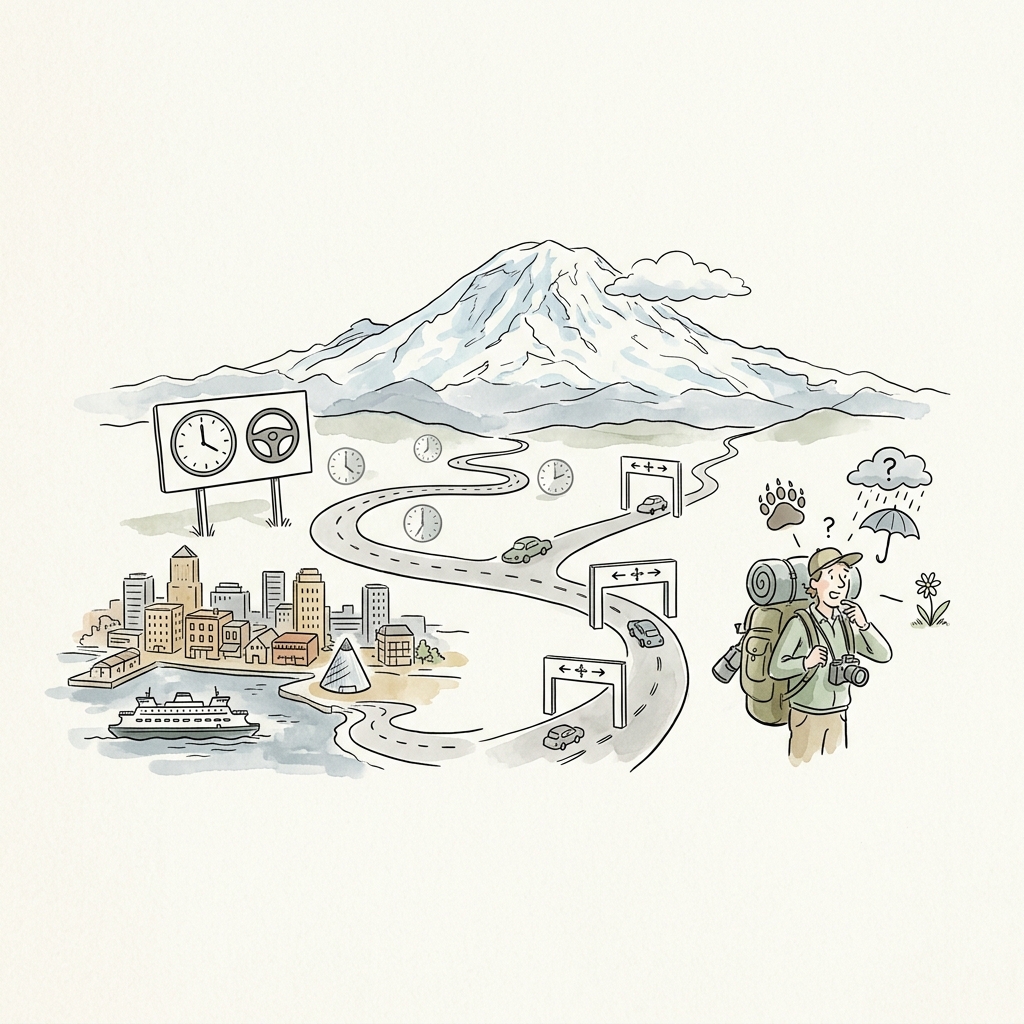
Tacoma is the closest major city to Mount Rainier National Park. The Nisqually Entrance — the park’s most-used year-round entry point — sits approximately 60 miles from downtown Tacoma via Highway 7 and Highway 706. That’s roughly 90 minutes of driving in normal conditions, compared to 2+ hours from Seattle, 3 hours from Portland, and 4+ hours from Spokane.
This proximity isn’t just a geographic fact — it shapes Tacoma’s identity. Residents here live with Rainier as a daily visual companion (weather permitting), and the mountain’s recreational opportunities function as an extension of Tacoma’s outdoor infrastructure. When Seattle residents plan a Rainier trip as a weekend commitment, Tacoma residents can realistically do a day hike and be home for dinner.
Entry Points From Tacoma
Nisqually Entrance (Year-Round)
The primary access point for visitors coming from Tacoma. Take I-5 South to Highway 7 (exit 133 in Tacoma), follow Highway 7 through Spanaway, Graham, Elbe, and connect to Highway 706 at Ashford. The road ends at the Nisqually Entrance. Drive time: approximately 85-95 minutes from downtown Tacoma, depending on traffic through Spanaway.
The Nisqually Entrance provides access to Longmire (historic district, museum, ranger station), Paradise (the park’s most visited destination at 5,400 feet elevation, wildflower meadows, visitor center, trailheads for Skyline Trail), and the road between them. This entrance and the road to Paradise are open year-round, though the road above Longmire may require chains November through April.
Carbon River Entrance (No Road Access — Fairfax Bridge Closed)
The closest entrance by straight-line distance — about 50 miles from Tacoma via Highway 167 and Highway 165 through Buckley and Carbonado. That access is now cut off entirely: WSDOT closed the SR 165 Fairfax Bridge — the only road to this corner of the park — permanently in April 2025 after its steel supports deteriorated, and the National Park Service confirms there is no public access to the Carbon River area from SR 165. Inside the park, the flood-damaged Carbon River Road was already limited to pedestrians and cyclists past the ranger station (the Carbon River Rainforest trail and the 5-mile walk to Ipsut Creek Campground), and those trailheads are now reachable only by long-distance hiking on in-park trails such as the Wonderland Trail.
This entrance accesses the park’s northwest corner — the most remote and least-visited section of Rainier. The Carbon Glacier here is the lowest-elevation glacier in the contiguous United States.
Mowich Lake (No Road Access — Fairfax Bridge Closed)
Its only road access was via Highway 165 through Buckley and Carbonado — across the Fairfax Bridge, closed permanently in April 2025 — then the unpaved Mowich Lake Road. There is currently no public access to Mowich Lake from SR 165 and no alternate driving route. Mowich Lake is the largest and deepest lake in the park and the trailhead for Spray Park (wildflower meadows rivaling Paradise) and Tolmie Peak Lookout — for now reachable only by long-distance hiking from inside the park.
White River / Sunrise (Summer Only)
Longer drive from Tacoma — about 2 hours via Highway 167 to Highway 410 through Enumclaw and into the park’s northeast corner. Sunrise is the highest point accessible by car in the park (6,400 feet) and offers the most dramatic close-up views of Rainier’s summit and Emmons Glacier. The road typically opens late June through mid-October.
Seasonal Access Reality
Mount Rainier’s access is dictated by snowfall. The park receives an average of 640 inches (53 feet) of snow annually at Paradise, making it one of the snowiest places on Earth measured at an inhabited location. Per NPS current conditions:
Year-round access: Nisqually Entrance to Paradise (chains may be required November-April above Longmire).
Summer only (typically July-October): Sunrise/White River, Stevens Canyon Road (connecting Nisqually side to Ohanapecosh/east side).
No road access at all: Carbon River and Mowich Lake (SR 165 Fairfax Bridge closed permanently in April 2025).
Limited/closed: Carbon River Road inside the park (pedestrian only, trailheads unreachable by road), West Side Road (closed to vehicles past Dry Creek).
Tacoma residents learn to check the NPS road status page before any trip between October and June. Roads can close with minimal notice due to weather, avalanche risk, or fallen trees.
What Tacoma-Based Visitors Should Know
The Timed Entry question: Mount Rainier ran timed-entry reservation pilots for Paradise and Sunrise in 2024 and 2025, but the park does not require timed-entry reservations anywhere in 2026 — it is managing congestion through parking instead. Arrive early on summer weekends (Paradise parking fills fast), and check the NPS website before future seasons, since this policy has changed year to year.
Fuel and services: The last reliable fuel stop heading to the Nisqually Entrance is Ashford or Elbe. There is no gas inside the park. Fill up before the Highway 706 corridor.
Cell service: Essentially nonexistent inside the park. Download maps and communicate plans before entering. Emergency-only satellite communication exists at ranger stations.
National Park Pass: Entrance fee is $30 per vehicle, good for seven days. Mount Rainier’s own annual pass is $55; the America the Beautiful pass is $80 and covers all national parks and federal recreation lands. Either annual pass is worth it if you’ll visit twice in a year.
Day hike sweet spots from Tacoma: Leave by 7 AM, arrive at Paradise by 8:30 AM, hike the Skyline Trail loop (5.5 miles, 1,700 feet elevation gain, 3-4 hours), return to Tacoma by early afternoon. This is the most popular Tacoma day-trip formula for Rainier.
The Gateway City Economy
Mount Rainier National Park drew over 2 million visitors in recent years according to NPS statistics. A significant portion of those visitors either stage from Tacoma (hotels, restaurants, gear shops) or pass through the city en route. The Highway 7 corridor through south Pierce County serves as the primary arterial for park-bound traffic.
Tacoma’s outdoor retail presence — REI’s flagship-sized store, numerous independent gear shops, and outfitter operations — exists in part because of this gateway function. The mountain brings tourism dollars through Pierce County regardless of whether visitors know they’re in Tacoma’s orbit.
Frequently Asked Questions
How long does it take to drive from Tacoma to Mount Rainier?
Approximately 85-95 minutes from downtown Tacoma to the Nisqually Entrance via Highway 7 and Highway 706. Add 30-40 minutes to reach Paradise from the entrance. Total drive time to Paradise is roughly 2 hours from Tacoma in normal conditions.
Which entrance to Mount Rainier is closest to Tacoma?
The Carbon River Entrance is the closest by distance (about 50 miles) but it has had no public road access since the SR 165 Fairfax Bridge closed permanently in April 2025. The Nisqually Entrance is the closest functional entrance — and the only year-round one — at about 60 miles from downtown Tacoma.
Can you visit Mount Rainier as a day trip from Tacoma?
Yes — this is one of Tacoma’s key advantages. Leave by 7 AM, reach Paradise by 8:30-9:00 AM, complete a substantial hike (Skyline Trail, Myrtle Falls, Bench and Snow Lakes), and return to Tacoma by mid-afternoon. It’s a realistic weekday or weekend day trip.
Do you need reservations to enter Mount Rainier National Park?
Not in 2026. The NPS ran timed-entry reservation pilots at Paradise and Sunrise in 2024 and 2025, but dropped them for 2026 in favor of parking management — no timed-entry reservation is required anywhere in the park this year. Check the official NPS website before future seasons, since the policy has changed year to year.
Is Mount Rainier open in winter?
The Nisqually Entrance and road to Paradise remain open year-round, though chains may be required above Longmire from November through April. Paradise is a popular snowshoeing and cross-country skiing destination in winter. Sunrise is closed by snow typically from November through June, and Mowich Lake and Carbon River have no road access at all since the April 2025 Fairfax Bridge closure.