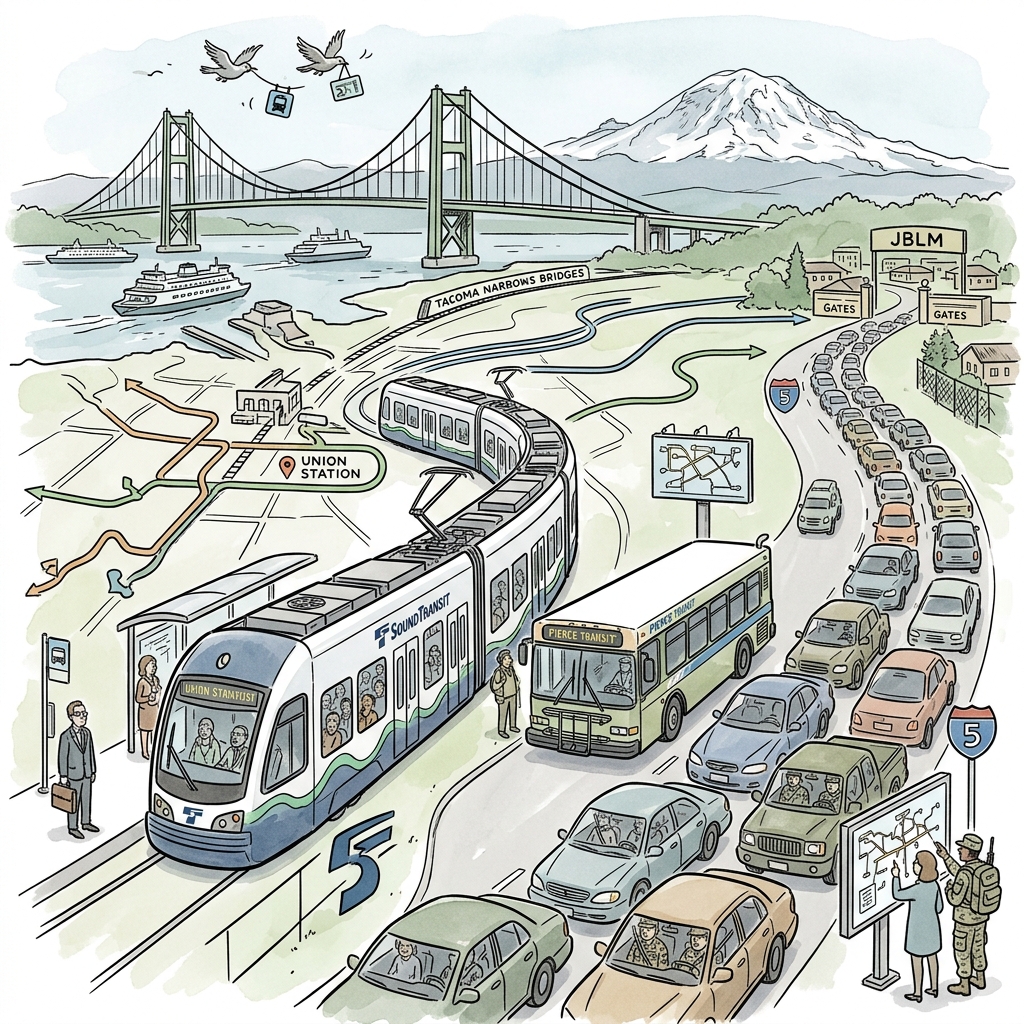
Tacoma’s Two-System Transit Reality
Tacoma is served by two distinct public transit agencies with overlapping but different missions. Pierce Transit handles local bus routes within Pierce County — the daily commute within Tacoma, connections to Lakewood, University Place, and neighborhood service. Sound Transit handles regional connections — the Sounder commuter rail to Seattle, the Tacoma Link light rail, and ST Express buses to King County.
Understanding how they fit together is essential for anyone living or working in Tacoma without relying entirely on a car. And understanding their limitations is equally essential for anyone coming from a city with better transit coverage.
Pierce Transit: Local Bus Network
Pierce Transit operates approximately 35 fixed bus routes across Pierce County. The system is hub-and-spoke, centered on the Tacoma Dome Station (the main transfer point where Pierce Transit, Sound Transit, and Greyhound all connect) and the downtown Commerce Street corridor.
High-frequency routes (15-minute headways during peak hours) include Route 1 (6th Avenue corridor), Route 2 (South Tacoma Way), Route 3 (Pacific Avenue), and Route 4 (Point Defiance). These form the backbone of the system and provide reasonable service for car-free living along those specific corridors.
The honest assessment: outside the high-frequency routes, Pierce Transit operates on 30-60 minute headways that make transit impractical as a primary mode for most trips. Evening and weekend service is reduced further. If your origin and destination aren’t both on a frequent route, you’re likely looking at transfer times that double or triple the equivalent drive time.
Pierce Transit ridership has recovered to approximately 75-80% of pre-pandemic levels as of recent reporting. The agency passed a significant sales tax measure in recent years to fund service improvements, with planned increases in frequency on key routes and new connections to developing areas.
Sound Transit: Regional Rail and Light Rail
Sounder S Line (Commuter Rail)
The Sounder S Line runs from Lakewood through Tacoma Dome to Seattle’s King Street Station, with peak-direction service (northbound morning, southbound evening). Trip time from Tacoma Dome to King Street: approximately 60 minutes. Service frequency: trains depart every 20-30 minutes during peak commute windows.
This is the commuter rail line that enables Tacoma residents to hold Seattle jobs — and it’s the transit service most responsible for Tacoma’s residential price appreciation. The monthly pass (included in ORCA regional passes) makes the cost roughly equivalent to gas and parking for driving, but with productivity time on the train.
Limitations: Sounder runs peak-direction only during commute hours. There is no midday, evening, or weekend Sounder service. If you need to get to Seattle outside of 6-9 AM or 3-7 PM, you’re using ST Express bus (slower) or driving.
Tacoma Link T Line (Light Rail)
The Tacoma Link T Line is a streetcar-style light rail running from the Theater District through downtown to the Hilltop neighborhood (extended 2023) and south to the Tacoma Dome Station. The entire T Line is fare-free — you don’t pay to ride it.
The T Line serves primarily as a downtown circulator connecting the main transit hub (Tacoma Dome), the government/business district (Union Station area), the entertainment district (Theater District), and Hilltop. It’s useful for moving within central Tacoma but doesn’t extend to residential neighborhoods beyond Hilltop.
The JBLM Commute Reality
Joint Base Lewis-McChord sits approximately 12 miles south of downtown Tacoma via I-5. It’s the largest military installation on the West Coast by personnel (over 40,000 military members plus civilians and contractors). The commute between Tacoma and JBLM is one of Pierce County’s defining traffic patterns.
The I-5 corridor between Tacoma and JBLM (exits 116-127) experiences significant congestion during morning and evening commute hours. Southbound morning rush (7:00-8:30 AM) and northbound evening rush (4:00-6:00 PM) can add 20-40 minutes to what would otherwise be a 15-minute drive.
Transit options for the JBLM commute: Sound Transit Route 592 connects Lakewood (adjacent to JBLM) to downtown Tacoma and Seattle. Pierce Transit Route 206 serves the Lakewood/JBLM area with connections to Tacoma Dome Station. However, transit is impractical for most JBLM-bound commuters because the base itself is enormous and not well-served by internal transit — you need a car once on base.
Park-and-ride capacity is a constraint. The Lakewood Station and South Tacoma Station park-and-rides fill early on weekday mornings. Sound Transit is expanding capacity at several locations, but demand consistently outpaces supply.
What’s Coming: ST3 and Pierce Transit Improvements
Sound Transit’s ST3 expansion plan includes extending the Tacoma Link light rail further south (potentially to Tacoma Community College) and improving Sounder service frequency. These projects are in various stages of planning and construction — timelines have been pushed back from original estimates, which is the norm for major transit capital projects in the Puget Sound region.
Pierce Transit’s service improvement plan focuses on increasing frequency on existing routes rather than adding new routes. The goal is 15-minute service on 8-10 key corridors — making transit usable for more trip types than just peak-commute office workers.
Frequently Asked Questions
Is the Tacoma Link light rail free?
Yes. The Tacoma Link T Line is completely fare-free. You can board at any station without paying or tapping a card. This applies to the entire T Line from Tacoma Dome Station through downtown to the Hilltop extension.
How long does the Sounder train take from Tacoma to Seattle?
Approximately 60 minutes from Tacoma Dome Station to King Street Station in downtown Seattle. Trains run peak-direction only during commute hours — northbound morning (roughly 5:30-8:30 AM departures) and southbound evening (3:30-6:30 PM departures). No midday, evening, or weekend service.
Does Pierce Transit go to JBLM?
Pierce Transit Route 206 serves the Lakewood area adjacent to JBLM with connections to Tacoma Dome Station. However, transit access to JBLM itself is limited — the base is large and not well-served by internal transit, so most commuters need a car once on base. Sound Transit Route 592 also connects Lakewood to Tacoma and Seattle.
What are the park-and-ride options in Tacoma?
Major park-and-rides include Tacoma Dome Station (largest, served by Sounder, ST Express, and Pierce Transit), South Tacoma Station, and Lakewood Station. All fill early on weekday mornings. Overflow parking is a persistent issue — arrive before 7:30 AM for guaranteed spots at Tacoma Dome.
Is public transit in Tacoma good enough to live without a car?
Possible but limiting. If you live and work on a high-frequency Pierce Transit route (Routes 1, 2, 3, or 4) and commute during peak hours, car-free living is feasible. For most other situations — evening trips, weekend errands, destinations off main corridors — you’ll find 30-60 minute headways frustrating. The system works for some lifestyles, not all.