Tag: Keyword Intelligence

  • High-Traffic GA4 Channels Delivering the Wrong Users — A Search Intent Diagnosis

    High-Traffic GA4 Channels Delivering the Wrong Users — A Search Intent Diagnosis

    A page can rank on the first page of Google, receive consistent organic traffic, and still be failing. The failure is silent — visible only when you look at what the arriving users actually do.

    When users search “how to apply for X” and land on a page about “what X is,” they leave immediately. The page ranked for the query but delivered the wrong content for the intent behind it. GA4 captures this as a short session with a high bounce rate — but it does not tell you why, and it does not tell you which queries are driving the mismatch.

    Intent Mismatch in the Data
    In GA4, intent mismatch produces a specific signature: high organic traffic, low engagement rate, and short session duration on the same page. If a page is receiving 200 organic sessions a month and engaging only 12% of them, one of three things is happening. The page ranked for queries it cannot actually answer. The content addresses a different aspect of the topic than users are searching for. Or the audience searching this query is at a different stage of the journey than the content is written for.

    All three are fixable. But only if you know which one you have.

    The Silent Scream in Your Internal Search Data
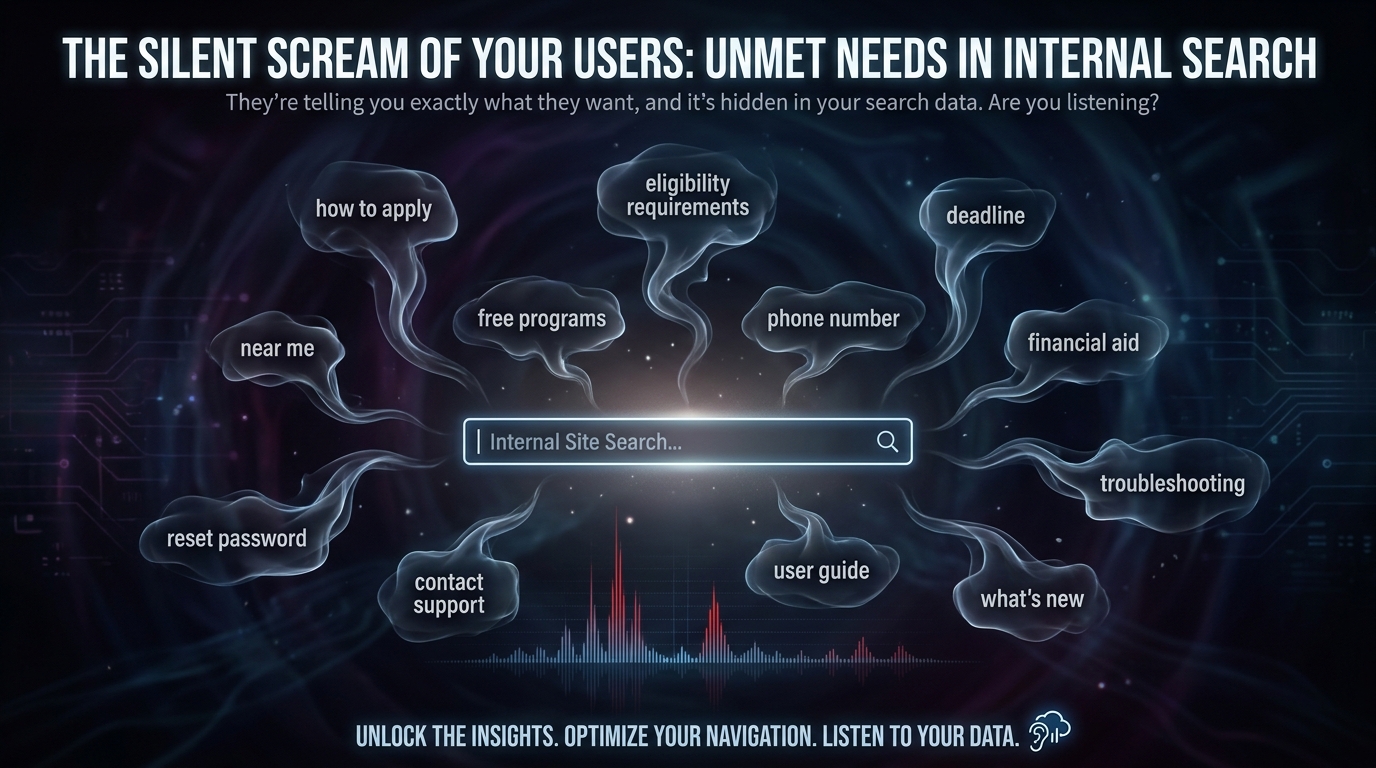
    Internal site search is the most underused intelligence source in GA4. When a user searches your site, they are explicitly telling you what they wanted and could not find from your navigation or your existing content. That is direct audience research, free, already collected in your property.

    The most valuable subset of internal search data is zero-result searches — queries that users entered into your search bar and got nothing useful back. These are your most urgent content gaps. A user who searched your site and found nothing is more frustrated than one who never searched. They came looking for something specific, engaged enough to try your internal search, and left empty-handed.

    The top 20 internal search terms for any content site are a ready-made content sprint list. They represent topics real users on your site actively wanted to find. No keyword tool produces a brief this precise.

    Your Intent Alignment Score

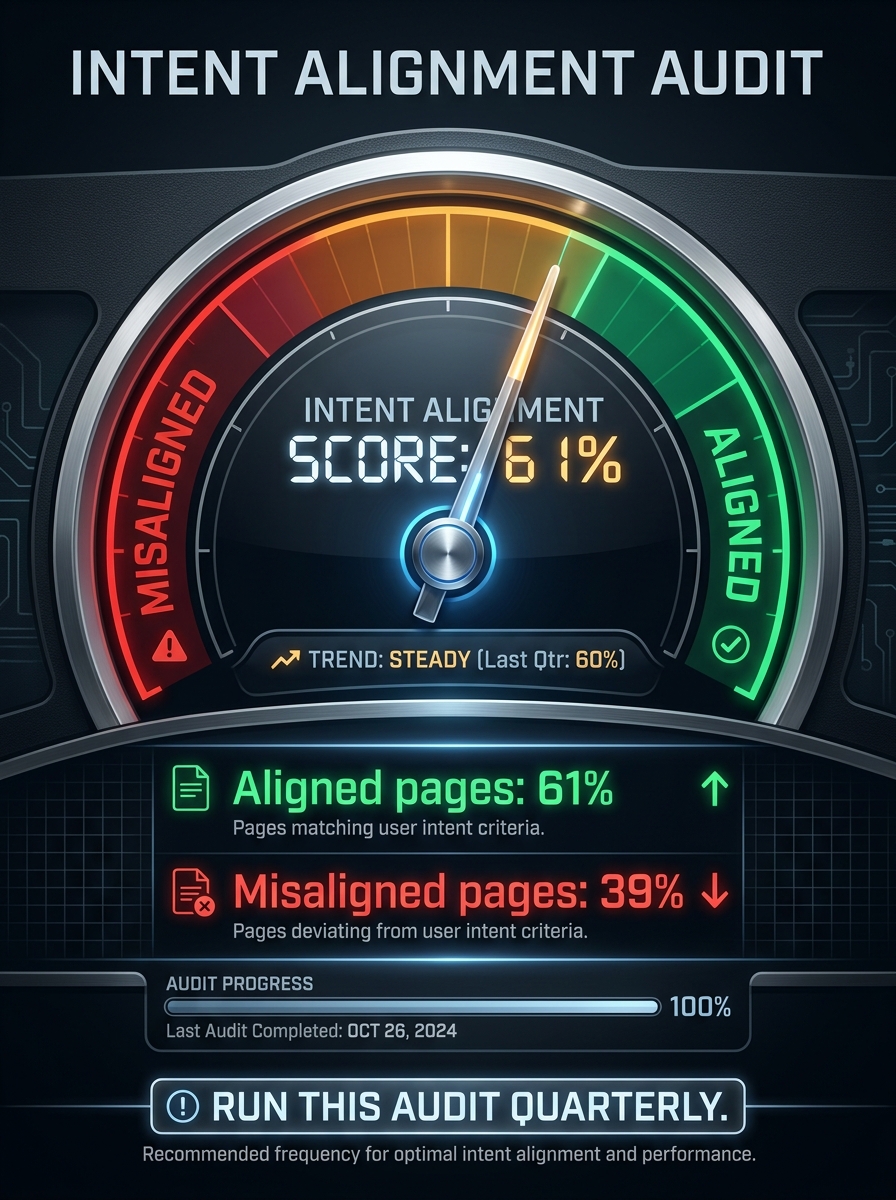
    Across your organic landing pages, a certain percentage are well-aligned with the search intent of users arriving on them — high traffic, high engagement, users who found what they needed. The remainder are misaligned — high traffic, low engagement, users who bounced because the content did not match what they were looking for.

    That ratio — aligned pages versus misaligned pages — is your intent alignment score. It is a quarterly tracking metric. If you are actively addressing misaligned pages through rewrites, redirects, and new content targeting the correct intent, the score should improve over time. If it is flat or declining, something is creating new misalignment faster than you are fixing old misalignment.

    Running the Intent Alignment Session

    This analysis runs in one session using Claude-in-Chrome alongside Analytics Advisor in GA4. The query sequence surfaces your highest-mismatch organic pages, extracts your internal search terms and gaps, and produces a baseline alignment score. The methodology is the Books for Bots: GA4 Search Intent Alignment Kit.


    Learn more about the GA4 Search Intent Alignment Kit →

  • Books for Bots: GA4 Search Intent Alignment Kit

    Books for Bots: GA4 Search Intent Alignment Kit

    Search query pointing to wrong page with red X and correct guide with green arrow

    BOOKS FOR BOTS — GA4 SERIES — BOOK 06

    GA4 Search Intent Alignment Kit

    Are your keywords landing on the right pages? Diagnose intent mismatch between what users searched and what they found — and surface what your audience wanted and could not find.

    39% misalignedOf organic landing pages delivering the wrong content for the search intent
    COMING SOON — $27

    A Page Can Rank Well and Still Fail

    If the user searched “how to apply for X” and landed on a page about “what X is,” they bounce immediately. GA4 captures this failure even when you cannot see the original query. High organic traffic with low engagement is almost always intent mismatch in disguise.

    Two puzzle pieces QUERY and CONTENT that do not fit

    CORE INSIGHT

    Internal site search is the most underused intelligence in GA4. When a user searches your site, they are explicitly telling you what they wanted and could not find. This kit makes that signal visible and actionable.

    User search queries rising like smoke from internal site searchPerson pulling wrong book while the right answer glows out of reachIntent alignment gauge 61% aligned 39% misaligned — run quarterlySearch intent key vs landing page lock — MISMATCH

    What’s Inside

    • 7 copy-paste queries for Analytics Advisor — one session
    • Organic traffic to engagement mismatch identification
    • Internal search term extraction — top 20 with gap analysis
    • Zero-result internal search diagnosis
    • Homepage navigation gap analysis
    • Intent alignment score — baseline metric to track quarterly
    • Content repositioning recommendation framework

    What You Need

    • Claude-in-Chrome — free from Anthropic
    • Editor or Analyst access to a GA4 property
    • Analytics Advisor (BETA) enabled
    • 30–60 minutes

    THE KEY INSIGHT

    Internal search tells you what people search on your site after they arrived. That is a different and more valuable signal than anything a keyword tool produces — and it is sitting in your GA4 right now.

    Individual Kit — Instant PDF Download

    COMING SOON — $27

    No subscription.

    BUNDLE

    Get All 6 Kits for $97

    Every GA4 intelligence methodology. Save $65.

    $162$97

    COMING SOON

    FREE STARTER

    Try Session 3 Free

    Seven queries revealing your ChatGPT vs Claude vs Copilot split in 30 minutes.

    COMING SOON — FREE

    Validated on live GA4 properties. April 2026.

  • SiteBoost for Fractional CFO Firms and Independent CFO Practices

    SiteBoost for Fractional CFO Firms and Independent CFO Practices

    What SiteBoost for Fractional CFO Firms Is: A structured SEO and content program for fractional CFO practices and firms that need to be found by business owners who are actively searching for financial leadership — not just browsing. We build content around the exact searches your best prospects use: problem-aware queries, industry-specific terms, and pricing research. The result is a pipeline of qualified inbound leads that does not depend on referrals or cold outreach.

    The Search Gap in Fractional CFO Services

    Demand for fractional CFO services has surged over the past three years. U.S. search interest for fractional CFO-related terms has climbed sharply, and interim CFO requests have increased substantially since 2020. The problem is that most fractional CFO websites look like they were built in 2014 — a services page, a brief bio, and a contact form. No content depth, no keyword targeting, no schema, no AI search visibility.

    The business owner who searches “SaaS fractional CFO” or “fractional CFO for manufacturing company” or “cash flow management CFO services” is a buyer. They are in research mode with real intent. Most fractional CFO firms are invisible to that buyer because they have nothing to find.

    What SpyFu data shows about this space: The leading fractional CFO domains — firms that have been operating for years — rank for fewer than 1,200 organic keywords and generate under $10,000 in monthly SEO value. That is not competition. That is an open field for any firm willing to build a real content program.

    How Fractional CFO Prospects Actually Search

    Research into fractional CFO buyer behavior reveals a consistent pattern: prospects search for the problem before they search for the solution. The searches that convert are not “hire fractional CFO.” They are:

    • “Cash flow unpredictable small business” — owner with a liquidity problem, not yet aware of fractional CFO as the answer
    • “SaaS fractional CFO” — founder who knows what they need and is qualifying providers by vertical expertise
    • “Fractional CFO cost” or “fractional CFO services pricing” — buyer evaluating investment, ready to engage
    • “Preparing company for sale CFO” — high-value exit-adjacent buyer with a specific timeline
    • “PE-backed company fractional CFO” — institutional client with a structured need
    • “When to hire a CFO startup” — awareness-stage founder who will become a buyer

    We build content that captures every stage of that search funnel — from the business owner who does not yet know they need a fractional CFO to the one who is comparing your firm against three others right now.

    What We Build for Fractional CFO Firms

    • Industry vertical landing pages — Dedicated pages for each vertical you serve: SaaS, manufacturing, healthcare, professional services, construction, e-commerce. Each page targets the specific searches for that vertical and demonstrates industry-specific financial fluency
    • Problem-aware content — Articles and guides built around the cash flow, fundraising, exit planning, and financial reporting problems that drive your best clients to search in the first place
    • GEO visibility for AI search — Structured so that when a founder asks ChatGPT or Perplexity which fractional CFO firms specialize in their industry or stage, your practice is named
    • Pricing and comparison content — Transparent cost-of-engagement content that captures high-intent pricing searches and converts researchers into inquiry submissions
    • Local and regional authority content — City and metro-specific pages that capture “fractional CFO in [city]” searches from founders who prefer a proximate relationship

    The Comparison

    Dimension Typical Fractional CFO Website SiteBoost for Fractional CFO
    Search visibility Under 1,200 organic keywords (industry average) Built to capture problem-aware + vertical + pricing queries
    Buyer funnel coverage Services page only Awareness → consideration → decision content at every stage
    Industry specificity Generic financial services Vertical-specific pages per industry you serve
    AI search visibility Not considered GEO optimization for ChatGPT, Perplexity, Google AI Overviews
    Lead acquisition model Referral-dependent Organic search as a parallel inbound channel that runs 24/7

    Who This Is For

    Solo fractional CFOs and small firms who get every client through referrals but want a search presence that reflects their expertise. Multi-practitioner fractional CFO firms competing for a client who is simultaneously talking to three other firms. Fractional CFO practices that specialize in a specific industry or company stage and want to own the search results for that niche. Financial advisory firms adding fractional CFO to their service mix who need to build organic visibility in a new category.

    Ready to talk about your practice?

    Tell us which industries you serve, what your current web presence looks like, and how you currently acquire clients. We will give you an honest read on what organic search can add to that pipeline.

    will@tygartmedia.com

    Frequently Asked Questions

    What keywords should a fractional CFO firm target?

    The highest-converting searches combine three layers: problem-aware terms (“cash flow management services for small business”), industry-vertical terms (“SaaS fractional CFO,” “fractional CFO for manufacturing”), and intent-specific terms (“fractional CFO cost,” “when to hire a fractional CFO”). We build content that covers all three layers, not just the brand keyword.

    How competitive is the fractional CFO SEO space?

    Far less competitive than most people assume. The leading fractional CFO domains rank for fewer than 1,500 organic keywords and generate modest monthly SEO value — thin content programs that can be outranked by a focused effort in six to nine months. The boutique opportunity is significant precisely because the incumbents have not invested in content.

    Does this work for a solo practitioner or only for firms?

    It works for both, and solo practitioners often see faster results. A solo fractional CFO with a specific vertical focus and a well-built content program can outrank a larger generalist firm for the niche searches that matter most. Depth of expertise plus content architecture beats headcount.

    What is GEO optimization for financial services?

    GEO — Generative Engine Optimization — structures your content so AI platforms name your practice when business owners ask questions like “which fractional CFO firms specialize in SaaS fundraising” or “best fractional CFO for manufacturing company.” Those queries are now extremely common among founders doing initial research. The practice that is named wins the next conversation.

    How long before we see meaningful results?

    Vertical-specific and problem-aware content typically shows rank movement within two to four months. Pricing and comparison searches can rank faster because the competition is thin. AI search citation patterns typically emerge within four to six months of a full content build. We set expectations specific to your competitive landscape.

  • Topic Intelligence Squeeze — Pull TI Data Into Your Content and Article Knowledge Base

    Topic Intelligence Squeeze — Pull TI Data Into Your Content and Article Knowledge Base

    Tygart Media / Content Strategy
    The Practitioner JournalField Notes
    By Will Tygart
    · Practitioner-grade
    · From the workbench

    What Is the Topic Intelligence Squeeze?
    The Topic Intelligence Squeeze is a structured data extraction and injection process — pulling keyword rankings, entity signals, content gap data, and optimization recommendations from Topic Intelligence (platform.topicintelligence.ai) and using that data to enrich your article knowledge base and direct specific post optimizations. It turns TI’s data layer into actionable content decisions.

    Topic Intelligence surfaces signals that most content teams miss or can’t act on fast enough — near-miss keywords sitting at positions 11–20, entity gaps between your content and ranking competitors, content freshness signals on posts that used to rank but are slipping. The data is there. The bottleneck is turning it into optimized posts quickly enough to matter.

    The squeeze process extracts TI data for a target domain, maps it to specific posts in your WordPress site, and feeds it directly into the optimization pipeline — so near-miss articles get refreshed, entity gaps get injected, and freshness signals trigger content updates before rankings drop further.

    Who This Is For

    WordPress site operators who have Topic Intelligence data available for their domain and want to close the gap between TI’s recommendations and actual post-level optimization execution.

    What the Squeeze Covers

    • Near-miss keyword extraction — Identify all keywords your site ranks positions 11–20 for, mapped to the specific posts responsible
    • Entity gap analysis — Compare your post entity coverage against TI’s recommended entity set for each keyword cluster
    • Freshness signal triage — Identify posts with declining rankings that need content updates vs. schema/AEO fixes
    • Knowledge base injection — TI data formatted and stored in your article knowledge base for ongoing session reference
    • Optimization priority queue — Ranked list of posts by estimated ranking uplift potential from TI data

    What We Deliver

    Item Included
    TI data pull for your domain
    Near-miss keyword map (post-level)
    Entity gap report per keyword cluster
    Freshness signal triage report
    Optimization priority queue (top 20 posts)
    Knowledge base injection (TI data formatted for AI sessions)
    First optimization pass on top 5 priority posts

    Ready to Turn TI Data Into Published Optimizations?

    Share your domain and confirm you have Topic Intelligence access. We’ll run the squeeze and deliver the priority queue within 3 business days.

    will@tygartmedia.com

    Email only. No commitment to reply.

    Frequently Asked Questions

    Do I need a Topic Intelligence account for this service?

    Yes. You need an active Topic Intelligence account with data for the domain you want squeezed. We access TI through your credentials during the engagement.

    What’s a near-miss keyword and why does it matter?

    A near-miss keyword is one your site ranks positions 11–20 for — meaning you’re on page 2 or the bottom of page 1, where almost no clicks happen. These are the highest-ROI targets for content optimization because you’re already most of the way there — a targeted refresh can move them to page 1 positions where clicks actually occur.

    Can this be run repeatedly on the same domain?

    Yes — and it should be. Running the squeeze every 60–90 days catches new near-misses as your content base grows and identifies freshness signals before rankings drop significantly.


    Last updated: April 2026

  • Dataforseo Claude Keyword Research — Article Hero Images Visual

    Dataforseo Claude Keyword Research — Article Hero Images Visual

    Dataforseo Claude Keyword Research
    Dataforseo Claude Keyword Research

    About This Image

    This image is part of the Article Hero Images collection in the Tygart Media visual library. Every image produced by Tygart Media is AI-generated using Google Vertex AI (Imagen), converted to WebP format, and injected with full IPTC/XMP metadata before publication.

    Technical Details

    • Format: WEBP
    • Collection: Article Hero Images
    • Media ID: 360
    • Pipeline: Vertex AI Imagen → WebP → IPTC/XMP → WordPress

    Image Licensing

    All images in the Tygart Media visual library are produced in-house using AI image generation and are owned by Tygart Media.