The Scale of the Problem
Tacoma, like every West Coast city of its size, is dealing with visible homelessness and a broader housing affordability crisis. The Pierce County Point-in-Time Count (conducted annually) identifies approximately 1,800-2,200 individuals experiencing homelessness across the county on any given night, with the majority concentrated in Tacoma. This number represents only those counted on a single night — actual annual homelessness (people who cycle through housing instability over a year) is significantly higher.
The visible encampments along I-5 corridors, under overpasses, and in specific parks generate the most community attention and political pressure. But the underlying issue is housing supply and affordability — a structural problem that visible encampments are a symptom of, not the whole of.
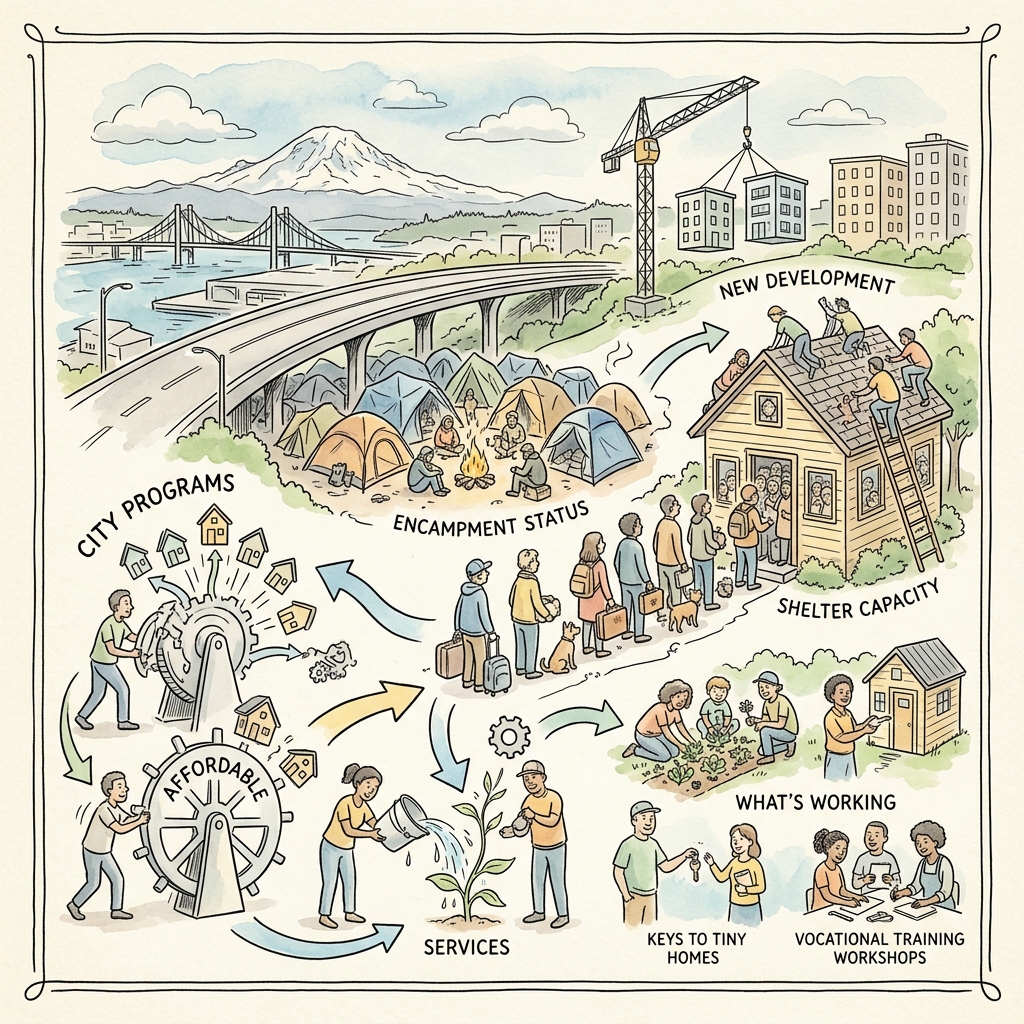
Encampment Status: Where and Why
As of current conditions, encampments in Tacoma concentrate in specific locations: areas adjacent to I-5 and Highway 16 on/off-ramps, certain parks and greenbelts, and industrial/commercial areas with limited foot traffic. The City of Tacoma conducts periodic removals/sweeps of encampments under its camping ban ordinance, but cleared sites often reoccupy within days or weeks as displaced individuals move to adjacent areas.
The legal framework: following the Martin v. Boise decision (and subsequent Grants Pass Supreme Court ruling in 2024), cities can enforce camping bans when shelter beds are available. Tacoma’s enforcement approach has evolved — the current policy generally requires offering shelter or services before removing encampments, though enforcement consistency varies by location and political pressure.
Shelter Capacity
Tacoma and Pierce County’s shelter system includes emergency overnight shelters, transitional housing, and low-barrier shelters (accepting people regardless of sobriety or identification status). Total capacity fluctuates seasonally — more beds are available during cold-weather months through emergency overflow programs.
Key facilities: the Tacoma Rescue Mission (faith-based, structured program), Catholic Community Services (multiple locations), the Stability Site concept (sanctioned camping with services), and various motel voucher programs funded through city and county contracts.
The gap: on most nights, demand exceeds supply. Not all unsheltered individuals will accept available shelter for various reasons — rules (sobriety requirements, curfews), pet restrictions, safety concerns (theft, violence in congregate settings), couple separation policies, and lack of storage for belongings. Low-barrier shelters address some but not all of these barriers.
City Programs and Spending
The City of Tacoma’s homelessness response encompasses multiple programs funded through General Fund allocations, federal grants (including significant COVID-era ARPA funding that has largely been spent down), and state funding:
Rapid rehousing: Financial assistance to move people from homelessness directly into rental housing with short-term (3-12 month) subsidy. Evidence shows this is the most cost-effective intervention for people who became homeless primarily due to financial crisis rather than chronic conditions.
Permanent supportive housing: Long-term subsidized housing paired with wraparound services (mental health, substance use treatment, case management) for chronically homeless individuals. Most expensive per unit but addresses the highest-need population. Several new permanent supportive housing buildings have opened in Tacoma in recent years.
Outreach teams: City-funded and contracted outreach workers who engage unsheltered individuals in encampments, offer services, and attempt to connect people with shelter, treatment, or housing. These teams serve as the human interface between the system and people living outside.
Diversion and prevention: Emergency rental assistance, utility assistance, and legal aid to prevent evictions before they result in homelessness. Dollar-for-dollar, prevention is the most efficient intervention — it costs far less to keep someone housed than to rehouse them after they fall into homelessness.
What’s Working (With Evidence)
Permanent supportive housing for chronically homeless individuals has demonstrated results locally — people placed in supportive housing units have high retention rates (80%+ remain housed after 12 months). The challenge is scale: each unit costs $250,000-$400,000 to build and $15,000-$20,000 annually to operate.
Rapid rehousing shows positive outcomes for families and individuals whose homelessness is primarily economic. The return-to-homelessness rate for rapid rehousing participants is lower than for people who exit shelter without housing assistance.
Coordinated entry (the system that matches people experiencing homelessness with available resources based on assessed need) has improved targeting — getting higher-need individuals into permanent supportive housing and lower-need individuals into rapid rehousing appropriately.
What Isn’t Working
The fundamental mismatch: the rate of people falling into homelessness continues to outpace the rate at which the system can house people. The shelter/housing pipeline processes fewer people out of homelessness annually than the number flowing in. Without significantly increased housing supply at the affordable end (below 50% AMI), the system cannot achieve net reduction.
Encampment sweeps without sufficient shelter alternatives are widely acknowledged (even by the city) to not resolve homelessness — they displace people, disrupt service connections, and cost money without reducing the unsheltered population. They respond to visible-symptom complaints rather than addressing the underlying cause.
The political conversation remains stuck between “enforce the law” and “provide housing first” camps, with insufficient energy directed at the housing production pipeline that both approaches ultimately depend on.
Frequently Asked Questions
How many homeless people are in Tacoma?
The Pierce County Point-in-Time Count identifies approximately 1,800-2,200 individuals experiencing homelessness on any given night, with the majority in Tacoma. This is a single-night snapshot — the number who experience homelessness at some point during a year is significantly higher.
What is the city doing about encampments in Tacoma?
The city conducts periodic removals under its camping ban, generally offering shelter or services before clearing sites. Cleared areas often reoccupy as displaced individuals move to adjacent locations. The approach has evolved since the 2024 Grants Pass Supreme Court decision gave cities more enforcement latitude.
Is there enough shelter space in Tacoma?
No. On most nights, demand exceeds supply. Additionally, not all unsheltered individuals will accept available shelter due to rules, safety concerns, pet restrictions, or couple separation policies. Low-barrier shelters reduce but don’t eliminate these barriers.
What housing programs does Tacoma offer for homeless individuals?
Key programs include rapid rehousing (short-term rental assistance), permanent supportive housing (long-term subsidized housing with services), outreach teams, and diversion/prevention (emergency rental assistance and eviction prevention). Funding comes from city, county, state, and federal sources.
Why does Tacoma have a homeless problem?
The primary driver is housing affordability — the gap between what the lowest-income residents can pay and what housing costs has widened steadily. Contributing factors include mental health system gaps, substance use disorder, domestic violence, and economic shocks. The visible encampments are a symptom of insufficient affordable housing supply relative to demand.