Last verified: October 10, 2026. Everything below reflects published guidance from Pierce County Emergency Management, the USGS Cascades Volcano Observatory, the National Park Service, and Washington’s Emergency Management Division at the time of writing. Live conditions change fast — for any active alert, current volcano status, or sign-up step, confirm against the official links provided in each section before you act on it.
Pierce County emergency alerts at a glance
- Sign up for Pierce County ALERT (free) — the county’s opt-in notification system reaches you by cell, home phone, text, email, and TTY/TDD. Register at piercecountywa.gov/921/Pierce-County-ALERT.
- Three ways to enroll — sign up online, call 253-798-6595, or text PCALERT to 888-777.
- Lahar warning sirens — more than 40 outdoor sirens run from Orting to the Port of Tacoma; learn the tones at the county’s Outdoor Warning System page.
- Mount Rainier hazard maps — find your lahar-zone and evacuation-route maps at piercecountywa.gov/3800/Hazard-Maps.
- Live volcano status — Mount Rainier’s current Volcano Alert Level and Aviation Color Code are posted (and updated) by USGS at the Cascades Volcano Observatory notice page.
- Build a two-week kit — Pierce County advises every household to be self-sufficient for at least two weeks; start at piercecountywa.gov/buildakit.
- In a mental-health crisis — call or text 988 (the Suicide & Crisis Lifeline, 24/7); it routes Pierce County callers to Washington’s regional crisis center. More at wa988.org.
How to sign up for Pierce County ALERT
Pierce County ALERT is the county’s free, opt-in mass-notification service. Fire, police, and other agencies use it to push timely information about emergencies straight to you — severe weather, unexpected road closures, missing-persons cases, and building or neighborhood evacuations. It does not happen automatically; you have to register, and it is worth doing today rather than during the next windstorm.
There are three enrollment paths, per Pierce County Emergency Management: sign up online through the Pierce County ALERT link, call 253-798-6595, or text PCALERT to 888-777. When you register online you can pick how you’re contacted — cell phone, landline, text, email, or TTY/TDD — and you can register up to five locations, so your home, workplace, a child’s school, and a parent’s address can all be covered under one account.
On privacy: the county states the contact information you provide is not accessed by Pierce County government for other purposes and is not given or sold to any vendor or outside organization. That’s a fair concern to have before handing over a phone number, and the answer is published on the official sign-up page if you want to read it directly.
One thing Pierce County ALERT is not: it does not replace Wireless Emergency Alerts (WEA), the FEMA-driven messages that hit every capable phone in a geographic area. Think of WEA as the broad blast and Pierce County ALERT as the targeted, location-specific layer you control. Run both.
Mount Rainier lahar warning system and the sirens
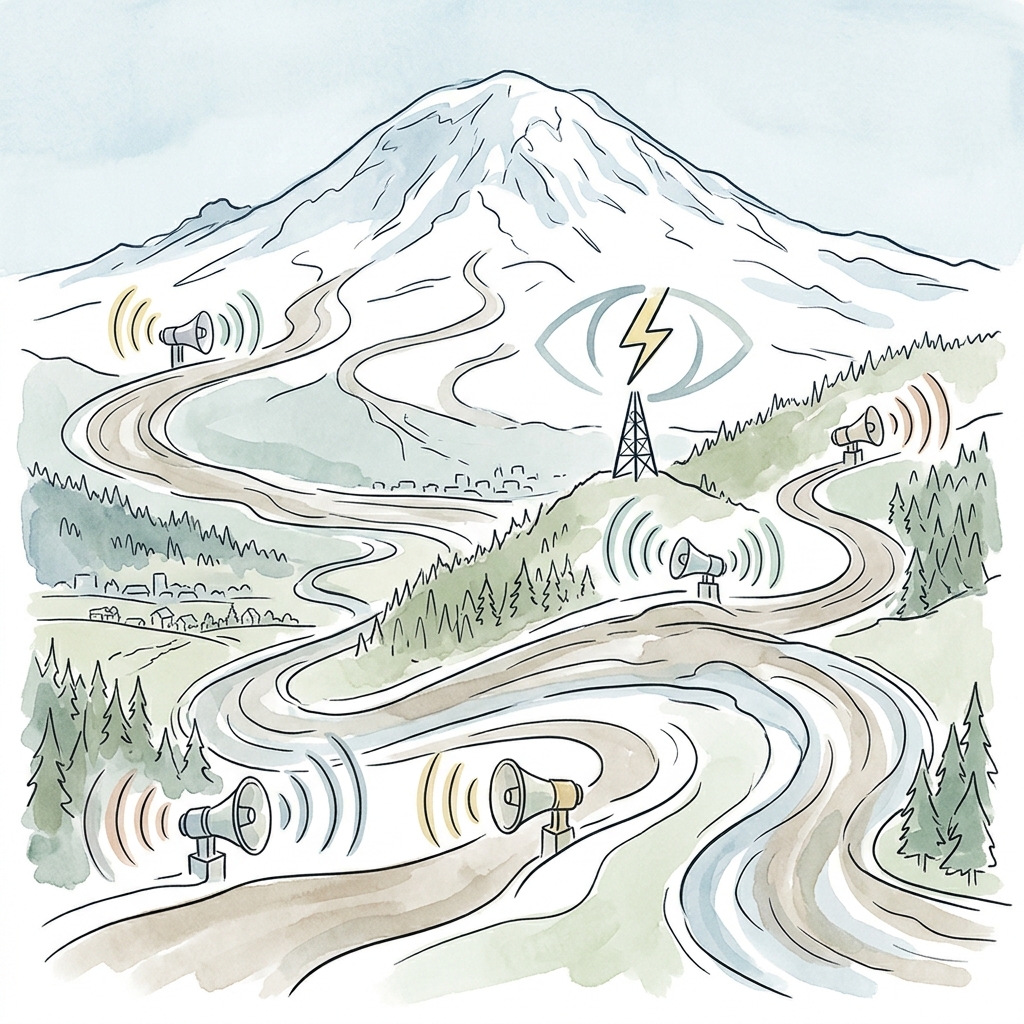
The single greatest volcanic hazard in this valley is not lava — it’s a lahar, a fast-moving volcanic mudflow that can travel down river drainages and reach populated areas in minutes. That speed is exactly why the warning system here is engineered the way it is. As the USGS describes, an automated detection network of acoustic flow monitors (AFMs) embedded near river drainages senses the ground vibrations a lahar produces. Those signals feed computers at the Washington State Emergency Operations Center and the Pierce County Department of Emergency Management, and when a lahar is confirmed, alerts go to 24-hour notification centers at Washington EMD and South Sound 911, which trigger the public warning.
The public-facing piece is the outdoor siren network — more than 40 sirens stretched from Orting down through the river valleys to the Port of Tacoma. When imminent danger is detected, the sirens sound a steady wailing tone, and the instruction is simple and non-negotiable: get off the valley floor and move to high ground immediately, on foot if you must. Do not wait for a second confirmation, do not drive into traffic if walking is faster, and do not return until officials say the threat has passed. Details and audio examples are on the county’s Outdoor Warning System page.
The sirens are tested so you can tell a drill from the real thing. The routine monthly test runs at noon on the first Monday of the month, using a Westminster Chime tone for about eight seconds followed by a voice announcement. There is one deliberate exception: in October, the annual full-scale test plays the actual emergency wail for several minutes — so a long wail you hear during a publicized October drill is a test, not an event. The rest of the year, the chime is the test and a prolonged wail is the emergency. Learn the difference now — in a real event you won’t have spare seconds to wonder which one you’re hearing.
Evacuation routes and getting to high ground
Pierce County and state agencies have mapped and signed designated lahar evacuation routes throughout the potential-impact zone, with directional signs that point you toward higher ground. Find the route for your specific neighborhood, school, or worksite on the county’s Mount Rainier Hazard Maps — and walk it once before you ever need it, because a posted route only helps if you already know where it goes.
Time is the whole game. Modeling cited by emergency planners suggests a large lahar in the upper Puyallup valley could reach the City of Orting in roughly 40 minutes after a warning sounds — and that’s the cushion only if you move at the first signal. Communities in the path have built infrastructure specifically to shave evacuation time, most notably Orting’s Bridge for Kids, a non-motorized crossing over SR-162 (under construction, with completion targeted for summer 2026) designed to move large numbers of people, including schoolchildren, to higher ground quickly. The City of Orting publishes local evacuation guidance and exercise dates on its emergency preparedness page.
Practical takeaways: if you live, work, or send kids to school on the valley floor, identify your nearest high ground and the route to it today; know that vehicles can become useless in gridlock, so a walking plan matters; and treat school and workplace drills as the real rehearsal they are.
Earthquakes, winter storms, building your kit, and crisis support
Lahars get the headlines, but the hazards most likely to disrupt your week are earthquakes and major winter storms. Pierce County’s core guidance, published across its preparedness pages, is built on a simple expectation: be ready to survive at least two weeks without outside assistance. After a large Cascadia or local quake, roads, power, and water service may not be restored for many days, and you should plan accordingly rather than assuming help arrives on day two.
Start with the basics from piercecountywa.gov/buildakit: water (a gallon per person per day), non-perishable food, medications, a first-aid kit, flashlights and batteries, a battery or hand-crank radio, warm layers and blankets for winter outages, and copies of key documents. For earthquakes specifically, practice Drop, Cover, and Hold On, secure tall furniture and water heaters, and know how to shut off your gas. For winter storms, keep your fuel topped off, prep for power loss, and never run a generator or grill indoors.
Disasters take a mental and emotional toll, too, and that part of preparedness is easy to overlook. If you or someone you’re with is in emotional distress or a suicidal crisis — during a disaster or any other day — call or text 988 to reach the Suicide & Crisis Lifeline, free and confidential, 24 hours a day. For Pierce County, 988 is staffed by Washington’s regional crisis center (Volunteers of America Western Washington), which works directly with South Sound 911 on behavioral-health calls. You can call, text, or chat — see wa988.org. For a life-threatening emergency, always call 911.
For official statewide preparedness resources and disaster recovery information, the Washington State Emergency Management Division is the authoritative complement to the county’s pages. And for the science behind the volcano hazard — including current status — the USGS Cascades Volcano Observatory and the National Park Service at Mount Rainier are the sources to trust over social media in a fast-moving event.
Frequently asked questions
How do I sign up for Pierce County ALERT?
You can enroll three ways: register online through the Pierce County ALERT system at piercecountywa.gov, call 253-798-6595, or text the keyword PCALERT to 888-777. Online sign-up lets you choose your contact methods and add up to five locations, and the service is free.
What do the Mount Rainier lahar sirens sound like?
An actual emergency uses a steady, prolonged wailing tone — your cue to move to high ground immediately. The routine monthly test is different: a Westminster Chime tone for about eight seconds followed by a voice announcement, run at noon on the first Monday of the month. The one exception is October, when the publicized annual test plays the real wail tone for several minutes. Outside of that announced October drill, if you hear the wail, evacuate. Confirm tone details on the county’s Outdoor Warning System page.
How much time would I have to evacuate before a lahar reaches Orting?
Emergency-planning estimates suggest a large lahar from the upper Puyallup valley could reach Orting in roughly 40 minutes after a warning, and that cushion only holds if you move the moment the sirens sound. Know your designated route to high ground in advance using the county’s Mount Rainier Hazard Maps.
Is Mount Rainier currently dangerous or about to erupt?
Mount Rainier’s volcano status changes over time and should never be assumed from a static webpage. The USGS Cascades Volcano Observatory posts the current Volcano Alert Level and Aviation Color Code, and updates it as conditions warrant — check the live notice at volcanoes.usgs.gov rather than relying on rumor or this article for current status.
How long should my emergency kit last in Pierce County?
Pierce County Emergency Management advises every household to be able to survive at least two weeks without outside assistance, because roads, power, and water may take many days to restore after a major earthquake or storm. Build your kit from the official checklist at piercecountywa.gov/buildakit.
Where can I get mental-health crisis help in Pierce County?
Call or text 988 to reach the Suicide & Crisis Lifeline — free, confidential, and available 24/7 by phone, text, or chat. For Pierce County, 988 is answered by Washington’s regional crisis center (Volunteers of America Western Washington), which coordinates with South Sound 911 on behavioral-health calls. Learn more at wa988.org. For any life-threatening emergency, call 911.