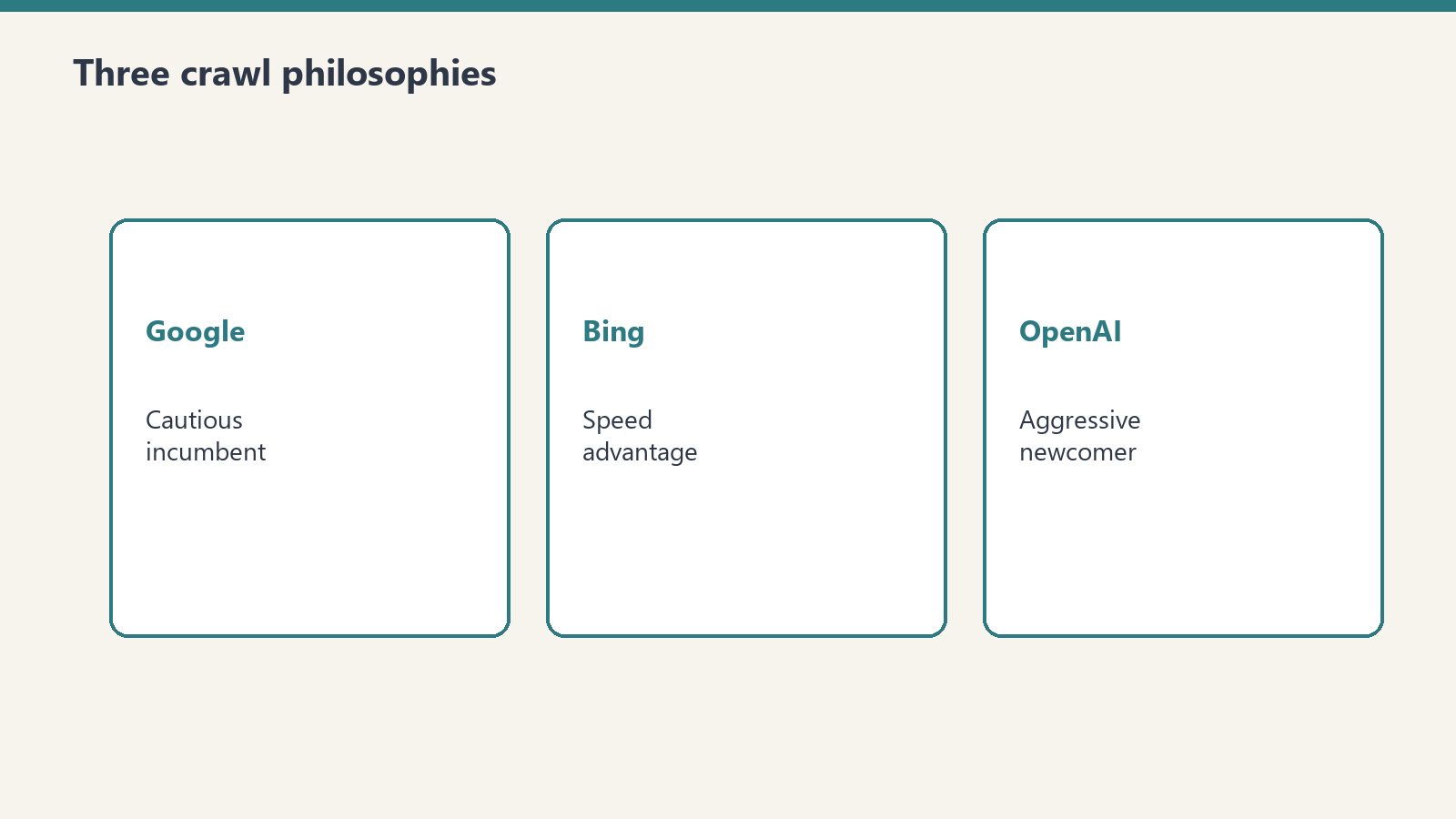
Definition: The crawl war is the emerging three-way competition between Google, Microsoft (Bing), and OpenAI to discover, index, and serve web content through their respective AI-powered search and answer systems — Google AI Overviews, Microsoft Copilot, and ChatGPT Search. Each ecosystem crawls the web with fundamentally different strategies, speeds, and philosophies, and those differences determine which content gets cited by which AI system first.
For two decades, the search engine crawl was a two-player game: Googlebot dominated, Bingbot trailed, and publishers optimized exclusively for Google. That era is over. When we published 40 Microsoft Copilot articles on tygartmedia.com and monitored server logs for 48 hours, we recorded 6,805 AI crawler hits from three distinct ecosystems — each crawling with different speeds, different intensities, and different objectives (Tygart Media server log analysis, June 2026). What we observed was not just traffic. It was a competitive intelligence blueprint showing exactly how each ecosystem discovers, evaluates, and serves content. The differences are dramatic, and they fundamentally change how publishers should think about content distribution.
The Three Ecosystems: Radically Different Crawl Philosophies
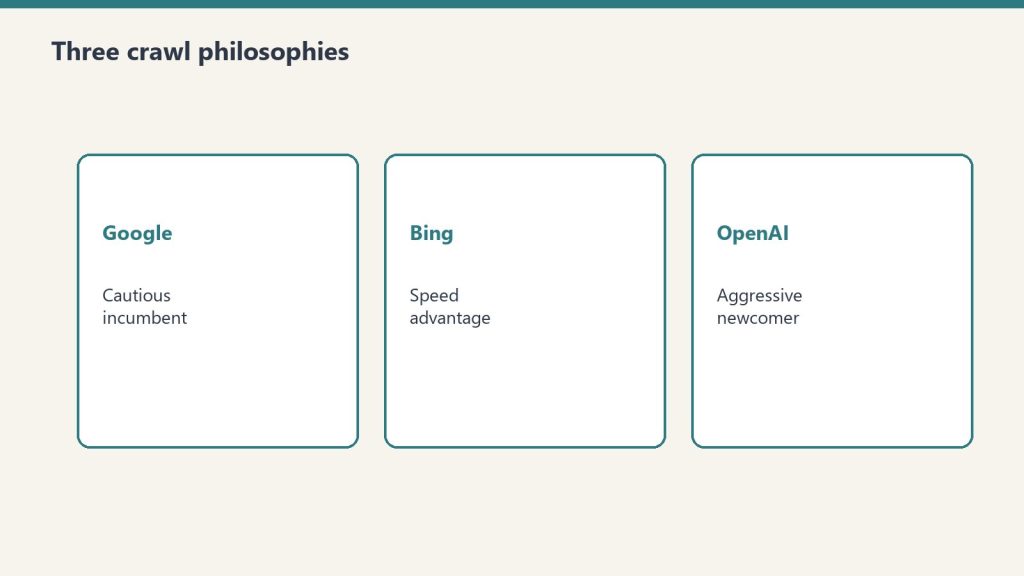
The crawl war is not just about who crawls more. It is about how each ecosystem approaches the fundamental challenge of web content discovery and evaluation. Our server log data revealed three starkly different approaches operating simultaneously on the same content:
Google: Slow and conservative. Googlebot approached our content at its own pace, significantly slower than both Bing and OpenAI. Despite being the world’s largest search crawler, Google’s response to our 40-article publication was measured and deliberate — no urgency, no burst crawling, no IndexNow acceleration.
Bing: Fast and protocol-responsive. Bingbot was the first crawler to reach every single one of our 40 articles, arriving within a consistent 4-hour post-publish window triggered by our IndexNow implementation. Bingbot’s behavior was predictable, fast, and directly responsive to publisher signals.
OpenAI: Aggressive and structural. OpenAI’s crawler fleet — GPTBot, ChatGPT-User, and OAI-SearchBot — generated the largest volume of activity, including a 1,123-request structural crawl in a single hour. OpenAI’s approach is the most intensive of the three, treating content discovery as an active, aggressive process rather than a passive one.
Google’s Crawl Strategy: The Cautious Incumbent
Google has been crawling the web longer than any other company, and its crawl strategy reflects two decades of optimization for thoroughness over speed. Googlebot is the most comprehensive crawler on the web — according to Cloudflare data from January 2026, Googlebot reaches 1.70 times more unique URLs than ClaudeBot, 1.76 times more than GPTBot, 2.99 times more than Meta-ExternalAgent, and 3.26 times more than Bingbot. No other crawler comes close in terms of coverage breadth.
But coverage is not speed. In our experiment, Googlebot was dramatically slower to discover and index our content than Bingbot. While Bingbot reached every article within 4 hours via IndexNow, Google’s crawlers took significantly longer (Tygart Media server log analysis, June 2026). This speed gap is structural, not accidental — and it reveals a fundamental strategic choice Google has made.
Why Google Is Slow: The IndexNow Abstention
The single biggest reason for Google’s slower crawl response is its refusal to adopt IndexNow. IndexNow is the protocol that allows publishers to push notifications directly to search engines when content is published or updated. Bing, Yandex, and other participating search engines receive these notifications and can respond within minutes. Google does not participate in IndexNow. Instead, Google relies on its own crawl scheduling, sitemap processing, and link-following algorithms to discover new content — a process that is thorough but inherently slower.
Google’s stated position is that it already discovers content efficiently through its existing infrastructure. But our data tells a different story for time-sensitive content. When speed of discovery directly impacts whether content gets cited in AI-generated answers, Google’s conservative approach creates a tangible disadvantage compared to Bing’s IndexNow-responsive pipeline.
Google’s AI Layer: AI Overviews and Google-Extended
Google’s approach to AI crawling is to layer AI capabilities on top of existing Googlebot infrastructure rather than deploying separate AI-specific crawlers. Content indexed by Googlebot feeds both traditional search results and Google AI Overviews. The only AI-specific crawler is Google-Extended, which handles the opt-out mechanism for AI training — blocking Google-Extended prevents content from being used for Gemini model training while keeping it available for search and AI Overviews.
This integrated approach means Google does not need to crawl content twice — once for search, once for AI. But it also means Google’s AI Overviews are limited by Googlebot’s crawl schedule. If Googlebot has not indexed a page, Google AI Overviews cannot reference it. And since Googlebot is slower to discover new content than Bingbot (which uses IndexNow), Google AI Overviews are systematically slower to surface newly published content compared to Microsoft Copilot.
Bing’s Crawl Strategy: The Speed Advantage
Microsoft’s Bing has historically been the underdog in search — smaller index, lower market share, less publisher attention. But in the AI era, Bing has a structural advantage that Google lacks: IndexNow responsiveness and deep integration with Microsoft Copilot.
In our experiment, Bingbot’s behavior was the most predictable and publisher-friendly of all three ecosystems. Every single one of our 40 articles was discovered by Bingbot within a consistent 4-hour window after publication, triggered by our IndexNow implementation (Tygart Media server log analysis, June 2026). This consistency is remarkable — it means publishers who implement IndexNow can predict, with near-certainty, when their content will enter Bing’s index and become available for Copilot citation.
The IndexNow Pipeline: Publisher to Copilot in Hours
The Bing-to-Copilot pipeline works like this: you publish content, IndexNow notifies Bing, Bingbot crawls and indexes your page within approximately 4 hours, and that indexed content immediately becomes available to Copilot’s retrieval system. This is the fastest path from publication to AI citation available today.
Our server logs confirmed this pipeline operating exactly as designed. Within 24 hours of publishing our 40 articles, we recorded 3 confirmed referral visits from copilot.microsoft.com, with 2 carrying the utm_source=copilot.com parameter (Tygart Media server log analysis, June 2026). That is less than one business day from publication to confirmed Copilot citation — a timeline that would be impossible without IndexNow’s speed advantage.
The YandexBot Shadow Effect
An unexpected finding in our data: YandexBot consistently shadowed Bingbot, hitting each article approximately 30 seconds after Bingbot’s initial visit (Tygart Media server log analysis, June 2026). This confirms that IndexNow notifications propagate across all participating search engines simultaneously. When you ping IndexNow, you are not just notifying Bing — you are notifying every participating engine, including Yandex and any future participants. This multiplier effect makes IndexNow even more valuable than its Bing integration alone would suggest.
Bing Webmaster Tools AI Performance Dashboard
Microsoft has further cemented its position in the crawl war by launching the AI Performance dashboard in Bing Webmaster Tools (public preview, February 2026). This dashboard surfaces citation metrics specifically for AI-generated answers across Microsoft Copilot, AI-generated summaries in Bing, and select partner integrations. Publishers can see total citations, grounding queries (the exact queries that triggered each citation), page-level citation activity, and visibility trends over time. No other search engine offers comparable AI citation analytics — Google has no equivalent dashboard for AI Overviews citation tracking.
OpenAI’s Crawl Strategy: The Aggressive Newcomer

OpenAI entered the web crawling game later than both Google and Microsoft, but its approach is by far the most aggressive. While Google crawls conservatively and Bing crawls responsively, OpenAI crawls intensively — deploying three separate crawlers (GPTBot, ChatGPT-User, OAI-SearchBot), each serving a distinct purpose, and generating enormous volumes of requests.
In our 48-hour monitoring window, OpenAI’s crawler fleet was the single largest source of AI crawler activity. ChatGPT-User alone generated 3,404 hits — each representing a real user’s query being answered using our content. GPTBot added a concentrated 1,123-request structural crawl in a single hour. Combined, OpenAI’s crawlers generated more traffic to our Copilot content cluster than any other AI company’s crawler fleet (Tygart Media server log analysis, June 2026).
The Structural Crawl Pattern: GPTBot’s Burst Behavior
The most distinctive behavior we observed from OpenAI was GPTBot’s burst crawling pattern. At 11:00 UTC on June 22, GPTBot executed 1,123 requests in a single hour, systematically visiting every article in our Copilot content cluster (Tygart Media server log analysis, June 2026). This is not the steady, distributed crawling you see from Googlebot or Bingbot. This is an aggressive, concentrated evaluation — OpenAI’s systems identifying a domain as a potential authority source and performing a comprehensive assessment in a compressed timeframe.
This burst pattern has significant implications for publishers. It suggests that OpenAI’s crawl system operates on a trigger model: when the system identifies a relevant domain (through user queries, link signals, or other discovery mechanisms), it dispatches GPTBot for a thorough, rapid evaluation rather than gradually crawling over days or weeks. For publishers, this means the first impression matters — when GPTBot arrives for a burst crawl, the quality and structure of your content at that moment determines whether your domain is classified as an authority source.
ChatGPT-User: The Real-Time Citation Engine
ChatGPT-User operates fundamentally differently from both Googlebot and Bingbot. Traditional search crawlers index content proactively — they crawl now so results are available later. ChatGPT-User fetches reactively — it visits your page only when a real user asks a question and ChatGPT needs your content to generate an answer. This makes ChatGPT-User the most direct connection between publisher content and user value in the entire AI search ecosystem.
The 3,404 ChatGPT-User hits we recorded represent 3,404 real moments where a real person received an answer that drew from our content (Tygart Media server log analysis, June 2026). Unlike traditional search traffic where you see a click and a pageview, ChatGPT-User traffic represents content consumption without a traditional visit — the user received value from your content through the AI intermediary. This is a paradigm shift in how content creates value, and publishers who do not track ChatGPT-User activity in their server logs are blind to an entire channel of content utilization.
The Crawl War Scoreboard: Head-to-Head Comparison
Based on our server log data and industry reporting, here is how the three ecosystems compare across the dimensions that matter most to publishers:
Speed of discovery: Bing wins decisively. IndexNow gives Bing a structural speed advantage that neither Google nor OpenAI can match for new content discovery. Our data showed a consistent 4-hour discovery window for Bingbot versus significantly longer for Googlebot (Tygart Media server log analysis, June 2026). OpenAI’s discovery speed varies — ChatGPT-User is demand-driven and can be near-instant for trending topics, while GPTBot’s burst crawling happens on OpenAI’s schedule, not the publisher’s.
Crawl intensity: OpenAI wins. The combined volume from GPTBot, ChatGPT-User, and OAI-SearchBot exceeds what any single crawler from Google or Microsoft generates. GPTBot’s 1,123-request burst alone would be an unusually intense day for most sites from any single traditional crawler.
Coverage breadth: Google wins. Googlebot reaches more unique URLs than any other crawler on the web — 1.76 times more than GPTBot and 3.26 times more than Bingbot according to Cloudflare data from January 2026. For comprehensive coverage, nothing beats Google’s crawl infrastructure.
Publisher transparency: Bing wins. The AI Performance dashboard in Bing Webmaster Tools provides citation-specific analytics that neither Google nor OpenAI offer. Publishers can see exactly which queries triggered citations and which pages were cited — actionable data that drives content optimization.
Publisher control: Anthropic leads (among AI companies) with independently controllable training and retrieval crawlers. Among the three ecosystems, OpenAI offers the most granular control with three separately configurable crawlers. Google’s Google-Extended provides training opt-out but no granular retrieval controls.
What This Means for Content Strategy: The End of Google-Centric SEO
The crawl war’s most important implication is strategic: optimizing exclusively for Google is no longer sufficient. The data from our experiment shows that AI systems from three different companies are actively crawling, evaluating, and citing web content — and each one uses different signals, different speeds, and different criteria for what it selects.
A content strategy that ignores Bing’s IndexNow advantage is leaving Copilot citations on the table. A strategy that ignores OpenAI’s aggressive crawling patterns is invisible to ChatGPT’s 3,404 query-driven fetches. A strategy that focuses only on Google’s organic crawl schedule is optimizing for the slowest discovery pipeline of the three.
The new paradigm is multi-engine optimization — designing content for discovery, evaluation, and citation across all three ecosystems simultaneously. This means implementing IndexNow for Bing speed, structuring content with schema markup for AI extraction across all platforms, building entity-rich content that satisfies all three ecosystems’ relevance criteria, and monitoring server logs for crawler activity from all major AI systems.
The Multi-Engine Optimization Framework
Based on our experiment data, here is the practical framework for optimizing across all three ecosystems:
For Bing and Copilot citation: Implement IndexNow for immediate content discovery. Target a 4-hour indexing window. Use Bing Webmaster Tools AI Performance dashboard to track citation metrics. Optimize for structured data that Copilot’s retrieval system can extract — Article schema, FAQPage schema, and BreadcrumbList schema.
For Google and AI Overviews: Submit sitemaps through Google Search Console. Ensure content is Google-Extended friendly (do not block Google-Extended unless you specifically want to opt out of Gemini training). Focus on E-E-A-T signals — author expertise, authoritative citations, and content depth — which Google’s AI Overviews weigh heavily in source selection.
For OpenAI and ChatGPT Search: Do not block OAI-SearchBot or ChatGPT-User in robots.txt (you can block GPTBot to prevent training use while keeping search access). Structure content with clear, extractable answers — question-formatted headings, definition boxes, and concise opening paragraphs that give ChatGPT clean extraction targets. Build topical authority through content clusters, which GPTBot’s burst crawling pattern appears to evaluate as a holistic signal.
For all three simultaneously: Server log monitoring is the universal requirement. It is the only way to see how each ecosystem’s crawlers are interacting with your content. Traditional analytics tools are blind to crawler traffic, making server logs the single most important data source for multi-engine optimization.
The Crawl War’s Impact on Publishing Economics
The crawl war has a direct impact on publishing economics that most publishers have not yet reckoned with. When AI crawlers generate 39% more traffic than traditional search crawlers — as our data showed (Tygart Media server log analysis, June 2026) — that traffic carries real server costs without corresponding ad revenue. AI crawlers do not see ads, do not generate pageviews in analytics, and do not contribute to the metrics that publishers use to sell advertising.
At the same time, the content that AI crawlers fetch is being used to generate answers that may reduce traditional search traffic — the phenomenon known as zero-click search. Publishers face a paradox: the more valuable your content is to AI systems, the more they crawl it, the more server resources they consume, and the more they potentially reduce your direct traffic by answering user queries without a click-through.
However, the 3 confirmed Copilot referrals we recorded suggest that AI citation does drive some click-through traffic — users who see a source cited in an AI answer do click through to read the full content. The question for publishers is whether citation-driven traffic will scale to replace or supplement the traditional search traffic that AI systems are cannibalizing. Our data suggests the click-through rate from AI citations is positive but modest, making content quality and authority optimization — rather than raw traffic volume — the new economic foundation for publishing in the AI era.
What Comes Next in the Crawl War
The crawl war is intensifying, not settling. Several developments are reshaping the competitive landscape. Bing Webmaster Tools’ AI Performance dashboard, launched in February 2026, gives publishers the first actionable data about AI citation performance — a competitive moat that Google has not yet matched. OpenAI’s continued expansion of ChatGPT Search is driving ChatGPT-User volumes higher, making it an increasingly important content discovery channel. And Google’s integration of AI Overviews into mainstream search results means that Google’s slower crawl speed may matter less over time as AI Overviews draw from Google’s already-comprehensive index.
For publishers, the strategic imperative is clear: the era of Google-only optimization is over. The crawl war has created a multi-engine landscape where content must be optimized for discovery, evaluation, and citation across three fundamentally different ecosystems. The publishers who adapt fastest — implementing IndexNow, monitoring server logs, and structuring content for AI extraction — will capture the citation advantage that defines the next era of content distribution.
Our 40-article experiment captured this war in real time: 6,805 AI crawler hits from three competing ecosystems, each approaching the same content with radically different strategies. The data does not lie. The crawl war is here, it is reshaping how content gets discovered and cited, and the publishers who understand it will win.
Frequently Asked Questions
Why is Bing faster than Google at discovering new content?
Bing participates in the IndexNow protocol, which allows publishers to push instant notifications when content is published or updated. Google does not participate in IndexNow and relies instead on its own crawl scheduling and sitemap processing. In our experiment, Bingbot reached every new article within a consistent 4-hour window after publication via IndexNow, while Googlebot was dramatically slower to discover the same content (Tygart Media server log analysis, June 2026). For publishers seeking fast AI citation through Microsoft Copilot, this speed advantage is decisive.
Does OpenAI crawl more aggressively than Google or Bing?
Yes. OpenAI deploys three separate crawlers — GPTBot, ChatGPT-User, and OAI-SearchBot — and their combined activity in our experiment exceeded any single crawler from Google or Microsoft. GPTBot alone executed a 1,123-request burst crawl in a single hour, and ChatGPT-User generated 3,404 hits representing real user queries (Tygart Media server log analysis, June 2026). OpenAI’s crawl philosophy is intensive and structural, designed to rapidly evaluate and index content domains rather than gradually discovering them over time.
What is multi-engine optimization and why does it matter?
Multi-engine optimization is the practice of designing content for discovery, evaluation, and citation across multiple AI ecosystems — Google AI Overviews, Microsoft Copilot, and ChatGPT Search — rather than optimizing exclusively for Google. It matters because each ecosystem uses different crawlers, different speeds, and different criteria for selecting content to cite. Our data showed AI crawlers from all three ecosystems actively evaluating the same content with different strategies (Tygart Media server log analysis, June 2026). Publishers who optimize only for Google are invisible to Copilot and ChatGPT citations.
How do I know which AI crawlers are visiting my website?
Check your server logs (access.log or combined.log files on Apache or Nginx) and search for AI crawler user agent strings: GPTBot, ChatGPT-User, OAI-SearchBot, ClaudeBot, Claude-SearchBot, PerplexityBot, AzureAI-SearchBot, meta-externalagent, and Google-Extended. Traditional analytics tools like Google Analytics do not capture crawler traffic because they rely on JavaScript execution, which crawlers do not perform. Server logs are the only way to see AI crawler activity on your site.
Should I implement IndexNow if I primarily care about Google rankings?
Yes. While IndexNow does not directly benefit Google (which does not participate in the protocol), implementing IndexNow gives you immediate access to Bing’s indexing pipeline and Microsoft Copilot citation — an AI citation channel you would otherwise miss entirely. In our experiment, Bingbot discovered all 40 articles within 4 hours via IndexNow, and we received 3 confirmed Copilot citations within 24 hours (Tygart Media server log analysis, June 2026). The implementation cost is minimal (a WordPress plugin), and the citation upside is significant.
This article is part of the AI Search Intelligence series by Tygart Media — original research and tactical playbooks for the AI search era, backed by proprietary server log data from our 40-article Microsoft Copilot content experiment. Related reading: How to Get Cited by Microsoft Copilot in 24 Hours | The AI Crawler Hierarchy: Who’s Reading Your Content | Copilot vs ChatGPT Enterprise