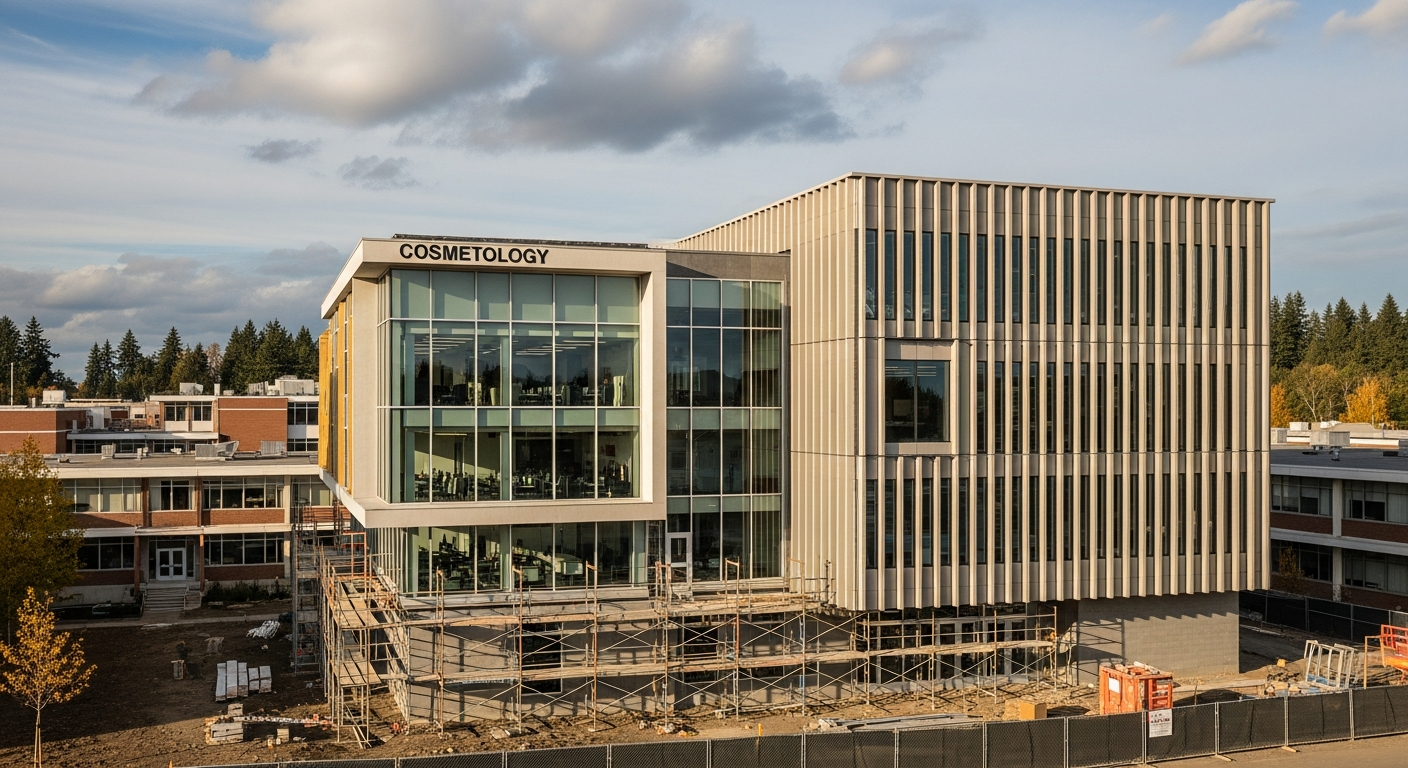
Tag: Cosmetology Program

  • For Everett Community College Students: What the Baker Hall Redesign Means for Cosmetology, Theater, and Your 2026-2028 Plans

    For Everett Community College Students: What the Baker Hall Redesign Means for Cosmetology, Theater, and Your 2026-2028 Plans

    For Everett Community College Students: What the Baker Hall Redesign Means for Cosmetology, Theater, and Your 2026-2028 Plans

    If you are at EvCC right now, or thinking about enrolling for fall 2026, or about to apply to the cosmetology or theater programs, the Baker Hall news matters in a specific way for you. The replacement building got smaller. The 2028 opening is still on. Your programs still get the spaces they were promised. But the way the campus looks between now and winter 2028 — and the building you eventually move into — has changed.

    This is the student-and-prospective-student guide to what the redesign means and what to plan around.

    Your Programs Are Safe

    The redesign cut roughly 10,000 square feet from the original 32,000-square-foot Baker Hall plan. What got preserved through the cuts:

    The cosmetology wing. A working salon with the plumbing, ventilation, and station layout cosmetology training requires. Classrooms. Meeting spaces. Department offices. None of that came out of the design.

    The 250-seat theater. A real performance space with dressing rooms, a set-construction shop, costume storage, and the support classrooms a theater program needs. The 250-seat figure stayed.

    What was cut was slack — the circulation space, the future-flex rooms, the breathing room around the core program functions. As a student, you will probably not notice that on day one in 2028. You will notice it five or ten years later if the program grows beyond what the smaller building can hold. That is a future-EvCC problem, not a current-student problem.

    What’s Happening Until Winter 2028

    The 1962 Baker Hall has not housed students in roughly two years. That means whatever interim arrangement your program is in right now is the arrangement that continues through 2026 and most of 2027. If you are in cosmetology, you are using the current cosmetology training facilities EvCC arranged when the old Baker Hall was vacated. If you are in theater, the same applies.

    The redesign does not change those interim arrangements. It just delays demolition of the old building so the construction window aligns with the revised drawings. Demolition is now timed against the new construction schedule, not happening on the original 2025 calendar.

    What Winter 2028 Looks Like

    If you are a current EvCC cosmetology or theater student on a two-year track, winter 2028 may be after your graduation. If you are on a longer track or you transfer in for fall 2026 or fall 2027, you may be the first cohort to take classes in the new Baker Hall. That cohort gets:

    • A modern cosmetology salon with proper plumbing, ventilation, and station infrastructure
    • A 250-seat theater with proper backstage, fly space, dressing rooms, and set-construction support
    • Classrooms designed around current teaching models, not 1962 teaching models
    • A building meeting current seismic, accessibility, and mechanical standards

    Those are real upgrades over what either program could ever deliver inside a 64-year-old building.

    What the Redesign Means If You’re Choosing EvCC

    If you are deciding whether to enroll at EvCC for cosmetology or theater specifically because of Baker Hall:

    The 2028 opening is on the table but not guaranteed. Public construction projects can slip. A six-month or one-year slip would not be unusual; a multi-year slip would be unusual but not impossible. Plan around winter 2028 with the understanding that fall 2028 is also possible.

    The program quality does not depend on the building. EvCC’s cosmetology and theater programs have been running through the entire Baker Hall transition. The quality of instruction is not waiting for 2028. If you start in fall 2026, you will get the program — just not in the new building.

    The smaller redesign is still a real upgrade. A 22,000-square-foot purpose-built building with a working salon and a 250-seat theater is meaningfully better than what the 1962 Baker Hall could have offered even after a renovation. The cuts removed slack, not core function.

    What to Watch For

    If you want to track the project’s progress as a student, the milestones to look for:

    • Construction documents revised and re-permitted (2026)
    • Cornerstone Construction trade-package rebids (2026)
    • Demolition of the 1962 Baker Hall
    • Foundation and shell work (2027)
    • Interior fit-out and inspections (late 2027)
    • Move-in and program opening (winter quarter 2028)

    EvCC’s facilities communications and the school’s board minutes are the most reliable sources for milestone updates as they happen.

    The Practical Takeaway

    If you are a cosmetology or theater student, the redesign is, on balance, a good outcome. The alternative — a project killed for budget — would have meant no new Baker Hall at all. The alternative — a supplemental appropriation request — would have meant a 12-18 month delay while Olympia worked through the request, with no certainty of approval. Cutting scope to keep the 2028 opening preserves the deliverable.

    The deliverable is what you actually need: a working salon for cosmetology training, a real theater for theater performance and production training, and modern classrooms for the support coursework. That is what arrives in winter 2028. Just slightly smaller than the original drawings showed.

    Frequently Asked Questions

    Does the Baker Hall redesign change EvCC’s cosmetology program?

    No. The cosmetology wing, including the working salon, was preserved through the redesign. The program continues as currently arranged through 2027 and moves into the new building in winter quarter 2028.

    Is EvCC’s theater program still getting a 250-seat theater?

    Yes. The 250-seat theater, dressing rooms, set-construction shop, and costume storage all survived the redesign.

    When does the new Baker Hall open for classes?

    Winter quarter 2028 is the current target. Demolition of the 1962 Baker Hall has been aligned with the revised construction window.

    What is happening to my program until winter 2028?

    The 1962 Baker Hall has not housed students for roughly two years, so program arrangements that have been in place since the building was vacated continue through the construction window. The redesign does not change those interim arrangements.

    Is the new Baker Hall smaller because EvCC is shrinking the program?

    No. The 10,000-square-foot reduction came from circulation space, flex space, and support functions — not from program-critical spaces. The cosmetology salon, the 250-seat theater, and the supporting classrooms were preserved at full scope.

    Could the 2028 opening still slip?

    Yes. Public construction projects can hit permit, supply, or labor delays. A short slip is not unusual; a multi-year slip would be unusual. Students should plan around winter 2028 with awareness that fall 2028 is possible.

    Will the new building be more accessible than the 1962 Baker Hall?

    Yes. New campus construction in Washington must meet current ADA and accessibility standards. The 1962 building was designed before those standards existed and would have required near-complete reconstruction to comply.


    Related Exploring Everett coverage:


  • Everett Community College’s $38 Million Baker Hall Replacement: The Complete 2026 Guide to the Redesign, the Programs, and the Winter 2028 Opening

    Everett Community College’s $38 Million Baker Hall Replacement: The Complete 2026 Guide to the Redesign, the Programs, and the Winter 2028 Opening

    Everett Community College’s $38 Million Baker Hall Replacement: The Complete 2026 Guide to the Redesign, the Programs, and the Winter 2028 Opening

    Most college construction stories that hit a budget wall get smaller, slower, or quieter. Everett Community College’s Baker Hall replacement just hit the wall — and the result is a campus project that got smaller, kept its core programs, kept its 2028 opening, and is more useful as a case study for state-funded capital construction in 2026 than a typical campus building update would be.

    Here is the complete 2026 guide to what is happening at Baker Hall: the $37.9 million project, what got cut, what survived, why the schedule still works, and what the building means for EvCC students, the cosmetology program, the theater program, and the surrounding waterfront-adjacent campus footprint.

    What Just Changed

    EvCC paused the Baker Hall rebuild and shrank the planned new building by about 10,000 square feet, citing rising construction costs. The original design called for 32,000 square feet. The revised version comes in at roughly 22,000 square feet — a third smaller.

    What did not get cut: the core program elements. The new Baker Hall still includes:

    • A dedicated cosmetology wing — including a working salon, classrooms, meeting spaces, and offices for the cosmetology department
    • A 250-seat theater with dressing rooms, a set-construction shop, and costume storage
    • Additional classroom space layered around those two anchors

    What got cut, in plain terms, is the slack. The square footage that allowed flex space, larger circulation areas, and room to grow programs into the building over the next decade — that is the part that gave way to the budget math. The bones of the program survive. The breathing room around them does not.

    The 2028 Target Is Still On

    Even with the redesign, EvCC is aiming for a winter quarter 2028 opening. That is the operational target the school is working toward right now. Demolition of the existing 1962 Baker Hall — which has not seen students in roughly two years — has been delayed to align with the revised construction window, but the timeline to having students in the new space has not slipped beyond winter 2028.

    A 2028 opening from a 2026 redesign is a real schedule. It requires:

    • Construction documents revised to the new scope
    • Permits refreshed against the revised drawings
    • Cornerstone Construction rebidding the trade packages with the smaller scope
    • Mobilization and site work in 2026
    • Foundation and shell in 2027
    • Interior fit-out and inspection in late 2027
    • Occupancy and program move-in for winter 2028 quarter

    Each of those steps has float built in, but not a lot of it. A 2028 opening is achievable; a slip to fall 2028 or beyond is not unimaginable if any of those phases hits a snag.

    The Players

    The professionals on the project:

    • Architect: McGranahan PBK, selected in February 2025
    • Contractor: Cornerstone Construction, brought on in May 2025
    • Funder: Washington State, through the 2023–25 capital budget cycle, with the $37.9 million allocation
    • Owner: Everett Community College

    That team has been in place for over a year. Keeping the architect and contractor through the redesign — instead of restarting procurement — is the move that protects the 2028 schedule. Restarting would have meant another 12-18 months easily.

    What Got Cut: The Slack, Not the Bones

    It is worth being specific about which 10,000 square feet came out of the design, because that is what determines how the building actually feels in 2028:

    Circulation space. Wider hallways, larger lobbies, more generous gathering spaces — these are the first things that get value-engineered when costs rise.

    Flex and growth space. The original design likely included shell space — built but unfinished rooms ready to be assigned to whatever program needed them in 2030 or 2032. That is one of the easier cuts because the impact is in the future, not at opening.

    Some support functions. Storage, mechanical clearance, prep areas around the theater and salon — all candidates for tightening.

    The cosmetology working salon and the 250-seat theater stayed because they are the reasons the building exists. EvCC’s cosmetology program needs salon-grade plumbing, ventilation, and station layouts that you cannot retrofit into a generic classroom. The theater program needs a real stage, a real fly system, and real backstage. Cutting those would have meant rebuilding the program around a different teaching model. The school chose to cut the slack instead.

    Why the 1962 Baker Hall Has to Go

    The existing Baker Hall opened in 1962. By 2026, that is a 64-year-old building. It has not housed students in approximately two years. Mid-twentieth-century campus buildings on the West Coast share a familiar problem set: seismic standards have moved several times since the original construction, mechanical systems are at or past end-of-useful-life, accessibility retrofits would require near-complete reconstruction, and the floor plans were designed for teaching models that no longer match how the programs operate.

    For a cosmetology program that needs salon-grade infrastructure and a theater program that needs proper stage and backstage, the 1962 building was no longer a workable home. That is why the replacement strategy got chosen over renovation in the first place.

    The Larger Construction-Cost Story

    The Baker Hall pause is one data point in a regional pattern. Construction costs across the Puget Sound have been outrunning state capital budget allocations for several budget cycles. Public-sector projects budgeted in 2023 dollars and bid in 2025 or 2026 dollars are routinely landing 15-30% over their allocations. The choices in those moments are: cut scope, get more money, or kill the project.

    EvCC chose to cut scope while preserving program. That preserves the public investment and keeps the 2028 opening on the table without going back to Olympia for a supplemental appropriation. For state-funded campus projects across Washington’s community college system, this is a useful template.

    What 2028 Looks Like for EvCC Students

    When students walk into the new Baker Hall in winter 2028, they will find a smaller building than the original plan, but a working cosmetology salon, a real 250-seat theater, and the classroom support those programs need. That is the deliverable.

    The building also fits into a larger EvCC campus context that includes the existing arts and humanities footprint, the Northshore-area campus connections, and the broader Everett Station and waterfront corridor. Baker Hall’s replacement sits in that fabric.

    Frequently Asked Questions

    What is happening with Everett Community College’s Baker Hall?

    EvCC paused and redesigned the $37.9 million Baker Hall replacement project, cutting roughly 10,000 square feet from the original 32,000-square-foot design due to rising construction costs. The cosmetology wing, 250-seat theater, and winter 2028 opening target all survived the redesign.

    Who designed and is building the new Baker Hall?

    McGranahan PBK is the architect, selected in February 2025. Cornerstone Construction is the contractor, brought on in May 2025. Both stay on the project through the redesign.

    When does the new Baker Hall open?

    Winter quarter 2028 is the current operational target. Demolition of the 1962 Baker Hall is being aligned with the revised construction window.

    Why was Baker Hall redesigned?

    Construction costs across the Puget Sound region rose between the project’s 2023 budget allocation and the 2025-26 bid environment, pushing the original design over the $37.9 million capital budget. EvCC chose to redesign at smaller scope rather than seek a supplemental appropriation or kill the project.

    What programs will the new Baker Hall house?

    The cosmetology program (with a working salon) and the theater program (with a 250-seat performance space, dressing rooms, set-construction shop, and costume storage) are the anchor tenants, plus additional classrooms.

    How big is the new Baker Hall?

    Approximately 22,000 square feet in the redesign, down from the original 32,000-square-foot plan.

    How is the project funded?

    Through Washington State’s capital budget. The $37.9 million allocation has been on the books since the 2023–25 budget cycle.

    What was wrong with the 1962 Baker Hall?

    The 64-year-old building has aging mechanical systems, outdated seismic standards, and floor plans that no longer match how the cosmetology and theater programs operate. It has not housed students in approximately two years. Replacement was chosen over renovation.


    Related Exploring Everett coverage:


  • Everett Community College’s $38M Baker Hall Replacement Just Got Smaller — Here’s What Got Cut and Why It Still Opens in 2028

    Everett Community College’s $38M Baker Hall Replacement Just Got Smaller — Here’s What Got Cut and Why It Still Opens in 2028

    Everett Community College’s $38M Baker Hall Replacement Just Got Smaller — Here’s What Got Cut and Why It Still Opens in 2028

    Q: What happened to Everett Community College’s Baker Hall replacement project?

    A: EvCC paused the long-planned $37.9 million Baker Hall rebuild and trimmed roughly 10,000 square feet from the original 32,000-square-foot design after construction-cost increases pushed the project over budget. The new building still includes a cosmetology wing with a working salon and a 250-seat theater, with McGranahan PBK as architect, Cornerstone Construction as contractor, and a target opening of winter quarter 2028.

    We’re going to write about a building that didn’t break ground this spring — because the story of why it didn’t, and what got changed before the next attempt, is more useful than we’d usually expect from a delayed campus project.

    Everett Community College’s Baker Hall replacement has been on the drawing board for years. It’s the building that’s supposed to give the cosmetology program a real home, fold the school’s theater program into a properly sized stage, and finally pull a building from 1962 — one that hasn’t seen students in roughly two years — out of EvCC’s footprint. The $37.9 million capital allocation has been on the books since the 2023–25 state budget cycle. The architect, McGranahan PBK, was selected back in February 2025. Cornerstone Construction came on as contractor in May 2025.

    And then construction-cost reality showed up.

    What Just Changed

    EvCC pushed back the Baker Hall rebuild and shrank the planned new building by about 10,000 square feet, citing rising construction costs. The original design was 32,000 square feet. Roughly a third of that is gone in the revised version.

    What didn’t get cut: the core program elements. The new Baker Hall still has the dedicated cosmetology wing — including a working salon, classrooms, meeting spaces, and offices for the cosmetology department — and it still includes a 250-seat theater with dressing rooms, a set-construction shop, costume storage, and additional classroom space. The bones of the program survive.

    What got cut, in plain terms, is the slack. The square footage that allowed flex space, larger circulation, room to grow programs into the building — that’s the part that gave way to the budget math.

    The 2028 Target Is Still On

    Even with the redesign, EvCC is aiming for a winter quarter 2028 opening. That’s the operational target the school is working toward right now. Demolition of the existing 1962 Baker Hall has been delayed to align with the revised construction window, but the timeline to having students in the new space hasn’t slipped beyond winter 2028.

    A 2028 opening from a 2026 redesign is a real schedule. Construction documents have to be revised, permits have to refresh, and Cornerstone has to rebid the trade packages with the new scope. Every one of those steps takes weeks or months. The fact that the target hasn’t moved suggests EvCC and the design-build team are treating the cuts as additive — make the building smaller, keep everything else moving — rather than reopening the design from zero.

    Why This Matters Beyond EvCC

    Three reasons this story matters even if you’re not enrolled in cosmetology or trying out for a play.

    First, it’s the construction-cost story you can actually see. Everett has a lot of large public projects in motion right now — the Edgewater Bridge ($34M, just opened), the West Marine View Drive pipeline ($113M, approved April 2), the Broadway pedestrian bridge ($3.1M for design, future construction vote separate), the downtown stadium ($10.6M for design, $120M total). Most of those projects’ cost numbers have only one direction they’re moving. Baker Hall is the same pressure showing up at a single, well-defined building you can drive past.

    Second, the cosmetology program is one of EvCC’s most direct workforce connections. The school’s cosmetology students earn the cosmetology, esthetics, and barbering hours required for state licensure. Snohomish County’s salon and beauty industry hires from those programs directly. A delayed building doesn’t pause licensure — students continue in the existing program space — but it does delay the full-scale, properly equipped salon environment the program has been planning for.

    Third, the 250-seat theater fills a gap downtown can feel. The Historic Everett Theatre, the Schack Art Center’s gallery space, and Tony V’s Garage all carry different parts of Everett’s performance ecosystem. A 250-seat campus theater isn’t a competitor to any of them — it’s a teaching venue with sufficient capacity to host community-facing student productions and small touring acts. EvCC’s theater program has been working in compromised spaces for years.

    The Architect and the Contractor

    McGranahan PBK was selected as the project architect in February 2025. The firm — known for educational and civic work across the Pacific Northwest — has experience designing buildings that combine vocational program space with performance venues, which is exactly what Baker Hall asks for.

    Cornerstone Construction joined as contractor in May 2025. Cornerstone has done multiple state-funded community college projects in Washington and is comfortable working under the procurement and reporting requirements that come with state capital dollars.

    Both firms are still on the project under the revised scope. EvCC didn’t restart the procurement; it asked the existing team to revise the design to fit the budget envelope.

    The Money Trail

    The $37.9 million construction allocation comes from the state’s 2023–25 capital budget cycle, channeled through the State Board for Community and Technical Colleges. That’s the standard funding path for community college capital projects in Washington — the legislature appropriates the money, the SBCTC tracks the spend, and the individual college runs the project.

    The fact that the cost increases pushed the project to a redesign rather than a request for additional state funding tells you something about where the legislature is on supplementary capital appropriations right now. EvCC made the call to descope rather than ask for more — at least for this round.

    If construction costs continue to climb between now and the next bid window, that math may revisit itself. For now, the project is sized to fit what’s actually in the bank.

    What Happens Between Now and 2028

    Here’s the practical sequence to watch.

    Mid-to-late 2026: Revised construction documents wrap, with the smaller building footprint and the locked-in program elements. Cornerstone re-engages the trade subcontractors to rebid the work at the new scope. Permitting through the City of Everett refreshes for the revised plans.

    Late 2026 or early 2027: Demolition of the existing 1962 Baker Hall, which has been sitting unused for about two years already. This is the most visible moment of the project — the old building comes down, the site clears, foundations start.

    2027: Active construction on the new building. This is the stretch where the cost-control discipline applied in the redesign either holds or doesn’t. Watch for change orders.

    Winter quarter 2028 (early January through mid-March 2028): Target opening to students. Cosmetology classes move into the new salon space. The theater program books its first student production in the new house.

    That’s the plan as it stands today.

    What This Doesn’t Solve

    Two things the redesign doesn’t fix.

    It doesn’t add classroom capacity to the broader campus. The original 32,000 square feet would have given EvCC a meaningful chunk of net new instructional space across multiple programs. The trimmed version brings the cosmetology program and the theater program into modern facilities but doesn’t relieve the pressure on the rest of the campus the way the original scope would have. EvCC’s enrollment recovery from the pandemic has been steady — students need space.

    It doesn’t accelerate the 1962 building’s demolition. Old Baker Hall sits, empty, on prime east-of-Broadway campus real estate. Until demolition starts, that footprint is just waiting. The redesign keeps demolition on the same general timeline rather than pulling it forward.

    Both of those are conversations for the next state capital budget cycle, when EvCC will have data from the revised build to inform the next ask.

    The Bigger Everett Picture

    The Baker Hall delay is a single project on a single campus, but it lands in a pattern. Across Everett, large public projects are running into the same pressure: design starts at one number, construction comes in higher, the response is either find more money or descope. The Edgewater Bridge held its number through completion. The downtown stadium has been wrestling with its $120M total versus the available funding. The Broadway pedestrian bridge hasn’t gotten to construction bidding yet but the design contract alone is $3.1M.

    What EvCC chose to do with Baker Hall — pause, descope, keep the team, hold the timeline — is one of the more disciplined responses to construction-cost pressure we’ve watched a public project in Snohomish County execute. It’s worth noting because the temptation when a budget breaks is to either ask for more or kill the project. EvCC did neither. The smaller Baker Hall still gets built. The cosmetology students still get a salon. The theater program still gets a 250-seat house.

    That’s not nothing. It’s a building, smaller than originally planned, on its original timeline.

    Frequently Asked Questions

    Q: When will Everett Community College’s new Baker Hall open?

    A: EvCC is targeting winter quarter 2028 — early January through mid-March 2028 — for the new Baker Hall to open to students.

    Q: How much was cut from the Baker Hall replacement design?

    A: Approximately 10,000 square feet was removed from the original 32,000-square-foot design after construction costs rose, leaving a smaller building that still contains the planned cosmetology wing and 250-seat theater.

    Q: How much does the EvCC Baker Hall replacement cost?

    A: The project carries about $37.9 million in construction funding from Washington’s 2023–25 state capital budget, channeled through the State Board for Community and Technical Colleges.

    Q: Who is the architect for EvCC’s Baker Hall?

    A: McGranahan PBK was selected as the project architect in February 2025 and remains on the project under the revised scope.

    Q: Who is the contractor for the Baker Hall replacement?

    A: Cornerstone Construction was selected as the contractor in May 2025 and continues with the project after the redesign.

    Q: What programs will the new Baker Hall house?

    A: A dedicated cosmetology wing — including a working salon, classrooms, meeting spaces, and offices — plus a 250-seat theater with dressing rooms, a set-construction shop, costume storage, and additional classroom space.

    Q: Why did EvCC delay the Baker Hall project?

    A: Rising construction costs across the Pacific Northwest pushed the project over its $37.9 million budget. EvCC chose to pause and redesign rather than request additional state funding, descoping the building by about 10,000 square feet to fit the existing allocation.

    Q: When will the existing 1962 Baker Hall be demolished?

    A: Demolition has been delayed to align with the revised construction window. Current sequencing puts demolition in late 2026 or early 2027, ahead of new construction running through 2027 and into early 2028.

    Deeper coverage on this story: