
Last refreshed: August 2026
GEO — Generative Engine Optimization — is the practice of structuring content so that AI answer engines (ChatGPT, Perplexity, Google AI Overviews, Gemini, and Claude) cite it in the answers they generate. In 2026, 68% of U.S. Google searches end without a click. Being cited in the answer that appears is now as important as ranking in the links below it.
This guide covers what GEO is, how it differs from traditional SEO, and five specific tactics that move citation rates — with particular relevance for sites publishing Claude and AI authority content.
Why GEO Matters in 2026

AI Overviews reduce organic click-through rate for the #1 ranked result by up to 58% (Ahrefs, December 2025) — but brands cited as sources within AI Overviews earn 35% more organic clicks than uncited brands on the same query.
The counterintuitive finding: zero-click is bad for uncited sites and good for cited ones. The goal is not to fight AI Overviews — it’s to be inside them.
The market data context:
- 68% of U.S. Google searches are zero-click in 2026, up from 60% in 2024
- When AI Overviews appear, the zero-click rate jumps to 83%
- Visitors arriving from AI citations convert at 4.4x the rate of traditional organic visitors
- The GEO market is projected at $365M in 2026, growing at 42.9% CAGR
The mechanism: AI search users arrive with specific, researched queries and a pre-formed shortlist. That intent profile makes them higher-converting even when the total count is smaller.
How GEO Differs From Traditional SEO
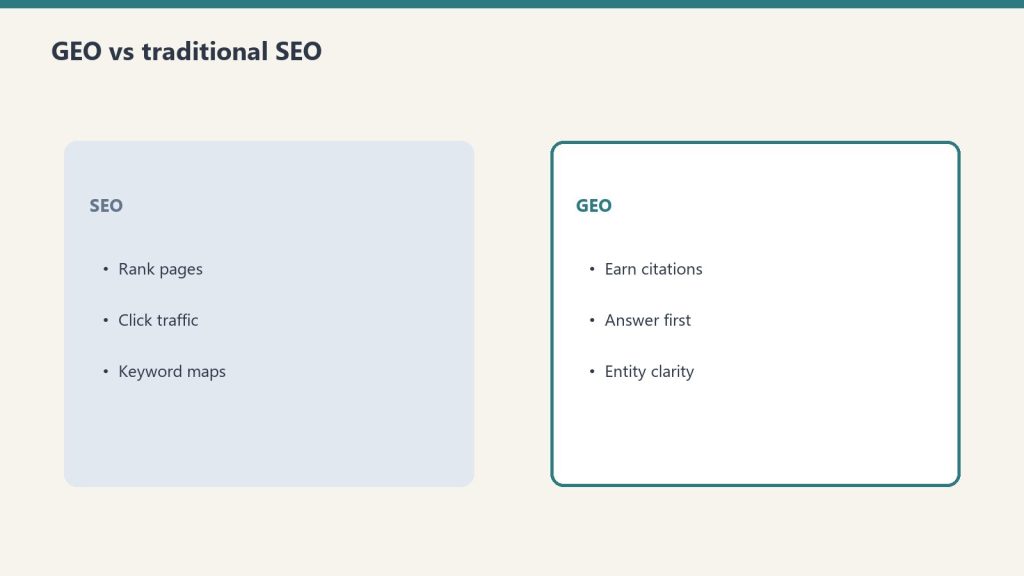
Traditional SEO optimizes for ranking position in a list of links. GEO optimizes for inclusion in the synthesized answer above those links. The signals overlap significantly, but GEO adds specific requirements around answer-first structure, data richness, and citation-friendliness.
| Dimension | Traditional SEO | GEO |
|---|---|---|
| Goal | Rank in top 10 | Be cited in the AI answer |
| Key signal | Backlinks, E-E-A-T, technical SEO | Answer-first structure, data richness, entity authority |
| Measurement | Organic clicks, ranking position | AI citation rate, brand mentions, branded search volume |
| Content structure | Topic depth, keyword distribution | Direct answer in first 200 words, FAQ schema |
| Success state | Position 1 | Cited source in AI Overview |
Important: the overlap between ranking in Google’s top 10 and being cited in AI Overviews collapsed from roughly 75% in mid-2025 to 17–38% in early 2026. Ranking well no longer guarantees AI citation. Both need to be optimized for separately.
Tactic 1: Answer First, Always

AI retrieval systems that use real-time web access evaluate a page’s relevance primarily on its opening content. The first 200 words of any article must directly and completely answer the primary query — not build up to the answer.
The structure that gets cited:
[H1 Title]
[Bold one-sentence direct answer in first paragraph]
[Supporting context and detail]
The structure that doesn’t:
[H1 Title]
[Background context]
[History of the topic]
[Eventually getting to the answer]
AI Overviews synthesize their answers from the opening of retrieved pages. A page that buries its answer 500 words in gets retrieved for its topic relevance and then can’t be cited because the direct answer isn’t extractable. The answer-first structure serves both GEO and usability simultaneously.
For AI authority content specifically: every article about a Claude feature, pricing tier, or model capability should open with the factual answer to the likely query, stated plainly in the first sentence or two.
Tactic 2: Add Original Data and Specific Numbers
AI systems and search engines treat original data, specific statistics, and citable figures as high-value content. Content with precise numbers gets cited more than content with generalizations.
The practical application:
- “Claude Enterprise typically costs $60–250+/user/month depending on usage intensity” is more citable than “Claude Enterprise is expensive for some teams”
- “68% of U.S. Google searches are zero-click in 2026” is citable; “most searches end without a click” is not
- “Claude Sonnet scores approximately 77% on SWE-bench Verified” is citable; “Claude is good at coding” is not
For tygartmedia.com content specifically: articles that include specific pricing numbers, benchmark scores, token counts, and performance figures will outperform articles that describe capabilities in qualitative terms. The Claude reference cluster (pricing, models, console) already does this well.
Attribution rule: Cite where specific numbers came from — a benchmark, a study, Anthropic’s official documentation. “According to Anthropic’s pricing page” or “per SWE-bench Verified benchmarks” tells AI systems the claim is grounded, not asserted.
Tactic 3: Use FAQ Schema
FAQ schema (FAQPage structured data) formats content explicitly as question-and-answer pairs, which is the format AI answer engines are built to extract and synthesize from. Pages with FAQ schema see measurably higher AI Overview inclusion.
Implementation in JSON-LD:
<script type="application/ld+json">
{
  "@context": "https://schema.org",
  "@type": "FAQPage",
  "mainEntity": [
    {
      "@type": "Question",
      "name": "What is Claude Enterprise pricing?",
      "acceptedAnswer": {
        "@type": "Answer",
        "text": "Claude Enterprise starts at approximately $20/user/month for access, with token usage billed separately at API rates. Real total cost typically runs $60–250+/user/month depending on usage intensity."
      }
    },
    {
      "@type": "Question",
      "name": "Is Claude Enterprise worth it?",
      "acceptedAnswer": {
        "@type": "Answer",
        "text": "For teams with compliance mandates (SSO, SCIM, audit logs) or more than 150 users, yes. For smaller teams without governance requirements, Claude Team is more predictable and usually sufficient."
      }
    }
  ]
}
</script>
In Rank Math (the plugin on tygartmedia.com): FAQ blocks in the WordPress editor automatically generate FAQPage schema without manual JSON-LD implementation. Add FAQ sections to every article and use the Rank Math FAQ block type.
Tactic 4: Build Entity Authority
AI systems and search engines treat entities — specific named things with consistent, verifiable information across the web — as more citable than generic topical content. Building entity authority for tygartmedia.com means consistent name, description, and factual claims across every surface the crawlers read.
Entity authority checklist:
- Organization schema on every page: Name, URL, description, logo, founder, same-as links to LinkedIn, social profiles
- Consistent author byline: “Will Tygart” as the author on every article, with a consistent bio that establishes expertise
- External mentions: Being cited by other authoritative sites on the same topics creates the external validation AI systems look for
- Wikipedia/Wikidata presence: Not always achievable, but having factually consistent information across third-party sites (LinkedIn, Crunchbase, social profiles) strengthens entity recognition
For an AI authority site specifically: the entity is “Tygart Media” and its associated expertise is Claude, Anthropic, and AI infrastructure for operators. Every article that earns an external link or citation strengthens that entity signal for all related queries.
Tactic 5: Freshness Signals
AI retrieval systems weight recency heavily for fast-moving topics. Claude pricing, model capabilities, and Anthropic’s roadmap change frequently. Articles with stale information get displaced by fresher sources even when the URL has more backlink authority.
Freshness tactics:
- “Last refreshed” date at the top of every article — signals to both users and crawlers that the information is current
- Add a “What’s new” or “What changed” section for evergreen articles that cover frequently updated topics
- Update timestamps when content changes — not just publishing dates, but explicit refreshed dates
- Track in Google Search Console which queries trigger AI Overviews and whether the site is cited in them — freshness issues often show up as sudden drops in AI citation before they show up as ranking drops
For Claude-related content: any article covering pricing, models, or features needs a refresh trigger whenever Anthropic makes changes. The May 2026 dispatch for timestamp refreshes on Fable 5-related pricing content is the right pattern.
Measuring GEO Performance
Standard GA4 and Search Console metrics don’t capture AI citation performance. The metrics that matter for GEO are AI citation rate, branded search volume, and assisted conversions from AI-referred traffic.
What to track:
| Metric | How to measure | What it indicates |
|---|---|---|
| AI-referred traffic | GA4 source filter for ChatGPT, Perplexity referrals | Direct AI citation traffic |
| Branded search volume | Google Search Console, “tygartmedia” queries | Brand awareness from AI citations |
| AI Overview appearances | GSC AIO report | Queries where the site is cited |
| CTR on AIO queries | GSC, filter by queries with AI Overviews | Whether citations drive clicks |
| Conversion rate from AI referrals | GA4 segmented by source | Value of AI citation traffic |
Manual testing: monthly, ask ChatGPT, Perplexity, and Claude the questions your audience asks — “what is Claude Enterprise pricing,” “how does Metricool API work,” “what is Anthropic’s history” — and see whether tygartmedia.com is cited. This is the most direct GEO feedback loop available.
Related on Tygart Media: how to use Claude · Anthropic API key.
Frequently Asked Questions
What is Generative Engine Optimization (GEO)?
GEO is the practice of structuring content and managing online presence so that AI answer engines — ChatGPT, Perplexity, Google AI Overviews, Gemini, and Claude — cite it in the answers they generate. It’s distinct from traditional SEO, which optimizes for ranking positions in link lists.
How is GEO different from SEO?
Traditional SEO optimizes for ranking position. GEO optimizes for citation inside AI-generated answers. The overlap between top-10 rankings and AI Overview citations has collapsed from 75% in 2025 to 17–38% in early 2026 — ranking well no longer guarantees AI citation. Both need to be optimized independently.
Does GEO replace SEO?
No. Traditional SEO fundamentals (E-E-A-T, backlinks, technical health) still power AI citations. GEO is an additional layer on top of a solid SEO foundation, not a replacement for it. Brands that excel at GEO in 2026 typically have strong traditional SEO as well.
How long does GEO take to work?
Plan for 3–6 months of consistent effort before seeing meaningful citation rate changes. Unlike traditional SEO ranking changes, which can be tracked daily, AI citation frequency changes slowly as crawlers re-index updated content and AI systems update their knowledge bases.
What is the conversion rate from AI-cited traffic?
AI search visitors convert at significantly higher rates than traditional organic visitors — roughly 4.4x according to Semrush data. The mechanism is intent: AI search users arrive with specific, researched queries and a pre-formed shortlist, which translates to higher purchase and contact intent.
What to Read Next
Claude AI Pricing — All Plans and API Rates
Anthropic Console: API Keys and the Workbench
Current Claude Model Version Tracker
Visual summary

About this image. This image is part of the Article Hero Images collection in the Tygart Media visual library. Every image produced by Tygart Media is AI-generated using Google Vertex AI (Imagen), converted to WebP format, and injected with full IPTC/XMP metadata before publication.
- Format: WEBP
- Collection: Article Hero Images
- Pipeline: Vertex AI Imagen → WebP → IPTC/XMP → WordPress