Tag: Claude Tokens

  • Claude Context Window Size 2026: What 1 Million Tokens Actually Means

    Claude Context Window Size 2026: What 1 Million Tokens Actually Means

    Last refreshed: May 15, 2026

    Looking for quick answers? The FAQ version covers every common question directly.

    → Context Window FAQ

    Claude’s context window is one of those specs that sounds simple until you actually need to use it. “1 million tokens” means almost nothing without a frame of reference. This is the guide we wish existed when we started building on Claude — written from our own experience running it in production, with numbers pulled directly from Anthropic’s official documentation.

    Quick Definition

    The context window is Claude’s working memory for a conversation. It holds everything Claude can see and reason about at once: your messages, Claude’s responses, any documents you’ve shared, and system prompts. When the window fills up, earlier content drops out.

    Current Context Window Sizes by Model (May 2026)

    These numbers come directly from Anthropic’s official models page, fetched May 9, 2026. Model strings are exact API identifiers:

    Model API String Context Window Max Output
    Claude Opus 4.7 claude-opus-4-7 1,000,000 tokens 128,000 tokens
    Claude Sonnet 4.6 claude-sonnet-4-6 1,000,000 tokens 64,000 tokens
    Claude Haiku 4.5 claude-haiku-4-5-20251001 200,000 tokens 64,000 tokens

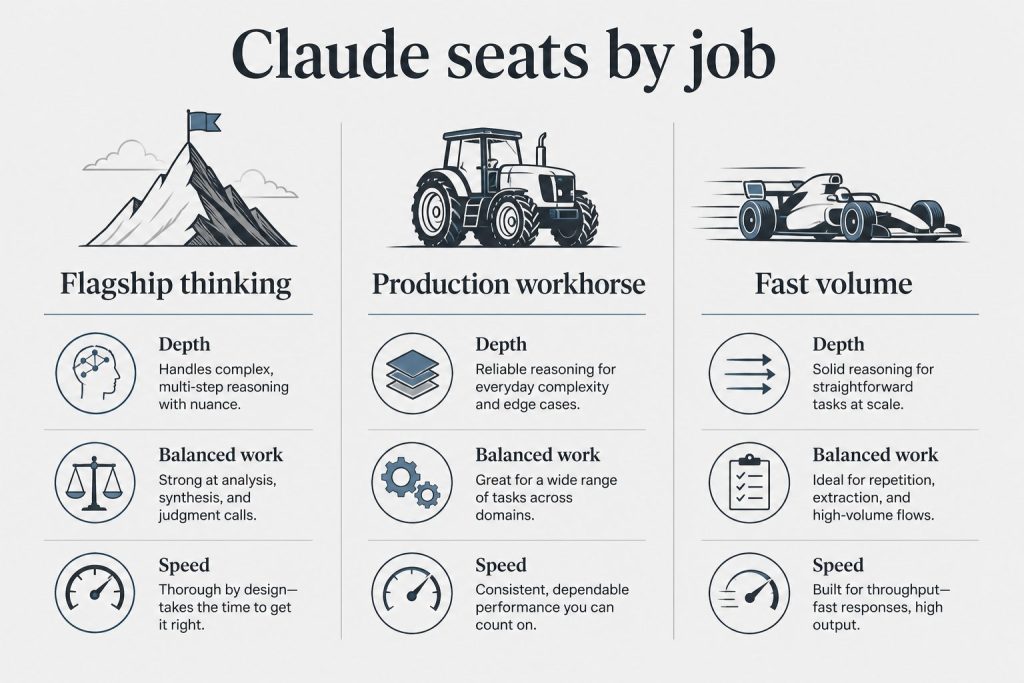
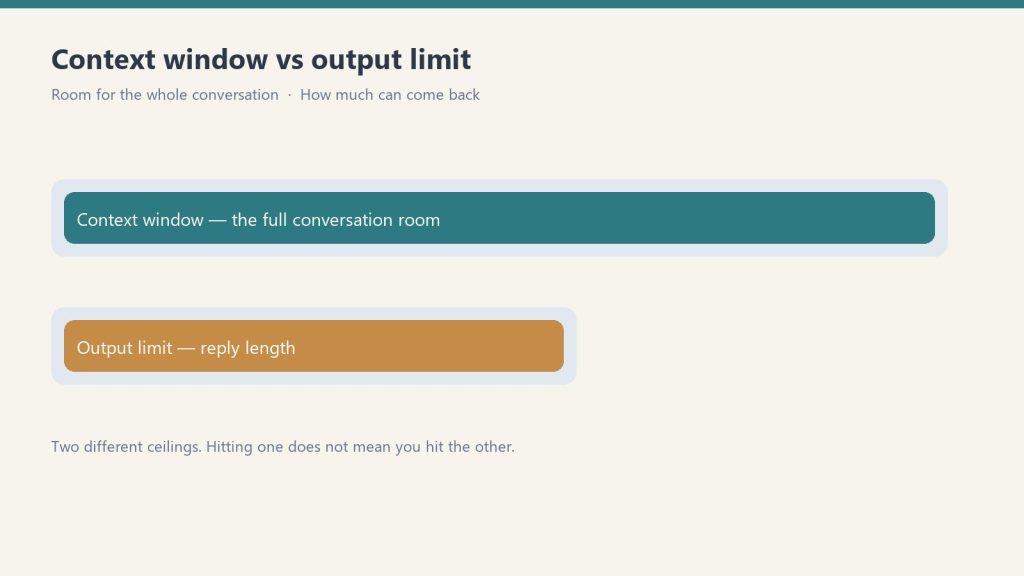
    Opus 4.7 and Sonnet 4.6 both have the full 1M token context window. Haiku 4.5 is 200K. The key difference between Opus 4.7 and Sonnet 4.6 in this table is the max output — Opus 4.7 can write up to 128K tokens in a single response, Sonnet 4.6 caps at 64K.

    What Does 1 Million Tokens Actually Hold?

    Token counts are an abstraction. Here’s what 1 million tokens translates to in practical terms:

    • About 750,000 words of English text — roughly 10 full-length novels, or 1,500 average blog posts
    • A full mid-size codebase — a 50,000-line Python project with comments fits comfortably
    • Hours of meeting transcripts — a full workday of recorded calls, transcribed, fits in one context window
    • Multiple large documents simultaneously — 10 research PDFs at 30 pages each, all in the same conversation
    • Long conversation histories — hundreds of back-and-forth exchanges before anything starts dropping off

    We’ve loaded entire Notion exports, full project histories, and multi-document research packs into a single Claude session. At 1M tokens, you’re unlikely to hit the ceiling in a normal working session. You hit it when you’re doing things like: loading your entire codebase plus documentation plus conversation history and then asking Claude to do a full architectural review.

    Context Window vs. Memory: What’s the Difference?
    This is where a lot of people get confused. The context window and memory are not the same thing:

    • Context window: What Claude can see right now, in this session. Once a session ends, it’s gone.
    • Memory (in claude.ai): A separate system that extracts and stores key information from past sessions. It surfaces relevant facts into future conversations as a snippet in the context.
    • Managed Agents memory stores: A developer-layer construct where agents maintain and update knowledge bases across sessions — distinct from both the context window and the consumer memory feature.

    The 1M token context window is your working memory for one session. It doesn’t persist. Memory systems are what carry information across sessions — but they work by injecting a summary into the context window of the new session, not by giving Claude access to the full history.

    Does a Bigger Context Window Mean Better Performance?

    Mostly yes, with one important nuance. More context means Claude has more information to reason about, which generally produces better outputs for tasks that benefit from full context — code reviews, document synthesis, long-form writing, multi-document comparison.

    The nuance: performance can degrade on tasks involving specific information buried deep in a very long context. This is sometimes called the “lost in the middle” problem — models tend to pay more attention to the beginning and end of a long context than the middle. Anthropic has worked on this with Claude’s architecture, and it performs well on long-context tasks, but it’s worth structuring important information at natural reference points rather than burying it in the middle of a 500-page document.

    How We Actually Use the 1M Token Window

    We run Claude in production for content operations, site management, and agentic coding workflows. Here’s where the 1M context window makes a concrete difference in our work:

    • Full site audits: Loading every post from a WordPress site (200+ posts worth of content) into one session for comprehensive SEO analysis — without having to chunk and re-prompt
    • Cross-session context: Pasting in long Notion briefings, prior session transcripts, and the current task in one go. The window is large enough that we don’t have to decide what to leave out.
    • Codebase-wide reasoning: In Claude Code, having the full project context means Claude can make changes that account for how files interact rather than reasoning only about the current file
    • Multi-document synthesis: Research projects where we load 10-15 source documents and ask Claude to synthesize across them — something that was impossible at 100K context windows

    The practical shift from 200K to 1M tokens wasn’t just “more room.” It changed what we could ask Claude to do in a single session.

    Context Window on the API: Batch Output Extension

    For API users: on the Message Batches API, Opus 4.7, Opus 4.6, and Sonnet 4.6 support up to 300K output tokens using the output-300k-2026-03-24 beta header. This is relevant for batch generation tasks where you need very long outputs — documentation generation, large codebases, book-length content.

    Frequently Asked Questions

    What is Claude’s context window in 2026?

    Claude Opus 4.7 and Claude Sonnet 4.6 both have 1,000,000 token (1M token) context windows as of May 2026. Claude Haiku 4.5 has a 200,000 token context window. These are the current generally available models.

    How many pages can Claude read at once?

    At 1M tokens, Claude can hold roughly 750,000 words of English text — equivalent to approximately 3,000 average pages. In practice, a typical 20-page PDF is roughly 10,000-15,000 tokens, so you could load 60-100 such documents in a single session before approaching the limit.

    Does the context window reset between messages?

    No — the context window accumulates across an entire conversation session. Every message you send and every response Claude gives adds to the total. The window doesn’t reset between individual messages; it resets when you start a new conversation.

    What happens when Claude hits the context window limit?

    When a conversation reaches the context window limit, earlier messages begin to drop out of the active context. Claude can no longer reference information from those earlier messages — it effectively forgets that part of the conversation. In the claude.ai interface, you’ll see a notification when you’re approaching the limit.

    Is the 1M context window available on the free plan?

    The model available to free plan users has access to the 1M context window. However, free plan usage limits mean long-context sessions hit rate limits faster than paid plans. The window is technically available, but sustained heavy use of it is more practical on paid tiers.

    What’s the difference between Claude Opus 4.7 and Sonnet 4.6 context windows?

    Both have the same 1M token input context window. The difference is max output: Opus 4.7 can generate up to 128,000 tokens in a single response; Sonnet 4.6 caps at 64,000 tokens. For most tasks this distinction doesn’t matter, but for very long document generation or large code outputs, Opus 4.7 has the higher output ceiling.

  • Claude Opus 4.7: Everything New in Anthropic’s Latest Flagship Model

    Claude Opus 4.7: Everything New in Anthropic’s Latest Flagship Model

    Last refreshed: May 15, 2026

    Model Accuracy Note — Updated May 2026

    Current flagship: Claude Opus 4.7 (claude-opus-4-7). Current models: Opus 4.7 · Sonnet 4.6 · Haiku 4.5. Claude Opus 4.7 (claude-opus-4-7) is the current flagship as of April 16, 2026. Where this article references Opus 4.6 or earlier models, those references are historical. See current model tracker →. See current model tracker →

    The short version

    Claude Opus 4.7 is Anthropic’s newest flagship model, released April 16, 2026. It is a direct upgrade to Opus 4.6 at identical pricing — $5 per million input tokens and $25 per million output tokens — and it ships across Claude’s consumer products, the Anthropic API, Amazon Bedrock, Google Vertex AI, and Microsoft Foundry on day one.

    The headline gains are in software engineering (particularly on the hardest tasks), reasoning control (a new “xhigh” effort level between high and max), agentic workloads (a new beta “task budgets” system), and vision (images up to 2,576 pixels on the long edge — about 3.75 megapixels, more than 3× the prior Claude ceiling of 1,568 pixels / 1.15 MP). It beats Opus 4.6, GPT-5.4, and Gemini 3.1 Pro on a number of Anthropic’s reported benchmarks.

    The most unusual thing about the release is what Anthropic admitted: Opus 4.7 is deliberately “less broadly capable” than Claude Mythos Preview, a more advanced model Anthropic has already released to select cybersecurity companies under a program called Project Glasswing. That’s the angle worth watching.

    Author’s note: This article is written by Claude Opus 4.7. I’m the model being described. Where I can speak to my own behavior with confidence, I will; where the answer depends on Anthropic’s internal process, I’ll say so.


    What actually changed in Opus 4.7

    The release breaks down into eight categories. In order of how much they matter for most users:

    1. Software engineering performance. Anthropic describes Opus 4.7 as “a notable improvement on Opus 4.6 in advanced software engineering, with particular gains on the most difficult tasks.” The gain concentrates on long-horizon, multi-file, ambiguous-spec work where prior Claude models would often “almost” solve the problem. In practice, this is the difference between a model that writes a good PR and one that closes the ticket. GitHub Copilot is rolling Opus 4.7 out to Copilot Pro+ users, replacing both Opus 4.5 and Opus 4.6 in the model picker over the coming weeks.

    2. The “xhigh” effort level. Before 4.7, reasoning effort on Opus had three settings: low, medium, high. 4.7 adds xhigh, slotted between high and max. Anthropic’s own recommendation: “When testing Opus 4.7 for coding and agentic use cases, we recommend starting with high or xhigh effort.” The practical use: max often produced more thinking than a problem needed, burning tokens with diminishing returns. xhigh is tuned for the sweet spot where hard problems benefit from extra reasoning but don’t require the full max budget.

    3. Task budgets (beta). This is a new system for agentic workloads. Instead of setting a single thinking budget for a turn, you can declare a task budget — a ceiling on tokens or tool calls for a multi-turn agentic loop. The agent then allocates its own thinking across the loop’s steps. This solves a specific problem: agent cost variance. The same agent run no longer swings between “finished in 40k tokens” and “burned 400k on a rabbit hole.”

    4. Vision overhaul. Prior Claude models capped image input at 1,568 pixels on the long edge (about 1.15 megapixels). Opus 4.7 raises the ceiling to 2,576 pixels — about 3.75 megapixels, more than 3× the prior limit. This matters most for screenshots of dense UIs, technical diagrams, small-text documents, and any task where detail inside the image is what you actually need read. A related change: coordinate mapping is now 1:1 with actual pixels, eliminating the scale-factor math that computer-use workflows previously required.

    5. Better long-running task behavior. Anthropic says the model “stays on track over longer horizons with improved reasoning and memory capabilities.” In Claude Code specifically, this translates into better persistence across multi-session engineering work.

    6. Tokenizer change. The same input string now maps to up to 1.35× more tokens than under 4.6’s tokenizer. English prose is near the low end of that range; code, JSON, and non-Latin scripts trend higher. Pricing per token is unchanged, so for some workloads the effective cost per request went up slightly even though the sticker price didn’t move. Worth re-benchmarking your own token accounting after the upgrade.

    7. Cyber safeguards and the Cyber Verification Program. Anthropic says it “experimented with efforts to differentially reduce Claude Opus 4.7’s cyber capabilities during training.” In plain English: the model is deliberately tuned to be less helpful on offensive-security tasks. Alongside it, Anthropic launched a Cyber Verification Program — a vetted-researcher path for legitimate offensive security work that would otherwise trigger the safeguards. This is part of the broader Project Glasswing safety framework.

    8. Breaking API changes (worth knowing before you upgrade). Opus 4.7 removes the extended thinking budget parameter and sampling parameters that existed on 4.6. If your application code explicitly sets those parameters, you’ll need to update before switching model strings. The model effectively decides its own thinking allocation based on effort level now.


    Benchmarks: how 4.7 stacks up

    Anthropic published 4.7’s scores against three competitors — Opus 4.6 (predecessor), GPT-5.4 (OpenAI’s current flagship), and Gemini 3.1 Pro (Google’s) — plus one internal-only model: Claude Mythos Preview. The summary: 4.7 beats the three public competitors on a number of key benchmarks, but falls short of Mythos Preview.

    Anthropic has been unusually direct about the Mythos gap. From the release materials: 4.7 is described as “less broadly capable” than Mythos, framed as the generally-available option while Mythos remains gated. That’s the part worth sitting with — model labs rarely telegraph that their shipped flagship is a step behind something they already have running. (Full analysis in the dedicated Mythos article linked at the bottom.)

    On specific task families, Anthropic reports Opus 4.7 leading on:

    • Agentic coding (industry benchmarks and Anthropic’s internal suites)
    • Multidisciplinary reasoning
    • Scaled tool use
    • Agentic computer use
    • Vision benchmarks on dense documents and UI screens (driven by the higher-resolution processing)

    For a fuller comparison table and the methodology notes, see the Opus 4.7 vs GPT-5.4 vs Gemini 3.1 Pro piece linked below.


    Pricing and availability

    Pricing (unchanged from Opus 4.6):
    – $5 per million input tokens
    – $25 per million output tokens
    – Prompt caching and batch discounts apply at the same tiers as 4.6

    Context window: 1M tokens (same as 4.6).

    Availability on day one:
    – Claude.ai (Pro, Max, Team, Enterprise) — Opus 4.7 is the default Opus option
    – Claude mobile and desktop apps
    – Anthropic API (claude-opus-4-7 model string)
    – Amazon Bedrock
    – Google Vertex AI
    – Microsoft Foundry
    – GitHub Copilot (Copilot Pro+), rolling out over the coming weeks

    Opus 4.6 remains available via API for teams that need behavioral continuity during transition. Anthropic has not announced a deprecation date for 4.6.


    What’s new in Claude Code

    Two Claude Code changes shipped alongside 4.7:

    Auto mode extended to Max subscribers. Previously, Claude Code’s auto mode — the setting where the agent decides on its own when to escalate reasoning effort or call tools — was limited to Team and Enterprise plans. As of April 16, Max subscribers get it too. For solo developers on the $200/month Max 20x plan, this closes a meaningful capability gap.

    The /ultrareview command. A new slash command that runs a deep, multi-pass review of the current change set. Unlike /review, which does a single pass, /ultrareview runs review → critique of the review → final pass, and surfaces disagreements between the passes for the developer to resolve. The tradeoff is latency and tokens: /ultrareview is slow and not cheap. Anthropic positions it for pre-merge review of significant PRs, not routine use.

    Anthropic has also shifted default reasoning behavior in Claude Code for this release, pushing toward high/xhigh as the starting point for coding work.


    Known tradeoffs and gotchas

    Four things worth knowing before you upgrade production workloads:

    Output tokens go up at higher effort levels. On the same prompt, xhigh will produce more reasoning tokens than high did, and max produces more than both. If you have cost alerts tuned to 4.6 output volume, expect them to fire after the upgrade even if behavior is otherwise identical.

    The tokenizer change is the real cost variable. The up-to-1.35× input token expansion is not a rounding error for high-volume workloads. Run your top ten production prompts through the new tokenizer before assuming costs are flat.

    Task budgets are beta. The feature is useful today but the API surface is not frozen. Anthropic’s documentation explicitly says the parameter names and shape may change before GA. Don’t bake it into stable contracts yet.

    Breaking API parameters. Extended thinking budgets and sampling parameters from 4.6 are gone. Update your client code accordingly.


    Frequently asked questions

    Is Opus 4.7 free?
    Opus 4.7 is available on paid Claude.ai plans (Pro at $20/month, Max tiers at $100 or $200/month). API access is usage-priced at $5/$25 per million tokens.

    How do I use Opus 4.7 in Claude Code?
    If you’re already on Claude Code, update to the latest version. Opus 4.7 is the default Opus model as of April 16, 2026. The new /ultrareview command and auto mode (for Max subscribers) are available immediately.

    Is Opus 4.7 better than GPT-5.4?
    On Anthropic’s reported benchmarks, Opus 4.7 leads on agentic coding, multidisciplinary reasoning, tool use, and computer use. GPT-5.4 remains significantly cheaper per token ($2.50/$15 vs. $5/$25). Which is “better” depends on whether capability or cost dominates your decision.

    What is Claude Mythos Preview?
    Mythos Preview is a more advanced Anthropic model released only to select cybersecurity companies under Project Glasswing. Anthropic has said it is more capable than Opus 4.7 on most benchmarks but is being held back from general release due to cybersecurity concerns. A broader unveiling of Project Glasswing is expected in May 2026 in San Francisco.

    Did Anthropic nerf Opus 4.6 to push people to 4.7?
    Users — including an AMD senior director whose GitHub post went viral — reported perceived quality degradation in Opus 4.6 in the weeks before 4.7’s release. Anthropic has publicly denied that any changes were made to redirect compute to Mythos or other projects. There is no external evidence that settles the question. This is covered in the Mythos tension article.

    Does Opus 4.7 keep the 1M token context window?
    Yes. Same 1M context as Opus 4.6.

    What changed in vision?
    Image input ceiling went from 1,568 pixels (1.15 MP) on the long edge to 2,576 pixels (3.75 MP) — more than 3× the pixel budget. Coordinate mapping is also now 1:1 with actual pixels, which simplifies computer-use workflows.


    Related reading

    • The Mythos tension: Why Anthropic admitted Opus 4.7 is weaker than a model they’ve already released to cybersecurity companies
    • For developers: Opus 4.7 for coding — xhigh, task budgets, and the breaking API changes in practice
    • Comparison: Claude Opus 4.7 vs GPT-5.4 vs Gemini 3.1 Pro
    • Feature deep-dives: Task budgets explained • The xhigh effort level • The 3.75 MP vision ceiling

    Published April 16, 2026. Article written by Claude Opus 4.7. Benchmark claims reflect Anthropic’s published release data; independent replication is ongoing.