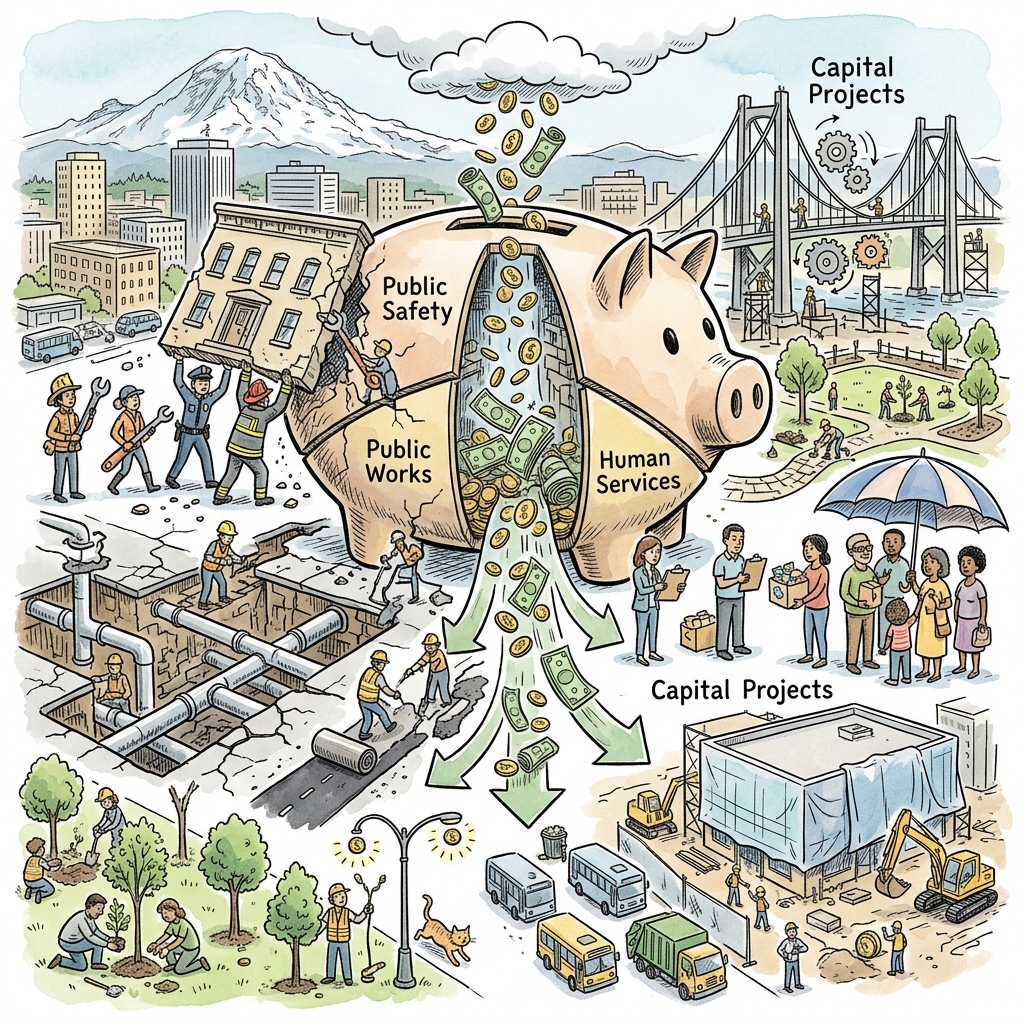
Following the Money
The City of Tacoma’s biennial budget tells you what the city actually prioritizes — not what elected officials say they prioritize, but where they direct resources. For residents and business operators, understanding the budget structure reveals why some services work well and others don’t, why some neighborhoods get investment and others wait, and where the fiscal constraints actually sit.
Tacoma operates on a biennial (two-year) budget cycle, with the City Council adopting the budget in odd-numbered years. The city’s combined budget (General Fund plus enterprise funds like Tacoma Public Utilities) runs in the billions — but the General Fund, which covers core city services like police, fire, parks, and streets, is the portion most residents interact with directly.
General Fund: The Core Services Budget
The General Fund for Tacoma’s current biennium totals approximately $900 million to $1 billion over two years (roughly $450-500 million annually). The major expenditure categories:
Public Safety (Police + Fire) — Typically consumes 55-65% of the General Fund. The Tacoma Police Department alone accounts for approximately 35-40% of General Fund spending. Tacoma Fire Department takes approximately 20-25%. This is broadly consistent with similarly-sized cities but reflects the political reality that public safety spending is the hardest line item to reduce regardless of which council is in power.
Community and economic development — Housing programs, homelessness response, business support, code enforcement. This category has grown as a share of the budget in recent years as the city increased spending on encampment management, shelter operations, and affordable housing investments.
Public works and streets — Road maintenance, pothole repair, stormwater management, traffic signals. Chronically underfunded relative to the maintenance backlog — a common pattern in cities with aging infrastructure built for a larger population than currently funds the system.
Parks and recreation — Metro Parks Tacoma operates separately from the city (it’s an independent special purpose district with its own taxing authority), so the city budget contains less parks spending than you might expect. The city funds coordination and some facility maintenance.
Tacoma Public Utilities: The City-Owned Enterprise
Unlike most American cities, Tacoma owns and operates its own electric utility (Tacoma Power), water utility (Tacoma Water), and wastewater system. These enterprise funds operate separately from the General Fund — they’re funded by ratepayers, not taxpayers — but their revenues contribute to the city’s overall fiscal health through a transfer to the General Fund.
Tacoma Power is particularly significant: it operates multiple hydroelectric dams on the Skokomish River and other waterways, providing some of the cheapest and cleanest electricity in the nation (approximately 10 cents/kWh residential rate vs. 12-15 cents nationally). The utility generates revenue that partially subsidizes city services through inter-fund transfers.
Capital Projects: Where Physical Investment Goes
The city’s Capital Improvement Program (CIP) funds new construction and major rehabilitation of public infrastructure. Current capital priorities per city planning documents include:
Street reconstruction and repaving — Tacoma has a significant backlog of streets rated in poor condition. The capital program funds systematic repaving by priority, though the annual investment doesn’t fully keep pace with deterioration rates.
Stormwater infrastructure — Separating combined sewers (old systems that mix stormwater with wastewater) to meet EPA Clean Water Act requirements. This is a multi-decade, multi-hundred-million-dollar obligation imposed by federal consent decree.
Bridge replacement and seismic retrofit — Multiple bridges within city limits are aging and require either replacement or earthquake resilience upgrades.
Community facility investment — Libraries, community centers, and public buildings receiving upgrades through bond-funded programs.
Revenue Sources: Where the Money Comes From
Tacoma’s General Fund revenue comes primarily from: sales tax (the city’s largest single revenue source), property tax, business and occupation (B&O) tax, utility tax, and various fees and permits. Washington State has no income tax, which means cities rely heavily on sales tax — a regressive revenue structure that makes city budgets sensitive to economic downturns (people buy less, revenue drops).
The property tax rate in Tacoma is moderate compared to other Pierce County jurisdictions — but the total tax burden (city + county + schools + special districts + state) adds up. Commercial property owners often cite the combined property tax + B&O tax burden as a concern for business attraction relative to suburban Pierce County locations that lack the B&O tax.
What Residents Complain About (Justified)
The perennial complaint that finds support in the budget data: street condition. The gap between road maintenance funding and the backlog of needed work is measurable and growing. The city would need to approximately double current street maintenance spending to achieve a “good” pavement condition index across the network — something no council has been willing to fund.
The other supported complaint: the ratio of public safety spending to outcomes. With 55-65% of the General Fund going to police and fire, residents in neighborhoods with persistent crime or slow emergency response reasonably ask what they’re getting for that investment. The answer involves staffing vacancies, training costs, and compensation packages that consume budget without directly translating to street-level presence — but the political conversation remains contentious.
Frequently Asked Questions
How big is Tacoma’s city budget?
The total city budget (including enterprise funds like Tacoma Public Utilities) runs in the billions over the two-year cycle. The General Fund — which covers core services like police, fire, and streets — is approximately $450-500 million annually, or roughly $900 million-$1 billion per biennium.
What does Tacoma spend the most money on?
Public safety (police and fire combined) consumes 55-65% of the General Fund. The police department alone accounts for 35-40% of General Fund spending. This proportion is consistent with similar-sized cities but leaves limited funding for streets, community development, and other services.
Does Tacoma have a city income tax?
No. Washington State does not allow cities to impose income taxes. Tacoma’s revenue comes primarily from sales tax, property tax, business and occupation (B&O) tax, utility tax, and fees. This reliance on sales tax makes the budget sensitive to economic conditions.
Does Tacoma own its own electric utility?
Yes. Tacoma Power is a city-owned utility operating hydroelectric dams that provide some of the cheapest electricity in the nation (approximately 10 cents/kWh). The utility operates as an enterprise fund separate from the General Fund but transfers revenue to support city services.
Why are Tacoma’s roads in bad condition?
The street maintenance budget doesn’t keep pace with the deterioration rate of the city’s road network. The city would need to roughly double current maintenance spending to achieve good pavement condition across all streets. No council has funded this level of investment, creating a growing backlog.