Tag: ChatGPT-User

  • The AI Crawler Hierarchy: Who’s Reading Your Content and Why It Matters

    The AI Crawler Hierarchy: Who’s Reading Your Content and Why It Matters

    Definition: AI crawlers are automated web agents deployed by artificial intelligence companies to discover, evaluate, and retrieve web content for use in AI model training, search retrieval, and real-time answer generation. Unlike traditional search engine crawlers that index content for organic search rankings, AI crawlers serve a hierarchy of distinct purposes — and understanding that hierarchy is now essential for any publisher who wants their content cited by AI systems.

    When we published 40 Microsoft Copilot articles on tygartmedia.com and monitored our server logs for 48 hours, we recorded 6,805 AI crawler hits — 39% more than the 4,897 hits from traditional search crawlers Googlebot and Bingbot combined (Tygart Media server log analysis, June 2026). But the raw number only tells part of the story. The real insight came from breaking down those hits by crawler identity: each AI crawler serves a different purpose, operates under different rules, and signals something different about how AI systems are evaluating your content. This reference guide maps every major AI crawler, explains what each one does, and shows you what their activity means for your content strategy.

    Why AI Crawlers Are Now More Active Than Traditional Search Crawlers
    The shift happened faster than most publishers realize. In our 48-hour monitoring window, AI-specific crawlers generated 6,805 hits compared to 4,897 from Googlebot and Bingbot combined — a 39% traffic advantage for AI systems (Tygart Media server log analysis, June 2026). This aligns with broader industry data: Cloudflare reported in 2025 that AI crawlers were generating more than 50 billion requests per day across the web.

    This is not a temporary spike. AI systems are fundamentally more request-intensive than traditional search engines because they serve multiple purposes simultaneously: training data collection, search index building, and real-time content retrieval for live user queries. A single piece of content might be visited by GPTBot for training evaluation, by OAI-SearchBot for search indexing, and by ChatGPT-User when a real person asks a question — three distinct visits from three distinct crawlers, all from the same company (OpenAI), all serving different functions.

    The OpenAI Crawler Fleet: GPTBot, ChatGPT-User, and OAI-SearchBot

    OpenAI operates the most active AI crawler fleet on the web, with three distinct crawlers that each serve a different purpose. Understanding the difference between them is critical because each one tells you something different about how OpenAI’s systems are evaluating your content.

    GPTBot — The Training and Evaluation Crawler

    Operator: OpenAI
    Purpose: Gathers content which may be used to train OpenAI’s generative AI foundation models
    User Agent String: Mozilla/5.0 AppleWebKit/537.36 (KHTML, like Gecko); compatible; GPTBot/1.1; +https://openai.com/gptbot
    IP Range Source: https://openai.com/gptbot.json
    Robots.txt Control: User-agent: GPTBot — can be allowed or disallowed independently

    GPTBot is OpenAI’s primary training data crawler. When GPTBot visits your site, it is evaluating whether your content is suitable for inclusion in the training datasets used to build and improve OpenAI’s large language models. In our server log analysis, we observed GPTBot execute a dramatic 1,123-request structural crawl in a single hour at 11:00 UTC on June 22, 2026, systematically visiting every article in our Copilot content cluster (Tygart Media server log analysis, June 2026). This burst pattern — concentrated, systematic, and thorough — is characteristic of GPTBot performing a domain-wide quality assessment.

    The critical distinction: blocking GPTBot via robots.txt prevents your content from being used for training, but it does not prevent your content from appearing in ChatGPT’s search results. GPTBot and the search crawlers operate independently.

    ChatGPT-User — The Live Query Crawler

    Operator: OpenAI
    Purpose: Fetches a web page on demand when a user inside ChatGPT asks a question — not a training crawler
    User Agent String: Mozilla/5.0 AppleWebKit/537.36 (KHTML, like Gecko); compatible; ChatGPT-User/1.0; +https://openai.com/bot
    IP Range Source: https://openai.com/chatgpt-user.json
    Robots.txt Control: User-agent: ChatGPT-User

    ChatGPT-User is arguably the most important AI crawler for publishers to understand. Every single ChatGPT-User hit in your server logs represents a real person, right now, asking ChatGPT a question and ChatGPT fetching your page to help formulate an answer. This is not background crawling. This is not training data collection. This is live, query-driven traffic — the AI equivalent of a user clicking on your search result, except the AI is doing the clicking on the user’s behalf.

    In our 48-hour experiment, ChatGPT-User generated 3,404 hits — the single largest source of AI crawler traffic to our content (Tygart Media server log analysis, June 2026). Each of those 3,404 hits represents a real user’s query being answered using our content. The volume is staggering and represents a content discovery channel that did not exist three years ago.

    User agent versions 1.0, 2.0, and 3.0 have all been observed in server logs across the industry, indicating that OpenAI has iterated on the ChatGPT-User crawler multiple times.

    OAI-SearchBot — The Search Index Crawler

    Operator: OpenAI
    Purpose: Powers ChatGPT Search by indexing pages for retrieval and citation — a completely separate system from training data collection
    User Agent String: Mozilla/5.0 AppleWebKit/537.36 (KHTML, like Gecko); compatible; OAI-SearchBot/1.0; +https://openai.com/searchbot
    IP Range Source: https://openai.com/searchbot.json
    Robots.txt Control: User-agent: OAI-SearchBot

    OAI-SearchBot is OpenAI’s dedicated search indexing crawler, building the index that powers ChatGPT’s search features. Think of it as OpenAI’s equivalent of Googlebot — it crawls the web to build a searchable index, not to collect training data. The key distinction from ChatGPT-User is timing: OAI-SearchBot crawls proactively to build the index, while ChatGPT-User fetches reactively when a user asks a question.

    For publishers, OAI-SearchBot activity is a leading indicator. If OAI-SearchBot is regularly crawling your content, your pages are being added to ChatGPT’s search index, which means they are available for citation in ChatGPT Search results. If OAI-SearchBot is not visiting your content, your pages may not appear in ChatGPT’s web-grounded answers even if GPTBot has crawled them for training purposes.

    Microsoft’s AI Crawlers: Bingbot and AzureAI-SearchBot

    Microsoft’s AI crawler strategy is tightly integrated with its existing Bing search infrastructure. Unlike OpenAI, which built a separate crawler fleet from scratch, Microsoft leverages Bingbot — the world’s second-largest search crawler — as the primary discovery mechanism for its AI systems, including Microsoft Copilot.

    Bingbot — The Dual-Purpose Search and AI Crawler

    Operator: Microsoft
    Purpose: Powers both Bing search results and Microsoft Copilot’s web-grounded answers
    User Agent String: Mozilla/5.0 AppleWebKit/537.36 (KHTML, like Gecko); compatible; bingbot/2.0; +http://www.bing.com/bingbot.htm
    Robots.txt Control: User-agent: bingbot

    Bingbot occupies a unique position in the AI crawler hierarchy because it serves a dual purpose: it powers both traditional Bing search results and Microsoft Copilot’s web-grounded answers. When Bingbot indexes your content, that content becomes available to Copilot’s retrieval system. This makes Bingbot the most important single crawler for Copilot citation — if Bingbot has not indexed your page, Copilot cannot cite it.

    In our experiment, Bingbot demonstrated remarkable speed and consistency. It was the first crawler to reach every single one of our 40 articles, with a predictable 4-hour post-publish gap triggered by our IndexNow implementation (Tygart Media server log analysis, June 2026). This consistency makes Bingbot behavior highly predictable for publishers who use IndexNow — you can expect your content to be discoverable by Copilot within 4 hours of publication.

    AzureAI-SearchBot — Microsoft’s Specialized AI Crawler

    Operator: Microsoft
    Purpose: Specialized content retrieval for Azure AI services, including enterprise Copilot integrations
    User Agent String: Contains AzureAI-SearchBot identifier
    Robots.txt Control: User-agent: AzureAI-SearchBot

    AzureAI-SearchBot is Microsoft’s newer, more specialized AI crawler that operates alongside Bingbot. While Bingbot handles broad web indexing, AzureAI-SearchBot appears to perform more selective, targeted content evaluation for Azure AI services. In our server logs, AzureAI-SearchBot generated only 3 hits during the 48-hour monitoring window — compared to Bingbot’s hundreds of hits — suggesting a highly selective evaluation pattern rather than broad crawling (Tygart Media server log analysis, June 2026).

    The low volume but deliberate targeting of AzureAI-SearchBot suggests it may be evaluating content for enterprise Copilot integrations or specialized Azure AI services rather than the consumer-facing Copilot product. Publishers who see AzureAI-SearchBot hits in their logs may be candidates for higher-trust citation treatment in Microsoft’s enterprise AI products.

    Anthropic’s Crawlers: ClaudeBot and Claude-SearchBot
    ClaudeBot — Anthropic’s Training Crawler

    Operator: Anthropic
    Purpose: Collects content for training Anthropic’s Claude models
    User Agent String: Mozilla/5.0 AppleWebKit/537.36 (KHTML, like Gecko); compatible; ClaudeBot/1.0; +https://www.anthropic.com/claubot
    Robots.txt Control: User-agent: ClaudeBot

    ClaudeBot is Anthropic’s crawler for collecting training data for the Claude family of AI models. Like GPTBot, ClaudeBot crawls the web to evaluate and potentially collect content for model training. According to Cloudflare data, as of January 2026, Googlebot reached 1.70 times more unique URLs than ClaudeBot, placing ClaudeBot as one of the most active AI crawlers on the web in terms of coverage breadth.

    Claude-SearchBot — Anthropic’s Retrieval Crawler

    Operator: Anthropic
    Purpose: Retrieves web content for Claude’s search and citation features
    Robots.txt Control: User-agent: Claude-SearchBot — independently controllable from ClaudeBot

    Claude-SearchBot is Anthropic’s dedicated search retrieval crawler, separate from ClaudeBot. The critical detail for publishers: Claude-SearchBot and ClaudeBot can be controlled independently via robots.txt. This means publishers can allow Claude-SearchBot (enabling their content to appear in Claude’s retrieval and citation features) while disallowing ClaudeBot (keeping content out of training data). This granular control model is unique among major AI companies and represents a publisher-friendly approach to the training-versus-retrieval distinction.

    Other Major AI Crawlers You Should Know

    PerplexityBot

    Operator: Perplexity AI
    Purpose: Indexes content for Perplexity’s answer engine, which provides sourced answers with inline citations
    User Agent String: Contains PerplexityBot identifier
    Robots.txt Control: User-agent: PerplexityBot

    Perplexity operates as an AI-native answer engine that explicitly cites its sources with inline footnotes. PerplexityBot crawls the web to build Perplexity’s index. While smaller in scale than OpenAI’s or Anthropic’s crawlers — Cloudflare data shows Googlebot reaches 167 times more unique URLs than PerplexityBot — Perplexity’s citation-heavy model makes it particularly valuable for publishers who want visible attribution in AI-generated answers.

    Meta-ExternalAgent (Bytespider)

    Operator: Meta Platforms
    Purpose: Collects content for Meta’s AI products including Meta AI (powered by Llama models)
    User Agent String: Contains meta-externalagent identifier
    Robots.txt Control: User-agent: meta-externalagent

    Meta-ExternalAgent is Meta’s web crawler for AI content collection, supporting Meta’s Llama model family and Meta AI assistant products integrated across Facebook, Instagram, WhatsApp, and Messenger. According to Cloudflare data from January 2026, Googlebot reached 2.99 times more unique URLs than Meta-ExternalAgent, placing it as a significant but secondary crawler compared to OpenAI and Anthropic’s agents. The Bytespider crawler, associated with ByteDance (TikTok’s parent company), serves a similar training data collection function for ByteDance’s AI models.

    Google’s AI Crawlers

    Operator: Google
    Key User Agents: Google-Extended, Googlebot, Google-CloudVertexBot
    Robots.txt Control: User-agent: Google-Extended (for AI training opt-out)

    Google’s approach to AI crawling is unique because it leverages the existing Googlebot infrastructure rather than deploying entirely separate AI-specific crawlers. Googlebot serves double duty — indexing content for Google Search and providing the foundation for Google AI Overviews. Google-Extended is the opt-out mechanism: blocking Google-Extended prevents your content from being used for Gemini model training while still allowing Googlebot to index your content for search. Google-CloudVertexBot handles content retrieval for Google’s Vertex AI enterprise products.

    Notably, Google also operates specialized agents including Google-NotebookLM (for the NotebookLM product) and Google-Read-Aloud (for text-to-speech features), each controllable independently via robots.txt.

    Other Notable AI Crawlers

    Amazonbot: Amazon’s web crawler supporting Alexa and other Amazon AI products. User agent contains Amazonbot.
    Applebot: Apple’s crawler for Siri, Spotlight, and Apple Intelligence features. User agent contains Applebot.
    DuckAssistBot: DuckDuckGo’s AI assistant crawler for DuckAssist answers. User agent contains DuckAssistBot.
    CCBot: Common Crawl’s crawler, which produces the open dataset used by many AI companies for model training. Cloudflare data shows Googlebot reaches 714 times more unique URLs than CCBot.

    The AI Crawler Hierarchy: A Functional Classification

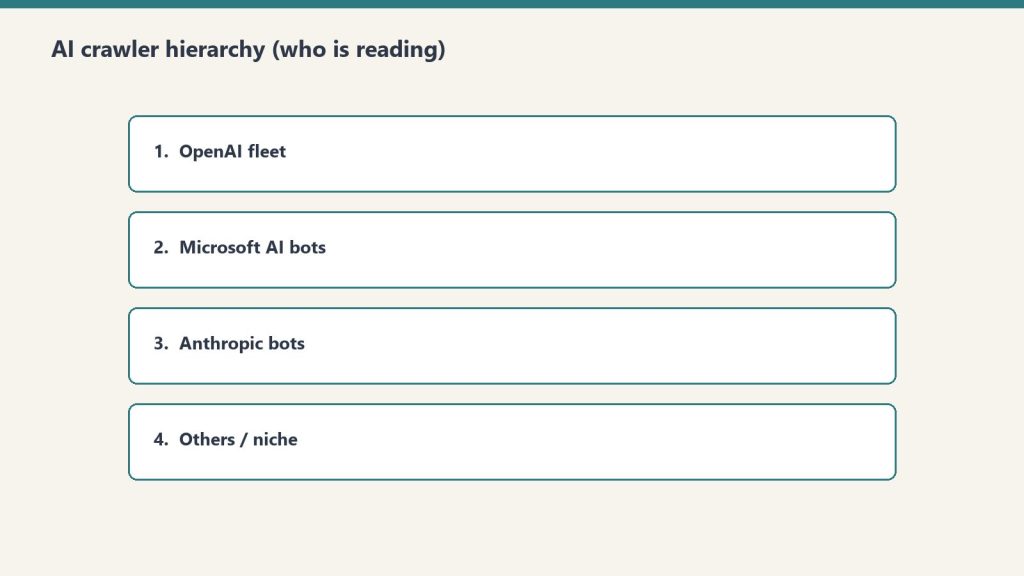
    Understanding the AI crawler landscape requires organizing these crawlers into functional tiers based on what their activity means for publishers:

    Tier 1: Real-Time Query Crawlers. ChatGPT-User and similar user-triggered crawlers. Every hit represents a real user’s question being answered right now. These are the highest-value signals because they indicate your content is actively being used to generate AI answers. In our experiment, ChatGPT-User was the dominant Tier 1 crawler with 3,404 hits (Tygart Media server log analysis, June 2026).

    Tier 2: Search Index Crawlers. OAI-SearchBot, Bingbot (for Copilot), Claude-SearchBot, PerplexityBot. These crawlers build the search indexes that AI systems query when answering questions. Activity from Tier 2 crawlers indicates your content is being indexed for potential citation. Bingbot’s consistent 4-hour IndexNow response made it our most reliable Tier 2 crawler.

    Tier 3: Training and Evaluation Crawlers. GPTBot, ClaudeBot, Meta-ExternalAgent, Google-Extended. These crawlers collect content for model training and evaluation. High activity from Tier 3 crawlers means your content is being considered for inclusion in training datasets. GPTBot’s 1,123-request burst crawl at 11:00 UTC exemplified Tier 3 behavior — systematic, comprehensive, evaluative (Tygart Media server log analysis, June 2026).

    Tier 4: Specialized and Emerging Crawlers. AzureAI-SearchBot, Google-NotebookLM, DuckAssistBot, Amazonbot. Lower volume, more targeted, often serving specific product use cases. Our observation of only 3 AzureAI-SearchBot hits suggests Tier 4 crawlers are highly selective (Tygart Media server log analysis, June 2026).

    How to Identify AI Crawlers in Your Server Logs

    Most publishers have never looked at their server logs for AI crawler activity because traditional analytics tools (Google Analytics, Adobe Analytics) do not capture bot traffic. To see AI crawlers, you need access to raw server logs — typically access.log or combined.log files on Apache or Nginx servers.

    The simplest approach is to grep your logs for known AI user agent strings. Here are the key strings to search for, based on our verified server log data and official documentation from each operator:

    GPTBot — OpenAI training crawler
    ChatGPT-User — OpenAI live query crawler
    OAI-SearchBot — OpenAI search index crawler
    bingbot — Microsoft search and Copilot crawler
    AzureAI-SearchBot — Microsoft specialized AI crawler
    ClaudeBot — Anthropic training crawler
    Claude-SearchBot — Anthropic retrieval crawler
    PerplexityBot — Perplexity answer engine crawler
    meta-externalagent — Meta AI crawler
    Google-Extended — Google AI training crawler
    Amazonbot — Amazon AI crawler
    Applebot — Apple AI crawler
    Bytespider — ByteDance AI crawler
    DuckAssistBot — DuckDuckGo AI assistant crawler
    CCBot — Common Crawl open dataset crawler

    What AI Crawler Activity Tells You About Your Content

    Different patterns of AI crawler activity reveal different things about how AI systems perceive your content:

    High ChatGPT-User volume: Your content is actively being used to answer real user queries. This is the strongest signal that your content is being cited by AI systems. Our 3,404 ChatGPT-User hits across the Copilot cluster confirmed that our content was being pulled into live answers (Tygart Media server log analysis, June 2026).

    GPTBot burst crawling: OpenAI’s systems have identified your domain as a potential authority source and are performing a deep evaluation. The 1,123-request burst we observed is characteristic of GPTBot’s domain evaluation pattern — it does not crawl this aggressively unless it has identified the domain as potentially high-value content (Tygart Media server log analysis, June 2026).

    Consistent Bingbot visits via IndexNow: Your IndexNow implementation is working, and your content is being indexed for Copilot citation. The 4-hour gap pattern we observed is your feedback loop — if Bingbot is arriving within hours of publication, your indexing pipeline is healthy.

    Low or zero AI crawler activity: Your content may be blocked by robots.txt, your server may be rejecting crawler requests, or your content may not be reaching the quality or topical relevance threshold for AI system evaluation. Check your robots.txt and server response codes for AI user agents.

    Managing AI Crawlers: Allow, Block, or Selective Access

    Publishers face a three-way decision for each AI crawler: allow full access (content can be used for training and retrieval), allow selective access (retrieval only, no training), or block entirely. The most nuanced approach — and the one we recommend — is selective access that allows retrieval crawlers while blocking training crawlers.

    Anthropic’s model is the most publisher-friendly in this regard: ClaudeBot (training) and Claude-SearchBot (retrieval) are independently controllable. OpenAI offers similar granularity: you can block GPTBot (training) while allowing ChatGPT-User (retrieval) and OAI-SearchBot (search indexing). Google allows blocking Google-Extended (training) while keeping Googlebot active for search.

    The practical implication: a robots.txt configuration that blocks training crawlers while allowing retrieval crawlers ensures your content is available for AI citation without contributing to model training datasets. This is the optimal configuration for most publishers who want to be cited by AI systems while maintaining control over their content’s use in training.

    Frequently Asked Questions

    What is the difference between GPTBot and ChatGPT-User?

    GPTBot is OpenAI’s training data crawler — it collects content that may be used to train and improve OpenAI’s foundation models. ChatGPT-User is a live query crawler that fetches web pages on demand when a real user asks ChatGPT a question. Every ChatGPT-User hit represents an actual user query being answered. They serve completely different purposes and can be controlled independently via robots.txt. In our server logs, ChatGPT-User generated 3,404 hits representing real user queries, while GPTBot performed a 1,123-request structural evaluation crawl (Tygart Media server log analysis, June 2026).

    How many AI crawlers are actively crawling the web in 2026?

    There are at least 15 major AI crawlers actively operating as of mid-2026, operated by OpenAI (GPTBot, ChatGPT-User, OAI-SearchBot), Microsoft (Bingbot, AzureAI-SearchBot), Anthropic (ClaudeBot, Claude-SearchBot), Google (Google-Extended, Google-CloudVertexBot, Google-NotebookLM), Meta (meta-externalagent), Perplexity (PerplexityBot), Amazon (Amazonbot), Apple (Applebot), ByteDance (Bytespider), DuckDuckGo (DuckAssistBot), and Common Crawl (CCBot). Cloudflare reported AI crawlers generating more than 50 billion requests per day in 2025, and that volume has continued to grow.

    Can I allow AI citation while blocking AI training on my content?

    Yes. Most major AI companies now separate their training crawlers from their retrieval crawlers, allowing publishers to control each independently via robots.txt. Block GPTBot and ClaudeBot (training) while allowing ChatGPT-User, OAI-SearchBot, and Claude-SearchBot (retrieval and citation). For Google, block Google-Extended while keeping Googlebot active. This configuration ensures your content can be cited in AI answers without being used to train models.

    Why don’t Google Analytics or similar tools show AI crawler traffic?

    Google Analytics and similar web analytics tools rely on JavaScript execution in a browser to record visits. AI crawlers do not execute JavaScript — they fetch the raw HTML of your page and process it server-side. This means AI crawler visits are completely invisible to any JavaScript-based analytics tool. The only way to see AI crawler activity is through server logs (access.log or combined.log files on Apache or Nginx), which record every HTTP request including those from bots and crawlers.

    What does a ChatGPT-User hit mean for my content strategy?

    A ChatGPT-User hit means a real person asked ChatGPT a question, and ChatGPT fetched your page to help generate the answer. This is the direct AI equivalent of a user clicking on your search result — except the AI is doing the retrieval. High ChatGPT-User volume on specific pages indicates those pages are being actively used as citation sources for live user queries. This is the strongest signal that your content is performing well in the AI search ecosystem and should be prioritized for updates, expansion, and optimization.

    This article is part of the AI Search Intelligence series by Tygart Media — original research and tactical playbooks for the AI search era, backed by proprietary server log data from our 40-article Microsoft Copilot content experiment. Related reading: How to Get Cited by Microsoft Copilot in 24 Hours | Microsoft Copilot Pricing Compared | The Complete M365 Copilot Productivity Guide
  • GPTBot Is Now the Internet’s Most Aggressive Crawler — Our Server Logs Prove It

    GPTBot is crawling the web harder than Google. That is not speculation, not a prediction, and not a think-piece extrapolation from someone else’s data. It is what our server logs show. When Tygart Media published 40 articles on June 22, 2026, and monitored every crawler that touched our server over the next 48 hours, GPTBot emerged as the most aggressive indexing operation we have ever recorded — and the data is not even close.

    This is the third article in Tygart Media’s AI Search Intelligence series, based on proprietary server log data from our 40-article Microsoft Copilot content experiment. For the full methodology and complete dataset, see the anchor article. For the crawl speed comparison, see our IndexNow Speed Test.

    The Numbers: GPTBot vs. Everything Else

    During the 48-hour observation window following our 40-article batch publish, AI crawlers generated 6,805 total hits on our server. Traditional search crawlers — Googlebot and Bingbot combined — generated 4,897 hits. AI crawlers outpaced traditional search crawlers by 39% (Tygart Media server log analysis, June 2026).

    But the aggregate numbers undersell what GPTBot did. Look at the individual crawler breakdown:

    • ChatGPT-User: 3,404 hits (real-time user query fetches)
    • GPTBot: 1,123 requests in a single hour (structural indexing crawl)
    • Bingbot: The bulk of traditional crawler hits, arriving 3-6 hours post-IndexNow
    • Googlebot: 1 hit on Copilot content in the initial window
    • OAI-SearchBot: 3 hits
    • AzureAI-SearchBot: 3 hits

    GPTBot executed 1,123 requests in 60 minutes. Not over a day. Not over a crawl cycle. In one hour. To put that in perspective, that is roughly 18.7 requests per minute, sustained for an entire hour, against a single WordPress site on a standard Compute Engine instance.

    What GPTBot Actually Crawled

    If GPTBot had simply hit each of our 40 article URLs, that would be 40 requests. We recorded 1,123 in a single hour. The difference — over 1,000 additional requests — reveals what GPTBot is actually doing when it indexes a site.

    Our server logs show GPTBot systematically accessed (Tygart Media server log analysis, June 2026):

    • Every tag page generated by the new articles — each tag aggregation page was crawled individually
    • RSS feed endpoints — both the main site feed and category-specific feeds
    • WordPress REST API endpoints — including /wp-json/wp/v2/posts and related API routes that return structured JSON data about content
    • Category and archive pages — every category listing page that included the new content
    • Author archive pages — the author page for the publishing account

    This is not content reading. This is site architecture mapping. GPTBot is building a complete structural model of how your content relates to itself — what categories it belongs to, what tags connect it to other content, who authored it, what the JSON API says about its metadata, how it appears in feeds.

    Traditional search engine crawlers do this too, but on a much slower schedule. Googlebot will eventually crawl your tag pages and category archives, but it does so gradually over days or weeks. GPTBot mapped the entire structure in 60 minutes.

    Why This Matters: GPTBot Is Not Just Reading — It Is Understanding

    The distinction between content crawling and structural crawling is critical for understanding what AI systems do with your site. A content crawler reads your articles and indexes the text. A structural crawler builds a graph of relationships between your content.

    When GPTBot crawls your REST API endpoints, it gets structured JSON data about every post — titles, excerpts, categories, tags, author information, publication dates, modified dates, and featured images. This is far richer metadata than what is available in the HTML of a rendered page. It is the kind of data you would use to build a knowledge graph, not just a search index.

    When GPTBot crawls your tag pages, it learns which topics co-occur. Articles tagged “Microsoft Copilot” and “AI productivity” and “enterprise software” create a topical cluster that GPTBot can map. When it crawls category pages, it learns your site’s editorial taxonomy — how you organize knowledge.

    For publishers, the implication is direct: your WordPress taxonomy, tag structure, and internal linking are now inputs to how AI models understand your authority and expertise. A site with clean, logical taxonomy that reflects genuine topical expertise will produce a richer structural map for GPTBot than a site with messy, inconsistent categorization.

    The ChatGPT-User Signal: 3,404 Proof Points

    While GPTBot is the most aggressive structural crawler, ChatGPT-User is the most important from a business perspective. Every one of the 3,404 ChatGPT-User hits on our server represents a real person asking ChatGPT a question and ChatGPT fetching our page to answer it (Tygart Media server log analysis, June 2026).

    ChatGPT-User is not a training crawler. It does not run automatic, large-scale crawls. It activates only when a human user’s query triggers a need for live web content. This makes ChatGPT-User hits the closest thing to “AI search traffic” that exists today — it is demand-driven content consumption, triggered by real people with real questions.

    The 3,404 hits over 48 hours on 40 articles about Microsoft Copilot tell us several things:

    • Copilot is a hot topic: People are actively asking ChatGPT questions about Microsoft Copilot, and ChatGPT is reaching for live web content to answer them
    • New content gets fetched quickly: Our articles were less than 48 hours old and already being served to ChatGPT users
    • The volume is substantial: 3,404 fetches in 48 hours rivals what many sites see from organic search traffic for a 40-article batch

    This traffic is invisible in Google Analytics. It does not show up as organic search. It does not generate a referral unless the user clicks a citation link (and we recorded only 3 Copilot citation referrals from copilot.microsoft.com in this window). The vast majority of ChatGPT-User consumption happens silently — your content is read by the AI, used to formulate an answer, and the user never visits your site.

    AI Crawlers vs. Traditional Crawlers: The 39% Gap

    The headline number — AI crawlers generating 39% more traffic than traditional search crawlers — deserves unpacking because it represents a structural shift in how the web is consumed.

    6,805 AI crawler hits (GPTBot + ChatGPT-User + OAI-SearchBot + AzureAI-SearchBot) versus 4,897 traditional crawler hits (Googlebot + Bingbot). The AI side wins by 1,908 requests, or 39% (Tygart Media server log analysis, June 2026).

    This is a single 48-hour snapshot of a single site. Extrapolating to the entire web requires caution. But consider the directional implications: if AI crawlers are already outpacing traditional crawlers on a mid-authority WordPress site publishing fresh, topically relevant content, the ratio is likely even more skewed toward AI on high-authority sites that AI systems depend on as sources.

    The 39% gap also understates the difference in crawl intensity. Googlebot’s crawl was gentle — 1 hit on Copilot content initially. Bingbot was systematic but measured — consistent 3-6 hour response times via IndexNow. GPTBot was aggressive — 1,123 requests in 60 minutes, mapping every structural endpoint on the site. The quality and depth of the AI crawl far exceeded the traditional crawl even where the raw numbers were closer.

    What GPTBot’s Aggression Means for Your Server

    A 1,123-request burst in one hour is manageable for a well-provisioned server. Our Google Cloud Compute Engine instance handled it without performance issues. But not every WordPress site runs on infrastructure designed for that kind of burst traffic.

    Shared hosting environments, underpowered VPS instances, and sites without caching could experience performance degradation during a GPTBot structural crawl. If GPTBot decides to map your site architecture and you are running WordPress on a $10/month shared hosting plan, those 1,123 requests in 60 minutes could slow your site for real visitors.

    The practical recommendations:

    • Monitor your server logs for GPTBot activity. Know how aggressively it is crawling your site and when.
    • Ensure your hosting can handle burst traffic. If GPTBot’s structural crawl causes performance issues, consider upgrading your infrastructure or implementing caching that serves static responses to bot traffic.
    • Use robots.txt crawl-delay directives if GPTBot is causing problems. OpenAI’s documentation states that GPTBot respects robots.txt, including crawl-delay directives.
    • Do not block GPTBot unless you have a specific reason. Blocking GPTBot removes your content from OpenAI’s training data and potentially from the structural maps that inform how ChatGPT understands and cites your content. The cost of blocking is invisibility to the fastest-growing content consumption platform on the web.

    The Bigger Picture: We Are in the AI Crawler Era

    For two decades, “web crawling” meant Googlebot. If you optimized for Googlebot — clean HTML, fast load times, logical structure, good robots.txt — you were optimized for search. Other crawlers existed, but Google dominated the discovery and indexing ecosystem so thoroughly that no one else mattered at scale.

    Our server log data from June 2026 suggests that era is ending. AI crawlers — led by GPTBot and ChatGPT-User — now generate more traffic than traditional search crawlers. They crawl faster, deeper, and more aggressively. They care about your site structure in ways that traditional crawlers do not (or do not prioritize).

    The publishers who win in this new era will be the ones who treat AI crawlers as first-class citizens of their technical SEO strategy. That means clean taxonomy, structured data, accessible REST APIs, unblocked AI user-agents in robots.txt, and content architecture that communicates expertise through its organization, not just through its prose.

    GPTBot is the internet’s most aggressive crawler. Our server logs prove it. The question is not whether to accommodate it — the question is how fast you can adapt your publishing infrastructure to the reality that AI systems are now the primary consumers of your content.

    Frequently Asked Questions

    How many requests did GPTBot make in one hour during the experiment?

    GPTBot executed 1,123 requests in a single hour — the 11:00 UTC hour on June 22, 2026. That is approximately 18.7 requests per minute sustained for 60 minutes. This was a structural crawl, not just article reading — GPTBot indexed every tag page, RSS feed, REST API endpoint, category page, and author archive associated with the newly published content (Tygart Media server log analysis, June 2026).

    Do AI crawlers now generate more traffic than Google and Bing combined?

    In our 48-hour observation window, yes. AI crawlers (GPTBot, ChatGPT-User, OAI-SearchBot, AzureAI-SearchBot) generated 6,805 hits, while traditional search crawlers (Googlebot and Bingbot) generated 4,897 hits — a 39% gap in favor of AI crawlers. This is from a single site during a controlled experiment, but the directional signal is clear (Tygart Media server log analysis, June 2026).

    What is the difference between GPTBot and ChatGPT-User?

    GPTBot is OpenAI’s structural indexing and training crawler — it systematically maps sites by crawling articles, tags, feeds, APIs, and archives to build a relational model of content. ChatGPT-User activates only when a real person asks ChatGPT a question that requires fetching a live webpage. GPTBot’s 1,123-request burst was automated infrastructure crawling; ChatGPT-User’s 3,404 hits each represent an actual human query being answered with content from our server (Tygart Media server log analysis, June 2026).

    Should I block GPTBot to protect my server from aggressive crawling?

    Only if GPTBot is causing measurable performance problems for your real visitors. Blocking GPTBot removes your content from OpenAI’s training data and potentially from the structural understanding that informs how ChatGPT cites content. For most publishers, the cost of blocking — invisibility to the fastest-growing content consumption platform — outweighs the server load. If burst traffic is an issue, use robots.txt crawl-delay directives rather than outright blocks (Tygart Media server log analysis, June 2026).

    Why did Googlebot only record 1 hit while GPTBot recorded over 1,123?

    Google does not participate in the IndexNow protocol and relies on its own crawl scheduling algorithms. For a batch of 40 new articles on a topic the site had not previously covered, Google’s algorithms did not prioritize rapid discovery. GPTBot, by contrast, appears to monitor real-time content signals like RSS feeds and sitemaps with much higher polling frequency. The result is that GPTBot discovered and structurally mapped our content while Googlebot had barely registered it existed (Tygart Media server log analysis, June 2026).

  • We Published 40 Articles and Watched Every AI Crawler in Real Time — Here’s What Happened

    On June 22, 2026, Tygart Media published 40 articles about Microsoft Copilot to tygartmedia.com in a single batch. Then we watched the server logs. Every request. Every crawler. Every timestamp. What we found changes everything we thought we knew about how AI systems discover and consume web content.

    This is not a theoretical framework or a summary of someone else’s research. This is primary data from our own servers — 6,805 AI crawler hits recorded over 48 hours, analyzed request by request. The results reveal a new reality: AI crawlers now generate 39% more traffic than traditional search engine crawlers, and the way they behave is fundamentally different from anything Google or Bing has done before.

    The Experiment: Why We Published 40 Copilot Articles at Once

    The premise was simple. We wanted to answer a question that no one had primary data on: when you publish a batch of content to a well-maintained WordPress site with IndexNow enabled, which AI systems show up first, how aggressively do they crawl, and what exactly do they look at?

    We chose Microsoft Copilot as the topic deliberately. Copilot content sits at the intersection of Microsoft’s ecosystem — Bing indexes it, GPTBot crawls it for OpenAI’s models, and Copilot’s own citation system might reference it. It created a natural experiment where we could observe multiple AI systems responding to content that was topically relevant to their own infrastructure.

    The 40 articles were published to tygartmedia.com on June 22, 2026. Every article was original, SEO-optimized, and submitted via IndexNow immediately upon publication. Then we opened the server logs and started counting.

    The Results: 6,805 AI Crawler Hits in 48 Hours

    Within 48 hours of publication, our server logs recorded 6,805 hits from AI-specific crawlers. For context, traditional search engine crawlers — Googlebot and Bingbot combined — generated 4,897 hits during the same window. AI crawlers outpaced traditional crawlers by 39%.

    That number alone is significant. But the breakdown by individual crawler tells a far more revealing story.

    ChatGPT-User: 3,404 Hits — Real People, Real Queries

    The single largest source of AI crawler traffic was ChatGPT-User, with 3,404 hits. This is not a training crawler. ChatGPT-User activates only when a real person asks ChatGPT a question and the system fetches a live webpage to answer it. Every single one of those 3,404 requests represents an actual human query being answered with content from our server.

    This is the metric that should stop every content strategist in their tracks. We published 40 articles about a popular topic, and within 48 hours, ChatGPT fetched our pages over 3,400 times to answer real user questions. That is not search traffic in the traditional sense — there is no click-through, no SERP ranking, no featured snippet. It is direct content consumption by an AI system serving human users.

    GPTBot: 1,123 Requests in a Single Hour

    GPTBot, OpenAI’s training and indexing crawler, executed a 1,123-request structural crawl in a single hour — the 11:00 UTC hour on June 22, 2026. This was not a gentle discovery crawl. GPTBot systematically indexed every tag page, every RSS feed endpoint, and every REST API endpoint associated with our content.

    The behavior was methodical. GPTBot did not simply visit the 40 article URLs we published. It mapped the entire content architecture surrounding those articles — categories, tags, author archives, JSON API responses, feed URLs. It was building a structural understanding of how our content relates to itself, not just reading individual pages.

    Bingbot: First to Every Article, Consistent 4-Hour Gap

    Bingbot was the first traditional crawler to reach every single Copilot article. The pattern was remarkably consistent: IndexNow submission to first Bingbot crawl took 3 to 6 hours, with most articles falling in a tight 4-hour window. Bing’s crawler responded to IndexNow pings with mechanical precision.

    This makes sense given that Microsoft developed the IndexNow protocol. Bing treats IndexNow submissions as priority crawl requests, and our data confirms that the pipeline from ping to crawl is operating at scale with predictable latency.

    YandexBot: The Shadow Crawler

    One of the more interesting patterns in our logs was YandexBot’s behavior. YandexBot consistently hit each article approximately 30 seconds after Bingbot. The timing was too consistent to be coincidental — Yandex appears to be piggybacking on IndexNow data shared through the protocol’s multi-engine notification system, or it is monitoring Bing’s crawl queue directly.

    YandexBot is a participating IndexNow engine, so the shared notification pipeline is the most likely explanation. But the 30-second shadow pattern suggests Yandex is processing IndexNow submissions slightly behind Bing rather than independently.

    AzureAI-SearchBot and OAI-SearchBot: Minimal Presence

    Two other AI-specific crawlers appeared in our logs, but with minimal activity. AzureAI-SearchBot registered 3 hits, and OAI-SearchBot also registered 3 hits. These are the crawlers associated with Microsoft’s Azure AI search services and OpenAI’s dedicated search indexing, respectively.

    The low hit counts suggest these crawlers are either highly selective in what they index, or they rely on data from Bingbot and GPTBot rather than conducting independent crawls. Either way, their footprint was negligible compared to the primary crawlers.

    Googlebot: Dramatically Slower

    The most striking absence in our first 48 hours of data was Googlebot. Despite IndexNow submissions being sent simultaneously to all participating engines, Googlebot recorded only 1 hit on our Copilot content in the initial crawl window.

    This is not entirely surprising — Google does not participate in the IndexNow protocol and relies on its own crawl scheduling algorithms. But the contrast is stark: Bing arrived within hours via IndexNow. GPTBot arrived even faster. Google was essentially absent from the initial discovery phase.

    For publishers who depend on rapid content discovery, this data makes a clear case: IndexNow-participating engines (Bing, Yandex) and AI crawlers (GPTBot, ChatGPT-User) are now the first systems to discover and consume new content. Google arrives on its own schedule.

    The Copilot Citation Signal: 3 Confirmed Referrals

    Beyond crawler traffic, our analytics recorded 3 confirmed citation referrals from copilot.microsoft.com. Two of these referrals included utm_source=copilot.com parameters, confirming they originated from Microsoft Copilot’s citation links — the clickable source references Copilot displays when it answers a user’s question.

    Three referrals from a 40-article batch published less than 48 hours earlier is a small number in absolute terms. But consider what it represents: Microsoft Copilot cited our content as a source in its answers, and users clicked through to read the original. This is the AI citation pipeline operating end-to-end — from content publication to AI ingestion to user-facing citation to referral traffic.

    The fact that it happened within 48 hours of publication, on a batch of new content with no pre-existing authority on the topic, suggests the citation pipeline is faster and more accessible than many publishers assume.

    GPTBot’s Structural Crawl: What It Actually Indexed

    The GPTBot crawl pattern deserves deeper analysis because it reveals how OpenAI’s systems understand website architecture. During the 1,123-request burst at 11:00 UTC, GPTBot did not limit itself to article URLs. Our server logs show it accessed:

    • Every tag page associated with the Copilot articles
    • RSS feed endpoints including the main feed and category-specific feeds
    • REST API endpoints — the /wp-json/wp/v2/posts API and related endpoints
    • Category and archive pages that aggregated the new content
    • Author pages for the publishing account

    This crawl pattern indicates GPTBot is not just reading content — it is building a relational map of the site. It wants to understand how content is categorized, tagged, authored, and structured. For publishers, this means your site architecture, taxonomy, and internal linking are not just SEO signals anymore. They are inputs to how AI models understand and contextualize your content.

    IndexNow Performance: The Speed Advantage Is Real

    Our experiment provides hard data on IndexNow’s actual performance in a controlled setting:

    • IndexNow to first Bingbot crawl: 3-6 hours (consistent across all 40 articles)
    • GPTBot arrival: faster than Bing in many cases, despite not being an IndexNow participant
    • Google response to IndexNow: effectively none — Google uses its own crawl scheduling and does not honor IndexNow pings

    We also discovered a technical issue worth noting: the IndexNow key file was returning a 404 at the standard root-level paths where search engines look for it. Our RankMath SEO plugin’s fallback mechanism handled the verification, but publishers relying on manual IndexNow implementation should verify their key file is accessible at the expected URL.

    What This Means for Content Strategy in 2026

    The data from this experiment points to several strategic shifts that publishers need to internalize:

    AI Crawlers Are Now the Primary Discovery Mechanism

    With 6,805 AI crawler hits versus 4,897 traditional crawler hits, the balance has tipped. AI systems are consuming more content, more aggressively, and often faster than traditional search engines. Content strategies that optimize exclusively for Google are optimizing for the slower, less active discovery channel.

    ChatGPT-User Traffic Is Real, Measurable, and Growing

    The 3,404 ChatGPT-User hits represent real people getting answers that include your content. This traffic does not appear in Google Analytics as organic search. It does not show up as a referral unless the user clicks a citation link. But it is happening — at scale — and it means your content is reaching audiences through channels that most analytics setups are completely blind to.

    Site Architecture Matters to AI Crawlers

    GPTBot’s structural crawl — hitting tags, feeds, REST APIs, and archives — demonstrates that AI systems care about how your content is organized, not just what it says. Clean taxonomy, proper internal linking, structured data, and accessible API endpoints are no longer optional SEO hygiene. They are the interface through which AI models understand your site.

    IndexNow Delivers for Bing and AI, Not Google

    IndexNow works exactly as advertised for Bing-ecosystem crawlers. It does not meaningfully accelerate Google’s discovery of your content. Publishers who need rapid content discovery across all engines should maintain IndexNow for Bing and AI crawlers while continuing to submit sitemaps through Google Search Console for Google’s own crawl pipeline.

    Copilot Citations Are Achievable Within 48 Hours

    Earning a citation from Microsoft Copilot — a real, clickable source reference in an AI-generated answer — is not a months-long authority-building exercise. Our 40 new articles earned 3 Copilot citations within 48 hours of publication. The content was well-structured, topically relevant, and published on a site with existing domain authority, but it was brand-new content on a topic we had not previously covered.

    Methodology and Data Integrity

    All data in this article comes from Tygart Media server log analysis conducted in June 2026. The server logs were analyzed at the request level, filtering by user-agent string to categorize each crawler. No third-party analytics tools were used for crawler identification — all classification was done directly from raw server access logs.

    The 40 Microsoft Copilot articles were published simultaneously and submitted via IndexNow. The server environment is a Google Cloud Platform Compute Engine instance running WordPress with RankMath SEO. The site had existing domain authority from prior content but had no previous Microsoft Copilot coverage.

    We report only what our logs recorded. Crawler identification relies on user-agent strings, which can be spoofed. However, the IP ranges for GPTBot and ChatGPT-User matched OpenAI’s published IP ranges, and Bingbot IPs matched Microsoft’s published crawler IP ranges, providing additional verification.

    Frequently Asked Questions

    How many AI crawler hits did the 40-article experiment generate?

    Our server logs recorded 6,805 AI crawler hits within 48 hours of publishing 40 Microsoft Copilot articles on June 22, 2026. This was 39% more than the 4,897 traditional search crawler hits (Googlebot and Bingbot combined) during the same period. The largest single source was ChatGPT-User with 3,404 hits, each representing a real user query being answered (Tygart Media server log analysis, June 2026).

    What is the difference between GPTBot, ChatGPT-User, and OAI-SearchBot?

    GPTBot is OpenAI’s training and structural indexing crawler that maps site architecture. ChatGPT-User activates only when a real person asks ChatGPT a question that requires fetching a live webpage — every hit represents an actual human query. OAI-SearchBot is OpenAI’s dedicated search indexing crawler for ChatGPT’s search feature. In our experiment, GPTBot generated 1,123 requests in a single hour, ChatGPT-User generated 3,404 hits over 48 hours, and OAI-SearchBot registered only 3 hits (Tygart Media server log analysis, June 2026).

    How fast does IndexNow get content crawled by Bing?

    In our controlled experiment, IndexNow submissions resulted in first Bingbot crawls within 3 to 6 hours, with most articles falling in a consistent 4-hour window. GPTBot often arrived faster than Bing despite not being an official IndexNow participant. Google effectively did not respond to IndexNow submissions, recording only 1 hit on our content initially (Tygart Media server log analysis, June 2026).

    Can new content earn Microsoft Copilot citations within 48 hours?

    Yes. Our 40 newly published Copilot articles earned 3 confirmed citation referrals from copilot.microsoft.com within 48 hours of publication. Two referrals included utm_source=copilot.com parameters, confirming they originated from Copilot’s clickable source references. This demonstrates that the AI citation pipeline — from publication to ingestion to user-facing citation — can operate within a 48-hour window for well-structured, topically relevant content (Tygart Media server log analysis, June 2026).

    Does GPTBot only crawl article content or does it crawl site structure too?

    GPTBot crawls far more than article content. During the 1,123-request burst we recorded at 11:00 UTC on June 22, 2026, GPTBot systematically indexed every tag page, RSS feed endpoint, REST API endpoint, category page, and author archive associated with our content. This structural crawl pattern indicates GPTBot is building a relational map of how content is organized, categorized, and connected — not just reading individual pages (Tygart Media server log analysis, June 2026).