Tag: Bing Crawler

  • Google vs Bing vs OpenAI: The New Crawl War Nobody’s Talking About

    Google vs Bing vs OpenAI: The New Crawl War Nobody’s Talking About

    Definition: The crawl war is the emerging three-way competition between Google, Microsoft (Bing), and OpenAI to discover, index, and serve web content through their respective AI-powered search and answer systems — Google AI Overviews, Microsoft Copilot, and ChatGPT Search. Each ecosystem crawls the web with fundamentally different strategies, speeds, and philosophies, and those differences determine which content gets cited by which AI system first.

    For two decades, the search engine crawl was a two-player game: Googlebot dominated, Bingbot trailed, and publishers optimized exclusively for Google. That era is over. When we published 40 Microsoft Copilot articles on tygartmedia.com and monitored server logs for 48 hours, we recorded 6,805 AI crawler hits from three distinct ecosystems — each crawling with different speeds, different intensities, and different objectives (Tygart Media server log analysis, June 2026). What we observed was not just traffic. It was a competitive intelligence blueprint showing exactly how each ecosystem discovers, evaluates, and serves content. The differences are dramatic, and they fundamentally change how publishers should think about content distribution.

    The Three Ecosystems: Radically Different Crawl Philosophies
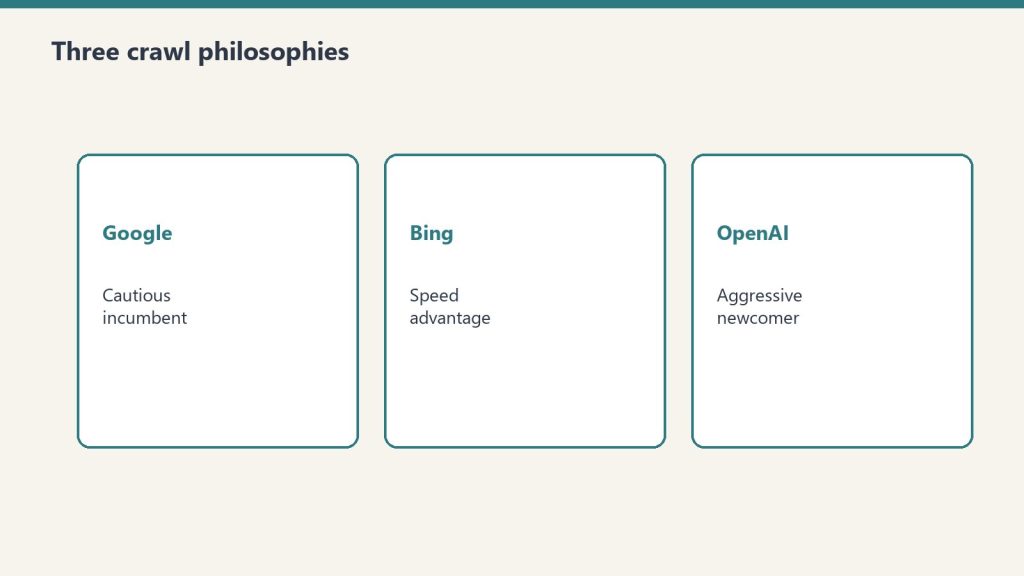
    The crawl war is not just about who crawls more. It is about how each ecosystem approaches the fundamental challenge of web content discovery and evaluation. Our server log data revealed three starkly different approaches operating simultaneously on the same content:

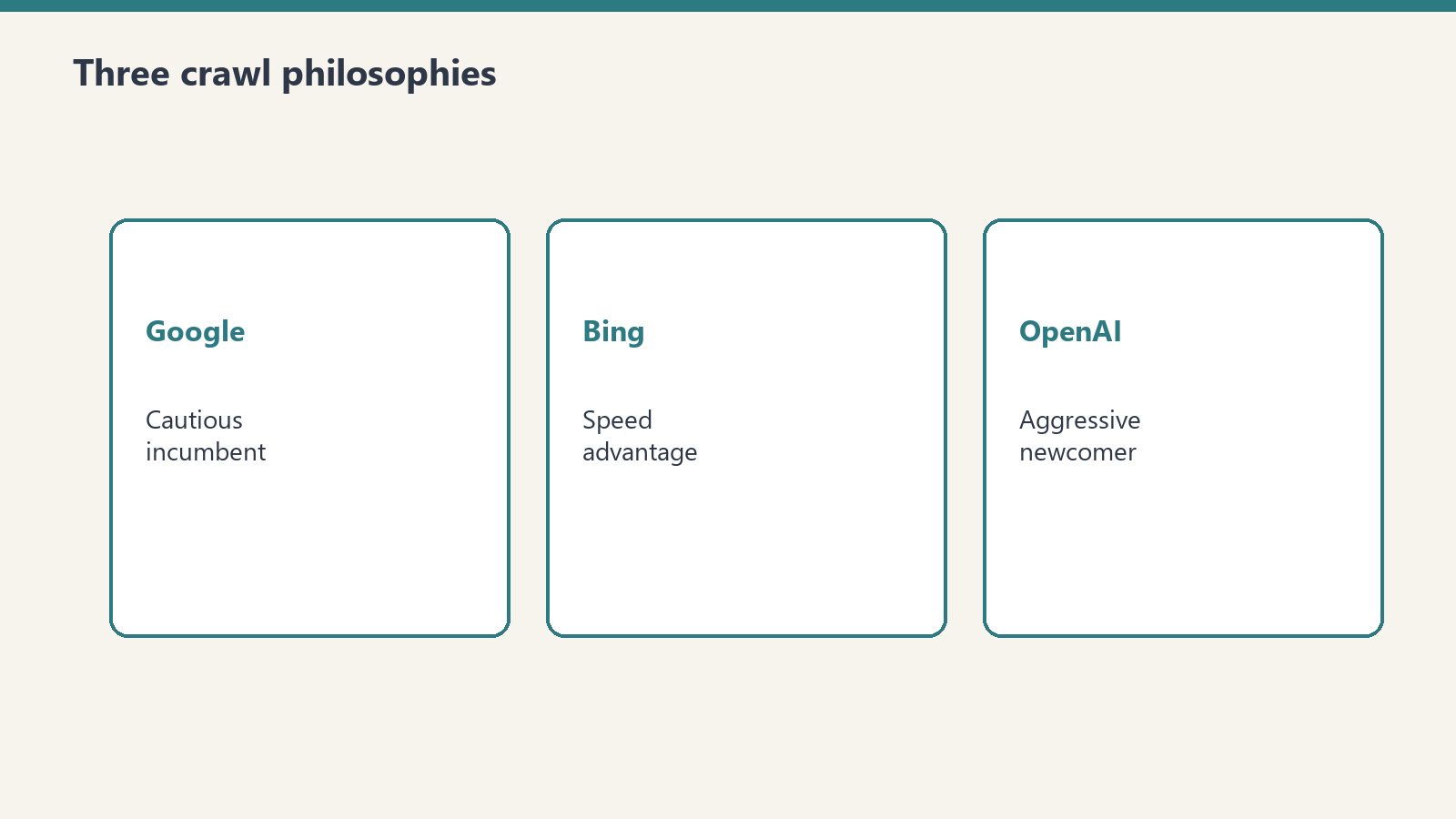
    Google: Slow and conservative. Googlebot approached our content at its own pace, significantly slower than both Bing and OpenAI. Despite being the world’s largest search crawler, Google’s response to our 40-article publication was measured and deliberate — no urgency, no burst crawling, no IndexNow acceleration.

    Bing: Fast and protocol-responsive. Bingbot was the first crawler to reach every single one of our 40 articles, arriving within a consistent 4-hour post-publish window triggered by our IndexNow implementation. Bingbot’s behavior was predictable, fast, and directly responsive to publisher signals.

    OpenAI: Aggressive and structural. OpenAI’s crawler fleet — GPTBot, ChatGPT-User, and OAI-SearchBot — generated the largest volume of activity, including a 1,123-request structural crawl in a single hour. OpenAI’s approach is the most intensive of the three, treating content discovery as an active, aggressive process rather than a passive one.

    Google’s Crawl Strategy: The Cautious Incumbent

    Google has been crawling the web longer than any other company, and its crawl strategy reflects two decades of optimization for thoroughness over speed. Googlebot is the most comprehensive crawler on the web — according to Cloudflare data from January 2026, Googlebot reaches 1.70 times more unique URLs than ClaudeBot, 1.76 times more than GPTBot, 2.99 times more than Meta-ExternalAgent, and 3.26 times more than Bingbot. No other crawler comes close in terms of coverage breadth.

    But coverage is not speed. In our experiment, Googlebot was dramatically slower to discover and index our content than Bingbot. While Bingbot reached every article within 4 hours via IndexNow, Google’s crawlers took significantly longer (Tygart Media server log analysis, June 2026). This speed gap is structural, not accidental — and it reveals a fundamental strategic choice Google has made.

    Why Google Is Slow: The IndexNow Abstention

    The single biggest reason for Google’s slower crawl response is its refusal to adopt IndexNow. IndexNow is the protocol that allows publishers to push notifications directly to search engines when content is published or updated. Bing, Yandex, and other participating search engines receive these notifications and can respond within minutes. Google does not participate in IndexNow. Instead, Google relies on its own crawl scheduling, sitemap processing, and link-following algorithms to discover new content — a process that is thorough but inherently slower.

    Google’s stated position is that it already discovers content efficiently through its existing infrastructure. But our data tells a different story for time-sensitive content. When speed of discovery directly impacts whether content gets cited in AI-generated answers, Google’s conservative approach creates a tangible disadvantage compared to Bing’s IndexNow-responsive pipeline.

    Google’s AI Layer: AI Overviews and Google-Extended

    Google’s approach to AI crawling is to layer AI capabilities on top of existing Googlebot infrastructure rather than deploying separate AI-specific crawlers. Content indexed by Googlebot feeds both traditional search results and Google AI Overviews. The only AI-specific crawler is Google-Extended, which handles the opt-out mechanism for AI training — blocking Google-Extended prevents content from being used for Gemini model training while keeping it available for search and AI Overviews.

    This integrated approach means Google does not need to crawl content twice — once for search, once for AI. But it also means Google’s AI Overviews are limited by Googlebot’s crawl schedule. If Googlebot has not indexed a page, Google AI Overviews cannot reference it. And since Googlebot is slower to discover new content than Bingbot (which uses IndexNow), Google AI Overviews are systematically slower to surface newly published content compared to Microsoft Copilot.

    Bing’s Crawl Strategy: The Speed Advantage
    Microsoft’s Bing has historically been the underdog in search — smaller index, lower market share, less publisher attention. But in the AI era, Bing has a structural advantage that Google lacks: IndexNow responsiveness and deep integration with Microsoft Copilot.

    In our experiment, Bingbot’s behavior was the most predictable and publisher-friendly of all three ecosystems. Every single one of our 40 articles was discovered by Bingbot within a consistent 4-hour window after publication, triggered by our IndexNow implementation (Tygart Media server log analysis, June 2026). This consistency is remarkable — it means publishers who implement IndexNow can predict, with near-certainty, when their content will enter Bing’s index and become available for Copilot citation.

    The IndexNow Pipeline: Publisher to Copilot in Hours

    The Bing-to-Copilot pipeline works like this: you publish content, IndexNow notifies Bing, Bingbot crawls and indexes your page within approximately 4 hours, and that indexed content immediately becomes available to Copilot’s retrieval system. This is the fastest path from publication to AI citation available today.

    Our server logs confirmed this pipeline operating exactly as designed. Within 24 hours of publishing our 40 articles, we recorded 3 confirmed referral visits from copilot.microsoft.com, with 2 carrying the utm_source=copilot.com parameter (Tygart Media server log analysis, June 2026). That is less than one business day from publication to confirmed Copilot citation — a timeline that would be impossible without IndexNow’s speed advantage.

    The YandexBot Shadow Effect

    An unexpected finding in our data: YandexBot consistently shadowed Bingbot, hitting each article approximately 30 seconds after Bingbot’s initial visit (Tygart Media server log analysis, June 2026). This confirms that IndexNow notifications propagate across all participating search engines simultaneously. When you ping IndexNow, you are not just notifying Bing — you are notifying every participating engine, including Yandex and any future participants. This multiplier effect makes IndexNow even more valuable than its Bing integration alone would suggest.

    Bing Webmaster Tools AI Performance Dashboard

    Microsoft has further cemented its position in the crawl war by launching the AI Performance dashboard in Bing Webmaster Tools (public preview, February 2026). This dashboard surfaces citation metrics specifically for AI-generated answers across Microsoft Copilot, AI-generated summaries in Bing, and select partner integrations. Publishers can see total citations, grounding queries (the exact queries that triggered each citation), page-level citation activity, and visibility trends over time. No other search engine offers comparable AI citation analytics — Google has no equivalent dashboard for AI Overviews citation tracking.

    OpenAI’s Crawl Strategy: The Aggressive Newcomer
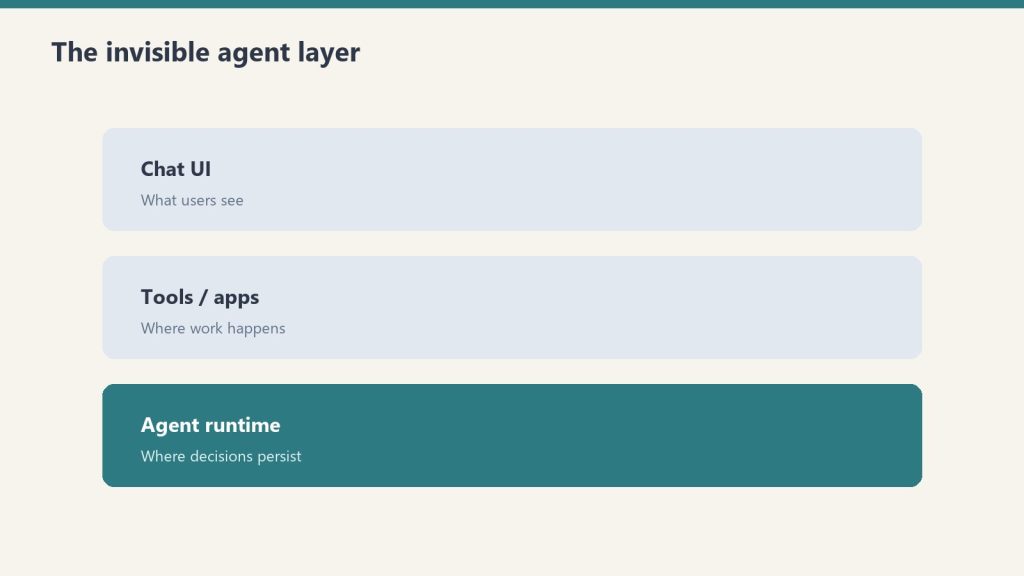
    OpenAI entered the web crawling game later than both Google and Microsoft, but its approach is by far the most aggressive. While Google crawls conservatively and Bing crawls responsively, OpenAI crawls intensively — deploying three separate crawlers (GPTBot, ChatGPT-User, OAI-SearchBot), each serving a distinct purpose, and generating enormous volumes of requests.

    In our 48-hour monitoring window, OpenAI’s crawler fleet was the single largest source of AI crawler activity. ChatGPT-User alone generated 3,404 hits — each representing a real user’s query being answered using our content. GPTBot added a concentrated 1,123-request structural crawl in a single hour. Combined, OpenAI’s crawlers generated more traffic to our Copilot content cluster than any other AI company’s crawler fleet (Tygart Media server log analysis, June 2026).

    The Structural Crawl Pattern: GPTBot’s Burst Behavior

    The most distinctive behavior we observed from OpenAI was GPTBot’s burst crawling pattern. At 11:00 UTC on June 22, GPTBot executed 1,123 requests in a single hour, systematically visiting every article in our Copilot content cluster (Tygart Media server log analysis, June 2026). This is not the steady, distributed crawling you see from Googlebot or Bingbot. This is an aggressive, concentrated evaluation — OpenAI’s systems identifying a domain as a potential authority source and performing a comprehensive assessment in a compressed timeframe.

    This burst pattern has significant implications for publishers. It suggests that OpenAI’s crawl system operates on a trigger model: when the system identifies a relevant domain (through user queries, link signals, or other discovery mechanisms), it dispatches GPTBot for a thorough, rapid evaluation rather than gradually crawling over days or weeks. For publishers, this means the first impression matters — when GPTBot arrives for a burst crawl, the quality and structure of your content at that moment determines whether your domain is classified as an authority source.

    ChatGPT-User: The Real-Time Citation Engine

    ChatGPT-User operates fundamentally differently from both Googlebot and Bingbot. Traditional search crawlers index content proactively — they crawl now so results are available later. ChatGPT-User fetches reactively — it visits your page only when a real user asks a question and ChatGPT needs your content to generate an answer. This makes ChatGPT-User the most direct connection between publisher content and user value in the entire AI search ecosystem.

    The 3,404 ChatGPT-User hits we recorded represent 3,404 real moments where a real person received an answer that drew from our content (Tygart Media server log analysis, June 2026). Unlike traditional search traffic where you see a click and a pageview, ChatGPT-User traffic represents content consumption without a traditional visit — the user received value from your content through the AI intermediary. This is a paradigm shift in how content creates value, and publishers who do not track ChatGPT-User activity in their server logs are blind to an entire channel of content utilization.

    The Crawl War Scoreboard: Head-to-Head Comparison

    Based on our server log data and industry reporting, here is how the three ecosystems compare across the dimensions that matter most to publishers:

    Speed of discovery: Bing wins decisively. IndexNow gives Bing a structural speed advantage that neither Google nor OpenAI can match for new content discovery. Our data showed a consistent 4-hour discovery window for Bingbot versus significantly longer for Googlebot (Tygart Media server log analysis, June 2026). OpenAI’s discovery speed varies — ChatGPT-User is demand-driven and can be near-instant for trending topics, while GPTBot’s burst crawling happens on OpenAI’s schedule, not the publisher’s.

    Crawl intensity: OpenAI wins. The combined volume from GPTBot, ChatGPT-User, and OAI-SearchBot exceeds what any single crawler from Google or Microsoft generates. GPTBot’s 1,123-request burst alone would be an unusually intense day for most sites from any single traditional crawler.

    Coverage breadth: Google wins. Googlebot reaches more unique URLs than any other crawler on the web — 1.76 times more than GPTBot and 3.26 times more than Bingbot according to Cloudflare data from January 2026. For comprehensive coverage, nothing beats Google’s crawl infrastructure.

    Publisher transparency: Bing wins. The AI Performance dashboard in Bing Webmaster Tools provides citation-specific analytics that neither Google nor OpenAI offer. Publishers can see exactly which queries triggered citations and which pages were cited — actionable data that drives content optimization.

    Publisher control: Anthropic leads (among AI companies) with independently controllable training and retrieval crawlers. Among the three ecosystems, OpenAI offers the most granular control with three separately configurable crawlers. Google’s Google-Extended provides training opt-out but no granular retrieval controls.

    What This Means for Content Strategy: The End of Google-Centric SEO

    The crawl war’s most important implication is strategic: optimizing exclusively for Google is no longer sufficient. The data from our experiment shows that AI systems from three different companies are actively crawling, evaluating, and citing web content — and each one uses different signals, different speeds, and different criteria for what it selects.

    A content strategy that ignores Bing’s IndexNow advantage is leaving Copilot citations on the table. A strategy that ignores OpenAI’s aggressive crawling patterns is invisible to ChatGPT’s 3,404 query-driven fetches. A strategy that focuses only on Google’s organic crawl schedule is optimizing for the slowest discovery pipeline of the three.

    The new paradigm is multi-engine optimization — designing content for discovery, evaluation, and citation across all three ecosystems simultaneously. This means implementing IndexNow for Bing speed, structuring content with schema markup for AI extraction across all platforms, building entity-rich content that satisfies all three ecosystems’ relevance criteria, and monitoring server logs for crawler activity from all major AI systems.

    The Multi-Engine Optimization Framework

    Based on our experiment data, here is the practical framework for optimizing across all three ecosystems:

    For Bing and Copilot citation: Implement IndexNow for immediate content discovery. Target a 4-hour indexing window. Use Bing Webmaster Tools AI Performance dashboard to track citation metrics. Optimize for structured data that Copilot’s retrieval system can extract — Article schema, FAQPage schema, and BreadcrumbList schema.

    For Google and AI Overviews: Submit sitemaps through Google Search Console. Ensure content is Google-Extended friendly (do not block Google-Extended unless you specifically want to opt out of Gemini training). Focus on E-E-A-T signals — author expertise, authoritative citations, and content depth — which Google’s AI Overviews weigh heavily in source selection.

    For OpenAI and ChatGPT Search: Do not block OAI-SearchBot or ChatGPT-User in robots.txt (you can block GPTBot to prevent training use while keeping search access). Structure content with clear, extractable answers — question-formatted headings, definition boxes, and concise opening paragraphs that give ChatGPT clean extraction targets. Build topical authority through content clusters, which GPTBot’s burst crawling pattern appears to evaluate as a holistic signal.

    For all three simultaneously: Server log monitoring is the universal requirement. It is the only way to see how each ecosystem’s crawlers are interacting with your content. Traditional analytics tools are blind to crawler traffic, making server logs the single most important data source for multi-engine optimization.

    The Crawl War’s Impact on Publishing Economics

    The crawl war has a direct impact on publishing economics that most publishers have not yet reckoned with. When AI crawlers generate 39% more traffic than traditional search crawlers — as our data showed (Tygart Media server log analysis, June 2026) — that traffic carries real server costs without corresponding ad revenue. AI crawlers do not see ads, do not generate pageviews in analytics, and do not contribute to the metrics that publishers use to sell advertising.

    At the same time, the content that AI crawlers fetch is being used to generate answers that may reduce traditional search traffic — the phenomenon known as zero-click search. Publishers face a paradox: the more valuable your content is to AI systems, the more they crawl it, the more server resources they consume, and the more they potentially reduce your direct traffic by answering user queries without a click-through.

    However, the 3 confirmed Copilot referrals we recorded suggest that AI citation does drive some click-through traffic — users who see a source cited in an AI answer do click through to read the full content. The question for publishers is whether citation-driven traffic will scale to replace or supplement the traditional search traffic that AI systems are cannibalizing. Our data suggests the click-through rate from AI citations is positive but modest, making content quality and authority optimization — rather than raw traffic volume — the new economic foundation for publishing in the AI era.

    What Comes Next in the Crawl War

    The crawl war is intensifying, not settling. Several developments are reshaping the competitive landscape. Bing Webmaster Tools’ AI Performance dashboard, launched in February 2026, gives publishers the first actionable data about AI citation performance — a competitive moat that Google has not yet matched. OpenAI’s continued expansion of ChatGPT Search is driving ChatGPT-User volumes higher, making it an increasingly important content discovery channel. And Google’s integration of AI Overviews into mainstream search results means that Google’s slower crawl speed may matter less over time as AI Overviews draw from Google’s already-comprehensive index.

    For publishers, the strategic imperative is clear: the era of Google-only optimization is over. The crawl war has created a multi-engine landscape where content must be optimized for discovery, evaluation, and citation across three fundamentally different ecosystems. The publishers who adapt fastest — implementing IndexNow, monitoring server logs, and structuring content for AI extraction — will capture the citation advantage that defines the next era of content distribution.

    Our 40-article experiment captured this war in real time: 6,805 AI crawler hits from three competing ecosystems, each approaching the same content with radically different strategies. The data does not lie. The crawl war is here, it is reshaping how content gets discovered and cited, and the publishers who understand it will win.

    Frequently Asked Questions

    Why is Bing faster than Google at discovering new content?

    Bing participates in the IndexNow protocol, which allows publishers to push instant notifications when content is published or updated. Google does not participate in IndexNow and relies instead on its own crawl scheduling and sitemap processing. In our experiment, Bingbot reached every new article within a consistent 4-hour window after publication via IndexNow, while Googlebot was dramatically slower to discover the same content (Tygart Media server log analysis, June 2026). For publishers seeking fast AI citation through Microsoft Copilot, this speed advantage is decisive.

    Does OpenAI crawl more aggressively than Google or Bing?

    Yes. OpenAI deploys three separate crawlers — GPTBot, ChatGPT-User, and OAI-SearchBot — and their combined activity in our experiment exceeded any single crawler from Google or Microsoft. GPTBot alone executed a 1,123-request burst crawl in a single hour, and ChatGPT-User generated 3,404 hits representing real user queries (Tygart Media server log analysis, June 2026). OpenAI’s crawl philosophy is intensive and structural, designed to rapidly evaluate and index content domains rather than gradually discovering them over time.

    What is multi-engine optimization and why does it matter?

    Multi-engine optimization is the practice of designing content for discovery, evaluation, and citation across multiple AI ecosystems — Google AI Overviews, Microsoft Copilot, and ChatGPT Search — rather than optimizing exclusively for Google. It matters because each ecosystem uses different crawlers, different speeds, and different criteria for selecting content to cite. Our data showed AI crawlers from all three ecosystems actively evaluating the same content with different strategies (Tygart Media server log analysis, June 2026). Publishers who optimize only for Google are invisible to Copilot and ChatGPT citations.

    How do I know which AI crawlers are visiting my website?

    Check your server logs (access.log or combined.log files on Apache or Nginx) and search for AI crawler user agent strings: GPTBot, ChatGPT-User, OAI-SearchBot, ClaudeBot, Claude-SearchBot, PerplexityBot, AzureAI-SearchBot, meta-externalagent, and Google-Extended. Traditional analytics tools like Google Analytics do not capture crawler traffic because they rely on JavaScript execution, which crawlers do not perform. Server logs are the only way to see AI crawler activity on your site.

    Should I implement IndexNow if I primarily care about Google rankings?

    Yes. While IndexNow does not directly benefit Google (which does not participate in the protocol), implementing IndexNow gives you immediate access to Bing’s indexing pipeline and Microsoft Copilot citation — an AI citation channel you would otherwise miss entirely. In our experiment, Bingbot discovered all 40 articles within 4 hours via IndexNow, and we received 3 confirmed Copilot citations within 24 hours (Tygart Media server log analysis, June 2026). The implementation cost is minimal (a WordPress plugin), and the citation upside is significant.

    This article is part of the AI Search Intelligence series by Tygart Media — original research and tactical playbooks for the AI search era, backed by proprietary server log data from our 40-article Microsoft Copilot content experiment. Related reading: How to Get Cited by Microsoft Copilot in 24 Hours | The AI Crawler Hierarchy: Who’s Reading Your Content | Copilot vs ChatGPT Enterprise
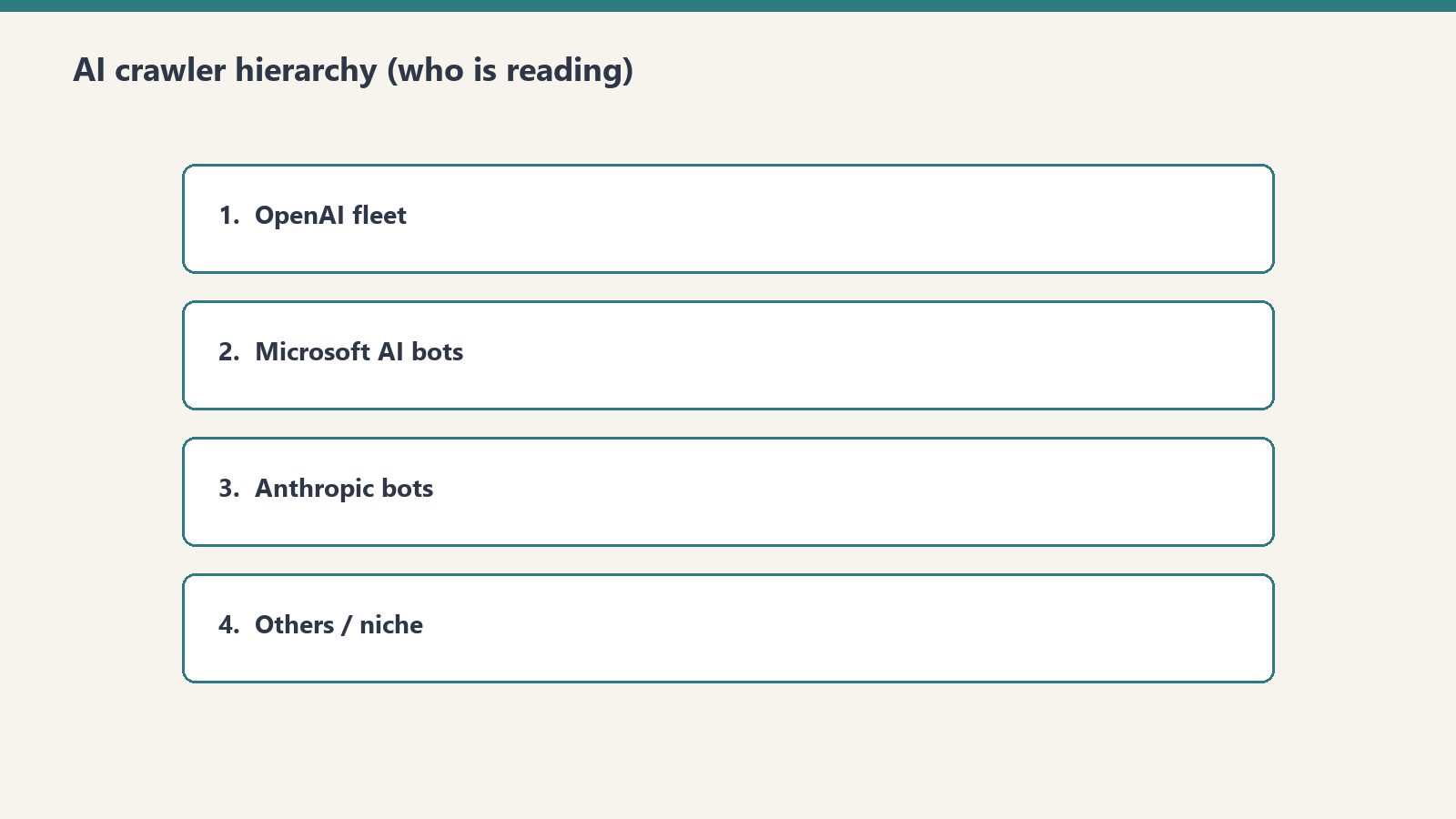
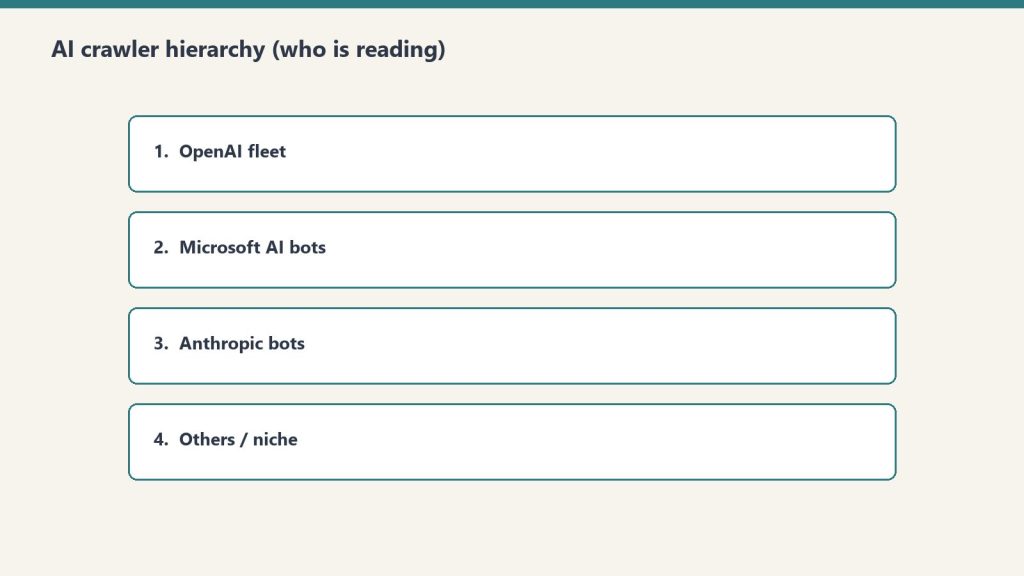
  • The AI Crawler Hierarchy: Who’s Reading Your Content and Why It Matters

    The AI Crawler Hierarchy: Who’s Reading Your Content and Why It Matters

    Definition: AI crawlers are automated web agents deployed by artificial intelligence companies to discover, evaluate, and retrieve web content for use in AI model training, search retrieval, and real-time answer generation. Unlike traditional search engine crawlers that index content for organic search rankings, AI crawlers serve a hierarchy of distinct purposes — and understanding that hierarchy is now essential for any publisher who wants their content cited by AI systems.

    When we published 40 Microsoft Copilot articles on tygartmedia.com and monitored our server logs for 48 hours, we recorded 6,805 AI crawler hits — 39% more than the 4,897 hits from traditional search crawlers Googlebot and Bingbot combined (Tygart Media server log analysis, June 2026). But the raw number only tells part of the story. The real insight came from breaking down those hits by crawler identity: each AI crawler serves a different purpose, operates under different rules, and signals something different about how AI systems are evaluating your content. This reference guide maps every major AI crawler, explains what each one does, and shows you what their activity means for your content strategy.

    Why AI Crawlers Are Now More Active Than Traditional Search Crawlers

    The shift happened faster than most publishers realize. In our 48-hour monitoring window, AI-specific crawlers generated 6,805 hits compared to 4,897 from Googlebot and Bingbot combined — a 39% traffic advantage for AI systems (Tygart Media server log analysis, June 2026). This aligns with broader industry data: Cloudflare reported in 2025 that AI crawlers were generating more than 50 billion requests per day across the web.

    This is not a temporary spike. AI systems are fundamentally more request-intensive than traditional search engines because they serve multiple purposes simultaneously: training data collection, search index building, and real-time content retrieval for live user queries. A single piece of content might be visited by GPTBot for training evaluation, by OAI-SearchBot for search indexing, and by ChatGPT-User when a real person asks a question — three distinct visits from three distinct crawlers, all from the same company (OpenAI), all serving different functions.

    The OpenAI Crawler Fleet: GPTBot, ChatGPT-User, and OAI-SearchBot

    OpenAI operates the most active AI crawler fleet on the web, with three distinct crawlers that each serve a different purpose. Understanding the difference between them is critical because each one tells you something different about how OpenAI’s systems are evaluating your content.

    GPTBot — The Training and Evaluation Crawler

    Operator: OpenAI
    Purpose: Gathers content which may be used to train OpenAI’s generative AI foundation models
    User Agent String: Mozilla/5.0 AppleWebKit/537.36 (KHTML, like Gecko); compatible; GPTBot/1.1; +https://openai.com/gptbot
    IP Range Source: https://openai.com/gptbot.json
    Robots.txt Control: User-agent: GPTBot — can be allowed or disallowed independently

    GPTBot is OpenAI’s primary training data crawler. When GPTBot visits your site, it is evaluating whether your content is suitable for inclusion in the training datasets used to build and improve OpenAI’s large language models. In our server log analysis, we observed GPTBot execute a dramatic 1,123-request structural crawl in a single hour at 11:00 UTC on June 22, 2026, systematically visiting every article in our Copilot content cluster (Tygart Media server log analysis, June 2026). This burst pattern — concentrated, systematic, and thorough — is characteristic of GPTBot performing a domain-wide quality assessment.

    The critical distinction: blocking GPTBot via robots.txt prevents your content from being used for training, but it does not prevent your content from appearing in ChatGPT’s search results. GPTBot and the search crawlers operate independently.

    ChatGPT-User — The Live Query Crawler

    Operator: OpenAI
    Purpose: Fetches a web page on demand when a user inside ChatGPT asks a question — not a training crawler
    User Agent String: Mozilla/5.0 AppleWebKit/537.36 (KHTML, like Gecko); compatible; ChatGPT-User/1.0; +https://openai.com/bot
    IP Range Source: https://openai.com/chatgpt-user.json
    Robots.txt Control: User-agent: ChatGPT-User

    ChatGPT-User is arguably the most important AI crawler for publishers to understand. Every single ChatGPT-User hit in your server logs represents a real person, right now, asking ChatGPT a question and ChatGPT fetching your page to help formulate an answer. This is not background crawling. This is not training data collection. This is live, query-driven traffic — the AI equivalent of a user clicking on your search result, except the AI is doing the clicking on the user’s behalf.

    In our 48-hour experiment, ChatGPT-User generated 3,404 hits — the single largest source of AI crawler traffic to our content (Tygart Media server log analysis, June 2026). Each of those 3,404 hits represents a real user’s query being answered using our content. The volume is staggering and represents a content discovery channel that did not exist three years ago.

    User agent versions 1.0, 2.0, and 3.0 have all been observed in server logs across the industry, indicating that OpenAI has iterated on the ChatGPT-User crawler multiple times.

    OAI-SearchBot — The Search Index Crawler

    Operator: OpenAI
    Purpose: Powers ChatGPT Search by indexing pages for retrieval and citation — a completely separate system from training data collection
    User Agent String: Mozilla/5.0 AppleWebKit/537.36 (KHTML, like Gecko); compatible; OAI-SearchBot/1.0; +https://openai.com/searchbot
    IP Range Source: https://openai.com/searchbot.json
    Robots.txt Control: User-agent: OAI-SearchBot

    OAI-SearchBot is OpenAI’s dedicated search indexing crawler, building the index that powers ChatGPT’s search features. Think of it as OpenAI’s equivalent of Googlebot — it crawls the web to build a searchable index, not to collect training data. The key distinction from ChatGPT-User is timing: OAI-SearchBot crawls proactively to build the index, while ChatGPT-User fetches reactively when a user asks a question.

    For publishers, OAI-SearchBot activity is a leading indicator. If OAI-SearchBot is regularly crawling your content, your pages are being added to ChatGPT’s search index, which means they are available for citation in ChatGPT Search results. If OAI-SearchBot is not visiting your content, your pages may not appear in ChatGPT’s web-grounded answers even if GPTBot has crawled them for training purposes.

    Microsoft’s AI Crawlers: Bingbot and AzureAI-SearchBot

    Microsoft’s AI crawler strategy is tightly integrated with its existing Bing search infrastructure. Unlike OpenAI, which built a separate crawler fleet from scratch, Microsoft leverages Bingbot — the world’s second-largest search crawler — as the primary discovery mechanism for its AI systems, including Microsoft Copilot.

    Bingbot — The Dual-Purpose Search and AI Crawler

    Operator: Microsoft
    Purpose: Powers both Bing search results and Microsoft Copilot’s web-grounded answers
    User Agent String: Mozilla/5.0 AppleWebKit/537.36 (KHTML, like Gecko); compatible; bingbot/2.0; +http://www.bing.com/bingbot.htm
    Robots.txt Control: User-agent: bingbot

    Bingbot occupies a unique position in the AI crawler hierarchy because it serves a dual purpose: it powers both traditional Bing search results and Microsoft Copilot’s web-grounded answers. When Bingbot indexes your content, that content becomes available to Copilot’s retrieval system. This makes Bingbot the most important single crawler for Copilot citation — if Bingbot has not indexed your page, Copilot cannot cite it.

    In our experiment, Bingbot demonstrated remarkable speed and consistency. It was the first crawler to reach every single one of our 40 articles, with a predictable 4-hour post-publish gap triggered by our IndexNow implementation (Tygart Media server log analysis, June 2026). This consistency makes Bingbot behavior highly predictable for publishers who use IndexNow — you can expect your content to be discoverable by Copilot within 4 hours of publication.

    AzureAI-SearchBot — Microsoft’s Specialized AI Crawler

    Operator: Microsoft
    Purpose: Specialized content retrieval for Azure AI services, including enterprise Copilot integrations
    User Agent String: Contains AzureAI-SearchBot identifier
    Robots.txt Control: User-agent: AzureAI-SearchBot

    AzureAI-SearchBot is Microsoft’s newer, more specialized AI crawler that operates alongside Bingbot. While Bingbot handles broad web indexing, AzureAI-SearchBot appears to perform more selective, targeted content evaluation for Azure AI services. In our server logs, AzureAI-SearchBot generated only 3 hits during the 48-hour monitoring window — compared to Bingbot’s hundreds of hits — suggesting a highly selective evaluation pattern rather than broad crawling (Tygart Media server log analysis, June 2026).

    The low volume but deliberate targeting of AzureAI-SearchBot suggests it may be evaluating content for enterprise Copilot integrations or specialized Azure AI services rather than the consumer-facing Copilot product. Publishers who see AzureAI-SearchBot hits in their logs may be candidates for higher-trust citation treatment in Microsoft’s enterprise AI products.

    Anthropic’s Crawlers: ClaudeBot and Claude-SearchBot

    ClaudeBot — Anthropic’s Training Crawler

    Operator: Anthropic
    Purpose: Collects content for training Anthropic’s Claude models
    User Agent String: Mozilla/5.0 AppleWebKit/537.36 (KHTML, like Gecko); compatible; ClaudeBot/1.0; +https://www.anthropic.com/claubot
    Robots.txt Control: User-agent: ClaudeBot

    ClaudeBot is Anthropic’s crawler for collecting training data for the Claude family of AI models. Like GPTBot, ClaudeBot crawls the web to evaluate and potentially collect content for model training. According to Cloudflare data, as of January 2026, Googlebot reached 1.70 times more unique URLs than ClaudeBot, placing ClaudeBot as one of the most active AI crawlers on the web in terms of coverage breadth.

    Claude-SearchBot — Anthropic’s Retrieval Crawler

    Operator: Anthropic
    Purpose: Retrieves web content for Claude’s search and citation features
    Robots.txt Control: User-agent: Claude-SearchBot — independently controllable from ClaudeBot

    Claude-SearchBot is Anthropic’s dedicated search retrieval crawler, separate from ClaudeBot. The critical detail for publishers: Claude-SearchBot and ClaudeBot can be controlled independently via robots.txt. This means publishers can allow Claude-SearchBot (enabling their content to appear in Claude’s retrieval and citation features) while disallowing ClaudeBot (keeping content out of training data). This granular control model is unique among major AI companies and represents a publisher-friendly approach to the training-versus-retrieval distinction.

    Other Major AI Crawlers You Should Know

    PerplexityBot

    Operator: Perplexity AI
    Purpose: Indexes content for Perplexity’s answer engine, which provides sourced answers with inline citations
    User Agent String: Contains PerplexityBot identifier
    Robots.txt Control: User-agent: PerplexityBot

    Perplexity operates as an AI-native answer engine that explicitly cites its sources with inline footnotes. PerplexityBot crawls the web to build Perplexity’s index. While smaller in scale than OpenAI’s or Anthropic’s crawlers — Cloudflare data shows Googlebot reaches 167 times more unique URLs than PerplexityBot — Perplexity’s citation-heavy model makes it particularly valuable for publishers who want visible attribution in AI-generated answers.

    Meta-ExternalAgent (Bytespider)

    Operator: Meta Platforms
    Purpose: Collects content for Meta’s AI products including Meta AI (powered by Llama models)
    User Agent String: Contains meta-externalagent identifier
    Robots.txt Control: User-agent: meta-externalagent

    Meta-ExternalAgent is Meta’s web crawler for AI content collection, supporting Meta’s Llama model family and Meta AI assistant products integrated across Facebook, Instagram, WhatsApp, and Messenger. According to Cloudflare data from January 2026, Googlebot reached 2.99 times more unique URLs than Meta-ExternalAgent, placing it as a significant but secondary crawler compared to OpenAI and Anthropic’s agents. The Bytespider crawler, associated with ByteDance (TikTok’s parent company), serves a similar training data collection function for ByteDance’s AI models.

    Google’s AI Crawlers

    Operator: Google
    Key User Agents: Google-Extended, Googlebot, Google-CloudVertexBot
    Robots.txt Control: User-agent: Google-Extended (for AI training opt-out)

    Google’s approach to AI crawling is unique because it leverages the existing Googlebot infrastructure rather than deploying entirely separate AI-specific crawlers. Googlebot serves double duty — indexing content for Google Search and providing the foundation for Google AI Overviews. Google-Extended is the opt-out mechanism: blocking Google-Extended prevents your content from being used for Gemini model training while still allowing Googlebot to index your content for search. Google-CloudVertexBot handles content retrieval for Google’s Vertex AI enterprise products.

    Notably, Google also operates specialized agents including Google-NotebookLM (for the NotebookLM product) and Google-Read-Aloud (for text-to-speech features), each controllable independently via robots.txt.

    Other Notable AI Crawlers

    Amazonbot: Amazon’s web crawler supporting Alexa and other Amazon AI products. User agent contains Amazonbot.
    Applebot: Apple’s crawler for Siri, Spotlight, and Apple Intelligence features. User agent contains Applebot.
    DuckAssistBot: DuckDuckGo’s AI assistant crawler for DuckAssist answers. User agent contains DuckAssistBot.
    CCBot: Common Crawl’s crawler, which produces the open dataset used by many AI companies for model training. Cloudflare data shows Googlebot reaches 714 times more unique URLs than CCBot.

    The AI Crawler Hierarchy: A Functional Classification

    Understanding the AI crawler landscape requires organizing these crawlers into functional tiers based on what their activity means for publishers:

    Tier 1: Real-Time Query Crawlers. ChatGPT-User and similar user-triggered crawlers. Every hit represents a real user’s question being answered right now. These are the highest-value signals because they indicate your content is actively being used to generate AI answers. In our experiment, ChatGPT-User was the dominant Tier 1 crawler with 3,404 hits (Tygart Media server log analysis, June 2026).

    Tier 2: Search Index Crawlers. OAI-SearchBot, Bingbot (for Copilot), Claude-SearchBot, PerplexityBot. These crawlers build the search indexes that AI systems query when answering questions. Activity from Tier 2 crawlers indicates your content is being indexed for potential citation. Bingbot’s consistent 4-hour IndexNow response made it our most reliable Tier 2 crawler.

    Tier 3: Training and Evaluation Crawlers. GPTBot, ClaudeBot, Meta-ExternalAgent, Google-Extended. These crawlers collect content for model training and evaluation. High activity from Tier 3 crawlers means your content is being considered for inclusion in training datasets. GPTBot’s 1,123-request burst crawl at 11:00 UTC exemplified Tier 3 behavior — systematic, comprehensive, evaluative (Tygart Media server log analysis, June 2026).

    Tier 4: Specialized and Emerging Crawlers. AzureAI-SearchBot, Google-NotebookLM, DuckAssistBot, Amazonbot. Lower volume, more targeted, often serving specific product use cases. Our observation of only 3 AzureAI-SearchBot hits suggests Tier 4 crawlers are highly selective (Tygart Media server log analysis, June 2026).

    How to Identify AI Crawlers in Your Server Logs

    Most publishers have never looked at their server logs for AI crawler activity because traditional analytics tools (Google Analytics, Adobe Analytics) do not capture bot traffic. To see AI crawlers, you need access to raw server logs — typically access.log or combined.log files on Apache or Nginx servers.

    The simplest approach is to grep your logs for known AI user agent strings. Here are the key strings to search for, based on our verified server log data and official documentation from each operator:

    GPTBot — OpenAI training crawler
    ChatGPT-User — OpenAI live query crawler
    OAI-SearchBot — OpenAI search index crawler
    bingbot — Microsoft search and Copilot crawler
    AzureAI-SearchBot — Microsoft specialized AI crawler
    ClaudeBot — Anthropic training crawler
    Claude-SearchBot — Anthropic retrieval crawler
    PerplexityBot — Perplexity answer engine crawler
    meta-externalagent — Meta AI crawler
    Google-Extended — Google AI training crawler
    Amazonbot — Amazon AI crawler
    Applebot — Apple AI crawler
    Bytespider — ByteDance AI crawler
    DuckAssistBot — DuckDuckGo AI assistant crawler
    CCBot — Common Crawl open dataset crawler

    What AI Crawler Activity Tells You About Your Content

    Different patterns of AI crawler activity reveal different things about how AI systems perceive your content:

    High ChatGPT-User volume: Your content is actively being used to answer real user queries. This is the strongest signal that your content is being cited by AI systems. Our 3,404 ChatGPT-User hits across the Copilot cluster confirmed that our content was being pulled into live answers (Tygart Media server log analysis, June 2026).

    GPTBot burst crawling: OpenAI’s systems have identified your domain as a potential authority source and are performing a deep evaluation. The 1,123-request burst we observed is characteristic of GPTBot’s domain evaluation pattern — it does not crawl this aggressively unless it has identified the domain as potentially high-value content (Tygart Media server log analysis, June 2026).

    Consistent Bingbot visits via IndexNow: Your IndexNow implementation is working, and your content is being indexed for Copilot citation. The 4-hour gap pattern we observed is your feedback loop — if Bingbot is arriving within hours of publication, your indexing pipeline is healthy.

    Low or zero AI crawler activity: Your content may be blocked by robots.txt, your server may be rejecting crawler requests, or your content may not be reaching the quality or topical relevance threshold for AI system evaluation. Check your robots.txt and server response codes for AI user agents.

    Managing AI Crawlers: Allow, Block, or Selective Access

    Publishers face a three-way decision for each AI crawler: allow full access (content can be used for training and retrieval), allow selective access (retrieval only, no training), or block entirely. The most nuanced approach — and the one we recommend — is selective access that allows retrieval crawlers while blocking training crawlers.

    Anthropic’s model is the most publisher-friendly in this regard: ClaudeBot (training) and Claude-SearchBot (retrieval) are independently controllable. OpenAI offers similar granularity: you can block GPTBot (training) while allowing ChatGPT-User (retrieval) and OAI-SearchBot (search indexing). Google allows blocking Google-Extended (training) while keeping Googlebot active for search.

    The practical implication: a robots.txt configuration that blocks training crawlers while allowing retrieval crawlers ensures your content is available for AI citation without contributing to model training datasets. This is the optimal configuration for most publishers who want to be cited by AI systems while maintaining control over their content’s use in training.

    Frequently Asked Questions

    What is the difference between GPTBot and ChatGPT-User?

    GPTBot is OpenAI’s training data crawler — it collects content that may be used to train and improve OpenAI’s foundation models. ChatGPT-User is a live query crawler that fetches web pages on demand when a real user asks ChatGPT a question. Every ChatGPT-User hit represents an actual user query being answered. They serve completely different purposes and can be controlled independently via robots.txt. In our server logs, ChatGPT-User generated 3,404 hits representing real user queries, while GPTBot performed a 1,123-request structural evaluation crawl (Tygart Media server log analysis, June 2026).

    How many AI crawlers are actively crawling the web in 2026?

    There are at least 15 major AI crawlers actively operating as of mid-2026, operated by OpenAI (GPTBot, ChatGPT-User, OAI-SearchBot), Microsoft (Bingbot, AzureAI-SearchBot), Anthropic (ClaudeBot, Claude-SearchBot), Google (Google-Extended, Google-CloudVertexBot, Google-NotebookLM), Meta (meta-externalagent), Perplexity (PerplexityBot), Amazon (Amazonbot), Apple (Applebot), ByteDance (Bytespider), DuckDuckGo (DuckAssistBot), and Common Crawl (CCBot). Cloudflare reported AI crawlers generating more than 50 billion requests per day in 2025, and that volume has continued to grow.

    Can I allow AI citation while blocking AI training on my content?

    Yes. Most major AI companies now separate their training crawlers from their retrieval crawlers, allowing publishers to control each independently via robots.txt. Block GPTBot and ClaudeBot (training) while allowing ChatGPT-User, OAI-SearchBot, and Claude-SearchBot (retrieval and citation). For Google, block Google-Extended while keeping Googlebot active. This configuration ensures your content can be cited in AI answers without being used to train models.

    Why don’t Google Analytics or similar tools show AI crawler traffic?

    Google Analytics and similar web analytics tools rely on JavaScript execution in a browser to record visits. AI crawlers do not execute JavaScript — they fetch the raw HTML of your page and process it server-side. This means AI crawler visits are completely invisible to any JavaScript-based analytics tool. The only way to see AI crawler activity is through server logs (access.log or combined.log files on Apache or Nginx), which record every HTTP request including those from bots and crawlers.

    What does a ChatGPT-User hit mean for my content strategy?

    A ChatGPT-User hit means a real person asked ChatGPT a question, and ChatGPT fetched your page to help generate the answer. This is the direct AI equivalent of a user clicking on your search result — except the AI is doing the retrieval. High ChatGPT-User volume on specific pages indicates those pages are being actively used as citation sources for live user queries. This is the strongest signal that your content is performing well in the AI search ecosystem and should be prioritized for updates, expansion, and optimization.

    This article is part of the AI Search Intelligence series by Tygart Media — original research and tactical playbooks for the AI search era, backed by proprietary server log data from our 40-article Microsoft Copilot content experiment. Related reading: How to Get Cited by Microsoft Copilot in 24 Hours | Microsoft Copilot Pricing Compared | The Complete M365 Copilot Productivity Guide

  • IndexNow Speed Test: How Fast Do Bing, GPT, and Google Actually Crawl New Content?

    IndexNow promises instant content discovery. But how fast is it really? We ran a controlled speed test — 40 articles published simultaneously to tygartmedia.com with IndexNow pings fired on every one — then measured exactly how long it took Bing, GPTBot, Google, and every other crawler to show up. The timestamps tell a story that IndexNow’s marketing materials do not.

    This is the second article in Tygart Media’s AI Search Intelligence series, based on proprietary server log data from our 40-article Microsoft Copilot content experiment conducted on June 22, 2026. Every timestamp and crawl interval cited here comes directly from our server access logs.

    What Is IndexNow and Why Speed Matters

    IndexNow is an open-source protocol that lets websites notify participating search engines the moment content is published or updated. Instead of waiting for a crawler to discover your new page organically — which can take days or weeks — IndexNow sends a direct ping saying “this URL has new content, come get it.”

    Microsoft developed IndexNow and Bing is its primary participant. Yandex, Naver, Seznam, and several other engines also participate. Google does not. As of early 2026, over 60 million websites use IndexNow, and 22% of clicked Bing URLs come from IndexNow submissions, according to Bing’s published data.

    For publishers, the speed question is not academic. If you are publishing time-sensitive content — news, product launches, competitive analysis — the difference between a 3-hour crawl delay and a 3-day crawl delay determines whether your content gets indexed before or after your competitors. And in the AI era, the question extends beyond traditional indexing: how fast do AI crawlers like GPTBot find your new content?

    Our Test Setup: 40 Articles, One Timestamp

    On June 22, 2026, we published 40 original articles about Microsoft Copilot to tygartmedia.com. The site runs WordPress with RankMath SEO on a Google Cloud Platform Compute Engine instance. RankMath handles IndexNow submissions automatically on publish.

    Every article was published within a short window, and IndexNow pings were fired for each URL. We then monitored our raw server access logs for every subsequent crawler visit, recording the user-agent string, timestamp, and requested URL for each hit.

    This gave us a clean dataset: 40 identical test cases (same site, same publish time, same IndexNow submission) with crawler-by-crawler arrival times we could compare head-to-head.

    Head-to-Head Results: Who Arrived First?

    Bing: 3 to 6 Hours via IndexNow

    Bingbot was the first traditional search engine crawler to reach our content, arriving within 3 to 6 hours of IndexNow submission. The pattern was remarkably consistent across all 40 articles — most fell within a tight 4-hour window from publication to first crawl.

    This is fast by search engine standards but not instant. IndexNow does not trigger immediate crawling. It places your URL into Bing’s priority crawl queue, and Bing processes that queue on its own schedule. For our batch of 40 articles, that schedule produced a 3-to-6-hour window with high consistency.

    For context, without IndexNow, new content on a site with our domain authority profile might wait 24 to 72 hours for Bing to discover it through sitemap parsing or link following. IndexNow compressed that to under 6 hours — a meaningful improvement for any publishing operation.

    GPTBot: Faster Than Bing

    Here is the result that surprised us most: GPTBot arrived at our content faster than Bingbot in many cases, despite GPTBot not being an official IndexNow participant.

    GPTBot is OpenAI’s crawler. It does not receive IndexNow pings directly. Yet it consistently reached our newly published articles before Bing’s own crawler had finished processing the IndexNow queue. At 11:00 UTC on June 22, GPTBot executed a 1,123-request structural crawl in a single hour, hitting not just article URLs but every tag, feed, and REST API endpoint on the site (Tygart Media server log analysis, June 2026).

    How does GPTBot discover content faster than IndexNow delivers it to Bing? The most likely explanation is that GPTBot monitors RSS feeds, sitemaps, or other real-time content signals independently. WordPress sites broadcast new content through multiple channels — RSS feeds update instantly, XML sitemaps regenerate on publish, and REST API endpoints reflect new posts immediately. GPTBot appears to be monitoring one or more of these channels with higher polling frequency than Bing’s IndexNow processing queue.

    The implication for publishers is significant: even if you do not use IndexNow, GPTBot is likely to find your new content quickly through other discovery mechanisms. But IndexNow remains essential for Bing-ecosystem discovery, which feeds Microsoft Copilot’s citation pipeline.

    YandexBot: 30 Seconds Behind Bing

    YandexBot arrived at each article approximately 30 seconds after Bingbot, with remarkable consistency across the full batch. Yandex participates in the IndexNow protocol, and this timing suggests Yandex processes IndexNow submissions from the same shared queue but with a slight processing delay relative to Bing (Tygart Media server log analysis, June 2026).

    The 30-second shadow is too consistent to be coincidental. It points to either a shared IndexNow notification infrastructure where Yandex processes submissions fractionally behind Bing, or to Yandex monitoring Bing’s crawl activity directly. Either way, publishers who submit to IndexNow get both Bing and Yandex coverage from a single ping.

    Googlebot: Effectively Absent

    Googlebot recorded only 1 hit on our Copilot content in the initial crawl window (Tygart Media server log analysis, June 2026). One hit. Across 40 articles. While Bing had crawled every article within 6 hours and GPTBot had mapped the entire site architecture.

    Google does not participate in IndexNow. Google has stated publicly that it relies on its own crawl scheduling, which considers factors like site crawl budget, historical update frequency, and sitemap change signals. For a batch of 40 new articles on a topic the site had not previously covered, Google’s algorithms apparently did not prioritize rapid discovery.

    This is not a criticism of Google’s approach — its crawl scheduling optimizes for different goals than real-time discovery. But for publishers who need content indexed quickly, the data is unambiguous: IndexNow-participating engines discover content in hours. Google discovers it on its own timeline.

    The IndexNow Technical Gotcha We Discovered

    During our experiment, we identified a technical issue that could affect other publishers: the IndexNow key file was returning a 404 at the standard verification paths where search engines expect to find it.

    IndexNow requires a verification key file at your site root (e.g., yourdomain.com/{key}.txt). Search engines check this file to confirm you authorized the IndexNow submission. In our case, the key file was not accessible at the expected root-level path, which should have caused verification failures.

    RankMath SEO’s fallback mechanism saved us — it handles IndexNow key verification through an alternative method that does not require the physical key file to exist at the root URL. But publishers using manual IndexNow implementations, or other SEO plugins without this fallback, should verify their key file is accessible by navigating directly to the expected URL.

    If your IndexNow submissions seem to be ignored by Bing, check the key file first. A 404 on the verification file silently kills the entire pipeline — Bing will not crawl the submitted URLs without successful verification.

    What the Speed Test Means for Your Publishing Strategy

    For Bing and Copilot Visibility

    IndexNow is the fastest path to Bing’s index, and Bing’s index feeds Microsoft Copilot’s citation system. Our 40-article experiment earned 3 confirmed Copilot citation referrals within 48 hours, and that pipeline started with IndexNow getting our content into Bing’s index within hours of publication.

    If you are publishing content that you want Copilot to cite, IndexNow is not optional — it is the first link in the citation chain.

    For AI Crawler Discovery

    GPTBot does not use IndexNow, but it finds new content fast anyway — faster than Bing in our test. This means your site’s real-time content signals (RSS feeds, sitemaps, REST API endpoints) are the discovery mechanism for OpenAI’s crawler ecosystem. Keep these endpoints clean, accessible, and unblocked in your robots.txt if you want AI systems to discover your content quickly.

    For Google

    Google’s crawl scheduling operates independently of IndexNow. If rapid Google indexing is important to you, continue submitting sitemaps through Google Search Console and requesting indexing for priority pages through the URL Inspection tool. Do not rely on IndexNow for Google discovery — the protocol has no effect on Google’s crawl behavior based on our data.

    For Multi-Engine Strategy

    The practical recommendation is to run both systems in parallel: IndexNow for Bing, Yandex, and the downstream AI systems that rely on Bing’s index, plus Google Search Console for Google’s independent crawl pipeline. Most WordPress SEO plugins handle IndexNow automatically, so the incremental effort is near zero.

    The Speed Hierarchy: From Fastest to Slowest

    Based on our server log data from the 40-article experiment, here is the definitive crawl speed ranking for newly published, IndexNow-submitted content (Tygart Media server log analysis, June 2026):

    1. GPTBot — fastest overall; arrived before IndexNow results in many cases; 1,123-request structural crawl in one hour
    2. ChatGPT-User — 3,404 hits over 48 hours; activates when real users query ChatGPT about relevant topics
    3. Bingbot — 3 to 6 hours via IndexNow; consistent, predictable timing
    4. YandexBot — ~30 seconds behind Bingbot; piggybacks on IndexNow shared infrastructure
    5. OAI-SearchBot — 3 hits total; minimal presence; appears highly selective
    6. AzureAI-SearchBot — 3 hits total; minimal presence
    7. Googlebot — 1 hit in initial window; operates on its own schedule independent of IndexNow

    The gap between the top of this list and the bottom is not hours — it is the difference between same-day discovery and multi-day (or longer) discovery. For publishers who need content discovered quickly, the AI crawlers and IndexNow-participating engines are delivering results that Google’s independent crawl schedule simply does not match.

    A Note on Methodology and Reproducibility

    Every crawl timestamp and interval cited in this article comes from raw server access logs on Tygart Media’s Google Cloud Platform Compute Engine instance, analyzed in June 2026. Crawler identification was performed by user-agent string matching, with IP range verification against OpenAI’s and Microsoft’s published crawler IP ranges for additional confirmation.

    The 40-article batch was published simultaneously to control for timing variables. All articles were submitted via IndexNow through RankMath SEO’s automatic submission feature. No manual crawl requests were submitted through Google Search Console, Bing Webmaster Tools, or any other interface — we wanted to measure organic and IndexNow-driven discovery only.

    This experiment is reproducible. Any publisher running a WordPress site with IndexNow enabled can monitor their server access logs after a batch publish and observe the same crawler patterns. The specific timing intervals may vary based on domain authority, server location, and crawl budget allocation, but the relative ordering — GPTBot fastest, Bing via IndexNow in hours, Google on its own schedule — should hold across most publishing environments.

    For the complete dataset including all crawler hit counts and the full methodology, see our anchor article: We Published 40 Articles and Watched Every AI Crawler in Real Time.

    Frequently Asked Questions

    How fast does IndexNow actually get content crawled by Bing?

    In our controlled test of 40 simultaneously published articles, IndexNow submissions resulted in first Bingbot crawls within 3 to 6 hours, with most articles falling in a consistent 4-hour window. This is significantly faster than the 24-to-72-hour organic discovery timeline for sites without IndexNow, but it is not instant — Bing queues IndexNow submissions and processes them on its own crawl schedule (Tygart Media server log analysis, June 2026).

    Does GPTBot use IndexNow to discover content?

    No. GPTBot is not an IndexNow participant, yet it arrived at our content faster than Bingbot in many cases. GPTBot appears to monitor RSS feeds, XML sitemaps, or REST API endpoints independently, giving it a faster discovery pipeline than Bing’s IndexNow processing queue. In our experiment, GPTBot executed a 1,123-request structural crawl at 11:00 UTC, mapping the entire site architecture within a single hour (Tygart Media server log analysis, June 2026).

    Does Google support IndexNow?

    No. Google does not participate in the IndexNow protocol as of June 2026. In our experiment, Googlebot recorded only 1 hit on our 40-article batch while Bingbot and GPTBot had fully crawled the content. Google relies on its own crawl scheduling algorithms and recommends using Google Search Console’s sitemap submission and URL Inspection tool for prioritized crawling (Tygart Media server log analysis, June 2026).

    Why was YandexBot always 30 seconds behind Bingbot?

    YandexBot, as an IndexNow participant, appears to process submissions from a shared notification infrastructure with a slight delay relative to Bing. The consistent 30-second gap across all 40 articles suggests either a shared queue processed fractionally behind Bing or direct monitoring of Bing’s crawl activity. The practical result is that a single IndexNow ping delivers both Bing and Yandex crawls almost simultaneously (Tygart Media server log analysis, June 2026).

    What should publishers do if IndexNow submissions are being ignored by Bing?

    Check your IndexNow key file first. The key file must be accessible at your domain root (e.g., yourdomain.com/{key}.txt). In our experiment, the key file was returning a 404 at standard paths, which would have silently killed the pipeline. Our RankMath SEO plugin’s fallback mechanism handled verification, but publishers using manual implementations should navigate directly to their key file URL to confirm it returns a 200 response (Tygart Media server log analysis, June 2026).