By Will Tygart • Long-form Position • Practitioner-grade
A chapter is a room. The room contains people who do business with each other in a specific geography. The room meets regularly, in an environment that builds genuine relationships. The room trusts the organization that convened it.
From a distribution standpoint, that’s almost an unfair asset.
Cold outreach to restoration contractors in Phoenix produces results consistent with cold outreach to anyone: under 5% response rate on a good day, conversion rates measured in single digits. An introduction at an RGL Phoenix event — made by a chapter ambassador who the contractor already trusts — produces results consistent with a warm referral from a peer. Same product. Same price. Different relationship context. Dramatically different conversion.
The Chapter Multiplication Effect
Seventeen chapters means seventeen geography-specific trust networks, each with their own membership of contractors, adjusters, agents, vendors, and property managers. Each chapter runs multiple events per year. Each event is an opportunity to be introduced, in context, to people who already know the organization that vouched for you.
The cost of accessing those introductions through traditional sales channels — hiring sales reps, running targeted ads, attending trade shows, building local SEO in seventeen markets — is not comparable. The network does the geographic distribution. The sponsorship buys access to the network’s trust infrastructure at a fraction of the cost of building it independently.
The Vendor Cascade
Each restoration company is a node with a vendor ecosystem behind it. The plumber they call for every water damage job. The roofer they sub after fire losses. The HVAC contractor they recommend when the remediation is done. The general contractor they partner with on large rebuilds.
Every one of those vendors needs what a restoration-focused digital agency provides. And the introduction that produces a new vendor client doesn’t come from cold outreach — it comes from the restoration contractor who says “this is my SEO guy, he understands our industry, you should talk to him.” That introduction is warm by definition. The vendor already trusts the person making it.
The chapter model turns one restoration client into three to five adjacent opportunities. Seventeen chapters with one to two restoration clients each produces a referral network that compounds. The math isn’t complicated. The patience to let it develop is the hard part.
Presence Without Travel
The secondary distribution effect is content. Articles, frameworks, and resources published with RGL positioning reach chapter memberships across all seventeen markets without requiring physical presence in any of them. A post that serves restoration professionals in Phoenix also serves them in Houston, Denver, Charlotte, and Southern California.
The chapter events create the trust layer. The content maintains presence between events. Combined, the sponsorship produces a distribution footprint that would cost significantly more to replicate through advertising or direct outreach — and produces a qualitatively different kind of visibility, because it’s embedded in a community rather than broadcast at one.
By Will Tygart • Long-form Position • Practitioner-grade
Most B2B networking formats have a fundamental problem: everyone in the room knows they’re there to network. That awareness changes behavior. The pitch antenna goes up. The business card comes out. The conversation is conducted with at least one eye on whether this person is a useful contact.
Golf solves this problem structurally. The stated purpose of being on a golf course is golf. The conversation that happens alongside it is incidental — which is exactly what makes it not incidental at all.
What Four Hours Does That Other Formats Can’t
A trade show interaction is five minutes if it goes well. A coffee meeting is forty-five. A lunch is ninety. A round of golf is four hours, in a setting with no phones, no presentations, no agenda, and a shared activity that provides natural conversation scaffolding without requiring anyone to perform networking.
The time matters because trust is built through accumulation of low-stakes interactions, not through single high-stakes ones. Four hours of casual, peer-level conversation between a restoration contractor and a property manager produces a different kind of relationship than four forty-five minute coffee meetings over a year — even though the total time is similar. The continuity, the physical proximity, the shared experience of a bad hole or a good shot, the moment when someone’s guard comes down because they’re focused on a putt — these accumulate into something that scheduled meetings can’t replicate.
Why It Works Especially Well in the Trades
In industries where trust determines who gets the call, the quality of the relationship is the product. A property manager with a water loss at 2am is not running a procurement process. They’re calling the person they trust most to handle it correctly. Golf builds the trust layer that makes you that person.
The restoration industry specifically runs on referral relationships — adjuster to contractor, property manager to contractor, contractor to specialty subcontractor. Every link in that chain is a trust relationship that preceded a business transaction. The contractors who consistently get the best work are not the ones with the best website or the highest review count. They’re the ones whose names come to mind first when someone needs to make a recommendation.
Golf is the environment where those names get lodged. Not through a pitch — through four hours of being a person someone enjoyed spending time with.
The Peer-Level Dynamic
Golf enforces equality in a way that most business environments don’t. On the course, everyone is equally subject to the conditions. The senior adjuster and the junior contractor are having the same experience — same wind, same rough, same pressure on the 18th. This equality of condition produces peer-level conversation that rarely happens in settings where professional hierarchy is visible.
Peer-level conversation is where trust forms. When someone shares a genuine opinion about a difficult claim, a frustrating TPA policy, or a subcontractor who keeps letting them down — information they’d never share in a formal meeting — the relationship has moved to a level that formal networking cannot produce. That’s the golf infrastructure working.
By Will Tygart • Long-form Position • Practitioner-grade
I sponsor a golf league.
Not a tour. Not a country club event. A B2B networking league built around the property damage restoration industry — contractors, adjusters, vendors, consultants, equipment suppliers, TPAs. Seventeen chapters across the country, each running events in their local market, each building the same thing: a room full of people who do business together, on a golf course, without their phones in their hands for four hours.
I didn’t build it. I didn’t found it. I didn’t hire the chapter ambassadors or negotiate the venues or design the scoring format. Those people did the work of building the organization. What I did was recognize what I was looking at and invest accordingly.
That distinction — sponsor versus owner — is the entire strategic point. And it’s almost never discussed in the literature about B2B networking, which tends to assume that to benefit from a network you need to run it.
You don’t. In some situations, you get more from being the most committed non-founder in the room than you would from being the founder. This is one of those situations, and understanding why requires understanding what a sponsored network actually provides versus what organizational ownership provides.
What the Owner Has That the Sponsor Doesn’t
The organization’s founder has control. They set the membership criteria, the chapter structure, the event format, the brand standards. They make the decisions about which markets to enter, which sponsors to accept, which directions to grow. They bear the operational overhead — the logistics, the coordination, the member management, the chapters that underperform and need attention.
Control is valuable. Operational overhead is expensive. For a solo operator running an AI-native content agency, the overhead of running a 17-chapter national networking organization is not compatible with the overhead of running 27 client WordPress sites, building content infrastructure, managing a GCP stack, and doing the writing. The person who built RGL made it their primary vehicle. I couldn’t make it mine without sacrificing what I’ve built elsewhere.
So I don’t have control. What do I have instead?
What the Committed Sponsor Has That the Owner Doesn’t
Credibility without burden. Trust without administration. Presence in every chapter market without the cost of maintaining a presence in every chapter market.
When a restoration contractor in Phoenix meets me at an RGL event, the context of that meeting is: I’m the person who invested in this thing they’re already part of, in their market, because I believe in what it’s doing. That’s a fundamentally different first impression than cold outreach. It’s even different from a vendor booth at a trade show, where the context is: I paid to have access to this audience.
Sponsorship inside a trust network signals alignment, not just interest. The people in the room are already there because they chose to participate in something that requires showing up — physically, repeatedly, over time. A sponsor who shares that belief system is perceived as one of them, not as someone who bought access to them.
The second thing the committed sponsor has: distributed presence. Seventeen chapters run events throughout the year in seventeen markets. Every event is an opportunity for Tygart Media to be in the room — not because I’m traveling to seventeen markets, but because the sponsorship means my name and my work are part of the organization’s identity in each of them. The chapter ambassador in Charlotte is introducing me as a sponsor before I’ve ever been to Charlotte. That’s distribution I couldn’t buy with advertising and couldn’t build with cold outreach.
The Trust Infrastructure That Golf Specifically Builds
The vehicle matters. RGL is a golf league, not a trade association or a conference or a LinkedIn group, and the choice of golf is not arbitrary. Golf creates something that almost no other B2B networking format creates: four uninterrupted hours of low-stakes, relationship-building conversation between people who are ostensibly there for something other than business.
The property manager and the restoration contractor are walking the same fairway, waiting for the same slow group ahead, talking about whatever comes up. The insurance adjuster and the equipment rep are sharing a cart for two hours. None of this is structured. None of it is a pitch. The relationship that forms is peer-level because golf is a peer-level environment — everyone is equally subject to the wind, the rough, and the occasional shank.
Compare this to the environments where most B2B relationships in the restoration industry form: trade show floors (loud, transactional, everyone scanning badges), vendor lunch programs (one party is clearly the host with an agenda), referral calls (cold or at best lukewarm, purpose-driven from the first sentence), and job sites (one party has positional authority over the other). None of these formats produce the kind of trust that golf produces, because none of them have four hours and no agenda.
The research on this is consistent: golf relationships convert to business relationships at higher rates than almost any other networking format, particularly in industries where trust determines who gets the call — construction, financial services, professional services, and the trades broadly. In restoration specifically, where a property manager is handing over a damaged building to someone they need to trust not to make it worse, the relationship quality matters enormously. A contractor who the PM has played golf with three times is not the same as a contractor who submitted the lowest bid on a cold RFP.
Chapters as Distribution Nodes
Here is the math that the second brain has been working on since I started taking the RGL sponsorship seriously.
Each chapter is a node in a trust network that contains: restoration contractors, insurance adjusters, insurance agents, public adjusters, equipment suppliers, specialty subcontractors, TPAs, and property managers. These are exactly the people who need what Tygart Media builds — SEO-optimized WordPress infrastructure, AI-native content pipelines, local search visibility.
A cold outreach to a restoration contractor in Phoenix gets a response rate consistent with cold outreach to anyone: under 5% on a good day, often much less. An introduction at an RGL Phoenix event — “this is Will, he’s the guy who sponsors the league, he runs digital for restoration companies” — gets a response rate consistent with a warm referral from a trusted peer. The same information, the same product, the same price, presented in two different relationship contexts, produces dramatically different conversion.
The compounding effect: each contractor client who comes through an RGL chapter introduction has a vendor ecosystem behind them. The plumber they call for every water damage job. The roofer they sub to after fire losses. The HVAC contractor they recommend when the remediation is done. Every one of those vendors needs the same thing — local SEO, a website that works, someone who understands their industry because they’re already inside it. The restoration company owner introduces you because you’re their person. You’re not pitching a cold vendor. You’re getting handed the relationship.
Seventeen chapters, running multiple events per year each. The math isn’t complicated. The question is whether the distribution infrastructure is being used strategically or just passively.
Network-Led Sales vs. Cold Outreach: The Structural Difference
Cold outreach is a numbers game. You contact enough people, a percentage respond, a percentage of those convert. The ratio is predictable and it’s low. The cost per acquisition is high because the conversion rate at the top of the funnel is low. This is the model most agencies run on because it’s scalable and doesn’t require the patience or investment that network-led growth requires.
Network-led sales is an entirely different model. The funnel starts not at outreach but at relationship. The relationship precedes the sales conversation. When the sales conversation happens — if it needs to happen at all — the context is already favorable. The prospect already knows who you are and why you’re credible. The objection is not “I don’t know you” but “is this the right time” — a much more solvable problem.
The tradeoff is time and investment. Network-led growth requires consistent presence over time, investment in the network’s success (not just personal extraction from it), and patience for the trust to compound before the pipeline materializes. For someone who wants clients this quarter, it’s too slow. For someone building a durable operation over years, it’s the only model that actually compounds.
The RGL sponsorship is a three-year investment that is still in early returns. The relationships built in year one convert in year two or three. The contractor who saw my name at six events and then had a conversation over drinks at the seventh is not comparing me to a cold outreach from a competitor — I’m already the default. The comparison set is empty.
What the Sponsorship Requires to Work
Passive sponsorship — writing a check and putting your logo on the website — produces brand awareness among people who are passively aware of the organization. That has some value and not much.
Active sponsorship — showing up, contributing, becoming genuinely part of the community — produces something different. The sponsorship that builds real pipeline requires the same thing the best sales relationships have always required: genuine investment in the other party’s success before asking for anything.
For RGL, that means showing up at chapter events when possible. Contributing content that serves the membership — articles, resources, frameworks that help restoration companies build better operations — not content that promotes your services. Introducing members to each other when you see an opportunity. Being the person in the network who gives more than they take, for long enough that the network comes to see you that way.
This is not a counterintuitive strategy. It’s the oldest sales strategy there is. What makes it work in a sponsored network specifically is that the organization does the community-building work for you. You don’t have to gather the room — the league gathers the room. You show up in the room that already exists and you add value. The infrastructure belongs to someone else. The trust you build inside it belongs to you.
Frequently Asked Questions
How do you measure ROI on a sponsorship like this?
The direct measure is client relationships that originated through RGL introductions. The indirect measure is harder but more important: the inbound reputation that makes cold outreach unnecessary for a growing percentage of new business. Sponsorship ROI is measured in years, not quarters. The mistake is applying quarterly conversion metrics to a relationship investment that operates on a different timeline.
What’s the difference between sponsoring a network and advertising to it?
Advertising is transactional — you pay for access to an audience and they see your message with the full awareness that you paid for the access. Sponsorship of a trust network is relational — you invest in the community’s infrastructure and are perceived as a member of it, not a vendor pitching at it. The same people receive both messages differently. The conversion dynamic is not comparable.
Does this strategy require significant travel and in-person time?
In-person presence amplifies it significantly but isn’t the only input. The content contribution — articles, frameworks, resources that RGL members find genuinely useful — builds presence in every chapter market without travel. The person who shows up at events AND provides consistent value between events compounds faster than someone doing either alone.
Can this model be replicated in other industries?
Yes, with one prerequisite: the network has to actually exist and have genuine trust value. A manufactured networking organization, or one where membership is purely transactional, doesn’t produce the same effect. The RGL works because the golf format builds real relationships and the industry focus means every room is full of people who actually do business together. The model transfers to any field where a genuine trust network exists and where sponsorship access is available — which is most industries, because most genuine trust networks are underwritten.
By Will Tygart • Long-form Position • Practitioner-grade
A CRM is a tool. A community is a behavior.
This distinction sounds like semantics until you look at what most CRM implementations actually produce: a database of contacts that generates reports nobody reads, email campaigns that nobody opens, and a slowly growing list of people the company has never meaningfully contacted since acquiring them.
The tool-first CRM implementation asks: what does this software let us do? The answer is: segment, score, automate, report. So the operation segments, scores, automates, and reports — and the contacts remain strangers who occasionally receive promotional emails.
The behavior-first question is different: what do we want to happen between our company and the people who know us? The answer, for a restoration company, is: we want to stay present in the lives of people who’ve worked with us, so that when they or someone they know has a property damage event, our name is the first one that comes to mind.
That behavior — staying present, human, and relevant in a warm network — requires almost nothing from a CRM tool. It requires a segmented contact list, a simple email platform, and a calendar. The behavior does the work. The tools are almost irrelevant to the outcome.
What the Behavior Actually Requires
The CRM community behavior has four components, all of which can be executed with tools most restoration companies already have:
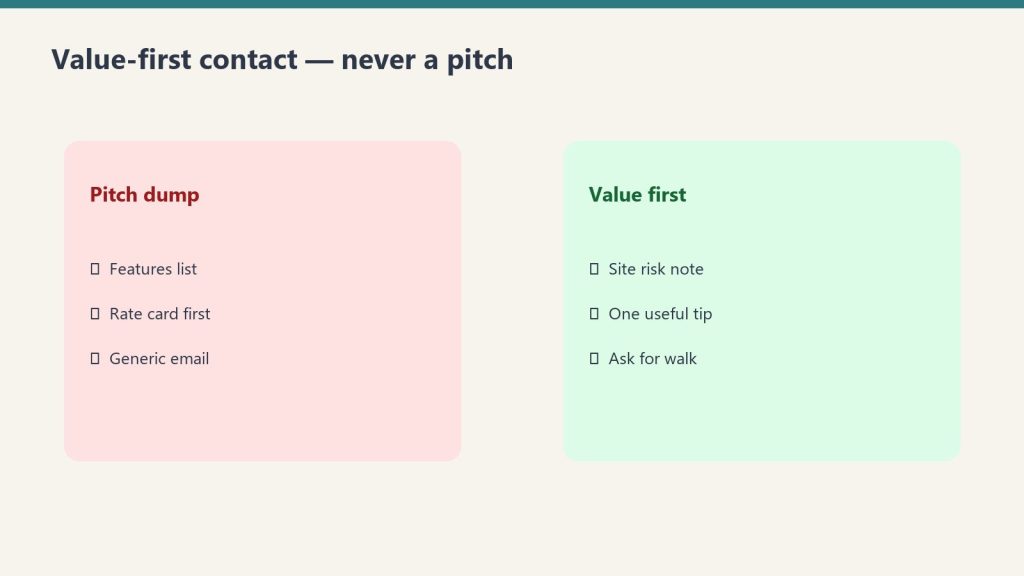
A reason to reach out that isn’t a sales pitch. The hiring email. The vendor referral ask. The pre-season safety checklist. The company anniversary note. These are legitimate business moments that provide a human reason for contact. The contact feels respected rather than marketed to. The company stays present without demanding anything.
A segmented list. Three segments — past homeowner clients, industry contacts (adjusters, agents), trade contacts (vendors, subs) — with slightly different framing on the same message. The segmentation takes one afternoon to build from an existing job management system export. It never needs to be rebuilt.
A calendar with four to six dates per year. This is the system. Not the CRM. Not the automation platform. The calendar that says: March, we hire or ask for a sub. June, we send the storm prep checklist. August, we mark the company anniversary. November, we hire again or ask for referral partners. The calendar makes the behavior consistent. Without it, the behavior doesn’t happen.
A simple log of what the contacts do. Who replied. Who referred someone. Who mentioned a neighbor with a flooded basement. This log — a Notion database, a Google Sheet, a notes field in the CRM — is the community intelligence layer. After two years, it shows you who your super-connectors are. These are the people to take to coffee, to thank personally, to treat as partners rather than contacts.
The Tool Is Almost Irrelevant
This behavior can be executed with a $13/month Mailchimp account, a spreadsheet, and a Google Calendar reminder. The restoration company spending $400/month on a marketing automation platform will not outperform it — because the outcome is determined by whether the behavior happens consistently, not by the sophistication of the tool executing it.
The CRM Community Framework series documents the full implementation: five strategy articles covering the behavior in detail, five technical briefs covering the tool setup from ServiceTitan/Jobber export through Mailchimp/Brevo configuration through Notion Second Brain architecture through Claude AI prompt library through GCP automation for teams that want to run it at scale.
The technical briefs exist because the tools matter for execution. But they are secondary documents. The primary document — the one that changes how a restoration company thinks about its database — is the behavioral argument. The tools serve it. They do not replace it.
Who this is for: The person who manages your company’s data — your office manager, operations coordinator, or IT contact. This is a technical brief. Hand it to them and say: “Build this for us.” The strategy behind it is in Your CRM Is Not a Lead Database.
What We’re Building and Why
What we’re building and why.
A restoration company’s customer relationship system contains contacts across multiple relationship types: past homeowner clients, insurance adjusters, insurance agents, public adjusters, subcontractors, suppliers, and vendors. The business value of these contacts is currently being left on the table because they all sit in a single undifferentiated list — or worse, in multiple disconnected systems.
This technical brief covers how to build a clean, three-segment contact database that can be exported to any email platform for the CRM community touch strategy. The output is a CSV-ready contact list with four fields: First Name, Email, Segment, and Job Type (for homeowners). The process takes 2–4 hours for a database of 200–1,000 contacts and does not require any new software purchases.
Step 1: Audit Your Current Data Sources
Step 1 — audit your current data sources.
Before building the segmented database, identify every place your contact data currently lives. For most restoration companies, this is a combination of:
Job management software (ServiceTitan, Jobber, Xactimate, or a custom system)
Accounting software (QuickBooks, FreshBooks) — often contains additional contact records
Email inbox — years of adjuster and agent correspondence with contact info in signatures
Business cards and physical records — especially older trade contacts
Google Contacts or Outlook — personal and professional contacts mixed together
Social media connections — LinkedIn connections that have business relationship context
Create a simple spreadsheet with one column per source and a rough count of contacts in each. This gives you the scope before you start merging.
Step 2: Export Raw Data from Each Source
ServiceTitan Export
Navigate to Customers in the left sidebar
Use the filter panel to select Customer Type: Residential for the homeowner segment; Commercial for business contacts
Click Export → Export to CSV
The export includes: customer name, address, phone, email, job history, and last job date
For the homeowner segment, add a filter for jobs completed in the last 5 years to avoid very stale contacts
Run a second export filtered to job type (Water Damage / Fire / Mold) to capture the Job Type field you’ll need for personalized emails
ServiceTitan note: The export may include multiple email addresses per contact (primary and secondary). Keep both in separate columns and let the email platform deduplicate. Do not discard secondary emails — these are often more reliably checked than the primary.
Jobber Export
Go to Clients in the navigation menu
Click the three-dot menu at the top right → Export
Select: Client Name, Email, Phone, Service Address, Tags, Last Job Date
The export is a CSV file. Open it in Excel or Google Sheets
If you’ve been using Jobber’s tags feature, filter by residential/commercial tag to create your segments. If not, sort by address type manually
Jobber note: Job type data lives in the Jobs table, not the Clients table. You’ll need to run a second export from Jobs (Reports → Job Reports → Export) and do a VLOOKUP on client ID to join job type data to client records.
QuickBooks Export
Go to Reports → Customer Contact List
Customize report to include: Customer Name, Email, Phone, Balance
Export → Export to Excel
This gives you billing-context contacts that may not appear in your job management system (e.g., commercial billing contacts, property management companies)
Email Inbox (for Industry Contacts)
For insurance adjusters and agents, the most reliable data source is often your email inbox. Here’s the efficient approach:
In Gmail, search for: “adjuster” OR “claims” OR “State Farm” OR “Allstate” OR “Farmers” — this surfaces the most relevant industry email threads
Export these to a spreadsheet: contact name, email, company, title (from email signatures)
In Outlook, use the same keyword search and export via File → Open & Export → Import/Export → Export to CSV
Expect 50–200 unique industry contacts from a 3-year inbox history
Step 3: Build the Master Contact Database
Step 3 — build the master contact database.
Consolidate all exported data into a single Google Sheet or Excel workbook with the following standardized columns:
Column
Format
Notes
First Name
Text
Separate from Last Name for personalization
Last Name
Text
Email
Email
Lowercase, validate format
Phone
Text
Keep for SMS campaigns if applicable
Segment
Select: Homeowner / Industry / Trade
The most important column
Job Type
Text: Water / Fire / Mold / Storm / Other
Homeowners only — leave blank for others
Job Date
Date
For homeowners — used to filter by recency
City/Zip
Text
For geographic filtering — local contacts only
Company
Text
For industry and trade contacts
Title
Text
For industry contacts — Adjuster, Agent, PA, etc.
Source
Text: ServiceTitan / Jobber / QB / Email / Manual
For deduplication tracking
Email Valid
Boolean: Y/N
Flag after validation step
Opted Out
Boolean: Y/N
Mark anyone who has unsubscribed or asked not to be contacted
Step 4: Deduplicate
If you’ve pulled from multiple sources, you will have duplicates. Deduplication is the most tedious part of this process but cannot be skipped — sending the same person two emails from the same campaign is a trust-breaker.
In Excel:
Select the Email column
Data → Remove Duplicates → check “Email” as the key column
Review the flagged duplicates before deleting — sometimes two records with the same email represent different relationship types (e.g., someone who was both a homeowner client and is now an adjuster). Keep the record with the more current relationship type in the Segment field.
In Google Sheets:
Add a helper column with formula: =COUNTIF($B:$B, B2) where column B is Email
Filter for values greater than 1 to find duplicates
Manually review and merge or delete
After deduplication, sort by Segment and do a manual spot check of 10 records per segment to verify the segmentation logic is correct.
Step 5: Validate Email Addresses
Sending to invalid email addresses hurts your sender reputation with your email platform, which reduces deliverability over time. Before importing into Mailchimp, Brevo, or any other platform, run a basic email validation pass.
Free option: Hunter.io offers 25 free email verifications per month. For a list under 500, their free tier covers a meaningful sample. Upload your list and verify the top contacts by relationship quality.
Paid option for large lists: NeverBounce or ZeroBounce. Both charge approximately $0.003–$0.008 per email verification. For a 500-contact list, total cost is under $5. Both services flag invalid addresses, role-based addresses (info@, support@), and disposable email domains. Remove all flagged emails before import.
Manual validation for high-value contacts: For your top 20–30 industry contacts (key adjusters, major agents), manual verification is worth it. Send a quick personal email asking them to confirm their preferred contact info. This also serves as a warm re-introduction before your first campaign.
Step 6: Import to Your Email Platform
Export your clean, validated, segmented contact database as three separate CSVs — one per segment — and import into your email platform of choice.
Mailchimp Import
Go to Audience → Manage Audience → Import Contacts
Upload CSV → Map columns to Mailchimp fields (First Name → FNAME, Email → EMAIL, Job Type → custom merge tag JOB_TYPE)
Assign a tag to each import: “Homeowner-2026”, “Industry-2026”, “Trade-2026”
Important: Do not create three separate Audiences. Use one Audience with tags. Mailchimp charges per contact, not per audience, but managing one audience with tags is significantly easier than managing three separate ones.
Brevo Import
Contacts → Import Contacts → Upload CSV
Map fields and create a list per segment: “Homeowners”, “Industry”, “Trade”
Brevo stores contacts once even if they appear in multiple lists — no duplicate billing risk
ServiceTitan or Jobber Built-In Email
If using the CRM’s native email for homeowner segments, the import step is not necessary — your homeowner data is already in the system. Create a saved filter for the homeowner segment you want to target and use it directly when setting up a campaign.
Step 7: Establish Ongoing Data Hygiene
The segmented database is only valuable if it stays current. Establish these three practices:
New client email capture at intake: Make email address a required field in your job intake form. In ServiceTitan, add it to the customer create form. In Jobber, it’s already a standard field — enforce it.
Post-job segment tagging: After every job closes, tag the homeowner record in your CRM with the job type. One minute of work per job prevents hours of data cleaning later.
Quarterly list audit: Set a recurring quarterly reminder to archive Mailchimp/Brevo contacts who unsubscribed in the previous quarter. Mailchimp charges for unsubscribed contacts unless they’re manually archived — this is a real cost that many companies pay unknowingly.
Tools Summary and Costs
Tool
Purpose
Cost
ServiceTitan
Job data export
Included in your existing plan
Jobber
Client data export
Included in your existing plan ($39–$599/mo)
Google Sheets or Excel
Master database build and deduplication
Free (Google Sheets) or included in Office
Hunter.io
Email validation (small lists)
Free up to 25/month
NeverBounce or ZeroBounce
Email validation (larger lists)
~$4–8 per 1,000 emails
Mailchimp Essentials
Email platform for segmented sends
$13–$30/month for most restoration databases
Brevo Starter (alternative)
Email platform, priced by sends not contacts
$9/month for up to 5,000 emails/day
Total one-time setup cost: $0–$15 (validation only). Ongoing monthly cost: $9–$30 (email platform). Total annual cost for a 500-contact database running 6 campaigns per year: under $400, including all platform fees.
Frequently Asked Questions
What if our job management software isn’t ServiceTitan or Jobber?
Any job management platform with a client list has an export function — check the Reports or Clients section for CSV export. The field names will differ but the process is the same: export, standardize column names in a spreadsheet, segment, import to email platform. If your software doesn’t support export, contact their support team — this is a standard feature and they will walk you through it.
How long does the initial database build take?
For a company with 200–500 contacts across two or three sources, expect 3–6 hours for a first-time build. After the initial build, ongoing maintenance is 30–60 minutes per quarter. If you have 1,000+ contacts across four or more sources, budget a full day for the initial consolidation and deduplication.
Do we need a dedicated person to manage this?
No. Once built, the database requires 30 minutes per quarter to maintain and an hour to set up each campaign. This is appropriate for an office manager or administrative coordinator, not a dedicated data or marketing role.
You need a reliable drywall sub. Or a specialty cleaning supplier. Or a caterer for your company appreciation event. Or an electrician you can confidently refer to homeowners after the remediation is done.
These are real operational needs that every restoration company has constantly. Most owners solve them the hard way — Google searches, calls to other contractors, trial-and-error with vendors they find cold. What almost nobody does is the obvious thing: ask the 600 people in their database who already know and trust their company.
This guide covers the vendor and supplier outreach strategy — the second major touchpoint in what we call the CRM Community Framework. You don’t need a new hire to execute this. You need one email, one segment, and 30 minutes.
Why This Works When Cold Outreach Doesn’t
Why vendor asks work when cold outreach doesn’t.
When you post a vendor search on a trade forum or send a cold email to a supplier you found online, you’re a stranger. The vendor has no context for who you are, what volume you do, or whether you pay on time. The relationship starts at zero.
When you email your CRM database with a vendor ask, every person receiving that email has a prior relationship with your company. Past homeowner clients know you did good work and were professional. Insurance adjusters have worked claims with you. Subcontractors know how you run a job. These are warm introductions waiting to happen — you just have to ask for them.
And here’s the secondary benefit that most owners miss: even the contacts who don’t know a vendor are being reminded that your company is active, growing, and doing interesting projects. A vendor ask email signals operational health. Companies that are struggling don’t post on social media or send emails about sourcing suppliers for interesting projects. It is passive brand maintenance disguised as a practical business email.
The Vendor Ask Taxonomy: What’s Worth Sending
The vendor ask taxonomy.
Not every operational need warrants a database email. The test is simple: would a genuinely good referral from someone in my network be more valuable than what I’d find cold? If yes, send it. Here are the categories that consistently pass that test:
Specialty Subcontractors
Drywall, painting, flooring, HVAC, electrical, plumbing. Any trade you regularly need for rebuild phases but don’t always have on contract. Your past clients include property managers, contractors, and homeowners who’ve renovated — they know tradespeople. Your adjusters know everyone in the local restoration and construction ecosystem. This is your highest-yield vendor ask category.
Specialty Suppliers
A new product line you’re adding (e.g., antimicrobial coatings, specialty cleaning agents), equipment suppliers you haven’t worked with, or a specific vendor for a material type you don’t use regularly. Your trade contacts and vendor network are the right audience for this one.
Service Vendors for Your Own Business
Catering for a company event. A photographer for updated headshots or job site documentation. A branded merchandise vendor for uniforms or promotional items. A commercial cleaning company for your shop or vehicles. These asks go to your full database — homeowners and industry contacts alike. They’re genuinely human asks that anyone could help with.
Referral Partners for Post-Job Services
The restoration job is done. Now the homeowner needs a good contractor for reconstruction, a HVAC tech for the system you flagged, or a structural engineer to sign off on something. Building a trusted referral list for these services is valuable for your clients and your reputation. Email your database: “We’re looking for a structural engineer we can confidently recommend to clients in the [market] area. If you know someone exceptional, I’d love an introduction.”
The Email Copy: Vendor Ask Templates
Same rules as the hiring email: short, plain text, personal tone, no sales pitch. The vendor ask should feel like a text message from a professional, not a procurement RFP.
Template A: Specialty Sub Search (Full Database, Local Filter)
Subject line: Looking for a great [trade] sub in [city/region] — know anyone?
Hi [First Name],
Quick ask — we’re working on a larger project coming up and are looking for a reliable [drywall / flooring / painting / electrical] subcontractor in the [city] area. Someone who does quality work and communicates well.
If you know anyone in the trades who fits that description, I’d love a quick introduction. Just reply here with their name and contact info and I’ll take it from there.
Thanks in advance, and hope you’re doing well.
[Your Name] [Company Name] [Phone]
Template B: Referral Partner Ask (Full Database)
Subject line: Building our referral network — do you know a great [contractor type]?
Hi [First Name],
One thing we try to do well is connect our clients with trusted professionals for the work that comes after our part is done. We’re currently building out our referral list for [reconstruction contractors / structural engineers / HVAC techs / general contractors] in the [region] area.
If you’ve worked with someone exceptional and would trust a personal recommendation, I’d genuinely appreciate the introduction. We’re not looking for a business arrangement — just trying to build a list of people we’d feel confident referring to our clients.
Reply any time. And as always, if you ever need anything from us, don’t hesitate.
[Your Name] [Company Name]
Template C: Event Vendor or Business Service (Warm Contacts, Full Database)
Subject line: Random ask — do you know a good [caterer / photographer / printer]?
Hi [First Name],
Totally different kind of email from me — we’re putting together a company appreciation event this spring and I’m looking for a caterer in the [city] area who does great work for smaller groups. Anything in the 30–50 person range.
If you have a go-to recommendation, I’d love to hear it. Reply here and I’ll reach out directly.
Hope things are good on your end.
[Your Name]
The Technical Setup: Same Infrastructure, Different List
If you’ve already built the three-segment email setup from the hiring email guide, you’re 80% done. The vendor ask uses the same list infrastructure. The only question is which segments receive which version:
Specialty sub search: Send to all three segments. Homeowners know tradespeople. Adjusters know the construction ecosystem. Trade contacts know it best of all.
Referral partner ask: Send to homeowners and industry contacts. Trade contacts already know your referral landscape.
Event vendor / business service: Send to your full database. This is a fully human ask that anyone could help with.
One tactical addition for vendor asks vs. hiring emails: consider adding one line at the bottom that invites the vendor themselves to reach out if the ask describes their own business. “If this describes you or your company, feel free to reply directly.” This occasionally turns a referral request into a direct vendor relationship.
Building This Into a System: The Notion Vendor Tracker
The vendor ask email generates two kinds of value: immediate referrals and long-term intelligence about who in your network knows whom. To capture both, build a simple tracker in Notion (free tier works fine for this).
Your Notion Vendor Tracker needs four database properties:
Vendor Name — the business or person being referred
Trade/Service Type — what they do
Referred By — which contact in your database made the referral (linked to your contact database)
Status — Contacted / Vetted / Active Vendor / Not a Fit
Every reply to a vendor ask email gets a row in this database. After 12 months of running this strategy quarterly, you’ll have a vendor intelligence layer that no competitor can replicate — because it came from your specific network, not a cold search.
The Referred By column is especially valuable. Over time, you’ll see which contacts in your database are the most connected and most likely to generate useful introductions. These are your super-connectors. They deserve extra attention in your community touch cadence.
Using Claude to Write Vendor Ask Emails for Any Scenario
Using Claude to write vendor ask emails.
The templates above cover the most common scenarios. For anything else, here are four prompts you can paste directly into Claude at claude.ai:
For a specialty sub search:
“Write a short, plain-text email from a restoration company owner to their past client database. We’re looking for a reliable [trade type] subcontractor in [city/region] for an upcoming project. The tone should be warm and direct — like a personal note, not a business solicitation. Ask if they know anyone who does quality work in this trade. Keep it under 100 words. Sign it from [owner name] at [company name].”
For a referral partner ask:
“Write a short email from a restoration company owner to insurance adjusters and past clients. We’re building a referral list of trusted [contractor type / engineer type] for post-restoration work, and we’re asking our network for recommendations. We’re not offering a referral fee — just trying to build a list of people we’d feel comfortable referring our clients to. Keep it under 120 words, conversational tone.”
For an event vendor ask:
“Write a casual, friendly email from a business owner to their contact list asking for a recommendation for a [caterer / event space / photographer] for a small company event of about [number] people in [city]. It should feel like texting a friend, not a business email. Under 80 words.”
For customizing to your market:
“I run a restoration company in [city] that handles residential water, fire, and mold jobs. My typical CRM contact is a homeowner who had a claim 1–3 years ago, or an insurance adjuster I’ve worked with on claims. Write a vendor ask email to this audience for [specific need]. Match the tone of this example from our company: [paste an example email you’ve written].”
Frequently Asked Questions
How is a vendor ask email different from spam?
The key difference is relationship context. You’re emailing people who have a prior relationship with your company — they’ve worked with you, used your services, or referred you business. A genuine operational ask to a warm contact is fundamentally different from unsolicited commercial email. The contacts who don’t want to hear from you will unsubscribe; the contacts who are engaged will stay and, often, reply.
What if the vendor ask generates more replies than we can handle?
This is a good problem to have, and it’s unlikely. A typical vendor ask to a 500-contact list generates 5–20 replies. Log each one in your Notion tracker, respond within 24 hours, and prioritize follow-up by referral quality. If volume becomes a real issue, add a line to the email: “If you have a recommendation, please reply by [date] so I can review all suggestions together.”
Should we offer to reciprocate referrals?
Yes, naturally, but don’t make it transactional in the email. A line like “We’re always happy to refer business your way as well” is appropriate in the trade contacts version. In the homeowner version, keep it purely human — you’re not negotiating a referral exchange with someone who had a water loss two years ago.
What’s the difference between this and a referral fee program?
A referral fee program creates a financial incentive structure. This strategy creates a community touchpoint. The distinction matters because the motivation for helping you is different — people who respond to this email are doing it because they like you and want to be helpful, not because they’re chasing a check. That’s a different kind of relationship and a stronger one long-term.
You have a job to fill. You’ve probably already drafted the Indeed posting. Before you publish it, spend 20 minutes doing something that will generate better candidates, cost nothing, and quietly remind 400 warm contacts that your company exists.
Send an email to your entire local database.
This guide is the tactical companion to the strategic case for treating your CRM as a community. That article explains why this works. This one tells you exactly how to do it — the segments, the copy, the timing, and the follow-up. Take this document and hand it to whoever manages your email or your CRM. They can have the campaign out this week.
Before You Write a Word: Pull and Segment Your Database
Pull and segment your database before you write.
The hiring email only works if it feels personal. A generic blast to a mixed list feels like spam. Three short, targeted emails to three different audiences feel like a phone call from someone who respects the relationship.
Your minimum viable segmentation is three groups:
Segment 1: Past Homeowner Clients (Local Only)
Filter your CRM or job management software for residential jobs completed in your service area in the last three to five years. If your system is ServiceTitan or Jobber, you can export this directly from the customer list filtered by job type and zip code. If you’re on a spreadsheet, sort by city or zip and pull anything within your service radius.
What you’re looking for: name, email address, job completion date, and job type (water, fire, mold, etc.). You don’t need anything else for this email.
Segment 2: Industry Contacts (Adjusters, Agents, Public Adjusters)
These are the professional referral relationships in your CRM — insurance adjusters you’ve worked with on claims, agents who have sent you referrals, PAs you’ve collaborated with. Filter by contact type if your CRM supports it, or manually tag this group.
Suppliers, subcontractors, and trade partners. These people understand your business from the inside and often have the strongest networks within the trades workforce.
If your database is in ServiceTitan: navigate to Customers → Export, then filter by customer type. For Jobber: go to Clients → Export CSV. For a spreadsheet: create a column called “Segment” and sort manually. The whole segmentation process for most restoration companies takes under an hour.
The Email Copy: Three Versions, One Campaign
The email copy — three versions, one campaign.
Each version is short. The goal is a 90-second read that feels like a note from a real person, not a marketing email. Do not use HTML templates with banners and logos. Plain text or minimal formatting performs significantly better for relationship-based emails. No header image. No footer with six social icons. Just your name, your company, and the ask.
Version 1: Past Homeowner Clients
Subject line: Quick question — do you know anyone looking for good work?
Hi [First Name],
It’s [Your Name] from [Company Name]. We had the pleasure of working with you on your [water/fire/mold] job at [property address or neighborhood] — hope everything has been holding up well since then.
I’m reaching out because we’re growing. We’re currently looking for a [position title — e.g., crew lead, project coordinator, estimator] to join our team, and before we post publicly, I wanted to reach out to people we’ve worked with and whose opinion I trust.
If you know someone who might be a great fit for a company like ours — a family member, a friend, someone in the trades looking for a stable company with a good culture — I’d love to hear from you. Just reply to this email with their name and I’ll take it from there. No formal application needed on your end.
Either way, I hope you’re doing well. And if you ever need us again or have any questions about your property, don’t hesitate to reach out.
[Your Name] [Title] [Company Name] [Phone Number]
Version 2: Industry Contacts (Adjusters, Agents)
Subject line: Growing our team — wanted to reach out to you first
Hi [First Name],
Hope things are going well on your end. I wanted to reach out personally because we’re adding to our team — specifically hiring for [position title] — and I always prefer to see if someone in my network has a connection before going the generic posting route.
If you know anyone in the area who would be a great fit for a professional restoration company — someone who takes their work seriously and wants to be part of a growing operation — I’d genuinely appreciate the introduction. Just reply with their contact info and I’ll handle it from there.
Thanks for everything over the years. Looking forward to the next one.
[Your Name] [Title] [Company Name] [Phone Number]
Version 3: Trade Contacts (Vendors, Subs)
Subject line: Hiring for [position] — know anyone good?
Hey [First Name],
We’re hiring for [position title] and figured I’d reach out to people in the trades before going the job board route. You know the kind of people we work with better than anyone.
If anyone comes to mind — someone looking to land somewhere solid — just shoot me a reply. Happy to take it from there.
[Your Name] [Company Name] [Phone]
The Technical Setup: Getting These Emails Out
You have three realistic paths depending on what tools you already have.
Path A: Your CRM’s Built-In Email (ServiceTitan or Jobber)
Both ServiceTitan and Jobber have basic email blast capability built in. In ServiceTitan, navigate to Marketing → Campaigns → Email. In Jobber, use the Client Communications feature under the Marketing tab. Compose your email, select your filtered list, and send. This is the fastest path if your contact list is already clean in the system. Limitation: formatting options are limited and tracking (opens, clicks) may be minimal depending on your plan tier.
Path B: Mailchimp (Recommended for Most Shops)
Mailchimp’s Essentials plan starts at $13/month for up to 500 contacts. For a typical restoration company database of 300–800 local contacts, you’ll likely stay in the $13–$30/month range depending on list size. The free plan as of 2026 caps at 250 contacts with no automation, which is not enough for most shops — pay for Essentials.
Setup process:
Export your three segments from your CRM as CSV files (Name, Email, Segment Type, Job Type)
Create three Audiences in Mailchimp — one per segment — or use one Audience with tags for each segment
Build one campaign per segment using the corresponding email template above
Schedule them to send on the same day, 30 minutes apart, so you’re not flooding your own inbox with replies simultaneously
Important Mailchimp note: the platform charges for unsubscribed contacts unless you manually archive them. If your list has been in Mailchimp for a while, audit it before your campaign — you may be paying for contacts who can’t receive your email. Archive anyone who unsubscribed more than 6 months ago.
Path C: Brevo (Best if You Have a Large or Mixed List)
Brevo (formerly Sendinblue) prices by emails sent rather than contacts stored, which works in your favor if you have a large database but only email them a few times a year. Their free plan includes 300 emails per day with unlimited contact storage. For a quarterly campaign to 800 contacts, Brevo’s free tier may cover your needs entirely. Upgrade to the Starter plan ($9/month) if you need scheduling and no daily send limit.
Timing and Frequency
Send the homeowner version on a Tuesday or Wednesday morning between 9am and 11am local time. Open rates for warm, local databases are typically highest mid-week in the morning window — people are at their desks, not yet in weekend mode.
Send the industry version on the same day, 30 minutes later. These contacts are professionals and check email throughout the day — timing matters less than it does for homeowners.
Send the trade version on the same day, afternoon. Tradespeople often check phones between jobs in the afternoon rather than first thing in the morning.
Do not send all three simultaneously. Staggering by 30 minutes gives you manageable reply volume and prevents any single moment of inbox overwhelm.
What to Do With the Replies
This is where most companies drop the ball. The email generates replies. Someone refers their nephew who’s looking for work. An adjuster forwards it to a plumber he knows. A past homeowner replies just to say hi and mention their neighbor had a pipe burst last month.
You need a simple log. A Notion page, a Google Sheet, or even a notes field in your CRM — whatever you’ll actually use. For every reply:
Log the sender name and contact type (homeowner, adjuster, vendor)
Log whether they referred someone (yes/no)
Log any other signal in the reply (lead mention, service inquiry, general warmth)
Set a follow-up reminder for 30 days if the reply was warm but didn’t lead anywhere immediately
This log becomes the seed of your community intelligence layer. Over time, you’ll see which contacts are active in your network and which have gone completely cold. That’s information worth having.
The Prompt Library: Using Claude to Write Your Versions
Using Claude to write your hiring email versions.
If you want to adapt these templates for your specific company voice, job title, or market, here are four ready-to-use prompts for Claude (claude.ai). Paste these directly into a new Claude conversation:
For the homeowner version:
“Write a short, plain-text hiring email from a restoration company owner to a past homeowner client. We completed [water damage / fire damage / mold remediation] work for them in [city]. We’re hiring a [job title]. The email should feel personal and warm, mention that we’re reaching out before posting publicly, and ask if they know anyone — family or friends — who might be a great fit. No sales pitch. No marketing language. Sign it from [owner name] at [company name]. Keep it under 150 words.”
For the industry version:
“Write a short professional email from a restoration company owner to an insurance adjuster they’ve worked with on claims. We’re hiring a [job title]. The tone should be collegial and peer-to-peer — not formal, not salesy. We’re reaching out to trusted contacts before posting publicly and asking for referrals if they know anyone in the area. Keep it under 120 words.”
For the subject line variations:
“Give me 5 subject line options for a hiring referral email from a restoration company to past clients. The email is not a job posting — it’s a personal note asking if they know anyone who might want to work at a company like ours. The tone should be warm and human, not corporate. No clickbait. No exclamation points.”
For customizing to your brand voice:
“Here are two emails I’ve written before that represent how I communicate with clients: [paste examples]. Using this voice, rewrite the following hiring email template: [paste template]. Keep the same message but make it sound like I wrote it.”
Frequently Asked Questions
Do I need to include an unsubscribe link in these emails?
If you’re sending through an email marketing platform like Mailchimp or Brevo, yes — the platform will add one automatically. If you’re sending through your CRM’s built-in email or directly from your own inbox to a small list, the legal requirements vary by country and list size. In the U.S., CAN-SPAM applies to commercial email. A personal, non-promotional email like this occupies a gray area — consult your legal advisor for your specific situation, but err toward including an unsubscribe option for any bulk send.
What if my CRM doesn’t have email addresses for past clients?
This is a data problem worth fixing before the next job completes. Make capturing email address a standard part of your intake process going forward. For the existing database, you can often find emails through invoice records, text message history, or a simple re-engagement call (“We’re updating our records — can I get the best email for you?”). Even 50% coverage on a 400-contact database is 200 warm reaches.
How long should I wait before sending this campaign?
Don’t wait. If you’re hiring now, send now. The email is most authentic when it reflects a real, current need. The whole premise is that this is a genuine business moment, not a manufactured excuse.
What if someone replies with a lead instead of a job referral?
Log it immediately. Route it to whoever handles incoming leads. Thank the person who referred it. This is the community strategy working exactly as intended — and it’s why the reply log matters.
By Will Tygart · Practitioner-grade · From the workbench
What Is a B2B Golf League for Trade Industries?
A B2B golf league is a structured networking vehicle — not a scramble, not a charity event — designed to put contractors, adjusters, property managers, vendors, and referral partners on the same course repeatedly throughout a season. The relationship is the product. Golf is the excuse. The deals happen in the cart.
Cold outreach in the restoration industry has a near-zero response rate. Trade shows are expensive and transactional. Referral relationships — the ones that produce consistent work — are built over time, in informal settings, with people who have chosen to spend 4 hours with you.
The Restoration Golf League (RGL) is a restoration industry golf network active in the Pacific Northwest — one we sponsor and participate in as a B2B networking vehicle. It was built to solve a specific problem: how does a small restoration operator build relationships with adjusters, property managers, and general contractors without a sales team or a trade show budget? The answer turned out to be a golf league format that runs April through October.
We’ve now documented the model so other trade operators can replicate it in their market.
Who This Is For
Who the restoration golf league setup is for.
Restoration company owners, plumbing and HVAC operators, roofing contractors, and commercial flooring companies who sell primarily through relationships and want a repeatable, low-cost way to build and maintain those relationships in their local market. Also works for vendors and suppliers who want ongoing access to contractors.
What the League Setup Includes
What the league setup includes.
Format design — Scoring format, flight structure, handicap system, and round length optimized for business networking (not competitive golf)
Player acquisition strategy — Outreach templates, target list structure, LinkedIn and direct outreach playbook for filling the first season
Sponsor structure — Hole sponsorship, season sponsorship, and in-kind trade frameworks so the league pays for itself
Communication system — Email sequence, text reminder cadence, and post-round follow-up templates
Scoring and leaderboard — Simple tracking system that keeps players engaged between rounds
Season calendar — 6-round template with tee time blocks, course negotiation guidance, and rain date logic
The playbook — Full written documentation of the RGL model adapted to your market and vertical
What We Deliver
What we deliver.
Item
Included
Custom league format document for your vertical and market
✅
Player acquisition outreach templates (LinkedIn + direct)
✅
Sponsor package deck (customizable)
✅
Season communication sequence (email + text)
✅
Scoring tracker (Google Sheets)
✅
Course negotiation talking points
✅
90-minute strategy call with Will (RGL sponsor and participant)
✅
30-day async support through first round
✅
Ready to Build the Relationship Network Your Competitors Don’t Have?
Tell us your trade vertical, your market (city/region), and roughly how many relationships you’re trying to build. We’ll tell you if the league model fits.
No. The RGL model was built for restoration but the format works for any trade industry where relationship-based selling drives revenue — roofing, plumbing, HVAC, flooring, commercial cleaning, and specialty contractors all fit the model.
How many players do you need to run a league?
A minimum viable league runs with 16 players (4 foursomes). The sweet spot is 24–32 players, which gives you enough variation across rounds that players meet new people each time.
What does it cost to run the league after setup?
Highly variable by market and course. The RGL model targets sponsor coverage of all hard costs — green fees, cart fees, and prizes — so the operator’s only expense is time. Most leagues break even or generate modest surplus by season two.
Do I need to be a good golfer to run this?
No. The format is designed for mixed skill levels. The operator’s job is logistics and relationship cultivation, not competitive golf. A handicap isn’t required — a willingness to spend time with people is.
Last updated: April 2026
Frequently Asked Questions
How much does it cost to set up a restoration golf league?
Startup costs typically range from $500 to $2,000 depending on whether you pay for course fees yourself or pass them through to participants. Ongoing per-round costs of $50–$150 per player can be fully sponsored by participating vendors, adjusters, or your own marketing budget. The return on a single adjuster relationship justifies the full annual cost of the league.
Who should I invite to a restoration golf league?
The core referral targets are insurance adjusters (independent adjusters and staff adjusters from carriers like Allstate, Travelers, and Farmers), commercial property managers, public adjusters, and general contractors who regularly call in restoration specialists. Subcontractors, equipment vendors, and TPA representatives round out a strong league roster.
How often should the league play?
Monthly rounds during the golf season (typically April through October in most US markets) produce enough recurring contact to build genuine relationships without feeling like a sales obligation. A season kickoff scramble and an end-of-season awards event anchor the calendar and create shareable content for social media.
Is a golf league compliant with insurance regulations on referral arrangements?
A properly structured golf league — where participation costs are reasonable, attendance is not conditioned on directing work, and no explicit quid pro quo exists — is generally compliant under state insurance referral regulations and RESPA. Consult a compliance attorney in your state before structuring any formal cost-sharing arrangements with adjusters. The goal is relationship-building, not a referral fee mechanism.
How do I track ROI from a restoration golf league?
Track referral source on every job intake form. Ask “how did you hear about us” and record the specific person, not just the channel. After two seasons, you will have a clear picture of which league relationships produced closed jobs and what the lifetime value of those referral relationships is. Most operators find that two or three adjuster relationships from a league justify the entire annual cost.