Tag: Audience-Driven

  • GA4 New vs Returning Users: What the 14x Session Duration Gap Is Telling You

    GA4 New vs Returning Users: What the 14x Session Duration Gap Is Telling You

    Your GA4 new versus returning user data contains a ratio you are probably not monitoring. That ratio — what percentage of total sessions come from returning visitors — is your retention baseline. It tells you whether your content is building an audience or just attracting drive-by traffic.

    Most content sites sit below 20% returning visitor sessions. Many are below 10%. That means for every 10 sessions the site earns, 9 of those users never come back.

    The 14x Duration Gap
    The behavioral difference between new and returning users on a typical content site is substantial enough that treating them as the same audience produces wrong conclusions about nearly everything.

    In a live GA4 audit on a real content site, returning users showed an average session duration of 4 minutes 12 seconds. New users averaged 18 seconds. Same site, same content, same pages — 14x difference in how long users stayed. Returning users also engaged at 61% versus 22% for new users, and viewed 3.8 pages per session versus 1.2.

    Every benchmark you track — engagement rate, bounce rate, session duration — is a blend of these two completely different behaviors. The aggregate number hides both the strength of your retained audience and the weakness of your new user conversion to loyalty.

    Loyalty Anchors
    Within any content library, a small number of pages are responsible for most return visits. These are your loyalty anchors — the content that made someone bookmark your site, set up a newsletter subscription, or search for you by name when they wanted to come back.

    Loyalty anchor pages share identifiable characteristics. They are almost always comprehensive — long enough to reward deep reading. They address a recurring need rather than a one-time question. They are reference material that users come back to, not just something they read once. And they often cover something slightly counterintuitive or genuinely surprising, which makes them memorable and worth recommending.

    Identifying your loyalty anchors in GA4 is a matter of filtering for pages where returning users are disproportionately represented in the session mix. Once identified, these pages deserve protection from monetization that would interrupt the user experience, regular updates to keep them fresh, and prominent internal linking to expose them to new users who might otherwise never find them.

    The Best Retention Channel

    Not all acquisition channels produce equal retention. Some channels deliver new users who return; others deliver one-time visitors. The channel producing your returning users is not always the channel producing your most new users — and optimizing for acquisition volume without understanding retention often means investing in the wrong channel.

    When you segment returning user sessions by acquisition channel in GA4, the result often surprises teams. Organic search frequently produces higher retention than social media, even at lower initial volume. Email produces some of the highest retention rates when the newsletter is genuinely curated. Direct traffic — users who typed your URL or bookmarked you — is almost entirely returning users by definition.

    Running the New vs Returning Session

    This analysis runs in one session using Claude-in-Chrome alongside Analytics Advisor in GA4. The methodology is the Books for Bots: GA4 New vs Returning Intelligence Kit.

    Learn more about the GA4 New vs Returning Intelligence Kit →
  • GA4 Bounce Rate by Time of Day: The Scheduling Intelligence Most Teams Never Pull

    GA4 Bounce Rate by Time of Day: The Scheduling Intelligence Most Teams Never Pull

    Most content teams publish when they have something ready. Almost none publish based on when their audience is actually paying attention. The behavioral data for those two things — when you publish versus when your best readers arrive — rarely aligns.

    GA4 bounce rate by day of week and hour of day tells you exactly when that window opens and closes. It is among the most actionable intelligence your analytics can produce, and among the least frequently pulled.

    Wednesday Is Not Random

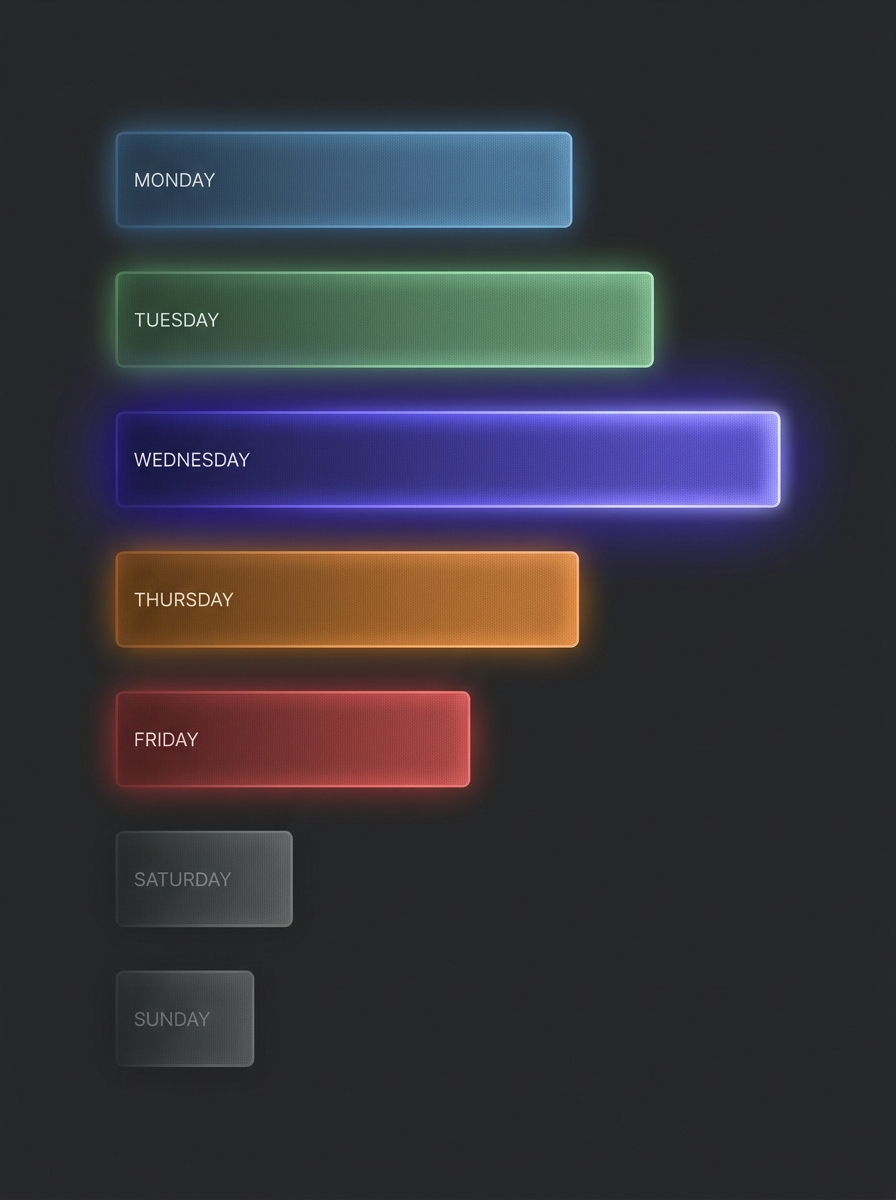
    In a live GA4 audit session on a real content site, Wednesday produced the highest engagement rate and longest average session duration across all seven days of the week. Saturday and Sunday dropped below 20% engagement. The spread between the best and worst day was larger than the team expected — and they had been publishing on a Friday cadence for months.

    The reason for the midweek peak is intent. Wednesday readers are in work mode, researching, planning, looking for answers they can act on before the week ends. Weekend readers are in browse mode — lower intent, higher bounce rate, shorter duration regardless of content quality. The content is the same. The audience arriving is different.

    The Three Daily Engagement Windows

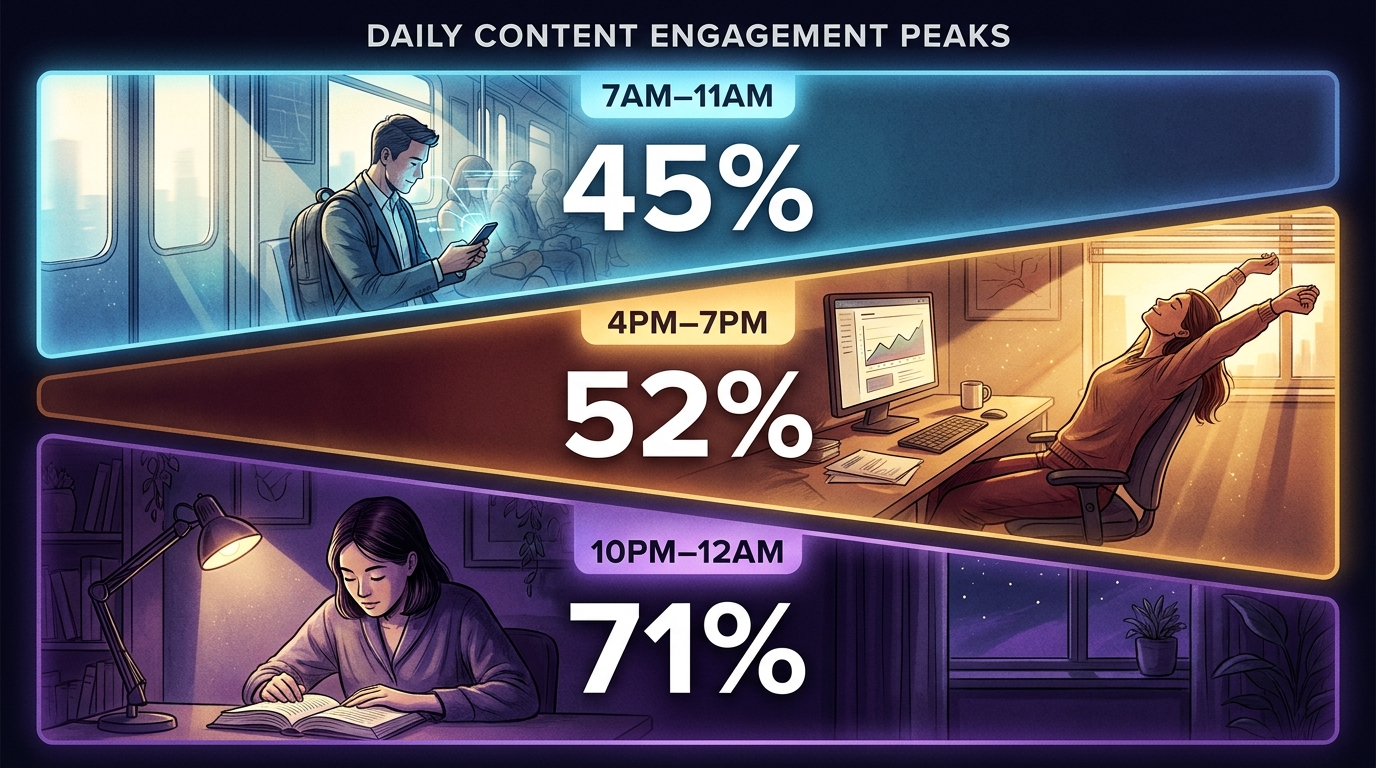
    Beyond day of week, hour-of-day analysis reveals three distinct engagement windows on most content sites.

    The morning window — roughly 7AM to 11AM — produces consistently elevated engagement rates. These are commuters, early starters, and researchers beginning their day. Session durations are moderate and bounce rates are lower than the daily average.

    The late afternoon window — 4PM to 7PM — shows another engagement spike on most sites. These users are often winding down work, reading something they bookmarked earlier, or doing planning research for the next day. Some days in this window show 100% engagement rates in the data — every session that started, engaged.

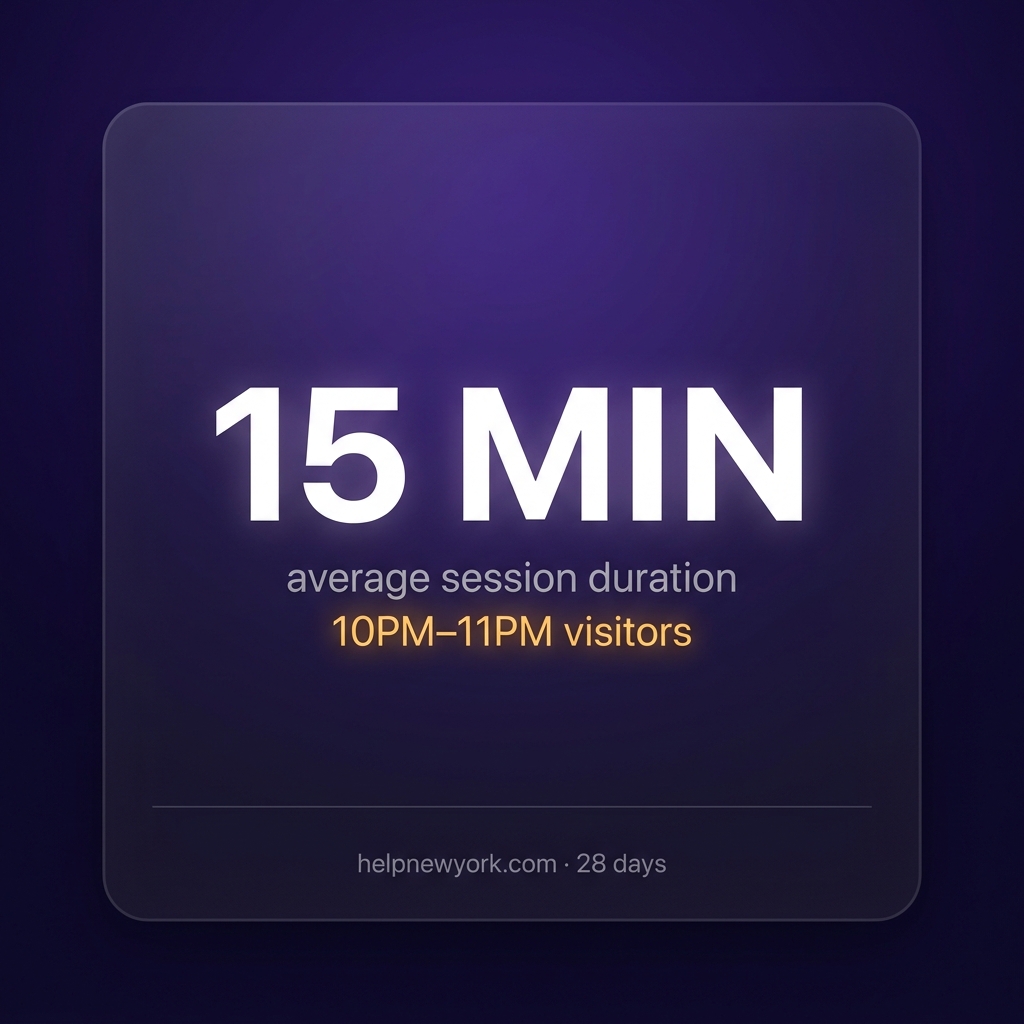
    The late-night window — 10PM to midnight — is the most counterintuitive finding. Volume is low, but engagement depth is exceptional. On the site audited, users arriving between 10PM and 11PM averaged over 15 minutes on page. These are focused, high-intent readers who have carved out time to go deep. Nobody is publishing for them. That is an opportunity.

    What This Means for Your Content Calendar

    The scheduling insight from this analysis is immediately actionable without creating any new content. You simply move planned publishes to align with peak engagement windows — Wednesday over Friday, 9AM or 5PM over noon — and you are serving the same content to a more receptive audience.

    For social promotion specifically, knowing that your peak engagement window is Wednesday morning means scheduling your distribution to that window rather than the time your team happens to be online.

    Running the Time Intelligence Session

    This analysis runs in one session using Claude-in-Chrome alongside Analytics Advisor in GA4. The query sequence surfaces your day-of-week ranking, your three peak windows by hour, your dead zones, and a concrete publish timing recommendation based on your actual property data. The methodology is the Books for Bots: GA4 Time Intelligence Kit.

    Learn more about the GA4 Time Intelligence Kit →

  • Your GA4 Referral Traffic Report Is Ranked Wrong — The Quality Inversion That Changes Your Strategy

    Your GA4 Referral Traffic Report Is Ranked Wrong — The Quality Inversion That Changes Your Strategy

    Open your GA4 referral traffic report and sort by sessions. The source at the top of the list is your most valuable referral partner, right?

    Almost certainly not. The default GA4 referral view is sorted by volume. Volume is the wrong metric for understanding referral quality. And the gap between your highest-volume referral source and your highest-quality referral source is almost always larger than you expect.

    The Quality Inversion

    When you re-rank your referral sources by engagement rate instead of session count, the leaderboard flips completely. The source you have been grateful for because it sends 300 sessions a month is often delivering 6-8% engagement — users who arrive, glance at the page, and leave in under 10 seconds. The source sending 8 sessions a month may be delivering 70%+ engagement — users who read deeply, navigate to related pages, and return weeks later.

    From a content investment perspective, those 8 sessions from the high-quality source are worth more than the 300 from the volume source. They represent real readers who found genuine value. The volume source is sending noise.

    What Drives the Gap

    The gap between volume and quality in referral traffic usually comes down to three things.

    Intent alignment. A high-volume referral source often sends users whose intent does not match your content. A directory site might link to you as a resource while its users are looking for a service provider. They arrive, realize you are informational content, and leave. A niche newsletter that links to you as recommended reading sends users who explicitly opted in to this exact type of content. Every session is pre-qualified.

    Audience specificity. The broader the audience of the referring site, the lower the average quality of the traffic it sends you. A general-interest news aggregator sends everyone. A specialized community sends people who care about your topic.

    Editorial context. When a referring site links to you in the body of a relevant article with a reason to click, the user arrives with context and intent. When your URL appears in a list of 50 links on a resource page, the user arriving has no specific reason to engage with your content over anyone else on the list.

    How to Find Your Hidden Gem Referrers

    The query you are looking for in GA4 is not “which referral source sends the most sessions.” It is “which referral sources have fewer than 20 sessions but an engagement rate above 50%.”

    That filter surfaces your hidden gems — the small sources that nobody is monitoring because they do not show up at the top of the volume-sorted list. These are the sites whose audiences are most aligned with your content, the writers and communities who are genuinely recommending you rather than listing you.

    Once you have the list, the outreach writes itself. A referral partner whose audience stays on your site for 4 minutes and returns regularly is a relationship worth formalizing. A content exchange, a guest post, a link placement in their next relevant piece — any of these turns an organic quality referrer into a deliberate partnership.

    What Your Bad Traffic Sources Are Costing You

    Beyond missing the hidden gems, there is a cost to the volume sources you are currently treating as successes. If a referral source is sending 300 sessions at 6% engagement and you are investing link-building effort to maintain or grow that relationship, you are optimizing for a metric that does not correspond to business value.

    The reallocation question is simple: what would happen if you redirected that same effort toward the sites whose audiences actually engage with your content?

    Running the Audit

    This analysis runs in a single session using Claude-in-Chrome alongside Google’s Analytics Advisor in GA4. The query sequence inverts the default referral view, surfaces your hidden quality sources, identifies your bad traffic sources with specific domain-level data, and produces a partnership opportunity list for outreach.

    No SQL. No BigQuery. No data analyst. The methodology is packaged as the Books for Bots: GA4 Referral Quality Audit.

    Learn more about the GA4 Referral Quality Audit →

  • Books for Bots: GA4 Time Intelligence Kit

    Books for Bots: GA4 Time Intelligence Kit

    24-hour engagement clock

    BOOKS FOR BOTS — GA4 SERIES — BOOK 02

    GA4 Time Intelligence Kit

    When your best traffic arrives. Day-of-week and hour-of-day patterns that tell you when to publish, when to promote, and when your audience is actually paying attention.

    15 minutes
    Average session duration for 10PM–11PM visitors — your hidden audience
    COMING SOON — $27

    Most Teams Publish When It’s Convenient

    This kit tells you when your audience is actually paying attention — and those two things are rarely the same. One session against Analytics Advisor reveals your peak engagement windows by day and hour, your dead zones, and a hidden late-night audience almost no one is writing for.

    Seven day engagement bars — Wednesday glows brightest

    FIELD FINDING — LIVE SESSION

    Wednesday produced the highest engagement rate and longest average session duration. Saturday and Sunday dropped below 20% engagement. The gap between best and worst day is larger than most teams expect.

    Three engagement peaks: 7AM-11AM 45%, 4PM-7PM 52%, 10PM-12AM 71%
    15 MIN average session duration for 10PM-11PM visitors
    Late night reader at laptop at 10:47PM
    Editorial calendar with Wednesday circled PUBLISH and weekends crossed out

    What’s Inside

    • 7 copy-paste queries for Analytics Advisor — one session
    • Day-of-week engagement ranking — all 7 days scored
    • Hour-of-day peak window identification — morning, afternoon, late night
    • Dead zone diagnosis — high volume, low quality windows
    • Late-night audience profiling — the segment nobody is writing for
    • Concrete publish timing recommendation from your actual property data

    What You Need

    • Claude-in-Chrome — free from Anthropic
    • Editor or Analyst access to a GA4 property
    • Analytics Advisor (BETA) enabled
    • 30–60 minutes

    THE KEY INSIGHT

    The scheduling insight from this kit is immediate and free to act on. You do not need to create new content. You need to redistribute what you already have into the windows where your audience is actually paying attention.

    Individual Kit — Instant PDF Download

    COMING SOON — $27

    No subscription.

    BETTER VALUE — BUNDLE

    Get All 6 Kits for $97

    Every GA4 intelligence methodology in one purchase. Save $65.

    $162$97

    COMING SOON — SEE BUNDLE

    FREE STARTER

    Try Session 3 Free

    Seven queries revealing your ChatGPT vs Claude vs Copilot split in under 30 minutes.

    COMING SOON — FREE

    Validated on live GA4 properties. April 2026.

  • What Would a Website Say If It Could?

    What Would a Website Say If It Could?

    Tygart Media / Content Strategy
    The Practitioner JournalField Notes
    By Will Tygart
    · Practitioner-grade
    · From the workbench

    I’ve been thinking about something I can’t quite shake.

    When you sit down to write for your website — who are you actually writing for? The answer seems obvious until you really look at it. You’d say: the reader. But is that true? And if it’s not the reader, is it you? Is it the algorithm? Is it the gap in your content map that some SEO tool flagged last Tuesday?

    Or — and this is the part I keep coming back to — are you writing for the website itself?

    The Website That Learns to Speak

    A website, left alone long enough, starts to develop something like a voice. Not the voice you intended. Not your brand guidelines. Something that emerges from the accumulation of every post, every page, every word you’ve put there over months and years. Search engines read it. AI systems index it. Scrapers pull it. And increasingly, the tools you use to generate new content pull from it too.

    Your website is now your source material.

    This is where it gets recursive in a way that feels almost alive. You write something. It gets indexed. You use that indexed material — through AI tools, through your own memory, through the patterns you’ve unconsciously absorbed — to write the next thing. Which gets indexed. Which informs the next thing after that.

    The website is quietly authoring itself through you.

    Four Audiences You’re Actually Writing For

    When I think honestly about the tension in content creation right now, I can identify four distinct forces pulling on every piece of writing that goes on a website. And almost nobody is conscious of all four at once.

    Writing for the reader is the purist’s answer. The person on the other side of the screen who has a question, a problem, a curiosity. They found you somehow. They’re reading. What do they need? This is the most human version of the work and, paradoxically, the easiest one to forget when you’re deep in a content calendar.

    Writing for the gaps is the strategist’s answer. You audit your content, find what’s missing, identify the keyword clusters you haven’t touched, the questions your competitors rank for that you don’t. You write to fill the map. This is legitimate. But it produces a certain kind of writing — useful, complete, a little bloodless.

    Writing for yourself is what happens when you stop performing. When you publish something because the idea won’t leave you alone, because you need to think out loud, because you have a genuine point of view that may or may not be welcome. This is where the most interesting things come from. It’s also the hardest to justify in a spreadsheet.

    Writing for the website is the one nobody names directly, but everyone is increasingly doing. You feed the machine you’ve already built. You maintain coherence with what’s already there. You let the existing body of work shape the next piece. You’re not just an author — you’re a gardener tending something that’s already growing on its own terms.

    The Recursion Problem

    Here’s where it gets philosophically uncomfortable: once you start treating your website as a database — as the launching point for everything you create next — you have to ask what happens to originality.

    If every new article is partially generated from the patterns of the old ones, are you growing? Or are you circling? Are you developing a point of view, or just achieving higher and higher fidelity to a version of yourself that was defined years ago?

    The recursion isn’t inherently bad. In fact, it’s how voice gets built. The best writers in any medium are recognizable precisely because their new work is in conversation with their old work. There’s a thread. A coherence. You can feel the same mind behind all of it.

    But there’s a version of this that becomes a trap. Where the website stops being a record of your thinking and starts being the limit of it. Where you can’t write something the site hasn’t already implied, because your tools are pulling from your history and your instincts are calibrated to what performed.

    The question isn’t whether to be recursive. The question is whether you’re conscious of it.

    What the Website Would Say

    If your website could speak — if the accumulated weight of everything you’ve published could form a sentence back to you — I think it would say something like: you’ve been circling this idea for a long time. Are you ready to go deeper, or are you going to keep publishing variations of what you already believe?

    That’s not an indictment. It’s an invitation.

    The most honest thing a website can do is hold a mirror up to the mind behind it. And the most honest thing a writer can do is notice when the mirror has become the only window they’re looking through.

    A New Way to Think About the Relationship

    I’m not arguing against using your existing content as a foundation. I do it. Everyone who publishes consistently does it. The site becomes a knowledge base, a reference point, a signal to yourself about what you’ve already said so you can figure out what you haven’t.

    But I think the writers and strategists who are going to do the most interesting work in the next few years are the ones who treat that foundation as a floor, not a ceiling. Who use the recursive pull of their own content as a diagnosis — here’s where my thinking has been living — and then deliberately write toward the edges of it.

    Not for the reader. Not for the gap. Not for the algorithm.

    For the idea that the site hasn’t said yet. The thought that doesn’t fit the existing patterns. The piece that, when you publish it, makes everything else on the site feel slightly more honest.

    That’s what I think the website is waiting for.


    Will Tygart is a content strategist and founder of Tygart Media. He thinks too much about the relationship between writers and the systems they build, and occasionally publishes that thinking here.

  • Human Prompting: When the Audience Writes the Live Show

    Human Prompting: When the Audience Writes the Live Show

    The Lab · Tygart Media
    Experiment Nº 267 · Methodology Notes
    METHODS · OBSERVATIONS · RESULTS

    The Prompt Show: What Happens When the Audience Writes the Set

    Stand-up comedy has always been a broadcast. One person walks on stage with a set they’ve rehearsed in the mirror, in the car, in smaller rooms, and they deliver it to a crowd that showed up to receive. The audience laughs or they don’t. The comedian adjusts. But the fundamental architecture hasn’t changed since vaudeville: one person talks, everyone else listens.

    I want to break that.

    A Format Without a Set List

    Picture this. A comedian — or maybe we stop calling them that — signs up for a show. They have no material prepared. No bits. No callbacks. Nothing rehearsed. They walk out to a mic and a stool, and the only thing they bring is themselves.

    The audience brings everything else.

    Think Phil Donahue, not open mic night. The room is full of people who came with questions. Real questions. Some researched. Some spontaneous. Some designed to get a laugh, sure. But the best ones — the ones that make this format transcend — are the ones where somebody in the audience actually did their homework.

    Human Prompting

    Here’s where it gets interesting. Before the show, the audience gets access to information about the person behind the mic. Their hometown. Their college. Their favorite team. The job they had before comedy. The thing they lost. The thing they built. Whatever the performer is willing to put on the table.

    And the audience uses that information to craft questions.

    This is human prompting. The same principle that makes a great AI query — specificity, context, emotional intelligence, knowing what to ask and how to ask it — applied to a live human being standing under a spotlight. The audience becomes the prompt engineer. The performer becomes the model. And what comes back isn’t a rehearsed bit. It’s a story that has never been told on stage before, delivered raw, in real time, with the kind of energy you only get when someone is genuinely surprised by what they’re being asked.

    Three Modes, One Show

    The format has natural variation built in. You can run all three modes in a single evening, like acts in a play:

    Mode 1: Curated. Questions are submitted ahead of time and the best ones are selected by a producer or host. This gives the show a high floor — every question has been vetted for depth, creativity, or emotional potential. The performer still doesn’t know what’s coming, but the audience has been filtered for quality.

    Mode 2: Host-Selected. The host reads the room, sees hands go up, and picks. There’s a middle layer of curation happening in real time. The host becomes a DJ of human curiosity — reading energy, sequencing moments, knowing when to go deep and when to go light.

    Mode 3: Completely Random. Names drawn from a hat. Seat numbers called. No filter. This is the highest-risk, highest-reward mode. You might get someone who asks where the performer went to high school. You might get someone who asks about the worst night of their life. The unpredictability is the product.

    Why This Works Now

    We live in an era where everyone understands prompting, even if they don’t use that word. Every person who has typed a question into ChatGPT, refined a search query, or figured out how to ask Siri something useful has been training the muscle that this format requires. The audience already knows, instinctively, that the quality of the answer depends on the quality of the question.

    And we’re starving for unscripted humanity. Podcasts exploded because people wanted real conversation. Reality TV keeps mutating because people want to watch humans be human. But both of those formats have editing, production, post-processing. The Prompt Show has none of that. It’s one person, responding to a stranger’s curiosity, with nowhere to hide.

    The Performer Isn’t a Comedian Anymore

    This is the part that matters most. The person on stage doesn’t need to be funny. They need to be honest. They need to be present. They need to have lived a life worth asking about and be willing to talk about it without a script.

    Comedians are naturals for this because they already know how to hold a room. But this format is bigger than comedy. It’s a storyteller on a stool. It’s a retired firefighter. It’s a first-generation immigrant. It’s anyone whose life contains stories that only come out when the right question is asked by someone who cared enough to think about it.

    The magic isn’t in the answer. The magic is in the space between the question and the answer — that half-second where the performer realizes nobody has ever asked them that before, and they have to figure out, live, in front of a room full of strangers, what the truth actually is.

    What Makes a Good Prompter

    Not every question lands. The person who tries to stump the performer, who wants a gotcha moment, who treats this like a roast — they’ll get a laugh, maybe, but they won’t get a story. The audience will learn quickly that the best moments come from the person who spent fifteen minutes reading the performer’s bio and thought: I wonder what it was like to leave that town. I wonder if they ever went back.

    The best prompters are the ones who ask the question the performer didn’t know they needed to answer.

    This Is Live Poetry

    Call it what you want. A prompt show. A story pull. A human query. Whatever the name, the format is the same: give people a reason to be curious about another human being, give that human being a microphone and no script, and get out of the way.

    The best comedy has always been the truth told at the right speed. This format just lets the audience decide which truth, and when.