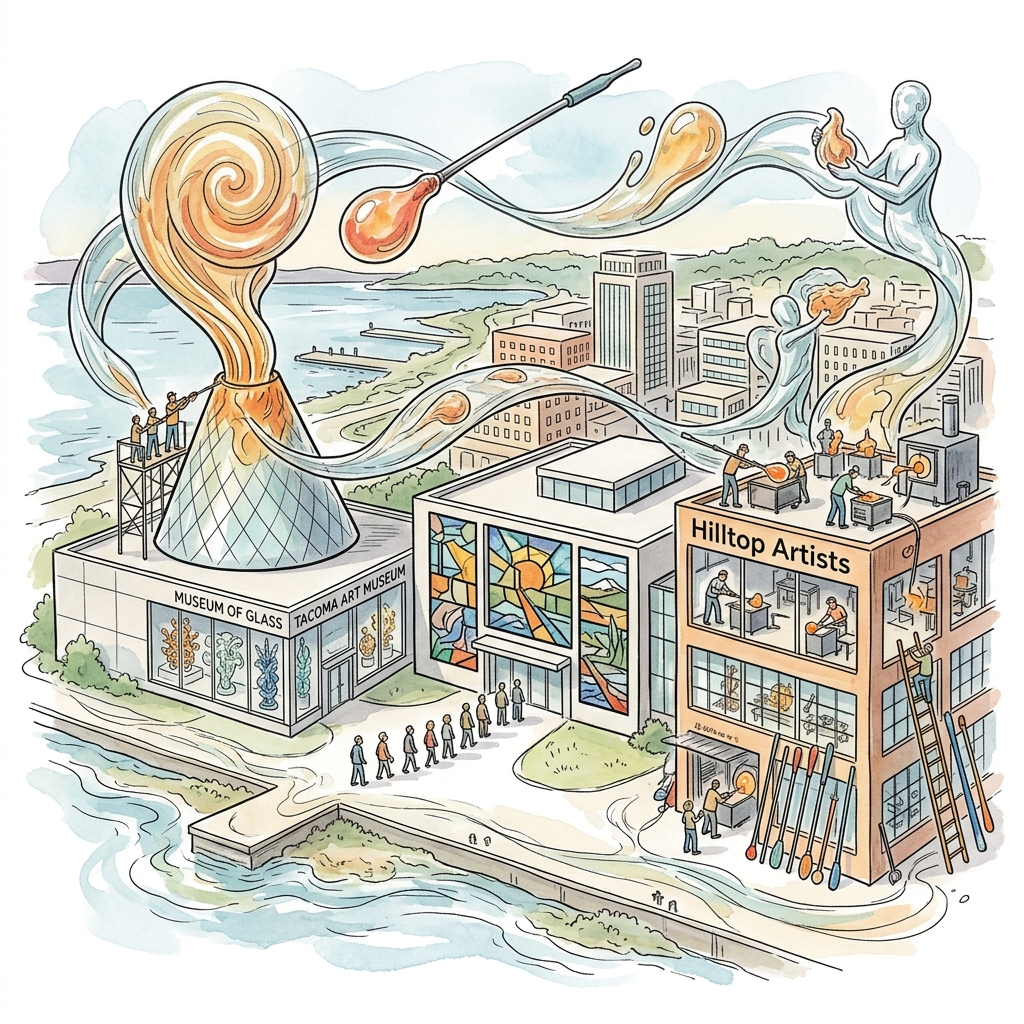
A City That Literally Forged Its Culture
Most cities back into their cultural identity. Tacoma built one — out of glass, on a Superfund site, anchored to the legacy of one artist who happened to grow up on the Hilltop. The result is a cultural infrastructure that’s unique in the United States: three interconnected institutions dedicated to glass arts, connected by a public bridge designed by the same artist, attracting visitors from around the world to a city that most Americans couldn’t find on a map twenty-five years ago.
This isn’t tourism marketing. This is what actually happened, and what it means for Tacoma’s cultural economy.
Museum of Glass: The Anchor
The Museum of Glass opened on July 6, 2002, on the waterfront of Commencement Bay. The building itself — designed by architect Arthur Erickson with its signature 90-foot stainless steel cone — was erected on a former Superfund site, part of the Thea Foss Waterway cleanup that transformed Tacoma’s industrial waterfront into a cultural district.
Since its founding nearly 25 years ago, the Museum of Glass has become a cultural icon in the Pacific Northwest. The institution is dedicated to the exhibition, education, and creation of glass art, and it operates one of the few museum-based hot shops in the world — a working glassblowing studio visible to visitors where artists create pieces in real time.
The Museum’s hot shop is the centerpiece. Live glassblowing demonstrations run daily, and the Hot Shop Team collaborates with visiting artists throughout the year. This isn’t a museum where you look at static objects behind glass — it’s a place where the art is being made in front of you, at 2,000 degrees, by people who have spent decades mastering a craft that dates back thousands of years.
The Dale Chihuly Connection
You can’t tell this story without Dale Chihuly. Born in Tacoma in 1941, Chihuly grew up in the Hilltop neighborhood and went on to become the most recognized glass artist in the world. His connection to Tacoma is literal and permanent: the Chihuly Bridge of Glass connects the Museum of Glass to the rest of the Museum District, and his installations are woven throughout the city’s public spaces.
Chihuly’s significance isn’t just artistic — it’s economic and institutional. His profile helped justify the investment in the Museum of Glass, attracted international attention to Tacoma’s cultural infrastructure, and created a model for how a single artist’s legacy can catalyze urban transformation. The Visit Pierce County tourism bureau features Tacoma’s glass arts as a primary cultural attraction, and Chihuly Walking Tours connect the Museum of Glass with the Tacoma Art Museum and other glass installations throughout the district.
Tacoma Art Museum: The Broader Canvas
The Tacoma Art Museum (TAM) sits adjacent to the Museum of Glass in the Museum District, and the two institutions collaborate regularly. TAM’s collection spans Northwest art in all media, but its glass holdings and programming connect it directly to the city’s glass arts identity.
Together, MOG and TAM anchor a museum district that also includes the Washington State History Museum, creating a three-institution cultural cluster within walking distance. This concentration matters for cultural tourism — visitors can spend a full day in the district, which drives hotel nights, restaurant visits, and retail spending in downtown Tacoma.
Hilltop Artists: The Pipeline
Hilltop Artists is the piece that makes this ecosystem self-sustaining. Founded as a nonprofit, Hilltop Artists offers tuition-free glassblowing programs to youth aged 12 to 20, based at Jason Lee Middle School in partnership with Tacoma Public Schools.
The program does two things simultaneously. First, it provides arts education and mentorship to young people in the Hilltop neighborhood — a community that has historically been underserved. Second, it feeds the talent pipeline for the glass arts ecosystem. Hilltop Artists participants are featured artists at the Museum of Glass on Third Thursdays during the academic year, and the organization has an annual Visiting Artist Residency in the MOG Hot Shop where students learn alongside the professional Hot Shop Team.
This is the difference between a cultural attraction and a cultural ecosystem. Attractions draw visitors. Ecosystems produce artists, maintain traditions, and regenerate themselves. Hilltop Artists is the regenerative element that ensures Tacoma’s glass arts identity outlasts any single artist or institution.
What This Means for Tacoma’s Economy
The Museum of Glass has fundamentally transformed Tacoma’s downtown waterfront, serving as a catalyst that started the restoration of the Thea Foss Waterway and contributing significantly to urban revitalization. The museum acts as a powerful catalyst for community engagement and cultural tourism, establishing the city as a vibrant cultural destination.
The economic ripple effects are visible. The Museum District has attracted restaurants, hotels, and commercial development that didn’t exist before 2002. The University of Washington Tacoma campus, which borders the district, benefits from the cultural amenity in its recruitment. And the tourism marketing — “City of Glass” — gives Tacoma a brand identity that’s distinctive, authentic, and impossible to replicate.
I walk the Bridge of Glass regularly. I’ve watched the Hot Shop Team work. I’ve seen Hilltop Artists kids pull their first piece out of a furnace. This isn’t a marketing exercise — it’s a genuine cultural infrastructure that works because it’s real, and it’s grounded in the community it serves.
Frequently Asked Questions
What is the Museum of Glass in Tacoma?
The Museum of Glass is a world-renowned contemporary art museum on Tacoma’s waterfront, dedicated to glass art exhibition, education, and creation. It opened in 2002 and features a working Hot Shop where live glassblowing demonstrations occur daily.
What is the connection between Dale Chihuly and Tacoma?
Dale Chihuly was born in Tacoma in 1941 and grew up in the Hilltop neighborhood. His legacy is woven into the city through the Chihuly Bridge of Glass, public installations, and his role in catalyzing the Museum of Glass and Tacoma’s cultural transformation.
What is Hilltop Artists?
Hilltop Artists is a nonprofit that offers tuition-free glassblowing programs to youth aged 12-20 at Jason Lee Middle School in Tacoma. Students are featured artists at the Museum of Glass on Third Thursdays and participate in annual visiting artist residencies in the Hot Shop.
Can you watch glassblowing at the Museum of Glass?
Yes. The Museum of Glass operates one of the few museum-based hot shops in the world, with live glassblowing demonstrations running daily. The Hot Shop Team creates pieces in real time, and visiting artists collaborate throughout the year.
How has the Museum of Glass impacted Tacoma?
The Museum has served as a catalyst for downtown waterfront transformation, starting the restoration of the Thea Foss Waterway and establishing a Museum District that includes the Tacoma Art Museum and Washington State History Museum. It has contributed significantly to cultural tourism and urban revitalization.