Last refreshed: October 2026
68% of U.S. Google searches end without a click in 2026. When AI Overviews appear, that rate hits 83%. The question for content-driven businesses is no longer how to rank — it’s how to be cited inside the answer that replaced the click.
This is a practical guide to structuring content, managing brand entity signals, and measuring visibility in a world where users get their answer before they ever reach your site.
What Zero-Click Actually Means for Content Businesses
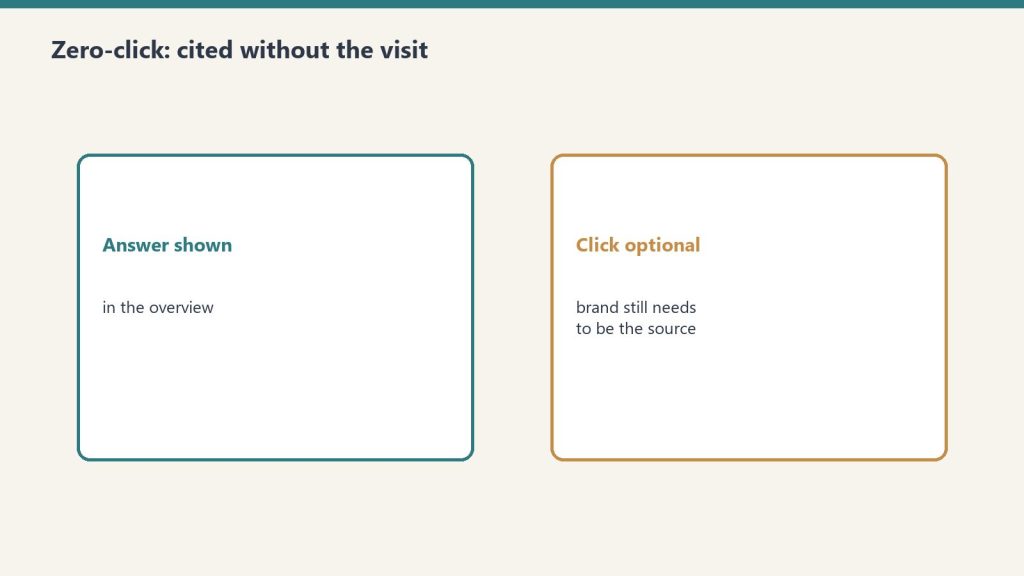
Zero-click doesn’t mean zero value. Brands cited inside AI Overviews earn 35% more organic clicks than uncited brands on the same query. The traffic goes to the cited brand — not to the site that ranks #1 but isn’t cited.
The data that reframes zero-click as a competition problem, not a traffic problem:
- 68% of U.S. Google searches are zero-click in 2026 (SparkToro, June 2026, based on Similarweb panel data)
- When AI Overviews appear, zero-click rate hits 83%
- Organic CTR for position #1 drops up to 58% when AI Overviews are present (Ahrefs, December 2025 data)
- Brands cited in AI Overviews earn 35% more organic clicks and 91% more paid clicks versus uncited brands
- AI-referred visitors convert at 4.4x the rate of traditional organic visitors (Semrush)
- The overlap between top-10 rankings and AI Overview citations: 17–38% in early 2026, down from 75% in mid-2025
The conclusion: ranking is no longer sufficient for visibility. A site can rank #1 and not be cited in the AI Overview that answers the query. The two need to be optimized separately.
How AI Overviews Decide What to Cite
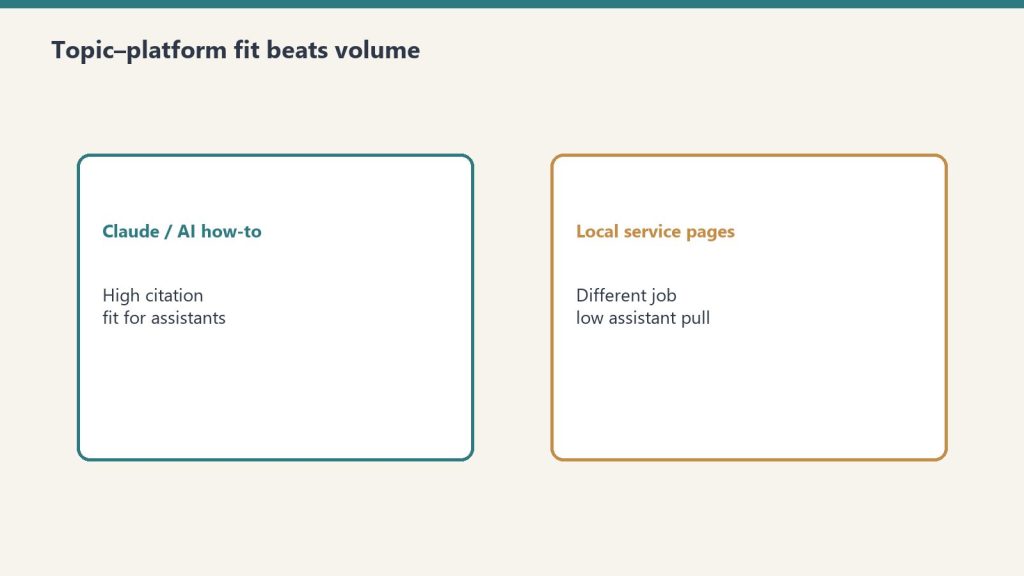
Google’s AI Overview system retrieves web pages in real time, synthesizes a 3–5 sentence answer, and cites 3–6 source pages. The selection criteria weight answer extractability, entity authority, freshness, and structured data — not just ranking position.
The signals that influence AI Overview citation:
Answer extractability: The answer to the query must appear in the first 200 words of the page, stated directly. Pages that build toward the answer, providing extensive context before the conclusion, are retrieved for topic relevance but can’t be cited because the extractable answer isn’t there.
Entity authority: Consistent, factually accurate information about the brand entity across the web — site, LinkedIn, social profiles, third-party mentions — signals that the source is authoritative on the topic. AI systems treat entities with strong external corroboration as more trustworthy.
Freshness: For fast-changing topics (Claude pricing, AI model capabilities, regulatory changes), recency is a significant weight. A page last updated in 2024 competes poorly against one updated in August 2026 on a query about current Claude pricing.
Structured data: FAQPage, HowTo, and Article schema markup signals to Google that content is formatted for extraction. Pages with properly implemented schema see measurably higher AI Overview inclusion.
E-E-A-T signals: Experience, expertise, authoritativeness, trustworthiness. An article written by a named author with a consistent byline and external presence outperforms anonymous content on contested or technical topics.
Strategy 1: Structure Every Page for Extraction
Answer-first structure is the single highest-leverage change for AI citation rates. The first paragraph of every article should directly and completely answer the likely query.
The structure AI systems can extract from:
H1: [Specific, query-answering title]

[Bold one-sentence direct answer to the query implied by the title]

[Supporting detail — the why, the how, the context]

H2: [First subtopic as a question]
[Bold answer sentence to the H2 question]
[Elaboration]
What this means in practice for tygartmedia.com content:
Every article about Claude pricing, model capabilities, or Anthropic history should open with the factual answer — not a framing sentence, not background, not “in this article we’ll cover.” The answer, stated directly, in the first two sentences.
The reason this matters beyond GEO: it’s also better for users. Answer-first structure is a discipline that makes content more useful and more likely to be cited. The SEO and GEO benefits are secondary to the writing quality improvement.
Strategy 2: Build and Maintain the Brand Entity
AI systems treat brands as entities — named things with verifiable, consistent information across multiple authoritative sources. Building entity authority means making sure that information is consistent, correct, and present everywhere crawlers look.
Entity checklist for tygartmedia.com:
On-site signals:
- Organization schema on every page (name, URL, description, logo, founder, sameAs links)
- Consistent author byline (“Will Tygart”) on every article
- Author bio that establishes expertise consistently across all articles
- Contact and about page with complete, factual business information
Off-site signals:
- LinkedIn Company Page with consistent description matching the website
- Google Business Profile (if applicable) with consistent NAP (name, address, phone)
- Third-party mentions and citations on authoritative sites in the AI/tech space
- Social profiles with consistent handles and descriptions
The consistency requirement: AI systems cross-reference. If the description on LinkedIn says “AI infrastructure for operators” and the website says something different, that inconsistency weakens the entity signal. Everything should say the same thing about the same thing.
Strategy 3: Implement Structured Data
FAQPage, Article, and Organization schema markup signals to AI Overviews that content is formatted for extraction. This is not optional in 2026 for sites that depend on search visibility.
Minimum structured data implementation:
FAQPage schema on every article with a FAQ section:
{
  "@context": "https://schema.org",
  "@type": "FAQPage",
  "mainEntity": [{
    "@type": "Question",
    "name": "What is Metricool pricing?",
    "acceptedAnswer": {
      "@type": "Answer",
      "text": "Metricool has a free plan and paid plans starting at the Starter tier. API access requires the Advanced plan or above. Pricing is per brand, not per connected social account."
    }
  }]
}
Article schema on all editorial content (author, published date, modified date, headline).
Organization schema site-wide (name, URL, logo, founder, sameAs).
In Rank Math (the plugin on tygartmedia.com): FAQ blocks in the WordPress editor generate FAQPage schema automatically. Use the Rank Math FAQ block for all FAQ sections rather than plain text. Article schema is enabled site-wide in Rank Math settings.
Strategy 4: Keep Content Current
AI retrieval systems weight freshness heavily for fast-changing topics. For any site publishing Claude pricing, model capabilities, or AI tool features, stale content is not just less useful — it actively loses citation ground to fresher sources.
Freshness implementation:
- “Last refreshed” date at the top of every article — visible to users and read by crawlers as a freshness signal
- “What’s new” section in evergreen articles covering frequently updated topics (Claude pricing, model capabilities, Metricool features)
- Update the modified date in Article schema whenever content is refreshed — not just the publication date
- Monitor Search Console for queries where the site appears in AI Overviews — freshness issues show up as drops in citation before they show up as ranking drops
Trigger list for mandatory refreshes on tygartmedia.com:
- Any Anthropic pricing change
- Any new Claude model release or deprecation
- Any Metricool feature update
- Any change to Anthropic’s Enterprise product structure
Strategy 5: Earn Third-Party Citations
AI systems give extra weight to content cited by other authoritative sources. Being linked to or mentioned by other sites publishing on Claude, Anthropic, and AI infrastructure strengthens the entity signals for all related queries.
Practical approaches:
Original data and research: Content with specific numbers, benchmarks, and original findings gets cited by others. The Claude pricing breakdowns, benchmark comparisons, and API cost calculations on tygartmedia.com are exactly the type of content other AI publications cite.
First-mover coverage: Publishing accurate, detailed coverage of Anthropic announcements before or alongside other publications builds a citation pattern over time.
Expertise-signal content: Content that can only be written from operational experience — running 24 brands in Metricool, building vector DB systems for business documents — earns citations because it’s not replicable from Anthropic’s documentation alone.
Measuring Zero-Click Performance
Standard click and session metrics are insufficient for measuring zero-click visibility. The right metrics are AI citation rate, branded search volume trend, and AI-referred conversion rate.
Measurement framework:
| Metric | Tool | What It Measures |
|---|---|---|
| AI Overview appearances | Google Search Console (AIO report) | Queries where site is cited |
| CTR on AIO queries | GSC, filter by AI Overview queries | Whether citations drive clicks |
| AI-referred traffic | GA4 source filter (ChatGPT, Perplexity) | Direct traffic from AI citations |
| Branded search volume | GSC, filter by brand terms | Awareness from zero-click exposure |
| Conversion rate from AI sources | GA4 segmented by source | Value of AI citation traffic |
Manual testing protocol: Monthly, ask ChatGPT, Perplexity, and Claude the questions your audience asks — “what is Claude Enterprise pricing,” “how does Metricool API work,” “what is the history of Anthropic” — and record whether tygartmedia.com is cited. This is the most direct feedback loop available and costs nothing.
If branded search volume is growing while organic clicks are flat or declining, the site is appearing in AI summaries and building awareness without receiving credit in standard traffic metrics. That’s the zero-click pattern working in favor of the brand — and the signal that citation strategy is working.
Frequently Asked Questions
What is zero-click search?
Zero-click search is a search that ends on the results page itself — the user gets their answer from an AI Overview, featured snippet, or knowledge panel and doesn’t click through to any website. In 2026, 68% of U.S. Google searches are zero-click.
Does zero-click hurt all websites equally?
No. Sites cited inside AI Overviews and featured snippets earn 35% more organic clicks than uncited sites on the same query. Zero-click hurts uncited sites and benefits cited ones. The competition shifts from ranking to citation.
What is the difference between GEO and zero-click optimization?
GEO (Generative Engine Optimization) is the discipline of getting cited inside AI-generated answers from ChatGPT, Perplexity, Gemini, and Claude. Zero-click optimization is specifically about Google search — being cited in AI Overviews and featured snippets. They use the same underlying tactics (answer-first structure, entity signals, structured data, freshness) applied to different surfaces.
How long does it take to see results from zero-click optimization?
Plan for 3–6 months of consistent effort before citation rates change meaningfully. AI systems update their citation patterns as they re-index updated content. The fastest wins come from freshness updates on existing high-traffic pages and FAQ schema implementation on pages that already rank.
Do clicks from AI citations convert differently?
Yes — significantly. AI search visitors convert at approximately 4.4x the rate of traditional organic visitors (Semrush). The mechanism is intent: users who get a specific answer from an AI Overview and then click through to the cited source are further along in their decision process than typical organic visitors.
What to Read Next
Generative Engine Optimization (GEO): 5 Ways to Ensure Your Content Is Cited by AI Overviews
Claude AI Pricing — All Plans and API Rates
Metricool Review 2026: The Social Media Tool for Multi-Brand Operations