Tag: AI orchestration

  • Is Zapier Building the Everything App? The Connector That Became an Orchestrator

    Is Zapier Building the Everything App? The Connector That Became an Orchestrator

    What Is Zapier?
    Zapier is a no-code automation platform founded in 2011 that connects over 8,000 apps through a unified workflow engine. Originally built around simple “if this, then that” triggers, Zapier has transformed in 2025–2026 into an AI orchestration platform—adding autonomous agents, multi-model AI routing, natural language workflow building, and an MCP server that exposes its entire integration library to external AI models including Claude.

    Every company in this series has come at the everything app from a position of strength. Microsoft from enterprise software. Google from search. OpenAI from the frontier model. Mistral from sovereignty and open source. But none of them started where Zapier started: already inside your workflows, connected to every tool you use, trusted with the actual operations of your business.

    That’s the sleeper advantage in this race. While everyone else is building toward the everything app from the outside in, Zapier has been inside the everything app since the day you first connected your Gmail to your CRM.

    The question is whether a 13-year-old automation company can evolve fast enough to own the AI orchestration layer—or whether it becomes the platform that makes everyone else’s AI more powerful.

    📚 Everything App Series

    This is article 9 in our ongoing series examining which AI companies are building the everything app:

    The Transformation: From Connector to Orchestrator
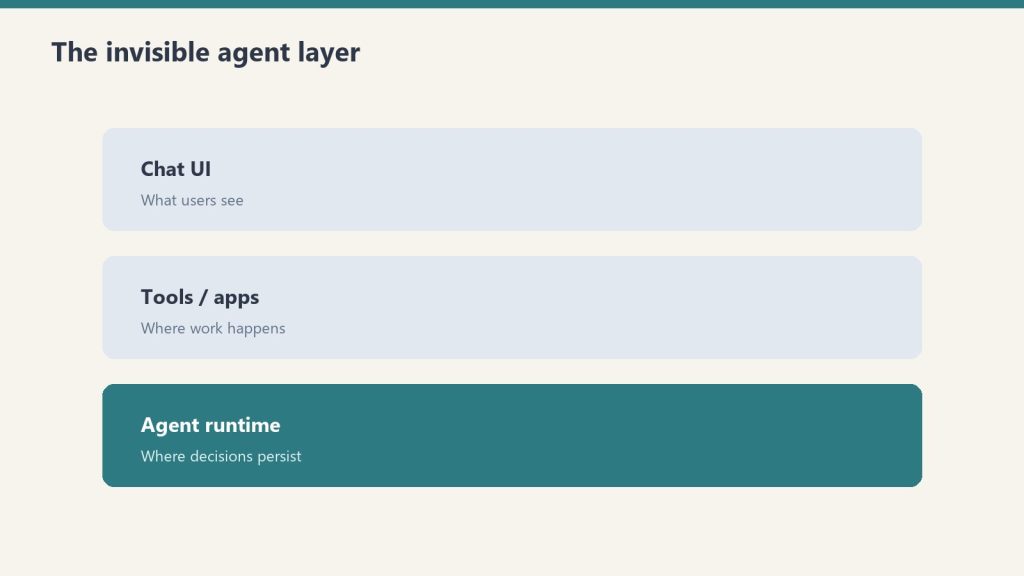
    For most of its first decade, Zapier’s value proposition was simple: connect two apps without writing code. You set a trigger (“when I get a new email in Gmail”), define an action (“add a row to my Google Sheet”), and Zapier ran the automation in the background. Powerful, but fundamentally passive. Zapier did what you told it to do.

    In 2025, that changed fundamentally. Zapier relaunched its positioning as an AI Orchestration Platform and shipped three products that move it from passive connector to active AI layer:

    Zapier Copilot lets you describe a workflow in plain language and watch Zapier build it. Instead of manually connecting triggers and actions, you say “whenever a new lead comes in from our website form, research them on LinkedIn, score them, and add the qualified ones to our CRM with a draft follow-up email.” Copilot builds the multi-step Zap. This collapses the skill barrier that kept many users on simpler workflows.

    Zapier Agents, launched in January 2025 and reaching general availability in December 2025, are autonomous AI teammates. Unlike Zaps (which follow a fixed sequence), Agents decide how to accomplish a goal. You give an Agent a role—”you are our inbound lead coordinator”—a set of tools from Zapier’s app library, and a goal. The Agent reasons through the task, calls the appropriate tools in whatever order makes sense, handles exceptions, and reports back. In August 2025, Zapier added agent-to-agent orchestration, letting Agents delegate subtasks to specialist Agents—the first multi-agent architecture available to non-developers at scale.

    Zapier Canvas is the visual command center that maps how all of this fits together: your Zaps, Tables, Interfaces, Chatbots, and Agents displayed as a connected system. Canvas makes the invisible visible—you can finally see the full automation architecture of your business and edit it from a single surface.

    The 8,000-App Moat

    Here’s the number that matters more than any AI feature: 8,000 connected apps.

    Building an AI integration with a single app is straightforward. Building reliable, maintained, authenticated integrations with 8,000 apps—including niche tools that serve specific industries, legacy enterprise software, and the long tail of SaaS that most AI companies ignore—is a 13-year infrastructure investment that no new entrant can replicate quickly.

    Every AI model that wants to take actions in the real world faces the same problem: getting access to the apps where work actually happens. OpenAI is building these integrations one by one. Google has its own ecosystem but a limited integration library beyond Workspace. Microsoft covers the Office stack but leaves everything else to third parties.

    Zapier already has the connectors. That means Zapier Agents can operate across your full stack on day one—not the curated stack of apps a closed AI platform supports, but the actual combination of tools your business uses, however idiosyncratic.

    Zapier MCP: The Move That Changes the Competitive Map
    The most strategically significant product Zapier shipped in 2025 wasn’t Agents. It was Zapier MCP.

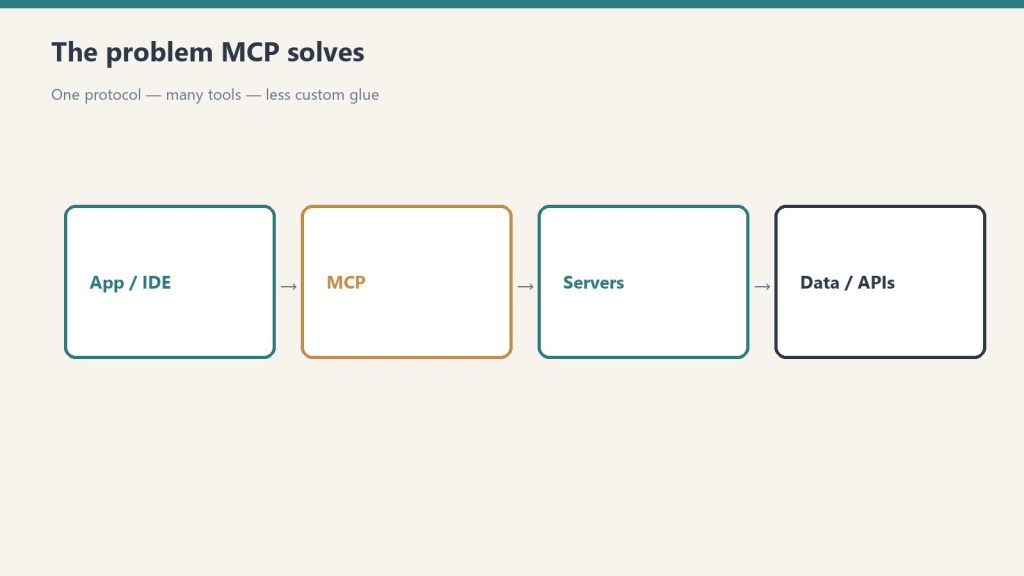
    Model Context Protocol (MCP) is the emerging standard that lets AI models call external tools. Zapier built an MCP server that exposes its entire integration library—all 8,000+ apps, tens of thousands of actions—to any AI model that speaks MCP. Claude can use it. GPT-4o can use it. Any MCP-compatible AI can use it.

    This is Zapier making a platform bet rather than a product bet. Instead of trying to be the AI model that users talk to, Zapier is becoming the action layer that every AI model reaches into when it needs to do something in the real world. The developer and coding agents plug in through the SDK. The AI assistants plug in through MCP. IT administrators see everything through unified audit logs and governance controls.

    Zapier is an official Anthropic integration partner. When Claude users need their AI to actually send an email, update a CRM record, add a calendar event, or post to Slack—Zapier is the infrastructure doing that work. That’s not a small bet. That’s positioning as the execution layer for the entire AI industry.

    The Financial Position: Profitable, Independent, Patient

    One underappreciated aspect of Zapier’s strategic position is its financial independence. Unlike most AI companies burning through venture capital at extraordinary rates, Zapier has been profitable for years. It has raised minimal external funding—approximately $1.4 million in a 2012 seed round and nothing significant since—and generates its own growth from revenue.

    Revenue reached $310 million in 2024 and is projected to approach $400 million in 2025. The company serves over 100,000 business customers. Its valuation is estimated around $5 billion—modest relative to OpenAI, Anthropic, or Mistral’s recent rounds, but built on actual cash flow rather than projected futures.

    This matters for the everything app question because Zapier is not under pressure to show explosive AI growth to justify a valuation. It can evolve its platform deliberately, double down on enterprise reliability, and build the trust that enterprise automation requires—without the distraction of a fundraising cycle or the fear of running out of runway.

    Zapier’s Approach to Enterprise AI Governance
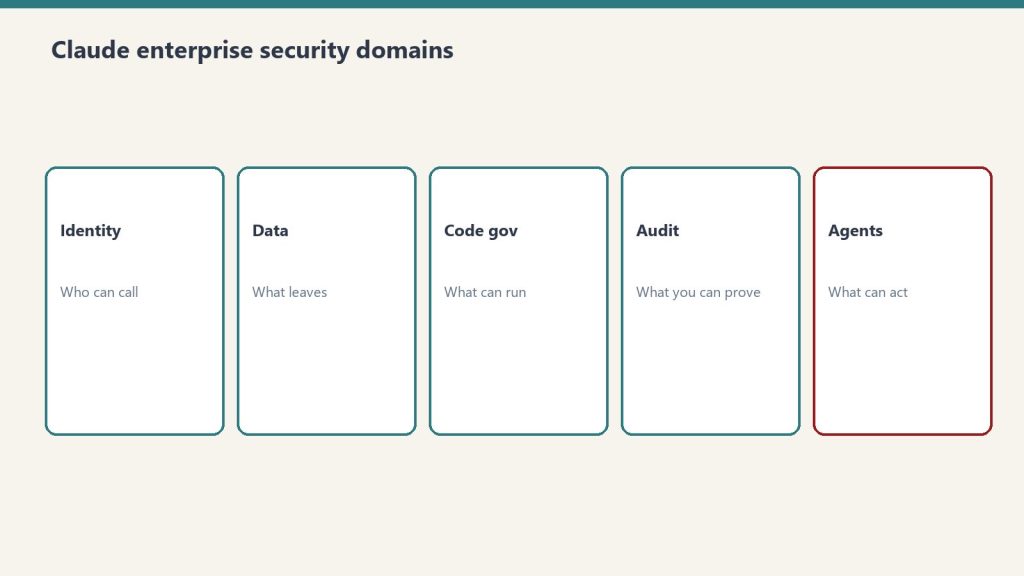
    One of the signal differences between Zapier’s AI platform and its competitors is the emphasis on controls alongside capability. The February 2026 product updates focused specifically on AI guardrails and governance: who can create agents, what apps agents can access, what actions require human approval, and full audit logs of everything that ran.

    This is the unsexy but critical work of making AI deployable in regulated environments. An autonomous agent that can send emails, update databases, and call external APIs is a significant liability risk without proper governance. Zapier’s enterprise controls—managed credentials, admin dashboards, approval workflows for high-risk actions, comprehensive audit trails—represent years of enterprise trust-building that AI-first startups are only beginning to think about.

    The AI guardrails feature allows administrators to set boundaries on what Agents can do autonomously versus what requires a human in the loop. This isn’t a limitation on Zapier’s AI ambitions—it’s the feature that gets Zapier past the enterprise security review that blocks most AI tools from production deployment.

    The Notion Everything Database Connection

    If you’re using Notion as an everything database—as we explored earlier in this series—Zapier is one of the most powerful connectors in your stack. Zapier’s Notion integration supports triggers on database property changes, creating and updating pages, querying databases, and more. Zapier Agents can use these Notion actions as tools, meaning an Agent can reason about your Notion data, make decisions, and update records—all without you touching a line of code.

    The practical architecture looks like this: your Notion everything database stores structured business context. A Zapier Agent monitors specific triggers (a new record appears, a property changes, a status updates). The Agent pulls relevant context from Notion, reasons over it using its AI model, takes actions across your other connected apps, and writes results back to Notion. The entire workflow runs in the background, governed by your Zapier admin controls, with full audit logs.

    For teams building on the Notion everything database model, Zapier isn’t competing with that architecture—it’s the automation and agent layer that makes it operational. You design the data model in Notion; Zapier handles the movement and the intelligence on top of it.

    Where Zapier Falls Short

    Zapier’s everything app candidacy has real limits, and they’re worth naming plainly.

    First, Zapier is a B2B tool that has never built meaningful consumer presence. Everything apps in the historical sense—WeChat, Line, Grab, Gojek—succeed by capturing daily personal habits: messaging, payments, food delivery. Zapier operates in the workflow automation category, which is powerful for businesses but invisible to consumers. There is no path from Zapier’s current position to consumer everything app.

    Second, Zapier depends on the apps in its library. If OpenAI, Google, or Microsoft decides to deprecate their public APIs or make integration prohibitively expensive, Zapier’s connectors break. The 8,000-app moat is only as strong as those 8,000 companies’ continued willingness to maintain open APIs. As AI platforms consolidate, that willingness may erode.

    Third, Zapier’s AI layer is not a frontier model. Zapier Agents use third-party models (primarily OpenAI’s GPT-4o and related) for their reasoning capabilities. This means Zapier’s AI quality ceiling is set by someone else. When OpenAI ships a better model, Zapier agents get smarter—but so does every OpenAI customer. Zapier cannot differentiate on model quality the way Mistral or OpenAI can.

    Finally, the no-code positioning that made Zapier accessible also limits its ceiling. Complex enterprise workflows—the kind that justify serious AI investment—often require the custom logic, error handling, and integration depth that Zapier’s visual interface makes difficult. Competitors like n8n (open-source), Make (formerly Integromat), and enterprise-focused platforms like MuleSoft are taking direct aim at the workflows Zapier can’t handle.

    The Verdict: The Action Layer, Not the Interface Layer

    Is Zapier building the everything app? Not in the way the term is usually understood. Zapier is not trying to be the app you open every morning, the one that knows your identity, your preferences, and your social graph. It has no interest in capturing your attention or your feed.

    Zapier is building something that might matter more for AI’s actual impact on work: the universal action layer. The layer that every AI model reaches into when it needs to do something that matters. The layer that connects AI reasoning to business reality across the entire software ecosystem—not the 50 apps in one company’s walled garden, but the 8,000 apps that businesses actually use.

    In a world where every AI platform is competing to be your interface, Zapier is quietly becoming the infrastructure that makes any interface actually work. That’s not the everything app thesis. It’s the everything execution thesis. And given that 13 years of profitable growth and 100,000 enterprise customers are backing it, it may be the most durable bet in this entire series.

    Key Takeaway

    Zapier is not competing to be the everything app. It’s becoming the action layer that makes every everything app actually functional—the 8,000-integration infrastructure that AI models plug into when they need to do real work in real systems.

    What’s Next in This Series

    This article closes the core competitive series on everything app contenders. But the conversation isn’t finished. Two threads we’ve opened in this series deserve their own deep dives: the xAI infrastructure pivot story—whether Elon Musk is quietly turning Colossus and X into the “everything app ability” rather than the everything app itself—and a Track 2 series on how to actually connect each of these platforms to a Notion everything database as your operational backbone.

    If you’ve been following this series from the beginning, you’ve seen the landscape of AI consolidation from nine different angles. The conclusion that keeps emerging: the everything app isn’t a product. It’s a position. And the race to own that position is just getting started.

    Frequently Asked Questions About Zapier and the Everything App

    What is Zapier’s current AI platform called?

    Zapier relaunched in 2025 as an AI Orchestration Platform. The platform includes Zapier Agents (autonomous AI teammates), Zapier Copilot (natural language workflow builder), Zapier Canvas (visual system map), Zapier Tables, Zapier Interfaces, Zapier Chatbots, and Zapier MCP (an integration server for external AI models). The foundational Zaps automation engine remains the core, with these AI products layered on top.

    What is Zapier MCP and why does it matter?

    Zapier MCP is a Model Context Protocol server that exposes Zapier’s entire integration library to external AI models. Any MCP-compatible AI—including Claude, GPT-4o, and others—can use Zapier MCP to take actions across the 8,000+ apps Zapier connects. This makes Zapier the action execution layer for AI systems built by other companies, not just for Zapier’s own agents. Zapier is an official Anthropic integration partner through this mechanism.

    How many apps does Zapier connect?

    As of 2026, Zapier connects over 8,000 apps. This integration library has been built and maintained over 13 years and represents Zapier’s primary competitive moat. No AI-first entrant has built a comparable breadth of authenticated, maintained app integrations.

    What are Zapier Agents?

    Zapier Agents are autonomous AI teammates that reason about goals rather than following fixed if-then sequences. Launched in January 2025 and reaching general availability in December 2025, Agents can browse the web, read data sources, update CRMs, draft communications, and delegate to other specialist agents through multi-agent orchestration. They’re configured with a role, a set of tool permissions, and a goal—then run autonomously within governance guardrails set by administrators.

    How does Zapier integrate with Notion?

    Zapier’s Notion integration supports database triggers, page creation and updates, and database queries. Zapier Agents can use these as tools in their reasoning loops, enabling autonomous workflows that read from and write to Notion databases. For teams using Notion as an everything database, Zapier provides the automation and agent execution layer that makes that data architecture operational across connected business apps.

    Is Zapier profitable?

    Yes. Zapier has been profitable for years and has raised minimal external funding since a $1.4 million seed round in 2012. Revenue reached $310 million in 2024 with projections near $400 million for 2025. This financial independence distinguishes Zapier from most AI platform companies and gives it patience to evolve its platform without fundraising pressure.

    What are Zapier’s AI governance features?

    Zapier offers enterprise AI governance through managed credentials, admin controls on which users and teams can create or deploy agents, approval workflows for high-risk actions, AI guardrails that bound what agents can do autonomously, and comprehensive audit logs of all agent activity. These controls were prominently featured in the February 2026 product update and represent Zapier’s push to make AI deployment safe for regulated enterprise environments.

    How does Zapier compare to Make (Integromat) and n8n?

    Make and n8n are Zapier’s primary competitors in workflow automation. Make offers more complex branching logic at competitive pricing. n8n is open-source and self-hostable, appealing to developers and privacy-conscious enterprises. Zapier differentiates on breadth of integrations, ease of use for non-technical users, and its newer AI layer (Agents, Copilot, MCP). For enterprises prioritizing AI orchestration with governance controls, Zapier’s platform depth currently leads. For developers wanting maximum flexibility or self-hosting, n8n is the primary alternative.
  • Error Handling and Fallbacks in Notion AI Workflows

    Error Handling and Fallbacks in Notion AI Workflows

    Error Handling and Fallbacks in Notion AI Workflows

    The 60-second version

    The default failure mode of a Notion agent is “stop.” That’s almost never what you want in production. Robust workflows define what happens for each kind of failure: agent times out, Worker fails, external API is down, the schema mismatched, the credit pool emptied. Each needs a planned response — retry, fall back to manual, escalate to human, log and continue. Without explicit handling, “the agent stopped working” becomes a mystery debug session.

    Five failure modes and their handling

    1. Agent timeout (rare but exists). A 20-minute Custom Agent run that doesn’t complete. Handling: log the timeout, surface to the human owner, don’t auto-retry (likely to repeat the same problem).
    2. Worker timeout (more common). Worker hits 30-second limit. Handling: structured error return from the Worker; agent decides whether to retry, partial-result, or fail. Don’t silently re-invoke.
    3. External API failure. API down, rate limited, or returning errors. Handling: retry with exponential backoff (max 3 attempts), then fall back to “external system unavailable” path with human notification.
    4. Schema mismatch. Agent expected JSON shape A, Worker returned shape B. Handling: validate at the boundary, log the mismatch, fall back to a default response, alert human to fix the schema drift.
    5. Credit exhaustion. Workspace credit pool hits zero (post-May 4). Handling: this is hard — the agent stops mid-execution. Mitigation is preventative: monitor credit consumption, alert at 75% of monthly budget, top up before zero.

    Three practical patterns

    The retry-with-backoff pattern.
    First attempt fails → wait 1 second, retry. Second fails → wait 4 seconds, retry. Third fails → escalate to human. Don’t retry indefinitely.
    The fallback-output pattern.
    When the primary path fails, return a known-safe default with metadata indicating it’s a fallback. Downstream consumers can check the metadata and decide whether to use the fallback or alert.
    The human-escalation pattern.
    Define clear handoff criteria. When the agent can’t complete, who gets pinged, with what context, in what channel? “Pings someone eventually” is not a plan.

    Logging requirements

    Production agent workflows need three log streams:
    Action log: what the agent did and when
    Error log: what failed, with enough context to diagnose
    Decision log: when the agent chose between options, what it chose and why
    Without all three, debugging takes 10x longer than it should.

    Where this goes wrong

    1. Trusting the default failure behavior. “The agent stopped” is rarely the right response. Define explicit handling.
    2. Silent retries. Retries that don’t log produce mysterious “sometimes it works” behavior. Always log retry attempts.
    3. No credit monitoring. Hitting credit zero stops every agent in the workspace. Monitor consumption proactively.

    What to read next

    Workers in TypeScript, Multi-Agent Orchestration, Security Posture, ROI Math.

  • Multi-Agent Orchestration in Notion: When One Agent Hands Off to Another

    Multi-Agent Orchestration in Notion: When One Agent Hands Off to Another

    Multi-Agent Orchestration in Notion: When One Agent Hands Off to Another

    The 60-second version

    Single mega-agents are tempting and bad. Specialized agents in a sequence with clear handoffs are harder to design but much more reliable. The principle: each agent does one thing well and hands a structured result to the next. Three handoffs is about the practical limit before debugging becomes painful. Beyond three, refactor.

    Three orchestration patterns that work

    1. The pipeline pattern.
    Agent A produces structured output → Agent B consumes and produces → Agent C consumes and produces final result. Each agent’s output schema matches the next agent’s input schema. Clear linear flow.
    2. The router pattern.
    A routing agent decides which specialist agent should handle the request, then dispatches. Specialists are scoped tightly to their domain. The router doesn’t do work itself; it just routes.
    3. The reviewer pattern.
    A producer agent generates output. A reviewer agent checks against criteria and either approves or returns specific feedback. Iterates until approved or max-attempts hit.

    Three patterns that fail

    1. Recursive agent chains. Agent A calls Agent B which calls Agent A again. Debugging is awful. Don’t.
    2. Shared mutable state. Two agents writing to the same database row simultaneously. Race conditions and overwrites. Don’t.
    3. Implicit handoffs. Agent A produces unstructured text; Agent B parses it. The first format change breaks everything. Use structured handoffs.

    Designing the handoff contract

    The handoff between agents is the highest-risk surface. Three rules:
    Define the schema explicitly. The output of Agent A is JSON-schema-validated input to Agent B.
    Version the schema. Schema changes are breaking changes. Version like APIs.
    Test the handoff in isolation. Mock Agent A’s output; test Agent B’s handling. Mock Agent B’s expected input; test Agent A’s production.

    Where orchestration goes wrong in production

    1. Cost compounds with depth. Each agent call consumes credits. A three-handoff workflow costs roughly 3x a single-agent workflow. Budget accordingly.
    2. Latency compounds too. A 5-second agent x 3 handoffs is 15 seconds end-to-end.
    3. Failure modes multiply. Agent A succeeds, Agent B fails, what happens? Define the failure handling explicitly.

    What to read next

    Workers for Agents in TypeScript, Building Your First Skill, Error Handling in Notion AI Workflows, Custom Agents vs Basic.

  • Notion Agents vs n8n Alone: When the Workflow Belongs Inside Notion

    Notion Agents vs n8n Alone: When the Workflow Belongs Inside Notion

    Notion Agents vs n8n Alone: When the Workflow Belongs Inside Notion

    The 60-second version

    This isn’t either-or. n8n is the deterministic workflow engine — when X happens, do Y across these 5 apps. Notion Agents are the reasoning layer — given the context, decide whether X actually warrants action and what the right action is. Combined via the n8n MCP bridge, they form a complete automation stack: agent reasons, n8n executes. Operators who treat them as competitors miss the leverage.

    When Notion Agents win

    • The workflow needs to read and synthesize Notion workspace content
    • Natural-language understanding of context matters
    • The “decide whether to act” question is the hard part
    • Schedule-driven autonomous work is the goal
    • The workflow output is itself in Notion

    When n8n wins

    • Pure cross-app data movement (no reasoning needed)
    • Hundreds of integration options matter
    • Visual workflow building with branching logic
    • High-volume deterministic automations
    • Workflows that don’t touch Notion at all

    The combined pattern

    The pattern that’s emerging:
    Notion Agent decides what to do based on context
    n8n workflow executes the cross-app coordination
    – Connected via the n8n MCP bridge inside Notion
    Example: Agent reads new lead in Notion → reasons whether it matches ICP → if yes, calls n8n workflow that updates Salesforce, sends Slack notification, schedules follow-up email.

    What n8n does that Notion Agents don’t

    • Massive integration catalog (Salesforce, Stripe, hundreds of others)
    • Visual flow building
    • High-throughput deterministic execution
    • Self-hosting option for compliance-sensitive use cases

    What Notion Agents do that n8n doesn’t

    • Natural-language understanding of unstructured workspace content
    • Native Notion database manipulation
    • Skills (saved natural-language workflows)
    • Workers for custom code execution
    • Schedule-driven autonomous reasoning

    Where this goes wrong

    1. Trying to do everything in one tool. Reasoning in n8n (limited) or deterministic execution in Notion Agents (expensive) is the wrong direction.
    2. Skipping the MCP bridge. Without it, you re-implement n8n integrations as Workers. Don’t.
    3. Letting agent reasoning replace simple n8n triggers. If the trigger is “row added to database,” that’s deterministic. Just use n8n.

    What to read next

    n8n MCP Bridge, Workers + External APIs, Notion AI vs Zapier, MCP foundation piece.

  • The n8n MCP Bridge: Letting Notion Agents Run Your Existing Automations

    The n8n MCP Bridge: Letting Notion Agents Run Your Existing Automations

    The n8n MCP Bridge: Letting Notion Agents Run Your Existing Automations

    The 60-second version

    n8n is where many ops teams already run their cross-app automations. Notion’s n8n MCP bridge lets Custom Agents call those automations as tools. The agent decides what to do; n8n executes the cross-app work. This combines two strengths: Notion AI’s natural-language understanding and database fluency, and n8n’s mature integration library and workflow tooling. You don’t have to rebuild your n8n setup inside Notion.

    What this enables

    Three patterns that get easier:
    1. Agent-triggered cross-app workflows. Agent reads a Notion page, decides an action is needed, calls the relevant n8n workflow which handles the actual work (Salesforce update, Stripe charge, file move, whatever).
    2. Existing n8n investment compounds. Every n8n workflow you’ve built becomes a tool the agent can use. The library grows as your agent-callable surface grows.
    3. Workflow logic stays in n8n. When the workflow logic changes, you change it in n8n once. All agents using that workflow inherit the change automatically.

    When to use n8n vs Workers

    Notion has Workers (developer preview) for custom code. n8n is for cross-app workflows. The split:
    Workers when you need custom logic that doesn’t exist as an integration
    n8n when you need to coordinate across many existing apps with mature connectors
    Both for complex flows where Workers handle specific computation and n8n handles app coordination
    For most ops teams, n8n is the right starting point. Workers are an advanced layer.

    Where this goes wrong

    1. Treating the agent as a smarter n8n trigger. The agent’s value is judgment about when to run the workflow. If you can express the trigger as a simple condition, just run n8n directly.
    2. Letting agents call destructive workflows without confirmation. Agent + n8n + Salesforce delete = potential disaster. Add human approval steps for destructive operations.
    3. Not versioning n8n workflows that agents call. When you change a workflow, agents don’t know. Version your workflows so agent prompts can pin to specific versions.

    What to read next

    Workers for Agents, MCP foundation piece, Notion Agents vs n8n Alone, The Solo Operator’s Stack.

  • Workers + External APIs: Building a Notion Agent That Talks to Anything

    Workers + External APIs: Building a Notion Agent That Talks to Anything

    Workers + External APIs: Building a Notion Agent That Talks to Anything

    The 60-second version

    Before Workers, Notion AI couldn’t reliably call external APIs. With Workers (developer preview), an agent can talk to anything — internal CRMs, public APIs, payment processors, shipping trackers — provided you’ve configured a Worker for it. Workers are sandboxed (30-second timeout, 128MB memory, approved-domain HTTP only) and run on Vercel Sandbox infrastructure. The setup is API-only as of April 2026; this isn’t a point-and-click feature, it’s a developer feature.

    The basic Worker pattern for API calls

    1. Agent receives a prompt requiring external data
    2. Agent calls Worker with structured input (e.g., {orderId: 123})
    3. Worker makes HTTP request to the approved external API
    4. Worker parses response, returns structured output to agent
    5. Agent incorporates result into its natural-language response
      This is the core loop. Everything else is variations on it.

    Three Worker + API patterns

    1. The data lookup Worker. Agent needs current information not in Notion. Worker calls external API (CRM, ERP, public data source), returns structured result. Common for “what’s the status of order X” type queries.
    2. The transform-and-write Worker. Agent receives data, Worker reshapes it for an external system, Worker writes via the external API. Common for syncing data from Notion to other systems.
    3. The orchestration Worker. Worker calls multiple APIs in sequence, collects results, returns synthesis to agent. Common for cross-system workflows that don’t fit n8n’s pattern.

    Approved domains and security

    Workers can only call domains you’ve added to the approved list. This is a feature. Two implications:
    – Plan your domain list before building. Adding domains later requires admin action.
    – Don’t approve broad domains (e.g., *.amazonaws.com) — be specific.

    Where this goes wrong

    1. Hitting the 30-second timeout. Workers aren’t for long jobs. Slow APIs need different patterns (queue + poll, or split into multiple Workers).
    2. Letting Workers call destructive endpoints without verification. Worker calling DELETE on a customer record is a single-line bug away from disaster. Add confirmation patterns.
    3. Treating Workers as Lambda. Workers are constrained for security reasons. The 30-sec/128MB limits are intentional. Build accordingly.

    What to read next

    Workers for Agents foundation piece, Workers in TypeScript (Deep Technical), n8n MCP Bridge, Security Posture.

  • Separating Intelligence from Execution: The AI Work Order Architecture

    Separating Intelligence from Execution: The AI Work Order Architecture

    Tygart Media Strategy
    Volume Ⅰ · Issue 04Quarterly Position
    By Will Tygart
    Long-form Position
    Practitioner-grade

    AI systems are good at identifying problems. Automated systems are good at fixing them. The failure mode that kills most AI automation projects is building them as one thing instead of two.

    When you couple intelligence and execution in a single system, you get something that can do everything slowly and nothing reliably. The intelligence layer needs to be conversational, contextual, and judgment-driven. The execution layer needs to be deterministic, fast, and parallelizable. These are fundamentally different behaviors, and they require different tools.

    The Work Order as the Bridge

    The behavior-first design for AI automation has three distinct stages: identify (Claude analyzes a system and surfaces what needs to be done), deposit (Claude writes a structured work order to a persistent queue), and execute (a Cloud Run worker reads the work order and runs the fix).

    The work order is the key artifact. It’s the contract between the intelligence layer and the execution layer. A well-formed work order contains everything the execution layer needs to run without asking Claude any follow-up questions: the target (site, post ID, endpoint), the operation (what to do), the parameters (how to do it), and the success criteria (how to know it worked).

    When the work order is well-formed, the execution layer is a dumb runner. It doesn’t need to understand context, history, or judgment. It reads the work order, executes the operation, and writes the result back. The intelligence that produced the work order stays in the intelligence layer — which is exactly where it belongs.

    What This Looks Like in Practice

    In a multi-site content operation, Claude might analyze a WordPress site and identify 47 posts with missing FAQ schema. The tool-first approach runs Claude in a loop, generating and publishing schema for each post sequentially. This is slow, context-dependent, and fragile — if Claude loses context mid-run, the job is incomplete and the state is unclear.

    The behavior-first approach: Claude generates 47 structured work orders, one per post, and deposits them in a Notion database with status “Queued.” A Cloud Run service reads the queue and processes each work order independently, in parallel, writing results back to each row. Claude is done in minutes. The Cloud Run service finishes the execution while Claude is doing something else entirely.

    The behaviors are clean. The tools serve them. The system scales horizontally without requiring Claude to be in the loop for execution.

    The Two Lanes of AI Automation

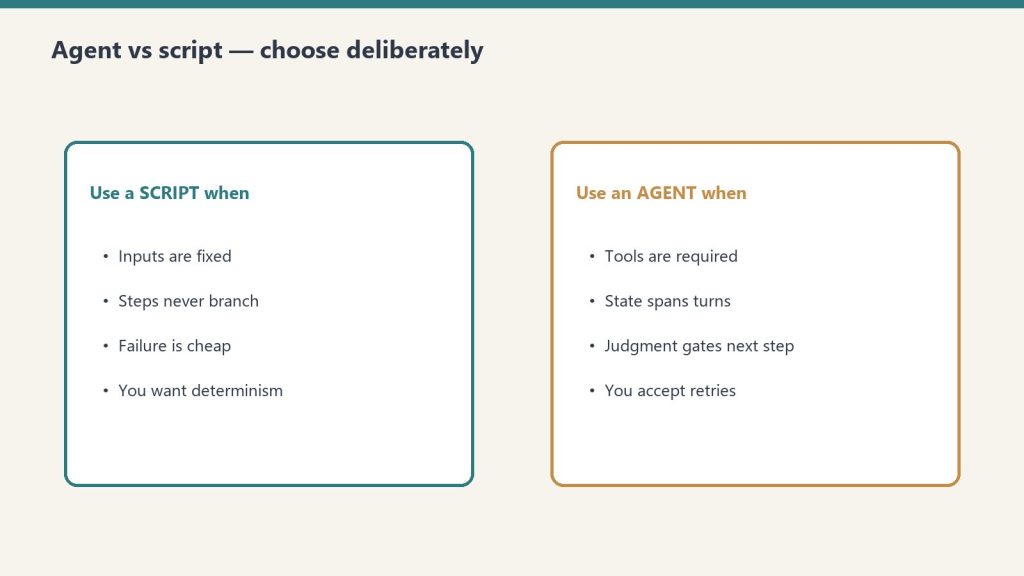
    Not everything belongs in the work order queue. Some operations require judgment that the execution layer can’t replicate: content quality assessment, strategy decisions, anything where “it depends” is the correct first answer. These belong in a different lane — one where Claude stays in the loop through completion.

    A mature AI automation architecture has both lanes clearly defined. Deterministic operations (taxonomy fixes, schema injection, meta rewrites, image uploads, internal link additions) go to the work order queue and run without Claude. Judgment-dependent operations (content strategy, quality review, client recommendations) stay in the conversational layer where Claude’s judgment can be applied continuously.

    The discipline is in knowing which lane each operation belongs in — and resisting the temptation to put judgment-dependent work in the queue just because it would be faster. Faster execution of the wrong thing is not an improvement.


  • Claude Managed Agents — Complete Pricing Reference + Dreaming Update (May 2026)

    Claude Managed Agents — Complete Pricing Reference + Dreaming Update (May 2026)

    Last refreshed: May 15, 2026

    May 2026 Update — Dreaming Feature + Beta Status

    Anthropic introduced Dreaming at Code w/ Claude (May 6, 2026) — a new Managed Agents capability where agents review their own session history overnight to improve future performance. Harvey (legal AI) reported a roughly 6× task completion rate increase after implementing it. Dreaming is developer-access preview only. Multiagent Orchestration and Outcomes are now in public beta. See the new Dreaming section below.

    What Is Claude Managed Agents? (Current Status, May 2026)

    Claude Managed Agents is Anthropic’s framework for long-running, stateful AI agents — agents that can maintain context across sessions, hand off between sub-agents, and now, improve themselves by reviewing their own work history. Here’s the current status of each component:

    Component Status Who Has Access
    Multiagent Orchestration Public Beta All API developers
    Outcomes Public Beta All API developers
    Dreaming Developer Preview Selected developers only

    Dreaming: The Feature the Press Mostly Missed

    Announced at Code w/ Claude on May 6, 2026, Dreaming is a Managed Agents capability that lets agents review and reorganize their own memory between sessions. The mechanism:

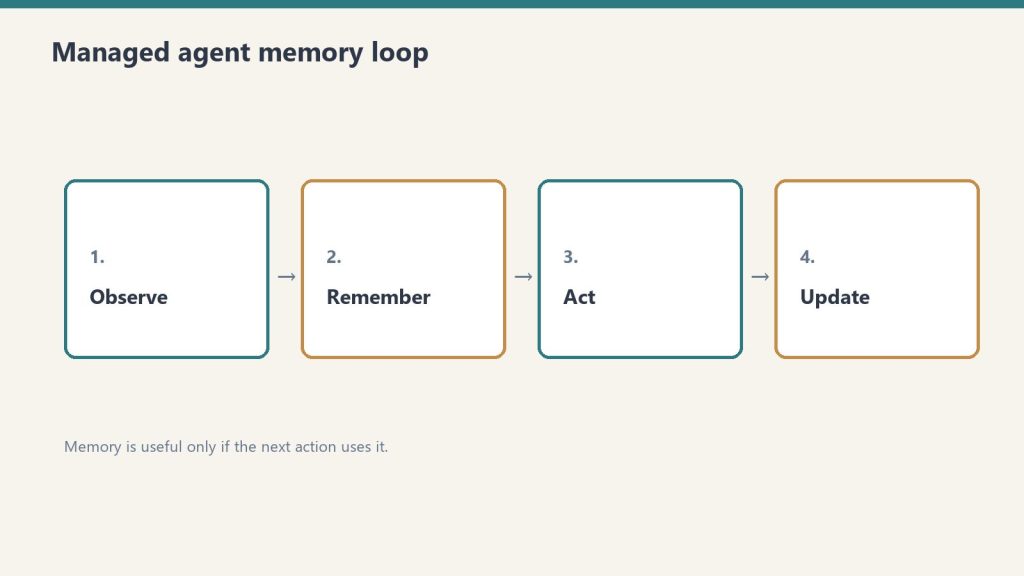
    1. After a session ends, the agent reads its existing memory store alongside the session transcripts
    2. It produces a new, reorganized memory store: duplicates merged, stale entries replaced, new patterns surfaced
    3. The next session starts with a higher-quality knowledge base — capturing insights no single session could hold

    This is meaningfully different from simply persisting conversation history. The agent isn’t just remembering what happened — it’s synthesizing what it learned. Think of it as the difference between taking notes and actually reviewing and reorganizing your notes the next morning.

    The Harvey Result

    Harvey, the legal AI company, reported approximately a 6× task completion rate increase after implementing Dreaming in their Managed Agents workflow. Harvey’s use case — complex legal research that spans multiple sessions with evolving context — is exactly the kind of work Dreaming was designed for. Sessions build on each other rather than starting fresh each time.

    Dreaming is developer-access preview as of May 2026. Docs: platform.claude.com/docs/en/managed-agents/dreams.

    What Dreaming Is Not

    A few clarifications worth making explicit:

    • Dreaming is not available to end users — it’s a developer-layer capability requiring implementation
    • It’s not persistent memory in the claude.ai chat interface
    • It’s not available to free or standard Pro subscribers through any interface
    • It’s a developer preview, not GA — expect it to evolve before full release

    Our Take: Why This Architecture Matters

    We run Managed Agents in our own Cowork workflows. The Dreaming announcement is the first time Anthropic has shipped something that resembles how expert human knowledge actually compounds over time — not by accumulating raw notes, but by periodically synthesizing and reorganizing what’s been learned into a cleaner structure.

    The Harvey 6× result is a real-world data point from a production legal AI workflow. That’s not a benchmark number — it’s a deployed system showing measurable improvement from session-to-session memory refinement. Whether that 6× figure holds across different use cases is unknown, but the direction of the effect is the signal: agents that learn from their own history outperform agents that don’t.

    For non-developer users watching this space: Dreaming is the preview of what agentic AI will look like when it becomes mainstream. The groundwork being laid now in developer preview will eventually surface in subscription-tier products.

    Model Accuracy Note — Updated May 2026

    Current flagship: Claude Opus 4.7 (claude-opus-4-7). Current models: Opus 4.7 · Sonnet 4.6 · Haiku 4.5. Claude Opus 4.7 (claude-opus-4-7) is the current flagship as of April 16, 2026. Where this article references Opus 4.6 or earlier models, those references are historical. See current model tracker →. See current model tracker →

    Tygart Media Strategy
    Volume Ⅰ · Issue 04Quarterly Position
    By Will Tygart
    Long-form Position
    Practitioner-grade

    You opened this tab because you need a number you can actually use. Not a vibe, not “it depends.” A real pricing breakdown you can put in a spreadsheet, a budget request, or a Slack message to your CTO.

    This is that page. Every pricing variable for Claude Managed Agents in one place, verified against Anthropic’s current documentation as of April 2026. Bookmark it. The beta will update; so will this.

    Quick Reference: The Formula

    Total Cost = Token Costs + Session Runtime ($0.08/hr) + Optional Tools
    Session runtime only accrues while status = running. Idle time is free.

    The Two Cost Dimensions

    Claude Managed Agents bills on exactly two dimensions: tokens and session runtime. Every pricing question you have collapses into one of these two buckets.

    Dimension 1: Token Costs

    These are identical to standard Claude API pricing. You pay the same rates you’d pay calling the Messages API directly. No Managed Agents markup on tokens. Current rates for the models most commonly used in agent work:

    • Claude Sonnet 4.6: ~$3/million input tokens, ~$15/million output tokens
    • Claude Opus 4.7: higher rates apply — check platform.claude.com/docs/en/about-claude/pricing for current figures
    • Prompt caching: same multipliers as standard API — cache hits dramatically reduce input token costs on long sessions with stable system prompts

    The implication: a token-heavy agent with a large system prompt that runs the same context repeatedly benefits significantly from prompt caching, and that benefit carries over unchanged into Managed Agents.

    Dimension 2: Session Runtime — $0.08/Session-Hour

    This is the Managed Agents-specific charge. You pay $0.08 per hour of active session runtime, metered to the millisecond.

    The critical word is active. Runtime only accrues while your session’s status is running. The following do not count toward your bill:

    • Time spent waiting for your next message
    • Time waiting for a tool confirmation
    • Idle time between tasks
    • Rescheduling delays
    • Terminated session time

    This is not how you’d bill a virtual machine. It’s closer to how AWS Lambda bills — you pay for execution, not reservation. An agent that “runs” for 8 hours but spends 6 of those hours waiting on human input has a very different bill than one running continuous autonomous loops.

    Optional Tool Costs

    Web Search: $10 per 1,000 Searches

    If your agent uses web search, each search costs $10/1,000 — that’s $0.01 per search. For most agents, this is negligible. For a research agent running hundreds of searches per session, it becomes a line item worth modeling separately.

    Code Execution: Included in Session Runtime

    Code execution containers are included in your $0.08/session-hour charge. You’re not separately billed for container hours on top of session runtime. This is explicitly stated in Anthropic’s docs and represents meaningful savings versus provisioning your own compute.

    Worked Cost Examples

    Example 1: Daily Research Agent

    Runs once per day. 30 minutes of active execution. Processes 10 documents, outputs a summary report. Moderate token volume.

    • Session runtime: 0.5 hrs × $0.08 = $0.04/day (~$1.20/month)
    • Tokens (estimate): 50K input + 5K output with Sonnet 4.6 = ~$0.23/run (~$7/month)
    • Total: ~$8–10/month

    Example 2: Weekly Batch Content Pipeline

    Runs 3x/week. 2-hour active sessions. Processes multiple documents, generates structured outputs.

    • Session runtime: 2 hrs × $0.08 × 12 sessions/month = $1.92/month
    • Tokens: depends on content volume — typically $10–40/month
    • Total: ~$12–42/month

    Example 3: Customer Support Agent (Business Hours)

    Active during business hours, handling tickets. 8 hours/day active, 5 days/week.

    • Session runtime: 8 hrs × $0.08 × 22 days = $14.08/month in runtime
    • Tokens: highly variable by ticket volume — the dominant cost driver at scale
    • Runtime cost alone: ~$14/month — tokens are likely 5–20x this depending on volume

    Example 4: 24/7 Always-On Agent

    The maximum theoretical runtime exposure. Continuous operation, no idle time.

    • Session runtime: 24 hrs × $0.08 × 30 days = $57.60/month
    • In practice, no agent has zero idle time — real cost will be lower
    • Token costs at this scale become the dominant factor by a wide margin

    Anthropic’s Official Example (from their docs)

    A one-hour coding session using Claude Opus 4.7 consuming 50,000 input tokens and 15,000 output tokens: session runtime = $0.08. With prompt caching active and 40,000 of those tokens as cache reads, the token costs drop significantly. The runtime charge stays flat at $0.08 regardless of caching.

    What’s Not Billed in Managed Agents

    A few things that might seem like costs but aren’t:

    • Infrastructure provisioning: Anthropic handles hosting, scaling, and monitoring at no additional charge
    • Container hours: Explicitly not separately billed on top of session runtime
    • State management and checkpointing: Included in the session runtime charge
    • Error recovery and retry logic: Anthropic’s infrastructure problem, not yours

    Rate Limits

    Managed Agents has specific rate limits separate from standard API limits:

    • Create endpoints: 60 requests/minute
    • Read endpoints: 600 requests/minute
    • Organization-level limits still apply
    • For higher limits, contact Anthropic enterprise sales

    How to Access Managed Agents Pricing

    Managed Agents is available to all Anthropic API accounts in public beta. No separate signup, no premium tier gate. You need the managed-agents-2026-04-01 beta header in your API requests — the Claude SDK adds this automatically.

    For high-volume agent applications, Anthropic’s enterprise sales team negotiates custom pricing arrangements. Contact them at [email protected] or through the Claude Console.

    The Pricing Signals Worth Noting

    Anthropic recently ended Claude subscription access (Pro/Max) for third-party agent frameworks, requiring those users to switch to pay-as-you-go API pricing. This signals a deliberate strategy: consumer subscriptions are for human-paced interactions; agent workloads route through the API. The $0.08/session-hour rate exists in that context — it’s infrastructure pricing for compute that runs beyond human attention spans.

    The session-hour model also signals something about Anthropic’s infrastructure cost structure. They’re pricing on active execution time because that’s what actually taxes their systems. Idle sessions don’t cost them much; active agents do. The billing model follows the actual resource consumption pattern.

    Frequently Asked Questions

    Is the $0.08/session-hour charge in addition to token costs, or does it replace them?

    In addition to. You pay both: standard token rates for all input and output tokens, plus $0.08 per hour of active session runtime. They’re separate line items.

    Does prompt caching work in Managed Agents sessions?

    Yes. Prompt caching multipliers apply identically to Managed Agents sessions as they do to standard API calls. If your agent has a large, stable system prompt, caching it can significantly reduce input token costs.

    What happens if my session crashes? Am I billed for the crashed time?

    Runtime accrues only while status is running. Terminated sessions stop accruing. Anthropic’s infrastructure handles checkpointing and crash recovery — the session state is preserved even if the session terminates unexpectedly.

    Can I use Managed Agents on the free API tier?

    Managed Agents is available to all Anthropic API accounts in public beta, but standard tier access and rate limits apply. Free API tier users receive a small credit for testing.

    How does this compare to running agents on my own infrastructure?

    See our full breakdown: Build vs. Buy: The Real Infrastructure Cost of Claude Managed Agents. Short version: the $0.08/hour is almost certainly cheaper than provisioning and maintaining equivalent compute, but you trade control and data locality for that simplicity.

    Are there volume discounts?

    Volume discounts are available for high-volume users but negotiated case-by-case. Contact Anthropic enterprise sales.

    Does web search billing count against the $10/1,000 rate if the search returns no results?

    Anthropic’s current docs don’t explicitly address failed searches. Treat any triggered search as billable until confirmed otherwise.

    For the full session-hour math worked out by workload type, see: Claude Managed Agents Pricing, Decoded: What a Session-Hour Actually Costs You. For the build-vs-buy infrastructure comparison: Build vs. Buy: The Real Infrastructure Cost. For enterprise deployment patterns: Rakuten Stood Up 5 Enterprise Agents in a Week.

  • AI Model Router Dispatch System — AI & Technology Concepts Visual

    AI Model Router Dispatch System — AI & Technology Concepts Visual

    AI model router dispatching tasks to optimal models based on cost latency and accuracy requirements
    AI model router dispatching tasks to optimal models based on cost latency and accuracy requirements

    About This Image

    This image is part of the AI & Technology Concepts collection in the Tygart Media visual library. Every image produced by Tygart Media is AI-generated using Google Vertex AI (Imagen), converted to WebP format, and injected with full IPTC/XMP metadata before publication.

    Technical Details

    • Format: WEBP
    • Collection: AI & Technology Concepts
    • Media ID: 438
    • Pipeline: Vertex AI Imagen → WebP → IPTC/XMP → WordPress

    Image Licensing

    All images in the Tygart Media visual library are produced in-house using AI image generation and are owned by Tygart Media.