Last refreshed: August 2026
Claude wins on coding quality and long-context reliability. GPT-5 wins on raw speed and cost per token. The right choice depends on which workload you’re optimizing for — and for most serious agentic coding workflows, Claude is the default for good reasons.
This comparison covers the metrics that matter for production API decisions in 2026: pricing at each tier, latency benchmarks, coding benchmark scores, context window handling, and where each model actually performs better. No marketing claims — just the numbers and where they point.
The Models Being Compared
The relevant comparison in 2026 is Claude Sonnet 4.6 / Opus 4.8 against GPT-5 / GPT-5.5 — the mid-tier workhorses and frontier flagships from each lab.
| Model | Provider | Input (per 1M tokens) | Output (per 1M tokens) | Context |
|---|---|---|---|---|
| Claude Haiku 4.5 | Anthropic | $0.80 | $4 | 1M tokens |
| Claude Sonnet 4.6 | Anthropic | $3 | $15 | 1M tokens |
| Claude Opus 4.8 | Anthropic | $15 | $75 | 1M tokens |
| GPT-5 | OpenAI | $1.25 | $10 | 400K tokens |
| GPT-5.5 | OpenAI | $5 | $30 | 1M tokens |
The pricing gap is the first thing to understand: GPT-5 is cheaper per token than Claude Sonnet at every tier. Claude Opus is the most expensive flagship at any lab. That cost difference only makes sense if the quality difference justifies it — and for specific workloads, it does.
Coding Performance
Claude leads on coding benchmarks in 2026. Claude Sonnet scores approximately 77% on SWE-bench Verified versus roughly 72% for GPT-5. Claude Opus 4.8 and Fable 5 push higher still — Fable 5 is the current leader on AutomationBench.
SWE-bench Verified measures a model’s ability to solve real GitHub issues — fixing bugs, implementing features, navigating existing codebases. It’s the most production-relevant coding benchmark available.
Why Claude leads on coding:
- Better multi-step refactor reliability on large codebases
- Stronger instruction-following in complex, multi-constraint prompts
- More consistent behavior across long agentic loops without drift
- Claude Code and Cursor both default to Claude models — a market signal that carries weight
Where GPT-5 is competitive on coding:
- Faster time-to-first-token for autocomplete-style workloads
- GPT-5.5’s terminal-based coding benchmark (Terminal-Bench: 82.7%) is strong
- Codex — OpenAI’s coding-specific deployment — is built on GPT-5.5 and optimized for that workload
The practical rule: for interactive coding assistance and agentic code execution, Claude Opus or Sonnet. For high-frequency autocomplete at scale where speed matters more than quality depth, GPT-5 mini or Haiku-class models.
Latency
GPT-5 is faster. OpenAI generally delivers 80–110 tokens per second on GPT-5; Claude Sonnet runs 60–90. Claude Haiku 4.5 is the fastest model in this comparison — first token in under 600ms on medium prompts, outpacing GPT-4.1 Mini by roughly 4x in March 2026 benchmarks.
Latency matters differently depending on the use case:
| Use case | Which latency matters | Winner |
|---|---|---|
| Interactive chat / autocomplete | Time-to-first-token | GPT-5 (or Claude Haiku) |
| Agentic batch processing | Throughput, quality | Claude Sonnet / Opus |
| Long-context document analysis | Context handling | Claude (1M vs GPT-5’s 400K) |
| Real-time voice pipeline | TTFT + throughput | OpenAI Realtime API (no Claude equivalent) |
For most production agentic workflows where the agent is running asynchronously, the latency difference between Claude Sonnet and GPT-5 is negligible compared to the quality difference on complex tasks.
Context Window
Claude’s 1M token context window is a meaningful technical advantage over GPT-5’s 400K. At 1M tokens, entire medium-sized codebases, full legal contract libraries, or complete email archives fit in a single context without chunking or retrieval engineering.
GPT-5.5 also ships with a 1M context window, but at $5/$30 per million tokens compared to Claude Sonnet at $3/$15. For long-context workloads where you need the full window, Claude Sonnet is both more capable and cheaper than GPT-5.5.
Practical implications of the context gap at the mid-tier (Claude Sonnet vs GPT-5):
- Codebases over 300K tokens: Claude handles them without chunking; GPT-5 requires retrieval engineering
- Long contract or document review: Claude reads the full document in one pass
- Multi-session agent context: Claude Managed Agents with memory handles this; GPT-5 requires custom solutions
Cost Comparison for Real Workloads
OpenAI is cheaper per token at every tier, but Claude’s 90% prompt caching discount and batch API 50% discount close the gap significantly for production workloads with repeated system prompts.
Workload cost comparison at scale:
| Workload | Claude Sonnet | GPT-5 | Notes |
|---|---|---|---|
| 10K daily chat queries (~500 tokens avg) | ~$15/day | ~$6.25/day | GPT-5 cheaper |
| Same, with 80% prompt caching | ~$4.50/day | — | No GPT-5 equivalent discount |
| 100M tokens/month agentic batch | ~$1,500 | ~$625 | GPT-5 cheaper without caching |
| Same, with Claude batch API (50% off) | ~$750 | ~$625 | Near parity |
The conclusion: for high-volume workloads with repeated context (system prompts, persistent agent instructions), Claude’s caching discounts make it competitive with GPT-5 on cost. For simple, stateless, high-frequency calls with no repeated context, GPT-5 is cheaper.
Tool Use and Agent Reliability
Claude is the dominant choice for agentic tool use in 2026. The Claude Agent SDK, Managed Agents platform, and Claude Code are purpose-built for autonomous multi-step workflows. OpenAI has function calling and a code interpreter, but no equivalent managed agent infrastructure.
Where this matters in practice:
- Claude Code and Cursor lean on Claude because the model follows multi-step instructions with better consistency
- Claude Managed Agents runs cloud-sandboxed agents with persistent memory, built-in tools, and multi-agent coordination — OpenAI has no direct equivalent
- For complex tool-use chains where the agent needs to recover from errors and continue, Claude’s behavior is more reliable
Where OpenAI has an edge:
- Computer Use is available natively on GPT-5 for web browsing and desktop control workflows
- OpenAI’s Realtime API integrates speech-to-text, LLM, and text-to-speech in one pipeline — no Claude equivalent exists
Which API to Choose
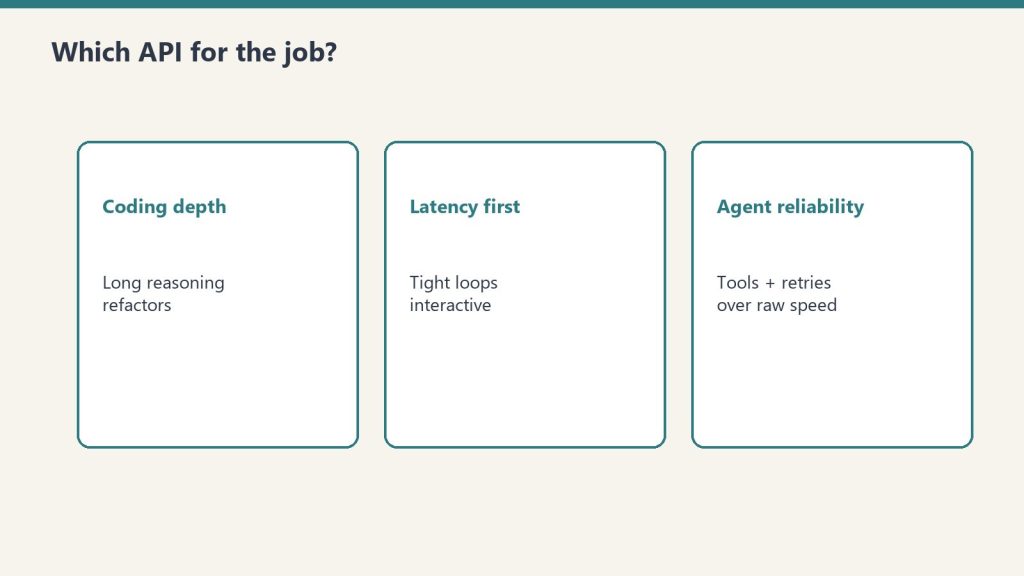
Use Claude for: coding, long-context document work, agentic workflows, and anything where instruction-following quality matters more than cost per token. Use GPT-5 for: high-frequency stateless calls, voice pipeline integration, and workloads where cost is the primary constraint.
Decision framework:
| If your primary need is… | Choose |
|---|---|
| Agentic coding and multi-step execution | Claude Sonnet / Opus |
| Long-context document analysis (>400K tokens) | Claude Sonnet |
| High-volume, cheap inference at scale | GPT-5 / Claude Haiku |
| Voice + LLM pipeline | OpenAI Realtime API |
| Production agent with persistent memory | Claude Managed Agents |
| Terminal-based coding workload | GPT-5.5 / Codex |
The most common real-world answer: Claude Sonnet for the reasoning-heavy core, Claude Haiku or GPT-5 for high-frequency auxiliary calls where speed and cost dominate. Running both APIs is normal and often optimal.
Frequently Asked Questions
Is Claude better than GPT-5 for coding?
Yes, on most production coding benchmarks. Claude Sonnet scores approximately 77% on SWE-bench Verified versus about 72% for GPT-5. Claude also handles multi-step refactoring and large codebase navigation more reliably. GPT-5.5 on Terminal-Bench (82.7%) is competitive for terminal-based workflows, and OpenAI’s Codex is optimized for that use case.
Is Claude more expensive than GPT-5?
Per token, yes — Claude Sonnet is $3/$15 per million tokens versus GPT-5 at $1.25/$10. Claude’s prompt caching (up to 90% off cached input) and batch API (50% off) close the gap significantly for production workloads with repeated context. Opus is the most expensive flagship model available.
Does Claude have a larger context window than GPT-5?
Yes at the mid-tier. Claude Sonnet has a 1M token context window; GPT-5 has 400K. GPT-5.5 also offers 1M tokens but at a higher price than Claude Sonnet. For workloads requiring full-document context without chunking, Claude Sonnet is the better mid-tier choice.
Which API is faster?
GPT-5 is faster on raw throughput (80–110 tokens/second vs Claude Sonnet’s 60–90). Claude Haiku 4.5 is the fastest model in this comparison for time-to-first-token. For most asynchronous agentic workloads, latency differences are less significant than quality differences.
What to Read Next
Anthropic Console: API Keys, Billing, and the Workbench
Claude AI Pricing — All Plans and API Rates